
The defining problem with indoor plants isn’t your watering schedule—it’s the insufficient photon density reaching the leaves. Standard household bulbs output a narrow green-yellow spike that leaves foliage leggy and variegation pale. You need a panel that delivers a Photosynthetic Photon Flux Density (PPFD) measured in μmol/m²/s, not just lumens.
I’m Min — the co-founder and writer behind Gadgets Feed. I’ve spent hundreds of hours dissecting PPFD maps, spectral distribution charts, and real customer growth data to separate the lights that actually drive chlorophyll from those that just glow.
This guide focuses on fixtures that deliver measurable PAR at usable distances, helping you find the most effective artificial light for plants for your specific indoor setup.
How To Choose The Best Artificial Light For Plants
Selecting the correct grow light requires evaluating spectral output, intensity (measured as PPFD), coverage area, and adjustable mounting. A light that excels for a single succulent may fail a multi-shelf herb garden.
Full Spectrum vs. Blurple: The Spectral Debate
Blurple lights (peaked at red 660nm and blue 450nm) were once the standard for photosynthesis, but they make it impossible to judge plant health visually. Modern full-spectrum white-light LEDs (380nm–800nm, color temperature around 5000K) supply the red and blue peaks plus green and far-red wavelengths that drive deeper canopy penetration and photomorphogenic responses. For most home growers, a high-CRI (90+) full-spectrum fixture is the versatile choice.
PPFD, Coverage, and the Inverse Square Law
PPFD (μmol/m²/s) tells you how many usable photons hit a square meter each second. A light rated at 500 PPFD at 6 inches drops to around 125 PPFD at 12 inches. Look for measured PPFD maps from the manufacturer and match the coverage area to your canopy size. Succulents need 200–400 μmol/m²/s; leafy greens can thrive at 150–250; flowering/fruiting varieties need 400–600.
Timers, Heat Management, and Mounting Versatility
Consistent photoperiods trigger flowering and prevent stress. Integrated timers (4/8/12/16-hour cycles) simplify daily schedules. Active cooling (fans) or passive heatsinks prevent leaf burn—touch the housing after 2 hours of operation. Clip-on lights suit shelf edging; floor stands with adjustable poles (up to 60+ inches) work for large potted plants; panel arrays cover propagation trays.
Quick Comparison
On smaller screens, swipe sideways to see the full table.
| Model | Category | Best For | Key Spec | Amazon |
|---|---|---|---|---|
| GLOWRIUM G462pro | Premium | Tall plants / versatile setup | 70.9in height, 16H timer, 24V low-voltage | Amazon |
| Barrina T10 Vertical | Premium | Tall plants / living room corners | 4FT height, 42W, CRI 96 | Amazon |
| SANSI 4-Head Clip | Mid-Range | Multi-directional coverage | 40W total, 4000LM, 4 goosenecks | Amazon |
| Ahopegarden Hydroponics | Premium | All-in-one hydroponic system | 12 pods, 5L tank, touch panel | Amazon |
| GLOWRIUM Double-Head | Mid-Range | Adjustable floor coverage | 36W, 63in height, 6 dimmable levels | Amazon |
| SANSI 3-Gooseneck Clip | Mid-Range | Desktop / shelf installations | 30W, 3000LM, lifetime bulb replacement | Amazon |
| ALIDE 6-Pack A19 Bulbs | Budget | Low-cost multi-socket setups | 10W/bulb, E26 base, 230° beam angle | Amazon |
In‑Depth Reviews
1. GLOWRIUM Single-Head Full Spectrum LED (G462pro)
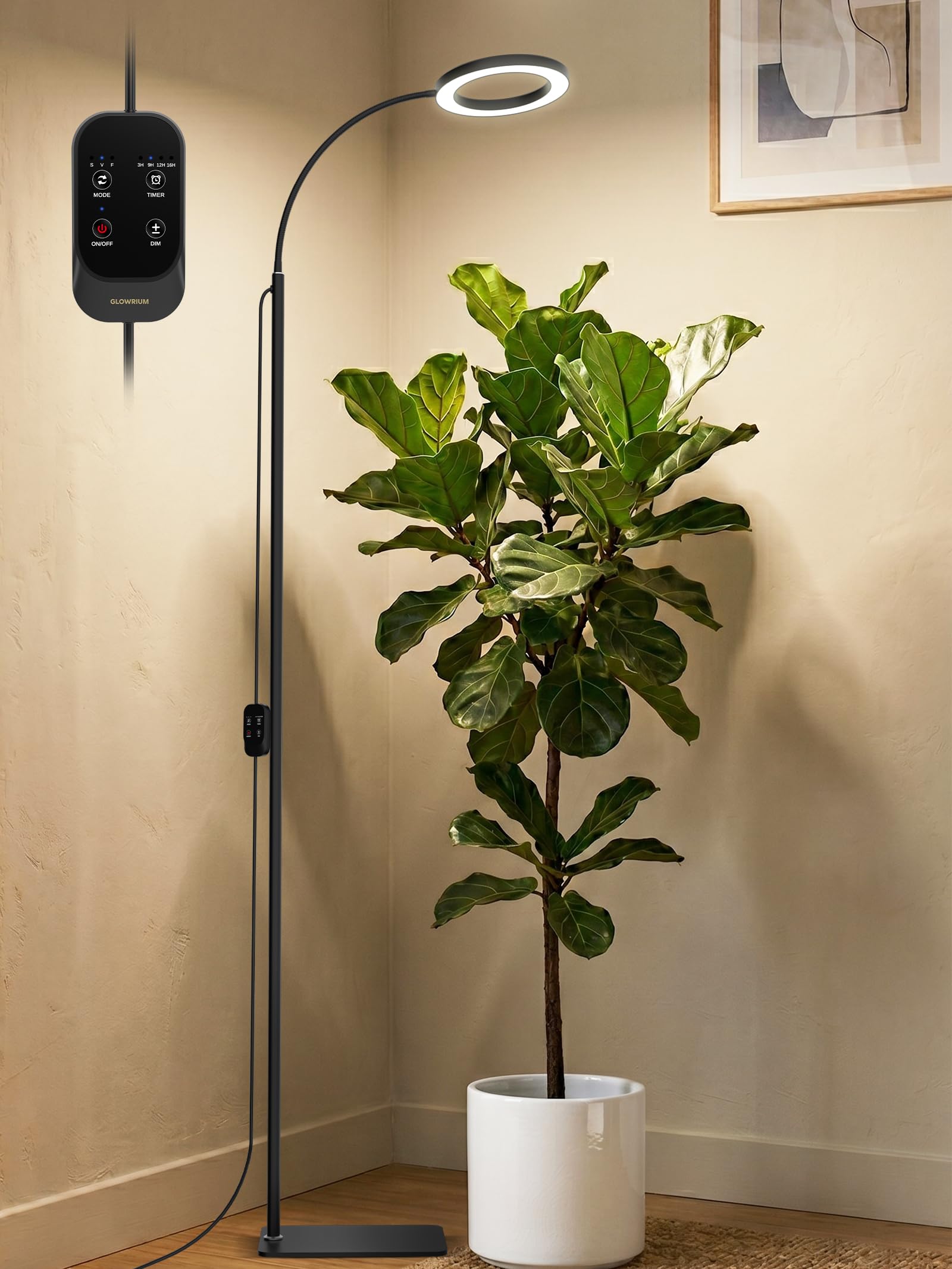
The GLOWRIUM G462pro stands out because it combines a full-spectrum 24V low-voltage LED engine with a massive 70.9-inch adjustable pole, making it one of the few options that can reliably cover a tall fiddle-leaf fig or a multi-tier plant stand. The enlarged lamp head uses a frosted diffuser to soften light output and eliminate harsh hot spots, so you can position it close to foliage without risk of localized burn.
The controls are the most advanced in this roundup: stepless dimming from 10% to 100% intensity, three spectral modes (warm white for seedlings, white+red for vegetative/flowering, and full spectrum for general growth), and four timer presets (3/9/12/16 hours). A built-in plant care assistant provides watering and fertilization reminders—a legitimate help for growers who struggle with consistency.
In practical use, African violets bloomed and cherry tomatoes fruited through winter under this unit. The 16-hour timer kept the photoperiod rock-steady without a separate smart plug. Users note the base requires a heavy pot for stability if used freestanding, but zip-tied to a pole shelf it becomes a rock-solid canopy light. At this feature-to-dollar ratio, it edges the competition.
Why it’s great
- Stepless dimming plus 16-hour timer offers unmatched schedule flexibility
- Low-voltage 24V system runs cool and safe for long unattended periods
- Plant care assistant with reminders is genuinely useful for beginners
Good to know
- Base needs a potted plant or weight to prevent tipping at max height
- Lamp head gets warm—keep 6+ inches from foliage
2. Barrina T10 Vertical Grow Light

The Barrina T10 reimagines grow lights as furniture: a slender 4-foot aluminum tower that casts light sideways (T10 side-lighting design) rather than downward, which evenly bathes tall potted plants like monstera and fiddle-leaf from top to bottom. The 5000K daylight color with a Color Rendering Index of 96 renders leaf textures accurately—no purple haze distorting your living room aesthetic.
Rated at 42W with high-quality LED chips delivering a solid PPFD, this unit includes a tripod floor stand and hanging clips. The assembly is tool-free: connect the pole, attach the base, plug in, and flip the foot switch. A remote control is included for changing brightness and power without bending down. Users report new leaves emerging within days on plants that previously sat in dim corners.
The main limitation is that the tripod legs can loosen over time; the included hex wrench tightens the screws to restore stability. Because the light is side-firing, it works best as a standalone lamp for one or two large plants—it won’t efficiently cover a wide propagation tray. For a corner with a single tall specimen, this is the most elegant solution available.
Why it’s great
- Side-lighting design covers tall vertical stems evenly
- CRI 96 renders plant colors naturally—no purple cast
- Tool-free assembly with remote control
Good to know
- Tripod legs may need hex screw tightening for stability
- Best for a single tall plant rather than multi-shelf setups
3. SANSI 4-Gooseneck Clip Plant Grow Light

The SANSI 4-head clip light addresses the coverage problem of single-point fixtures by placing four individually articulating 10W PAR20 heads on goosenecks, each outputting 1000 lumens for a combined 4000 lumens (equivalent to a 600W incandescent). Each head uses SANSI’s ceramic LED technology for superior heat dissipation and a rated lifespan far exceeding standard board-mounted LEDs.
The integrated 4/8/12-hour auto-timer is based on a 24-hour cycle from the moment you set it—set it at 6 PM to run 12 hours, and it cycles on at 6 AM daily. The included heavy-duty clip mounts to shelves, desks, or poles, and each gooseneck holds position reliably once bent. A whole-life free bulb replacement policy backs the purchase: if any head fails, SANSI replaces the bulb without requiring the whole fixture.
The caveat: bulbs run hot enough to scorch leaves if placed closer than 4–6 inches, and the timer resets if power is interrupted—no memory retention. The clip is sturdy but can’t bear the combined weight if all four heads are extended sideways (the clamp may swivel). Still, for a multi-plant shelf where each head targets a different pot, this is the most flexible unit here.
Why it’s great
- Four independent heads provide directional coverage across multiple plants
- Lifetime free bulb replacement reduces long-term cost
- Ceramic LED technology dissipates heat effectively for longer lifespan
Good to know
- Bulbs get hot—keep minimum 4–6 inches from foliage
- Timer resets after power loss; no backup memory
4. Ahopegarden Hydroponics Growing System Kit

The Ahopegarden merges a full-spectrum LED panel with a 5-liter deep-water-culture hydroponic system, making it a turnkey solution for growers who want both light and nutrient delivery in one appliance. The 12-pod capacity with adjustable plant height up to 17 inches accommodates everything from basil to compact tomato varieties. An LCD touch panel controls two light modes (vegetative and flowering/22-hour high-output).
The integrated ultra-quiet water pump cycles on a 30-minute schedule to aerate the root zone without audible disturbance—significant for a bedroom or office setup. Included A&B nutrient solution, planting baskets, sponges, and seedling covers mean you can be growing within an hour of unboxing. Users report a 50% germination rate even with old seeds, and the system outperforms AeroGarden equivalents on height extension and water capacity.
The trade-off: the light panel is not detachable—you can’t use it independently. The 22-hour flowering mode is aggressive for leafy greens; you’ll want the standard mode for lettuce and herbs. Also, the plastic construction, while durable, doesn’t feel as premium as the Barrina’s aluminum finish. For the kitchen countertop gardener who wants a single appliance for herbs and salad greens, this is the most complete package.
Why it’s great
- Complete hydroponic system with pump, nutrients, and full-spectrum light
- 5L water tank requires less frequent refills than smaller units
- Quiet pump operation suits indoor living spaces
Good to know
- Light panel is integrated and cannot be repositioned separately
- 22-hour mode may overdrive lettuce—use standard cycle for greens
5. GLOWRIUM 2-Head Full Spectrum LED with Stand
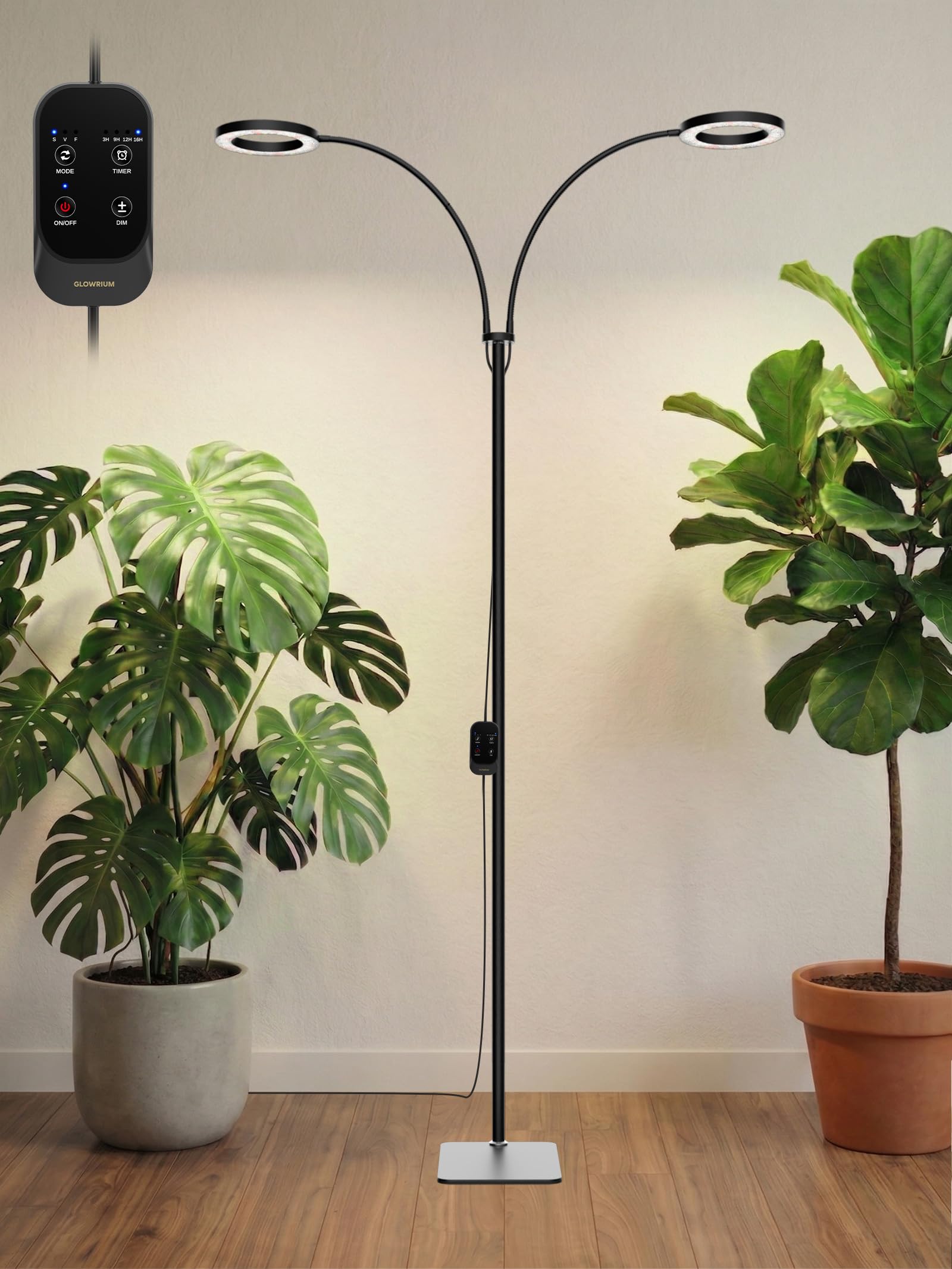
The GLOWRIUM double-head variant takes the single-head’s philosophy and splits the output across two independently adjustable 36W lamp heads mounted on a 63-inch three-section pole. Each head rotates 360 degrees, allowing you to aim one beam at a tall Monstera and the other at a low spread of succulents simultaneously. The base is wide and weighted with a non-slip bottom—no tipping concern at max height.
Three lighting modes (warm white for germination, white+red for flowering, full spectrum for general) pair with six dimming levels from 10% to 100%, letting you dial in the exact PPFD for your plant type. The built-in timer offers 3/9/12-hour cycles, and the 13-foot power cord means you can place it far from an outlet. The aluminum lamp heads dissipate heat well; users report the housing stays cool enough to touch after hours of operation.
The main caveat is that the double head is heavy—the lamp heads and pole together require a dedicated floor space. It’s not a light you’ll frequently reposition. Also, the timer selection is limited to three presets versus the four on the G462pro. For a dedicated plant corner with diverse light needs, this dual-head design delivers more usable photons than any single-point fixture in this price tier.
Why it’s great
- Two fully rotatable heads cover different height zones simultaneously
- Wide weighted base eliminates tipping at full extension
- Aluminum housing dissipates heat for extended runtimes
Good to know
- Heavy assembly—best for permanent placement, not frequent moves
- Timer limited to 3/9/12-hour presets (no 16-hour option)
6. SANSI 3-Gooseneck Clip Plant Grow Light

The SANSI 3-head clip light is the sweet spot for compact indoor setups: three 10W PAR20 bulbs on goosenecks, each outputting 1000 lumens at 4000K, for a total of 3000 lumens. The clip is substantial and the goosenecks hold their angle reliably—critical when targeting light at a specific leaf cluster. The 4/8/12-hour timer is identical to the 4-head version and runs the same 24-hour cycle logic.
SANSI’s patented ceramic LED technology means these bulbs dissipate heat more efficiently than standard aluminum-board LEDs, which translates to stable PPFD output over the bulb’s lifetime. The lifetime free bulb replacement is a real differentiator: if a bulb dims or fails years down the road, SANSI ships a replacement at no cost. User reviews confirm the units survive year-round use without degradation.
The limitation: at 3000 lumens total, this unit provides adequate light for 2–3 medium plants but may underwhelm for a dense 4-foot shelf. The clip, while strong, struggles with the combined weight if all three heads are fully extended—the fixture may tilt. As an entry-level multi-head system that grows with your collection, this offers the best balance of output and upgrade path.
Why it’s great
- Lifetime free bulb replacement eliminates long-term LED failure concern
- Ceramic LED technology provides stable output and efficient heat management
- Individual goosenecks allow precise targeting for multi-plant shelves
Good to know
- Clip can tilt under the full weight of three extended heads
- Total 3000LM suits 2–3 small plants, not dense multi-shelf setups
7. ALIDE E26 A19 LED Plant Grow Light Bulbs (6-Pack)
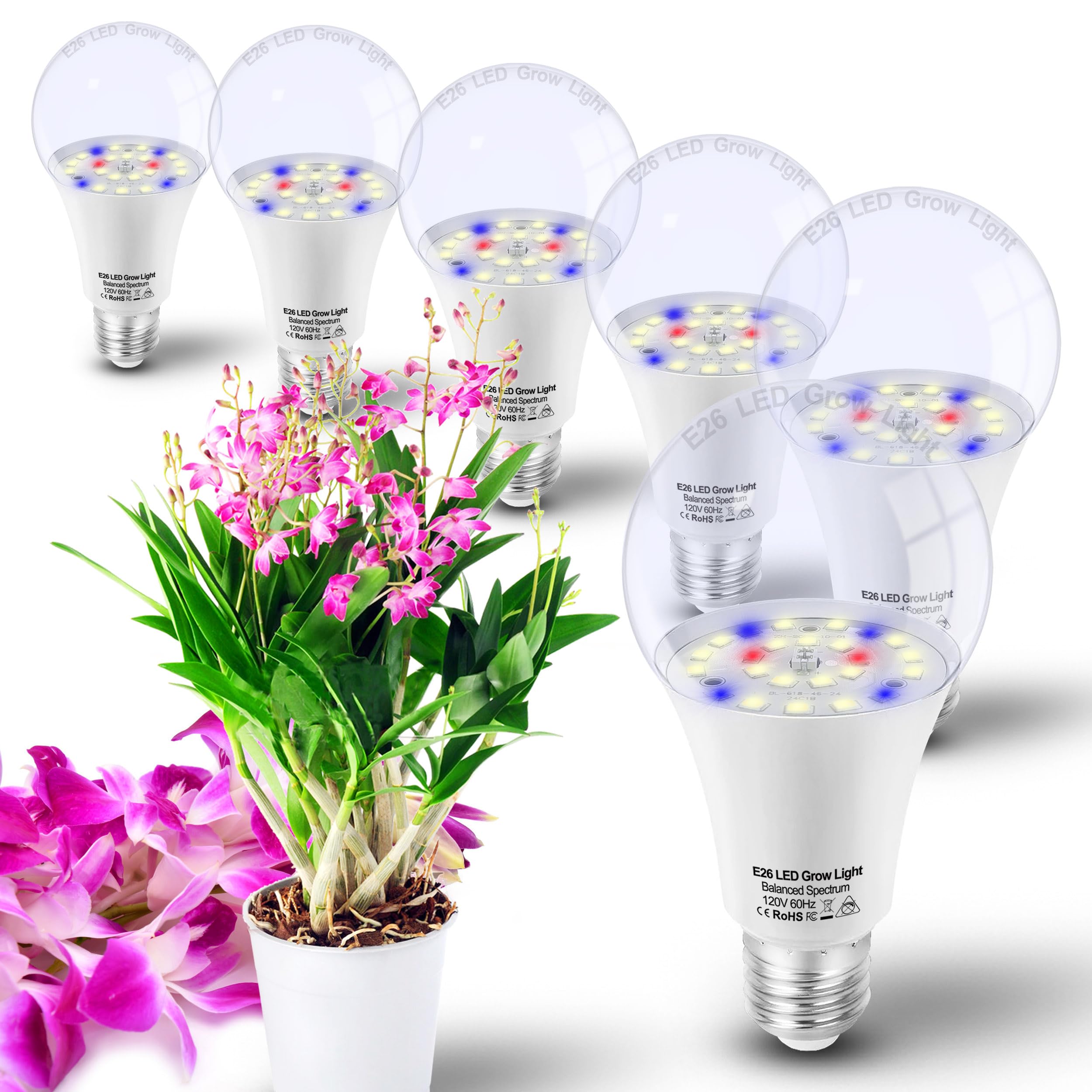
The ALIDE 6-pack is the most cost-effective way to convert an entire room’s overhead fixtures into grow lighting. Each A19 bulb draws just 10 watts while outputting 1000 lumens (100W equivalent) from a mix of red (660nm), blue (450nm), yellow (590nm), and 5000K white LEDs. The 230-degree beam angle is unusually wide for a grow bulb—it covers a broader radius than standard PAR bulbs, making these suitable for general area illumination rather than spot-targeting.
The spectral distribution is thoughtfully engineered: blue (400-499nm) drives germination; green (500-570nm) promotes leaf expansion; yellow (570-599nm) supports root development and early germination; red (600-699nm) encourages flowering, fruiting, and stem elongation. At a certified PPF of 23 μmol/s, a single bulb provides enough light for a small succulent or a 6-inch herb. Plug six into a track or multi-socket fixture, and you get a uniform canopy light for a modest propagation table.
Caveats: the light is cool and visibly blue-white (5000K)—not warm or decorative. The bulbs are not waterproof, so outdoor use requires a weatherproof fixture. The PPFD falls off quickly beyond 12 inches, so keep bulbs within 6–10 inches of the canopy for measurable results. For growers on a strict budget who already own lamps and sockets, this pack delivers the lowest cost-per-watt of any option here.
Why it’s great
- Lowest cost-per-watt—perfect for large multi-socket installations
- Four-wavelength spectral mix targets all growth stages
- 230° wide beam angle maximizes coverage per bulb
Good to know
- PPFD drops significantly beyond 12 inches—position close to foliage
- Not waterproof; outdoor use requires additional weatherproof housing
FAQ
How close should I place an artificial light for plants to the leaves?
Can I use a regular white LED bulb instead of a dedicated grow bulb for my plants?
What does the red and blue lights on grow fixtures actually do for plants?
Final Thoughts: The Verdict
For most users, the artificial light for plants winner is the GLOWRIUM G462pro because it combines a 70.9-inch adjustable pole, stepless dimming, and a 16-hour timer in a sleek low-voltage package. If you want multi-directional coverage for a shelf of diverse plants, grab the SANSI 4-Gooseneck Clip Light. And for an all-in-one hydroponic setup that handles both lighting and nutrient delivery, nothing beats the Ahopegarden 12-Pod Kit.