
Our readers keep the lights on and my morning glass full of iced black tea. As an Amazon Associate, I earn from qualifying purchases.
Specs are compiled from manufacturer listings and verified buyer reviews and can change over time — please confirm the key details on the product page before buying.
The biggest frustration with any color wheel is colors that clash or turn muddy when mixed. A useful wheel maps complements, triads, and how tints and shades alter pure hues. That’s the difference between a tool that guides your mixing and one that just decorates a drawer.
I’m Min — the founder and writer behind Gadgets Feed. This guide is built by comparing the manufacturers’ published specifications and the patterns across verified customer reviews, so you get each pick’s real strengths and trade-offs instead of marketing spin.
Whether you paint, quilt, design, or teach, the best artist color wheel for you depends on your medium, your space, and how deep you want to dive into color theory.
Our Picks at a Glance


How To Choose The Best Artist Color Wheel
Color wheels look similar at a glance, but the details change how useful they are in daily practice. The right wheel depends on your medium, workflow, and whether you’re teaching or mixing paint.
Know your color model
Traditional wheels use red, yellow, and blue as primaries — the RYB model. Others, like the CMY wheel, use cyan, magenta, and yellow, which are the primaries your printer uses. The CMY arrangement shows cleaner secondary mixes, which matters if you mix paint or ink by hand.
Decide what you need beyond the basic chart
Some wheels only show pure hues. Better ones add tints (white added), tones (gray added), and shades (black added), plus grayscale value finders. If you match fabrics, yarns, or threads, look for a wheel that lays flat on material or has slots for auditioning colors.
Match the size to how you work
A pocket guide slips into a plein-air bag, while a large 9-1/2″ wheel sits on a studio desk for quick reference. Teachers often want something visible from across a classroom. Think about where you’ll reach for it — that decides the right dimensions.
Quick Comparison
| Model | Best For | Color Model | Diameter / Size | Special Feature | Amazon |
|---|---|---|---|---|---|
| Color Mixing Guides Set★ Best Overall | Beginners learning theory | RYB + Creative | 9-1/4″ | Color Schemes Guide included | Amazon |
| CMY Primary Mixing WheelPaint Mixer | Paint mixing reference | CMY | 8 x 9.75″ | Workbook included | Amazon |
| Color Wheel Pocket GuidePortable Pick | Portable on-the-go use | RYB | Pocket size | Gray Scale Value Finder | Amazon |
| Essential Color Wheel Companion | Quilting & fabric matching | RYB | 12.18 x 13.87″ | 24-color wheel + plans | Amazon |
| Grumbacher Large Color Wheel | Classroom & home use | RYB | 9-1/2″ | 60 color combos shown | Amazon |
| Essential Color Wheel Companion (Slotted) | Jewelry & portable matching | RYB 24-wedge | 3.5″ L x 1.8″ W | Slotted for color auditioning | Amazon |
| Kolormondo Mini 3-D Colorwheel | Teaching color in 3D | 3-D sphere | 5.6 x 5.6″ | 5 round pieces, 6 wedges | Amazon |
| simple to use Color Wheel Set | Quilters & beginners | RYB + 10 discs | 9.41 x 9.05″ | 10 overlay discs | Amazon |
| Quiller Color Wheel | Painters mixing all media | RYB | 8.5 x 8.5″ | Laminated, lists pigments | Amazon |
In‑Depth Reviews
1. Color Mixing Guides: Color Wheel (9-1/4″) Plus Creative Color Wheel
Our pick — over 4.5★ from 350+ verified ratings; the strongest balance of quality and price.
Two wheels and a cheat sheet that finally make color relationships click
If you’ve ever stared at a flat wheel and still felt lost, this set removes the guesswork. You get two separate 9-1/4″ wheels — a standard one and a Creative Color Wheel — plus the Color Schemes Guide by Dumas V, which is a quick reference perfect for any beginner. Buyers report the colors are noticeably more accurate than other wheels they’d returned, with red plus blue matching in all three spots on the wheel.
The standard wheel flags complementary, split complementary, and triad schemes, and shows grayscale, tints, tones, and definitions of color terms. The crowd favorite feature is color coordination — dozens of owners single that out as the reason they keep it on their craft desk. For a potter, it sparked new mixing ideas his head-and-not-his-eyes mentor appreciated; for card makers it’s become a core tool.
The honest catch: the “quick guide” is a thin piece of paper with five word definitions, nowhere near the booklet the image suggests. skip it if you’re expecting a full workbook — buy this for the two accurate wheels, not the bonus.
What wins people over
- Colors stay consistent across the whole wheel — no more clashing primaries
- Two 9-1/4″ wheels cover both theory and creative schemes
- Quality earns high marks from owners, with 4.7 stars across hundreds of ratings
The trade-offs
- The included guide is just a paper sheet, not a real booklet
- You may find the Creative wheel redundant if you already own a basic one
Reach for this if: you’re new to color theory and want two wheels that show accurate mixing plus scheme guidance.
Look elsewhere if: you need a compact wheel for travel — these are full-size desk tools.
2. The Color Wheel Company CMY Primary Mixing Wheel W/Workbook
The cyan-magenta-yellow wheel that makes hand-mixed paint behave
Most wheels rely on red-yellow-blue, but this 2-sided 8×9.75″ wheel runs on cyan, magenta, and yellow — the primaries that actually deliver clean secondary mixes. The mix side shows colors blended with each other or with black and white; flip it over and the harmony side lays out analogous and complementary pairs. A gray scale, tints, tones, and color-term definitions are all printed right on the tool.
Owners use it constantly for deciding color schemes while painting, and the accompanying workbook earns repeated praise as a genuinely informative booklet. An 8-year-old niece found it informative enough to teach herself mixing, which says a lot about clarity. This wheel stands out for graphics-design students too, who call it exactly what they needed.
The CMY wheel weighs 2.08 ounces; the pocket guide weighs 3.2 ounces, so it’s easy to keep in a project bag. The recurring sentiment is that small space packs a lot of information.
Smart buy if: you mix paint or ink by hand and want primaries that behave logically. The CMY layout fixes the muddy-secondaries problem that RYB wheels leave you with.
Think twice if: you want a wall-mountable reference — this one is a working tool, not a poster.
3. Color Wheel Pocket Guide with Gray Scale Value Finder
A pocket-sized wheel that tags along to every plein-air session
This ASW pocket guide exists for one reason: to be carried. At 3.2 ounces in plastic, it’s light enough to live in an outdoor painting bag, and owners describe it as just the right size for the plein-air go-bag. The built-in gray scale value finder helps you judge light and dark relationships, which is exactly what you need when composing scenes on location.
The most-discussed strength is usefulness — nearly thirty owners call it a big help for color mixing and adult coloring books. Another strong point is color understanding, with over twenty noting it sharpened how they see color relationships. One owner appreciated that it rarely uses the proportional tool but still keeps a couple around because they’re so handy.
The catch is material: it’s plastic cardstock that bends if you’re rough with it. Some owners note the durability is mixed and the cheap build can flex in a pocket. Also, if a lanyard is promised, don’t count on finding one in the package.
Why it earns its spot
- Gray scale value finder for judging light and dark
- Small enough to live in any go-bag or purse
- Strong usefulness and color-understanding feedback from owners
Fair warning
- Cardstock bends easily — treat it gently
- The advertised lanyard often doesn’t show up
Grab this if: you work outside or travel and want a wheel you’ll actually have with you.
Pass if: durability matters more than portability — the plastic build won’t survive a rough studio life.
4. Essential Color Wheel Companion (Reference Guide)

A large wheel that takes the guesswork out of matching fabrics and quilts
At a generous 12.18 x 13.87 inches, this C&T Publishing wheel is built for spreading out on a sewing table. One side shows 24 pure colors, each with four essential color-plan wheels; flip it and you see every color’s tints, shades, and tones. The Ives-based wheel draws on yellow, magenta, and cyan as primaries, and it’s steeped in Joen Wolfrom’s nature-inspired color plans — monochromatic, complementary, analogous, split-complementary, and triadic.
You get a wheel that makes picking quilt fabrics and jewelry pairings feel simple to use — twenty-two owners say it removes the guesswork. The cardstock is sturdy, and the printed colors stay vibrant even years later. One quilter credits it with a finished quilt that “go perfectly well without clashing.” It hangs on a crafting room wall, looking good while doing real work.
The trade-off: the printed type is small in places, and some owners find the instructions hard to parse. An occasional unit arrives with a bent corner — the cardstock isn’t flexible, so treat the packaging kindly. If you want readability at arm’s length, this one asks you to lean in.
Choose it for: quilting, fabric, and jewelry matching where seeing tints and shades matters. The size makes it a studio mainstay.
pass on it if: you need something compact — this wheel wants a dedicated surface.
5. Grumbacher Large Color Wheel Mixing Guide, 9-1/2″ Dia.

A no-nonsense 9-1/2″ wheel that lays out 60 mixing combos at a glance
Grumbacher keeps it straightforward: one side displays shades, tints, and primary mixes, and the reverse shows complementary and analogous harmonies. A color key walks you through pure color, low intensities, triadic, split, and direct harmonies, plus a 50/50 mix of 60 color combinations. For hobbyists jumping between scrapbooking, painting, photography, and even decorating, this is the reference that connects it all.
What wins people over is the wheel itself — eleven owners single out its quality, and another ten praise how it makes color theory easy to understand. A painter’s spouse uses it constantly to set up shades, and it’s specifically recommended for young artists just learning color harmony. It’s a great refresher if you haven’t taken an art class in years, with color intensities that are especially helpful.
The one harsh take: a single owner found the printed tints “muddy” and gray-ish, calling the whole thing disappointing. That’s an outlier against a 4.5-star consensus across 150 ratings, but it’s worth knowing if you’re picky about exact print fidelity. This is a solid workhorse, not a precision instrument.
Get it if: you want a dependable, budget-conscious wheel for mixed hobbies and teaching basics.
Think twice if: you need laboratory-accurate print color — the tints skew toward gray for some eyes.
6. C&T Publishing Essential Color Wheel Companion (Slotted)

A slotted wheel you can lay straight onto fabric for instant matching
This compact wheel, at 3.5″ L x 1.8″ W, is engineered around one trick: wheel-shaped slots that let you audition colors directly against fabric, yarn, or beads without lifting anything. It carries 24 numbered color wedges, each showing bands of tints and shades on one side. Owners lay it flat on material to compare, and jewelry makers find it particularly handy.
The praise for color selection is loud — forty-two owners call it the best color wheel they’ve seen for choosing combinations, with fifteen more praising the build quality. It’s praised as more accurate than a red-yellow-blue wheel for teaching a granddaughter tints, shades, tones, and complements. For a desk-friendly, easily readable reference, it’s “one of the best color wheels ever.”
The recurring gripe is durability — it’s sturdy enough for typical use but not heavy-duty, and a few owners want it beefier. Some find the print hard to read in dim light. If you want a wheel that doubles as a matching tool rather than a poster, this earns its place.
Standout strengths
- Slots let you place colors against fabric or beads directly
- 24 numbered wedges with tints and shades on one side
- Color selection is the most-praised feature by a wide margin
Honest limits
- Build feels light — not built for rough handling
- Print can be hard to read up close
Reach for it if: you match materials by eye and want the wheel to do the comparing for you.
Look elsewhere if: you need a large wall reference — this one stays in your hand.
7. Kolormondo Mini 3-D Colorwheel
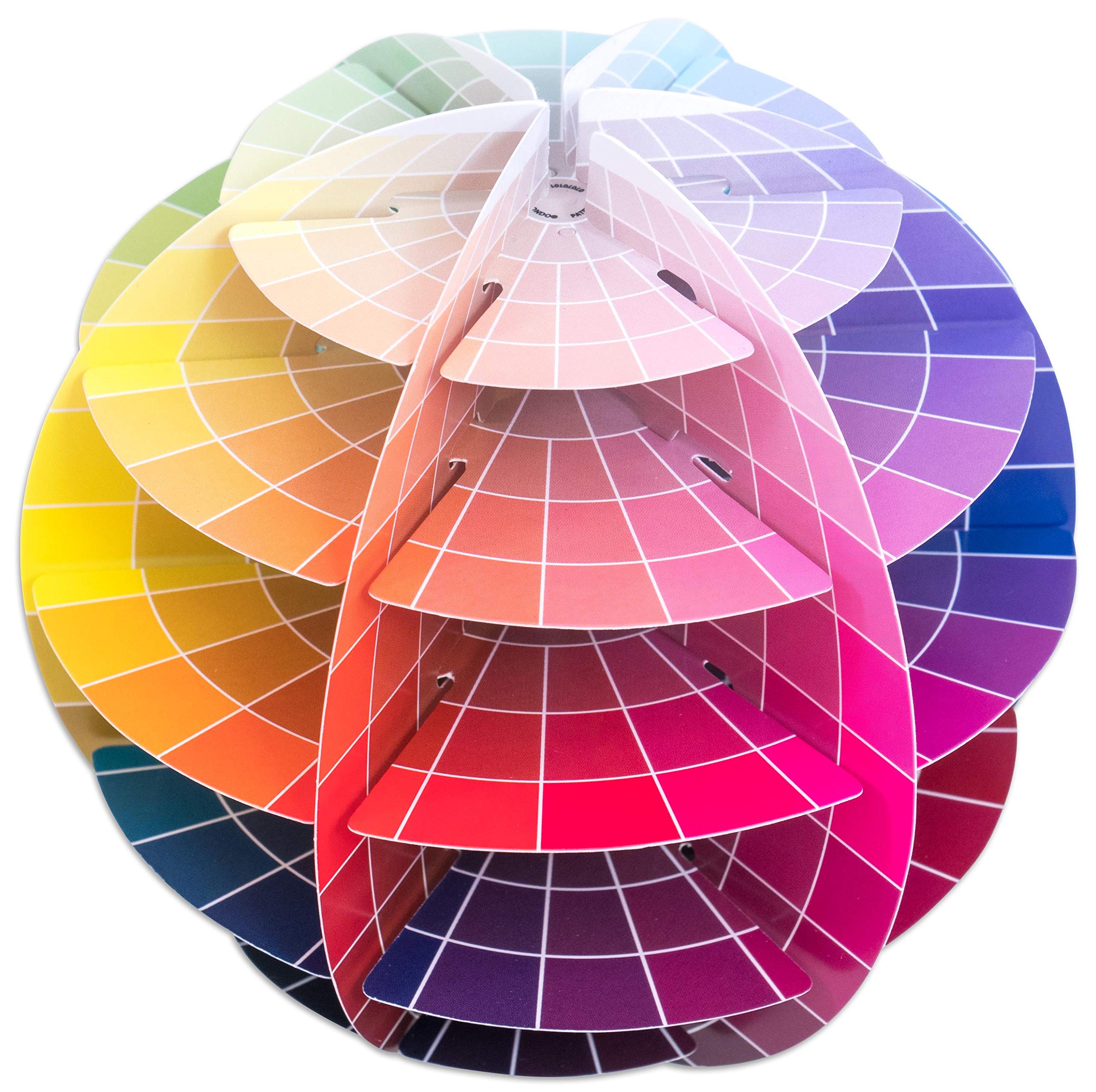
A tiny plastic sphere that shows how color really works in three dimensions
Flat wheels can’t show how value and chroma relate, and this Kolormondo fixes that. It assembles from 5 round pieces and 6 wedges into a 5.6 x 5.6″ plastic sphere where colors transition through light and dark as you rotate it. Teachers call it a great visual for class, and one owner says many people learn faster about temperature, value, and chroma when they see it in 3D.
This wheel explains color theory better than a flat one — one instructor used it across multiple classes to show why “the regular flat color wheel is less than adequate” for real discussion. An 8-year-old can grasp mixing from it, yet it stays detailed enough for art lessons.
The limits: it ships slowly — one owner waited through multiple delivery-date changes before it finally arrived. It’s also small, so it’s a teaching aid rather than a desk reference. A rare unit could arrive with cosmetic flaws; treat the wedges gently when assembling.
Buy it for: classrooms and anyone who learns color by seeing light and dark shift in space. It makes abstract theory tangible.
Pass if: you need a flat quick-reference chart — this is a concept tool, not a matching guide.
8. simple to use Color Wheel Set: 10 Discs for Dynamic Color Selection
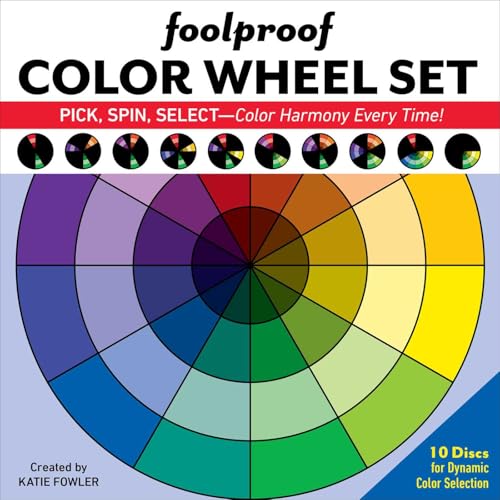
Ten overlay discs that black out distractions and spotlight winning combos
Katie Fowler’s set shows 12 basic colors in pure form, tint (white added), tone (gray added), and shade (black added) — then throws in ten discs that lay over the wheel to reveal color combinations. The magic is that each disc blacks out everything else, so you see exactly one scheme at a time. That visual isolation is why owners call it “a huge step above” basic complementary wheels.
Color selection is the most-praised feature, with fifteen owners spotlighting vivid colors and handy cutouts. Quilters and classroom teachers love that the opposite side of each disc labels the color group it represents. The combinations work because colors in the selected scheme mix to a neutral gray — a principle that makes palettes feel easy.
The honesty check: sturdiness gets negative feedback, with several owners describing the discs as flimsy. The base also lacks color names and detailed hue info, so you’ll want a separate reference for that. This is a thinking tool, not a rugged one.
Grab it if: you’re a quilter, beginner, or teacher who wants to test schemes before committing — the discs make color choices simple to use.
it’s not for you if: you need sturdy construction — the discs demand gentle handling, so rough use may bend them.
9. Jack Richeson Quiller Color Wheel for All Media, 8.5 by 8.5-Inch

A laminated 8.5″ wheel that names actual pigments for every mix
Stephen Quiller’s wheel is built for painters who mix oil, watercolor, and acrylic. It’s laminated in sturdy plastic so it survives constant studio use, and it measures a compact 8.5 x 8.5 inches. The standout difference: it lists watercolors and pigments by name, so you can relate actual paint colors to the wheel — the thing owners say they’ve always struggled with.
Color information is the top-praised feature, with thirty-two owners valuing the named pigments and paint lists. The colors are arranged like solar system planets, showing proximity and relationships, which one owner calls highly educational for learning where colors sit. You can even dab custom paints onto it with codes as a personal reminder, given how much manufacturer color varies.
The fair criticism: the print size is small — thirteen owners find the text hard to read, and one wishes it came at 12 x 12 inches. Several also consider it overpriced for what’s printed on it. But for a working painter who wants pigment-level guidance, the laminated durability and named colors justify the premium.
Why painters love it
- Laminated plastic holds up in tough studio conditions
- Lists pigments and paint names for real mixing guidance
- Compact 8.5 x 8.5″ size suits oil, watercolor, and acrylic
What holds it back
- Small print strains the eyes
- Premium price for a relatively simple printed wheel
Pick this if: you mix paint daily and want a durable wheel that names your pigments.
Choose differently if: your eyes need larger print or your budget is tight — the text is genuinely small.
Understanding the Specs
RYB vs CMY color models
The traditional red-yellow-blue wheel is what most artists learn first, and it’s great for understanding harmony schemes. The CMY model — cyan, magenta, yellow — matches how printers and modern color theory actually work, giving you cleaner secondary mixes when you blend paint by hand. If you mix pigments, CMY tends to feel more logical; if you’re teaching classic theory, RYB is the familiar starting point.
Tints, tones, and shades
A tint is a pure color with white added; a shade has black added; a tone has gray added. Wheels that print these variations on each wedge give you a huge head start on matching fabric, yarn, or paint without trial and error. Check that the wheel labels these clearly, since that’s what turns a pretty chart into a working tool.
FAQ
What is the difference between an RYB and a CMY color wheel?
Will a color wheel help me match fabric for a quilt?
What does a gray scale value finder do on a color wheel?
Which color wheel is best for teaching a child or classroom?
How do I use overlay discs on the simple to use Color Wheel Set?
Is a laminated color wheel worth the extra cost?
What size color wheel should I buy?
What are tints, tones, and shades on a color wheel?
Can a color wheel help me mix paint colors accurately?
How durable are color wheels made of cardstock?
Final Thoughts: The Verdict
The crowd favorite — the artist color wheel pick, the Color Mixing Guides Set, wins because its two accurate 9-1/4″ wheels plus the beginners’ guide make color relationships click for newcomers and pros alike, backed by a 4.7-star consensus. If you mix paint by hand and want primaries that behave, the CMY Primary Mixing Wheel is the smarter buy. And for quilters matching fabric, the Essential Color Wheel Companion takes the guesswork out of every palette.
How We Picked
We do not accept paid placement. Every pick is matched to a real buyer and a real use-case; we do not hands-on test units.
Sources & Methodology
Specifications: manufacturer listings and product documentation. Review insights: verified customer reviews, as of August 2026. Pricing: not shown on this page (it changes often); check the current price via the retailer link.
As an Amazon Associate, Gadgets Feed earns from qualifying purchases. This does not affect which products we feature.