
Digitizing a physical artwork without losing its soul requires more than just any flatbed. The paper grain, the subtle brush texture, and the exact pigment hue—these details vanish under a lens meant for text documents. An scanner built for art must resolve highlights in acrylics, capture the deep blacks of charcoal, and handle oversized canvases without distortion or color shift.
I’m Min — the co-founder and writer behind Gadgets Feed. I spent hundreds of hours researching sensor types, color depth, and DPI thresholds to find which scanners preserve fine-art fidelity across watercolor, pastel, and mixed media.
Whether you’re archiving original paintings, digitizing sketchbooks, or creating high-resolution prints for sale, choosing the right hardware matters. This guide cuts through marketing noise to recommend the best artwork scanner for every artist’s budget and studio need.
How To Choose The Best Artwork Scanner
An artwork scanner is fundamentally different from a document scanner. It must handle variable media thickness, delicate surfaces, and oversized formats while maintaining color accuracy and shadow detail. Prioritize these factors to avoid washed-out scans or damaged originals.
Sensor Technology: CCD vs. CIS
CCD (charge-coupled device) sensors use a lens and mirrors to capture light, offering superior depth of field and dynamic range. This is critical for art with thick paint, canvas texture, or embossed detail. CIS (contact image sensor) flattens the image and is less forgiving of uneven paper—fine for documents, but can miss subtle brushstrokes and cause color banding in gradients.
Optical Resolution and Color Depth
For fine art reproduction, 1200 dpi is the sweet spot—enough to capture ink stippling and pencil hatching without ballooning file sizes. True 48-bit color depth (16 bits per channel) retains smooth tonal transitions in sky washes and skin tones, while 24-bit scanners may posterize subtle blends. Avoid interpolated resolution claims; only optical DPI matters for real detail.
Media Size and Handling
Artwork rarely fits standard letter-size. Look for an A3 (11.7 x 16.5 inches) or larger platen. Overhead book scanners offer a larger capture area and can handle bound sketchbooks, but require consistent lighting. Flatbed models with a frameless border allow edge-to-edge scanning of full-bleed prints. Delicate media like pastels need a gentle, non-contact scanning method.
Quick Comparison
On smaller screens, swipe sideways to see the full table.
| Model | Category | Best For | Key Spec | Amazon |
|---|---|---|---|---|
| Epson Perfection V800 | Premium Flatbed | Fine art & film archival | 6400 dpi CCD, 4.0 Dmax | Amazon |
| CZUR ET MAX | Overhead Scanner | Large books & thick originals | 38MP, 410 DPI, laser flatten | Amazon |
| CZUR ET24 Pro | Overhead Scanner | Artists digitizing sketchbooks | 24MP, 5696×4272, auto-flatten | Amazon |
| Epson XP-980 | All-in-One Printer | Proofs & reference copies | 48-bit input, 5760 dpi print | Amazon |
| VIISAN 3120 | A3 Flatbed | Oversized artwork & CAD | 1200 dpi, 48-bit, 8 sec scan | Amazon |
| Plustek OS1180 | A3 Flatbed | Comic & tabloid-size art | 1200 dpi, 48-bit, A3 scan | Amazon |
| ScanSnap iX2400 | Document Scanner | Digitizing paper sketches | 600 dpi, 45 ppm duplex | Amazon |
| Canon imageFORMULA RS40 | Photo Feeder | Bulk digitizing of prints | 600 dpi, 40 ppm ADF | Amazon |
| VIISAN S21 | Overhead Scanner | Fragile & bound materials | 26MP, A2 capture, finger removal | Amazon |
In‑Depth Reviews
1. Epson Perfection V800 Photo Scanner

The Epson Perfection V800 remains the benchmark for fine-art scanning thanks to its dual-lens CCD system and a 4.0 Dmax dynamic range that captures shadow texture in charcoal and watercolor washes without clipping. At 6400 dpi optical resolution, it resolves individual pencil strokes and ink stippling at a level that CIS-based scanners simply cannot match. The 9 x 11.7-inch platen accommodates standard art paper, and the built-in transparency unit handles 35mm slides and medium-format film.
Color fidelity is outstanding: 48-bit input means smooth transitions across subtle gradients, and the bundled Epson Scan software offers professional-level controls for gamma, tone curve, and unsharp masking. Users report that even faded 1940s prints regain cloud detail and highlight subtlety that low-DPI devices miss. The auto-correction feature can darken some images, but switching to professional mode gives full manual control.
Weight at nearly 21 pounds makes it a stationary desktop device, not a portable option. The V800 is ideal for artists, photographers, and museums who demand archival-grade scans of original paintings, negatives, and prints. Dust on the platen requires occasional cleaning, but the optical quality justifies the investment.
Why it’s great
- 6400 dpi CCD captures fine brush and pencil detail
- 4.0 Dmax delivers deep shadow gradation
- Dual-lens system optimizes resolution for different media
Good to know
- Heavy; not portable
- Software can auto-enhance in ways that distort fine art
- Dust removal may affect image detail if not overscan
2. CZUR ET MAX Professional Book Scanner

The CZUR ET MAX redefines large-format art scanning with a 38MP CMOS sensor delivering 7168 x 5376 resolution (410 DPI at A3 size). Its patented laser curve-flattening technology automatically corrects page curvature from thick art books and bound sketchbooks—no pressing or unbinding required. The overhead design eliminates glass contact, making it safe for fragile media like pastels, loose charcoal, and mixed-media collages.
Scanning speed is exceptional: practiced users can capture 30–40 pages per minute using the foot pedal, making it viable for digitizing entire swatch books or portfolio collections in minutes instead of hours. The ABBYY OCR engine recognizes 180+ languages, useful for translating sketch notes or exhibition labels. Users report that the auto-flatten feature works reliably even on thick, uneven pages, though glossy or highly reflective coated art paper may produce glare.
At roughly 2.2 pounds, the ET MAX is highly portable and can be stored upright. The software, while powerful, is Windows-native and offers limited Linux support (only specific Ubuntu builds). For artists scanning large volumes of bound material, this is the fastest path to high-quality digital copies without damaging the original work.
Why it’s great
- 38MP at A3 produces sharp digital archival scans
- Laser flatten eliminates book curvature
- Foot pedal enables high-volume scanning
Good to know
- Not ideal for glossy or reflective artwork
- Software reliability varies by OS
- Requires consistent lighting setup
3. CZUR ET24 Pro Book Scanner

The CZUR ET24 Pro brings overhead scanning to artists who need a balance of resolution and affordability. Its 24MP camera captures 5696 x 4272 pixels (320 DPI at A3), enough for high-quality prints up to 13 x 19 inches. The third-generation auto-flatten and deskew technology works well on typical sketchbooks and saddle-stitched comics, converting double-page spreads into single pages without manual cleanup.
Setup is straightforward: plug in USB, install the software, and the 2.0-inch preview screen confirms framing before capture. The three-angle LED lighting (head light plus two side lights) helps reduce glare on semi-glossy prints. Users note that the foot pedal (sold separately) dramatically speeds up batch scanning, making it a reliable tool for comic artists and illustrators with large back catalogs. The software also supports ABBYY OCR for 180+ languages.
Maximum resolution is lower than the ET MAX, so painters needing extreme detail (e.g., for giclee prints) may prefer the 38MP version. The ET24 Pro also works best with matte papers; high-gloss acrylics may produce reflections. For budget-conscious artists who digitize sketchbooks and reference materials daily, this is the sweet spot.
Why it’s great
- 24MP at A3 delivers print-ready scans
- Auto-flatten reduces post-processing
- Affordable entry to overhead scanning
Good to know
- Lower DPI than CCD flatbeds for fine detail
- Glare on reflective surfaces
- Foot pedal sold separately
4. Epson Expression Photo XP-980
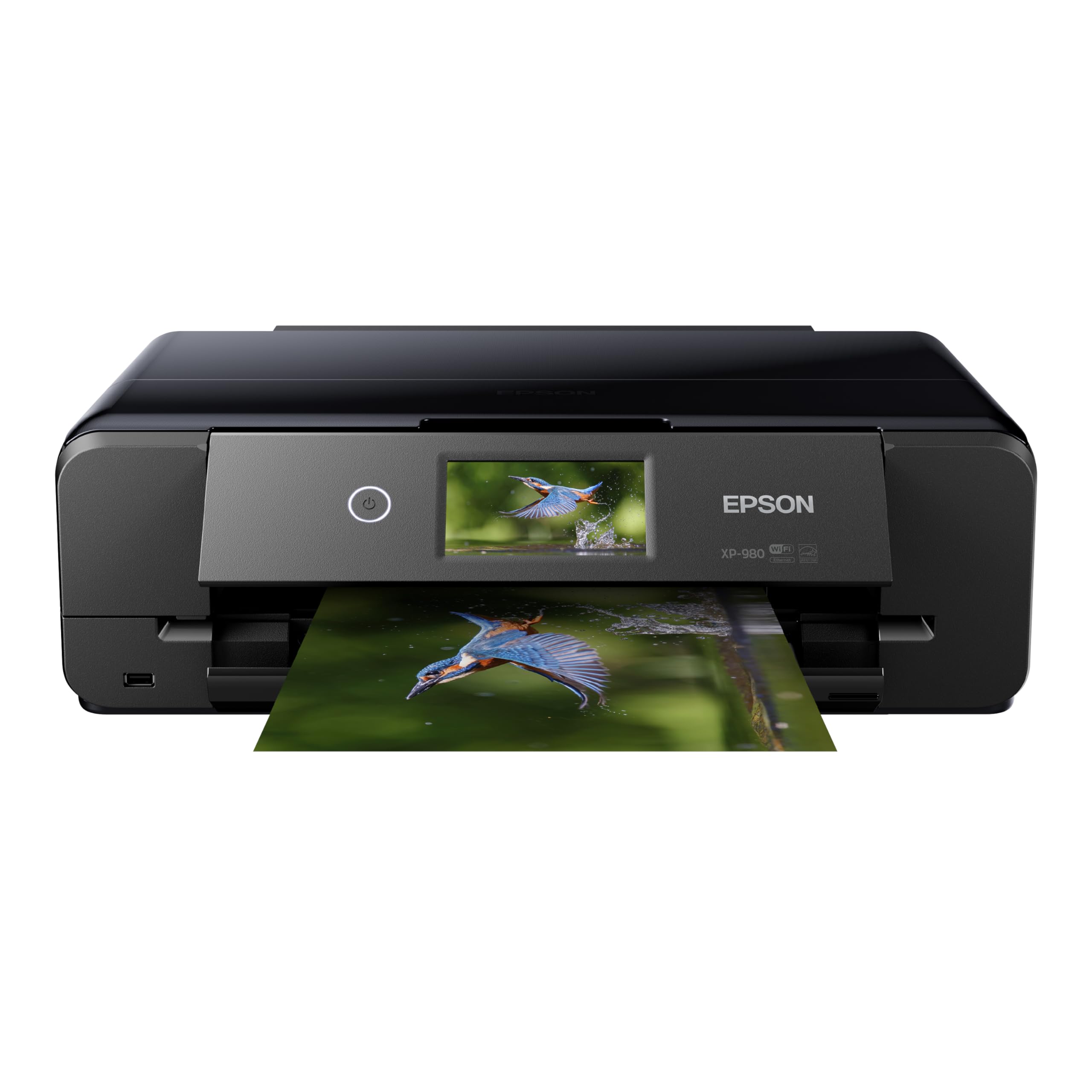
The Epson XP-980 is an all-in-one that bridges scanning and printing for artists who need proofing capabilities. Its flatbed scanner provides 48-bit color input, capturing fine art with decent fidelity for reference copies and digital proofs. The 6-color Claria Photo HD ink system prints borderless up to 11 x 17 inches at 5760 x 1440 dpi, giving artists the ability to review color accuracy on glossy or luster paper immediately.
Wireless connectivity and a 4.3-inch touchscreen simplify setup, and the separate paper trays for plain and photo stock reduce media switching. Users report that 8×10 glossy prints from iPhone photos look excellent, and the scanner’s auto-correction can revive faded colors in vintage artwork. However, the scanner darkens some images in default mode, and the flatbed is not A3-sized, limiting oversized art.
The printer side consumes ink relatively quickly—several maintenance cleaning cycles may waste a third of a cartridge during infrequent use. For artists who both scan and print high-quality reference proofs in a single device, the XP-980 saves desk space. For dedicated archival scanning, a standalone scanner like the V800 remains superior.
Why it’s great
- 48-bit input captures art with good color depth
- Prints borderless up to 11×17 inches
- Wireless printing from mobile devices
Good to know
- Flatbed limited to letter size
- Ink consumption can be high
- Scanner auto-correction alters fine art tones
5. VIISAN 3120 A3 Flatbed Scanner

The VIISAN 3120 offers one of the most cost-effective paths to A3 scanning for artists working with large paper. Its 11.98 x 16.8-inch platen accommodates tabloid-size watercolor sheets, CAD drawings, and mounting board without stitching. The CIS sensor delivers 1200 x 1200 dpi optical resolution at 48-bit color depth, producing scans with smooth gradients and acceptable detail for most illustration and print work.
Speed is a strong suit: a full A3 color scan at 200 dpi takes around 8 seconds. The auto-scan function activates when the lid closes, streamlining batch work. Users mention that the scanner handles thick art books better than some flatbeds, and the frameless border allows edge-to-edge capture of full-bleed prints. Color accuracy is generally good, though some users report washed-out color scans at higher settings when using the default software.
The bundled ViiScan software allows full-resolution capture on Windows at 1200 dpi, while Mac users are limited to 600 dpi via ICA. External power is required (no USB bus power). For artists primarily on Windows who need large-format scans without breaking the bank, the VIISAN 3120 is a solid mid-range choice.
Why it’s great
- True A3 platen for oversized art
- Fast 8-second color scans
- Frameless design for full-bleed capture
Good to know
- CIS sensor lacks CCD shadow depth
- Mac users limited to 600 dpi
- Color accuracy can be inconsistent
6. Plustek OS1180 A3 Flat Scanner

The Plustek OS1180 is a dedicated A3 flatbed that uses a CCD sensor (often listed as CIS in specs, but users note deep shadow capture closer to CCD behavior) with 1200 dpi resolution and 48-bit color. Its 11.7 x 17-inch scan area is ideal for comic art boards and tabloid-size paintings. The LED light source eliminates warm-up time, making on-demand scanning more energy-efficient.
Users consistently praise the intuitive one-touch controls for scan, email, OCR, and PDF creation, which reduce the learning curve. The ABBYY OCR engine adds document-conversion capability for mixed-media portfolios. For color art, the Plustek offers complete brightness fine-tuning, giving artists control over exposure. Comic artists specifically note that 10 x 15-inch boards fit with minimal trimming, and the scanner is reliable for clean, high-res captures.
Some users report driver instability requiring a computer restart, and the bundled software (DocAction) is basic. Third-party software like VueScan can unlock better color fidelity. The unit is not portable and weighs around 10 pounds. For artists who need a consistent, large-format capture device with excellent post-purchase support, this is a reliable mid-range option.
Why it’s great
- A3 flatbed fits tabloid and comic boards
- Intuitive one-touch controls for speed
- CCD-like shadow detail for artworks
Good to know
- Driver issues may require occasional restarts
- Bundled software is basic
- Adequate color fidelity, not archival grade
7. ScanSnap iX2400 Document Scanner
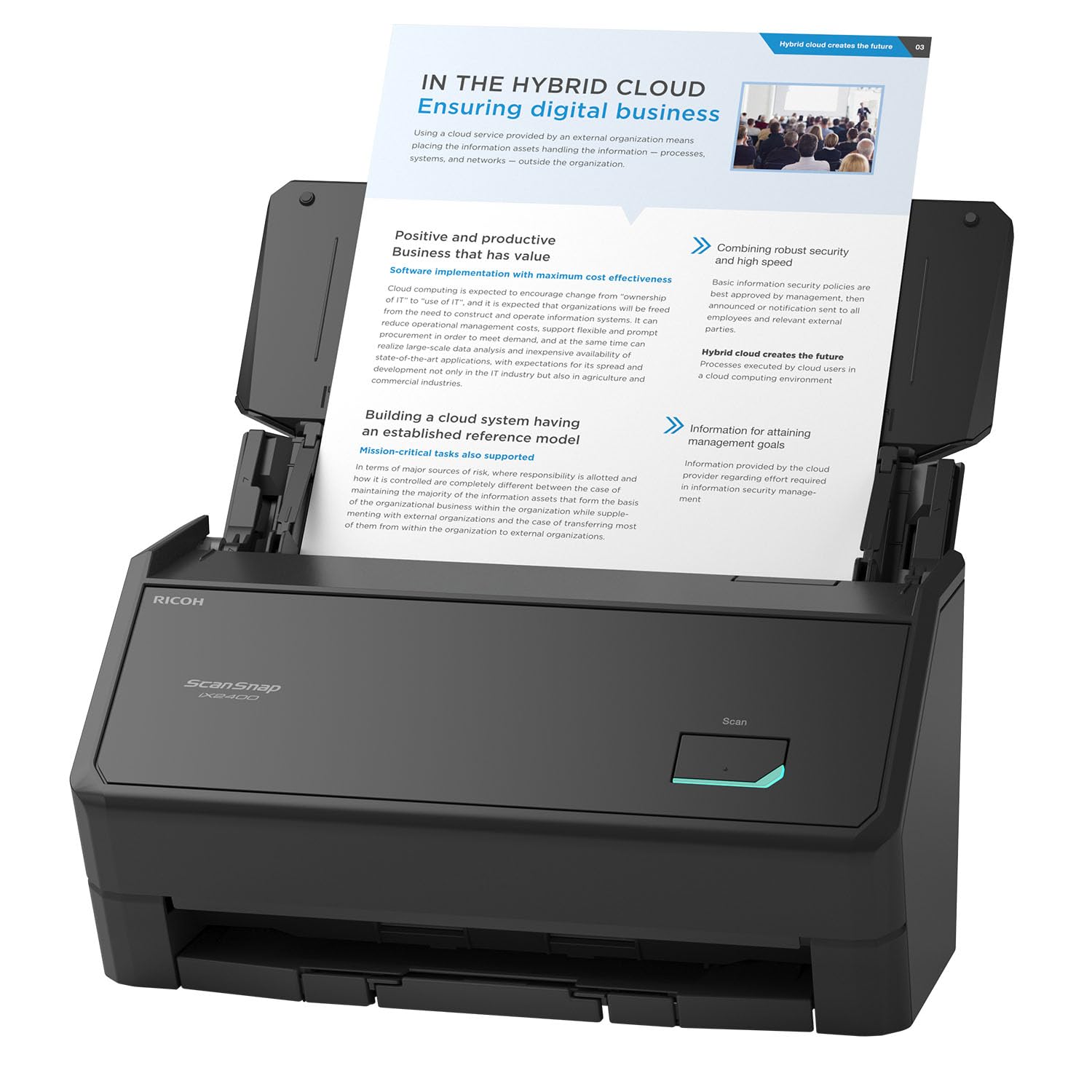
The ScanSnap iX2400 is a high-speed duplex document scanner that excels at digitizing paper sketches and reference sheets. Its 100-sheet automatic document feeder processes up to 45 pages per minute at 600 dpi, making it ideal for artists who want to digitize large stacks of loose sketches, printouts, or reference clippings quickly. The one-touch button and ScanSnap Home software automatically detect size, color, and orientation, and remove blank pages.
While the iX2400 is not designed for fine-art archival (600 dpi CIS sensor lacks the shadow detail and color depth for paintings), it produces clean, searchable PDFs of line art and text documents. Users report that business cards, receipts, and envelopes feed without jams, and the dual-sided scanning saves substantial time compared to flatbed alternatives. The compact footprint (11.5 x 6.3 inches) fits well on crowded desks.
The software is not TWAIN-compatible, limiting integration with advanced scan tools, and occasional upside-down scans require manual rotation. USB-only connectivity means no network scanning. For artists on a tight budget whose primary need is digitizing flat paper sketches and documents at high speed, this is an efficient workhorse.
Why it’s great
- 45 ppm duplex speed for bulk scanning
- Auto-cleanup and blank-page removal
- Reliable feeder for various paper types
Good to know
- 600 dpi limits fine-art detail
- No TWAIN integration
- Not suitable for oversized or thick media
8. Canon imageFORMULA RS40 Photo Scanner

The Canon imageFORMULA RS40 is an entry-level photo feeder that scans both sides of prints and documents at up to 40 items per minute. It handles a variety of media types including Polaroid, receipts, and cards up to 600 dpi optical resolution. The bundled software includes red-eye correction and face smoothing, which can be useful for reviving old personal prints but is less relevant for fine-art reproduction.
Users appreciate the fast throughput for digitizing large piles of mixed media, and the adjustable contrast settings help recover dark-image detail that default mode loses. However, the CIS sensor produces acceptable quality only for moderate resolution needs—artists expecting museum-grade color depth will be disappointed. The software tends to create large temp files at 1200 dpi that can fill system storage, and the ADF may misalign mixed-size materials, causing jams.
For an artist with a backlog of flat personal photos and reference clippings, the RS40 is a time-efficient solution. It is not suited for delicate or oversized artwork, and the photo-correction tools should be disabled for archival purposes. The one-year warranty is reassuring for light commercial use.
Why it’s great
- Fast 40-ppm duplex scanning
- Handles varied media sizes and thicknesses
- Adjustable contrast for dark photos
Good to know
- CIS sensor lacks fine-art color depth
- Software temp files can fill drives
- ADF jam-prone with mixed-size stacks
9. VIISAN S21 A2 Overhead Scanner

The VIISAN S21 is an overhead document camera scanner that captures up to A2 size (594 x 420 mm) using a 26MP sensor. This makes it uniquely suited for digitizing oversized maps, large paintings, newspapers, and bound books that exceed standard flatbed capacity. The adjustable-height arm (90-degree hinge) allows positioning over thick originals, and the bundled software offers auto-flattening, finger-erasure, and double-page splitting.
While the resolution is lower than CCD flatbed scanners at an effective 600 DPI (software-enhanced), the S21’s non-contact scanning is invaluable for delicate pastels, chalk, or unstable media that cannot be pressed under a glass platen. Users note that the built-in three-level LED light works best in dim environments but is not powerful enough for highly reflective items. The overhead design also enables 3D object capture and video recording for process documentation.
Setup is simple for basic use, but the software has limited functionality on ARM devices (e.g., Surface Pro X). Some users report that the hinge can become unreliable over time, and built-in lighting may not be sufficient for glossy finished paintings. For artists who frequently digitize large, fragile, or bound originals, the S21’s A2 capture area is a unique advantage in the entry-level overhead category.
Why it’s great
- A2 capture area for oversized artwork
- Non-contact scanning protects fragile media
- Auto-flatten and finger-removal features
Good to know
- Effective resolution limited to 600 DPI
- Not compatible with ARM-based devices
- Hinge reliability may degrade over time
FAQ
What DPI should I use to scan a painting for archival printing?
Can I use a document scanner for watercolor or pastel artwork?
Final Thoughts: The Verdict
For most artists, the best artwork scanner winner is the Epson Perfection V800 because its 6400 dpi CCD sensor and 4.0 Dmax deliver archival-grade color and shadow detail across paintings, prints, and film. If you need to digitize thick art books and bound sketchbooks without unbinding, grab the CZUR ET MAX. And for large-format originals on a budget, nothing beats the VIISAN 3120 A3 flatbed.