
Our readers keep the lights on and my morning glass full of iced black tea. As an Amazon Associate, I earn from qualifying purchases.
Specs are compiled from manufacturer listings and verified buyer reviews and can change over time — please confirm the key details on the product page before buying.
Dropping your monthly cable bill is as simple as plugging in an indoor TV antenna — you still get live news, sports, and network shows for free. The only trick is picking one that locks onto your local broadcast towers without constant freezing. This guide compares six popular models — from paper-thin indoor panels to rugged omnidirectional rooftop units — so you can match the right antenna to your exact location and what you watch.
I’m Min — the founder and writer behind Gadgets Feed. This guide is built by comparing the manufacturers’ published specifications and the patterns across verified customer reviews, so you get each pick’s real strengths and trade-offs instead of marketing spin.
Whether you are 10 miles or 50 miles from the nearest towers, these are the top contenders for your as seen on tv tv antenna upgrade, ranked by reception strength, build quality, and ease of installation.
Quick Picks
- Channel Master Omni+ 50 — Best Overall
- Winegard FL5500A FlatWave — Premium Pick
- Mohu Leaf Amplified — Best Value
- 5000+ Miles Range TV Antenna (Arrasolt Melas) — Compact Power
- 5000+ Miles Indoor TV Antenna (Forlovv) — Best Value
- 2026 Upgraded TV Antenna (Nelapsano) — High Amplification
How To Choose The Best As Seen On TV TV Antenna
Picking the right antenna depends on three things: how far you live from broadcast towers, where you can place the antenna, and what channels you really want. A model that works great 15 miles from the city may struggle at 50 miles, so matching the range to your actual location is the first step. Every antenna here uses a different approach — some are slim indoor panels designed to disappear behind your TV, while others are larger omnidirectional units meant for an attic or rooftop. You also need an antenna that handles both VHF (channels 2-13) and UHF (channels 14+) since local broadcasters use both bands. Here is what you should be looking at.
Range And Your Distance From Towers
The advertised range is the single most important number on an antenna box. If you live in a city or suburb within 15-20 miles of the broadcast towers, a rated 50-mile antenna is more than enough. If you are out in the country or beyond a major city’s suburbs, you will want something rated for 60 miles or more. The catch is that real-world range is always lower than the box says — hills, trees, thick walls, and even weather cut into reception. Subtract about 20–30% from the advertised range for a realistic expectation. Before you buy, look up your address on a site like the FCC’s DTV reception maps to see which channels you can realistically get.
Amplified Vs. Non-Amplified
An amplifier (also called a signal booster) is a small powered circuit that strengthens the incoming signal. This is helpful if you live 30+ miles from towers or if the antenna is in a basement, attic, or behind a brick wall. But if you are close to the towers (under 15 miles), an amplifier can actually overload the signal — making reception worse. Some antennas let you flip the booster on or off, which is a handy feature. The Mohu Leaf Amplified model, for example, gives you that control with a physical switch on its in-line amplifier.
Indoor Versus Outdoor Installation
Most people start with an indoor antenna because the setup is as simple as plugging it in and running a channel scan. An indoor antenna works best when placed high on a wall or in a window that faces the tower direction. But some homes — especially those with metal roofs, foil-backed insulation, or lots of obstructions — simply cannot get a reliable indoor signal. In that case, a weatherproof outdoor model like the Channel Master Omni+ 50, which you can mount on a roof or in an attic, will give you much more consistent reception. Outdoor installation takes a little more effort (mounting brackets and possibly a longer cable), but the signal quality improvement is substantial.
Quick Comparison
| Model | Best For | Advertised Range | Impedance | Dimensions (L x W x H) | Amazon |
|---|---|---|---|---|---|
| Channel Master Omni+ 50 | Attic or rooftop installation | 50+ Miles | 75 Ohms | 28.75″ x 9″ x 2″ | Amazon |
| Winegard FL5500A FlatWave | Indoor urban/suburban | 60 Miles | 74.99 Ohms | 12″ x 0.6″ x 13″ | Amazon |
| Mohu Leaf Amplified | Compact indoor spaces | 60 Miles | 75 Ohms | 11.38″ x 0.04″ x 9.25″ | Amazon |
| 5000+ Miles Range Antenna (Arrasolt Melas) | Budget-friendly indoor/outdoor | 5000+ Miles | 80 Ohms | 5″ x 2.7″ x 10″ | Amazon |
| 5000+ Miles Indoor Antenna (Forlovv) | Value pick with lifetime warranty | 5000+ Miles | 80 Ohms | 5.11″ x 2.73″ x 10.23″ | Amazon |
| 2026 Upgraded TV Antenna (Nelapsano) | High amplification needs | 5000+ Miles | 90 Ohms | 5.3″ x 3″ x 8.66″ | Amazon |
In‑Depth Reviews
1. Channel Master Omni+ 50

The heavy lifter that pulls its weight indoors or out, with true 360° reception.
This antenna is for the person who wants a permanent, reliable solution that does not need to be re-aimed every time you switch channels. The Omni+ 50 uses an omnidirectional (360-degree) design that picks up signals from every direction at once, which makes it ideal if your broadcast towers are scattered around you rather than all in one spot. It is larger than the flat panels — measuring 28.75 inches long — but buyers report that it improves signal strength from 60% to 95% and signal-to-noise ratio from 70% to 98%, which practically eliminates the pixelation and freezing you get with weaker antennas.
It works with both UHF and VHF, including the harder-to-receive VHF-Low channels 2 through 6. One reviewer in a suburban area with trees around their home noted it successfully picked up all major stations except one VHF channel. The included mounting bracket lets you attach it to a roof, an existing satellite mount, or a wall. Because it uses a standard 75-Ohm coaxial connection, pairing it with an optional preamp (a separate signal booster) further stabilizes the signal in stormy weather, according to the same reviewer. Unlike the slim indoor models, this one requires a bit more assembly and a permanent mounting spot, but the trade-off is day-in, day-out reception you can count on.
Built for the Long Haul
- True omnidirectional reception — no aiming needed
- Handles both UHF and VHF (including VHF-Low)
- Included mounting bracket for roof, attic, or satellite-mast install
What to Weigh
- Larger form factor — not an invisible indoor panel
- No mast or coax cable included in the box
- Best results often require a separate preamp for fringe areas
Who should mount this: Homeowners who can access an attic or rooftop and want the strongest, most consistent signal without constant repositioning.
One honest caveat: If you are strictly renting or need a zero-install solution you can hide behind a curtain, a flat indoor panel like the Mohu Leaf will be simpler to set up.
2. Winegard FL5500A FlatWave
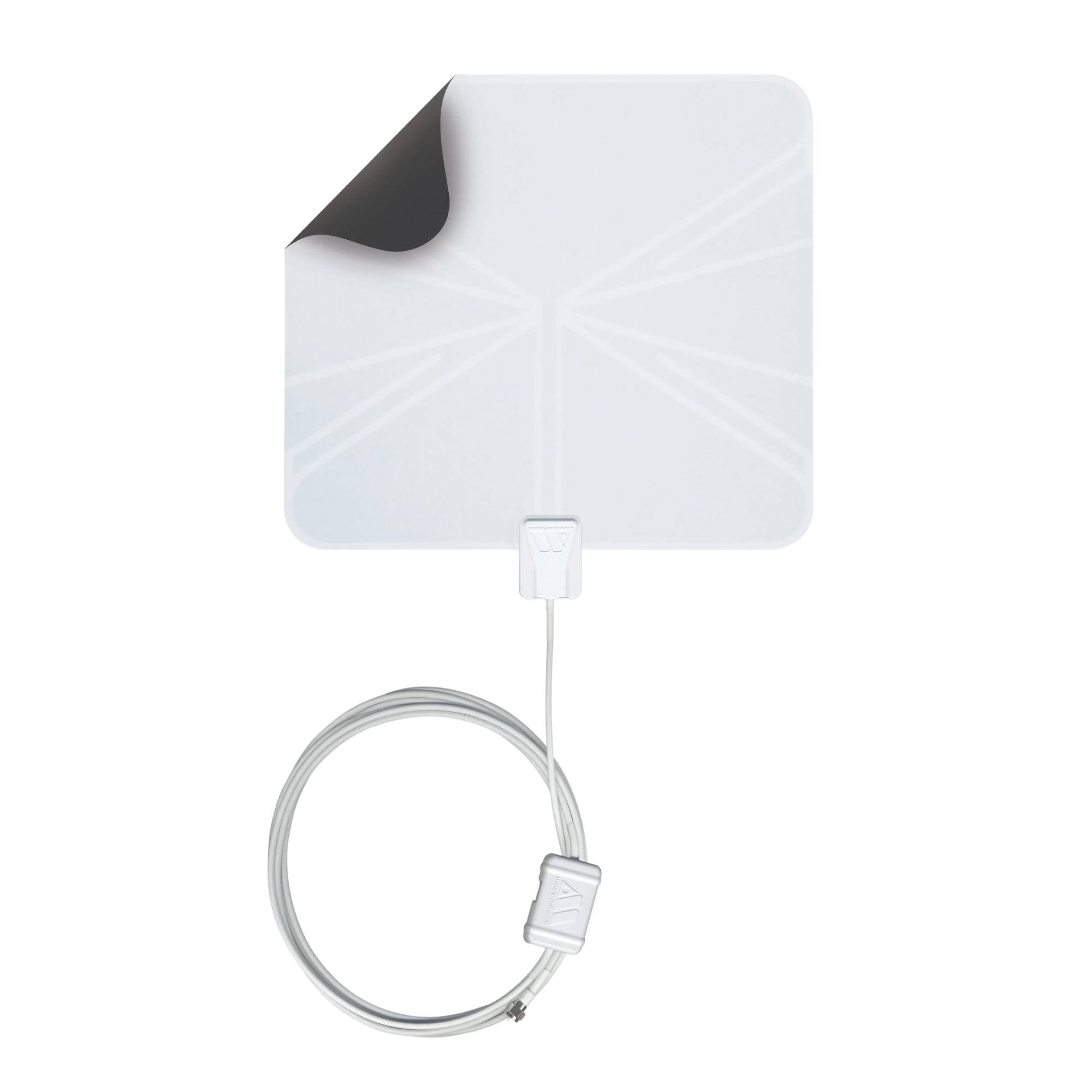
A sleek indoor panel that relies on a dedicated app to nail the perfect placement.
The Winegard FlatWave stands out because the makers also provide a free app that guides you through finding the best spot for the antenna in your home. The panel itself is impressively thin — 12 inches tall by 13 inches wide, and only 0.6 inches deep — so it blends into a room much like a small picture frame. One reviewer in South Philly, just 10-15 miles from the broadcast towers, taped it onto their first-floor ceiling and pulled in 22 channels with the amplifier on.
It is built for metro and suburban areas with a real-world rated range of up to 60 miles. Buyers who live 35-40 miles from the city report receiving about 40 out of 67 available channels on a 1080p TV. The key advantage here is that you can toggle the amplifier to adapt to your signal strength — if you are close to towers, you can leave it off and avoid overloading the tuner. The antenna covers both UHF and VHF signals, so you get access to the full spectrum of local broadcast stations. The 18.5-foot coaxial cable gives you decent placement flexibility, though some users note the cable is permanently attached, meaning you cannot swap it for a shorter or right-angle connector if your TV is mounted flush against a wall.
Smart Design Choices
- Winegard app helps you identify the ideal antenna location
- Ultra-thin dual-color panel (0.6 inches deep) for discreet installation
- Built on decades of Winegard’s U.S.-based engineering
Installation Notes
- Coax cable is permanently attached — no 90-degree adapter option
- Rated for 36 channels — less capacity than some competitors
- May struggle to hold a weak signal for a single distant station
Reach for this if: You want a polished indoor-only antenna with a helpful app, and you live within 40 miles of your local towers.
Look elsewhere if: You need a rugged outdoor antenna or need to swap the coax cable — the permanently attached cable limits what you can do with cable routing.
3. Mohu Leaf Amplified

The paper-thin panel that hides behind your TV and lets you flip the booster on or off.
At just 0.04 inches thick, the Mohu Leaf Amplified is the thinnest antenna in this lineup — it literally looks like a sheet of paper on your wall. The defining feature is the Jolt Switch, an in-line USB amplifier you control with a physical switch. Flip it on if you need a signal boost (say you are 30+ miles from the towers), and flip it off if you are close and the amplified signal is causing pixelation. Owners mention pulling in about 60 channels with the amplifier on, and one reviewer compared it directly to a cheaper antenna and noted this one delivered 47 crisp channels versus only 21 from the budget model.
The 60-mile range rating gives you a solid safety margin; the multi-directional UHF and Hi-VHF elements mean it picks up signals from both the front and back of the panel. The included 12-foot coaxial cable and hook-and-loop tabs make it truly a five-minute installation: you stick it on a wall or window, plug it into your TV’s coax port, and run a channel scan. That said, a small number of customers note occasional pixelation in heavy weather, and a few found the provided push pins unusable. The Leaf is best for single-TV homes or compact living spaces where you want a near-invisible antenna that still delivers consistent local channels.
what separates it
- Ultra-thin 0.04-inch profile blends into any room
- Jolt Switch lets you toggle the amplifier on or off
- Rated for 60 miles — one of the longest ranges in an indoor-only panel
Minor Quirks
- 12-foot cable is shorter than the 38-40ft cables on budget competitors
- Some reviewers point out occasional pixelation in bad weather
- Included push pins may need to be swapped with standard pins
Snag this for: An apartment, dorm, or rental where you cannot drill holes and you want an antenna that practically disappears on the wall.
One trade-off: The 12-foot cable limits placement flexibility compared to competitors that include 38-40 feet of cable.
4. 5000+ Miles Range TV Antenna (Arrasolt Melas)
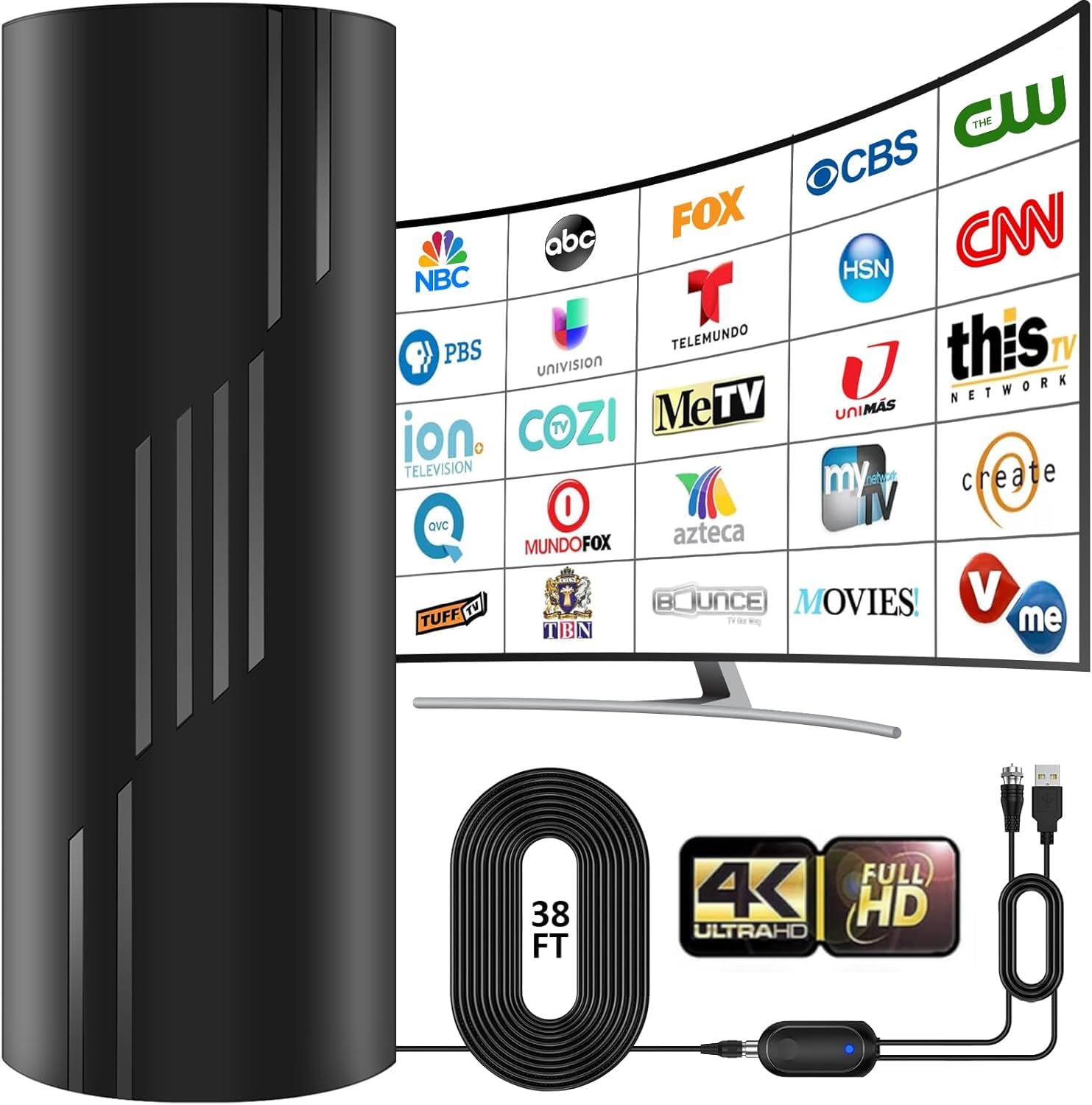
A compact indoor/outdoor option with an extra-long 38-foot coax cable for flexible routing.
This antenna from Arrasolt Melas has a small footprint — just 5 inches by 2.7 inches by 10 inches — which means it tucks into corners and shelves easily. Shoppers say it works well in suburban areas with strong reception, picking up a good number of clear channels. One review highlighted that the amplifier boosts weak signals effectively and that the unit supports both 4K and 1080p formats. The 38-foot high-performance coaxial cable is the standout spec here, giving you a lot of freedom to place the antenna in a high window or on a far wall while still reaching your TV.
The antenna has a slim weatherproof design, so if indoor placement does not work, you can mount it on a balcony or even a yacht or RV without worrying about moisture damage. It is rated at 80 Ohms impedance, which is a standard match for most modern TVs and converter boxes. Setup is genuinely plug-and-play: connect the coax to “CABLE/ANT IN,” position it high up, and run a channel scan. The 48-month warranty adds confidence. The one thing to remember is that if the signal is weak in your specific room, moving the antenna a few feet — or even to a different wall — can make the difference between a snowy picture and a clear HD signal.
Flexible Setup
- 38-foot coax cable gives you excellent placement freedom
- Weatherproof shell works indoors or outdoors
- 48-month warranty — the longest coverage on this list
Reach Check
- Compact size means less surface area to capture weak signals
- May need repositioning to find the best reception spot
- No app or signal-finder tool to guide placement
Grab it if: You need a very small antenna with a long cable to reach from a distant window to your TV, or you want indoor/outdoor flexibility at a budget-friendly price point.
skip it if: You live in a deep fringe area more than 40 miles from towers — the small panel lacks the surface area of larger antennas for really weak signals.
5. 5000+ Miles Indoor TV Antenna (Forlovv)
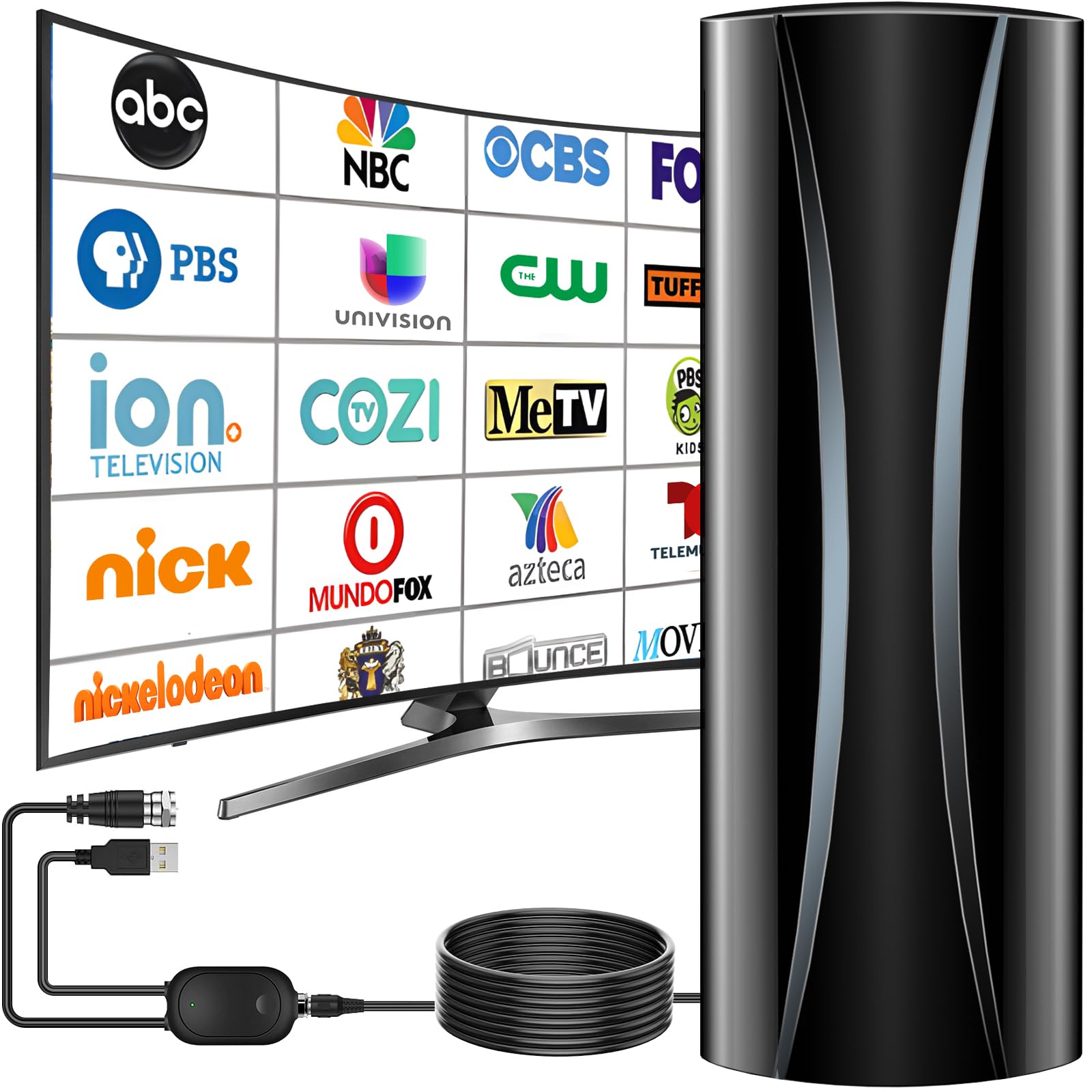
A no-fuss plug-and-play antenna that backs its performance with a lifetime warranty.
The Forlovv model is nearly identical in size and shape to the Arrasolt Melas above — about 5 inches by 2.7 inches by 10 inches — but it adds an adjustable amplifier that lets you set it to “near” or “far” depending on your distance from the towers. Buyers report a simple setup process that takes minutes, and many say they are pulling in around 30 channels with stable signal even in cloudy weather. One reviewer noted a high-quality picture on major networks like ABC and NBC, and another said the antenna outperforms others they have tried in terms of channel count and clarity.
It comes with a 40-foot coax cable, which is two feet longer than the Arrasolt Melas version, and the weatherproof shell makes it suitable for outdoor mounting as well. The lifetime warranty and 365-day free returns are the biggest reason this antenna stands out — if it does not deliver the number of channels you expect, you have a full year to return it with no hassle. The 80-Ohm impedance is identical to the Arrasolt Melas antenna, but the adjustable amplifier gives you more control over signal boosting, which can be the difference between a stable picture and an unwatchable one in borderline reception areas.
Risk-Free Investment
- Lifetime warranty and 365-day free returns protect your purchase
- Adjustable amplifier (near/far setting) for flexible placement
- 40-foot coaxial cable is the longest on this list
A Few Fine Points
- Compact size means less physical surface for capturing distant signals
- Setup requires a USB outlet to power the amplifier
- No smartphone app for placement guidance
Pick this if: You want a low-risk trial — the lifetime warranty and 365-day return window let you test reception without commitment.
Not for you if: You are in a very weak signal area beyond 40 miles from the towers and need a larger antenna or rooftop mount for reliable reception.
6. 2026 Upgraded TV Antenna (Nelapsano)

A compact panel packing a 90-Ohm impedance and a powerful amplifier for fringe areas.
This Nelapsano antenna is slightly wider than the previous two compact models, measuring 5.3 inches by 3 inches by 8.66 inches, and it drives a higher impedance of 90 Ohms. Buyers who installed it outdoors report it pulls in dozens of local HD channels — one review counted over 50 free channels in a suburban area with no signal loss even near an airport. The 360-degree reception claim means it picks up stations from all directions without aiming, similar to the Channel Master Omni+ 50 but in a much smaller form factor.
The included 38-foot premium HDTV cable and weatherproof construction make it suitable for both indoor and outdoor use, whether you mount it on a wall, window, or rooftop. Multiple reviewers highlight the signal booster as effective at maintaining strong reception during bad weather, with one saying it “exceeded expectations” after a ten-minute setup. The downsides are mostly about the amplifier needing a USB port for power (which is common), and the compact size means it does not have the same raw signal-capturing surface area as a traditional outdoor antenna. For a mid-range suburban home where you want a small, versatile antenna that works right from the start, this is a strong contender.
Signal Strength
- 90-Ohm impedance — highest on this list for signal matching
- 38-foot cable and weatherproof build for flexible mounting
- Owners mention 50+ channels in suburban areas
Sizing Consideration
- Compact panel = less surface area than a full-size outdoor antenna
- No app or channel-finder included for placement
- Requires a USB power source for the amplifier
Reach for this if: You want a compact, indoor/outdoor antenna with a high-impedance amplifier that gives you an edge in boundary-signal areas.
Look elsewhere if: You have a large house with the TV far from the antenna mounting point — the 38-foot cable is generous but may not be enough for a corner-to-corner route.
Understanding the Specs
Impedance (Ohms)
Impedance is the electrical resistance the antenna presents to the signal traveling down the cable. A standard TV tuner expects a 75-Ohm match — most antennas on this list fall between 75 and 80 Ohms, with the Nelapsano model coming in at 90 Ohms. A mismatch between the antenna and the TV’s input can cause a small amount of signal loss, but in practice the difference between 75 and 90 Ohms is minor for typical home setups. What matters far more is that the cable itself is properly rated (RG6 is best) and that all connections are tight.
Range And Real-World Reception
The advertised range on the box (like “60 miles” or “5000+ miles”) is an upper-limit theoretical number measured under perfect, wide-open conditions. In the real world, walls, windows with low-E coatings, nearby buildings, trees, and hills all cut into that number. A 60-mile antenna in a dense suburban neighborhood typically delivers clean reception at 20–30 miles. That is why the Winegard FlatWave, at 60 miles, and the Channel Master Omni+ 50, at 50+ miles, can both outperform antennas with a higher printed range — they are built with better materials and their range is honestly stated. The “5000+ miles” claims on some compact models are marketing hyperbole; treat any range over 100 miles as “test this in your home” rather than a guaranteed spec.
FAQ
How many channels can I expect with an indoor antenna?
Will an antenna work if I live in an apartment with no window facing the towers?
What is the difference between UHF and VHF reception?
Do I really need an amplifier or signal booster?
Can I use an indoor antenna outdoors?
Why do some antennas have a 40-foot cable and others only 12 feet?
What does “omnidirectional” reception mean?
Do I need a separate digital converter box?
Final Thoughts: The Verdict
Across the board, the as seen on tv tv antenna winner is the Channel Master Omni+ 50 because its true omnidirectional reception and capacity for both UHF and VHF make it the most reliable choice for installing once and forgetting about it. If you want an ultra-thin indoor panel that can be set up in five minutes, grab the Mohu Leaf Amplified. And for a budget-friendly compact antenna that works indoors or outdoors and comes with a lifetime warranty, the standout is the Forlovv 5000+ Miles Indoor TV Antenna.
How We Picked
We do not accept paid placement. Every pick is matched to a real buyer and a real use-case; we do not hands-on test units.
Sources & Methodology
Specifications: manufacturer listings and product documentation. Review insights: verified customer reviews, as of July 2026. Pricing: not shown on this page (it changes often); check the current price via the retailer link.
As an Amazon Associate, Gadgets Feed earns from qualifying purchases. This does not affect which products we feature.