
Asbestos is a banned carcinogen that still lurks in millions of older homes, schools, and commercial buildings. When you disturb it during renovation or remediation, the microscopic fibers become airborne and lodge in lung tissue for decades. A standard shop vacuum or household canister unit will simply blow those fibers right back into the room through its exhaust. That is why a certified HEPA vacuum designed specifically for hazardous particulate is not a luxury—it is the only acceptable tool for the job.
I’m Min — the co-founder and writer behind Gadgets Feed. This guide comes from many hours spent cross-referencing HEPA certification standards, filter efficiency ratings at 0.3 microns, airflow specs in CFM, and real-world customer feedback on nine competing models to separate true asbestos-grade containment from marketing talk.
After sifting through the data, the best asbestos hepa vacuum must carry individually tested and serialized HEPA certification, a bagged primary filtration stage, and enough static water lift to pull fine dust from deep crevices without clogging.
How To Choose The Best Asbestos HEPA Vacuum
Selecting an asbestos HEPA vacuum is not like picking a household cleaner. The margin for error is measured in microns and the consequence of a failed seal is permanent lung damage. You need to evaluate certification validity, filtration stage design, motor durability, and accessory compatibility with equal weight. Below are the four pillars that separate a compliant remediation tool from a dangerous imposter.
True HEPA Certification vs. “HEPA-Type” Marketing
The term “HEPA” is legally defined in the US by the Institute of Environmental Sciences and Technology (IEST) standard. A true HEPA filter captures 99.97% of particles at 0.3 microns. Anything labeled “HEPA-type,” “HEPA-style,” or “HEPA-like” uses a lower-grade media that fails this standard and is not legally permissible for asbestos abatement. You must verify that the vacuum carries an individually serialized and tested HEPA filter—not just a generic claim printed on the box. Machines like the Dustless Technologies D1606 meet this bar with individual certification numbers printed on the filter itself.
Two-Stage Filtration: Why a Bag Comes First
In an asbestos vacuum, the order of filtration matters immensely. A bagless design forces all debris—including the sharp, fibrous asbestos particles—directly onto the HEPA filter surface. This clogs the HEPA rapidly, reduces suction, and creates a mess when you empty the bin. A two-stage system uses a disposable filter bag as the first stage, capturing the bulk of particulate before the air reaches the HEPA. This extends HEPA life dramatically and makes disposal safer because you seal the bag before handling it. Every model in this guide that genuinely qualifies for asbestos work uses bagged primary filtration.
Static Water Lift and Airflow for Fine Particulate
Asbestos fibers are lightweight but they embed themselves in porous surfaces like old drywall compound, ceiling texture, and floor mastic. A vacuum needs strong static water lift (measured in inches) to pull those embedded fibers free. Most premium dust extractors deliver between 90 and 115 inches of water lift. Lower numbers around 60 to 70 inches are fine for general surface debris but insufficient for pulling contamination out of cracks and textured finishes. The Clean Obsessed CO711, for example, delivers over 115 inches of water lift in a compact package.
Auto-Cleaning Systems and HEPA Integrity
Several high-end dust extractors feature automatic filter cleaning that pulses air backwards through the filter to dislodge dust. While this is excellent for maintaining airflow in woodworking, it introduces a risk in asbestos work: each pulse can compromise the seal of a bag or HEPA gasket if not engineered correctly. If you choose a model with auto-cleaning, verify that the system can be disabled. The Makita VC4210L and Bosch VAC090AH both allow you to switch off the cleaning cycle, ensuring that the HEPA chamber remains undisturbed during hazardous material pickup.
Quick Comparison
On smaller screens, swipe sideways to see the full table.
| Model | Category | Best For | Key Spec | Amazon |
|---|---|---|---|---|
| Dustless Technologies D1606 | Premium Canister | Certified Asbestos & Lead Abatement | Individually Serialized HEPA | Amazon |
| Fein Turbo I HEPA Pro Set | Mid-Range Extractor | Quiet Dust Extraction | 66 dB / 151 CFM | Amazon |
| Makita VC4210L | Premium Dust Extractor | Two-Stage HEPA Filtration | 11 Gal / 148 CFM | Amazon |
| Festool 578441 CT 15 | Compact Premium | Portable Jobsite Extraction | 3.96 Gal / HEPA Certified | Amazon |
| DEWALT DWV010 | Mid-Range Extractor | Automatic Filter Cleaning | 150 CFM / 15 Amp | Amazon |
| Bosch VAC090AH | Premium Extractor | OSHA Silica Compliance | 150 CFM / 97″ Water Lift | Amazon |
| Metabo ASR 35 AutoCleanPlus | Premium Extractor | Continuous Concrete Dust | 157 CFM / Washable HEPA | Amazon |
| Atrix VACOMEGAS Omega Supreme | Compact Service Vac | ESD-Safe Fine Dust | 88% @ 0.3 Micron / 1 Gal | Amazon |
| Clean Obsessed CO711 | Budget-Friendly Canister | High Suction on a Budget | 115″+ Water Lift / 10 Lbs | Amazon |
In‑Depth Reviews
1. Dustless Technologies D1606 True HEPA Shop Vac

The Dustless Technologies D1606 is one of the few vacuums on the market where each HEPA filter is individually tested, certified, and serialized. That means you can trace the actual performance record of the filter inside your machine. It is also EPA RRP and OSHA compliant for hazardous materials including asbestos, lead paint, silica, and hexavalent chromium. With a 16-gallon capacity and a three-stage filtration system—bag, pre-filter, and final HEPA—it provides complete containment without blowing dust back into the workspace.
Users consistently report strong suction for drywall sanding and paint removal projects, and the ability to switch between wet and dry pickup without swapping filters adds convenience on mixed demolition jobs. The included accessories cover crevice, floor, and brush tasks out of the box. Several professional contractors note that they have purchased multiple units for their crews, which speaks to reliability under daily abuse.
That said, a few buyers experienced broken plastic clips and hose connector issues on day one. The replacement HEPA filters are expensive—around per set—but this is the cost of verified containment. The exhaust can also stir settled dust in the room, so pairing it with proper ventilation and a respirator remains mandatory. For genuine asbestos abatement, this is the benchmark machine.
Why it’s great
- Individually serialized HEPA filter with traceable certification
- EPA RRP and OSHA compliant for asbestos, lead, and silica
- Three-stage bagged filtration extends HEPA life significantly
Good to know
- Replacement HEPA filters are expensive and must be sourced carefully
- Some users report brittle plastic clips and hose fittings
- Exhaust flow can stir ambient dust if room is not ventilated
2. Fein Turbo I HEPA Pro Set Wet/Dry Dust Extractor

Fein engineered the Turbo I HEPA Pro to deliver shop-vac-level performance at a whisper-quiet 66 decibels, which is roughly the volume of a normal conversation. That makes it a strong candidate for indoor remediation work where prolonged noise exposure is a concern. It delivers 151 CFM of airflow and 98 inches of static water lift, numbers that rival larger commercial units. The included HEPA filter and filter bag bring it to dust class L compliance for fine particulate containment.
The 13-foot anti-static hose, 19-foot cord, and swivel wheels give impressive reach and maneuverability around a jobsite. The autostart outlet with soft-start prevents power spikes when connecting sanders or saws, and the accessory kit includes a brush, crevice nozzle, and floor tools. Users frequently mention that it keeps the workspace visibly cleaner than their previous shop vacs, especially during drywall sanding and concrete grinding.
On the downside, hose storage is awkward—looping the hose around the attachment set tends to fall off during transport. It is also not as refined as Festool in terms of accessory docking and cord management. For the price, you get excellent HEPA performance and quiet operation, but you sacrifice some of the polished storage engineering found on premium German extractors.
Why it’s great
- Exceptionally quiet at 66 dB for extended work sessions
- 151 CFM and 98″ water lift rival larger commercial vacuums
- Autostart outlet with soft-start protects connected tools
Good to know
- Hose and accessory storage is poorly integrated and prone to falling off
- Lacks the refined accessory docking of higher-priced competitors
- Filter bag cost adds recurring expense for heavy use
3. Makita VC4210L 11 Gallon Wet/Dry HEPA Dust Extractor

The Makita VC4210L packs a full feature set—HEPA filter, automatic filter cleaning, variable speed control, tool-activated power outlet, and wet/dry capability—into a price point that undercuts many premium competitors. Its 12-amp motor generates 148 CFM of suction and 92 inches of water lift, and the two-stage filtration system uses a main flat filter plus a HEPA final filter to capture 99.97% of particles at 0.3 microns. The automatic filter cleaning cycles every 20 seconds with a noticeable popping sound, but you can disable it by switching to wet mode.
Users consistently praise the noise level, calling it significantly quieter than comparable Shop-Vac and DeWalt models. The variable speed dial is useful for adjusting suction when using sanders or other tools that require lower airflow. The included 13-foot anti-static hose, crevice nozzle, and fleece filter bag provide everything needed to start right away. Several buyers note that after 12 hours of concrete grinding, the suction remains strong with minimal filter clogging.
Some users report that the instructions are purely pictorial and require some guesswork during assembly. The auto-cleaning thump can be startling in a quiet workspace, and the vacuum does not include a larger 2.5-inch hose for bulky debris. For a dedicated HEPA dust extractor that handles sub-micron containment without breaking the bank, the VC4210L is a compelling choice.
Why it’s great
- Full feature set at a more accessible price than Festool or Metabo
- Quieter than most competitors with effective HEPA filtration
- Auto-cleaning can be disabled for hazardous material work
Good to know
- Pictorial-only instructions can make assembly frustrating
- Auto-cleaning pop is loud and may be disruptive in quiet spaces
- No 2.5-inch hose included for large debris pickup
4. Festool 578441 CT 15 Dust Extractor with HEPA Filter
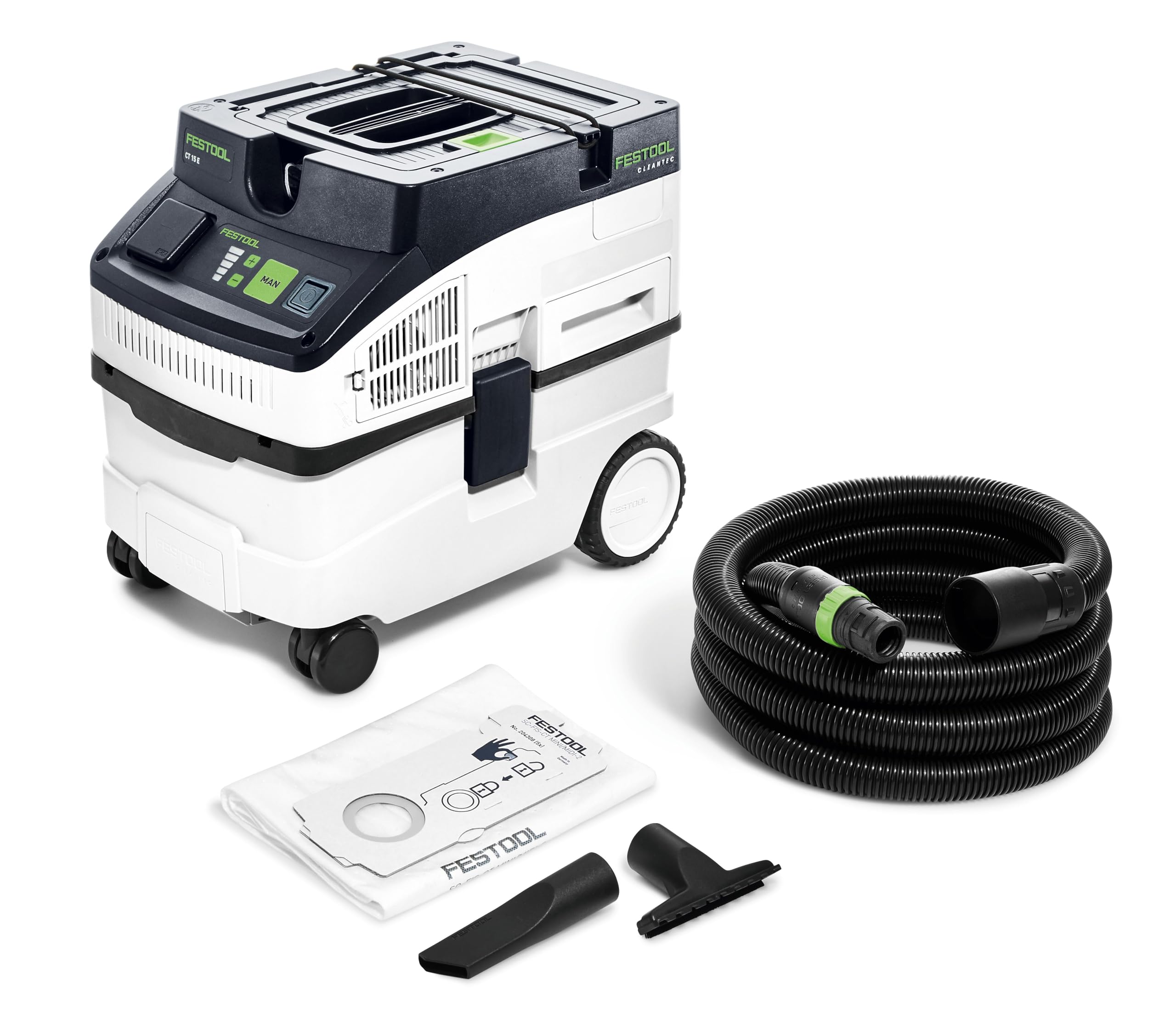
Festool’s CT 15 is the entry point into the brand’s legendary dust extraction ecosystem, but it is no stripped-down model. It features a HEPA-certified filter, an AutoClean system that pulses the filter to maintain suction, and a high-performance turbine that matches the suction of the larger CT 26. At 24 pounds with a compact 3.96-gallon container, it is light enough to carry up stairs and small enough to fit on a workbench shelf. The flat top surface doubles as a tool rest, which is a thoughtful jobsite convenience.
The AutoClean system is genuinely effective at preventing filter clogging during heavy sanding or grinding. The crevice and upholstery nozzles store onboard, reducing accessory loss. Users report that the blower function on the exhaust port is surprisingly useful for clearing sawdust from surfaces. The robust chassis includes steel axles and a 3-year comprehensive warranty that covers wear and tear—an uncommon level of support.
The main drawback is the small container capacity, which fills quickly during large demolition or abatement work. The hose diameter is 27/32 inches, which is narrower than the 1.25-inch or 1.5-inch hoses on larger units, so it is best suited for fine dust rather than mixed construction debris. For dedicated asbestos HEPA work in small areas or on multi-story sites where portability matters most, the CT 15 is hard to beat.
Why it’s great
- HEPA certified with AutoClean filter pulsing for sustained suction
- Compact and lightweight at 24 lbs for easy transport
- 3-year comprehensive warranty covering wear and tear
Good to know
- Small 3.96-gallon capacity fills quickly on large jobs
- Narrow hose diameter is not ideal for bulky construction debris
- No Bluetooth or Systainer dock, unlike higher Festool models
5. DEWALT DWV010 HEPA Dust Extractor with Automatic Filter Cleaning
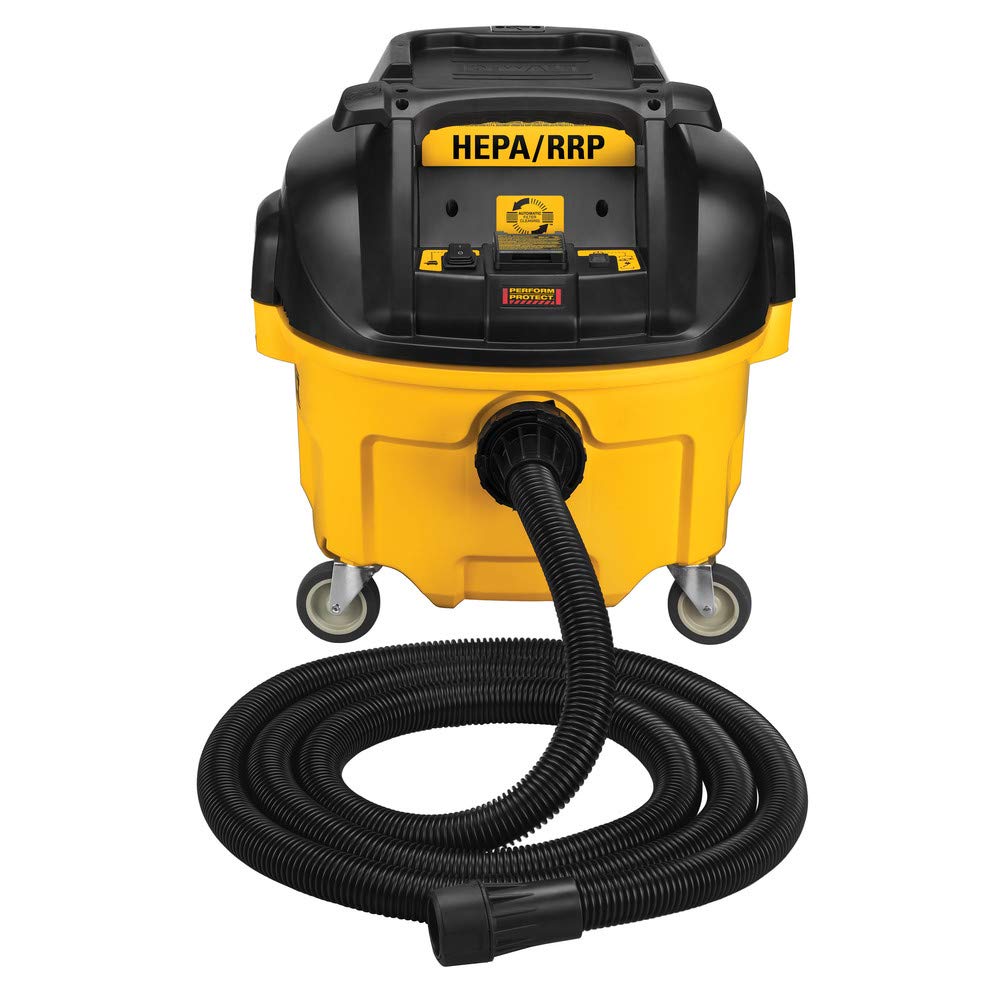
The DEWALT DWV010 is built around a 15-amp motor that pushes 150 CFM of airflow, and its automatic filter cleaning system pulses every 30 seconds to prevent suction drop-off. This model meets the EPA Lead Renovation, Repair and Painting (RRP) Rule when used with DWV9330 filters, making it a legitimate choice for lead and asbestos containment. The power tool actuation feature lets the vacuum start and stop automatically when a connected tool is triggered, which is convenient for sanding and sawing workflows.
The 15-foot anti-static hose and universal hose connector provide a secure, swivel-capable fit. Users appreciate that it works with a range of adapters—DWV9000 for sanders, DWV9120/9130/9140 for other tools. The filter bag (DWV9402) is replaceable and captures bulk debris before it reaches the HEPA, which keeps the final filter clean for longer. Several buyers report using it for years on lead paint and plaster dust without the filter clogging.
On the downside, the suction is noticeably weaker than a standard shop vac, so pre-sweeping large debris is often necessary. The hose is stiff and difficult to coil for storage, and the included accessories use friction-fit connections that tend to separate during use. The auto-cleaning pulse causes a brief suction loss each cycle, which can be disruptive. For a dedicated HEPA extractor with DEWALT ecosystem compatibility, it delivers solid performance with some ergonomic compromises.
Why it’s great
- 15-amp motor delivers strong 150 CFM airflow
- EPA RRP compliant when paired with DWV9330 HEPA filters
- Power tool actuation simplifies sanding and sawing cleanup
Good to know
- Suction is weaker than a standard shop vac for large debris
- Stiff, proprietary hose is difficult to store and maneuver
- Friction-fit accessory connections can separate during use
6. Bosch VAC090AH 9 Gallon Dust Extractor with Auto Filter Clean
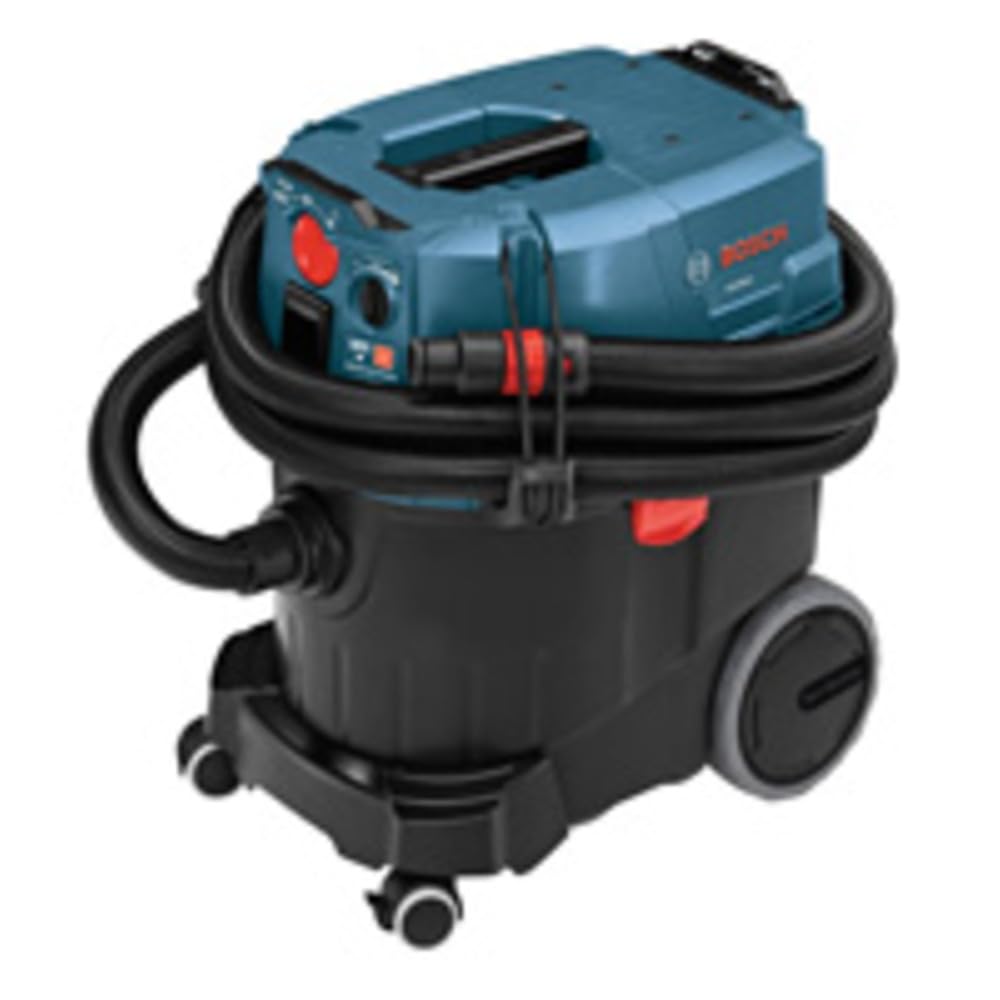
The Bosch VAC090AH is engineered from the ground up for OSHA Silica Table 1 compliance, making it a natural fit for asbestos and hazardous dust work. Its 120-volt motor delivers a maximum 150 CFM with 97 inches of static water lift, and the auto-cleaning system pulses the filter every 15 seconds to maintain peak suction. The HEPA filter captures 99.97% of particles at 0.3 microns, and the included fleece filter bag provides the first stage of containment.
Users consistently mention how quiet the unit is compared to typical shop vacs—the loudest sound is the auto-cleaning thump, which can be disabled if desired. The power tool activation works seamlessly with miter saws, track saws, and sanders. The long hose and cord provide excellent reach without needing to reposition the unit frequently. Several contractors report using it for fiberglass cutting, drywall sanding, and thinset grinding with over 99% dust capture.
The main complaint is the price: it is a significant investment for a 9-gallon unit, and the accessory set is sparse given the cost. The auto-cleaning thump occurs every 15 seconds by default, which can be annoying in quiet indoor settings. Removing the HEPA filter reduces power by 2-3x and disables the auto-cleaning, so you must keep the filter installed. For users who prioritize OSHA compliance and reliable fine dust containment, the VAC090AH justifies its premium.
Why it’s great
- Designed for OSHA Silica Table 1 compliance out of the box
- Auto-cleaning every 15 seconds maintains strong suction
- Very quiet operation with long hose and cord for extended reach
Good to know
- Premium price with a sparse accessory set included
- Auto-cleaning thump occurs every 15 seconds by default
- Removing HEPA filter significantly reduces performance
7. Metabo ASR 35 AutoCleanPlus 11 AMP HEPA Vacuum
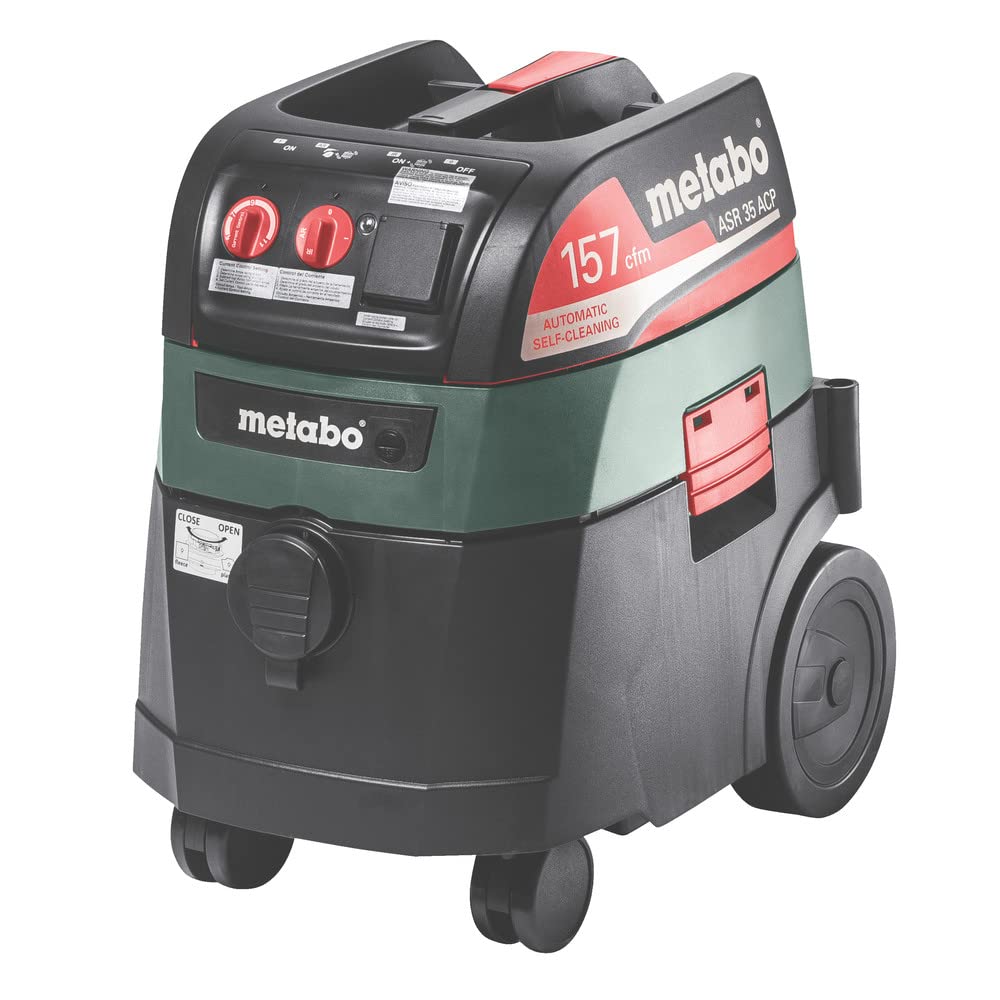
The Metabo ASR 35 AutoCleanPlus is purpose-built for continuous extraction on construction sites where concrete dust and rock debris are the norm. It pushes 157 CFM of airflow through an 11.7-amp motor, and the AutoClean impulse filter cleaning system triggers only when airflow drops, rather than on a fixed timer. This smart approach minimizes suction loss and extends filter life. The two included HEPA polyester filter cassettes are washable, reducing ongoing replacement costs.
Users who grind concrete for 8-hour shifts report that the Metabo maintains consistent suction without clogging, outperforming competitors that pulse every 10 to 30 seconds with more noticeable suction drops. The power socket for tool activation works reliably with both Festool and other brand tools. The variable suction control allows you to dial down power for lighter tasks like sanding.
However, some units have arrived with incompatible power plugs for the US market, and replacement motor parts like carbon brushes are difficult to source—Metabo reportedly requires a full motor replacement after the brushes wear out. Dust can also enter the power switch over time, requiring periodic disassembly and cleaning. For heavy construction dust extraction it is a beast, but parts availability is a genuine long-term concern.
Why it’s great
- Smart auto-cleaning triggers only when airflow drops, not on a timer
- Washable HEPA filter cassettes reduce recurring filter costs
- Excellent suction consistency during long concrete grinding sessions
Good to know
- Motor repair parts are difficult to source; full replacement often needed
- Dust can accumulate in the power switch over time
- Some units have incompatible plugs for US electrical outlets
8. Atrix VACOMEGAS Omega Supreme 1-Gallon Vacuum

The Atrix VACOMEGAS Omega Supreme is a unique tool in this space. It is a compact, ESD-safe service vacuum designed for technicians who need fine dust capture in electronics, printer repair, or guitar workshop environments. Its patented filter achieves 88% efficiency at 0.3 microns, which is below true HEPA spec (99.97%) but far better than standard shop vac filtration. The toolbox-style chassis stores all accessories internally, making it highly portable.
At less than 70 dB, it is among the quietest service vacuums available. The stretch hose extends to about 6 feet and compresses to 2 feet, which is perfect for benchtop use. Users in printer maintenance and musical instrument repair praise its ability to contain toner powder and fine metal dust without exhausting particles into the workspace. The ESD-safe design also prevents electrostatic discharge around sensitive electronics.
Understand that this is not an asbestos abatement vacuum. Its 1-gallon capacity and 88% filter efficiency mean it is not certified for hazardous material containment under EPA RRP rules. It is best viewed as a precision fine-dust tool for controlled indoor environments where the risk is low-level particulate, not active asbestos remediation. For benchtop dust control in a tech repair or workshop setting, it excels.
Why it’s great
- ESD-safe design prevents static discharge around sensitive electronics
- Compact toolbox form factor with onboard accessory storage
- Very quiet at under 70 dB for noise-sensitive environments
Good to know
- Not true HEPA certified—88% efficiency at 0.3 microns
- 1-gallon capacity is too small for abatement-scale work
- Not EPA RRP compliant for asbestos or lead containment
9. Clean Obsessed Commercial HEPA Canister Vacuum CO711

The Clean Obsessed CO711 is a lightweight commercial canister vacuum that punches well above its weight class in suction power. It delivers over 115 inches of water lift—more than many units twice its price—while weighing under 10 pounds. The H10 five-layer micro-filtration system is paired with an optional reusable SMS cloth bag (sold separately) for primary debris capture. The 27-foot commercial-grade cord and 8-foot hose provide solid reach without needing to swap outlets constantly.
The 8-piece tool kit includes a floor tool with swivel neck, upholstery tool, round brush, crevice tool, and a stainless steel telescopic wand, covering most cleaning scenarios out of the box. Users report that it handles heavy pet hair and gravel dirt with ease, and the adjustable padded shoulder strap makes it comfortable to carry during extended use. Several buyers mention that it outperforms major brand canister vacuums on carpet and hard floors alike.
The catch is that the H10 filter is less efficient than true HEPA at 0.3 microns, so this unit should not be your primary tool for active asbestos remediation. Some units have suffered motor failures after limited use, and the yellow plastic housing feels less durable than metal-bodied competitors. For general commercial cleaning and light fine-dust work on a budget, it is an incredible value, but it does not meet the certification bar for hazardous material containment.
Why it’s great
- Exceptional 115+ inch water lift in a sub-10-pound package
- Long 27-foot cord and 8-piece tool kit offer great reach and versatility
- Very affordable for a commercial-grade canister vacuum
Good to know
- H10 filter is less efficient than true HEPA at 0.3 microns
- Some units have experienced early motor failure
- Plastic housing is less durable than metal competitors
FAQ
Can I use a standard HEPA shop vac for asbestos cleanup?
What is the difference between HEPA and ULPA for asbestos?
How often should I replace the HEPA filter in an asbestos vacuum?
Final Thoughts: The Verdict
For most users, the best asbestos hepa vacuum winner is the Dustless Technologies D1606 because it carries individually serialized HEPA certification, three-stage bagged filtration, and EPA RRP compliance at a price that undercuts premium European extractors. If you want whisper-quiet operation with professional-grade suction, grab the Fein Turbo I HEPA Pro Set. And for a full-featured dust extractor that balances cost, HEPA performance, and quiet operation, nothing beats the Makita VC4210L.