
Our readers keep the lights on and my morning glass full of iced black tea. As an Amazon Associate, I earn from qualifying purchases.
Specs are compiled from manufacturer listings and verified buyer reviews and can change over time — please confirm the key details on the product page before buying.
If you want the short answer: the Premium Foam Japanese Floor Mattress in twin size is the safest floor-sleeping buy for most people, and the MAXYOYO 6-inch is the one to pick if you want real cushioning under your hip bones. The rest of this list splits cleanly into two families — foam-filled futons that cushion, and rush-grass tatami that breathe — and which one you want depends on whether you are sleeping on it nightly or using it as a daytime mat.
I’m Min — the founder and writer behind Gadgets Feed. This guide is built by comparing the manufacturers’ published specifications and the patterns across verified customer reviews, so you get each pick’s real strengths and trade-offs instead of marketing spin.
Thickness is where floor sleeping is won or lost, and the spread here runs from a 0.4-inch grass mat to a 6-inch foam build. Everything below is sorted by what the mattress actually does under your back, so you can stop guessing and choose the right asian floor mattress for your room.
Our Picks at a Glance


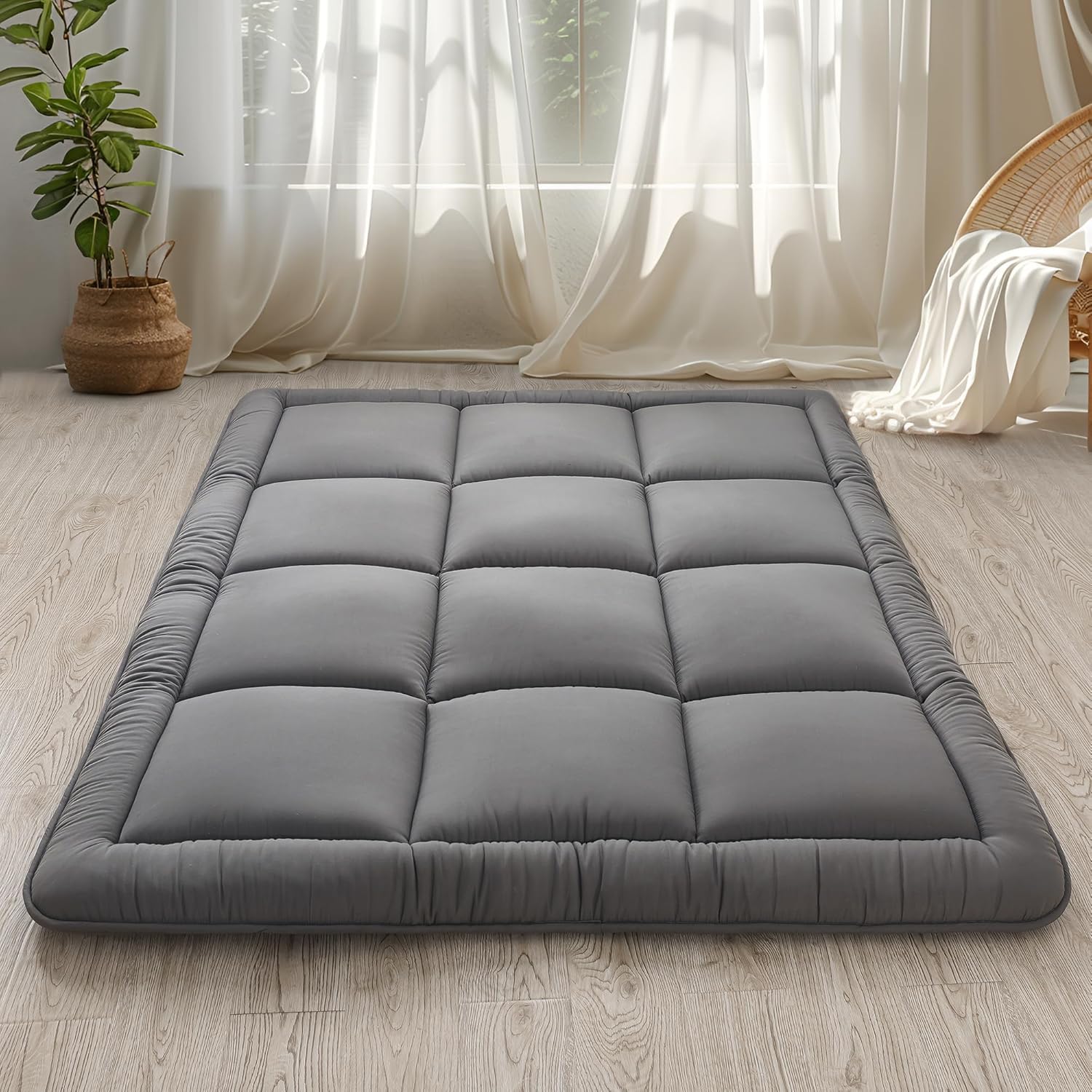
How To Choose The Best Asian Floor Mattress
The mistake most first-time buyers make is treating every floor mattress as the same object with a different label. They are not. A shredded-memory-foam futon and a rush-grass tatami behave nothing alike under your body, and buying the wrong one is why so many people give up on floor sleeping after a week.
Decide foam or grass before anything else
Foam futons are built to cushion and conform — you sink slightly and the fill spreads your weight. Rush-grass tatami are built to sit firm and breathe, so air moves under you and sweat dries instead of pooling. If you are sleeping on the floor every night, foam is the more forgiving choice. If you want a mat for yoga, meditation, or daytime floor seating that rolls away afterward, grass is the better fit.
Thickness is the number that decides your mornings
On this list the range runs from 0.4 inches of grass up to 6 inches of foam, and that gap is the difference between feeling the floor and not feeling it at all. Side sleepers and anyone with hip or shoulder pressure points should be looking at the thicker end. Stomach sleepers and daytime sitters can go thinner without regret. Be honest about how you sleep, because a 2-inch mat under a side sleeper is a short experiment.
Check the real size, not the listing photo
Floor mattresses are sold in twin, full, and queen footprints, and the widths vary more than you would expect. A twin can run 39 inches wide while a queen runs 60 inches, and that extra width is what lets two people share. Measure the floor space you plan to use first, then match it — a queen that overhangs a doorway becomes a daily annoyance no matter how comfortable it is.
Plan for the unpacking wait
Almost every foam mattress here ships vacuum-compressed into a cylinder, which means it arrives flat and thin and needs time to expand. Expect anywhere from 48 hours to a few days, and longer in cold weather. Do not judge the thickness on the day it lands — that is the single most common reason a perfectly good mattress gets returned.
Quick Comparison
| Model | Best For | Thickness | Size (L x W) | Fill | Amazon |
|---|---|---|---|---|---|
| Premium Foam Japanese Floor Mattress (Twin)★ Best Overall | Everynight floor sleeping on a budget | 3 inches | 80″ x 39″ | High-density foam | Amazon |
| VEVOR Japanese Tatami MatBreathable Pick | Yoga and meditation on hard floors | 0.5 inches | 80″ x 39″ | Natural rush grass | Amazon |
| WhatsBedding Japanese Floor Mattress (Queen)Best for Sharing | Two people sharing a foldaway bed | 3 inches | 80″ x 60″ | Shredded memory foam | Amazon |
| CotanLyama Premium Foam Futon (Queen) | Guest rooms that need a real bed | 3.2 inches | 80″ x 60″ | High-density foam | Amazon |
| MAXYOYO 6″ Extra Thick | Side sleepers and sore hips | 6 inches | 80″ x 39″ | High-density foam | Amazon |
| ZonLi Japanese Floor Mattress (Full) | Washable cover and daily use | 4 inches | 80″ x 54″ | Foam + memory foam | Amazon |
| D&D Futon Furniture Traditional | Firm traditional cotton futon feel | 3 inches | 80″ x 54″ | Cotton batting, foam, polyester | Amazon |
| Aircliff Japanese Floor Futon (Twin) | Carrying to another room or a campsite | 2.5 inches | 80″ x 39″ | Polyester, high-density foam | Amazon |
| MIINA Japanese Traditional Tatami (Full) | Layering under a futon as a base | 0.4 inches | 78″ x 55″ | Rush grass | Amazon |
In‑Depth Reviews
1. Premium Foam Japanese Floor Mattress Futon, Twin
Our pick — 4.5+★ from 650+ verified ratings; the strongest balance of quality and price.
Nine stacked layers of foam that hold their shape instead of flattening into a pancake.
This is the pick for someone who genuinely wants to sleep on the floor every night and does not want to feel the boards by morning. The build is nine layers deep — five of them padding — around a high-density foam core, which gives you a medium-firm surface that spreads your weight rather than denting in one spot. The manufacturer claims the nine-layer structure resists collapse over long use, and that claim is the whole reason this sits at the top of the list.
What wins people over is the construction, closely followed by how it sleeps. The microfiber cover uses a three-dimensional stitched lattice pattern to lock the filler in place, so the surface stays flat through the night instead of bunching under your shoulders. Owners typically clock it as a sensible balance between soft and firm rather than a cloud, which is exactly what a floor sleeper wants — too soft and you are back to feeling the floor through the padding.
Two honest notes. The size is the most disagreed-about thing here: some owners find the 80″ x 39″ twin plenty for two people to nap on, while others expected a wider footprint than advertised, so measure before you assume. And like every vacuum-packed futon on this list, it needs three days in warm weather — up to three weeks in cold — before it reaches its full 3-inch depth. The maker also asks you to use a comforter cover or sheet to protect the microfiber fabric.
What earns the top spot
- Nine-layer construction with five padding layers resists collapse
- 3-inch thickness in a medium-firmness feel that stays stable all night
- Medium pricing makes a nightly floor sleeper possible without a big outlay
- Doubles as a play mat, tent mat, or car-trip bed
What to expect going in
- Needs three days to three weeks to reach full thickness after unboxing
- The 39-inch twin width divides opinion when two people nap on it
- Requires a sheet or comforter cover to keep the fabric clean
Buy it for: nightly floor sleeping where you want support that survives the night, plus enough versatility to pull it out for guests.
Look at something wider if: you already know two adults will share it — the 60-inch queen options below cover that ground.
2. VEVOR Japanese Tatami Mat
A half-inch of woven grass that lets air move where foam simply traps it.
Here is the number that matters: 0.5 inches. Next to the 3.2-inch CotanLyama further down this list, the VEVOR is the thinner of the two — a difference large enough that the two are barely the same product category in practice. This is not a mattress you sink into. It is a firm, breathable mat made from natural rush grass that you lay on a hard floor for yoga, stretching, or a floor-sleeping habit with a very traditional feel.
Buyers are drawn in by the felt quality — how solid and well-woven it is underfoot — and by how well it handles hard tile. It folds into three layers when you are done, so it tucks into a corner or a closet instead of living permanently in the middle of the room. The rush grass is also the reason it works in warm rooms: the material absorbs sweat and manages humidity, which is the opposite of what a sealed foam slab does.
The catch, and it is a real one, is the smell. Fresh rush grass carries a strong natural scent from the start, and the reaction to it splits sharply — some owners find it pleasant and calming, others find it overpowering. The manufacturer is upfront about this and suggests airing the rush grass in a well-ventilated spot until the scent fades. A few also note the non-slip backing does not fully stop sliding on smooth flooring. If you are sensitive to smells, this is the one to think hardest about.
The honest read: superb for meditation, stretching, and warm-weather floor sitting; not a substitute for a cushioned futon if you are sleeping on it every night.
Plan for the scent: budget a few days of airing before the mat goes into a bedroom you actually sleep in.
Reach for this if: your floor time is exercise, meditation, or daytime lounging on tile and you want air movement rather than padding.
Pass if: a strong natural grass scent in the room would bother you more than a bit of firmness would.
3. WhatsBedding Japanese Floor Mattress, Queen
A full 60-inch queen footprint that folds away into a cabinet when the guests leave.
The deciding spec here is the 60-inch width. Compared with the 39-inch twin at the top of this list, that extra span is what makes it a genuine two-person sleeping surface rather than a solo pad, and it is the reason to look at this one when a spare room has to double as an office. The 3-inch body is filled with shredded memory foam held between two layers of polyester padding, and the maker has reinforced the middle to stop the sagging that older futons were known for.
Where it earns its place is convenience. It folds or rolls into a compact bundle for a cabinet, and it fits in a car trunk for camping trips. The cover is 100% polyester and the whole thing weighs 14.7 lbs, so one person can move it without help. Buyers consistently praise how well it works as a temporary bed and how genuinely functional the pack-away design is.
Be clear-eyed about what a 3-inch shredded-foam pad is, though. It is not a plush comforter, and the most common criticism is that it feels thinner than expected and compresses under weight — some find the floor comes through more than they would like. Measure expectations against the depth, not the photo. It also needs two to three days to recover its thickness after shipping.
The trade-off in plain terms: you are buying floor space and sharing width, not deep cushioning.
Best paired with: a mattress topper or thick sheet if you plan to sleep on it longer than a weekend.
Made for you if: the mattress has to disappear by day and still sleep two by night.
Think twice if: you want the deep, sink-in feel of a thick foam futon — the 6-inch MAXYOYO is the better match.
4. CotanLyama Premium Foam Japanese Futon, Queen
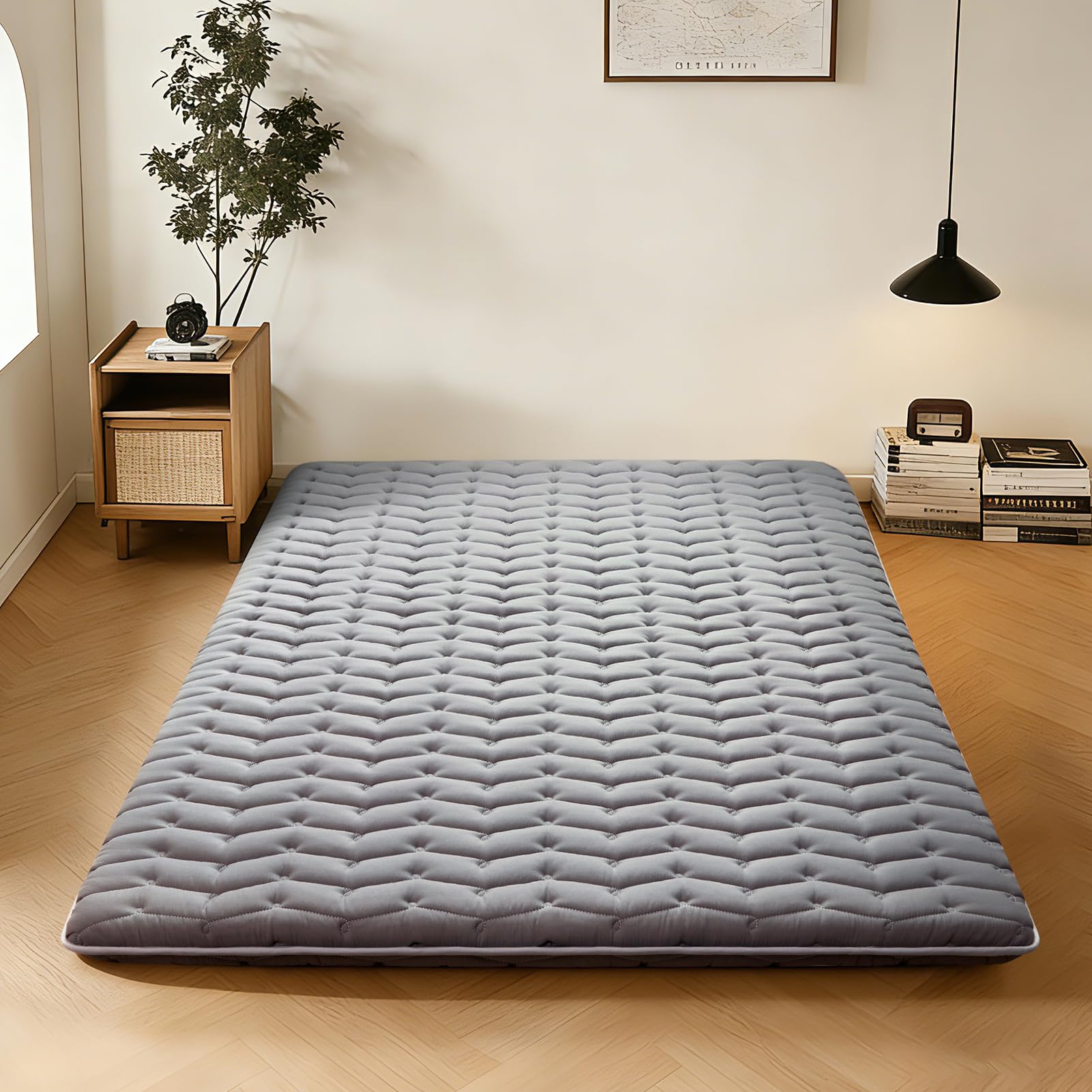
The extra tenth of an inch and the stitched grid that keep the filling where you put it.
At 3.2 inches against the WhatsBedding’s 3 inches, the depth difference is small on paper, but the construction behind it is the real story. This is a nine-layer build — microfiber cover, soft sponge, high-density support foam, and polyester fiberfill — quilted with fixed-point 3D stitching that locks every filler layer in place. The practical result is that the mattress does not develop one sunken dent where your hips land, which is the failure mode that kills cheaper floor futons.
Owners treat it as a proper step up from an air mattress, and the balanced medium-firm surface suits both back and side sleepers who want a floor bed that gives support without a hard edge. The breathable microfiber surface stays comfortable in warm rooms, and the reinforced quilted edges resist breaking down. It is also a genuine queen at 60 inches wide, so a couple can use it.
On the other side of the ledger, folding it back into storage is not everyone’s experience — some manage it easily, plenty find it takes effort, and the maker’s own guidance to flip or rotate it every two to three months tells you it expects careful handling. It ships vacuum-compressed and needs 48 to 72 hours to expand, longer in the cold. Use a sheet, because the fabric surface will show wear without one.
Where it shines
- Fixed-point 3D quilting prevents internal filler shifting
- 3.2-inch queen at 60″ x 80″ sleeps two comfortably
- Double-sided, so rotating it extends usable life
- Reinforced edges resist breakdown over time
Where it asks more of you
- Folding for storage is a two-hand job, not a quick flick
- 48 to 72 hours to expand fully once opened
- Needs a sheet or cover to keep the microfiber clean
Ideal for: a guest room that needs to feel like a real bed rather than an inflatable stopgap.
Not for: someone who wants to fold the mattress up and stow it every single morning — the ZonLi below is easier on that front if flexibility matters more.
5. MAXYOYO 6″ Extra Thick Japanese Floor Mattress

Six inches of foam — the closest thing on this list to sleeping on a real mattress, minus the frame.
No other pick here comes close on depth. The MAXYOYO measures about 6 inches thick, versus the 3-inch futons above, and that number is the entire argument for it. Inside sits an upgraded high-density base support foam sandwiched between thick polyester layers, wrapped in a skin-friendly polyester cover. If you have ever given up on floor sleeping because your hip went numb, this is the version to try.
The comfort verdict is the most settled on this whole list — comfort is what buyers talk about first and most, followed closely by value and back support. People describe falling asleep quickly and waking without the ache they expected from a floor bed, and the firm-but-supportive surface is why. It also comes with a dustproof cover in the matching colour and a pair of straps, so storage and carrying are handled from the start.
Two things to weigh. The 39-inch width is a twin, so it is a solo sleeper’s mattress, not a shared one. And portability is where opinions scatter — it is genuinely heavy and awkward to roll tight, so treat it as a mattress that lives in place and gets moved occasionally, not one you stow daily. It also arrives compressed and needs time to plump back to its 6-inch height.
The number that sells it: 6 inches of thickness against 3 inches on the standard futons — the difference you feel by morning.
The honest caveat: all that foam makes it a pain to roll up and carry, so plan a permanent spot for it.
Pick this one if: pressure points are your reason for buying — side sleepers and anyone who has failed at thin floor mats before.
Look elsewhere if: the mattress has to be rolled and stored every day, or two people need to sleep on it.
6. ZonLi Japanese Floor Mattress, Full
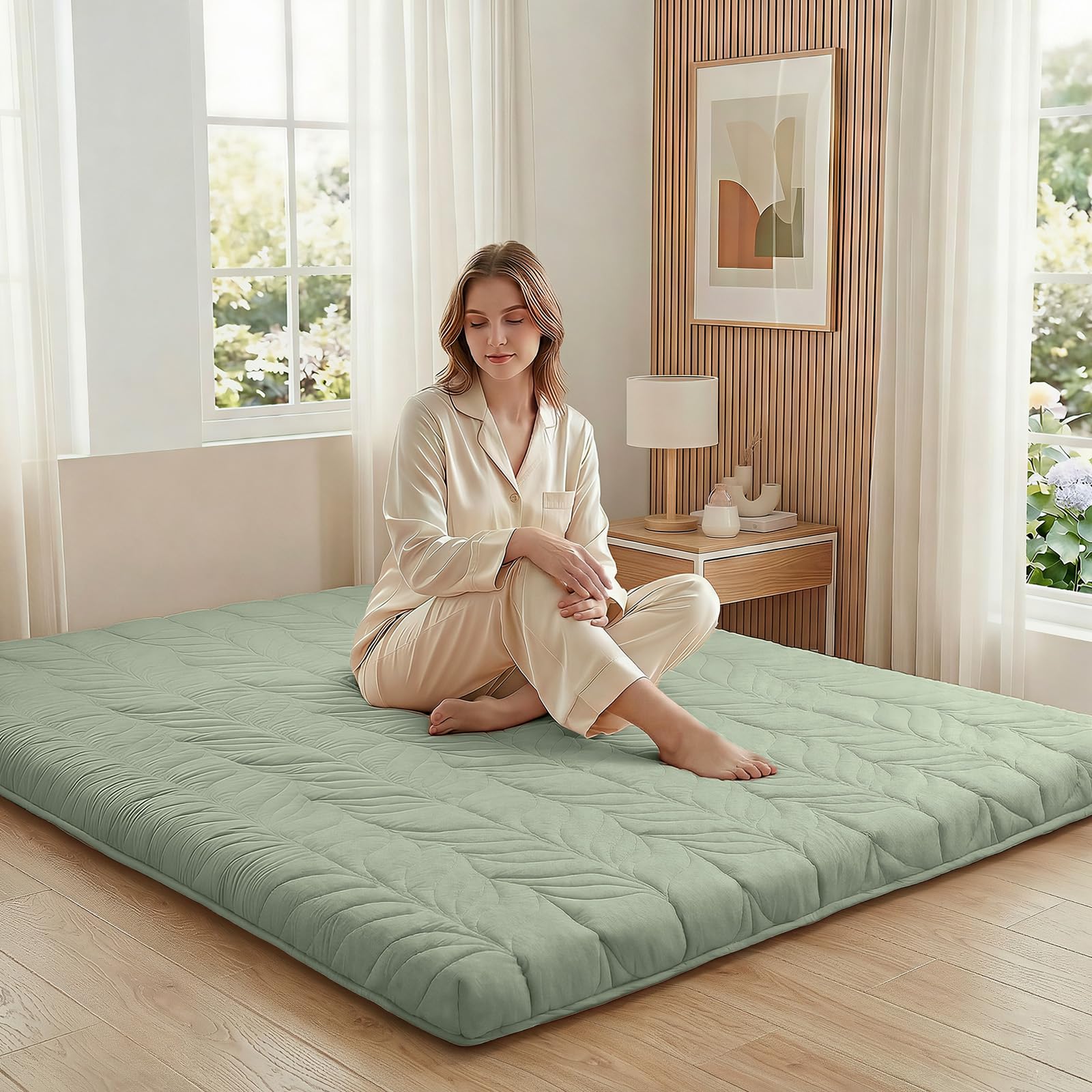
The one that actually goes in the washing machine — cotton cover off, foam core stays put.
Most floor mattresses tell you to use a sheet and spot clean. This one lets you unzip the cotton cover and put it through the machine, which over months of nightly use is not a small thing. Underneath that cover sits a 4-inch high-density foam and memory foam core, firmer than most of the list, with a smooth natural stitching pattern across the surface.
The support is the other draw. The foam gives a smooth, even sleeping surface while the memory foam layer adds contouring, and owners regularly describe it as better than an air mattress for a night’s sleep. It comes as a full at 80″ x 54″, so it holds two adults, and it ships with two elastic straps and a canvas storage bag for rolling it away. The maker backs it with a year of after-sales support on the foam core and cover.
Where it gets awkward: it is firmer than a memory-foam topper and some find it does not look as deep as the photos suggest, so set your expectations on the firm side. Folding it back up neatly divides opinion too — some manage it, others find it stubborn. And it needs two to three days to regain thickness after arriving compressed, with sun-drying or a futon dryer suggested to keep it fluffy.
The case for it
- Zippered cotton cover is machine washable — rare on this list
- 4-inch foam and memory foam core at a firm feel
- 80″ x 54″ full size fits two adults
- Ships with straps and a canvas storage bag
Know before you commit
- Firmer than memory-foam shoppers may expect
- Folding for storage is not easy for everyone
- Two to three days to expand after unboxing
Go for it if: hygiene matters more to you than a plush feel, and you want a cover you can genuinely launder.
Choose differently if: you want a soft, sink-in surface — this one is built firm.
7. D&D Futon Furniture Traditional Japanese Futon, Full

A shikifuton built the old way — cotton, foam, and a deliberate flattening.
Three layers of cotton batting, a layer of supportive foam, and a layer of polyester fiber — that is the stack. The design intent is different from the high-density foam futons above: this one is meant to flatten to a firm, firm surface that holds your body straight rather than contouring around it. If you have been told a proper Japanese futon should feel like a hard bed, this is that bed.
What it delivers is a 3-inch thick, 80″ x 54″ full-size sleeping mat with a cool, cotton-forward feel instead of foam squish. Owners praise comfort and sleep quality most of all — waking without back pain comes up again and again — and the roll-up design is a big part of the appeal. It rolls for daytime storage, exactly as the shikifuton tradition intends, freeing the room floor when you are not using it.
Two things to know. It is not machine washable — spot clean, air it in the sun regularly, and use a cover sheet to keep it clean. And the smell from the cotton and foam is genuinely divisive from the start; give it a few hours of airing outside before you decide. It arrives vacuum-compressed, so wrinkles and creases on arrival are normal rather than a defect.
Its character: firm, cotton-forward, and honest about it — the closest thing here to a traditional shikifuton feel.
The maintenance reality: no machine wash, so a good cover sheet and regular sunning are part of ownership.
Right for: buyers chasing the authentic firm, roll-it-up futon experience rather than foam-soft comfort.
Wrong for: anyone who wants to toss the cover in the washer or expects a plush landing.
8. Aircliff Japanese Floor Futon Mattress, Twin

Ten and a half pounds of futon you can actually move to another room on your own.
At 10.7 lbs, the Aircliff is the lightest foam futon here — light enough to carry to a different room or load into a car without a second pair of hands. The 2.5-inch body is built around high-density base support foam with a quilted cotton top layer over polyester padding, and the maker has reworked the middle layer so the mattress rebounds to shape instead of collapsing under long use.
What owners like best is simple comfort. It is soft enough to feel like a bed but firm enough to support a back through the night, and the quilted cotton surface is breathable against the skin in a way polyester-only covers are not. It rolls up small for storage, and it comes with a pair of bandage straps to hold it in that roll. For a single sleeper in a small flat or a dorm room, that combination is hard to argue with.
The 2.5-inch thickness is the honest limit. If you are a heavier adult or a committed side sleeper, plan on feeling some floor through it. It is also a twin at 80″ x 39″, so a solo bed. Like the rest, it ships compressed into a small package with wrinkles on the surface, and the maker asks you to lay it flat for 48 hours before judging it.
What it wins on: 10.7 lbs and a compact rolled size — the most practical pick for day-to-day moving and storage.
What it costs you: 2.5 inches of foam is the thinnest foam build on this list, so heavy sleepers may want more.
Suits you if: you move house, sleep in different rooms, or want a floor bed you can shift without thinking about it.
Skip if: you weigh more, sleep on your side, or want the cushioning of a 4-inch build like the ZonLi.
9. MIINA Japanese Traditional Tatami Mat, Full

A 0.4-inch grass mat is a foundation, not a bed — and it is very good at that job.
This is the thinnest thing on the list by a wide margin. At 0.4 inches and weighing 3 kg, the MIINA is a woven igusa (rush grass) tatami mat in a 78″ x 55″ full footprint — thinner even than the 0.5-inch VEVOR above. It works the way traditional tatami works in Japan: as the base layer you unroll a foam futon on top of, so the grass manages moisture and temperature underneath while the futon does the cushioning.
Owners talk about the scent more than anything else, and unlike the VEVOR, the reaction here is consistently warm — the fresh-grass smell is experienced as a feature of the mat rather than an issue. Beyond that, it draws praise for how it looks and for the calm it brings to a room: the natural igusa weave is genuinely handsome, which is why people use it as a rug as much as a mat. The non-slip, non-woven backing helps it stay put on smooth floors, and it quad-folds for storage — much easier to stash than a foam futon.
Two honest limits. It is firm — firmly firm. Rush grass offers no real give, so back-sleeping on it alone is a different experience from lying on a foam futon. And durability is the open question: some buyers report wear over time, so it is best treated as a base layer under a futon or a floor covering for lighter use, not a surface that takes body weight alone every night.
Why it earns the top tier
- 100% natural rush grass that regulates temperature and humidity
- Full 78″ x 55″ footprint in a 0.4-inch mat
- Quad-fold design stores far more easily than a foam futon
- Non-slip non-woven backing keeps it in place
The realistic limits
- 0.4 inches of grass gives almost no cushioning on its own
- Durability over years divides owners
- Firm surface is not everyone’s idea of a sleeping mat
Best used as: the natural base under a foam futon, or a beautiful floor mat for a living room or meditation corner.
Not the pick if: you were hoping to sleep directly on it — pair it with foam and it becomes excellent.
Understanding the Specs
Thickness (inches)
This is the depth of the mattress and the single number that decides whether you feel the floor through it. A 0.4-inch rush-grass tatami regulates moisture and gives you a firm foundation; a 3-inch foam futon cushions nightly sleep; a 6-inch build like the MAXYOYO is for anyone with hip or shoulder pressure. Match the number to how you sleep — thicker for side sleepers, thinner for sitters and exercisers.
Fill material (foam vs rush grass)
High-density base support foam is dense foam that holds shape and rebounds rather than collapsing into one dent — the reason a well-built futon survives long use. Shredded memory foam is loose foam flakes that conform to your body; it is soft but can compress thin. Rush grass is woven natural grass that lets air move through and manages humidity, so it stays cool and dry, but it is firm and gives almost no cushion.
Size and width
Floor mattresses come in twin, full, and queen footprints. The width matters more than the length: a 39-inch twin is a solo bed while a 54-inch full or 60-inch queen can hold two adults. Measure your floor space first — a mattress that overhangs a doorway becomes a daily annoyance regardless of how well it sleeps.
Care and maintenance
Some futons have machine-washable covers (ZonLi) while others are spot-clean only and cannot go in the washing machine (D&D). Nearly all foam futons ask for a cover sheet to prevent wear and moisture. Rush grass and cotton futons want regular sunning and airing to stay fresh and dry. Match the care routine to how much maintenance you are willing to do.
FAQ
How long does an Asian floor mattress take to fully expand after shipping?
What is the difference between a foam futon and a rush grass tatami?
Can two people share a twin floor mattress?
Does a thick floor mattress actually help with back pain?
How do I clean an Asian floor mattress?
Will a 0.4-inch tatami mat work as a bed on its own?
Why do rush grass tatami mats smell strong from the start?
Which floor futon is easiest to roll up and store every day?
Do I need to lay a sheet or cover over a foam floor mattress?
Can I use a floor mattress on a hard tile or concrete floor?
Final Thoughts: The Verdict
The safest floor-sleeping pick is the Premium Foam Japanese Floor Mattress in twin — its layered high-density foam holds shape and its medium-firm surface stops the floor from finding your hips. If deep cushioning is what you want, go straight to the MAXYOYO 6″ and let its extra thickness do the work. And if you specifically want a breathable base layer for meditation, yoga, or to sit under a futon, the MIINA rush-grass tatami is the one built for that job.
The nudge worth acting on: the Aircliff is the highest-scoring pick on this entire list at 4.5+ stars across 80+ ratings, and at 10.7 lbs it is also the lightest and easiest to move — the crowd favorite here is not the priciest pick, which is exactly why it deserves a serious look if portability matters to you.
How We Picked
We do not accept paid placement. Every pick is matched to a real buyer and a real use-case; we do not hands-on test units.
Sources & Methodology
Specifications: manufacturer listings and product documentation. Review insights: verified customer reviews, as of November 2026. Pricing: not shown on this page (it changes often); check the current price via the retailer link.
As an Amazon Associate, Gadgets Feed earns from qualifying purchases. This does not affect which products we feature.