
Our readers keep the lights on and my morning glass full of iced black tea. As an Amazon Associate, I earn from qualifying purchases.
Finding a microphone that catches the softest whisper, the crinkle of paper, or the gentle tap of a keyboard without hissing or humming is the whole challenge of ASMR recording. You need a mic that is sensitive enough to capture those tiny details but smart enough to ignore the hum of your computer fan or the traffic outside your window.
I’m Min — the co-founder and writer behind Gadgets Feed. This guide is built by comparing the manufacturers’ published specifications and the patterns across verified customer reviews, so you get each pick’s real strengths and trade-offs instead of marketing spin.
Whether you are a beginner or a seasoned content creator, this guide walks through the real-world performance, noise handling, and special features of each option to help you find the right asmr microphone for your specific recording setup and budget.
How To Choose The Best ASMR Microphone
Picking the right mic for ASMR is less about volume and everything about sensitivity and background noise control. Here are the key specs to look for.
Pickup Pattern Matters Most
For ASMR, a cardioid (heart-shaped) polar pattern is your best friend. It captures sound mainly from the front while rejecting noise from the sides and rear. This means your quiet whispers come through clearly, but the hum of your PC or the click of your mouse stays out of the recording.
Sample Rate and Bit Depth
Think of this as the detail level of your audio. A higher bit depth (24-bit is the standard for quality) and a higher sample rate (96kHz is common on good USB mics) capture more subtle details in the sound. This is critical for ASMR, where the texture of a sound, like brushing a microphone or tapping wood, is the whole point.
Built-In Shock Mount and Pop Filter
A shock absorber (shock mount) is a suspension system inside the mic or its stand that dampens vibrations from bumps on your desk. A pop filter is a foam cover or screen that stops explosive “p” and “b” sounds from creating a burst of air that distorts the recording. For ASMR, you want both built-in or easily added.
Quick Comparison
On smaller screens, swipe sideways to see the full table.
| Model | Category | Best For | Key Spec | Amazon |
|---|---|---|---|---|
| Audio-Technica AT2020USB-X | Premium | Crystal-clear studio-quality sound | 24-bit/96kHz with internal headphone monitoring | Amazon |
| Logitech Blue Yeti | Mid-Range | Versatile recording with four pickup patterns | Custom three-capsule array & 120dB max SPL | Amazon |
| Sennheiser Profile | Premium | Warm, natural vocal tone with tactile controls | 60dB S/N ratio & 125dB max SPL | Amazon |
| HyperX Quadcast 2 Frost | Mid-Range | Streaming and ASMR with LED indicators | Removable shock mount & 24-bit/96kHz | Amazon |
| Razer Seiren V3 Chroma | Mid-Range | Dynamic streaming with reactive lighting | 96dB audible noise & built-in shock absorber | Amazon |
| Razer Seiren V3 Mini | Budget | Compact, tap-to-mute convenience on a desk | 20dB audible noise & supercardioid pickup | Amazon |
| HyperX SoloCast 2 | Budget | Budget plug-and-play with impressive range | 79dB audible noise & 24-bit/96kHz | Amazon |
In‑Depth Reviews
1. Audio-Technica AT2020USB-X

The Audio-Technica AT2020USB-X is the top pick because its 24-bit/96kHz analog-to-digital converter keeps whisper and brush sounds crisp, not muddy. It records at 24-bit/96kHz (capturing 96,000 audio snapshots per second with high detail), so the texture of a finger tap or a soft exhale is preserved without adding fuzz.
You can plug in headphones and hear your own recording with zero delay, which means you catch pops or room noise right as they happen. At 80dB of audible noise (the mic’s own background hiss), it is quieter than the Logitech Blue Yeti’s 120dB, so your silent gaps stay clean. Buyers report that it is very sensitive and picks up everything in the room, including a furnace vent or a loud PC fan, so a quiet recording space is essential.
The soft-touch capacitive mute button and two-state LED ring (blue for active, red for muted) are simple and reliable. Its stainless steel enclosure feels solid and premium. This is the mic to beat for pure audio fidelity in ASMR.
Why it’s great
- Studio-quality 24-bit/96kHz audio captures the finest details
- Zero-latency headphone monitoring for real-time audio checks
- Stainless steel build feels premium and durable
Good to know
- Very sensitive; will pick up furnace vents and PC fans
- LED light stays on even after PC shutdown
2. Logitech Creators Blue Yeti

What sets the Logitech Blue Yeti apart from the Audio-Technica AT2020USB-X is its four switchable pickup patterns, not a single fixed one. It hits 120dB max SPL (the loudest sound it can take without distorting), so it handles louder moments without crackling, but it is not as quiet for intimate whisper recordings as the AT2020USB-X’s 80dB noise floor.
Its four patterns (cardioid, omni, bidirectional, stereo) let you record a single voice, a whole room, or a two-person talk without buying another mic. For ASMR, the stereo pattern captures a binaural-like effect (a left-right spatial image) that drops the listener into the middle of the sound. The custom three-capsule array delivers broadcast-quality clarity, and the Blue VO!CE software lets you add EQ effects and noise gates to polish your audio. Reviewers specifically mention that this mic excels for ASMR and social media content creation.
The all-metal build feels heavy-duty and professional. It includes instant mute, headphone volume, and gain controls on the front, so you do not have to dive into software mid-recording. The catch is its large footprint—this is not a travel mic. Choose the Logitech Creators Blue Yeti over the top pick if you need multiple pickup patterns for varied ASMR setups or want built-in controls and software effects without extra gear.
Where it shines
- Four pickup patterns cover solo, room, and stereo recording
- 120dB max SPL handles loud vocals without distortion
- Onboard gain and headphone controls put you in charge
Worth noting
- Larger and heavier than most alternatives
- Blue VO!CE software required for full customization
3. SENNHEISER Professional Profile

The Sennheiser Profile is for the ASMR creator who wants broadcast-grade German engineering without the hassle of an audio interface—just plug the USB into your laptop and start recording crinkling plastic or soft whispers. Its cardioid condenser capsule handles up to 125dB max SPL, so louder triggers won’t break up, and the 60dB S/N ratio keeps the noise floor low enough for quietest breaths.
Physical dials for gain, mix, and volume mean you never open software; one reviewer noted the direct headphone jack sounds “superior to software-dependent mics” and keeps cables tidy. You also get a mute button, built-in headphone jack, and separate controls for volume and mix (balancing mic input with computer playback).
The 1.2m USB-C cable and plug-and-play setup have you recording in seconds on Windows, Mac, or Linux—though the included low stand usually demands a boom arm for proper positioning. That 60dB signal-to-noise ratio is the whisperer’s edge.
What stands out
- Warm, natural Sennheiser tone without needing XLR gear
- 125dB max SPL and 60dB S/N ratio provide clean dynamic range
- Physical dials for gain, mix, and volume keep you software-free
The trade-offs
- Included stand is low; a boom arm is recommended
- No polar pattern options—single cardioid only
4. HyperX Quadcast 2 Frost

The single number that matters most in this category is 24-bit/96kHz resolution, and the HyperX Quadcast 2 Frost scores a direct match with the Audio-Technica AT2020USB-X, so your whisper triggers and keyboard taps come through with the same clarity—but it adds a removable shock mount (a suspension system that isolates the mic from desk bumps) that the Audio-Technica lacks.
The on-board controls let you adjust gain, monitor your audio, and switch between four polar patterns (stereo, cardioid, omni, bidirectional). Reviewers rave about the “crystal clear, no background noise pickup” and say it is “great for streaming, overkill for Discord.” At 335 grams, it is lighter than the Sennheiser Profile, making it easier to mount on a boom arm without sagging.
The downside is that the LED lighting is a single color (frost white) with adjustable pulse and dim settings but no full RGB customization, which gives this mic a strong price-to-value read for streamers who prioritize audio clarity and mounting ease over flashy aesthetics.
The upsides
- 24-bit/96kHz recording for high-fidelity ASMR audio
- Removable shock mount kills desk noise and vibrations
- Four polar patterns give you cardioid, stereo, and omni options
Keep in mind
- Single-color frost LED, not full RGB customizable
- Touch-to-mute sensor can be overly sensitive at times
5. Razer Seiren V3 Chroma

The Razer Seiren V3 Chroma is built for the streamer who wants their mic to double as a visual centerpiece. Its stream-and-game reactive RGB lighting links to in-game events and Twitch alerts—but beneath the flash, it packs a supercardioid condenser capsule with a digital gain limiter that prevents audio distortion when you get excited.
At 96dB of audible noise (the mic’s own hiss), it is quieter than the Logitech Blue Yeti (120dB) and uses the same mic capsule design as the V3 Mini but in a larger body with a built-in shock absorber. Owners mention that this mic is a “major upgrade from Fifine A6T” and that the background noise cancellation is effortless. The Razer Synapse software lets you set studio-level sample rates and manage separate volume mixes for your playback vs your audience.
The multi-function tap-to-mute sensor can be mapped to adjust lighting or toggle the gain limiter. At 14.4 ounces and 8.39 inches tall, it has a substantial presence on a desk, so a boom arm is recommended for the best positioning. It is perfect for the budget buyer who wants a quiet, distortion-proof mic with flashy RGB that reacts to their stream.
Why we’d pick it
- Digital gain limiter prevents distortion from loud triggers
- Reactive Chroma RGB adds visual flair to your stream
- Synapse software gives you studio-level bitrate control
A few caveats
- Plastic enclosure, not as rugged as metal-bodied mics
- Large footprint may need a boom arm for ideal placement
6. Razer Seiren V3 Mini

The Razer Seiren V3 Mini is for the creator who needs a tiny desktop mic that still sounds great—perfect for small desks, travel setups, or a secondary recording rig. Its supercardioid pickup pattern (tighter than standard cardioid) rejects more side noise, like a clicking mouse or spinning fan, than the HyperX SoloCast 2’s broader cardioid pattern.
With an audible noise rating of 20dB (its own baseline hiss), this is the quietest mic on the list, making it excellent for capturing soft ASMR sounds without background noise. The tap-to-mute sensor with an LED status light is a hit with reviewers who say it “works really well if you are on work calls all the time.” The mic is plug-and-play via USB-C, needing no drivers, and the built-in shock absorber dampens accidental desk knocks.
The one consistent catch, as reviewers report, is that the background noise dampening is “less effective than others” and is “fixable via software.” For raw, untreated rooms, its noise rejection is solid but not perfect. At only 0.52 pounds, it is easy to angle or mount on a lightweight boom arm.
Strong points
- Ultra-compact 0.52-pound design fits any desk setup
- 20dB audible noise floor is the quietest in the group
- Supercardioid pattern aggressively blocks side noise
Before you buy
- No on-mic sensitivity or volume controls
- Background noise dampening may need software tweaks
7. HyperX SoloCast 2
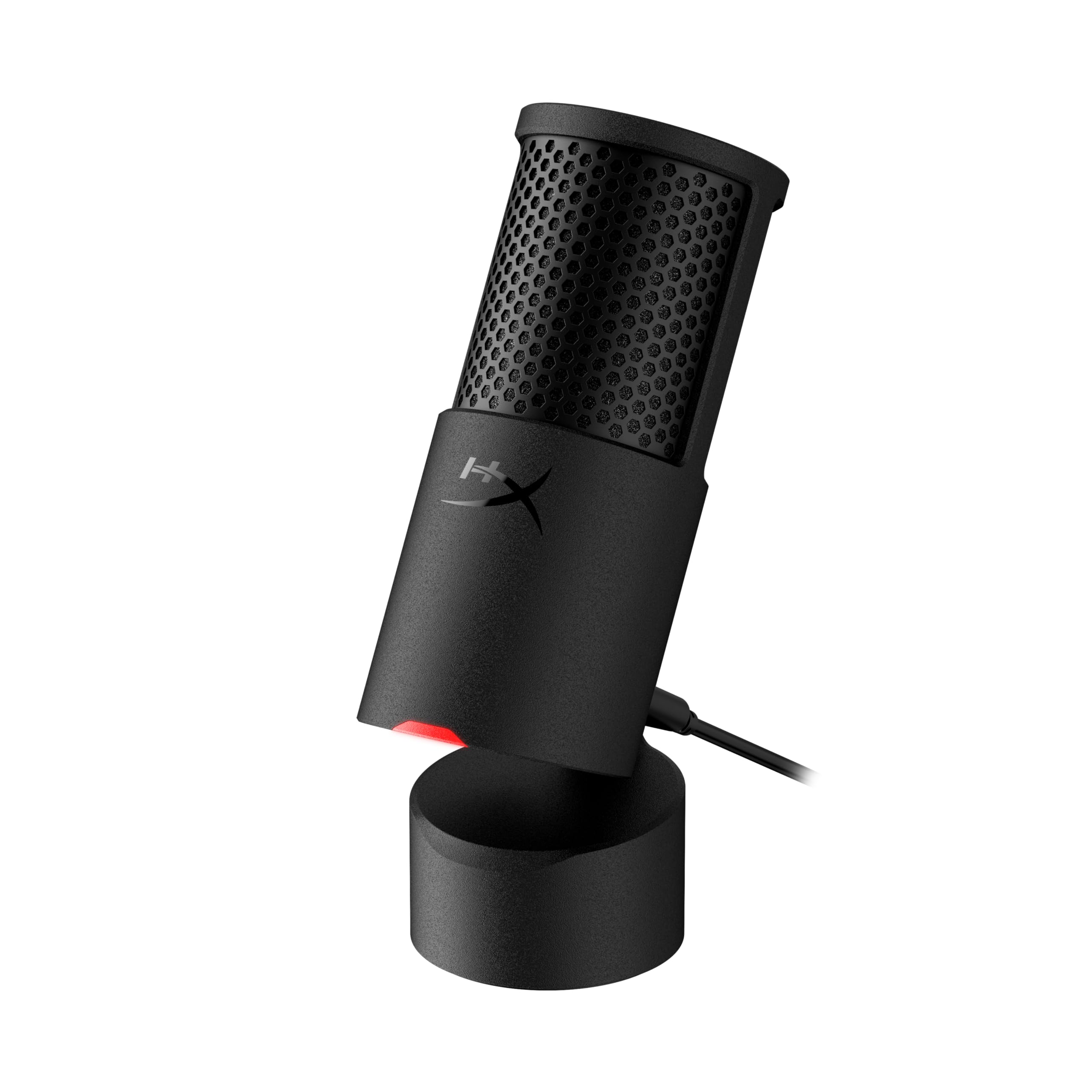
The HyperX SoloCast 2 delivers the same 24-bit/96kHz recording resolution as the premium Audio-Technica AT2020USB-X and HyperX Quadcast 2, but at a much lower cost. For the budget-conscious ASMR beginner, this is the biggest bang for your buck in terms of raw audio quality.
It packs a built-in foam pop filter (blocks “p” and “b” blasts) and an internal shock mount, so you get clear, plosive-free recordings right out of the box. Reviewers report “excellent value with clear sound from up to 25-30 feet away” and call the audio “crisp and natural.” The cardioid polar pattern focuses on your voice while reducing room echo. Its compact size and tiltable weighted base make it easy to position.
The trade-off is that the SoloCast 2 has an audible noise of 79dB (its own hiss), which is higher than the Razer V3 Mini’s 20dB—so it may pick up more background hum in a quiet room. It also has no onboard gain control, so you will need to adjust levels in software. The one clear reason to choose it is for the highest-resolution audio at the lowest price in this guide.
What we like
- 24-bit/96kHz studio-quality audio at a budget price
- Built-in pop filter and shock mount clean up raw recordings
- Compact, tiltable design with a weighted base for stability
The downsides
- No onboard gain control; needs software adjustment
- Higher 79dB noise floor than dedicated quiet mics
Understanding the Specs
Polar Pattern
The polar pattern describes the direction the microphone hears sound from. Cardioid (heart-shaped) picks up from the front and rejects the sides and rear—perfect for ASMR to cut out room echoes and computer fan noise. Supercardioid is even tighter, rejecting more side noise, but it also catches a tiny bit from the rear, so you need to watch your mic placement.
Sample Rate & Bit Depth
Think of sample rate (measured in kHz, like 96kHz) as how many snapshots of sound the mic takes per second, and bit depth (like 24-bit) as how much detail each snapshot holds. 24-bit/96kHz is the target for ASMR because it captures the full texture of whispers and soft sounds without adding noise.
Audible Noise (dB)
This is the baseline hiss or hum the mic itself produces. A lower number (like 20dB on the Razer V3 Mini) means a quieter noise floor, which is critical for ASMR where silence between triggers is part of the experience. A higher number (like 120dB on the Blue Yeti) means more self-noise, but the mic can also handle louder sources without distortion.
Shock Mount & Pop Filter
A shock mount is a suspension system that isolates the mic from vibrations—think desk thumps or footsteps. A pop filter is a foam or mesh screen that blocks explosive “p” and “b” sounds from hitting the capsule. For ASMR, both are essential because any bump or pop ruins the immersive quiet.
FAQ
Do I need a binaural microphone for ASMR or is a regular USB mic good enough?
What is the difference between a condenser and a dynamic mic for ASMR?
Why does the sample rate matter for recording soft sounds?
Final Thoughts: The Verdict
For the majority of shoppers, the asmr microphone winner is the Audio-Technica AT2020USB-X because its 24-bit/96kHz audio and zero-latency monitoring give you the most professional sound out of the box. If you want the most versatile recording capabilities with four pickup patterns, grab the Logitech Blue Yeti. And for the best value entry into high-res recording, the HyperX SoloCast 2 delivers the same 24-bit/96kHz resolution at a fraction of the cost.