
Our readers keep the lights on and my morning glass full of iced black tea. As an Amazon Associate, I earn from qualifying purchases.
Specs are compiled from manufacturer listings and verified buyer reviews and can change over time — please confirm the key details on the product page before buying.
You want a home machine that lets you train assisted dips and pull-ups without feeling wobbly or cheap. The truth is, the best one for you depends on if you want a simple family tower or a precise counterweight setup — and the three top options split cleanly along those lines. One is a compact home tower with a padded assist, one is a taller tower with a pneumatic assist, and one is a plate-loaded counterweight machine built for serious, long-term strength gains.
I’m Min — the founder and writer behind Gadgets Feed. This guide is built by comparing the manufacturers’ published specifications and the patterns across verified customer reviews, so you get each pick’s real strengths and trade-offs instead of marketing spin.
You are here because you want a home setup that helps your assisted dips and pull-ups feel smooth and stable — this breakdown of the assisted dip machine options tells you which one fits your space, your weight, and your budget.
Our Picks at a Glance
How To Choose The Best Assisted Dip Machine
Every assisted dip machine does the same core job — it strips away some of your body weight so you can train the movement even if you are not strong enough to do it freely yet. The real differences show up in how smoothly the assist works, how stable the frame feels at your weight, and whether the machine grows with you as you get stronger.
Match the weight capacity to your body weight
The maximum weight recommendation is the single most important number to check before you buy. If you weigh 200 lbs, a tower rated for 440 lbs gives you a thick safety margin and a much sturdier feel than a lighter-duty model rated lower. Heavier users describe lighter frames as “flimsy,” so buy for the heaviest person who will use it — not the average.
Understand the three assist styles
You will find three ways machines lighten your load. A padded knee or foot platform with resistance bands is the simplest and cheapest — the band does the pulling. An assisted pad on a power tower works similarly but uses your body’s position to support you. The premium approach is a plate-loaded counterweight system, where you load actual weight plates that pull you up at a 1:1 ratio — this gives the smoothest, most controllable reps and is what you will want if you plan to train seriously for years.
Check the base footprint and ceiling clearance
Stability depends on the base. A wide H-shaped base with rubber feet spreads the load and resists tipping, while a narrow frame will rock when you swing. Also check the height: the tallest towers reach around 99 inches, so measure your ceiling before committing to a full-size machine that needs 93–95 inches of clearance to use safely.
Quick Comparison
| Model | Best For | Max Weight | Frame Weight | Height Range | Amazon |
|---|---|---|---|---|---|
| SPORTSROYALS Power Tower★ Best Overall | Best all-around home tower | 440 lbs | 63 lbs | 64.56″–87.01″ | Amazon |
| GMWD 4-in-1 Leverage Machine | Serious long-term strength training | 600 lbs | 156 lbs | 88.6″ tall | Amazon |
| KINGKANG Assistive Tower | Compact spaces and light assist | 450 lbs | 66 lbs | 68.5″–83″ | Amazon |
In-Depth Reviews
1. SPORTSROYALS Free Standing Pull Up Bar, Power Tower for Home Gym Training
Our pick — over 4★ from 18,000+ verified ratings; the strongest balance of quality and price.
The crowd-pleasing tower that stays planted through heavy reps and adjusts to fit the whole family.
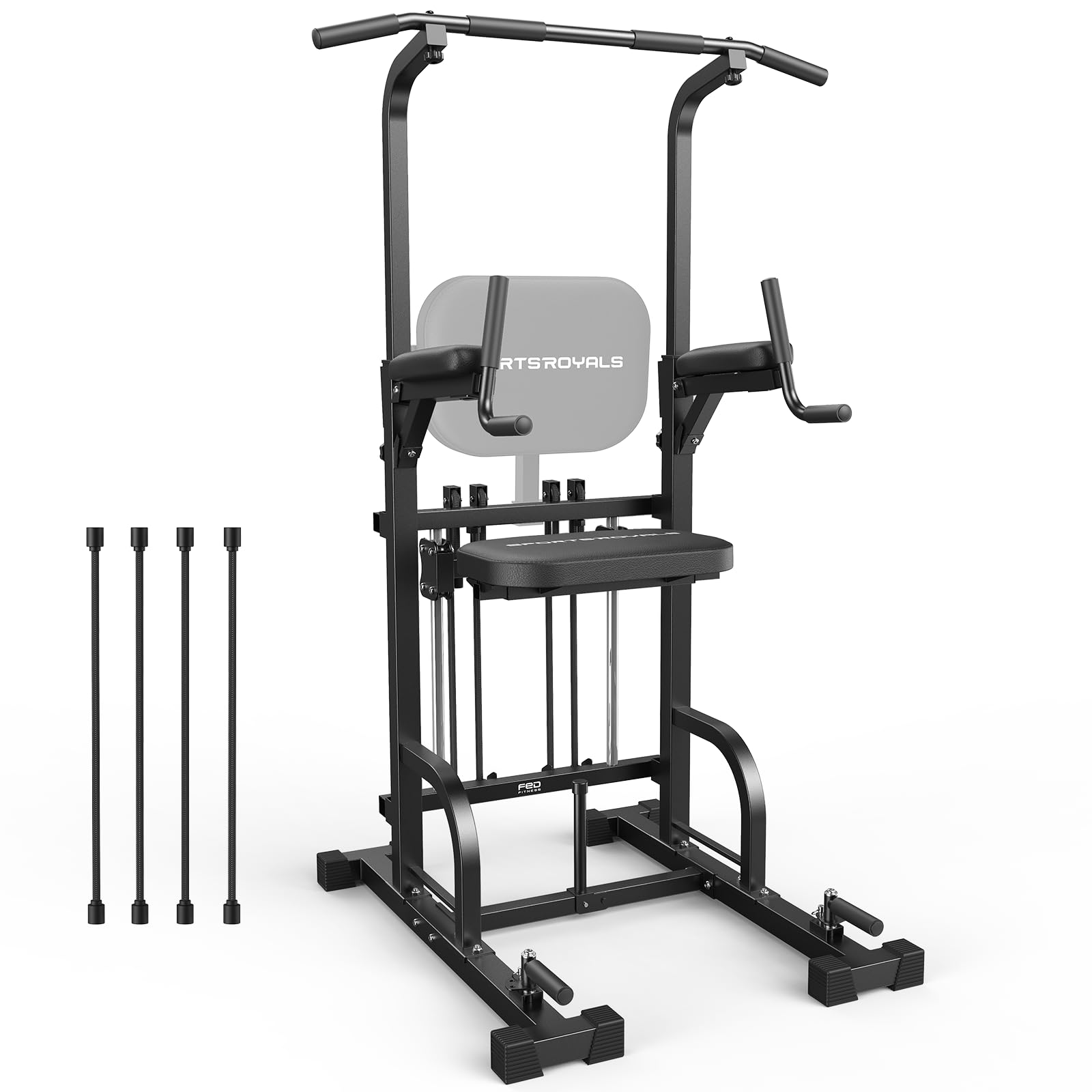
The 440-lb rating and 63-lb frame are why this tower feels planted instead of shaky — buyers report it holds rock steady even at 185 lbs and 255 lbs, with no tipping and solid dips. The 39.7-inch H-shaped base spreads the load across eight non-slip rubber feet, so you can push hard through your dips without worrying about the frame rocking. Quality and sturdiness are the two most-praised aspects of this model, which is why it holds the “Best Overall” slot here.
The 2-in-1 assisted pad is the headline feature: unfold it for pull-up assistance, then fold it into a backrest that helps correct your posture. Height adjusts across 6 levels, from 64.56″ to 87.01″, so a shorter beginner and a taller family member can both find their spot. The armrests tilt inward at 10 degrees — a small angle that stops your arms from sliding off when you sweat — and the push-up handle rotates 45 degrees for variety. Resistance bands adjust from 22 lbs to 88 lbs, which covers the early strength-building phase well. It gives you more height range than the KINGKANG, which only adjusts from 68.5″ to 83″.
The honest catch is the assembly experience. Owners mention the manual is overcomplicated and hard to follow, with some parts arriving without clear labeling — expect roughly 40 minutes to 1.5 hours depending on your patience, and it helps to pre-sort the bolts. A few owners also mention the assist wheels are jerky rather than silky-smooth, so if you want a buttery, gym-style counterweight feel, this pad-based tower is not that. For a value-focused home tower that multitasks across pull-ups, dips, push-ups, and leg raises, this is the most complete pick.
What owners rave about
- Rock-solid stability at 185–255 lbs with no wobble, thanks to a 440-lb rating and wide 8-point base
- 6-level height adjustment from 64.56″ to 87.01″ fits the whole household
- 2-in-1 pad flips between pull-up assist and a posture-correcting backrest
- 10-degree inward armrest tilt prevents arm slippage mid-set
Where it trips up
- Assembly instructions are overcomplicated and contradict the video for some buyers
- Assist wheels can feel jerky rather than smooth on some units
- No low bar for Australian rows, so you improvise with dip handles
Grab this if: you want one sturdy, well-rounded tower for the whole family that handles pull-ups, dips, and leg raises while staying affordable.
Think twice if: you need a perfectly smooth metal-on-metal counterweight feel, or you expect a painless 15-minute build.
2. GMWD 4-in-1 Leverage Assisted Chin and Dip Machine
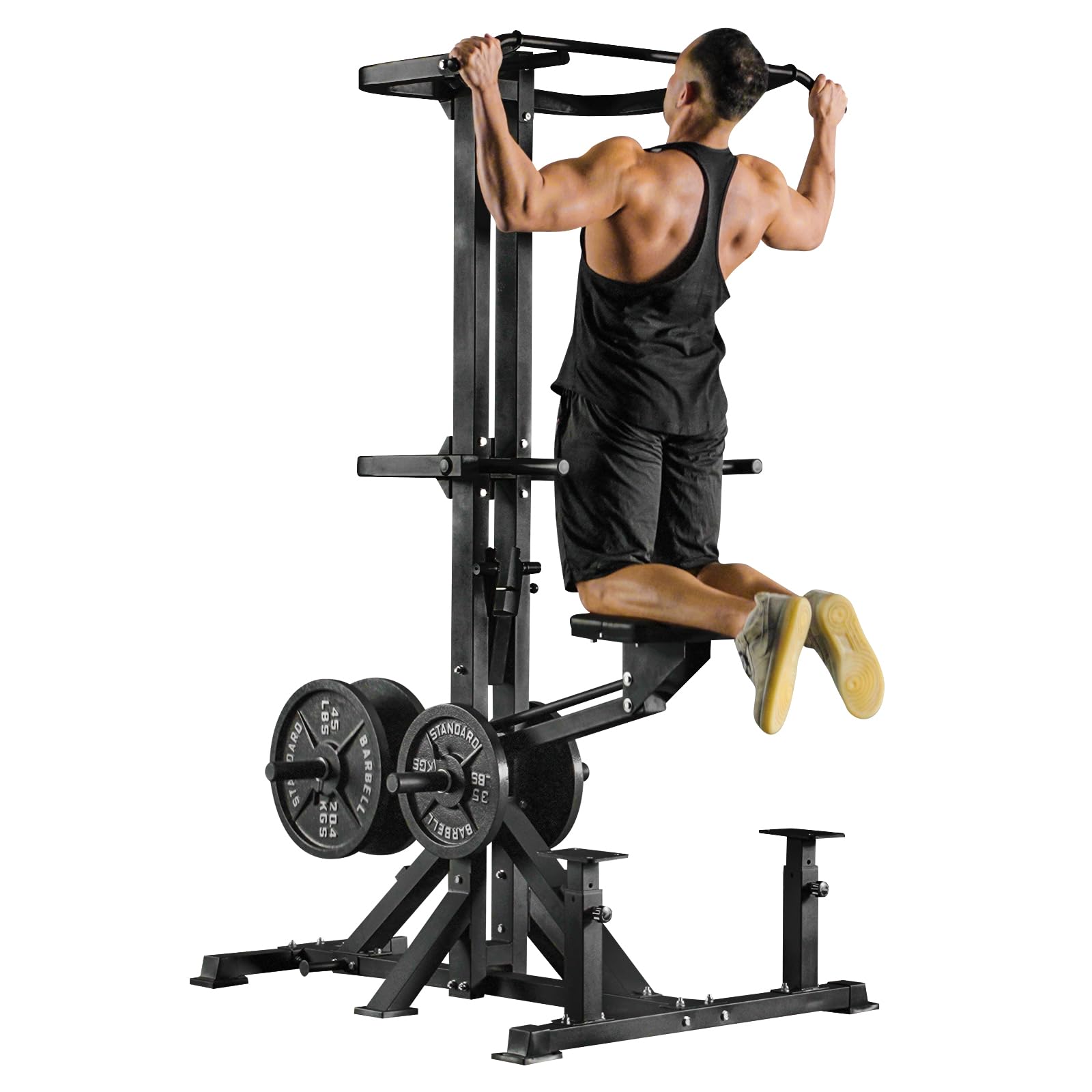
The plate-loaded counterweight machine that turns assisted dips into a long-term strength project.
Precision is why you would pick this over the SPORTSROYALS tower: a 1:1 counterweight system where you load actual weight plates that pull you up at exactly the weight you set — no bands, no jerky pad, just precise, controllable resistance. The 156-pound frame in thick 11-gauge alloy steel is rated for a 600-lb maximum weight recommendation, and the whole build uses six triangular structures to resist wobble. Customers note it held firm on carpet and handled a 6’2″ user comfortably, with one household logging 10,000–12,000 reps over five months without a single issue.
The 4-in-1 design packs a pull-up assist station, a chin station, a dip station, and a core trainer into a compact footprint of 18.54 sq ft — genuinely useful if you are squeezing a full workout corner into a spare room. Each weight holder takes up to 150 lbs, and there is a band peg for adding resistance-band training modes on top of the plate stack. Assembly is the most positively-reviewed part of this product: parts come bagged and labeled, the instructions are clear, and one person can handle the build — though the ~150-lb box realistically wants two people to move it.
The trade-off is space and ceiling height. The machine stands 88.6″ tall and needs 93–95 inches of ceiling clearance, and it spans 44.5″ wide by 60″ deep — noticeably larger than the 27″-wide KINGKANG tower beside it, so it will not suit a tight apartment. A minor assembly hiccup: one reviewer noted a bushing location error in the manual and a missing carriage bolt, and the pivot axles benefit from greasing during the initial build to avoid friction later. This is the highest-investment choice here, but it is the one that grows with you for years rather than months — if you have the room and the budget, the counterweight smoothness is worth it.
Why it wins: the 1:1 counterweight system gives you gym-machine smoothness and accuracy that pad-based towers simply cannot match, and the 600-lb frame rating means it will never feel undersized.
The honest trade-off: it demands 93–95 inches of ceiling clearance and a two-person carry-in, and you will want to grease the pivot axles during assembly.
3. KINGKANG Assistive Power Tower, Dip Station & Pull Up Bar for Home Gym

The lean, space-saving tower whose 70-lb pneumatic assist takes the edge off for lighter users.
A 27-inch width makes this the most apartment-friendly frame in this lineup, and it tops out at 99″ while adjusting through 6 gears between 68.5″ and 83″ — so it fits under lower ceilings that the GMWD cannot, since that machine needs 93–95 inches. The assist comes from a pneumatic rod and wheel system rated at 70 lbs (a pneumatic assist uses air pressure to help push you up), which reviewers point out is safer and smoother than a rope-based setup for beginners working on pull-ups and dips. The 66-pound carbon steel frame carries a 450-pound maximum weight recommendation, and the scratch-resistant coating keeps it looking clean through daily use.
Functionality is the most consistently praised trait — the multi-grip pull-up bar, dip bars, and ab back pad cover the basics well, and the narrow width is actually ideal for leg raises. Height and hand-position both adjust, so shorter and average-size adults can find a comfortable setting quickly. That is the key fit note: shoppers say it feels great for average-size adults and under, and stable when you install all 12 bolts and caps in the right order, but it can feel flimsy for users over 200 lbs, and the assist is not built for heavy training loads — unlike the SPORTSROYALS, which buyers report holds steady at 255 lbs.
The catch is in the details. The arm cushions are the recurring gripe — owners mention the stitching can rip, especially for shorter users who bear down on them, and the machine may want a couple of weight plates on the base to stop it shifting during movement. Assembly instructions are absent or weak, and the quality is honestly mixed: some find it sturdy and well-built, others read it as a budget-grade frame. This is a capable starter tower for lighter users and smaller spaces, not a heavy-duty anchor for big lifters.
The fit call: buy this for a compact home gym serving average-size adults and beginners who want a gentle, safe 70-lb assist.
Look elsewhere if: you weigh over 200 lbs, hate fiddly assembly without instructions, or plan to load serious weight onto the frame.
Understanding the Specs
Counterweight System vs. Assisted Pad
How the machine lightens your body weight is the single biggest quality difference. A plate-loaded counterweight machine (like the GMWD) uses a 1:1 ratio — load 50 lbs of plates and exactly 50 lbs of your body weight is pulled up, giving you precise, smooth resistance you can track rep to rep. A pad-based power tower uses a cushioned platform or a resistance band instead — simpler and cheaper, but the assist can feel jerky and less consistent, and you cannot dial in an exact number as easily.
Frame Weight and Max Weight Rating
Stability is physics: a heavier frame with a higher maximum weight recommendation simply moves less when you do. The GMWD brings a 156-lb frame rated to 600 lbs, the KINGKANG a 66-lb frame rated to 450 lbs, and the SPORTSROYALS a 63-lb frame rated to 440 lbs. A wide base multiplies this — an H-shaped base with rubber feet resists tipping far better than a narrow one, especially when you swing during pull-ups.
FAQ
How much ceiling height do I need for an assisted dip machine?
Will an assisted dip machine hold my body weight?
What is the difference between a pad-based tower and a counterweight machine?
How much floor space does an assisted dip machine take?
Can I do exercises other than dips and pull-ups on these machines?
How hard is assembly for these machines?
Is a 70-lb assist enough for a complete beginner?
Will these machines wobble during pull-ups?
How do I know which assisted dip machine is right for me?
Final Thoughts: The Verdict
For most people, the assisted dip machine winner is the SPORTSROYALS Power Tower because it delivers rock-solid 440-lb-rated stability, 6-level height adjustment, and a 2-in-1 assisted pad at a value that the crowd — nearly 18,000 owners strong — keeps endorsing. If you want the precision of a true counterweight system and have the ceiling height to spare, grab the GMWD 4-in-1. And for a small apartment or a lighter beginner, the KINGKANG is the one to reach for.
How We Picked
We do not accept paid placement. Every pick is matched to a real buyer and a real use-case; we do not hands-on test units.
Sources & Methodology
Specifications: manufacturer listings and product documentation. Review insights: verified customer reviews, as of August 2026. Pricing: not shown on this page (it changes often); check the current price via the retailer link.
As an Amazon Associate, Gadgets Feed earns from qualifying purchases. This does not affect which products we feature.