
A pull-up is the ultimate upper-body litmus test, but for many, gravity wins the battle before the fight even starts. The gap between wanting a strong back and actually grinding out a strict rep is enormous, and that’s exactly where an assisted pull up machine bridges the divide. These aren’t just glorified bars—they’re counterbalance systems, leverage platforms, and multi-station home gyms designed to let you build lat, bicep, and core strength without cheating your way through a half-rep.
I’m Min — the co-founder and writer behind Gadgets Feed. I’ve spent hundreds of hours digging into the engineering, load ratings, and real-world user reports across this specific fitness niche to separate machines that actually counterbalance from towers that just hold a bar.
Whether you’re a beginner chasing the first unassisted rep or an intermediate lifter refining form under load, the best assisted pull up machine must deliver a stable platform, adjustable resistance, and a footprint that fits your space without wobbling through a single rep.
How To Choose The Best Assisted Pull Up Machine
An assisted pull up machine is not a basic power tower with a knee pad. The real engineering difference lies in how it offloads your body weight. Some use a counterbalance weight arm with plate-loaded resistance, others use heavy elastic bands, and the most sophisticated models integrate a selectorized weight stack for instant adjustments mid-set. Your choice depends on how precisely you want to manage progressive overload and how much floor space you can dedicate to a single-purpose or multi-purpose station.
Counterbalance Mechanisms: Weight Arm vs Bands vs Stack
A dedicated lever arm with weight horns lets you load iron plates that physically pull the assist pad downward, directly reducing the weight you have to lift. This is the smoothest, most linear form of assistance. Resistance band systems, found on some power towers like the Sportsroyals, use elastic bands that increase tension as they stretch—meaning the hardest part of the pull-up (the bottom) gets the least help, which is biomechanically inverted from what most users need. Weight stack machines like the ROBORE home gym eliminate plate handling entirely, giving you pin-selectable resistance from 10 to 160 lbs for instant dropsets, but they come with a much larger footprint and a higher price floor.
Base Stability and Frame Construction
When you’re pulling down against a counterbalance, the entire machine wants to tip toward you if the base isn’t wide enough or heavy enough. Look for an H-shaped base with at least 39 inches of length, steel tubing thickness of 2mm or more, and a total machine weight above 60 pounds for band-assist towers, or above 200 pounds for weight-stack units. Thinner 1.5mm tubing on budget models transmits wobble into your grip, which kills lat engagement and makes you fight the machine instead of your own muscles.
Ergonomic Fit: Pad Height, Grip Width, and User Height
The assisted pull up machine must match your torso length, not just your overall height. The knee or shin pad should adjust through a range that places your knees at a 90-degree bend when you’re in a dead hang—any higher and you lose lat stretch, any lower and the pad doesn’t catch your weight. Grip options should include wide overhand, neutral (palms facing each other), and close underhand to target different back and bicep fibers. Tall users over 6 feet need a top bar height of at least 85 inches to avoid knees hitting the floor on a full extension.
Quick Comparison
On smaller screens, swipe sideways to see the full table.
| Model | Category | Best For | Key Spec | Amazon |
|---|---|---|---|---|
| PowerTec Levergym | Premium | True counterbalance training | 400 lbs max load / weight arm | Amazon |
| Sportsroyals Assist Tower | Mid-Range | Band-assisted versatility | 88 lbs max band resistance | Amazon |
| ROBORE Home Gym | Premium | All-in-one cable training | 160 lb weight stack | Amazon |
| JOROTO Foldable Tower | Mid-Range | Space-saving power tower | 450 lbs capacity / 2mm steel | Amazon |
| Pooboo Power Tower | Mid-Range | Adjustable incline bench included | 440 lbs / 11-level height | Amazon |
| GOIMU LS01 Lat Tower | Mid-Range | 3-in-1 pulley system | 730 lbs frame capacity | Amazon |
| K KINGKANG Assist Tower | Mid-Range | Pneumatic rod assisted system | 70 lbs assist / 6-level height | Amazon |
| DONIUZ Power Tower | Budget-Friendly | High capacity dip station | 660 lbs / 2mm steel | Amazon |
| ONETWOFIT Pull Up Station | Budget-Friendly | Entry-level adjustable height | 440 lbs / 8-level height | Amazon |
In‑Depth Reviews
1. PowerTec Levergym Assisted Chin Up Bar and Dip Station

This is the gold standard of what an assisted pull up machine should be: a dedicated counterbalance system with a loaded weight arm that physically reduces how much body weight you lift. The lever arm lets you load iron plates on the weight horns, creating a smooth, linear reduction in resistance through the entire range of motion—no elastic band preload, no jerky catch at the bottom. The frame is built from thick alloy steel and supports a maximum user load of 400 lbs, with a five-year warranty on the moving frame that backs the engineering.
The adjustable knee pad and multi-position grip handles let you switch between wide pull-ups, neutral-grip chin-ups, and dip movements without leaving the station. At 270 lbs user-reported stability, the Levergym absorbs heavy counterweight loads without rocking, and the machine’s 57.5-inch width gives enough lateral space for comfortable shoulder position during dips and wide-grip work. Assembly takes about three hours solo, but the YouTube guide from PowerTec clarifies the process significantly.
The trade-off is footprint and price—this machine occupies a 57.5 x 81.7-inch floor area and sits at the top of the price spectrum. The included components cover the L-CDA+19 package, but you’ll need your own Olympic plates to load the weight arm. For anyone serious about progressive overload, assisted form, and eventual unassisted pull-ups, the PowerTec is a lifetime purchase that mimics the feel of a commercial gym counterbalance station without the club membership.
Why it’s great
- True plate-loaded counterbalance provides the smoothest, most linear assistance through the entire pull-up range
- Sturdy 400 lb max load frame with five-year warranty on moving components
- Multi-grip handles and dip bars for full upper-body training without accessory purchases
Good to know
- Requires a large 57.5 x 81.7-inch footprint, not suitable for small apartments
- Assembly is involved at roughly three hours and requires a helper for the weight arm install
- You must buy separate Olympic weight plates as the machine ships without them
2. Sportsroyals Power Tower Pull Up Bar Station
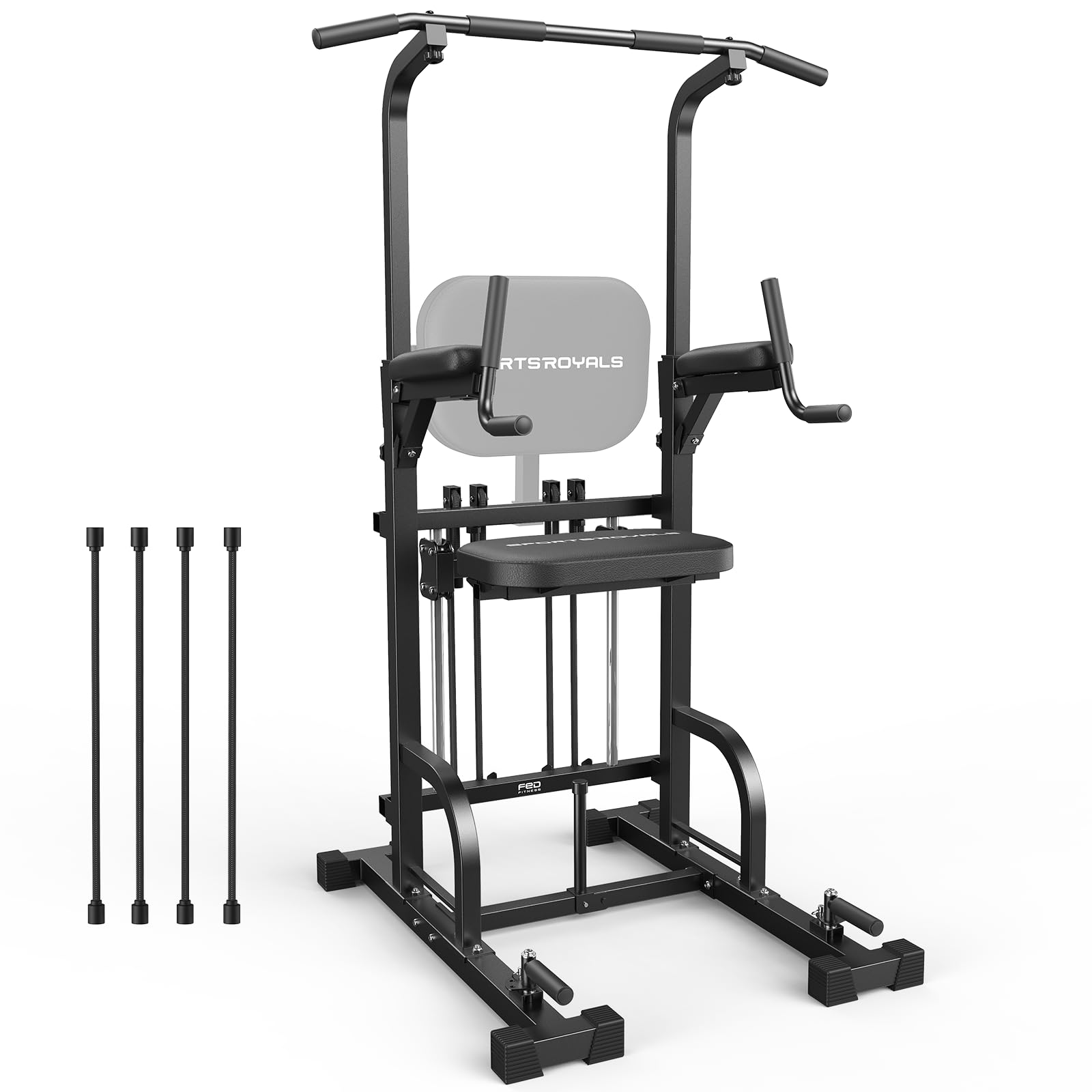
The Sportsroyals assisted power tower uses four heavy-duty resistance bands that collectively provide up to 88 lbs of assistance, with each band adding roughly 22 lbs of force. This elastic system creates a rising tension curve—the bands pull hardest at the top of the movement and least at the bottom—which makes it ideal for beginners who need help locking out the top half but still want a challenge on the initial pull from a dead hang. The 2mm commercial steel tubing and 39.7-inch H-shaped base with eight rubber contact points deliver stability that supports users up to 440 lbs without the frame walking during intense sets.
The 6-level height adjustment on the top bar ranges from 64.56 to 87.01 inches, accommodating users from 5’1” to over 6’5”. The arm pads are angled inward at 10 degrees to prevent slipping when you’re sweating through high-rep assisted dips, and the thick foam cushions distribute pressure evenly across the elbows. The backrest folds into an assisted pad for pull-ups or extends as a support for leg raises and core work, giving you a 2-in-1 function that adapts mid-workout without tools.
Assembly time runs about one hour with a friend, and the overcomplicated manual is offset by a clear video walkthrough. Some users report a slight creak from the top pull-up bar at higher body weights (225+ lbs), but the frame itself does not show dangerous flex. The resistance bands feel accurate for their stated 22 lb increments, though the seat position is better suited for assist on pull-ups than for band-assisted dips. At this mid-range price, the Sportsroyals delivers the best balance of band-assist range, user height accommodation, and multi-exercise functionality in a single station.
Why it’s great
- 88 lbs of band assistance in 22 lb increments covers most beginner to early-intermediate strength levels
- Ergonomic 10-degree inward arm pads prevent elbow slip during sweaty dip sessions
- Adjustable height range from 64.56 to 87.01 inches fits the entire family from kids to tall adults
Good to know
- Elastic assistance is inverse to biomechanical need—least help at the weakest bottom position
- Top pull-up bar may creak under users exceeding 225 lbs over time
- Band seat position is optimized for pull-ups but feels off for assisted dips
3. ROBORE Home Gym System with 160LB Weight Stack

The ROBORE home gym takes a completely different approach to assisted pull-up training by integrating a 160 lb selectorized weight stack into a full-body cable station. Instead of a knee pad with bands or a lever arm, you use the high pulley with the lat bar for pulldowns that work your entire back and biceps, while the low pulley handles seated rows, triceps pressdowns, and preacher curls. The weight stack uses a pin system that lets you adjust resistance in small increments instantly—perfect for progressive overload without loading plates between sets.
The frame is built from alloy steel with a guarded weight stack, non-slip base, and smooth cable movement that handles repeated daily use. The multi-position pulley system (high, mid, and low) opens up over 15 exercise options, including chest press, pec fly, seated cable ab crunch, and leg extensions. The adjustable seat moves through three heights, accommodating users from 5’2” to 6’4”, and the removable preacher curl pad helps isolate biceps without loading your lower back. Despite the 66 x 38-inch footprint, this machine consolidates what would normally require a power rack, cable crossover, and lat pulldown station into one compact unit.
The trade-off is that this is not a pure assisted pull-up machine—it replaces the counterbalance feel with lat pulldowns, which train the same movement pattern but don’t engage your stabilizers through a full-body hang. Assembly instructions are vague, and the cable system developed slack after two months for some users, though customer service responded with free replacements. At this mid-range price for a full weight-stack gym, the ROBORE is an outstanding value if your primary goal is a versatile home gym that includes back and arm work, but pure pull-up specialists should look at the PowerTec or Sportsroyals.
Why it’s great
- 160 lb selectorized weight stack allows instant resistance changes without plate handling
- Three pulley positions provide over 15 exercises including lat pulldowns, rows, and chest press
- Compact 66 x 38-inch footprint replaces multiple machines in a home gym
Good to know
- Uses cable pulldowns rather than body-weight counterbalance, altering the stabilizer engagement
- Assembly instructions are vague and some hardware pack variances reported
- Cable slack developed after two months for some units, requiring customer support contact
4. JOROTO Foldable Pull Up Dip Station
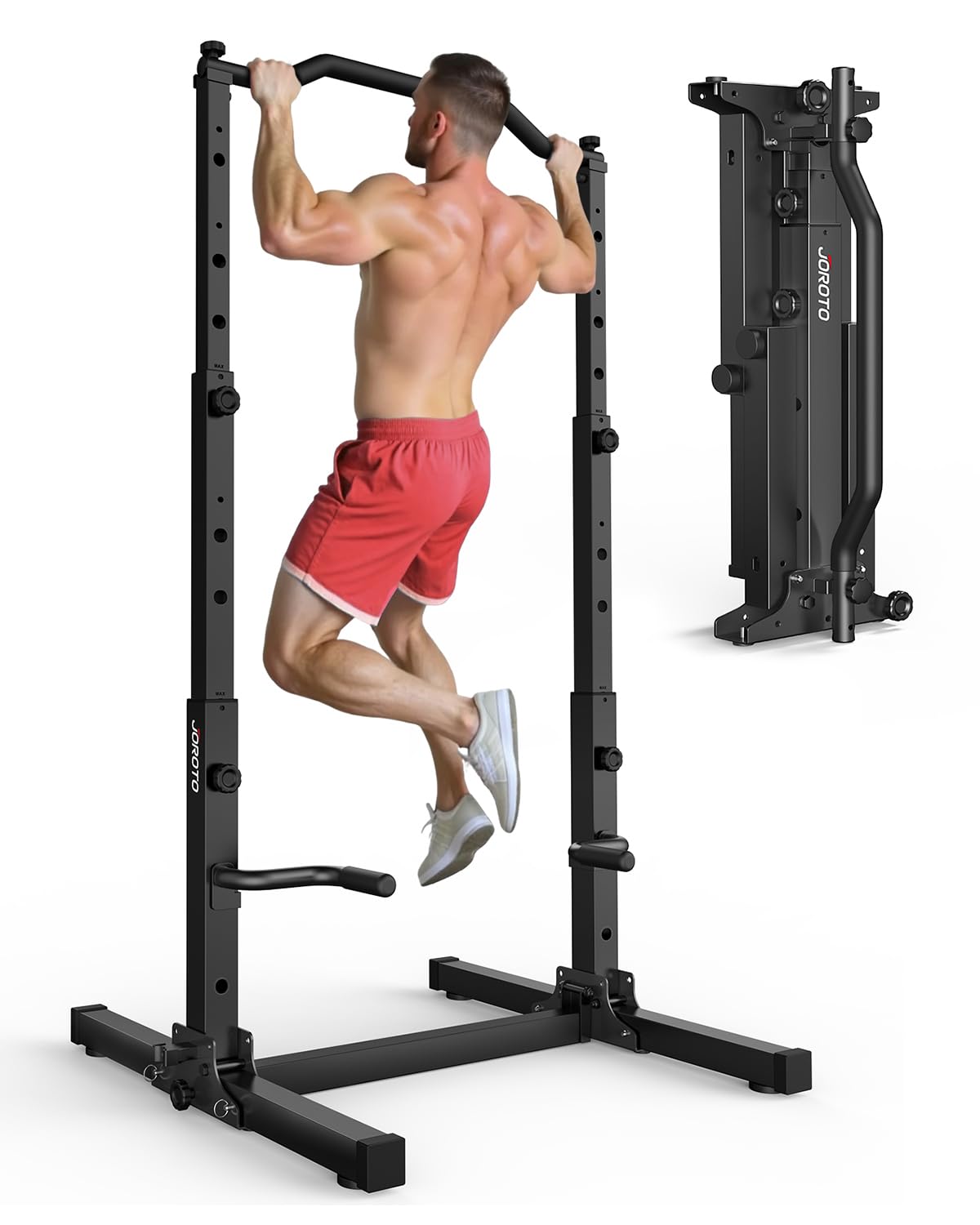
The JOROTO foldable power tower addresses the single biggest pain point of a dedicated pull-up station: floor space. After your workout, the base folds into a 41.5-inch profile that leans against a wall or slides under a bed, transforming from a full 44 x 41-inch footprint to a storage-friendly unit in under two minutes. Despite the collapsible mechanism, JOROTO constructed this from 2mm thickened steel tubing with a total weight of 65 pounds, supporting a 450 lb capacity without the frame wobbling during pull-ups, dips, or vertical knee raises.
The top pull-up bar offers 4 adjustable height levels ranging from 40.4 to 82.8 inches, while the parallel dip bars have 7 separate height settings. A built-in lower bar accommodates children or shorter users who need a lower starting point. The base includes adjustable leveling knobs that you turn after installation to eliminate any rocking on uneven floors—a detail that separates stable towers from frustrating ones. Users at 6 feet tall report they must bend their knees slightly on pull-ups, so the 82.8-inch max height is best for users under 6’2” who want a dead hang.
Setup is straightforward with the included tools, and the 24-month warranty from JOROTO adds confidence for a foldable mechanism that sees daily articulation. The dip bars feel solid, and the integrated push-up handles at the base expand the exercise variety. The foldable joint is the most mechanically stressed part—JOROTO uses a heavy-duty hinge with locking pins that have held up in early reviews, but long-term durability of the folding mechanism is the key variable. For apartment dwellers and garage gym users who hide their equipment between sessions, this is the most space-conscious mid-range option available.
Why it’s great
- Folds to 41.5 inches for easy storage under a bed or against a wall between workouts
- 2mm thickened steel and 65 lb total weight deliver stability rivaling non-foldable towers
- Adjustable base leveling knobs eliminate rocking on uneven garage or basement floors
Good to know
- Max bar height of 82.8 inches forces users over 6 feet to bend knees on pull-ups
- Folding mechanism hinge may show wear over years of daily articulation
- Adjusting height settings is slightly awkward when done solo without a second person
5. Pooboo Power Tower Dip Station with Incline Bench
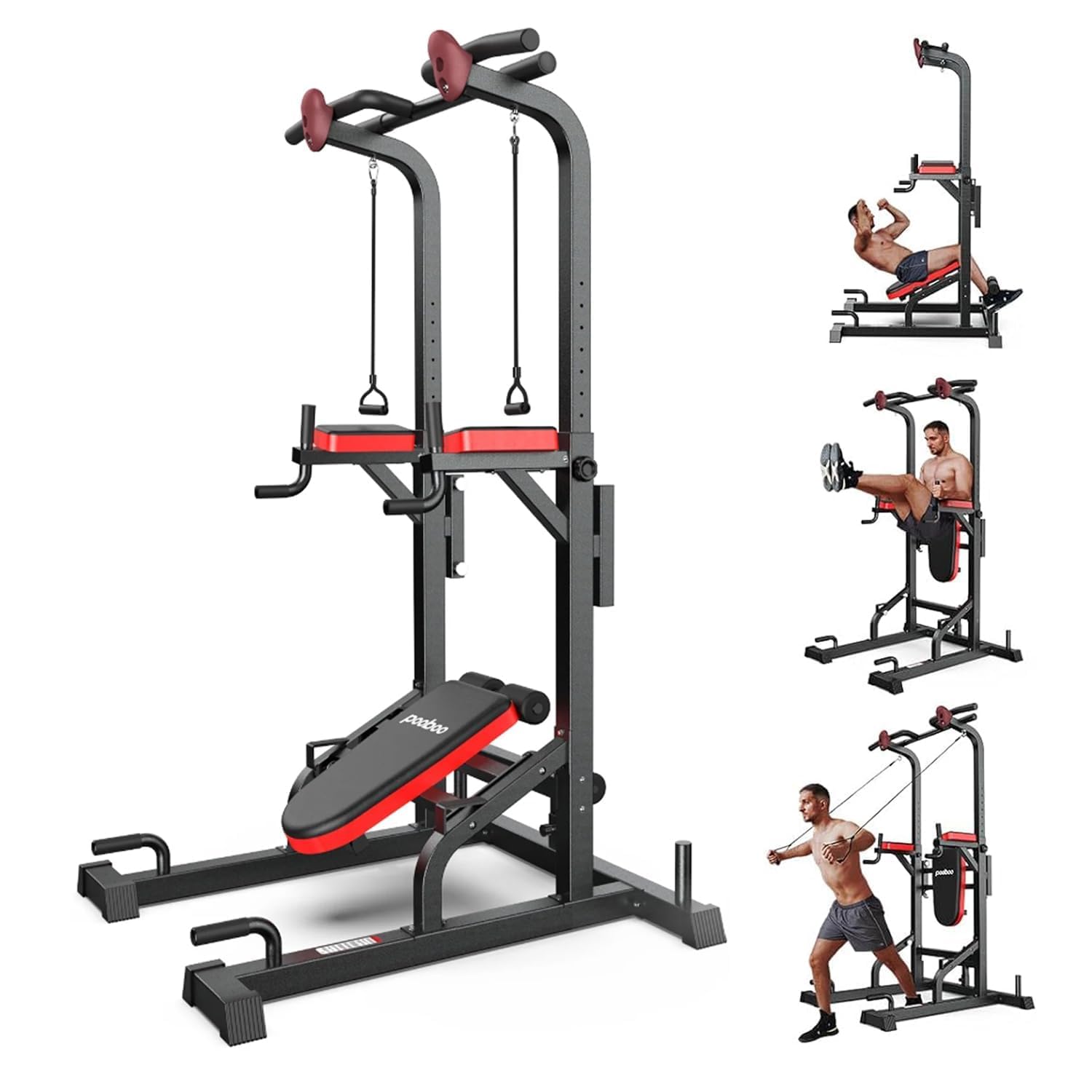
The Pooboo power tower distinguishes itself in the crowded mid-range by including a detachable, foldable incline bench that adds chest pressing, dumbbell rows, and ab work to the standard pull-up and dip routine. The 11-level height adjustment on the pull-up bar spans 71.4 to 94.4 inches—one of the tallest ranges at this price point, covering children at the lowest setting and users over 6’5” at the highest. The H-shaped base measures 41.73 inches in length with four wider anti-slip foot covers and a safety locknut system that keeps bolts tensioned even under vibration from dynamic movements.
Pooboo uses heavy alloy steel with a rock-climbing textured grip on the pull-up handles, which provides tactile feedback and prevents hand slippage without chalk. The 440 lb maximum weight recommendation is supported by user reports of daily use over several months without the frame loosening or developing squeaks. Assembly takes around 20 minutes with the clearly labeled parts and included tools, which is notably faster than most multi-function towers. The elastic ropes included in the package are a bonus for burnout finisher sets or band-assisted pull-ups at lower resistance levels.
The incline bench is a generous 24 x 12.5 x 22 inches with ergonomic contouring, though the pad is not as thick as a standalone weight bench. The bench folds flat against the tower when not in use, maintaining the compact storage profile. Users consistently praise the dual gas strut system that makes adjusting the bench angle smooth and tool-free. For someone building a home gym on a budget who wants a power tower plus a bench press option, the Pooboo delivers two functional stations in the floor space of one.
Why it’s great
- Detachable foldable incline bench adds chest press and ab work without extra equipment
- 94.4 inch max bar height accommodates the tallest users with room for a full dead hang
- Fast 20-minute assembly with labeled parts is the quickest in its category
Good to know
- Incline bench pad is thinner than dedicated weight benches, less comfortable for heavy pressing
- Safety locknut system requires a socket wrench to adjust; hand tools included may strip
- Elastic ropes are low resistance and best suited for light burnout work, not primary assistance
6. GOIMU LS01 LAT Pulldown Machine
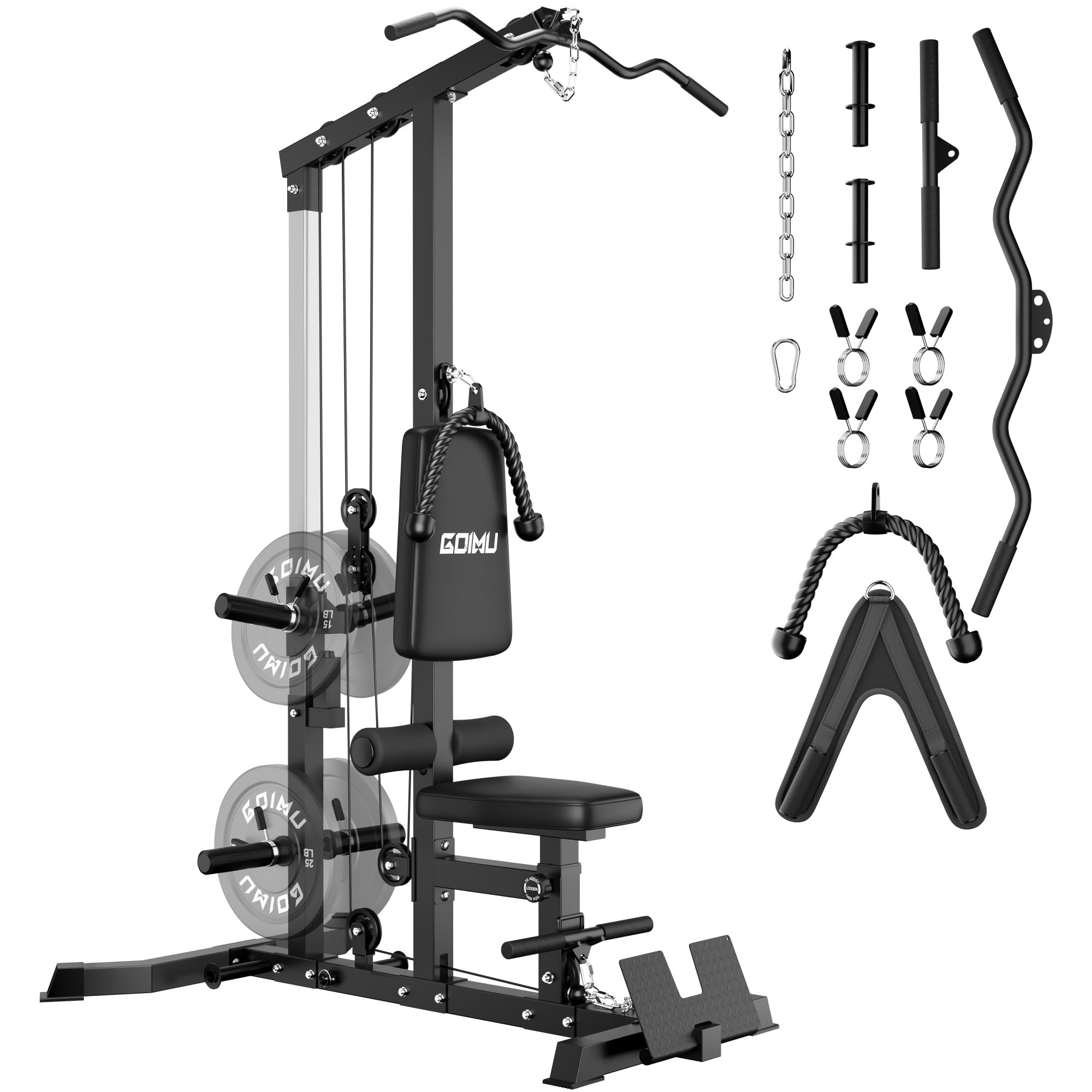
The GOIMU LS01 is not a power tower—it’s a dedicated lat pulldown and cable row station that occupies just 3.12 square feet of floor space. The steel frame is built from 2mm thick tubing with a bold 730 lb weight capacity, though the plastic pulleys and cable system are realistically comfortable up to about 200 lbs of loaded resistance. The 3-in-1 pulley setup includes high, mid, and low anchor points, giving you lat pulldowns, seated rows, triceps pressdowns, and an ab crunch station all from the same upright frame.
Ergonomically, the seat adjusts to three heights that work for users from 5’2” to 6’4”, and the leg hold-down secures you in place for heavy rows. The included attachments—lat bar, cable bar, tricep rope, ab crunch strap, and two band pegs—cover most upper-body pulling movements without requiring additional purchases. The detachable weight sleeve accepts both 1-inch and 2-inch Olympic plates, so you can use whatever iron you already own, and the integrated weight storage keeps plates off the floor.
The critical trade-off is range of motion: the total cable pull length is about 5 feet, which means lat pulldowns reach the stops before full stretch for users over 6 feet tall. Straight-arm pulldowns, which require a longer cable arc, are essentially impossible for tall athletes. The front leg/foot pedal is also a clunky trip hazard in small spaces. But at this mid-range price for a dedicated cable tower with plate compatibility, the LS01 is a space-saving powerhouse for lifters who prioritize lat width and back thickness over the body-weight counterbalance experience.
Why it’s great
- Ultra-compact 3.12 sq ft footprint fits in apartment corners and small home gyms
- Three pulley anchor points (high, mid, low) support a full back and arm workout routine
- Detachable weight sleeve accepts both standard 1-inch and Olympic 2-inch plates
Good to know
- 5-foot cable pull length limits full range of motion for users over 6 feet tall
- Plastic pulleys are smooth but not built for sustained heavy loading above 200 lbs
- Front foot pedal protrudes and can be a trip hazard in tight workout spaces
7. K KINGKANG Pull Ups Dip Station

The K KINGKANG uses a pneumatic rod system instead of elastic bands or a counterweight arm to provide up to 70 lbs of assisted pull-up resistance. The pneumatic cylinder delivers a consistent, non-linear assist that is less rubber-band-like and more gas-spring-like—meaning the assistance is present from the bottom of the pull and does not spike at the top the way elastic bands do. The tilting station uses wheels and pneumatic rods for a safer, smoother adjustment than rope-based systems, and the unit folds away when not in use.
The carbon steel frame is coated with a scratch-resistant finish and supports a maximum user weight of 450 lbs. The height adjusts through 6 gear positions from 68.5 to 83 inches, and the hand position has 4 adjustable lengths for different grip widths. The elbow pad uses high-density foam that reduces pressure on the triceps during dips and provides a comfortable platform for ab crunch work. The detachable cushion can be set flat for floor exercises, adding push-up and plank support to the machine’s repertoire.
The major limitation is base width: the frame is only 26 inches wide, which makes it space-saving but less stable for larger users over 200 lbs unless all bolts are torqued in the correct right-to-left sequence during assembly. Reviewers at 6 feet tall note the backrest feels short and unstable during pull-ups, which reduces its utility as a pure pull-up trainer for taller athletes. For smaller to average-sized users (under 6 feet, under 200 lbs), the pneumatic assist and compact footprint make this a unique alternative to band-based systems at a mid-range entry point.
Why it’s great
- Pneumatic rod system provides smoother, more consistent assistance than elastic bands
- Compact 26-inch wide frame is one of the narrowest assisted towers for tight spaces
- Folding tilting station with wheels makes moving and storing the unit simple
Good to know
- Narrow 26-inch base feels unstable for users over 200 lbs without perfect bolt torque sequence
- Backrest is too short for comfortable pull-up support for users 6 feet tall or taller
- Pneumatic rod assist is capped at 70 lbs, not enough for heavier beginners needing more offload
8. DONIUZ Power Tower Pull Up Bar and Dip Station
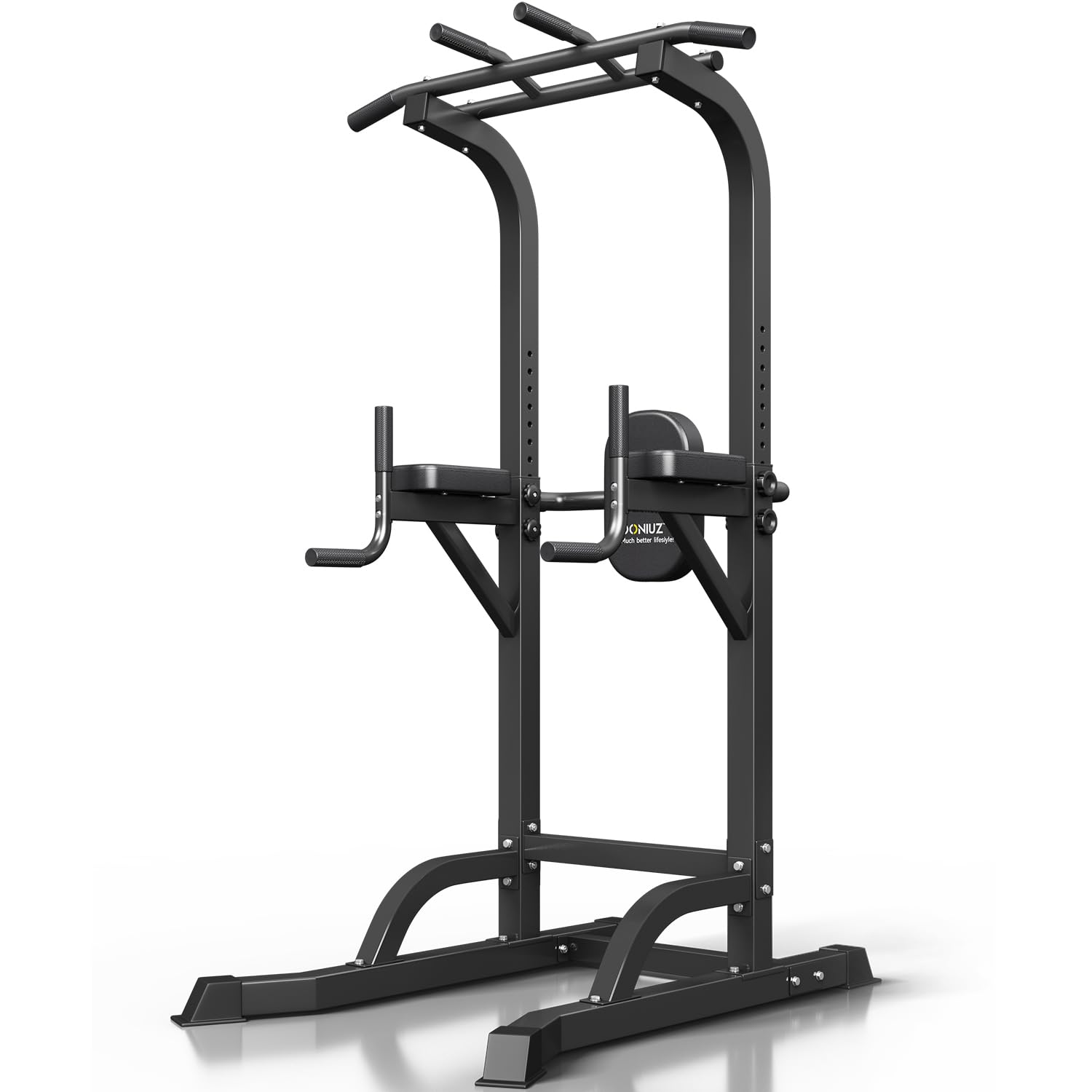
The DONIUZ power tower is a budget-friendly entry point that punches above its price tier with a 660 lb weight capacity—the highest absolute load rating among all the products in this guide. The 2mm thickened premium steel tubing resists corrosion and provides a rigid frame that, at 65 pounds total weight, sits confidently on the floor. The height adjusts from 74.8 to 87 inches through a multi-gear regulation system that clicks into place without tools, making it easy for multiple household users to switch settings quickly.
The ergonomic design includes a stable backrest and elbow pads that reduce shoulder strain during dips and knee raises. The multiple handles on the pull-up frame allow wide, close, and neutral grip variations, targeting different back and bicep regions. The suction cup feet at the base require installation on flat concrete or hard flooring—carpeted surfaces reduce stability because the suction can’t seal, which is a critical installation detail that some users miss. Assembly is straightforward with the provided tools and manual, though the instructions could benefit from clearer torque recommendations.
Stability during swinging pull-ups is the weakest point: at 180 lbs, taller users report the tower feels slightly unstable if they kip or use momentum, though it has not tipped in any documented review. This is a power tower best used for slow, controlled reps rather than dynamic CrossFit-style movements. The armrest padding is comfortable for extended dip sets, and the compact 32 x 41-inch footprint fits in dorm rooms and small apartments. For a budget buy that prioritizes raw weight capacity over stability under dynamic load, the DONIUZ delivers tremendous value for controlled strength training.
Why it’s great
- 660 lb max load rating is the highest of any unit tested, supporting users of all sizes
- 2mm corrosion-resistant steel tubing provides durability that competes with mid-range towers
- Tool-free multi-gear height adjustment is quick and intuitive for family sharing
Good to know
- Suction cup base requires smooth, hard flooring—carpet eliminates stability and can cause wobble
- Feels less stable during kipping or momentum-based pull-ups; best for controlled slow reps
- Some taller users report the arm pads are positioned slightly narrow for wider shoulders
9. ONETWOFIT Pull Up Station Power Tower
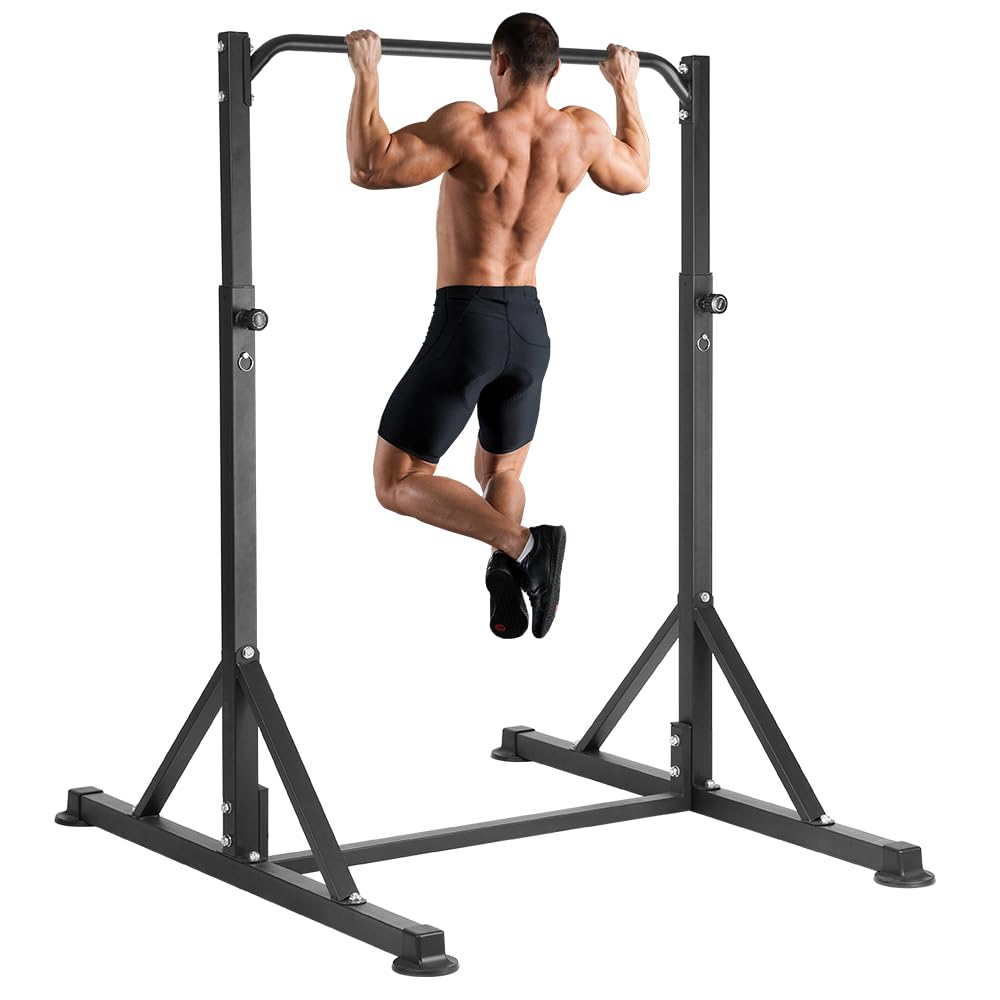
The ONETWOFIT pull up station is the most straightforward, no-frills entry in this guide—a free-standing power tower with 8 height adjustment levels from 76 to 92 inches, built from 1.5mm thickened steel tubing with a 440 lb capacity. The frame uses a reinforced triangular base with four non-slip foot pads that grip the floor during controlled movements, and the extra-wide 39.1-inch frame provides ample shoulder clearance for wide-grip pull-ups without bumping your legs against the uprights. This is a pure, unassisted power tower—there is no band assist, no counterweight arm—just a stable platform for bodyweight pull-ups, chin-ups, and knee raises.
Assembly requires a ratchet set (the included wrench tends to strip under torque) and takes about 30 minutes. The shipping weight is 45 lbs, making this one of the lighter towers in the guide, which is a double-edged sword: easier to move around your garage but less inherently stable if you generate momentum. Users at 6 feet tall report needing a small jump or a block to reach the tallest bar setting, so the 92-inch max height works best for users up to 5’10” who want a full dead hang. The pull-up bars lack knurling, which means you may want to add chalk or grip tape for sweaty sessions.
Outdoor durability has been confirmed by users leaving the tower exposed for three months without rust, though the alloy steel coating is rated for indoor use primarily. The main structural compromise is the 1.5mm steel thickness—thinner than the 2mm found on the JOROTO or DONIUZ units—which means the frame has more lateral flex during dynamic movements. For someone who just needs a solid, affordable bar to start grinding pull-ups and doesn’t require assist mechanisms or folding storage, the ONETWOFIT is the lowest-cost gateway into consistent upper-body training.
Why it’s great
- 39.1-inch wide frame provides excellent shoulder clearance for wide-grip pull-ups
- 8 height levels from 76 to 92 inches offer a broad adjustment range for different users
- Low shipping weight of 45 lbs makes it easy to reposition around the garage or yard
Good to know
- 1.5mm steel tubing is thinner than the 2mm standard on most mid-range towers, flexing more
- No knurling on pull-up bars requires grip tape or chalk in humid or sweaty conditions
- Included assembly wrench strips easily; a ratchet set is mandatory for proper bolt torque
FAQ
Is it better to use a counterbalance weight arm or resistance bands for assistance?
How much floor space do I need for a stable assisted pull up machine?
Can a lat pulldown machine replace an assisted pull up machine?
What weight of band assistance should I start with if I can’t do one pull-up?
Final Thoughts: The Verdict
For most users, the best assisted pull up machine winner is the PowerTec Levergym because its plate-loaded counterbalance provides the smoothest, most linear assistance curve that directly translates to unassisted pull-up strength. If you want a space-saving solution with band assistance that covers the whole family, the Sportsroyals Power Tower is your pick. And for a full all-in-one weight-stack home gym that works your entire upper body, nothing beats the ROBORE Home Gym System.