
Our readers keep the lights on and my morning glass full of iced black tea. As an Amazon Associate, I earn from qualifying purchases.
Specs are compiled from manufacturer listings and verified buyer reviews and can change over time — please confirm the key details on the product page before buying.
You want to capture the Orion Nebula or the Andromeda Galaxy, but the thought of polar alignment, guiding cameras, and stacking software feels like a second job. Smart telescopes solve that by bundling the camera, the tracking mount, and the processing into one box you control from your phone — you pick a target on a star map, and the scope finds it, tracks it, and stacks the images for you.
I’m Min — the founder and writer behind Gadgets Feed. This guide is built by comparing the manufacturers’ published specifications and the patterns across verified customer reviews, so you get each pick’s real strengths and trade-offs instead of marketing spin.
if you want a grab-and-go companion for a camping trip or a premium station for regular deep-sky sessions, this guide to the astrophotography smart telescope market breaks down four models that automate the hard parts so you can focus on the view.
Quick Picks
- DWARFLAB Dwarf Mini Smart Telescope — Best Overall
- DWARFLAB Dwarf 3 Smart Telescope — Best Value
- ZWO Seestar S30 Pro Smart Telescope — Top Performer
- Vaonis Vespera Pro Smart Telescope — Premium Pick
How To Choose The Best Astrophotography Smart Telescope
Not every smart scope works for every target. Some are built for wide-field nebula shots, others shine on close-up views of the Moon, and a few can handle daytime wildlife too. Here are the three specs that separate a fun gadget from a capable astro-imaging tool.
Field of view vs. focal length
The field of view, measured in degrees, tells you how much sky fits in a single frame. A wider field (around 4.6 degrees) is ideal for big targets like the Milky Way or the Andromeda Galaxy, while a narrower field (under 3 degrees) gives you tighter crops of smaller objects like the Ring Nebula. The focal length (in millimeters) drives that crop — a 160mm lens is a wide-angle for deep space, whereas a longer focal length behaves more like a telephoto.
Mount type: Alt-Az vs. equatorial (EQ) mode
An altazimuth mount moves up/down and left/right, which is simple and fine for bright targets. But for long-exposure deep-sky photography, an equatorial (EQ) mode rotates the scope to follow the Earth’s spin precisely, preventing stars from trailing. If the scope offers both AZ and EQ modes, you get the best of both worlds — quick setup for casual viewing, and EQ for stacking faint nebulae.
App integration and on-board processing
The entire point of a smart telescope is that the app handles alignment, target selection, and image stacking. Look for a built-in star map (also called a sky atlas) so you can tap on M31 and have the scope GOTO it automatically. Cloud processing is a bonus — it means the scope or its companion app stacks and stretches your raw frames on a remote server, so you don’t need a laptop or any computer software.
Quick Comparison
On smaller screens, swipe sideways to see the full table.
| Model | Best For | Weight | Field of View | Mount / Modes | Amazon |
|---|---|---|---|---|---|
| DWARFLAB Dwarf Mini | Ultra-portable deep-sky | 1.85 lb | 2.45 Degrees | Alt-Az + EQ | Amazon |
| DWARFLAB Dwarf 3 | Dual-purpose astro + wildlife | 3 lb | — | Alt-Az | $549.00Amazon |
| ZWO Seestar S30 Pro | Best all-around imager | 3.6 lb | 4.6 Degrees | Alt-Az + EQ | $699.00Amazon |
| Vaonis Vespera Pro | Premium observation station | 11.02 lb | — | Automatic | Amazon |
In‑Depth Reviews
1. DWARFLAB Dwarf Mini Smart Telescope
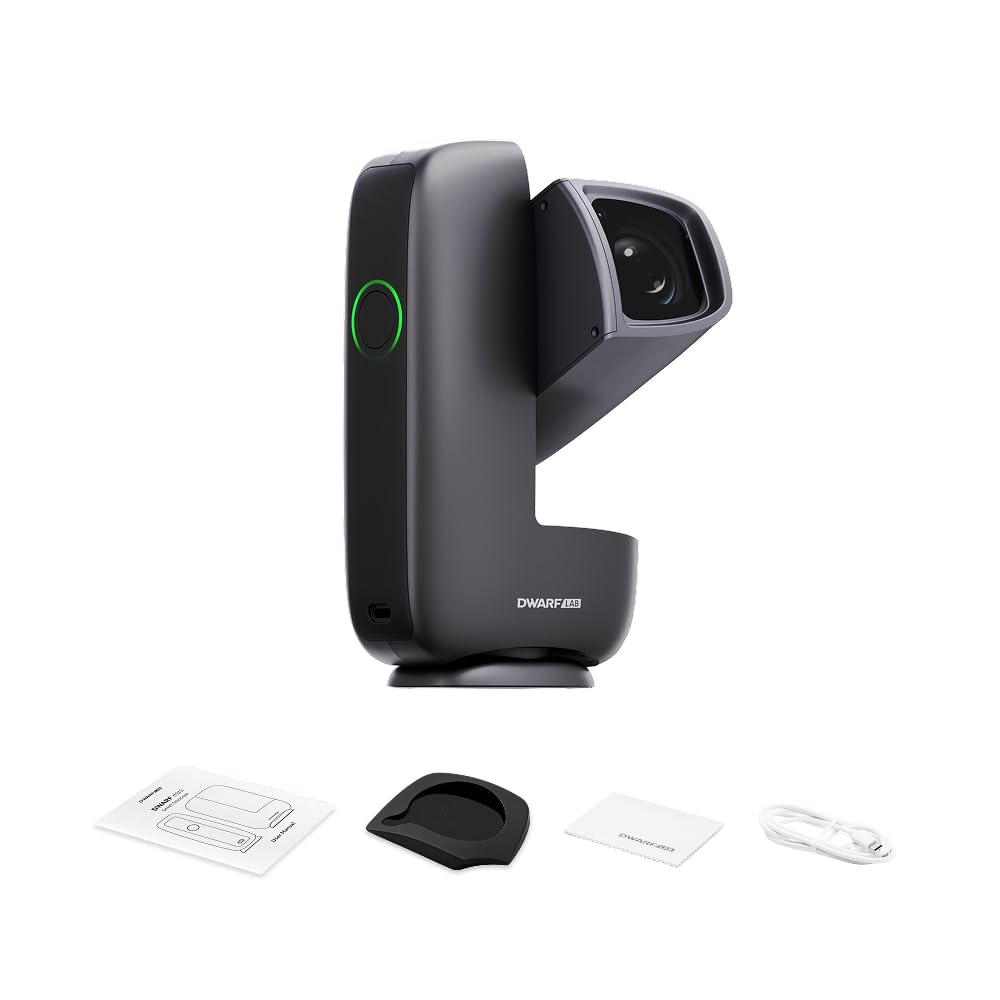
The featherlight 1.85-pounder that brings pro-level EQ mode to a backpack-friendly body.
At 1.85 pounds, this scope is 1.9x lighter than the ZWO Seestar S30 Pro — it slips into a large pocket or backpack, making it the ultimate grab-and-go for dark-sky trips. The all-in-one design houses a high-sensitivity Sony IMX662 sensor (with 2.9µm pixels) that captures low-noise detail on faint nebulas and star clusters. You get both an altazimuth mount for quick setup and an equatorial (EQ) mode for stacking shots with single-frame exposures up to 90 seconds — the kind of capability usually found in rigs twice its size.
Buyers report it is “good for astrophotography of galaxies, nebulas, Moon, and sunspots,” and one reviewer noted the auto target finding via the intuitive app works flawlessly. The trade-off is the field of view measures 2.45 degrees, which is 88% narrower than the Seestar S30 Pro’s 4.6 degrees, so large objects like the Milky Way won’t fit in a single frame. The built-in light pollution filter helps cut through city glow, and the cloud processing means you never touch a computer — just shoot and enhance.
The app has a few counter-intuitive quirks, but owners mention they become easy after a few uses. This pick is for anyone who values portability above all else and wants deep-sky EQ mode without the weight penalty.
Why it wins
- Ultra-light 1.85 lb design fits any backpack.
- EQ mode with up to 90 sec exposures for deep-sky stacking.
- Built-in light pollution filter and cloud processing.
The trade-offs
- Narrower field of view (2.45 degrees) limits large-target framing.
- Not suitable for planetary detail — no close-up power.
- App quirks noted in reviews, though learnable.
Reach for this if: you want the lightest EQ-capable smart scope for hiking and camping.
Look elsewhere if: your priority is a wide field for Milky Way mosaics — the Dwarf Mini’s 2.45-degree view is too tight.
2. DWARFLAB Dwarf 3 Smart Telescope
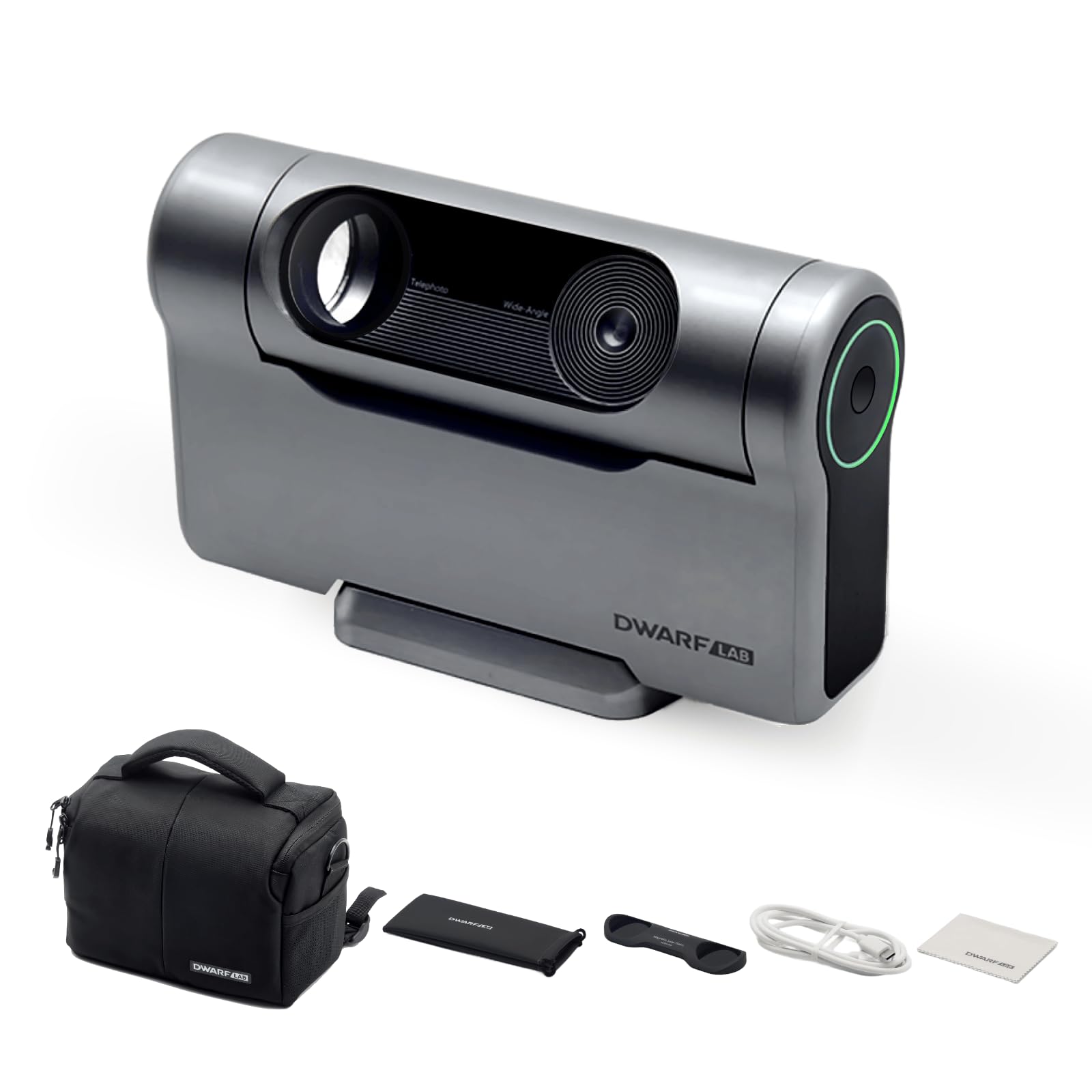
The dual-lens smart scope that photographs both wildlife and the Milky Way without switching kits.
Unlike the Seestar S30 Pro, which focuses purely on astro and daytime telephoto, the Dwarf 3 sports a dedicated dual imaging system: a telephoto lens for deep-space objects and a wide-angle lens for capturing the Milky Way and star trails. Weighing 3 lb, it is lighter than the ZWO Seestar S30 Pro at 3.6 lb, and it’s compact enough for a standard backpack. The 4K auto-tracking follows celestial objects and moving subjects — so you can film a deer in the afternoon and a nebula after dark.
Reviewers report it delivers “excellent astrophotography for size/price: Milky Way, galaxies, nebulae, star clusters,” and one owner noted the app handles denoising and stacking well, even under heavy light pollution. The cloud-powered one-touch processing means you get finished images without a laptop. The catch is the mount is altazimuth only — no equatorial mode — so those 90-second-plus exposures the Dwarf Mini offers in EQ are not available here. That said, for an all-in-one travel companion that doubles as a 4K spotting scope, the Dwarf 3 is tough to beat at its price point.
Buyers recommend the DWARFLAB Mini Tripod for stability, and the added carrying bag and magnetic filters in the box are a welcome bonus. The app can be glitchy with connection drops, but the consensus is that the imaging results justify the occasional reset.
What stands out
- Dual-lens system for astro and terrestrial/wildlife photography.
- 4K auto-tracking for moving subjects and deep-sky objects.
- Carrying bag and filters included; lightweight at 3 lb.
What holds it back
- No EQ mode — limited to Alt-Az tracking only.
- App connectivity glitches reported by multiple users.
- Power loss mid-session can complicate image processing.
Best for: the outdoor enthusiast who wants one compact device for daytime wildlife and night-sky imaging.
skip it if: you require equatorial long-exposure for stacking faint deep-sky objects — the Dwarf Mini is the better EQ choice.
3. ZWO Seestar S30 Pro Smart Telescope
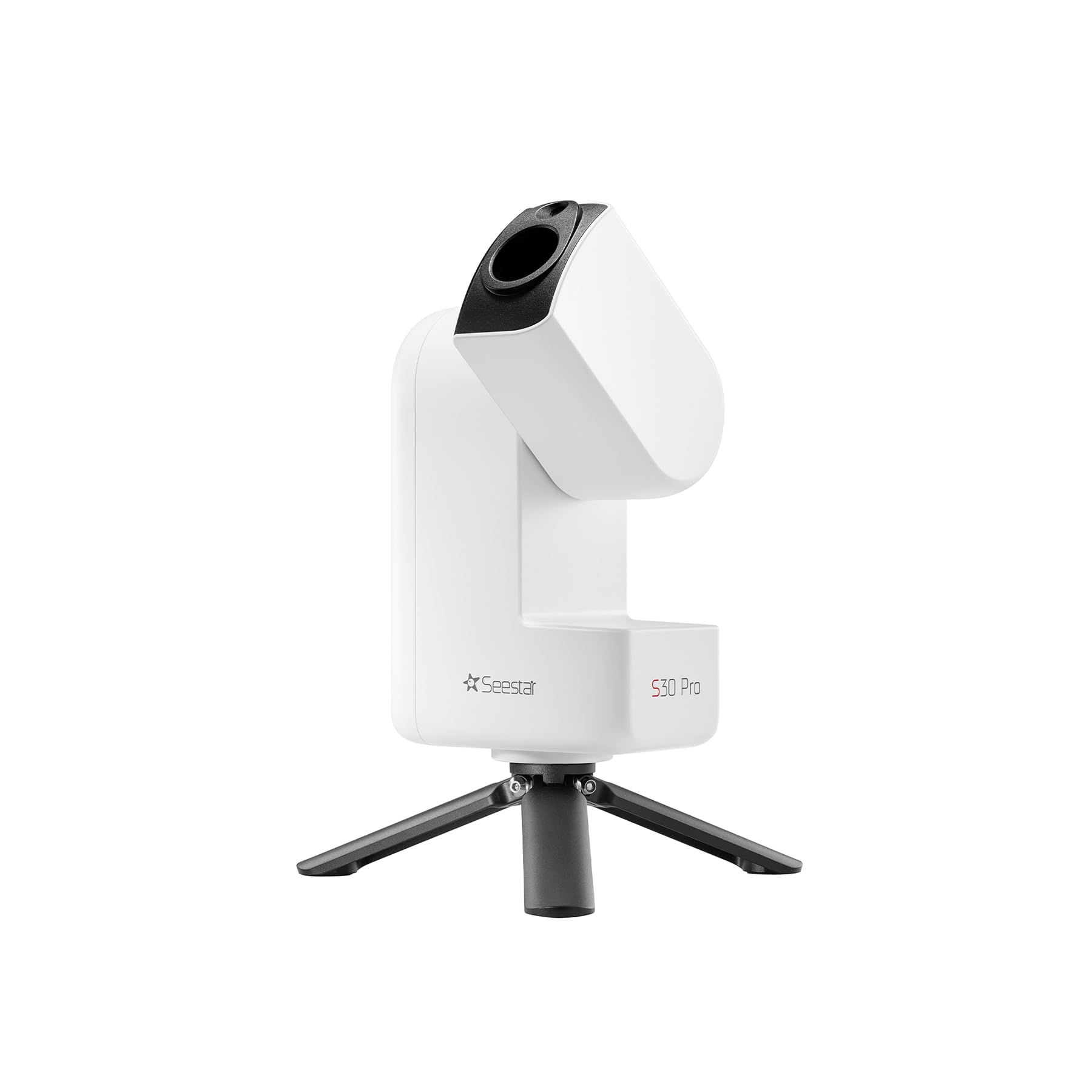
The 4.6-degree field champion that captures entire Milky Way swaths in one shot.
With a field of view of 4.6 degrees — 88% wider than the Dwarf Mini’s 2.45 degrees — the Seestar S30 Pro is the wide-angle king of this lineup, designed to frame large objects like the Andromeda Galaxy and the entire Veil Nebula in a single image. The dual-camera system pairs an IMX585 telephoto sensor with an IMX586 wide-angle camera, and the 160mm apochromatic lens (a 4-element design that reduces color fringing) delivers sharper stars and deeper contrast. Built-in filters knock down light pollution and infrared light, which helps reveal nebulae even from suburban backyards.
Buyers describe it as “fantastic and easy to use” — one reviewer shared that “within a half hour of opening the box we were able to put it outside and it instantly found the sun and gave us this picture!” The auto GOTO tracking reliably keeps targets centered, and the one-tap Milky Way and star trails modes stitch multiple frames into 8K ultra-wide images. It also functions as a long-range daytime camera for birdwatching, includes anti-dew protection, and packs 128GB of storage plus scheduled imaging for all-night sessions.
The main drawback is that the daytime scenery and birdwatching mode produces poor-quality photos — the reviewer noted it is “great for space not so much for scenery photos.” It is also the heaviest of the budget-friendly picks at 3.6 pounds, though still reasonably portable. If wide-field deep-sky imaging is your goal, this is the dedicated tool for it.
Core strengths
- Widest field of view at 4.6 degrees for large nebula and galaxy framing.
- 8K mosaic stitching and one-tap Milky Way mode.
- 128GB storage, anti-dew, and scheduled imaging for long sessions.
Notable limitations
- Scenery and birdwatching photo quality is poor.
- Heavier than the Dwarf 3 (3.6 lb vs. 3 lb).
- No dedicated wide-angle lens for astro — uses main telephoto for all deep-sky.
Pick this for: serious wide-field astrophotography with automatic mosaic stitching and the largest field of view available.
Skip it for: dual-use astro + terrestrial photography — the daytime mode is lackluster compared to the DWARFLAB Dwarf 3.
4. Vaonis Vespera Pro Smart Telescope
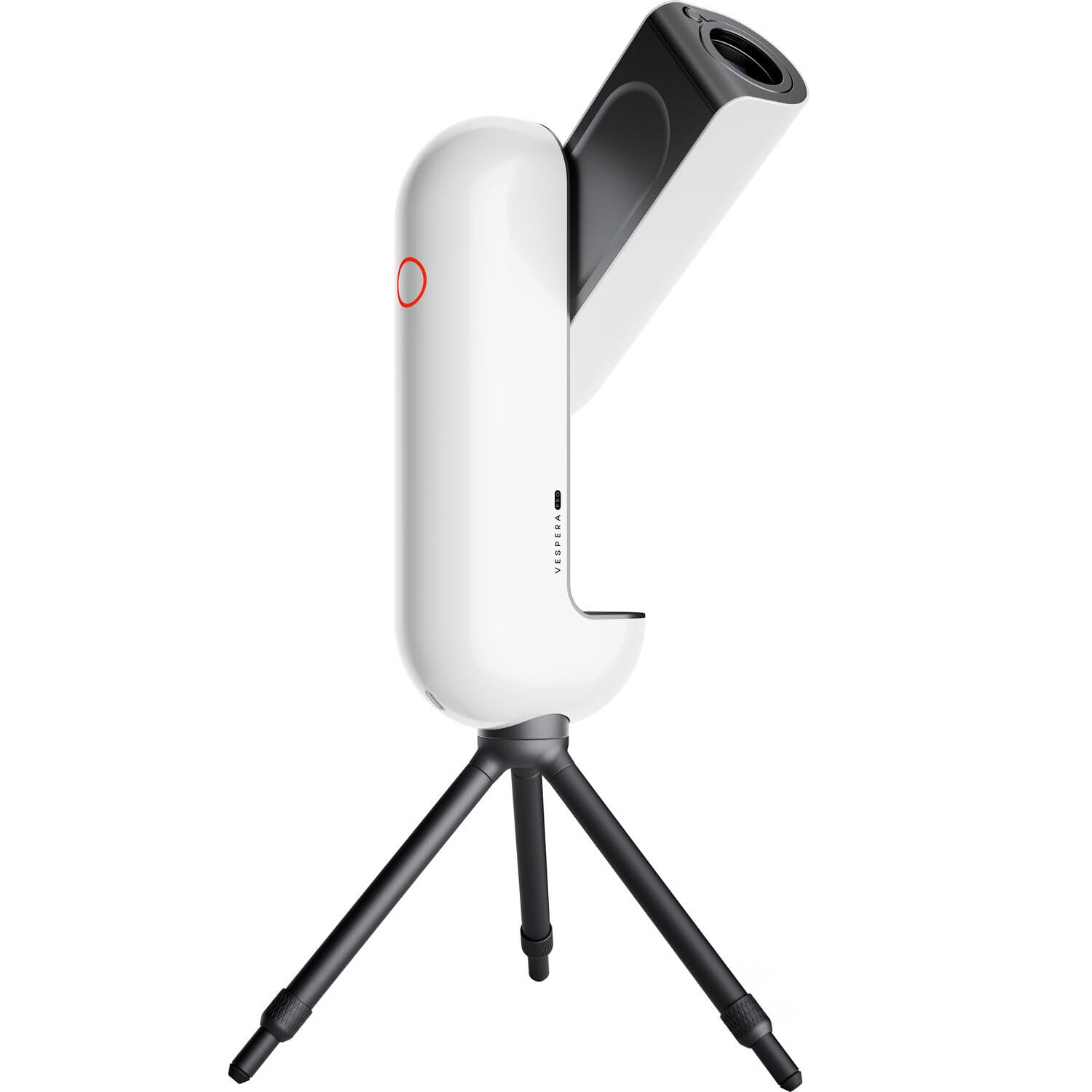
The heavy-hitting observation station that trades portability for professional-grade sensor and processing power.
The Vespera Pro is a different beast — at 11.02 pounds it is six times the weight of the Dwarf Mini, built less like a portable scope and more like a dedicated observation station. The core upgrade is the ultra-high-sensitive SONY IMX676 Starvis 2 sensor, which is paired with a custom field corrector that exploits the full potential of the larger sensor without edge distortion. The Vaonis-exclusive CovalENS technology enables live panorama capture, letting you sweep across the sky and stitch a mosaic on the fly.
Reviewers praise the “reliable tracking, excellent image stacking/processing, mosaic mode, dew heater, multi-night observations” and note the battery life stretches 9-10 hours with ample 225GB storage. One buyer mentioned it is “transformative for amateur astronomy, very well-designed.” The trade-off is connectivity: the Vespera Pro does not connect to your home WiFi — you must connect directly to the telescope’s own WiFi network — and file transfer requires FTP (no USB-C drag-and-drop). The app also lacks a built-in sky map, relying on a limited object catalog, so you cannot browse the night sky freely the way you can with the Dwarf or ZWO apps.
For dedicated imagers who want to get the most out of a premium sensor over long multi-night sessions, the Vespera Pro’s image quality and battery stamina are class-leading in this group. But the higher price and quirks make it a specialist tool rather than a first step into smart astrophotography.
Why it’s different
- SONY IMX676 Starvis 2 sensor with custom field corrector for edge-to-edge sharpness.
- 9-10 hour battery life and 225GB storage for all-night, multi-night sessions.
- CovalENS live panorama capture and automatic dark calibration.
Where it stumbles
- No home WiFi connection — direct connect only, which is less convenient.
- No USB-C file transfer; slow FTP only.
- App lacks a sky map and has a limited object catalog.
Ideal for: the serious amateur astronomer who wants premium sensor quality, long battery life, and multi-night observation without compromise.
Not for: beginners or those who want a simple, portable scope — the learning curve, connectivity quirks, and 11-pound station weight demand commitment.
Understanding the Specs
Field of View
Measured in degrees, the field of view tells you how much sky fits into a single image. A wider field, like the 4.6 degrees on the ZWO Seestar S30 Pro, is essential for capturing large objects such as the Andromeda Galaxy or the entire North America Nebula in one frame. A narrower field, like the Dwarf Mini’s 2.45 degrees, gives you a tighter crop — useful for small targets like the Ring Nebula or individual star clusters. If you want big mosaic sweeps of the Milky Way, prioritize a wider FOV.
EQ Mode (Equatorial Tracking)
A standard altazimuth mount moves the scope up/down and left/right, which is fine for casual viewing. But for long-exposure deep-sky photography, the stars will drift in the frame unless the mount rotates to follow the Earth’s spin exactly. That is what equatorial (EQ) mode does. Scopes like the Dwarf Mini and Seestar S30 Pro offer EQ mode, enabling exposures up to 90 seconds without star trailing — critical for capturing faint nebula detail. If the scope lacks EQ mode, your exposure length will be limited, and you will need to stack shorter subs.
FAQ
What is a smart telescope and how is it different from a regular telescope?
Can I use a smart telescope for daytime photography or wildlife?
Do I need an equatorial mount for astrophotography?
What does “auto GOTO” mean on a smart telescope?
Can a smart telescope work under city light pollution?
How heavy is a typical smart telescope and can I travel with it?
Do I need a computer or software to process the images?
Will a smart telescope show me planets like Jupiter and Saturn?
How long does the battery last on a smart telescope?
Can I connect a smart telescope to my home WiFi network?
Final Thoughts: The Verdict
For most buyers, the best astrophotography smart telescope is the DWARFLAB Dwarf Mini because it packs EQ mode, cloud processing, and a light pollution filter into a package small enough to take anywhere. If you want a dual-purpose scope for daytime wildlife and night-sky imaging in one device, pick up the DWARFLAB Dwarf 3. And for serious wide-field deep-sky work with automated 8K mosaics, the ZWO Seestar S30 Pro is the dedicated tool that delivers the widest field of view in the group.
How We Picked
We do not accept paid placement, and we did not hands-on test every unit. Instead, we match each pick to a real buyer and use-case by comparing the manufacturers’ published specifications against the patterns in verified customer reviews — so you get each pick’s real strengths and trade-offs instead of marketing copy.
Sources & Methodology
Specifications: manufacturer listings and product documentation. Review insights: verified customer reviews, as of July 2026. Pricing: not shown on this page (it changes often); check the current price via the retailer link.
As an Amazon Associate, Gadgets Feed earns from qualifying purchases. This does not affect which products we feature.
Product prices and availability are accurate as of the date/time indicated and are subject to change. Any price and availability information displayed on Amazon at the time of purchase will apply to the purchase of this product. As an Amazon Associate I earn from qualifying purchases.
CERTAIN CONTENT THAT APPEARS ON THIS SITE COMES FROM AMAZON. THIS CONTENT IS PROVIDED "AS IS" AND IS SUBJECT TO CHANGE OR REMOVAL AT ANY TIME.
Amazon and the Amazon logo are trademarks of Amazon.com, Inc. or its affiliates.