
Commercial coffee loses its flavor peak within days of roasting, yet most beans on store shelves were roasted weeks or months ago. Home roasting solves this by letting you control the exact roast profile, from the first crack of a light City roast to a rolling full-city dark, using green beans that stay fresh for up to two years in storage.
I’m Min — the co-founder and writer behind Gadgets Feed. I’ve spent countless hours parsing batch capacities, drum versus fluid-bed architectures, and the real-world noise and smoke profiles of home roasters to separate equipment that delivers repeatable results from gear that frustrates with its learning curve.
Whether you’re a curious beginner or an espresso enthusiast chasing a specific origin profile, choosing the right at home coffee roaster means matching your batch size, ventilation setup, and desired level of automation to a machine that won’t fight you on the first roast.
How To Choose The Best At Home Coffee Roaster
Home coffee roasters fall into two primary architectures: fluid-bed (hot air) machines that suspend beans in a heated airstream, and rotating drum roasters that tumble beans over a gas or electric heat source. Each approach affects roast time, chaff management, and the final flavor profile you can reliably achieve. Beyond the architecture, you’ll weigh batch size, ventilation requirements, and whether you prefer manual control or automated programs.
Batch Capacity and Your Weekly Habit
If you drink two to three cups daily, a roaster with a 120-gram to 180-gram green bean capacity will give you enough roasted coffee for roughly a week per batch. Heavy espresso drinkers or households with multiple coffee drinkers should look at 250-gram to 400-gram machines to avoid running multiple cycles back-to-back. Larger drums (500 grams) save time but require more space and produce significantly more smoke and chaff in a single session.
Fluid-Bed vs. Drum: Smoke, Chaff, and Roast Consistency
Fluid-bed roasters use forced hot air that lifts beans and blows chaff into a separate collector, making cleanup simpler and providing excellent visibility of the bean color change. Drum roasters rely on conductive heat from a rotating metal cylinder, which can produce a more traditional, deeper flavor profile but often demands a gas burner and generates more smoke that must be vented outside. Drum machines also tend to be heavier and noisier due to the rotating motor and gear mechanism.
Control Interfaces: Manual Knobs vs. Digital Programs
Entry-level and mid-range fluid-bed roasters typically offer analog knobs for heat and fan speed, forcing you to listen for the first crack and manually adjust. More advanced digital units let you save custom profiles with specific temperature ramps, fan curves, and cooldown stages. If you value repeatability and plan to experiment with different bean origins, a machine with programmable settings and a real-time temperature display will reduce guesswork dramatically.
Ventilation and Smoke Management
All home roasting produces smoke — especially beyond the first crack into medium and dark territory. Some machines include integrated smoke filters for light roasts and aluminum exhaust pipes for directing smoke outdoors. If you roast indoors, check whether the unit can be placed near a range hood or open window. Fluid-bed machines tend to produce less smoke per batch than drum roasters at equivalent settings, but dark roast profiles will challenge any indoor ventilation setup.
Quick Comparison
On smaller screens, swipe sideways to see the full table.
| Model | Category | Best For | Key Spec | Amazon |
|---|---|---|---|---|
| Fresh Roast SR800 | Fluid Bed | Consistent mid-volume roasting | 226g green bean capacity | Amazon |
| Fresh Roast SR540 Bundle | Fluid Bed | Complete starter experience | 120g capacity with extension tube | Amazon |
| MAGO MAGA Roma Pro | Fluid Bed | Auto programs for beginners | 300g capacity, digital display | Amazon |
| Fresh Roast SR540 | Fluid Bed | Entry-level fluid-bed reliability | 120g capacity, 9 heat levels | Amazon |
| KALDI Mini | Drum | Gas-powered drum roasting | 250g capacity, thermometer included | Amazon |
| Precision PKF-500 | Drum | Automated 1lb batches with smoke filter | 1lb capacity, touchscreen interface | Amazon |
| NIASIA PKF-500g | Drum | High-volume drum roasting | 500g capacity, 9 auto profiles | Amazon |
| DYVEE KAKA-G400 | Drum | Quartz glass gas drum roasting | 400g capacity, 12V motor | Amazon |
| Hario Retro RCR-50 | Manual | Small-batch hand-crank roasting | 50g capacity, heat-resistant glass | Amazon |
In‑Depth Reviews
1. Fresh Roast SR800 Coffee Roaster
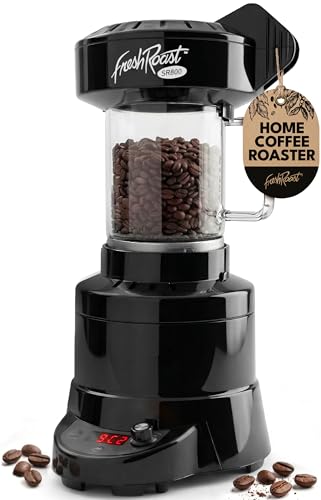
The SR800 doubles the capacity of the SR540 to 226 grams of green beans per batch, making it the sweet spot for a household that drinks three to four cups daily. Its fluid-bed design uses a convection fan and nine-level heat settings that you adjust via a push-and-turn knob — no smartphone app, no gimmicks, just precise real-time temperature display and manual control that experienced roasters appreciate.
At roughly 450°F peak temperature, the SR800 reaches first crack around the 7-minute mark with a typical washed Central American bean. Users report that the machine can handle 180 grams comfortably even in cooler ambient temperatures, though pushing it to the full 226 grams may require pre-heating the chamber and stirring the beans manually in the first minute to avoid uneven drying.
The unit is compact at 8 x 8 x 14 inches and weighs just over 6 pounds, but it lacks a programmable cooldown cycle, so you’ll need to dump the hot beans into a separate cooling tray immediately after the roast finishes. The chaff collector is effective for light and medium roasts, but dark roasts produce enough smoke that outdoor or range-hood placement is strongly recommended.
Why it’s great
- Largest practical batch size in the mid-range fluid-bed category
- Analog-style knob interface gives real-time heat and fan control
- Reliable aftermarket support and flat-fee repairs
Good to know
- Control button can become temperamental after extended use
- No on-board cooling cycle — requires separate cooling tray
2. Fresh Roast SR540 Coffee Roaster Bundle
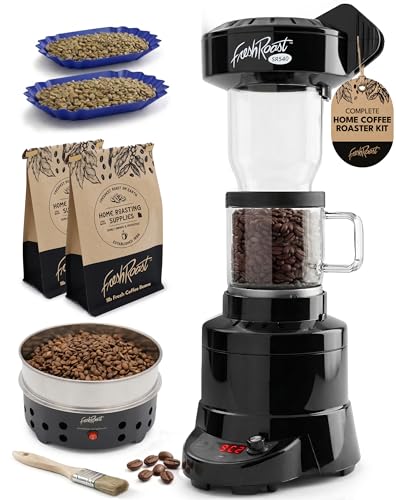
This bundle takes the standard SR540 and adds a glass extension tube, a dedicated bean cooler, a sample of green coffee beans, cupping trays, and a chaff brush. The extension tube improves heat retention and bean movement within the fluid-bed chamber, allowing the SR540 to roast up to about 170 grams more evenly than the base model alone can manage.
The included bean cooler is a separate fan unit that drops the bean temperature from over 400°F to room temperature in roughly three minutes, locking in the flavor profile at the moment you decide to stop the roast. Without it, you’d have to shake the beans in a colander or metal pan, risking uneven cooling and muted aromatics.
Users report that the roasted output from this setup competes with machines costing twice as much, provided you take the time to dial in the fan and heat curves for each new bean origin. The bundle’s main caveat is that the extension tube sits on top of the main chamber without a locking mechanism, so it can tip if the unit is bumped during the roast cycle.
Why it’s great
- Complete kit includes everything needed for first roast
- Dedicated bean cooler preserves roast quality
- Programmable digital controls with 9 heat and fan levels
Good to know
- Extension tube sits loosely and can tip during operation
- Maximum practical batch is closer to 6 oz than the advertised 8 oz
3. MAGO MAGA Roma Pro Smart Home Coffee Bean Roaster
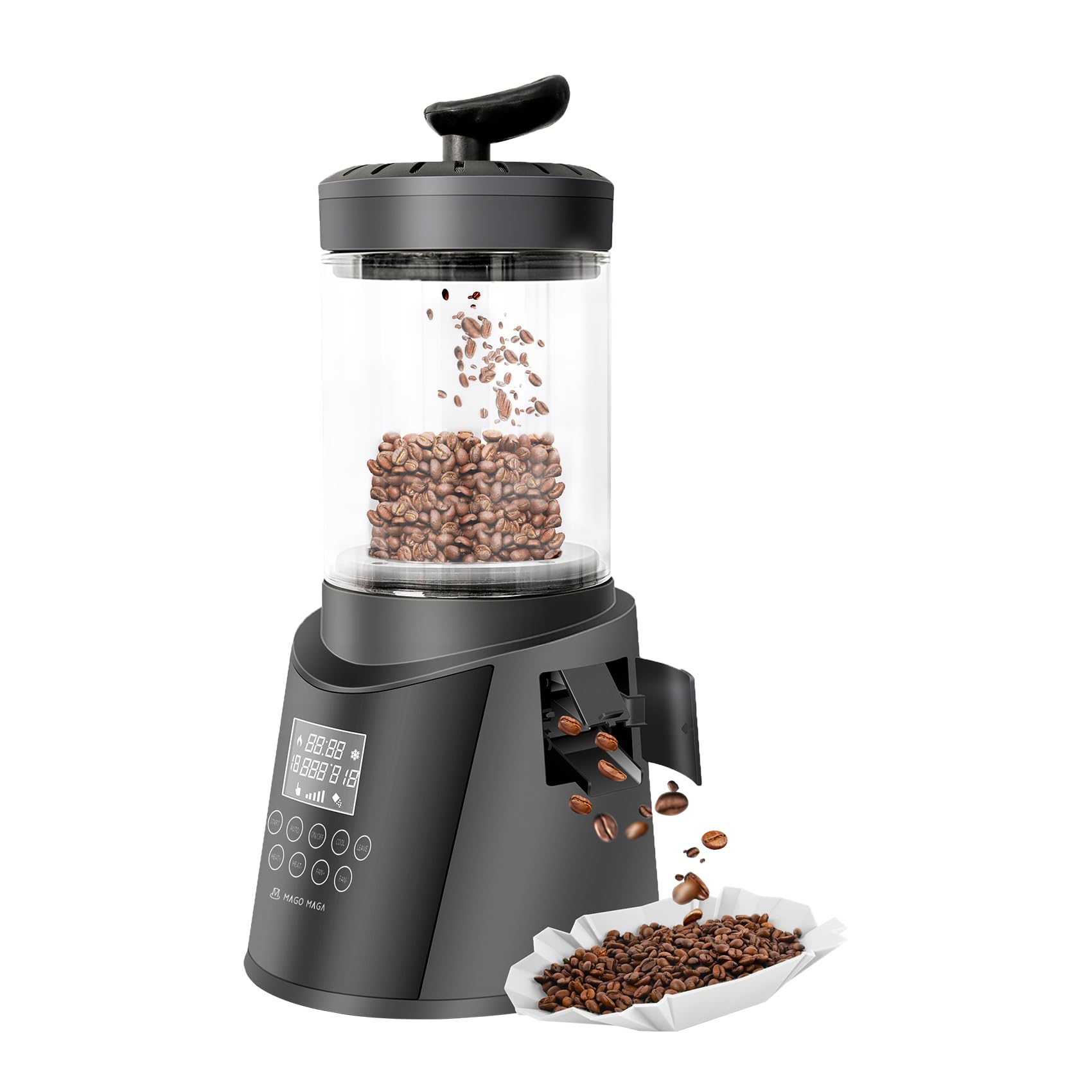
The Roma Pro earned a 2025 SCA Best New Product Award by combining a fluid-bed hot air system with a digital display, automatic roasting profiles, and a 300-gram green bean capacity. It offers both Celsius and Fahrenheit readouts, a timer, and a double-layer glass window for real-time color monitoring. The auto mode is designed for beginners — you select a profile and the machine ramps heat and fan speed through drying, browning, and development phases.
For experienced roasters, the manual mode lets you override every parameter and record your own curves. The ultra-low smoke claim holds up for light and medium roasts due to an efficient chaff collector and a controlled airflow path that minimizes particulates escaping into the room. The auto-cooling function kicks in after the roast ends, dropping the beans to safe handling temperature in about 90 seconds.
Some users report variability in thermo-couple accuracy between units, and the 120V power supply limits how aggressively the machine can ramp heat during the browning phase, extending total roast time to 12-14 minutes for 300 grams. The company’s customer service is responsive, with quick replacements for the glass roasting tube if it cracks from thermal shock during cleaning.
Why it’s great
- Auto mode delivers consistent results with minimal supervision
- Large 300g capacity suits daily drinking households
- Auto-cooling preserves flavor and reduces handling risk
Good to know
- Some units show thermo-couple variance of 10-15°F
- 120V limits heating speed during development phase
4. Fresh Roast SR540 Automatic Coffee Bean Roaster
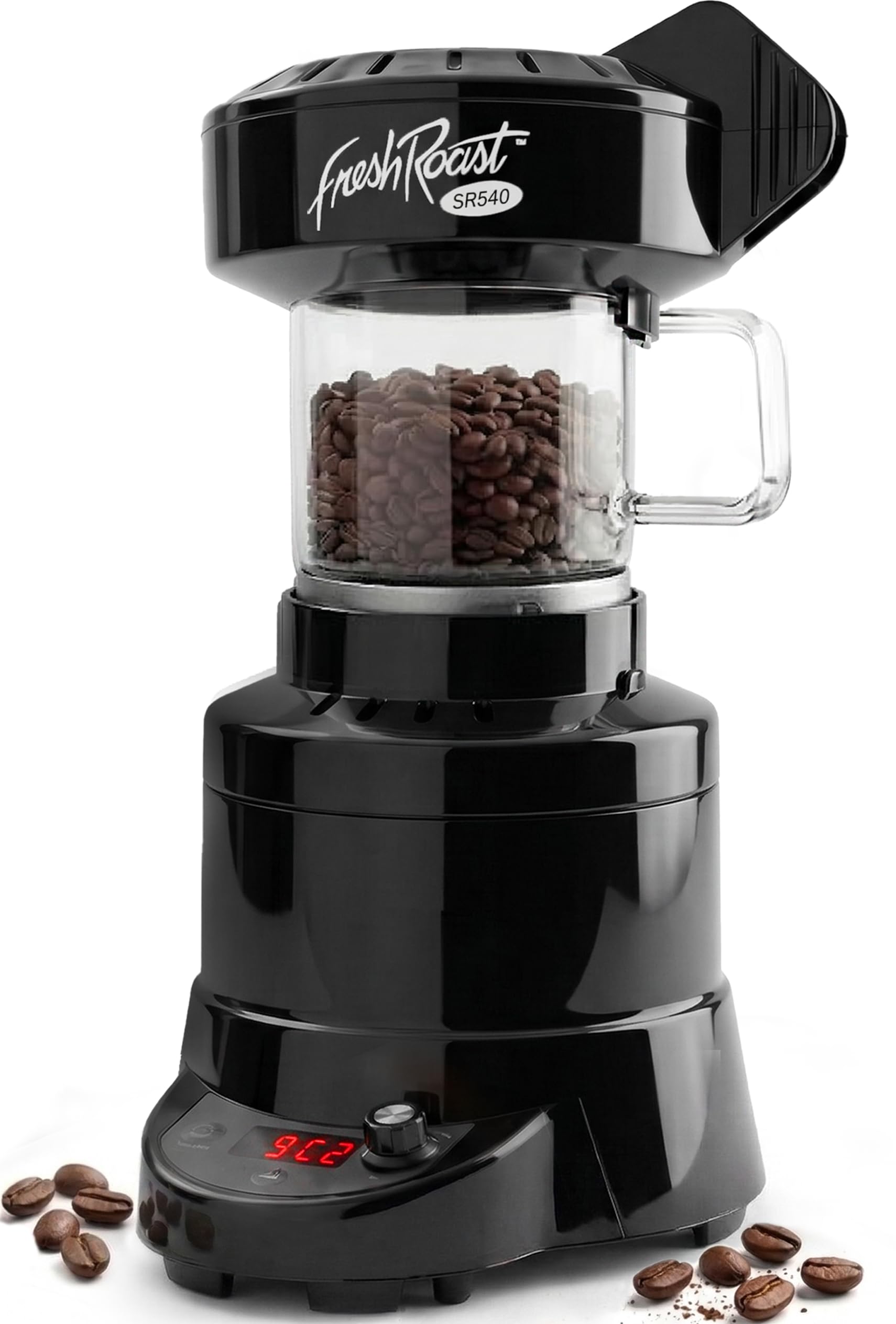
The SR540 is the entry point to Fresh Roast’s fluid-bed lineup, roasting up to 120 grams of green beans per batch — enough for about a week of coffee for a single-drip drinker. Its analog-style interface uses physical knobs for heat, fan speed, and time, with a digital status display that shows the real-time chamber temperature.
Users consistently praise its rugged build; many report hundreds of successful batches over several years. The fluid-bed system uses convection to suspend and agitate the beans, which means chaff is automatically blown into a separate collection basket rather than accumulating inside the drum. Cleanup involves emptying the chaff collector and wiping the glass chamber with a dry cloth.
The main limitation is batch size: at 120 grams, households that go through more than 3 ounces of roasted coffee per day will need to run multiple roasts per week. The machine also lacks a programmable cooldown, so you’ll need to dump the beans into a colander or metal pan immediately after the roast timer ends to prevent carryover cooking. First crack is audible at around 7-8 minutes with most washed beans.
Why it’s great
- Proven reliability with years of daily use reported
- Effective chaff separation via fluid-bed design
- Straightforward analog controls with no app dependency
Good to know
- 120g batch is small for multi-cup households
- No on-board cooling — external cooling tray required
5. KALDI Mini Home Coffee Roaster

The KALDI Mini is a stainless steel drum roaster that sits on top of a gas burner (not included) and rotates via a 12V motor to tumble 200 to 250 grams of green beans. It includes a thermometer that mounts on the drum face, giving you a rough idea of the bean mass temperature. Because it’s a gas-fired drum, it reaches roast temperatures faster than most electric fluid-bed machines and imparts a deeper, more caramelized flavor profile.
Users who invested time in the learning curve report that the KALDI produces exceptionally even roasts with excellent control over the rate of rise. The drum’s noise level is low — you can clearly hear the first and second cracks without the roar of a fan motor. The motorized drum runs on a separate 12V adapter, keeping the machine safe from high-voltage exposure near the gas burner.
The main complaint is that the motor gearbox sits close to the drum and can overheat during back-to-back roasts, potentially shortening the motor’s lifespan. The unit also lacks a wind shield, so positioning it on a standard gas grill requires careful setup to avoid uneven heating from drafts. Beans can jump out of the drum opening after the first crack, so a mesh cover is recommended for dark roasts.
Why it’s great
- Gas-powered drum delivers traditional, deep flavor profiles
- Low noise makes crack detection easy
- Stainless steel build feels durable and heavy-duty
Good to know
- Gas burner and wind shield not included
- Motor gearbox can overheat during consecutive roasts
6. Precision PKF-500 Electric Coffee Roaster
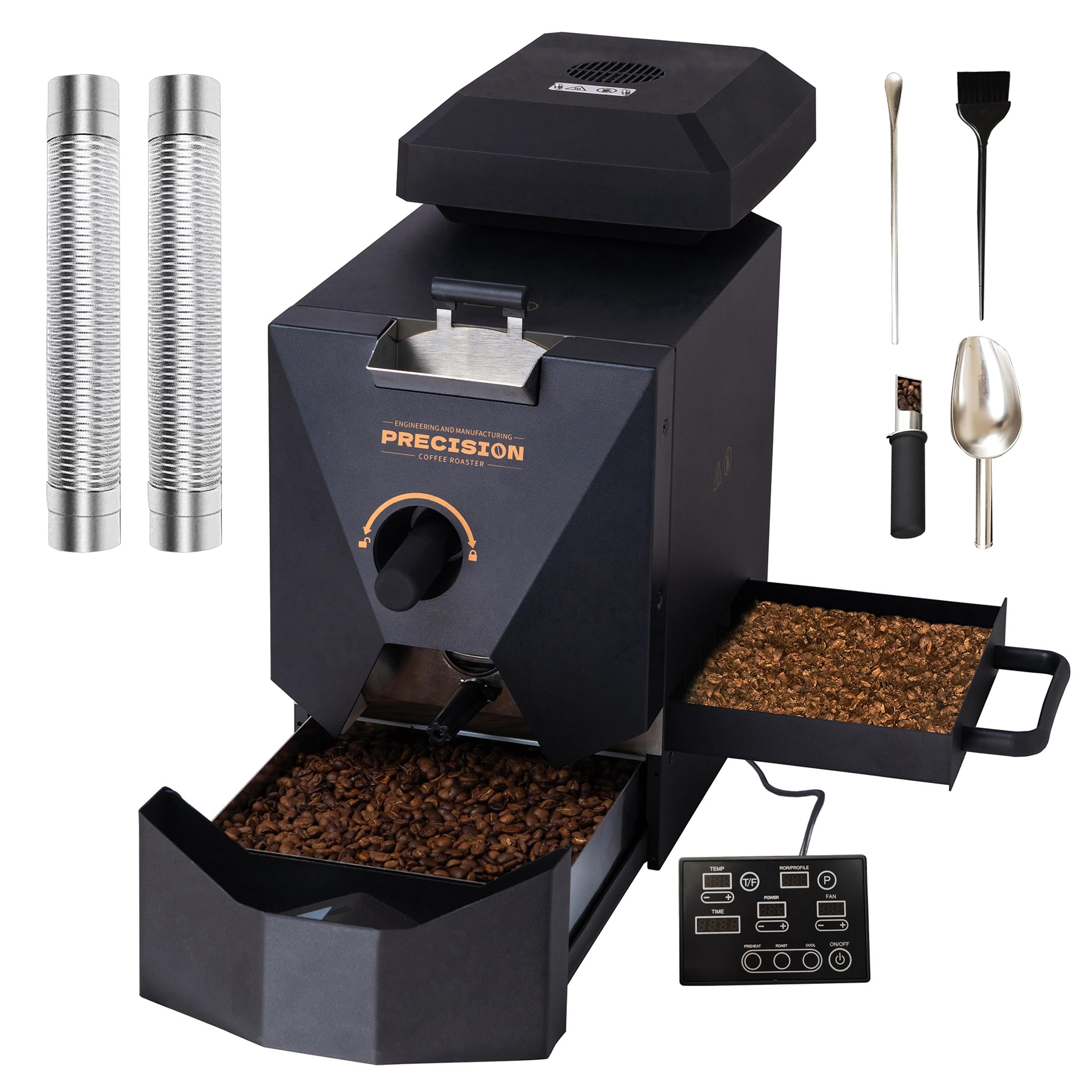
The PKF-500 is a 1-pound capacity drum roaster with a touchscreen interface that offers automatic, assisted, and manual roasting modes. It includes a smoke filter and a vent pipe that can be routed to a window for medium and dark roasts. The observation window and sample spoon let you pull beans mid-roast to check color and development without stopping the drum.
Experienced home roasters who have used it for over 50 pounds of beans report that the pre-set medium roast profile works reliably for most washed and honey-processed origins. The machine’s display is bright and responsive, though some users find the control labels difficult to read in direct sunlight. The assisted mode allows you to start with an automatic profile and then switch to manual control during the development phase for finer adjustment.
Durability concerns appear after extended use: moisture from the exhaust can condense on the circuit board, leading to control panel glitches, and heat buildup inside the chassis can trigger mid-roast shutdowns if the user doesn’t allow sufficient cool-down time between batches. The company provides replacement parts at reasonable costs, but users in colder climates have reported that leaving the unit in freezing temperatures can cause sensor errors.
Why it’s great
- 1lb capacity handles weekly needs for heavy-drinking households
- Three operation modes accommodate beginner to expert skill levels
- Sample spoon and window enable real-time roast monitoring
Good to know
- Condensation can cause circuit board issues over time
- Requires cool-down break between batches to avoid shutdown
7. NIASIA PKF-500g Automatic Coffee Roaster

The NIASIA PKF-500g is a 500-gram drum roaster built for high-volume home use, with a recommended sweet spot of 350 to 400 grams per batch. It includes nine pre-programmed roasting profiles covering light, medium, and dark roasts, plus specific curves for sun-dried, washed, and honey-processed beans. The machine also ships with a smoke purifier for light roasts and two aluminum exhaust pipes for venting medium and dark roast smoke outdoors.
Customers who have used the unit for over 50 pounds of beans report that the auto profiles produce consistent results for medium roasts, though the standard setting tends to over-roast light profiles — manual override during the development phase fixes this. A separate high-speed cooling fan and cooling tray bring beans down to room temperature in under two minutes, which is critical when working with large batches that retain significant thermal mass.
The drum is driven by a motor-gear system that can be noisy enough to mask the sound of the first crack, so you’ll rely more on the digital timer and temperature display than on audio cues. The smoke filter works well for light roasts but overheats during back-to-back dark roasts, requiring the exhaust pipes for heavy smoke loads. Some users also note that beans smaller than 4 mm can wedge between the drum and the housing, causing the drum to jam.
Why it’s great
- 500g capacity is the largest in this roundup for home use
- Nine auto profiles cover most processing methods
- Included cooling tray and fan preserve roast quality
Good to know
- Motor noise can drown out first crack audio
- Small beans may jam the drum mechanism
8. DYVEE KAKA-G400 Coffee Roaster

The KAKA-G400 uses a quartz glass drum mounted on a 304 stainless steel frame, powered by a 12V motor that rotates the drum over a gas burner. The transparent drum gives you a full 360-degree view of the bean color progression — a major advantage for roasters who want to judge development visually rather than relying on a thermometer. Its recommended batch is 200 to 300 grams for best results, with a maximum of 400 grams.
Users who roast outdoors on a propane burner find the machine solid and consistent after a short learning curve. The glass drum develops a natural patina over time, but monthly cleaning with wood ash or a mild abrasive restores transparency. The chaff escapes through slots in the drum, which means you’ll need to roast in a well-ventilated area or be prepared to sweep up after each batch.
Two design issues appear frequently in user feedback: the included thermometer responds slowly and its mounting clip is unreliable, and the motor gearbox requires periodic food-grade oil to prevent squeaking. Beans smaller than 5 mm can also slip through the drum’s slots, so this machine works best with standard-to-large specialty green beans rather than peaberry or tiny centrals.
Why it’s great
- Transparent quartz drum offers continuous roast color visibility
- Stainless steel frame provides stability during gas operation
- Large 400g capacity suits weekly batch roasting
Good to know
- Thermometer is slow to respond with an unreliable mount
- Motor gearbox needs periodic oiling for quiet operation
9. Hario Retro Coffee Roaster RCR-50

The Hario Retro Coffee Roaster is a hand-cranked, heat-resistant glass device that holds 50 grams of green beans. It operates over a gas stove burner, requiring you to manually rotate the crank while watching the beans change from green to yellow to brown. There is no fan, no digital display, and no automation — just you, the glass drum, and the sound of the first crack.
Users who enjoy the sensory ritual of roasting report that this machine produces excellent results with Ethiopian and Colombian beans after a few practice runs. A 50-gram batch takes roughly 12 to 15 minutes over medium heat. The glass body gets dirty quickly, and the crank mechanism can feel stiff until the beans warm up and expand, reducing friction inside the drum.
The major limitation is batch size: 50 grams yields roughly 3 to 4 tablespoons of roasted beans, enough for two to three pour-overs. You’ll need to run multiple batches if you drink more than one cup per day. The false feedback — odd crackling noises before the first crack — can confuse beginners, but experienced manual roasters use the color change through the transparent glass as their primary cue rather than sound alone.
Why it’s great
- Transparent glass body provides clear roast progression visibility
- Hand-crank operation is quiet and meditative
- Made in Japan with durable materials
Good to know
- 50g batch is tiny — requires multiple runs for daily drinkers
- False crackling sounds can confuse first-time users
FAQ
Do I need to vent a home coffee roaster outdoors?
How long do green coffee beans stay fresh?
Can I roast decaf coffee beans in a home roaster?
Why does my home-roasted coffee taste grassy or bready?
Final Thoughts: The Verdict
For most users, the at home coffee roaster winner is the Fresh Roast SR800 because it delivers the best balance of batch size (226g), precise manual control, and reliable build quality at a price that makes sense for daily roasting. If you want automated profiles and a larger 300g capacity without sacrificing indoor smoke management, grab the MAGO MAGA Roma Pro. And for dedicated drum roasting enthusiasts who want the deepest flavor development from a gas-fired setup, nothing beats the KALDI Mini when paired with a propane burner and a wind shield.