
Our readers keep the lights on and my morning glass full of iced black tea. As an Amazon Associate, I earn from qualifying purchases.
Specs are compiled from manufacturer listings and verified buyer reviews and can change over time — please confirm the key details on the product page before buying.
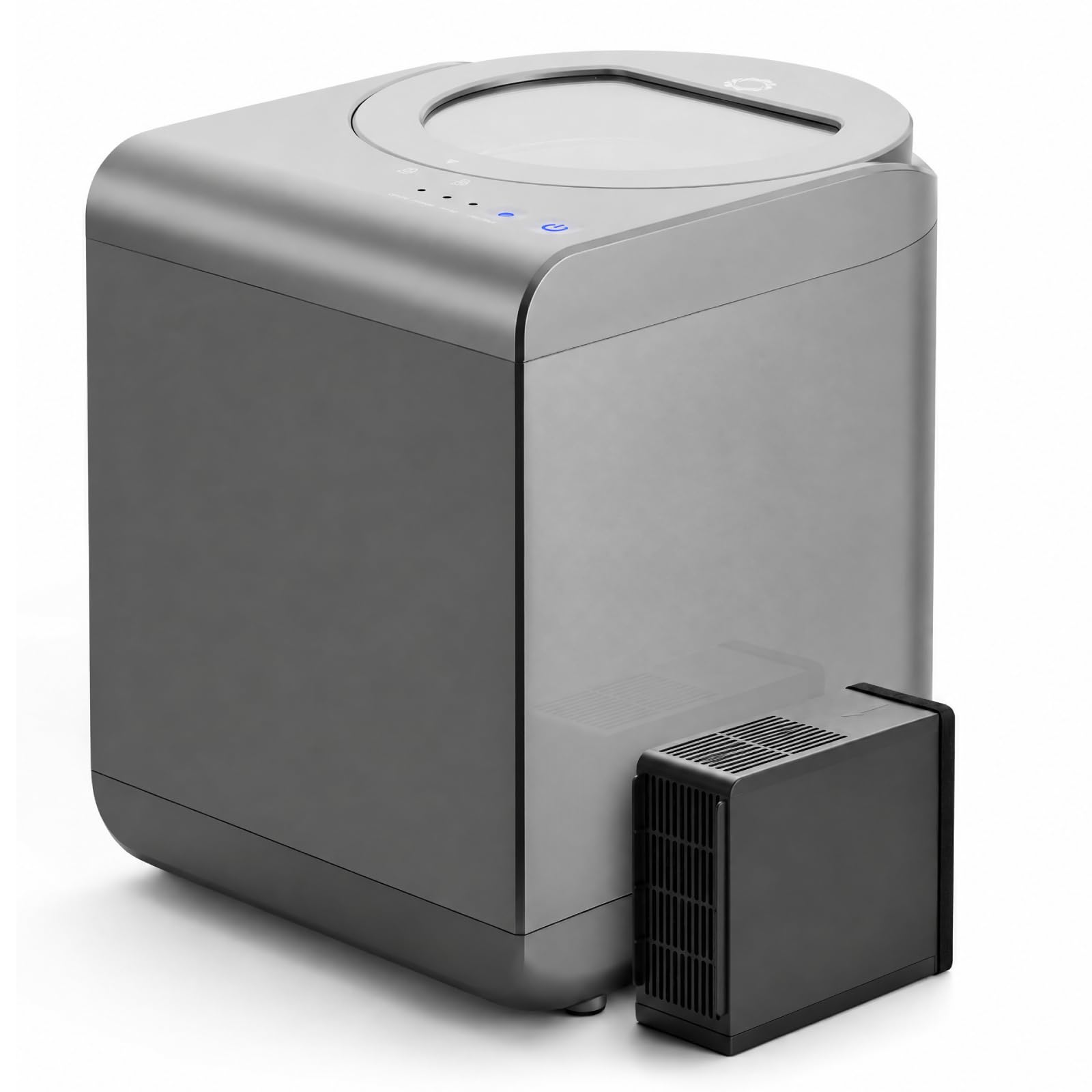
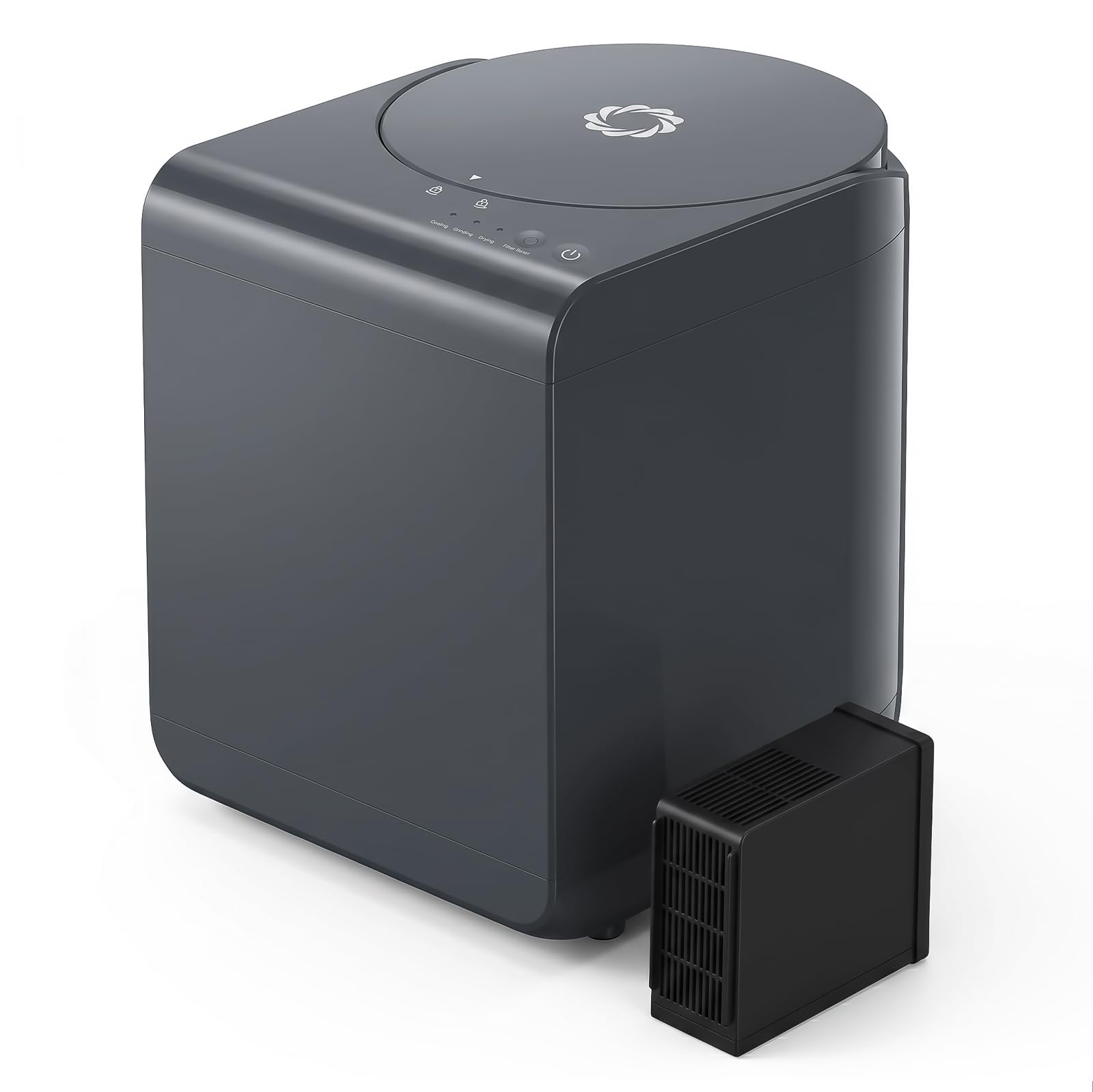
An at-home composter does one simple job: it turns your kitchen scraps into garden-ready soil instead of a smelly bag under the sink. The real decision is if you want a passive ceramic crock that holds scraps until you carry them out, or an electric machine that dries and grinds them into powder overnight. For the friendliest set-and-forget kitchen experience, the electric Airthereal R500-V is the pick most families land on. For a tidy countertop bin with no plug, the Chef’n EcoCrock is the crowd favorite — 4.5+ stars across 2,800+ owners.
I’m Min — the founder and writer behind Gadgets Feed. This guide is built by comparing the manufacturers’ published specifications and the patterns across verified customer reviews, so you get each pick’s real strengths and trade-offs instead of marketing spin.
Below you’ll find a dedicated pick for every kind of home, from a bare-bones counter crock to a 14-liter machine that chews through scraps daily. Filter the options honestly and you’ll find the right at home composter for your kitchen and your patience.
Our Picks at a Glance

How To Choose The Best At Home Composter
First, decide what you actually want to happen to your scraps. A passive bin holds them until you walk them outside; an electric composter dries and grinds them down right on your counter, often shrinking the volume substantially. That choice alone narrows the field before you compare a single spec.
Passive crock or electric grinder
A ceramic crock like the Chef’n relies on a charcoal filter to keep the contents from smelling while you collect scraps. It needs no plug and runs silent. An electric machine like the Airthereal R500 does the processing for you — it uses heat and blades to turn scraps into a dry powder you can dig into your garden. The trade-off: electric models need counter space and a nearby outlet, and they make some noise during a cycle.
Match the capacity to your cooking volume
Capacity in liters tells you how much you can load before emptying. A 2.5-liter machine suits a couple or a small household eating modestly. A 3-to-4-liter model fits a family of four’s daily peels and coffee grounds. If you cook for a crowd, a 14-liter unit like the Reencle Prime handles far more before you need to touch it.
Know your filter and cleaning routine
Odor control lives or dies on the carbon filter. Check how many the box includes and how often the machine reminds you to swap it. Cleaning also matters more than most buyers expect — an inner bucket that is dishwasher safe saves you scrubbing, while a fixed drum means wiping by hand. Look for a machine with a built-in cleaning cycle if fuss-free maintenance is a priority.
Quick Comparison
| Model | Best For | Capacity | Type | Weight | Amazon |
|---|---|---|---|---|---|
| Chef’n EcoCrock★ Best Overall | Tidy counter collection | 3 L | Passive ceramic | 4.5 pounds | Amazon |
| Airthereal R500-VAlso Great | Families of 4–5 | 2.5 L | Electric | 10 kg | Amazon |
| Airthereal R500Overnight Pick | Fast overnight cycles | 2.5 L | Electric | 16.8 pounds | Amazon |
| Growell GWEC04GY | Low-electricity grinding | 3.2 L | Electric | 11.86 kg | Amazon |
| iDOO I-E-01-WH | Automatic hands-off process | 3 L | Electric | — | Amazon |
| FoodCycler Eco 3 | Quiet daily grinding | 3.5 L | Electric | 12.9 kg | Amazon |
| Ouaken J6001A | Family of four | 4 L | Electric | 7.15 kg | Amazon |
| FRYLINE FR01 | Larger batches | 4 L | Electric | 18 pounds | Amazon |
| Reencle Prime | High-volume households | 14 L | Microbe aerobic | 20.1 pounds | Amazon |
In‑Depth Reviews
1. Chef’n EcoCrock Counter Compost Bin
Our pick — 4.5+★ from 2,500+ verified ratings; the strongest balance of quality and price.
This is the no-plug, no-sound option: a ceramic crock that just makes collecting scraps feel tidy.
Not everyone wants a machine humming on the counter. The EcoCrock is a 3-liter ceramic bin — about 0.75 gallons — with a vented lid and a removable inner bucket, so the whole job is simply holding peels until you carry them outside. Because it is ceramic and not an appliance, it is quiet and simple by design. The quality of the piece is what wins people over most; it is the single most-discussed strength in its reviews, by a wide margin.
Where it earns its keep is cleanliness and smell control. Two replaceable natural charcoal filters come included, and owners describe the filtered ceramic staying tidy in daily use. The removable inner bucket is top-rack dishwasher safe, and the outer ceramic wipes clean with hot water. Emptying it takes moments — a tapered shape lets the scraps slide straight out into the main pile without mess. That said, empties happen often, because 3 liters fills fast when you cook.
It is the lightest setup here too. At 4.5 pounds, it sits firmly on the counter without feeling heavy to lift when the bucket needs clearing, and it tucks into a tight corner without a cord to route. The recurring gripe is the lid fit; treat the seal gently and it stays put. As a at home composter that just collects, it is the honest, no-machinery way to start.
Why it earns the spot: built-in charcoal filtration, a dishwasher-safe inner bucket, and four and a half pounds of ceramic that stays put — no power, no noise, no moving parts to fail.
The honest limit: a passive crock only holds scraps; it does not break them down, so you carry the bucket a lot more often than you would with an electric machine.
Reach for this if: you want silent, cordless, dishwasher-friendly collection and don’t mind carrying scraps out regularly.
Look elsewhere if: you expect the compost to process itself on your counter.
2. Airthereal R500-V Electric Composter
A glass lid turns waste disposal into something you can actually watch happen.
Most electric composters hide the whole process inside an opaque drum, so you press a button and hope. The R500-V puts a transparent glass cover on top, so you can follow the drying and grinding as it happens and see exactly when the batch is ready. Depending on how much you load, a full cycle finishes in roughly 2 to 5 hours.
Inside sits the upgraded SHARKSDEN Tri-Blade — a serrated three-blade grinder (three toothed blades that chop food waste) that chews scraps down more aggressively than a plain blade set. The brand claims waste reduction of up to 90%, so a full bucket of peels turns into a small scoop of powder you can dig into your beds. The 2.5-liter capacity (about 10.5 cups) is the balance: reviewers describe it as sized right for families of four to five, which is the practical reason this one takes the top spot over its cheaper sibling, the R500.
What keeps it from being a nuisance is the quiet running and the odor handling — a biodegradable activated carbon filter mops up most of the smell during and between cycles. One-button operation means you load, press, and walk away. Airthereal backs it with 3-year warranty coverage: a 1.5-year limited warranty plus 1.5 extra years of full protection for Amazon customers, no registration needed. The honest catch is durability: the reports are mixed, and a unit that fails early is a real possibility, not a myth.
Where it shines
- Transparent glass cover lets you watch the cycle in real time
- Serrated SHARKSDEN Tri-Blade grinds food waste down hard
- 2 to 5 hour cycles, quiet operation, activated carbon filters
- 3-year total warranty coverage for Amazon customers with no registration
Where it gives ground
- Durability in the review pages is mixed — some early failures reported
- 2.5 L means frequent emptying for a large household
Plays best with: families that want to see the process, run it quietly, and get garden powder in one evening.
Docks a point for: the long-run reliability record, which is not as clean as the glass cover suggests.
3. Airthereal R500 Electric Kitchen Composter
Load it after dinner, wake up to powder — the four-hour cycle is the whole pitch.
This is the plain-lid version of the top pick, and it keeps the same core idea: collect scraps through the day, switch it on before bed, and find dried powder by morning. The 4-hour cycle is the standout number, and the review pages back that it processes consistently under three hours for many loads. A 2.5-liter bucket handles the daily output of a small family; larger households will empty it more than once a day.
The SHARKSDEN Trinity Blade is a three-blade grinding set that pulls food waste toward the blades from multiple directions, so a chunk of rind gets broken down rather than riding around the edge. Functionality and composting are the two things reviewers praise hardest, which tracks with how the machine turns scraps into usable fertilizer for garden beds. It is also the lighter of the two Airthereal units at 16.8 pounds, so shifting it to the sink for a rinse is easy.
The aluminum bucket is easy to clean and dishwasher safe, and the biodegradable carbon filters keep smells down between runs. Airthereal includes a one-year manufacturer warranty. The recurring gripe is the same one the R500-V inherits: durability is a mixed story, and a small number of units fail earlier than they should. What it costs you is fewer creature comforts than the glass-cover model — no live view, but the same grind.
What you gain
- 4-hour overnight cycle turns scraps into powder by morning
- SHARKSDEN Tri-Blade grinds from multiple directions
- Dishwasher-safe aluminum bucket, one-button operation
- Biodegradable carbon filters, one-year warranty
What you give up
- No transparent lid, so you can’t watch the cycle
- Durability reports are mixed
Suits: the night-run household that values speed over watching the process.
Not for: anyone who wants to monitor the batch through a glass cover.
4. Growell GWEC04GY Electric Kitchen Composter
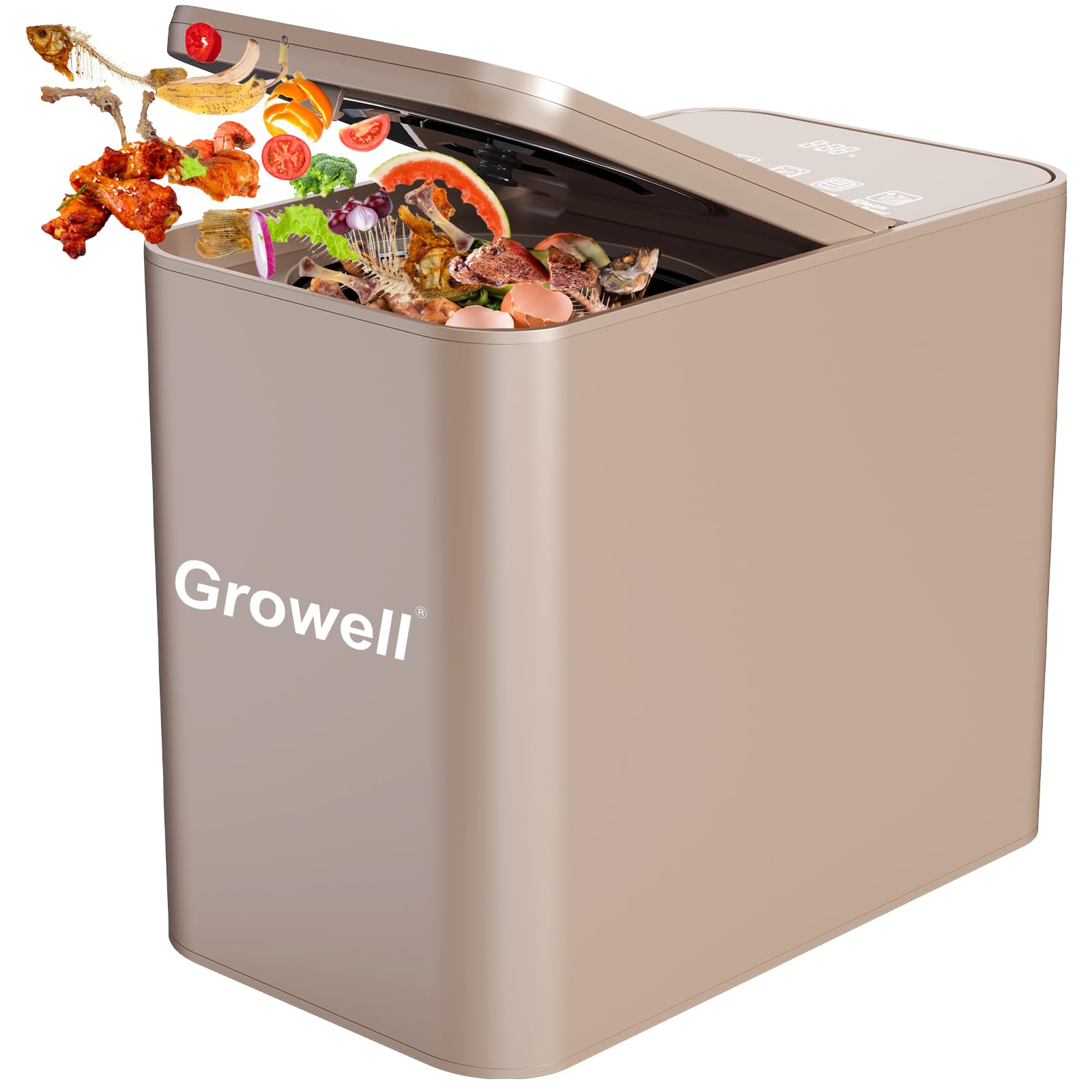
A 500W brushless motor with a 30,000-hour service rating is the durability promise most machines won’t make.
If long-run motor life is what you care about, this is the number to study. The brushless motor (a motor with no carbon brushes to wear out) is rated for 30,000 hours of service, which points to years of daily cycling. It delivers 500W of grinding force to chew through tough scraps, yet it draws just 0.2 kWh per hour (kilowatt-hours, the unit on your power bill) — modest power for that much force. Dual AUTO and Manual modes let the machine decide the run time based on how wet your waste is, finishing in up to 8 hours, or let you set anywhere from 1 to 10 hours for the texture you want.
The 3.2-liter bucket (about 13.5 cups) suits a small household, and reviewers describe the size as compact and the operation as quiet — as low as 50 decibels (roughly a quiet conversation), so you can set a cycle at night and grab the result in the morning. The sealed design with a large carbon box filters odors, and a storage mode circulates air to keep things fresh between empties. The filter alerts you at 300 hours of use, so you know when to swap it. The built-in cleaning mode saves the most time: add water, press Clean, and the inner barrel is handled.
What makes the Growell interesting is the package — stainless steel and aluminum-alloy construction, a clear display for progress, and a 3-year warranty from the purchase date. It is heavier than it looks at 11.86 kg, so plan its spot before you lift it. If you want the most motor and the simplest cleanup in one machine, this is the one to beat.
The efficiency angle: 500W of grinding force at just 0.2 kWh per hour, with a 30,000-hour brushless motor — the rare machine that pairs muscle with low electric draw.
The honest catch: at 11.86 kg, it is not a counter appliance you shuffle around; pick a permanent spot and leave it parked.
Great for: buyers who want a long-life motor, low power draw, and a self-cleaning barrel.
Think twice if: you need to move the machine between counters.
5. iDOO I-E-01-WH Electric Composter
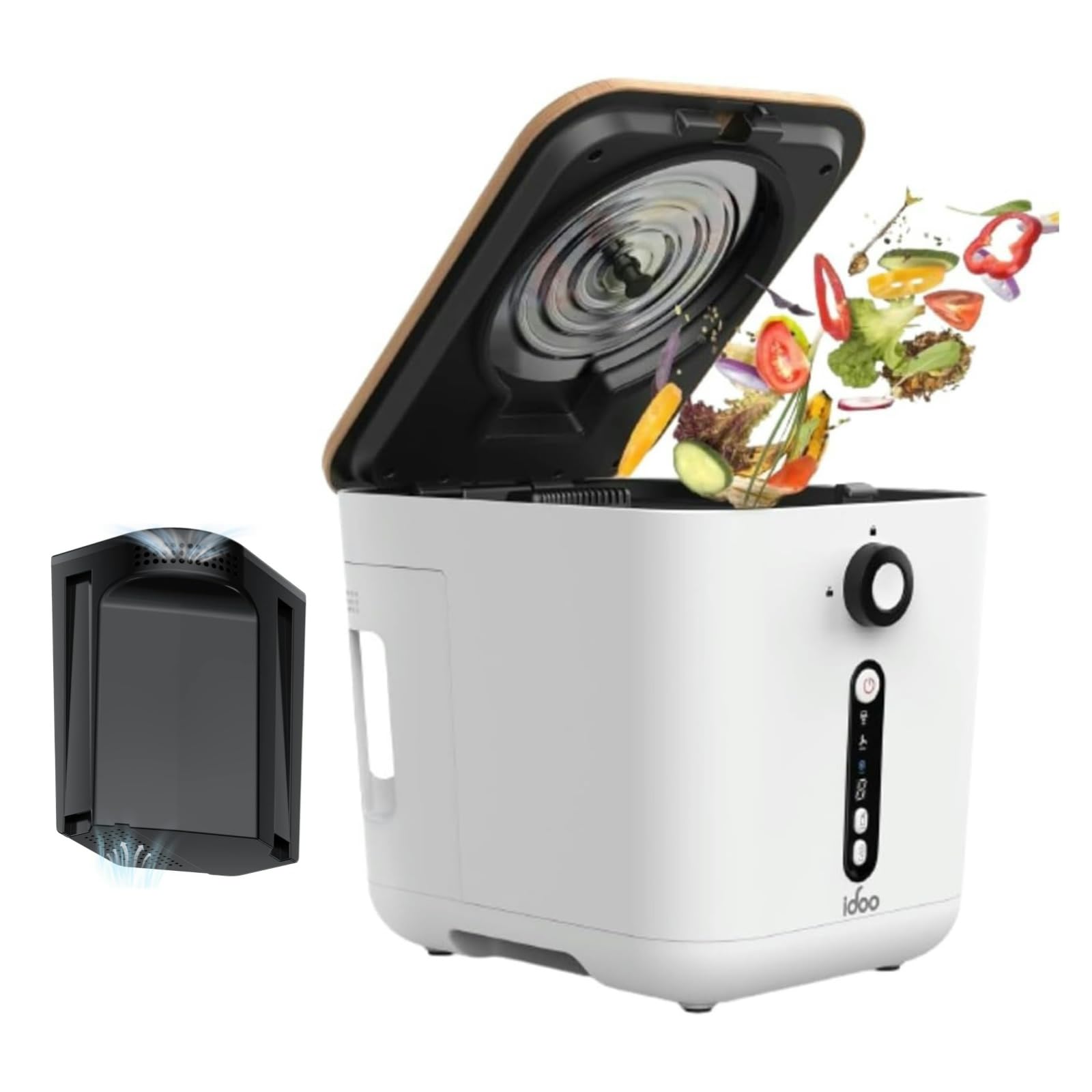
Load the top, walk away — this is the hands-off machine for people who don’t want to think about compost.
The iDOO’s whole personality is automation. You fill the top compartment, and the machine runs the process itself — no cycle buttons to learn, no manual turning. Inside, two packs of activated carbon work at once alongside an airtight body and a built-in odor filter, so the smell is kept at bay rather than merely masked. That simple setup is what buyers respond to; it is the most-praised strength in its reviews.
The 3-liter capacity sits in the middle of the range here, and the sleek white body is meant to slide into a kitchen or office nook without drawing attention. The removable waste compartment and the user-friendly controls keep maintenance manageable — pull the bin, rinse, and slot it back. The finish is the one to size honestly: the review pages are split on build quality, with some calling it well made and others finding it light, and the size itself draws mixed reactions. It is a machine for someone whose priority is the automation rather than the tactile feel of the plastic.
One thing to note about the dimensions: the listed 17.7-inch length and 23.6-inch height make this a taller unit that needs its own footprint, so measure the counter before committing. Get that right and the push-a-button simplicity is genuinely the point.
Best for: the buyer who wants to load scraps and forget about them, with two carbon filters doing the smell work.
Skip if: you have limited counter depth — this one is taller and wider than most.
6. FoodCycler Eco 3 Compact Kitchen Food Recycler
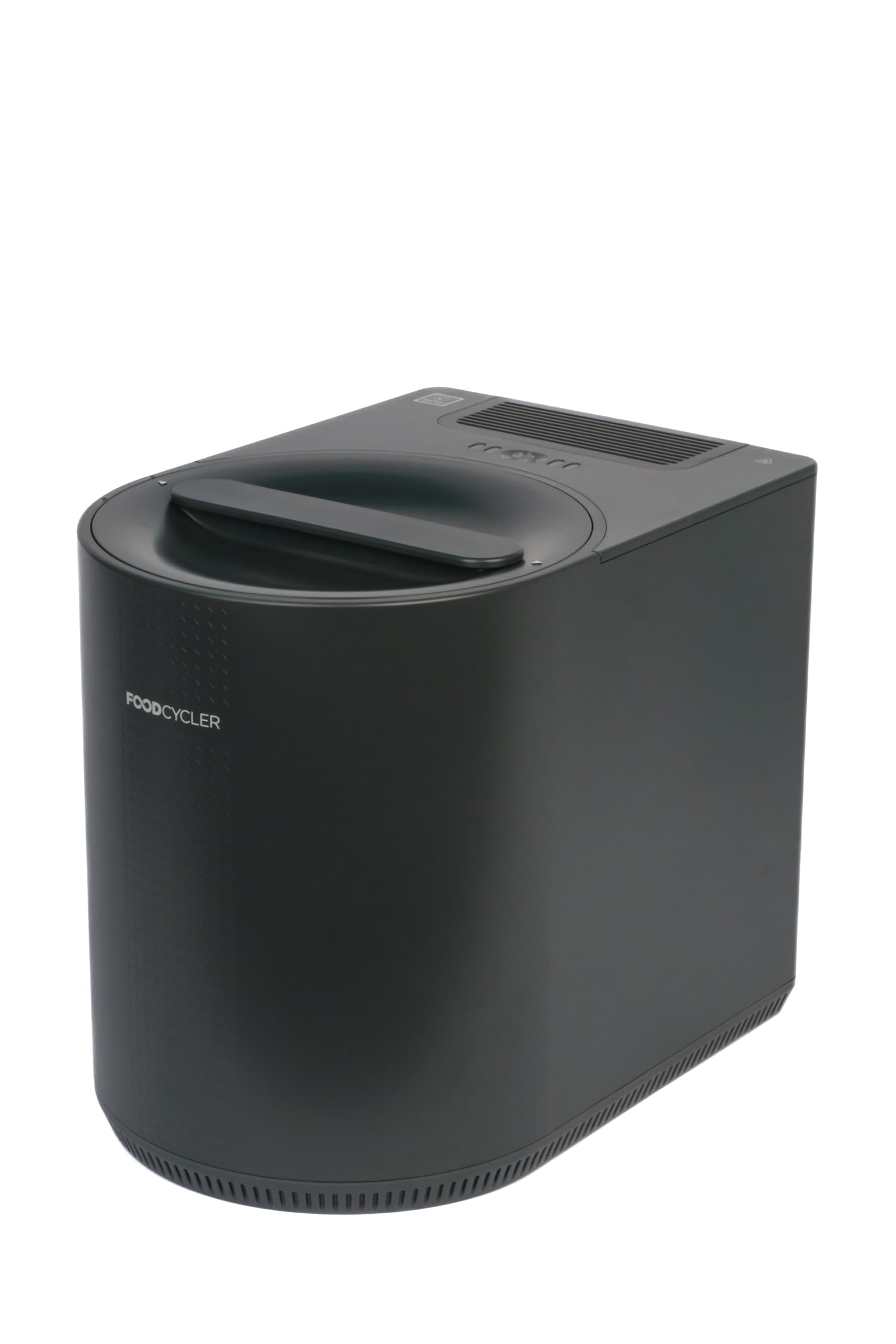
The Vortech grinder reportedly handles pits, peels and bones — the tough stuff that stops other machines.
What separates the Eco 3 from the rest of the electric field is the grinder. The patented Vortech system is built to take what others can’t — pits, peels, bones, leftovers — rather than jamming on the first avocado pit. It also uses a refillable carbon filter instead of a cartridge, which cuts down on the replacement chore. A 3.5-liter bucket sits between the small machines and the big ones, big enough for a busy two-cook kitchen.
The colorway aside, the form is genuinely compact, and moving the removable bucket to your prep area is part of the design. One touch starts the cycle, and real-time LEDs show the progress, so you always know whether it is still working. It runs quietly enough to keep going while you relax, and the review pages back that it dramatically cuts how much trash goes out — one kitchen even processed a whole raw brisket. The finish on the bucket is the weak point: some buyers report the inner surface chipping and peeling over time, so treat the removable bin gently.
It is a heavier machine than the capacity suggests, so find its home before you unbox it. For a household that generates tough scraps and wants a grinder that takes them, this is a strong mid-tier contender.
What stands out
- Vortech grinder handles pits, peels, bones and leftovers
- Refillable carbon filter instead of disposable cartridges
- Quiet operation with real-time progress LEDs
What to watch
- Bucket coating can chip and peel on the inside
- Heavy for its size
Made for: kitchens that toss bones and pits and need a grinder that won’t flinch.
Worth noting: the bucket finish calls for gentle handling to keep it intact.
7. Ouaken J6001A Electric Composter

A 4-liter bucket at under 40 dB — big enough for a family and quiet enough to run overnight.
The Ouaken trades on capacity and quiet. It runs below 40 decibels, which is close to a quiet refrigerator hum, so a night cycle is realistic. The three-mode setup is where it earns its keep: Crush mode cuts volume and odor with low energy use, Ferment mode builds higher-quality compost, and Clean mode handles the drum.
Functionality and reliability are its two most-discussed strengths — the reviews say it produces good, usable compost and works well for a household of four. A transparent lid and easy-touch interface make it simple to see the batch and switch modes. The carbon filter lasts up to 5 months, which cuts down on how often you buy replacements. The dishwasher-safe detachable bucket means maintenance is a quick pull-and-rinse if you skip the clean cycle.
The honest caveat is the one the maker itself flags: empty the bucket between runs. If you start a second cycle on top of a full one, the material clumps, the run stretches longer, and the fan and blades can suffer. Follow that rule and it is genuinely good value for a family machine. It is also light enough at 7.15 kg to shift on the counter when needed.
What the daily routine looks like: load the 4L bucket across the day, pick Crush to shrink it or Ferment to enrich it, and let the sub-40 dB run do its work overnight.
The rule you can’t skip: empty between cycles — leaving a full bucket in place risks clumping and blade trouble.
Pick this for: a family of four that wants a big bucket, quiet nights, and mode control.
skip it if: you won’t stay on top of emptying between runs.
8. FRYLINE FR01 Electric Composter
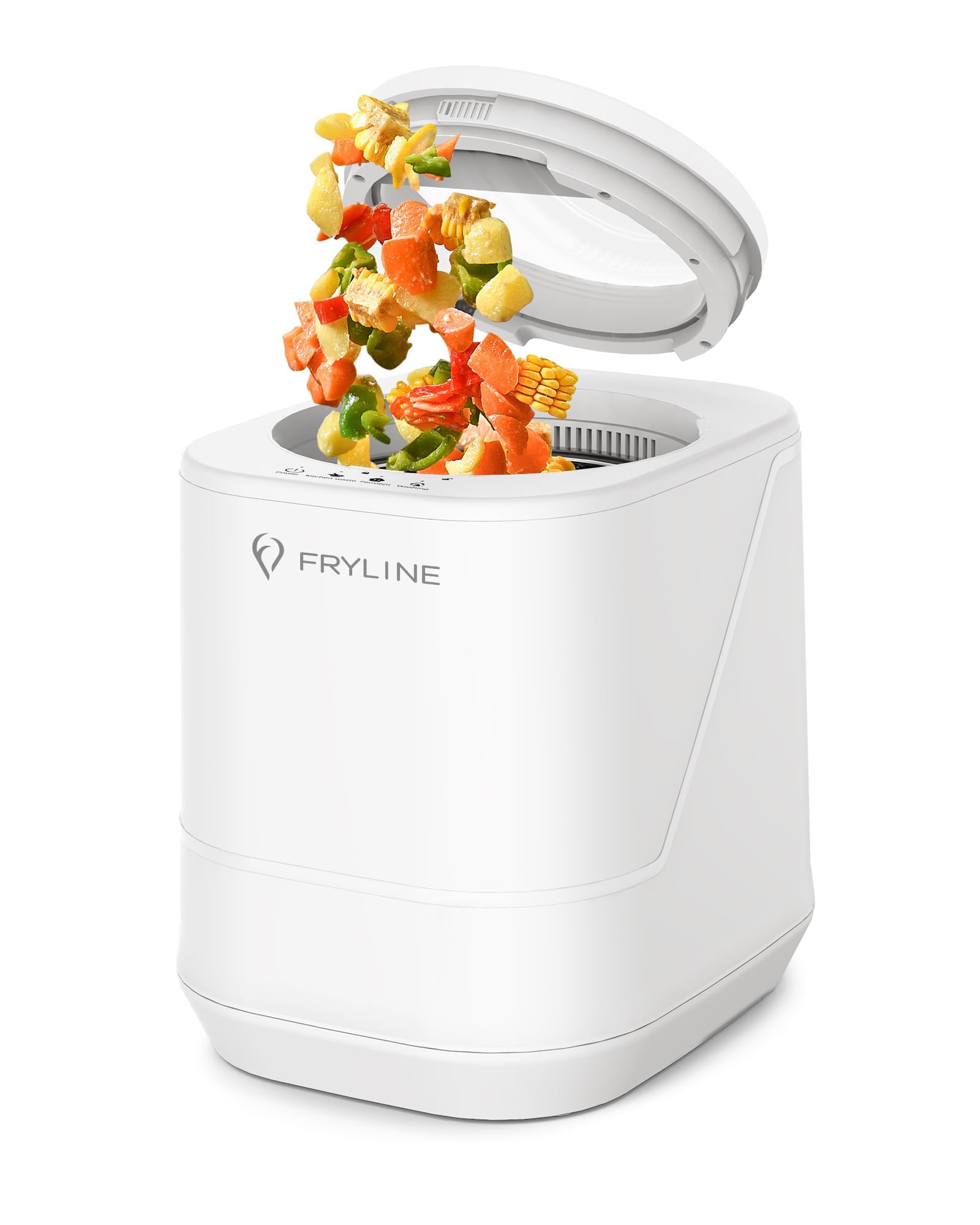
A 4-liter machine that reduces waste by up to 90% within 3 hours — with a filter that tells you when it’s done.
The FRYLINE’s standout number is its speed: it dries, grinds, and cools waste down to a fraction of its volume within 3 hours, and runs at under 40 dBA, so an evening start fits any household. That 4-liter capacity makes it one of the roomier compact machines and a good fit for a family’s daily scraps. Three modes — Crush, Ferment, and Clean — let you pick between volume reduction and richer compost, or let the machine clean its own drum.
Two features separate it from the crowd. The large carbon filter removes odors during processing and alerts you once it hits its 1,000-hour limit, so you are never guessing about replacement. And the low-speed, high-torque blades are built to handle most food materials without choking. The detachable bucket is dishwasher safe, which makes the cleanup a pull-and-load rather than a scrub. The honest catch is reliability: the recurring purchase consideration here is what you give up in long-term confidence at this price level — some units stop early, and the value split is mixed.
The 18-pound weight means you will want a permanent landing spot, but the clear-lid design makes the machine easy to monitor as it runs. For a buyer focused on speed and a lit-up filter reminder, it earns its place on the shortlist.
Good fit for: buyers who want a 3-hour run and an unmissable filter-reminder.
Off the table if: long-run reliability is your deal-breaker.
9. Reencle Prime Electric Composter

A 14-liter drum that decomposes up to 2.2 pounds of food scraps a day and runs at a whisper.
If the smaller machines feel like toys, the Reencle Prime is the opposite end of the market. Its 14-liter drum is the largest here — roughly five times a 2.5-liter machine — and it uses patented microbe technology rather than pure heat and blades. That aerobic approach turns up to 2.2 pounds of food scraps into actual compost in anywhere from 2 to 24 hours. The result is real, nutrient-rich compost rather than just dried powder, which is the reason this one sits at the top of the price ladder.
The noise figure is the number that surprises people. It runs as low as 28 dB, which is whisper level — quieter than most of the grinders in this list. The 3-layer filter system handles odors, and the box comes complete with a carbon filter, a compost starter pack, and a shovel, so you can start the same day. Waste reduction of up to 90% is the promised outcome, which means most of your kitchen volume disappears instead of going to the bin.
The honest trade-offs are real, though. The lid operation draws mixed reactions, and at 20.1 pounds it is not a machine you move around — but with a 14-liter bucket you are emptying far less often than with a 2.5-liter unit. This is the one for a busy family that cooks a lot and wants a single, serious machine.
Where it holds its own
- 14-liter drum — the largest in this lineup
- 28 dB operation and a 3-layer filter system
- Patented microbe aerobic process makes real compost
- Starter pack, carbon filter, shovel included
What costs you
- Heaviest machine here at 20.1 pounds — a fixed-spot appliance
- Lid operation draws mixed reactions
Ideal for: a large cooking household that wants one big drum and true compost, not just powder.
Not ideal for: anyone who wants a counter appliance they can shuffle around.
Understanding the Specs
Capacity in Liters
Capacity tells you how much food waste the bucket holds before you empty it, so it is really a measure of how often you touch the machine. A 2.5-liter machine suits a couple; a 4-liter model fits a family of four’s daily peelings; a 14-liter unit takes larger, busier households. Size the bucket to the scraps your household generates in a day, not to the largest figure in the specs.
Cycle Time and Noise in Decibels
Cycle time is how long a machine takes to dry and grind a load into powder or compost — some finish in 2 to 5 hours, others stretch to 8 in automatic mode. The decibel rating tells you how loud it runs: a quiet-fridge level lets you start it at night, while a louder machine is better for a daytime run. If you process scraps overnight, both numbers matter together.
Carbon Filters and Odor Control
Odor control depends on a carbon filter — an activated-charcoal element that traps the smells from decomposing food. Some machines tell you when the filter is spent, either at an hour-count milestone or a set replacement period, and some include refillable filters instead of disposable cartridges. Match the filter’s rated life to how often you run the machine so you aren’t reordering cartridges every few weeks.
Bucket Material and Cleaning
Look for a removable inner bucket that is dishwasher safe — it turns cleanup into a pull-and-load instead of a scrub. Some machines add a built-in cleaning cycle where you add water and press a button. Others use ceramic or cast-aluminum parts you rinse and wipe. Material also drives weight: a stainless or ceramic drum is far heavier to lift than an aluminum or plastic bucket.
FAQ
Is an electric composter better than a plain countertop bin?
How often do I need to empty the bucket?
Can I put bones and avocado pits in my composter?
How long does a carbon filter last before I replace it?
Will an electric composter fit on a standard kitchen counter?
Can I run the composter at night without waking the house?
What is the difference between drying scraps and real compost?
Do these machines need special compost starter packs?
Can I put a ceramic countertop crock in the dishwasher?
How much power does an electric composter use?
Final Thoughts: The Verdict
For the best overall balance of quiet running, odor control and a cycle you can watch, the Airthereal R500-V is the one to buy — its glass cover, serrated tri-blade and 2-to-5-hour cycle make it the most reassuring pick in the lineup. If your priority is long motor life and low power draw, reach for the Growell GWEC04GY and its 30,000-hour brushless motor. If you cook for a crowd and want a true 14-liter drum (about 59 cups) that produces real compost, the Reencle Prime is the big-machine answer. For a no-plug, no-noise start, the ceramic Chef’n EcoCrock still earns its tidy place on the counter.
How We Picked
We do not accept paid placement. Every pick is matched to a real buyer and a real use-case; we do not hands-on test units.
Sources & Methodology
Specifications: manufacturer listings and product documentation. Review insights: verified customer reviews, as of November 2026. Pricing: not shown on this page (it changes often); check the current price via the retailer link.
As an Amazon Associate, Gadgets Feed earns from qualifying purchases. This does not affect which products we feature.