
Our readers keep the lights on and my morning glass full of iced black tea. As an Amazon Associate, I earn from qualifying purchases.
Specs are compiled from manufacturer listings and verified buyer reviews and can change over time — please confirm the key details on the product page before buying.
You already know freshly ground flour smells nothing like the stale bags at the grocery store. But pick the wrong mill, and you will either get a 30-minute arm workout or a motor that dies after the first batch of wheat berries. This guide explains the real specs—capacity, motor power, and runtime limits—so you choose a machine that handles a weekend bake session without wasting money.
I’m Min, the founder of Gadgets Feed. This guide uses the manufacturers’ published specs and patterns from verified customer reviews to give you each pick’s real strengths and trade-offs.
Whether you grind for a single loaf or stock up for a month, here is the full breakdown of what you need from a capable at home grain mill.
Quick Picks
- OKF 1000g Grain Mill, 304 Stainless Steel Spice — Best Overall
- NutriMill Impact Compact High Speed Electric — Premium Pick
- The Kitchen Mill – Electric Grain Mill — Compact Power
- CGOLDENWALL 700g Electric Grain Grinder Mill — Best Value
- OKF 550g Grain Mill, 304 Stainless Steel Spice — Entry Champ
- WONDERMILL Junior Deluxe Grain Mill — Off-Grid Specialist
How To Choose The Best At Home Grain Mill
Picking a grain mill depends on matching the machine to your grain type and your batch size. The two main styles you will find are impact mills (high-speed blades or rotors that pulverize grain) and burr mills (two grooved plates that crush the grain between them). Each style behaves differently with hard wheat versus oily seeds. The specs below are the three things serious home millers check before buying.
Motor Power and Speed
A motor’s wattage (measured in watts, W) tells you how fast the mill can turn whole kernels into fine flour. Higher wattage generally means faster milling, especially with hard grains like wheat or spelt. Speed, measured in rotations per minute (rpm), also matters: a 28000 rpm machine can produce flour in seconds, but that speed generates heat, which can affect the nutrients in the flour. Most high-speed motors also have a duty cycle—a limit on how long you can run them continuously before the motor needs a cooldown.
Capacity and Bin Size
The capacity of a mill (given in grams for blade-style grinders or cups for impact mills) tells you how much grain the hopper holds before you need to refill. If you bake one loaf at a time, a smaller capacity—around 550g to 700g—is fine. If you regularly bake multiple loaves or batches of pasta, look for a mill that holds 1000g (2.2 lbs) or has a separate flour canister that collects the output, like a 12-cup canister. The grinding bin size also affects the footprint on your counter.
Milling Head Material and Versatility
Milling heads come in stainless steel or stone. Steel burrs handle oily grains, nuts, and high-moisture ingredients without gumming up, and they are more durable. Stone burrs produce a slightly cooler flour because they grind slower, which some bakers believe preserves flavor and nutrients better. A machine that lets you swap between burr sets gives you the widest range of what you can mill, from dry wheat to nut butter.
Quick Comparison
| Model | Best For | Motor Power | Capacity | Milling Style | Amazon |
|---|---|---|---|---|---|
| OKF 1000g Grain Mill | Bulk Grinding | 3000W | 1000g (2.2 lbs) | High-Speed Blade | Amazon |
| NutriMill Impact Compact | Frequent Baking | 1200W | 8-cup hopper / 12-cup canister | Impact | Amazon |
| The Kitchen Mill | Fast Output | 1000W | 24 cups in under 10 min | High-Speed | Amazon |
| CGOLDENWALL 700g | Versatile & Safety | 2400W | 700g (1.5 lbs) | High-Speed Blade | Amazon |
| OKF 550g Grain Mill | Entry-Level Grinding | 2000W | 550g | High-Speed Blade | Amazon |
| WONDERMILL Junior Deluxe | Off-Grid / Oily Grains | Manual (hand crank) | 1.25 cups per minute | Stone & Steel Burrs | Amazon |
In‑Depth Reviews
1. OKF 1000g Grain Mill, 304 Stainless Steel Spice Grinder, 3000W High-speed
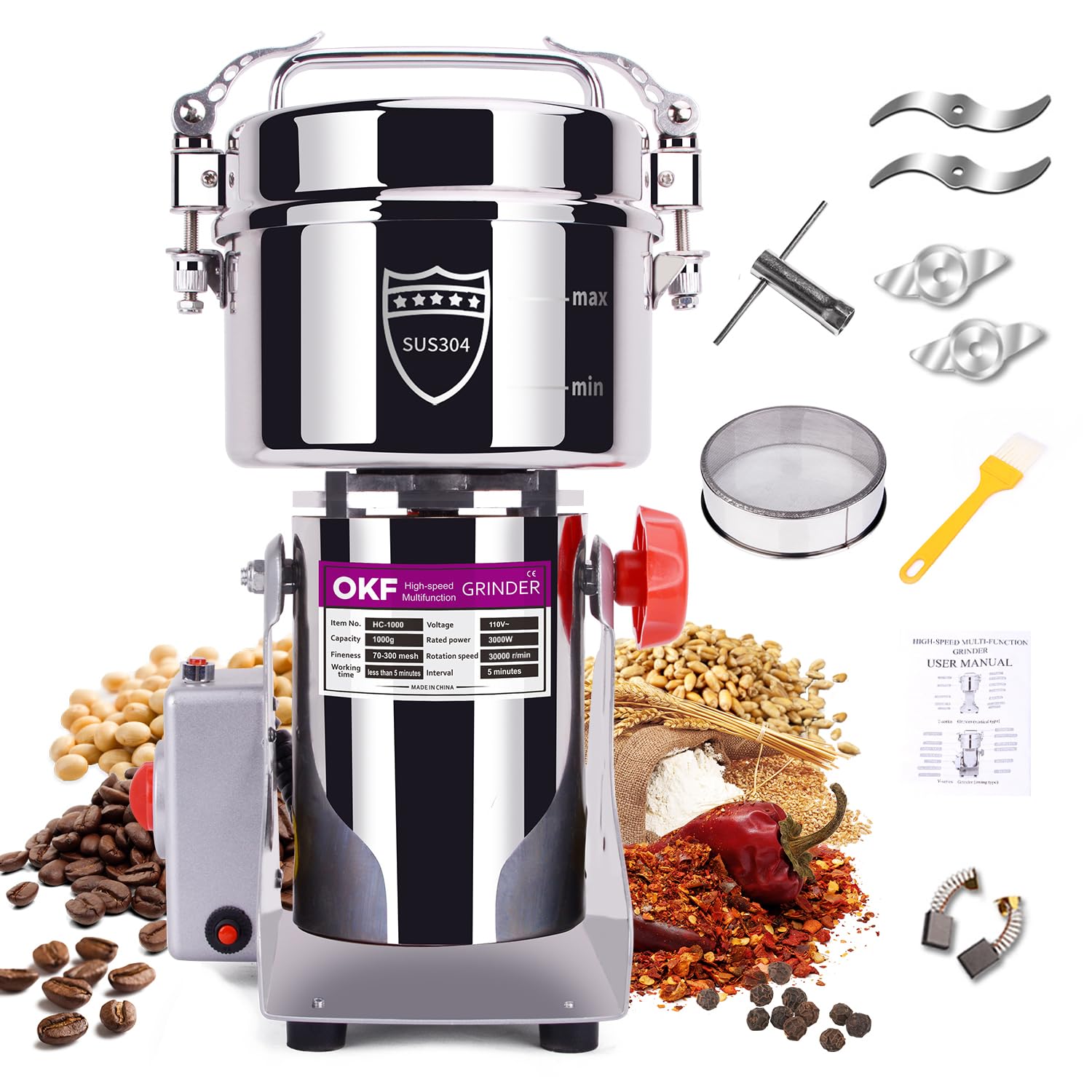
The 3000W motor and 1000g (2.2 lb) hopper mean you fill it once and get enough flour for the week.
This mill holds the largest capacity among the blade-style mills here—1000g (2.2 lbs)—so you can fill the hopper once and grind enough flour for several loaves. The triple-blade system (powder, rotary, and dust removal blades) lets you dial in fineness from a coarse 70 mesh to a superfine 300 mesh, which means you can go from cornmeal to pastry flour by adjusting the timer.
High-speed grinding creates heat. Buyers report the motor burns out if you run it over 5 minutes continuously, and you must wait 10-15 minutes to cool—the same duty cycle as the 550g version. That works fine for 30-second to 2-minute grain runs, but you need to plan your batches. The 304 stainless steel body keeps food safe, and the lid catches debris. Owners mention the included brush makes cleaning the inner chamber easy (just a damp cloth, no submersion).
Compared to the smaller CGOLDENWALL at 2400W, this OKF holds 1000g (2.2 lbs) versus the CGOLDENWALL’s 700g (1.5 lbs), and runs at 30000 rpm versus 28000 rpm, so you get more flour per cycle and finer control over the grind. The trade-off is size: at 9″L x 9″W x 14.2″H, it takes up more counter space than the 5.5″ base of the 550g mill.
The Power Advantage
- Holds 1000g (2.2 lbs) — largest capacity among the blade-style mills here, good for multiple loaves.
- 3000W motor (30000 rpm) grinds hard wheat and corn into fine flour in seconds.
- 304 stainless steel body and grinding bin for food safety and durability.
- Adjustable fineness from 70 to 300 mesh via the timer.
The Heat Reality
- Motor burns out if run over 5 minutes continuously; must cool 10-15 minutes between runs.
- Noisy operation—will shake and move across the counter.
- Larger footprint (9″ x 9″ base) takes up counter space.
- No tool included to remove the blade for thorough cleaning.
Buy it for: bakers who need a lot of flour fast from a single machine—the high capacity and 3000W motor mean fewer refills and seconds per batch.
Watch for: the 5-minute runtime limit means you cannot feed grain continuously; you work in short bursts with cooldown gaps.
2. NutriMill Impact Compact High Speed Electric Grain Mill

This impact mill uses a 1200W motor to fling grain against a steel ring, producing fine flour without the heat of blade grinders.
Unlike blade-style grinders, the NutriMill uses an impact milling head that flings grain against a stainless steel ring at high speed. This action creates fine-textured flour ideal for bread without overheating the grain, which some customers note keeps more nutrients intact. The 1200W motor still powers through hard wheat, and the patented Cyclone Air Filtration maintains airflow so the mill does not choke on fine dust.
Reviewers report that the impact head grinds 3 cups of wheat berries in seconds and 12 cups in about 5 minutes—significantly quieter than the blade grinders. The 8-cup hopper feeds into a separate 12-cup flour canister, so you are not stopping to empty the bin mid-batch. A single knob controls both speed and feed rate (seven settings from coarse to fine), which simplifies operation versus timer-based blade mills. Reviewers point out that levels 1-2 are slow for fine flour; they recommend staying at level 3 or above for consistent bread-flour texture.
Compared to the 1000g OKF, the NutriMill holds slightly less grain per hopper fill, but its continuous milling design (no cooldown duty cycle reported) means you could run multiple batches back-to-back for baking marathons. The impact heads are for dry grains only—skip oily seeds and nuts, as those need burr plates.
Built for Batch Baking
- Impact milling produces fine bread flour without overheating the grain.
- 12-cup flour canister collects output so you mill multiple loaves without emptying.
- Patented cyclone air filtration keeps the mill running cleanly.
- Quieter than blade-style grinders—shoppers say “quieter than expected.”
Not for Oily Grains
- Cannot handle oily seeds, nuts, or high-moisture ingredients (use burr mill for those).
- Low settings (1-2) are very slow for fine flour; best results above level 3.
- Top is difficult to clean thoroughly; needs a brush for crevices.
- Larger footprint than compact blade mills.
Choose this for: regular bread bakers who want consistent fine flour without worrying about motor cooldown—the impact design runs continuous batches.
Keep in mind: if you also mill oily spices or nut butter, this mill will not handle them; keep a burr mill for that.
3. The Kitchen Mill – Electric Grain Mill

At 10″L x 8.5″W x 7.75″H and 8 lbs, this is the smallest electric mill here—and the only one assembled in the USA.
The manufacturer claims it produces up to 24 cups of flour in under ten minutes, which makes it one of the fastest per-cup-output mills here. The 1000W commercial motor drives a high-speed milling chamber with a stainless steel interior that, according to the brand, never gums, jams, or glazes, even with sticky gluten-free grains like rice or sorghum.
Buyers primarily use it for fine flour, and they report it does that very well. The see-through mill pan lets you monitor the flour output without stopping the machine. However, multiple buyers report it is very noisy—one owner says ear protection is a good idea. The top cover (clear plastic) feels less sturdy than the motor base, and a long-term user reported the attachment point feels like it could break after a year. Cleaning is straightforward: a baker’s brush or a dry hand towel wipes the stainless chamber clean.
Unlike the previous NutriMill, The Kitchen Mill is a single-function fine-flour machine. It does not produce coarse grinds for brewing or cracking grains for porridge. If your goal is exclusively bread and pastry flour from dry grains, this is the fastest route between whole kernel and finished flour in a compact package.
Speed in a Small Box
- Most compact electric mill here (10″ x 8.5″ x 7.75″)—fits under standard cabinets.
- Produces 24 cups of flour in under ten minutes.
- Stainless steel milling chamber resists gumming and jamming.
- Assembled in the USA by a family-owned company.
Single-Speed Reality
- Only produces fine flour—no coarse grind options for brewing or porridge.
- Very noisy; ear protection recommended by some buyers.
- Clear plastic cover feels less durable than the metal base—potential break point.
- 90-day limited warranty is shorter than most competitors.
Pick this if: you need fine flour fast and counter space is tight—this is the smallest electric mill that can still output 24 cups in under ten minutes.
Skip it for: versatile grinding that includes coarse cracked grain, oily nuts, or spices—this mill does fine flour and fine flour only.
4. CGOLDENWALL 700g Electric Grain Grinder Mill Safety Upgraded 2400W

The 2400W motor and 700g capacity sit between the smaller and larger OKF models, but this one has two unique safety features: an open-cover-stop mechanism and an overload protector.
This 700g-capacity mill sits between the OKF 550g and 1000g models in size but brings two unique safety features: an open-cover-stop mechanism (the mill instantly shuts off if you lift the lid) and an overload protector that automatically stops the motor if it gets too hot or draws too much current. The 2400W motor spins at 28000 rpm, which is 2000 rpm slower than the 3000W OKF above, but still fast enough to turn wheat berries into superfine powder in seconds.
Reviewers report it handled 3 cups of wheat berry and dried bean mix easily in seconds, and they note it is quieter than expected for a 2400W machine. The swing-type design (the grinding chamber rocks slightly during operation) helps distribute the grain more evenly for consistent fineness. The 700g capacity (1.5 lbs) is the balance for a baker making one or two loaves per batch—you are not refilling constantly like with the 550g model, but you are not stuck with a massive hopper like the 1000g.
One reviewer noted a powder leakage issue: there is no rubber seal on the lid, so fine flour dust can escape from the gap during grinding. The included accessories—carbon brushes (spare motor brushes), spare blades, a sieve (a mesh screen for sifting flour), and a cleaning brush—extend the mill’s life and make maintenance easy. The 1-year warranty is longer than The Kitchen Mill’s 90-day coverage.
Safety-First Value
- 2400W motor grinds dry grains, herbs, and spices to superfine powder in seconds.
- Open-cover-stop and overload protector reduce risk of motor burnout or injury.
- 700g capacity (1.5 lbs) fits single-to-double loaf baking without constant refills.
- Includes spare carbon brushes, blades, sieve, and cleaning brush.
Mess Factor
- No rubber seal on lid—fine flour leaks from the gap during operation.
- Motor must rest 5-10 minutes after every 3 minutes of operation.
- Lid must be fully buckled to start; adjusting the lid position can be fiddly.
- Swing design takes more counter space than a static base.
Best for: the baker who wants safety features (lid shut-off, overload protection) at a mid-range price—the 2400W motor still delivers fast results.
The catch: expect some flour dust to settle around the machine during use; wipe down the lid seal area after every batch.
5. OKF 550g Grain Mill, 304 Stainless Steel Spice Grinder, 2000W High-speed

The 2000W motor and 550g capacity are the smallest electric combo here, perfect for a single loaf without wasted counter space.
At 5.5″L x 5.5″W x 14″H and 7.7 lbs, this 550g mill is the smallest and lightest electric option in the list. The 2000W motor spins at 28000 rpm and uses the same triple-blade design (powder, rotary, dust removal) as its larger 1000g sibling. It covers the same 70 to 300 mesh fineness range, so you can grind anything from coarse cracked corn to ultra-fine rice flour. The 304 stainless steel construction keeps the grinding chamber food-safe and easy to wipe down.
A consistent thread in buyer reviews is that this mill is effective for turning wheat berries into powder for bread, but buyers caution that the motor burns out if run over 5 minutes continuously, requiring a 10-15 minute cooldown. That runtime limitation is identical to the larger 1000g model. A couple of reviewers also mention the machine is noisy and tends to vibrate across the counter during operation—a silicone mat underneath helps keep it in place.
Compared to the 1000g OKF, this mill holds 550g versus the 1000g OKF’s 1000g capacity, and uses 2000W versus 3000W motor power. It is noticeably more portable and easier to store, but you will refill the hopper more often for multiple loaves. For a single loaf of bread, it is perfectly matched: fill the bin once, run for 30-40 seconds, and you have fresh flour ready.
Space-Saver with Punch
- Small footprint (5.5″ base) fits tight kitchen counters and stores easily.
- 2000W motor grinds grains and spices to 70-300 mesh fineness.
- 304 stainless steel body and bin for food safety and durability.
- Timer-controlled fineness—set the time, walk away, come back to finished flour.
Limited Duty Cycle
- Motor burns out if run over 5 minutes; needs 10-15 minute rest between runs.
- Noisy and shakes during operation—moves on smooth countertops.
- 550g capacity means frequent refills for more than one loaf.
- No blade removal tool included; cleaning the blade area is awkward.
Grab this for: a first-time grain mill buyer who bakes one loaf per batch and wants the smallest electric machine that still has enough power for hard wheat.
skip it if: you bake multiple loaves in one session—the 550g capacity and 5-minute runtime limit will frustrate you with refills and cooldowns.
6. WONDERMILL Junior Deluxe Grain Mill with Stone and Stainless Steel Burrs
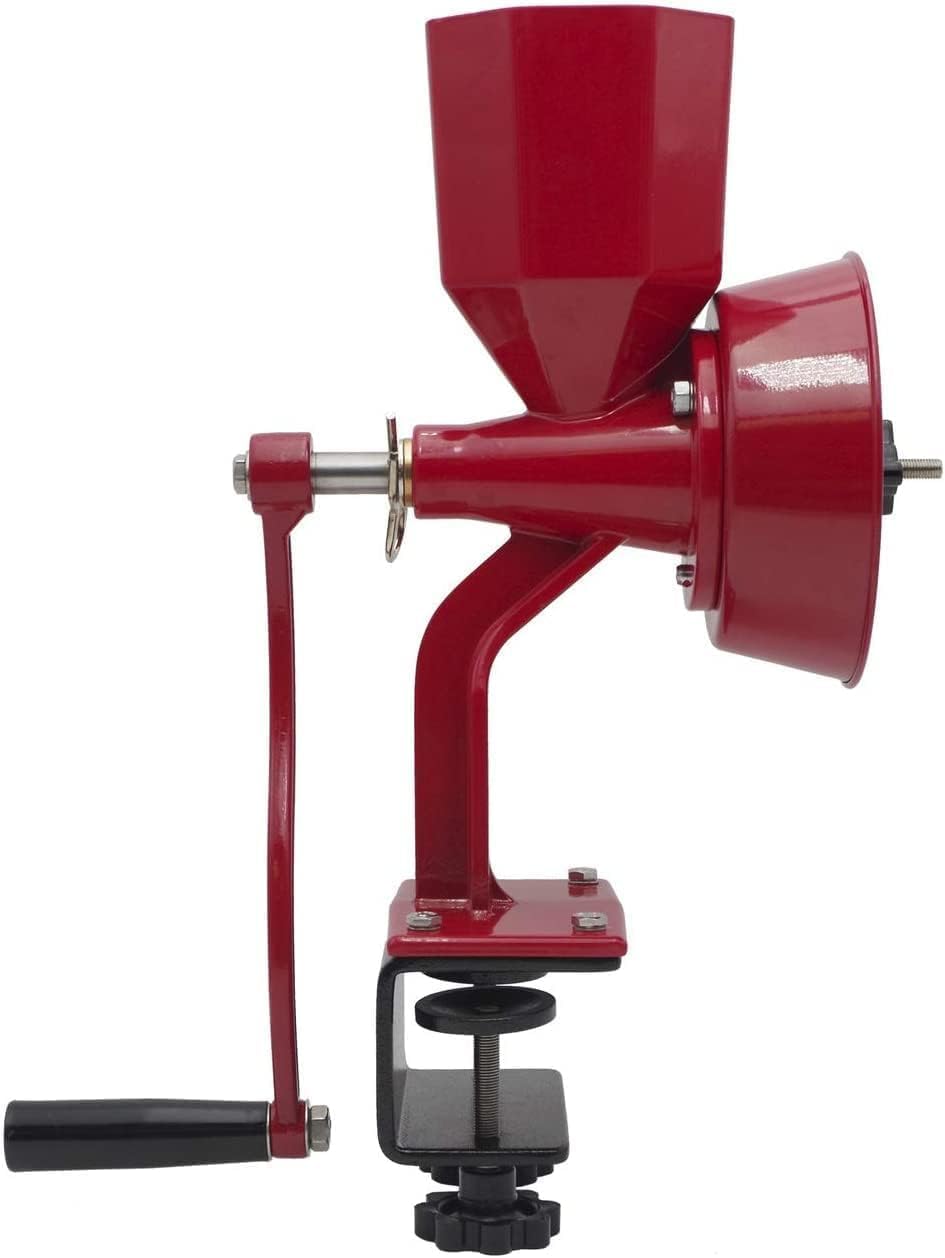
This manual mill uses stone and steel burrs to grind what no electric mill can handle: oily nuts, high-moisture grains, and chocolate.
This is the only manual mill on the list, and it earns its place by handling ingredients that destroy electric blade mills: oily nuts (almonds, peanuts, cashews), high-moisture grains, chocolate, cocoa nibs, flax seeds, and coconut. The Junior Deluxe comes with two burr sets—stone burrs for dry grains like wheat and corn, and stainless steel burrs for oily or moist ingredients—that you can swap in seconds. The manufacturer says it grinds 1.25 cups of flour per minute, which is 65% more than other hand mills in its price range.
Reviewers praise the all-metal construction (aircraft aluminum body with epoxy coating) and the dual-clamp mount that secures the mill to a counter without drilling. The locking adjustment knob lets you set a precise grind from ultra-fine (00 flour) to super coarse cracked grain. One buyer mentioned that grinding 1 cup of hard red wheat to fine flour took under 5 minutes—a realistic pace for manual operation. The stone burrs produce a non-gritty flour that a reviewer called “true flour mill quality,” though the steel burrs can feel rough with sporadic jolts.
There is a catch: manual grinding is a genuine workout, especially for older users or anyone making multiple cups of flour. The instructions do mention a drill can be attached to motorize the mill, and a reviewer confirmed that mod boosts speed by 4x. For off-grid use, emergency preparedness, or anyone who wants complete control over the milling speed and temperature, this is the most versatile mill in the entire list.
Ultimate Versatility
- Two burr sets (stone and stainless steel) cover dry grains, oily nuts, chocolate, and nut butters.
- All-metal unibody construction with aircraft aluminum—built to last a lifetime.
- Dual-clamp mount secures to counter without drilling.
- Adjustable grind from ultra-fine (00 flour) to very coarse cracked grain.
- No electricity needed—works off-grid or during power outages.
Manual Effort Required
- Hand-cranking is a workout—1 cup of fine flour takes under 5 minutes, but multiple cups is tiring.
- No numerical grind settings; dialing in consistency takes practice.
- Flour can spew sideways from the burrs during operation; no included shield.
- Small hopper (1.25 cups); requires frequent refills for larger batches.
Reach for this if: you need one mill for everything—dry wheat, oily almonds, wet coconut, and nut butter—without depending on electricity.
Think twice if: speed and convenience matter more than versatility; an electric mill finishes a batch while you are still cranking the first cup.
Understanding the Specs
Motor Wattage and RPM
The wattage (W) of a grain mill motor tells you how much electrical power it converts into grinding force. Higher wattage translates directly to faster milling, especially with hard grains like spelt or hard red wheat that require more energy to pulverize than soft white wheat. The 3000W OKF mill, for example, finishes a batch of 500g of wheat in around 30 seconds, while a 1000W mill might take over a minute for the same quantity. RPM (rotations per minute) is the speed the blade or milling head spins. At 30000 rpm, the blades hit the grains thousands of times per second, producing very fine flour quickly, but also generating heat. Slower milling (like with stone burrs) keeps flour cooler but takes more time and physical effort.
Duty Cycle and Cooldown
Every high-speed electric grain mill in this article has a duty cycle—a maximum continuous running time before the motor risks overheating. A typical duty cycle is 3 to 5 minutes, after which the machine needs a rest period of 5 to 15 minutes to cool down. This is not a design flaw; it protects the motor from burning out under the heavy load of grinding hard grains. If you plan to mill multiple batches in one session, you need to account for these cooldown gaps. The NutriMill and The Kitchen Mill use lower-wattage motors and different milling mechanisms (impact and high-speed respectively) that allow longer continuous operation without the same strict duty cycle. Manual mills like the WONDERMILL have no duty cycle—you control the speed and heat with your own pace.
Capacity (Grams vs Cups)
Grain mills measure capacity either by the weight of grain the grinding bin can hold (in grams, typically 550g, 700g, or 1000g) or by the volume of the hopper (in cups). Weight-based capacity is more accurate because different grains have different densities—a 550g bin holds about 4 cups of wheat berries but only 3 cups of denser corn. Capacity determines how much flour you get per batch before refilling. The 1000g (2.2 lbs) OKF mill produces roughly 8 cups of flour per full bin, enough for two standard loaves of bread. The NutriMill’s 8-cup hopper feeds into a separate 12-cup flour canister, so you can mill multiple consecutive batches without stopping to empty the container.
Milling Head Types
The milling head is the part that does the work, and there are three common types in home grain mills. Impact mills use a high-speed rotor to hurl grain against a stationary steel ring, shattering the kernels into fine flour. They are fast, produce very consistent fine flour, and generate some heat. Blade grinders use spinning stainless steel blades (similar to a coffee grinder) and pulse the grain with the timer. They are the most affordable and versatile, able to handle spices and herbs alongside grains, but they produce more heat and have stricter duty cycles. Burr mills crush the grain between two grooved plates (stone or steel) that turn against each other. Stone burrs are cooler and preferred by purists for flavor retention; steel burrs handle oily and high-moisture ingredients without gumming.
FAQ
Can I grind oily grains like flax or sesame in an electric grain mill?
How long does a grain mill motor typically last?
What is the difference between stone burrs and steel burrs for grinding grain?
Can I grind coffee beans in a grain mill?
How do I clean a grain mill without damaging the motor?
Is a manual grain mill faster than an electric one?
Will a 2000W grain mill work for grinding hard red wheat?
What does “70 to 300 mesh” mean on a grain mill?
Can I make nut butter in a grain mill?
What is the best grain mill for gluten-free flours like rice or sorghum?
Final Thoughts: The Verdict
For most buyers, the at home grain mill winner is the OKF 1000g Grain Mill because it combines the largest 1000g capacity with a 3000W motor that out-powers every other blade mill here, giving you fine flour in seconds for multiple loaves per batch. If you want continuous milling without cooldowns and the cleanest fine flour for bread, grab the NutriMill Impact Compact. And for off-grid versatility or milling oily nuts and spices that electric mills cannot handle, the standout is the WONDERMILL Junior Deluxe with its dual stone and steel burrs.
How We Picked
We do not accept paid placement. Every pick is matched to a real buyer and a real use-case; we do not hands-on test units.
Sources & Methodology
Specifications: manufacturer listings and product documentation. Review insights: verified customer reviews, as of July 2026. Pricing: not shown on this page (it changes often); check the current price via the retailer link.
As an Amazon Associate, Gadgets Feed earns from qualifying purchases. This does not affect which products we feature.