
Our readers keep the lights on and my morning glass full of iced black tea. As an Amazon Associate, I earn from qualifying purchases.
Specs are compiled from manufacturer listings and verified buyer reviews and can change over time — please confirm the key details on the product page before buying.
Whether you’re training for a race, managing a health condition, or just want to know what your heart is doing at rest, an at-home monitor turns a vague feeling into a concrete number. The market splits into three useful camps: fingertip pulse oximeters for quick spot checks, chest straps for workout-grade data, and smartwatches for round-the-clock tracking. This guide walks you through the best of each type, so you can match the device to your actual daily routine instead of buying the most complicated option on the shelf.
I’m Min — the founder and writer behind Gadgets Feed. This guide is built by comparing the manufacturers’ published specifications and the patterns across verified customer reviews, so you get each pick’s real strengths and trade-offs instead of marketing spin.
We focus on accuracy, battery life, and comfort, so you can find reliable at home heart monitors that fit how you actually live and move.
Our Picks at a Glance

How To Choose The Right At Home Heart Monitor
Your first decision isn’t about brands — it’s about form. A fingertip oximeter gives you a spot-check of pulse and blood oxygen in seconds. A chest strap gives continuous, precise heart rate during workouts. A smartwatch tracks passively all day and night. Each solves a different problem, so start with what you actually want to learn about your heart.
Decide between spot checks and continuous tracking
If you only need to check your resting pulse or oxygen level now and then, a fingertip oximeter is the simplest tool. If you’re training by heart rate zones, a chest strap is far more responsive to rapid changes than a wrist sensor. If you want trends over weeks — resting heart rate, sleep patterns, stress — a smartwatch collects that data without you thinking about it.
Check the display and reading speed
A clunky display makes a good sensor hard to live with. Look for an OLED screen that’s bright and legible, and check whether you can rotate the readout so it faces you no matter how you hold the device. Reading time matters too — a solid monitor settles on a number within about 8 seconds.
Quick Comparison
| Model | Best For | Battery Life | Connectivity | Wear Style | Amazon |
|---|---|---|---|---|---|
| Innovo Deluxe iP900AP★ Best Overall | Quick, clinical-grade spot checks | 30 hours | None | Fingertip Clip | Amazon |
| easy@Home EHP035Best Value | Bright multi-angle readings | 24 hours | None | Fingertip Clip | Amazon |
| Zacurate Cute DigitalCompact Pick | Small fingers and kids | 30 hours | None | Fingertip Clip | Amazon |
| WRINERY Pulse Oximeter | Value with a protective case | — | None | Fingertip Clip | Amazon |
| Wahoo TRACKR | Rechargeable chest-strap training | 200 hours | ANT+, Bluetooth | Chest Strap | Amazon |
| Polar H10 | Maximum sensor accuracy | 400 hours | ANT+, Bluetooth, 5 kHz | Chest Strap | Amazon |
| Fitbit Inspire 3 | All-day wellness tracking | 10 days | Bluetooth | Wristband | Amazon |
| Garmin vívoactive 5 | Deep health metrics on a bright screen | 11 days | Bluetooth, Wi-Fi | Smartwatch | Amazon |
| Samsung Galaxy Watch 7 | Phone-connected smartwatch experience | 30 hours | Bluetooth | Smartwatch | Amazon |
In‑Depth Reviews
1. Innovo Deluxe iP900AP Fingertip Pulse Oximeter
Our pick — over 4.5★ from 50,500+ verified ratings; the strongest balance of quality and price.
The fingertip clip that wins on comfort and crowd approval
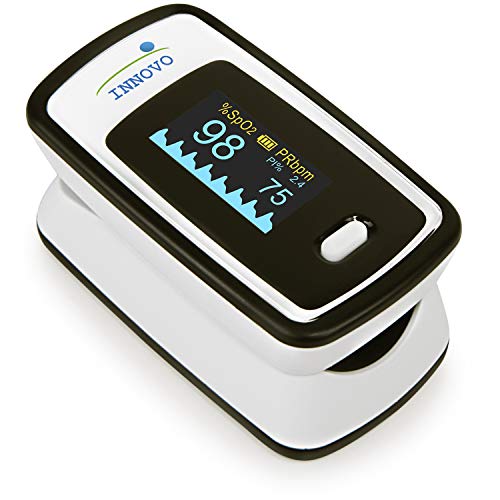
The Innovo iP900AP is the monitor people reach for when they want a reading that feels trustworthy without the pinching many clips cause. It measures both blood oxygen (SpO2) and pulse rate, and it’s built to work even when blood flow in your finger is low — a detail the improved LED and sensor handle well. The display shows your numbers clearly, and you can adjust its brightness to suit the room.
It goes further than a basic clip with a plethysmograph — a waveform showing your pulse strength — and a perfusion index that indicates blood flow volume. This is why owners praise its quality above all else, with well over three thousand detailing the build and dependability. The battery life stretches to 30 hours, so it survives weeks of daily spot-checks before you swap the included AAA batteries.
There’s also an auditory alarm and pulse detection beeps if you want audio feedback, plus a lanyard for carrying. The one trade-off buyers flag is the lack of a protective case at this price — you may want a pouch if it lives in a gym bag. As owners put it: “it picks up an accurate reading without the pinching a lot of them have.”
Why it wins
- Comfortable clip design praised for avoiding pinching
- Adjustable display brightness and clear numbers
- 30-hour battery life with batteries included
- Works at low blood perfusion for harder cases
What to consider
- No storage case included at this price point
- Reliability gets mixed notes — most units are flawless, rare ones power off early
Reach for this if: you want a dependable, comfortable fingertip monitor for daily SpO2 and pulse checks at home or on the go.
Look elsewhere if: you need a hard case for rough travel storage — you’ll be adding your own pouch.
2. easy@Home Fingertip Pulse Oximeter EHP035
A sealed-body clip that blocks stray light for steadier outdoor readings
The easy@Home EHP035 tackles the classic oximeter flaw head-on. Most clips are open on the sides, so stray light leaks in and confuses the sensor in bright sun — this one avoids that design weakness. Buyers report the solid construction reads reliably even “in sunlight or other strong luminescence,” which makes it a favorite for hikers and cyclists who check numbers mid-trail.
You get a reading in about 8 seconds, shown on a sharp OLED screen you can flip into four directions with seven display modes — including a bar graph that gives a visual cue for irregularities like a weak heartbeat. Hold the power button to cycle through 10 brightness levels, and the unit shuts itself off after 8 seconds idle to save power. Its two AAA batteries run continuously for over 24 hours, which trails the Innovo’s 30 hours by a clear margin — the clip lasts roughly 25% less on a set of batteries.
Quality and accuracy are the two things owners mention most, and the package includes a lanyard, carrying pouch, and batteries. The honest caveat is in the manufacturer’s own note: this is for sports and aviation use, not medical use, so don’t treat it as a diagnostic tool.
Grab it when: you want an affordable, accurate clip you can trust for fitness and travel, especially outdoors.
Think twice if: you need a medical-grade monitor — this one is explicitly not intended for medical use.
3. Zacurate Cute Digital Fingertip Pulse Oximeter
The animal-themed clip built for slender fingers and nervous families
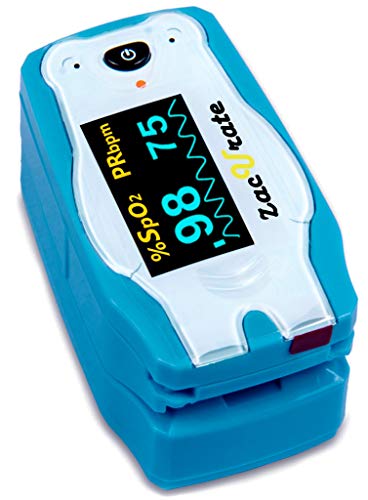
The Zacurate Cute Digital solves a problem most oximeters ignore: small fingers. It’s designed for a finger thickness of 0.2 to 0.6 inch (5-16 mm), so it suits children, petite adults, and anyone who finds standard clips too roomy. Owners praise how well it works on newborns and how it calms anxious families — the accurate readings and “mind-calm” benefits come up repeatedly.
Functionality is the standout here, with over 270 buyers singling it out — it gives quick SpO2 and pulse readings on a sharp OLED display you can rotate into any of six layouts. The plethysmograph waveform confirms proper finger placement, which is why accuracy-minders like it against hospital units. It ships with two AAA batteries, a silicone cover, a pouch, and a lanyard, plus a 12-month warranty with an optional free 12-month extension.
At 30 hours of battery life it matches the top pick’s stamina. The size feedback runs both ways though — some find the compact chamber perfect while others say it’s still too big for the very smallest newborn fingers, so measure before you buy.
The real appeal: a comfort-focused clip that fits small hands and pairs impressive accuracy with a load of accessories from the start.
Who it’s not for: anyone with large adult fingers — the small 5-16 mm chamber is the whole point here.
4. WRINERY Fingertip Pulse Oximeter
An ER-nurse-approved clip that proves a budget sensor can still read true
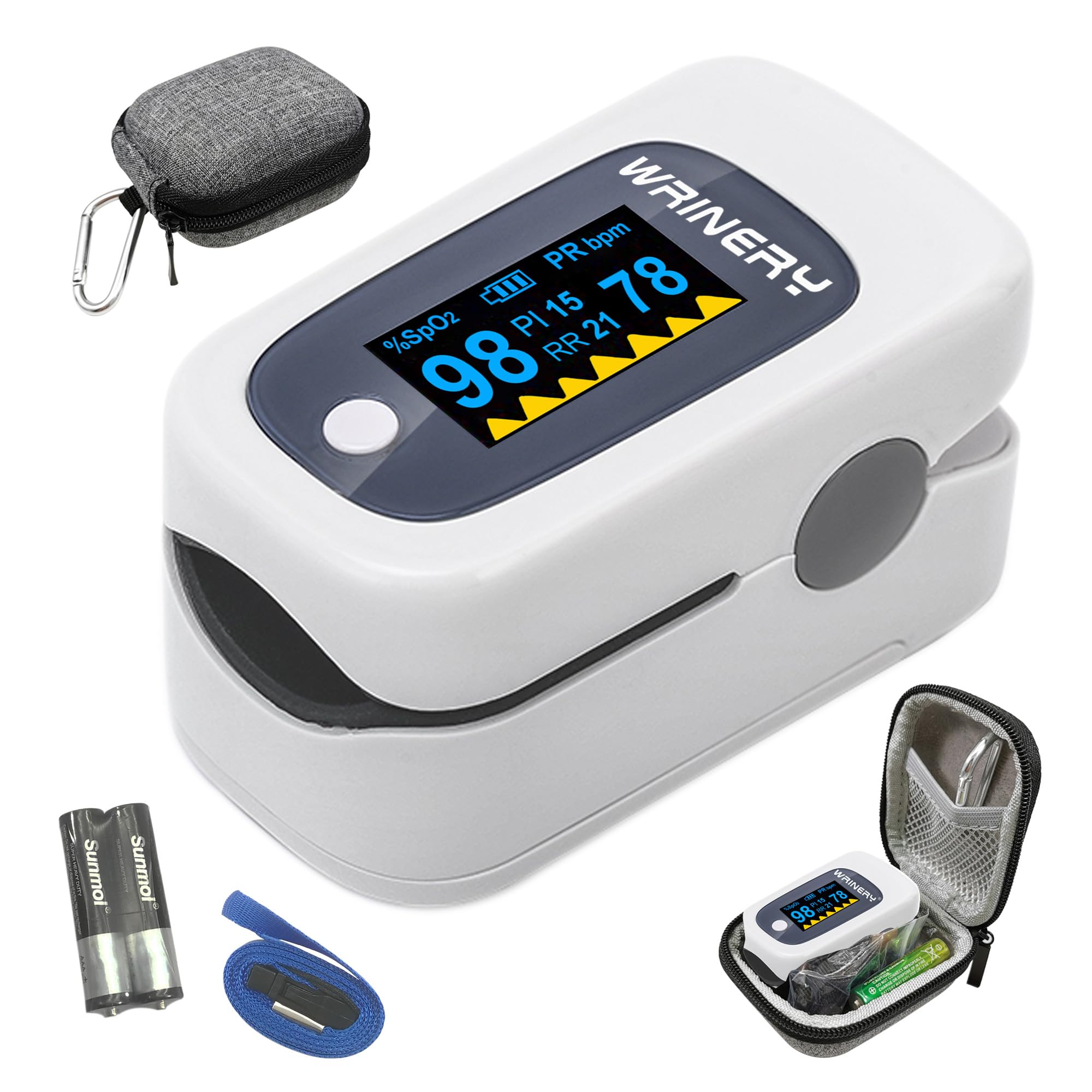
The WRINERY clip earns its place with a surprising stamp of approval — an ER nurse found its readings solid, aided by the plethysmograph waveform, and called out accurate perfusion index and respiratory rate numbers. That’s meaningful praise for a device in the budget tier, and it pairs with owners using it for COVID baseline tracking and finding the pulse matched their Fitbit.
Functionality is what people talk about most here, with 55 calling it out, and the value lands well too — it comes with a high-quality protective case, a hook, a lanyard, and two AAA batteries. You get readings on a vivid OLED display within about 8 seconds, and the compact size accommodates a wide range of finger sizes from young people to seniors. A carabiner is included, so it clips onto a bag easily.
The readout quality splits opinion, though — some find it very accurate and clear while others struggle to interpret it, and the beep it makes isn’t everyone’s favorite. Like the easy@Home, it’s not for medical use; it’s built for home, sports, and aviation monitoring.
Buy it for: a well-priced, well-accessorized clip whose accuracy earned professional respect.
skip it if: you can’t abide any sound — the confirmation beep is a recurring complaint.
5. Wahoo TRACKR Heart Rate Monitor

The chest strap that finally ditches the coin-cell battery ritual
The Wahoo TRACKR is the answer for athletes tired of swapping watch batteries in a chest strap. It packs a high-capacity rechargeable battery with a quoted 200 hours of active life, and owners mention charging every 6-8 weeks even after long runs — one called the rechargeability “perfect” as an upgrade over battery-changing models. It charges over USB-C, which is fast and familiar.
Connectivity is the other headline: it pairs via ANT+ and Bluetooth, so it broadcasts to your phone, a wide range of fitness equipment, and popular training apps. It worked with Zwift from the start, a relief for riders who’d tried cheaper straps that failed. An LED indicator confirms heart rate detection, battery status, and that you’re still connected to your devices during a session.
Functionality wins the most praise, beating earlier Wahoo models with fewer dropouts and wrong readings. The slim, soft strap holds the sensor securely through intense exercise, though the strap itself runs small — larger users note they needed a third-party strap. The durability questions are the caveat, with a few finding the battery/head assembly feels fragile when removed.
Why cyclists and runners like it
- Rechargeable battery — no more buying coin cells
- Dual ANT+ and Bluetooth for app and gym-equipment pairing
- 200-hour active battery life
- LED feedback on detection and connection status
Known trade-offs
- Strap runs small for larger chests — plan a replacement
- A few customers note the battery/head assembly feels fragile
Choose this if: you train with apps like Zwift and want a rechargeable strap that just works from the start.
Pass if: you have a larger build and need a strap that fits straight out of the package.
6. Polar H10 Heart Rate Monitor Chest Strap
The reference-grade chest strap that serious athletes still measure everything against
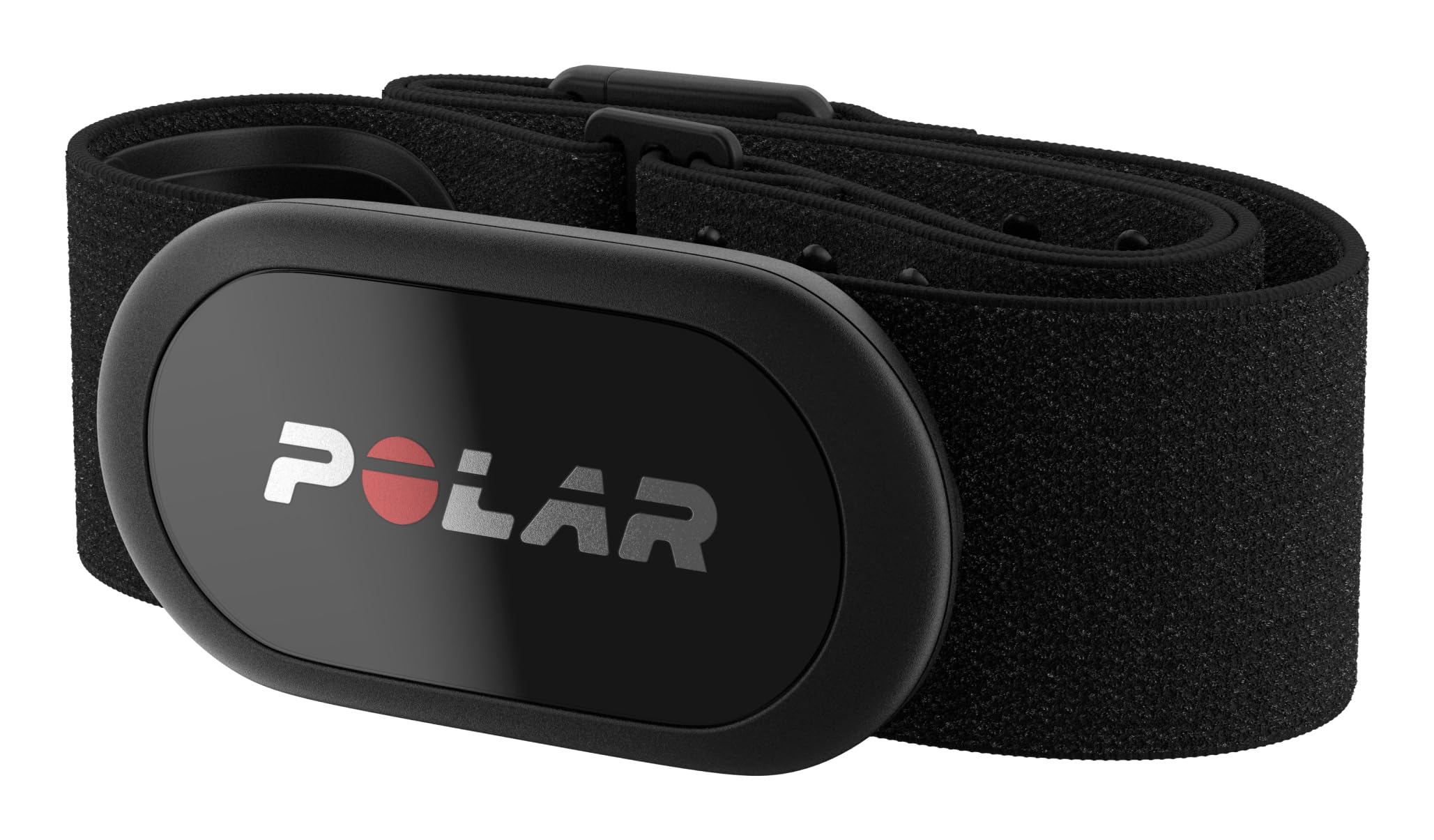
The Polar H10’s ECG-based sensor is the most accurate in Polar’s history, with owner tests showing 92.9% accuracy running, 99.3% cycling, and 95.3% weight training against reference gear. It shows 0 on dropout instead of freezing on a stale reading, a detail that frustrated former Garmin HRM-Dual owners immediately noticed.
It’s also the most versatile connector here. You get Bluetooth, ANT+, and 5 kHz (GymLink), and you can run Bluetooth and ANT+ simultaneously — or even two Bluetooth connections at once. That flexibility is why gym-goers, cyclists, and swimmers all use it. It’s fully waterproof and stores multiple hours of data internally, so you could leave your phone behind. The CR2025 battery (included) lasts up to 400 hours, far outpacing the Wahoo’s 200-hour battery.
The Polar Pro chest strap uses silicone dots and an easy buckle to stay comfortable and interference-free — and it holds its shape better than competitors, needing no gel to get a reading. The honest caveat is connectivity: plenty of owners connect smoothly, but a meaningful group battles pairing issues, and battery life draws some negative feedback. This is the pick for people who want ECG-grade data and don’t mind a little setup friction.
The case for it: class-leading sensor precision, dual simultaneous connections, and a strap that stays flat without gel.
The catch: pairing can be finicky, so it rewards patient setup and a compatible app ecosystem.
7. Google Fitbit Inspire 3
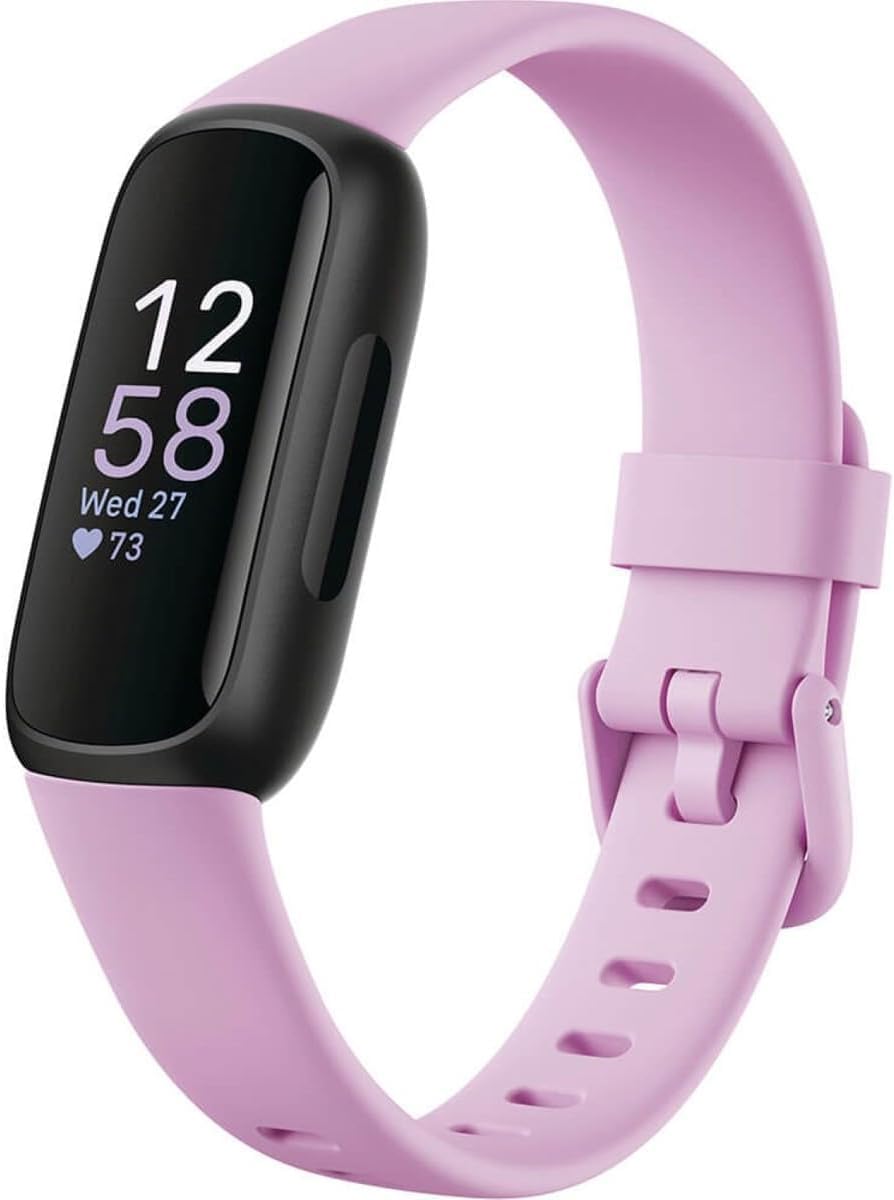
A featherlight wristband for people who want heart data without living in a watch
The Fitbit Inspire 3 is the low-key option for round-the-clock monitoring. At a glance it’s a slim, super-light band that’s water resistant to 50 meters, so it lives on your wrist through showers, swims, and sleep. Its 10-day battery in smartwatch terms is enormous — you can go a full week-plus between charges, and reviewers point out 8-9 days even with the always-on display enabled.
It tracks 24/7 heart rate, resting heart rate, high/low heart rate alerts, and irregular rhythm notifications, plus SpO2 and menstrual health. The sleep tracking is automatic, with a Sleep Score, smart wake vibrating alarm, and sleep mode. You also get a Daily Readiness Score, Active Zone Minutes, 20+ exercise modes, and a stress management score with guided breathing sessions. Calls, texts, and app notifications appear on the color touchscreen.
People love the tracking — that’s the most-praised aspect, with 649 calling it out — but the unit’s reliability is genuinely mixed. Some bands work flawlessly for years while others stop working or struggle to sync; connectivity complaints are the most common negative thread. One owner measured treadmill steps wrong when holding the rails, and another found ankle wear more accurate than wrist. This is a wellness tracker, not a medical device — ideal for casual users who want trends, not clinical certainty.
The everyday strengths
- Super-light all-day wear with 50-meter water resistance
- 10-day battery life
- Automatic sleep and stress tracking with scores
- Color touchscreen with phone notifications
Where it stumbles
- Reliability is mixed — some units stop working or stop syncing
- Connectivity complaints are the most common negative sentiment
Best suited to: anyone who wants passive 24/7 heart and sleep trends in an unobtrusive, comfortable band.
Not ideal for: training-focused athletes who need precise, workout-grade heart rate — a chest strap reads faster.
8. Garmin vívoactive 5 Smartwatch

A bright-screen smartwatch for people who want their heart data explained, not just shown
The Garmin vívoactive 5 pairs a bright, colorful AMOLED display with the deepest passive health analysis in this list. It tracks wrist-based heart rate around the clock, then turns that data into a Body Battery energy score that tells you when you’re charged up or need rest, factoring in sleep, naps, stress, and workouts. Owners consistently call it better than an Apple Watch for fitness and sleep tracking specifically.
Battery life is the headline spec: up to 11 days in smartwatch mode. Where the Inspire 3 gives you a week, this stretches to nearly double that, and shoppers say the realistic range lands around a week to two weeks depending on use. You also get a sleep score with personalized sleep coaching, HRV status, and a morning report with fitness age. It’s built for movement with 30+ built-in GPS sports apps — walking, running, cycling, HIIT, swimming, golf, and even wheelchair mode that tracks pushes instead of steps.
Quality is the most-praised aspect by a wide margin, with 850 owners highlighting the build and screen, and the appearance is a close second. The catch is battery life consistency — while many rave about it, a smaller group reports it barely lasting a day, and reliability does split opinion. If you want music, it stores playlists from Spotify, Amazon Music, and Deezer for phone-free listening. This is a fitness-and-health-first watch that skips the voice-assistant smart features to focus on what your body is doing.
Why it stands out: the Body Battery and HRV insights turn raw heart data into actionable rest-and-train guidance.
Before you buy: expect variability in battery life from unit to unit — most see a week-plus, some far less.
9. Samsung Galaxy Watch 7 Smartwatch

The wrist computer that uses Galaxy AI to filter your heartbeat out of the noise
The Samsung Galaxy Watch 7 is for people who want a full smartwatch that also happens to be a serious heart monitor. Its headline trick is AI-enhanced heart rate tracking — Galaxy AI filters out your body’s movement for a more accurate reading during workouts, then compares your current performance against your last one. The personalized Energy Score calculates today’s physical readiness based on what you did yesterday, using that same data.
It’s also a sleep powerhouse: sleep tracking with Galaxy AI helps detect moderate to severe sleep apnea, and Wellness Tips analyze your collected data on your phone to suggest better habits. The 44mm version pairs a sharp AMOLED display with a snappy processor, and owners praise the build quality, customizability, and accurate GPS and HR. For Samsung phone owners, the connection is smooth — one buyer called it “like a mini phone on your wrist.”
Battery life is the real trade-off here. The quoted average is 30 hours — the shortest of any pick in this guide that runs on its own power — and real-world reports vary wildly from about 11-14 hours up to 3 days without the always-on display. It does charge to 100% in about 2 hours, which softens the blow. One owner’s Watch 7 with AOD (always-on display) ran two days, while a light-use user stretched to five. If you want a week between charges, the Garmin or Fitbit beat it — but neither matches its smartwatch integration.
What it does best
- AI-enhanced heart rate tracking filters out body motion
- Sleep apnea detection with Galaxy AI
- Sharp AMOLED display and premium build
- smooth integration with Samsung phones
The compromises
- 30-hour battery average — the shortest of the wearables here
- Battery life varies wildly from 11 hours to 3 days by use
Choose this if: you’re deep in the Samsung ecosystem and want AI-driven heart and sleep insights with full smartwatch features.
Look elsewhere if: long battery life is non-negotiable — you’ll be charging this one most days.
Understanding the Specs
Battery Life
For fingertip clips, battery life is quoted in hours of continuous use — the Innovo hits 30 hours and the easy@Home 24, so both last weeks of daily spot-checks on one set of AAA batteries. Chest straps and smartwatches measure differently: the Wahoo quotes 200 hours of active training, the Polar H10 stretches to 400 hours on a single coin cell, while wearables like the Garmin vívoactive 5 give 11 days of always-on smartwatch use.
Connectivity
Fingertip oximeters just show you a number — there’s no wireless at all. Chest straps and smartwatches broadcast your heart rate. ANT+ and Bluetooth are the two standards that matter: ANT+ is common on gym equipment and cycling computers, while Bluetooth pairs with your phone. The Polar H10 runs both at once, plus a 5 kHz signal, making it the most versatile connector in this lineup.
FAQ
What is the difference between a pulse oximeter and a heart rate monitor?
Which is more accurate for heart rate, a chest strap or a smartwatch?
Why does my fingertip pulse oximeter give different readings on different fingers?
Are these monitors suitable for medical use?
How long does the battery last on these devices?
Can I connect a chest strap to my phone or gym equipment?
Will a smartwatch work for serious heart rate training?
What does the plethysmograph waveform do?
How do I get the most accurate reading from a fingertip oximeter?
Final Thoughts: The Verdict
For most people, the at home heart monitors winner is the Innovo Deluxe iP900AP because it pairs comfortable, non-pinching clip design with 30-hour battery life and the accuracy features owners trust most — quality, ease of use, and reading clarity regardless of the display angle. If you’re training with heart rate zones, the Wahoo TRACKR chest strap gives you 200 hours of rechargeable, app-connected tracking. And for all-day passive insights with deep analysis, the Garmin vívoactive 5 is the one to reach for — its 11-day battery and Body Battery energy score are hard to argue with, even if you only check your wrist twice a day.
How We Picked
We do not accept paid placement. Every pick is matched to a real buyer and a real use-case; we do not hands-on test units.
Sources & Methodology
Specifications: manufacturer listings and product documentation. Review insights: verified customer reviews, as of August 2026. Pricing: not shown on this page (it changes often); check the current price via the retailer link.
As an Amazon Associate, Gadgets Feed earns from qualifying purchases. This does not affect which products we feature.