
A knife is only as good as its edge. A dull blade turns every slice into a struggle, increases the risk of slipping, and robs you of the precision cooking demands. Whether you own a single chef’s knife or a drawer full of pocket blades, the right sharpener restores that factory-fresh bite and keeps your tools performing at their peak without expensive trips to a professional.
I’m Min — the co-founder and writer behind Gadgets Feed. I spend countless hours cross-referencing abrasive grit ratings, angle guide tolerances, and motor torque specs to separate the sharpeners that deliver consistent results from those that just scratch the surface.
This guide analyzes seven different models — from guided whetstones to high-speed electric systems — so you can confidently choose the best at home knife sharpener for your kitchen and workshop needs.
How To Choose The Best At Home Knife Sharpener
Choosing the right sharpener depends on how much blade material you want to remove, how consistent you need the edge to be, and how much time you are willing to invest. A pocket-friendly pull-through is not the same tool as a multi-stage electric system, and the wrong choice can grind away too much steel or leave an edge that is simply not sharp enough.
Abrasive Type and Grit Progression
The abrasive material — corundum, diamond, or ceramic — determines how aggressively the sharpener cuts steel. Diamond is the hardest and fastest for reprofiling damaged edges, while corundum whetstones offer a smoother feel with more control. Grit numbers tell the story: a coarse 100-400 grit reshapes a chipped blade, a medium 1000 grit refines the edge, and a fine 3000+ grit polishes it to a razor finish. A good system lets you progress through at least two grit stages.
Angle Control and Consistency
Every knife has an optimal sharpening angle — typically 15° to 17° for kitchen knives and 20° for heavier outdoor blades. Fixed angle guides remove guesswork, ensuring every pass removes steel at the same plane. Magnetic guides, spring-loaded arms, and preset slots all serve the same purpose: eliminating the wobble that creates uneven edges. If you are a beginner, look for a sharpener with built-in angle stops rather than relying on freehand muscle memory.
Sharpening Speed and Material Removal
Electric sharpeners with diamond abrasives and 100-watt motors can remove metal ten times faster than a manual stone. This is useful for reviving a neglected blade in under a minute, but it also means one mistake can leave a groove in your knife. Manual stones and rolling sharpeners are slower and demand more passes, but they give you finer control over how much steel is removed and produce a polished edge that many chefs prefer.
Quick Comparison
On smaller screens, swipe sideways to see the full table.
| Model | Category | Best For | Key Spec | Amazon |
|---|---|---|---|---|
| Chef’sChoice 15XV | Electric | Professional-grade speed & finish | 3-stage diamond / 15° Trizor edge | Amazon |
| Homly Professional Electric | Electric | Easy electric sharpening on a budget | 3-stage diamond abrasives | Amazon |
| Goodjob Complete Kit | Water Stone | All-in-one stone kit for beginners | 4 stones: 400/1000 + 3000/8000 grit | Amazon |
| Work Sharp Benchtop Whetstone | Water Stone | Guided angles on a whetstone | 1000/6000 grit + 15°/17° guides | Amazon |
| Bogoni Rolling Sharpener | Rolling | Fast, safe sharpening with no skill | 400 diamond / 3000 ceramic discs | Amazon |
| VN3 Grihot Tungsten Carbide | Pull-Through | Heavy-duty restoration & serrated blades | 3-action tungsten carbide system | Amazon |
| Norton Combination Oil Stone | Oil Stone | Durable bench stone for tools & knives | 100 / 280 grit corundum stone | Amazon |
In‑Depth Reviews
1. Chef’sChoice 15XV Professional Electric Knife Sharpener

The Chef’sChoice 15XV is the gold standard for electric sharpeners, combining a 5-pound brushed-metal chassis with a patented 3-stage EdgeSelect system. Stages 1 and 2 use 100-percent diamond-plated abrasives to sharpen and hone, while stage 3 employs a flexible abrasive stropping system that polishes the edge and extends the life of serrated knives. The flexible spring guides automatically adjust to the blade contour, maintaining a consistent 15-degree angle without any manual setup.
This machine converts traditional 20-degree factory edges into the company’s Trizor XV 15-degree configuration, a geometry that delivers exceptional sharpness while retaining enough durability for daily use. A first-time sharpening takes about one minute, and subsequent touch-ups require roughly ten seconds per knife. The noise level sits between 65 dB and 75 dB — quieter than most kitchen blenders. Users report that a single unit lasts five years even when sharpening a set of twenty knives regularly, though the diamond abrasives will eventually wear out with relentless commercial-grade use.
The 15XV works on both straight-edge and serrated blades, and the metal housing gives it a permanent home on the counter without looking out of place. If you want the fastest path to a razor edge and are willing to invest in a premium unit, this is the sharpener that sets the benchmark.
Why it’s great
- Three-stage diamond system delivers a polished edge in under a minute
- Patented flexible guides maintain a precise 15-degree angle automatically
- Brushed metal housing is durable and kitchen-worthy
Good to know
- Premium price places it above casual buyers’ budgets
- Removes material faster than manual stones, so careful pressure is required
2. Homly Professional Electric Knife Sharpener

The Homly Electric Knife Sharpener brings diamond abrasive technology to a mid-range price point, offering a three-stage system that sharpens, hones, and polishes without requiring manual angle adjustment. Each slot guides the blade at a fixed angle via spring-loaded guide rods, making it nearly impossible to hold the knife wrong. The first two stages use 100% diamond plating for aggressive material removal, while the third stage refines the edge to a smooth finish.
At 3 pounds with a 12.2-inch footprint, this unit is lighter than the Chef’sChoice but still stable enough to sit on a counter without sliding. Users report that the motor runs quietly and that fish fillet knives — notoriously tricky to sharpen — come out sharper than factory new after a few passes. The flexible spring guide rod keeps the blade at an ideal angle over the full length of the edge, which prevents the uneven wear that fixed-slot sharpeners can cause.
The Homly works on all metal steel knives, including chef knives, Santoku blades, and pocket knives, but it does not handle ceramic knives. A 2-year warranty backs the unit, and customer support is responsive within the stated service window. For anyone who wants electric convenience without stepping all the way up to premium pricing, this sharpener delivers a genuinely sharp edge in seconds.
Why it’s great
- Diamond abrasives in all three stages for fast, consistent sharpening
- Spring-loaded guide rods automatically maintain the correct sharpening angle
- Very quiet operation compared to other electric models
Good to know
- Not compatible with ceramic knives
- Requires light, quick passes to avoid creating a groove in the blade
3. Goodjob Complete Knife Sharpening Stone Kit

The Goodjob Complete Kit is the most comprehensive water stone package in this lineup, including two double-sided whetstones (400/1000 grit and 3000/8000 grit), a bamboo base, a flatting stone, a leather strop with green compound, cut-resistant gloves, and both a honing guide and angle guide. The stones use Japanese Osaka firing technology — baked at 2000°F for 48 hours across 20 processes — which results in a hard, slow-wearing abrasive surface that cuts consistently without shedding grit unevenly.
The progression from 400 grit (edge repair) through 1000 grit (refining) to 3000/8000 grit (polishing) covers the full spectrum of sharpening needs. The included angle guide clips onto the knife spine, giving beginners a reliable reference point, while the silicone non-slip bamboo base keeps the stones from sliding across the counter. Users note that even heavily damaged kitchen knives with visible dings can be restored to paper-cutting sharpness within ten minutes after moving through the two coarse stones.
One minor complaint is that the logo printed on one stone surface creates a slight friction bump, which some owners sand down lightly for a perfectly flat face. The kit also lacks a spray bottle for misting the stones as they dry during longer sessions. Despite those small details, this set gives you every accessory needed to start sharpening like a hobbyist, and the 1-year warranty adds peace of mind.
Why it’s great
- Four grit stages (400 to 8000) cover repair, sharpening, and polishing
- Includes cut-resistant gloves, angle guide, and leather strop for a complete setup
- Japanese firing process creates a hard, durable stone surface
Good to know
- Logo on stone face can create a small friction bump during use
- No spray bottle included for re-wetting the stones mid-session
4. Work Sharp Benchtop Whetstone Knife Sharpener

Work Sharp solves the biggest frustration with traditional whetstones — holding a consistent angle — by integrating removable magnetic sharpening guides that lock onto the stone at 15° or 17°. The corundum combination stone offers a 1000 grit side for sharpening and a 6000 grit side for honing, covering the two most useful stages for kitchen knife maintenance. The water control base keeps the stone steady and channels excess water into a reservoir, minimizing the mess that usually accompanies wet sharpening.
The stone measures 4 inches by 2.25 inches, which feels slightly compact for larger chef’s knives but is adequate for most household blades. An anti-skid rubber mat sits underneath the base, preventing the entire assembly from sliding during aggressive passes. Users who are new to whetstone sharpening report that the magnetic guides make a noticeable difference — the knife stays at the same angle from heel to tip, producing a burr evenly across the edge without the frustration of freehand wobble.
The kit includes a user guide with tips from the company, which is a 4th-generation family operation based in Oregon. Limited lifetime warranty backs the product. If you want the precision of a whetstone but find freehand sharpening intimidating, the Work Sharp Benchtop is a smart compromise that removes the guesswork without sacrificing the stone-sharpening feel.
Why it’s great
- Magnetic angle guides lock at 15° or 17° for consistent freehand sharpening
- Water control base reduces mess and provides stable stone storage
- 1000/6000 grit combination covers sharpening and honing in one stone
Good to know
- Stone surface is on the smaller side — 4 inches long — requiring longer strokes on large blades
- Base is made of plastic and does not feel as premium as the stone itself
5. Bogoni Rolling Knife Sharpener
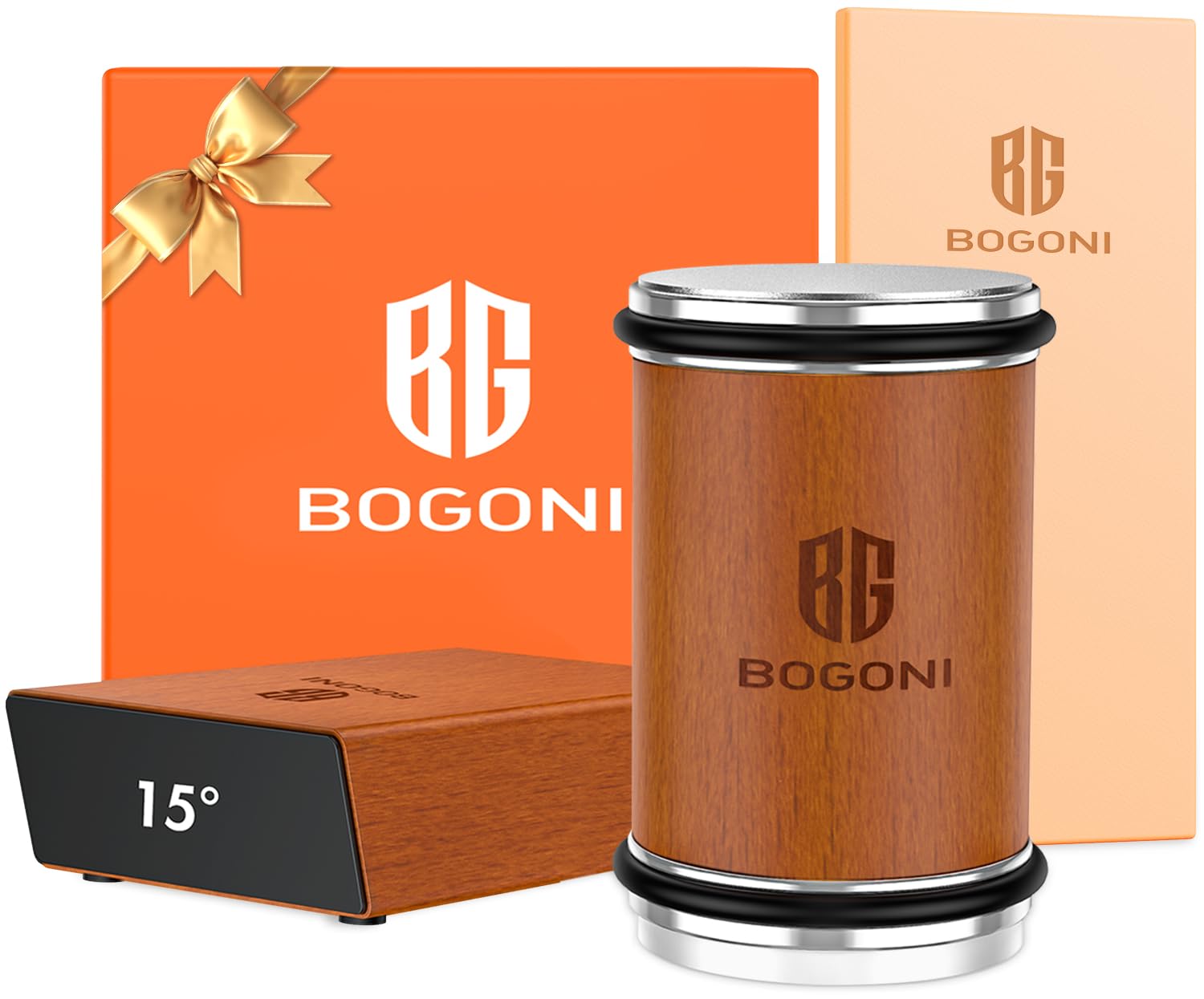
The Bogoni Rolling Sharpener is a fresh take on the manual sharpening category, using a wooden roller housing a 400-grit diamond disc for reshaping and a 3000-grit ceramic disc for polishing. Instead of dragging the blade across a stationary stone, you roll the tool along the knife edge with magnetic angle guides (15° or 20°) that snap onto the blade spine. Six built-in N52 neodymium magnets in the base hold the knife firmly in place, eliminating slipping and wobble during the sharpening motion.
This design is especially friendly for users with wrist or hand fatigue — a professional chef who developed tendonitis reported that the rolling motion required significantly less effort than a traditional stone and still restored a badly dinged blade to razor sharpness in under four minutes. The replaceable discs mean the tool can last for years without losing cutting performance, and the included leather strop adds a final polishing step that burnishes the edge to a mirror finish.
The compact natural wood body measures 4.6 inches by 5.9 inches, making it easy to store in a drawer or display on a counter. It works on most kitchen and outdoor knives but is not designed for serrated blades. The magnetic guides are strong and click into place securely, and the entire kit arrives in a deluxe gift box. For anyone who wants a fast, safe, and low-effort sharpening experience without electricity, the Bogoni is an excellent choice.
Why it’s great
- Rolling motion requires minimal wrist effort — ideal for users with joint pain
- Magnetic angle guides at 15° and 20° ensure consistent edge geometry
- Diamond and ceramic discs are replaceable for long-term use
Good to know
- Not suitable for serrated knives
- Roller design requires a bit of practice to maintain even pressure across the full edge
6. VN3 Grihot Professional Knife Sharpener
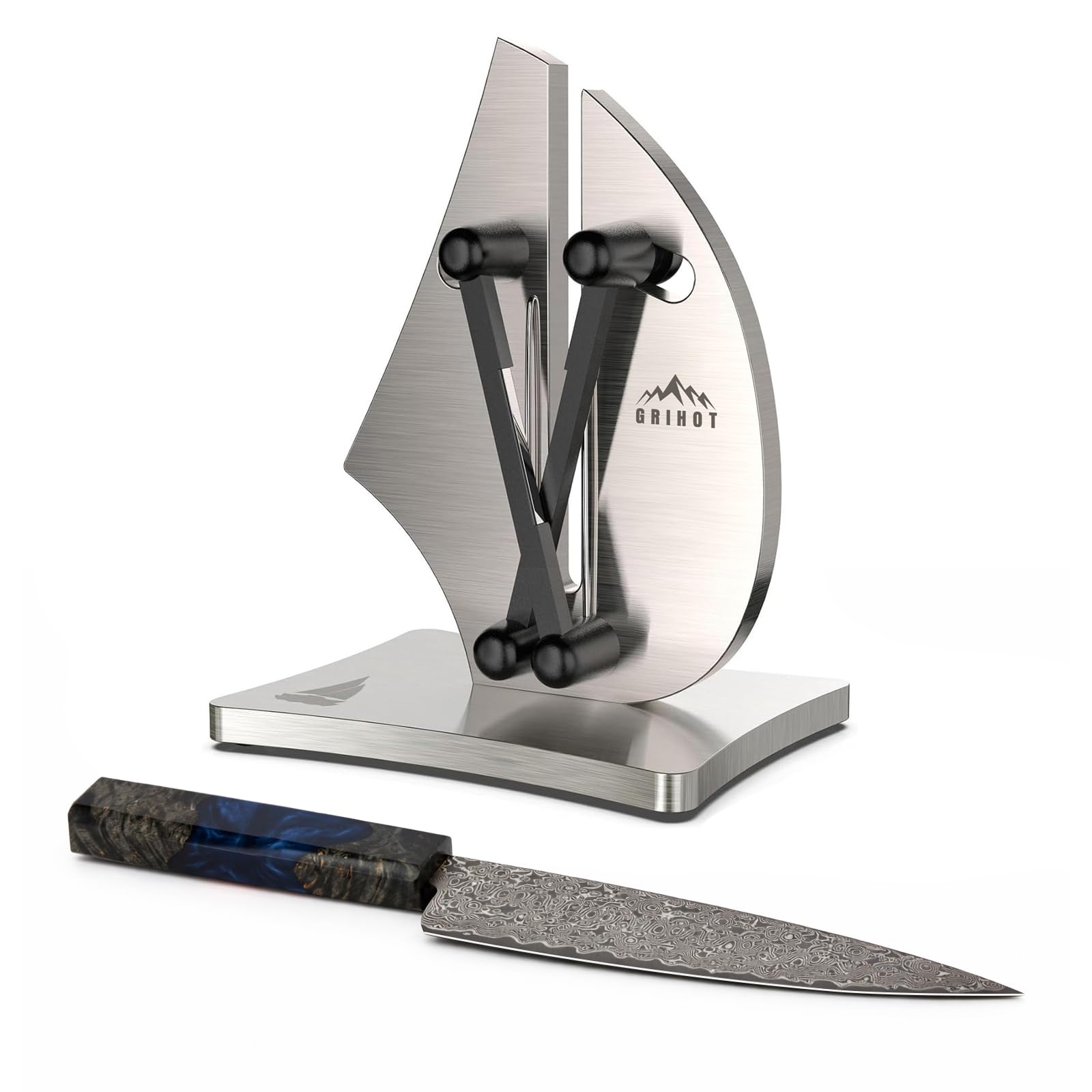
The VN3 Grihot stands out for its heavy-duty construction — a solid 304 stainless steel and Himalayan tungsten carbide body weighing nearly 2 pounds — and its three-action sharpening system. The base of the sailboat-shaped unit has three separate slots: one for repair (aggressive material removal), one for restoration (medium sharpening), and one for final sharpening (fine edge). Each slot uses independent spring-loaded tungsten carbide arms that self-adjust to the blade’s thickness and angle, so you do not need to set any guides or measure anything.
This sharpener excels at reviving knives that have been neglected for years. Users report taking twenty knives — including heavily blunted blades and serrated bread knives — from unusable to shaving-sharp in about 30 minutes. The tungsten carbide arms are replaceable, and the company includes a spare set in the box. The unit underwent 196 hours of grinding and polishing during manufacturing, resulting in a smooth, burr-free finish on the metal surfaces that feels substantial in the hand.
The Grihot is designed solely for steel knives; it should not be used on ceramic blades. It also requires a learning curve — the spring-action arms work best with consistent, moderate pressure, and pulling the knife too fast can leave a rough edge. A 5-year warranty backs the purchase. If you own a mix of kitchen knives, hunting knives, and serrated blades and want one tool that can restore them all, the VN3 is a durable workhorse.
Why it’s great
- Three-action system with dedicated repair, restoration, and sharpening slots
- Tungsten carbide arms self-adjust to blade thickness — no manual setup needed
- Heavy stainless steel construction with a 5-year warranty
Good to know
- Not suitable for ceramic knives
- Requires practice to find the right pull speed and pressure for a clean edge
7. Norton Combination Grit Oil Stone

The Norton Combination Oil Stone is a no-frills bench stone that focuses on what matters: durable corundum construction and a dual-grit surface. One side uses 100-grit abrasive for aggressive edge repair and reprofiling, while the reverse side uses 280 grit for sharpening and maintaining a usable edge. The stone measures 8 inches by 2 inches by 1 inch and weighs 1.5 pounds, giving it enough mass to stay put on a workbench without sliding around.
Unlike water stones that require soaking before use, this oil stone comes pre-filled with lubricant and is designed to be used with Norton’s sharpening oil or even WD-40. The oil keeps metal particles floating on the surface rather than embedding into the stone, which prevents glazing and extends the stone’s working life. Users report that the coarse side cuts aggressively enough to reprofile hatchets and plane irons, while the 280-grit side — though not fine enough for a polished edge — leaves a serviceable working edge that can be refined further with a higher-grit stone or strop.
The stone works best for larger blades and tools where the 2-inch width is sufficient for a full stroke. It is less ideal for very small pocket knives or curved blades. This is not a finish sharpener; you will want a finer stone (1000 grit or above) for polishing. But for anyone who needs a budget-friendly, durable stone for tool maintenance and knife repair, the Norton is a timeless classic that has been trusted for decades.
Why it’s great
- 100-grit side removes material fast for repairing damaged edges and tools
- Oil-filled stone requires no soaking — just add oil and sharpen
- Durable corundum construction outlasts softer water stones
Good to know
- 280-grit fine side is not fine enough for a polished, razor finish
- 2-inch width is narrow for long chef’s knives — requires multiple passes
FAQ
What grit do I need to sharpen a very dull kitchen knife?
Can I damage my knife with an electric sharpener?
How often should I sharpen my kitchen knives?
Should I get an oil stone or a water stone?
Final Thoughts: The Verdict
For most users, the at home knife sharpener winner is the Work Sharp Benchtop Whetstone because its magnetic angle guides take the guesswork out of stone sharpening while the 1000/6000 grit progression handles both sharpening and honing. If you want electric speed and consistent three-stage diamond sharpening, grab the Homly Professional Electric. And for the best high-end performance that will last for years, nothing beats the Chef’sChoice 15XV.