
A nagging earache in your child at 2 AM or a feeling of fullness that won’t clear—these moments leave parents and caregivers facing a frustrating choice: rush to urgent care or just hope it goes away. A personal otoscope puts the power of visual inspection back in your hands, letting you see the ear canal and tympanic membrane before deciding on next steps.
I’m Min — the co-founder and writer behind Gadgets Feed. I’ve spent hundreds of hours cross-referencing clinical-grade specs against consumer reviews to separate the tools that actually illuminate the eardrum from those that waste your time.
After analyzing lens quality, illumination consistency, and build durability across dozens of models, this guide will walk you through exactly what matters when picking the best at home otoscope for your family.
How To Choose The Best At Home Otoscope
Not all otoscopes are created equal. A cheap plastic model with a dim bulb will leave you staring at a yellow glow, while a proper tool with an optical glass lens and bright LED can reveal the crisp landmarks of a healthy eardrum. Focus on these three factors.
Optical or Digital: Which View Do You Need?
Traditional optical otoscopes use a magnifying lens and a light source—you look directly through the head. They offer zero latency and the clearest optical path, but only you can see the image. Digital otoscopes use a tiny camera to stream the view to a screen or smartphone. This allows sharing with a doctor remotely and capturing photos, but you rely on camera resolution and display quality. For routine checks and sharing with a pediatrician, digital is the smarter bet. For instant, uncompromised clarity, optical glass still wins.
Lighting and Magnification: The Make-or-Break Specs
A bright, white LED light is non-negotiable—it must be bright enough to illuminate the tympanic membrane without creating a hotspot. Look for models with at least 4 LEDs and adjustable brightness. Magnification around 3x to 4x is standard; too high and you lose the field of view, too low and you miss detail. Optical glass lenses (not acrylic) resist scratches and distortion over time, which matters when you’re examining a squirming toddler.
Quick Comparison
On smaller screens, swipe sideways to see the full table.
| Model | Category | Best For | Key Spec | Amazon |
|---|---|---|---|---|
| ScopeAround MS450 | Digital Screen | Standalone home use | 4.5″ IPS screen, 32GB card | Amazon |
| Doctor Mom 4th Gen | Optical | Instant, no-app viewing | Optical glass lens, 4x mag | Amazon |
| CynaMed ENT Kit | Diagnostic Kit | Full ENT exam set | Otoscope + ophthalmoscope set | Amazon |
| ScopeAround SA160 | Digital Screen | Portable everyday checks | 3.9mm lens, 8GB card | Amazon |
| Anykit AKE390S | Smartphone | iPhone/Android telemedicine | 3.5mm lens, 0.15″ dia | Amazon |
| 1080P HD Otoscope (Aertnelz) | Digital Screen | Budget digital with screen | 1080P sensor, 1.38″ screen | Amazon |
| AnyScope Digital | Smartphone | Entry-level phone camera | 0.15″ ultra-fine lens | Amazon |
In‑Depth Reviews
1. ScopeAround Digital Otoscope MS450

The ScopeAround MS450 earns the top spot because it eliminates the single biggest friction point in at-home otoscopy: the need for a smartphone app. Its built-in 4.5-inch IPS display powers on instantly, and the 3.9mm camera wand with a built-in gyroscope keeps the image oriented correctly even when you rotate the device. The 6 adjustable LED lights let you dial in the brightness from dim to clinical-grade white, which is critical for seeing the tympanic membrane without glare.
Physicians and audiologists in the reviews specifically praise its build quality—the wand is metal, not plastic—and the battery life supports multiple inspections per charge. The included 32GB memory card means you can store photos and videos locally and later transfer them to a PC or laptop for telemedicine consultations. The fixed focus requires a steady hand and the right distance (around 1-2 cm), but once you find the sweet spot, the image clarity rivals entry-level clinical scopes.
It comes with soft silicone ear tips, ear spoons, and a sturdy stand that frees up both hands during inspection. The only real trade-off is the lack of an insufflation bulb for pneumatic otoscopy, which is a feature reserved for professional medical equipment. For home screening, earwax checks, and sharing visual evidence with a doctor, this is the most complete standalone package available.
Why it’s great
- Large 4.5″ IPS screen means no phone pairing needed
- Gyroscope keeps image upright for intuitive use
- 32GB internal storage for extensive photo/video capture
Good to know
- Fixed focus requires practice to get a sharp image
- Cleaning tools are basic; prefer irrigation for wax removal
2. Doctor Mom 4th Generation LED Pocket Pro Otoscope
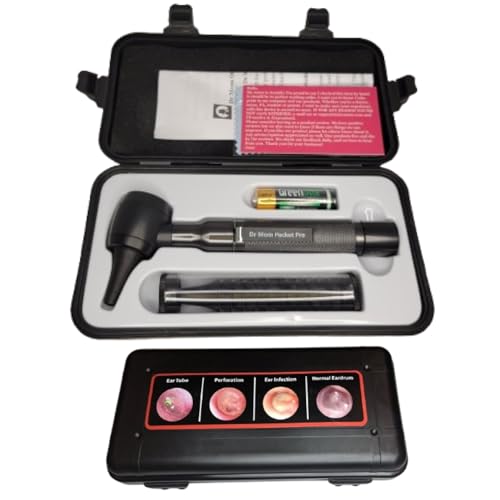
If you want the purest optical path without any camera sensor or screen getting in the way, the Doctor Mom 4th Generation is the benchmark. Designed by an ER physician, this otoscope uses an optical quality glass lens with 4X magnification and zero distortion—you look through the head and see the eardrum as clearly as your own eye can resolve. The anodized aluminum body is noticeably heavier and more rugged than the plastic alternatives, which actually helps steady the scope during an exam.
The full-spectrum white LED is bright without being harsh, and the manufacturer claims the LED module should never need replacement. Battery life is exceptional; a single set of alkaline batteries lasts through many exams thanks to the low power draw of the LED. The kit includes both adult and pediatric disposable specula tips, plus a protective hard case and an ear anatomy chart that helps parents interpret what they see. Users report successfully identifying middle ear infections and avoiding unnecessary urgent care visits.
The most convincing endorsement comes from an RN who calls it a worthy replacement for a Welch Allyn scope at a fraction of the weight. The only caveat is that this is a purely optical tool—no screen, no photos, no video. You cannot share the image with a remote doctor unless you describe what you see. For parents who just need to rule out an obvious infection before bed, this is the most reliable and durable option.
Why it’s great
- Optical glass lens delivers unmatched clarity and zero distortion
- Rugged aluminum body resists cracks and drops
- Forever warranty from an American company
Good to know
- No digital capture or sharing capability
- Specula tips can feel slightly wobbly when attached
3. CynaMed ENT Diagnostic Kit
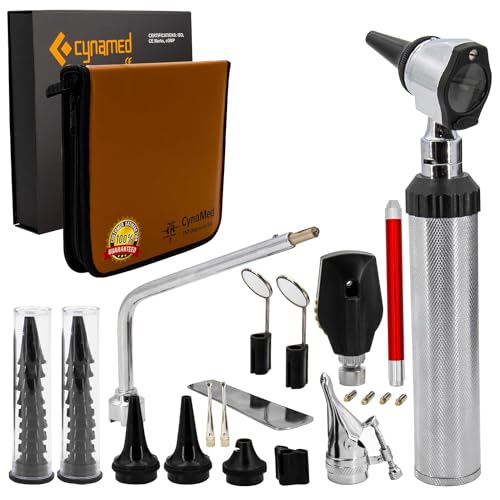
The CynaMed set goes beyond a simple otoscope by bundling an ophthalmoscope, nasal dilator, earwax remover, and multiple mirror attachments into a single portable leather case. This is the right choice if you want a multi-purpose diagnostic tool that covers ears, nose, and throat in one purchase. The otoscope head uses a bright LED, and the handle is a durable chrome-and-plastic construction that has survived drops in clinical settings according to user reviews.
Medical students and nurse practitioners frequently cite this kit as ideal for practicing exam techniques. The interchangeable heads lock securely onto the handle, and the controls for the ophthalmoscope are smooth and responsive—important when you’re learning to adjust diopter settings. The entire set weighs 1.81 pounds, which is substantial for a home kit but necessary to include all the tools. Users consistently praise the illumination consistency and the professional look of the leather bag for transport.
The most critical feedback involves durability: one unit stopped working after four uses, but the seller replaced it free of charge even after the Amazon return window expired. This suggests the company stands behind its product, but you may need to test the unit promptly upon arrival. For a parent who only needs an otoscope, this kit might be overkill. For a medical trainee or a very thorough home health enthusiast, the breadth of tools makes it a compelling package.
Why it’s great
- Complete ENT exam set in one purchase
- Secure interchangeable heads and smooth controls
- Professional leather bag for organized storage
Good to know
- Some units have shown early failure; test immediately
- Heavier than standalone otoscopes at 1.81 lbs
4. ScopeAround Digital Otoscope SA160
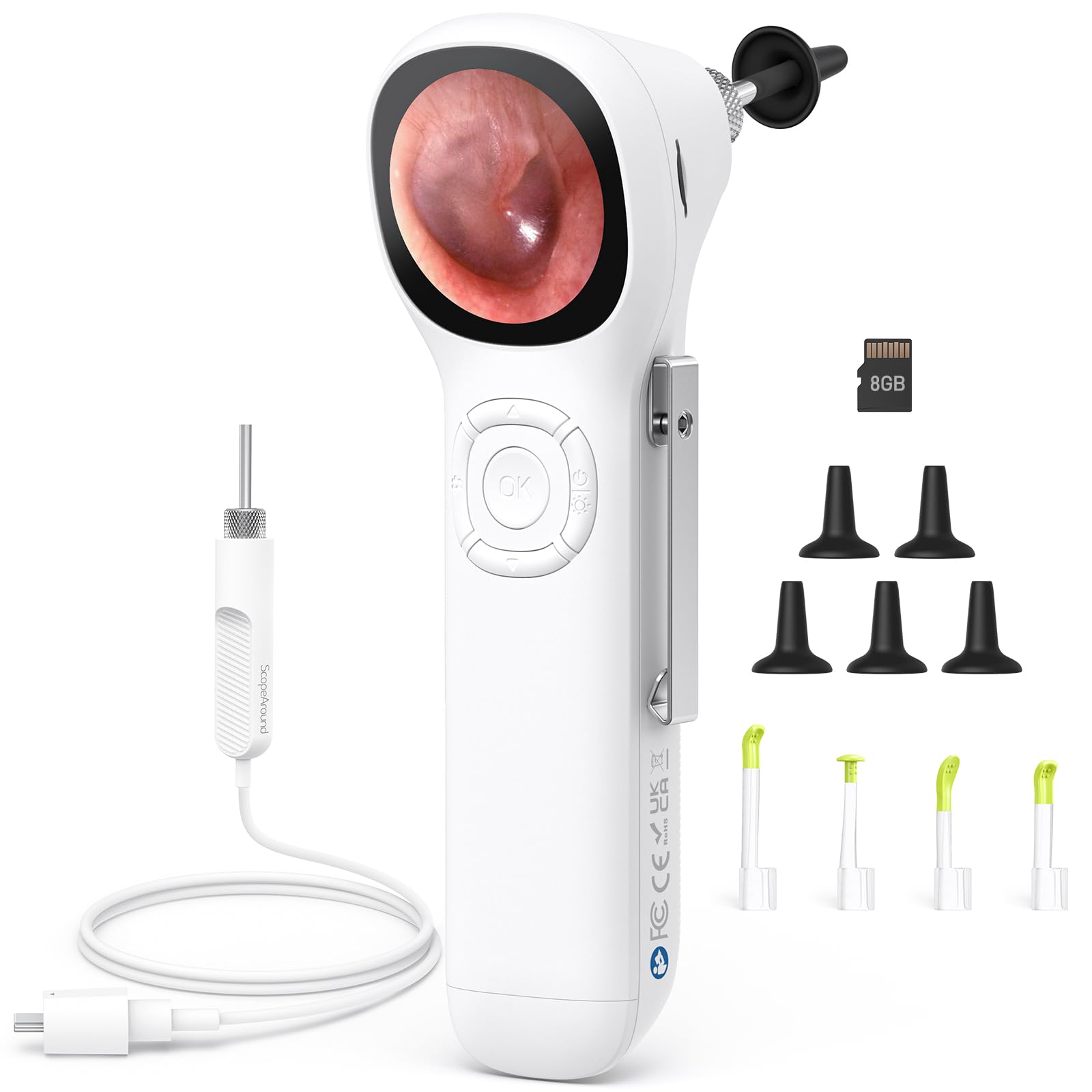
The ScopeAround SA160 is the smaller sibling in the ScopeAround family, built around the same no-app philosophy but in a more compact form factor. It features a clear IPS display that works instantly when powered on—no Bluetooth, no Wi-Fi, no app installation. The 3.9mm slim lens is detachable via an extended cable, which makes it easier to inspect your own ear without contorting your neck to look at a screen.
The manual focus ring lets you dial in sharpness, though it takes a few tries to get right at the optimal working distance of 1-2 cm. The 6 LED lights with three brightness levels provide enough illumination for most ears, and the included 8GB memory card stores plenty of photos and 720p video clips. Users particularly appreciate the ability to capture images and share them via email or text for a quick opinion from a family member who is a nurse or doctor.
It comes with five specula sizes, alcohol pads, ear picks, and Q-tips. The FSA/HSA eligibility is a nice bonus. The main limitation is the 720p effective resolution—fine for checking large wax blockages but not as crisp as higher-end digital scopes for examining the fine structure of the eardrum. The manual focus also means a learning curve; you cannot just point and get a perfect image instantly.
Why it’s great
- No phone or app needed for operation
- Detachable lens cable for self-examination
- FSA/HSA eligible for flexible spending
Good to know
- 720p resolution is adequate but not sharp for fine detail
- Manual focus requires practice and steady hands
5. Anykit Digital Otoscope AKE390S

The Anykit AKE390S is a smartphone-based digital otoscope that connects directly via Type-C to modern iPhones and Android devices. The ultra-fine 0.15-inch diameter lens slides into the ear canal with minimal discomfort, and the accompanying XScope app provides both full-screen and split-screen modes. Split-screen is particularly useful: you can compare the current live view with a previously captured image to track changes in wax buildup or irritation over time.
Setup is fast—scan the QR code, install the app, and plug in the camera. Reviewers consistently note that the image is clear and well-lit, with brightness comparable to what they saw at an audiologist’s office. The soft silicone earpicks are safe for light wax removal, though the camera lens does get smudged by earwax during the procedure, requiring frequent cleaning. The 3.5mm lens length is enough to reach the eardrum in most adults without bottoming out.
The biggest drawback is the app dependency: if your phone dies or the app crashes, you have no otoscope. The LEDs also stay on whenever the camera is connected, which drains the phone battery faster than expected. Some users report the image quality varies significantly between Android devices due to OTG compatibility nuances. For a dedicated Apple user with a recent iPhone, this is a sleek, lightweight solution. For Android users, confirm OTG support before purchase.
Why it’s great
- Very slim 0.15″ lens for comfortable insertion
- Split-screen mode enables before/after comparisons
- Instant image sharing via phone for remote consultation
Good to know
- Requires phone app; no standalone use
- LEDs cannot be turned off, draining phone battery
6. 1080P HD Otoscope (Aertnelz)
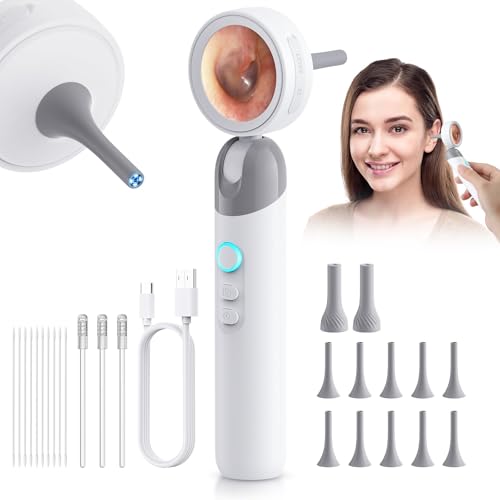
The Aertnelz 1080P HD Otoscope packs a 1080P camera sensor into a affordable digital body with its own 1.38-inch IPS screen. The small screen is adequate for quick checks, and the 1080P sensor provides noticeably more detail than the 720P competitors when you zoom in on the eardrum. It has USB-C charging, four LED lights with adjustable brightness, and 3x magnification, making it a surprisingly capable unit for its position in the market.
One of its better features is the rotating inspection head that swivels 90 degrees, which helps when examining a child who won’t hold still. The package includes 10 silicone tips for ears and nose, two skin inspection tips, adhesive ear sticks, and cotton swabs. An audiologist reviewer specifically called it a affordable alternative to medical equipment, noting the crisp images of the ear canal. The Type-C connectivity also supports PC viewing, though the built-in screen is the primary interface.
The drawbacks center on the learning curve for focus distance. The optimal window is 1.4–2 cm—too close or too far and the image blurs. This is a fundamental limitation of fixed-focus camera-based otoscopes, not a defect of this specific unit. The included manual is sparse, and the device requires a MicroSD card (not included) for saving video. For the budget-conscious buyer who wants a digital screen without the premium price, this offers the best image resolution in its tier.
Why it’s great
- True 1080P sensor resolution for detailed ear canal images
- Rotating head and Type-C charging for convenience
- Multi-use tips for ear, nose, and skin inspection
Good to know
- Very short focus window (1.4-2 cm) causes blurring
- Requires separate MicroSD card for video storage
7. AnyScope Digital Otoscope
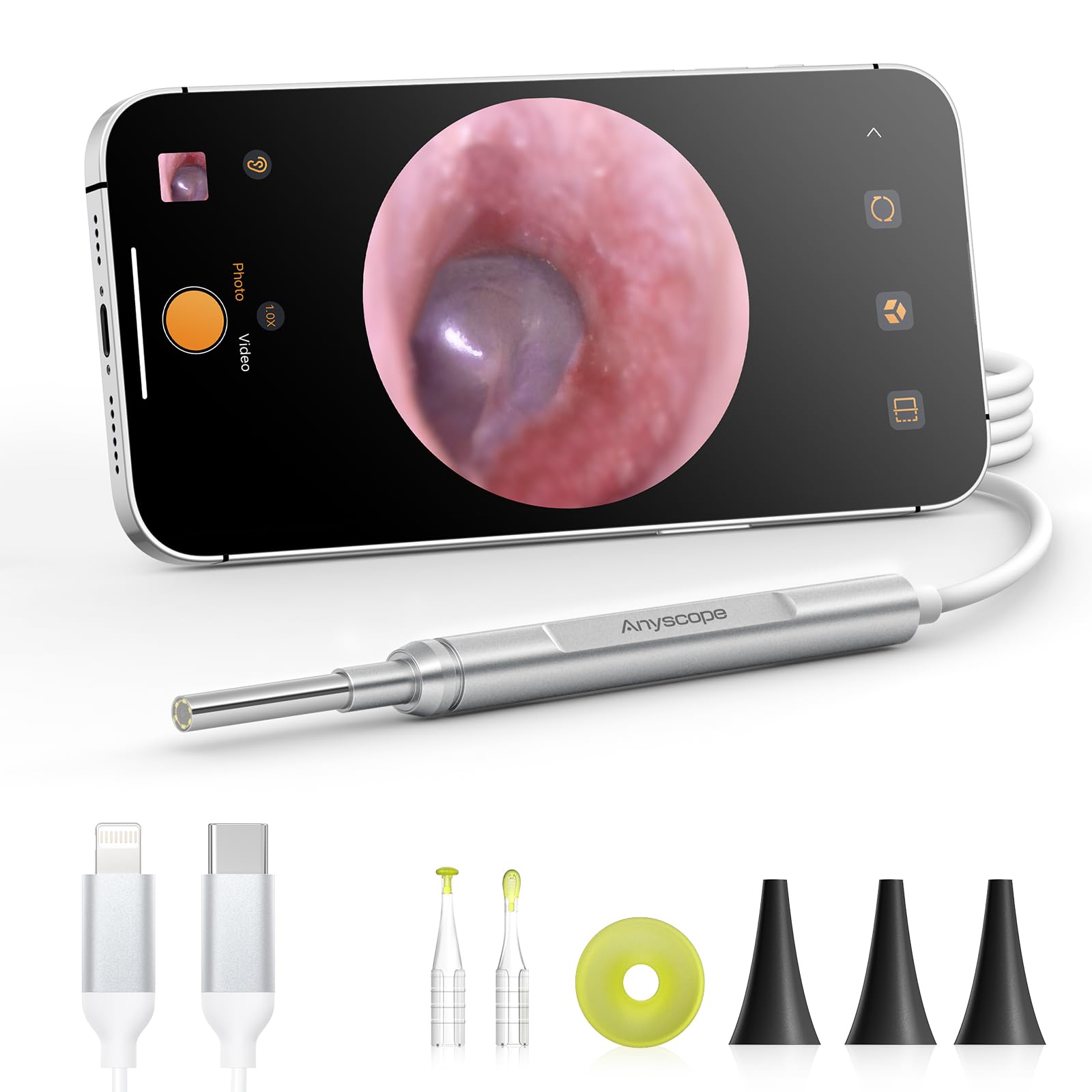
The AnyScope Digital Otoscope is the entry point for anyone curious about otoscopy without wanting to spend much. It uses the same phone-powered approach as the Anykit but at a lower entry cost. The 0.15-inch ultra-fine lens is identical in diameter to the Anykit, making it comfortable for insertion, and it supports both Android (8.0+ with OTG) and iPhone (iOS 9.0+). The app provides full-screen and split-screen modes for easy comparison.
Where it shines is simplicity. Reviews consistently mention that setup is trivial—plug it in, open the app, and the live feed appears immediately. Users on iPhone 15 Pro Max report surprisingly clear tympanic membrane visualization. The included specula and adjustable protection cover help prevent accidental injury during insertion. It also records photos and videos directly to the phone’s camera roll, so sharing with a doctor is just a text message away.
The trade-offs are noticeable. The build quality feels lighter than the Anykit, and the lack of a carrying case (which many reviewers lament) means you need to store the lens carefully to avoid scratches. The cable is also quite short, limiting how far you can move from your phone. For the most budget-friendly way to start visually inspecting ears at home, this works well. But the app dependency and lightweight construction make it less suited for frequent or multi-person use.
Why it’s great
- Extremely easy setup with no complex configuration
- Clear images on recent iPhones for eardrum checks
- Wide compatibility with Android and iOS devices
Good to know
- No storage case included for the delicate camera
- Short cable and lightweight build feel less durable
FAQ
Can I see an ear infection with a home otoscope?
Should I get an optical or digital otoscope for home use?
How far do I insert an otoscope into the ear?
Final Thoughts: The Verdict
For most users, the best at home otoscope winner is the ScopeAround MS450 because its large built-in screen, gyroscopic image stabilization, and generous 32GB storage eliminate the two biggest pain points: phone pairing and image orientation. If you want uncompromised optical clarity and durability that will last a decade, grab the Doctor Mom 4th Generation. And for medical students or thorough home diagnosticians who want a full ENT suite, the CynaMed ENT Kit is the most complete set you can buy.