
A batting cage in the backyard used to mean a dedicated pitcher, a coach, or a parent with a functioning rotator cuff. That dependency is the single biggest barrier to consistent reps. An at-home pitching machine eliminates that bottleneck, turning any open space into a training lab where the only variable is your own swing mechanics.
I’m Min — the co-founder and writer behind Gadgets Feed. I’ve spent hundreds of hours cross-referencing spec sheets, motor types, speed ranges, ball feeder mechanisms, and real user durability reports across the youth to collegiate training spectrum to separate the machines that actually deliver consistent strikes from those that throw more curveballs than intended.
Whether you are building a backyard practice station for a 10-year-old or refining your own cage reps, the best at home pitching machine must balance motor reliability, pitch consistency, and ball compatibility with the space and budget you have.
How To Choose The Best At Home Pitching Machine
Buying a pitching machine without understanding the motor, wheel type, and ball feeder mechanism is a gamble. These three components determine whether your machine throws strikes reliably or turns batting practice into a frustration exercise. Here is the breakdown of the specs that actually matter.
Motor and Wheel Configuration
Single-wheel machines rely on friction against a spinning tire to launch the ball. They are simpler, lighter, and cheaper, but they produce less spin variety and can wear faster over thousands of pitches. Dual-wheel machines use two counter-rotating wheels that pinch and accelerate the ball, offering superior speed accuracy, spin control (topspin, backspin, curveballs), and longer component life. For serious training that mimics live pitching, dual-wheel is the benchmark.
Speed Range vs. Distance
Speed is meaningless without the pitching distance. A machine rated at 60 MPH at 46 feet delivers a different reaction time than the same 60 MPH at 25 feet. Manufacturers often advertise maximum speed without specifying the measurement distance. For youth players (ages 7-12), a range of 15-48 MPH at 30-40 feet is appropriate. For high school and adult training, you want 40-80 MPH at 46-60 feet. Cross-reference the speed claim with the included tripod height and typical cage length.
Ball Compatibility and Feeder Type
Not all machines accept regulation baseballs or softballs. Many entry-level and mid-range units are designed exclusively for dimpled plastic practice balls (lite balls, wiffle balls, or dimpled nylon balls) to reduce wear on the motor and wheels. Auto-feeders vary widely in reliability. A gravity-fed vertical stack is the most jam-resistant design. Spring-loaded or rotating plate feeders can bind when ball seams catch on the mechanism. Check real user reports for feeder jamming rates rather than trusting the marketing photos.
Quick Comparison
On smaller screens, swipe sideways to see the full table.
| Model | Category | Best For | Key Spec | Amazon |
|---|---|---|---|---|
| PowerNet Launch F-lite | Mid-Range | Dual-sport versatility | 40-90 MPH at 25 ft | Amazon |
| Personal Pitcher Pro Starter | Premium | Skill development kits | Battery-powered, auto-feeder | Amazon |
| Heater Junior Baseball | Mid-Range | Youth speed control | 15-48 MPH, 12-ball feeder | Amazon |
| Heater Slider Lite 360 | Budget-Friendly | Curveball practice | Pivot head, lite balls | Amazon |
| Furlihong 6902BHA | Mid-Range | Solo soft toss drills | Rechargeable, 300+ balls per charge | Amazon |
| Jugs | Premium | Durable soft toss | 8-hour battery, 14-ball hold | Amazon |
| Furlihong 636BH Dual-Wheel | Premium | Speed and angle control | 40-68 MPH, 10-speed gears | Amazon |
| Vertura Batting Cage | Budget-Friendly | All-in-one cage setup | 22x12x8 ft, 3-ply netting | Amazon |
| LOBSTER Elite Tennis | Premium | Professional tennis drills | 35-80 MPH, triple oscillation | Amazon |
In‑Depth Reviews
1. PowerNet Launch F-lite Softball & Baseball Pitching Machine

The PowerNet Launch F-lite sits at the sweet spot of the market because it handles both sports with interchangeable tripod legs that alter pitch height for baseball versus softball. It simulates 40 to 90 MPH at 25 feet across four adjustable speed settings, which covers the full youth-to-high school spectrum. The machine comes with six F-lite baseballs and six F-lite softballs, so you are ready for dual-sport practice out of the box.
Reliability is strong. Real users report consistent placement through hundreds of pitches across multiple age groups (10u through 16u). The machine is calibrated specifically for PowerNet’s own lightweight dimpled balls, and the warranty explicitly voids when using other brand balls. That proprietary lock-in is the trade-off for the consistent launch quality that makes this unit a favorite among travel-ball families.
Setup is tool-free with the included legs, and the machine is light enough to carry from garage to field. It also doubles as a fielding drill tool via pop flies and line drives. The occasional shot wanders left or right, but reviewers treat that as realistic variation rather than a defect. For a dual-sport household, this is the most versatile pick in the mid-range.
Why it’s great
- Seamless baseball-to-softball switch with interchangeable legs
- Broad speed range (40-90 MPH simulated) fits multiple ages
- Sturdy build with consistent placement reported by youth coaches
Good to know
- Only works reliably with PowerNet F-lite balls
- Top-end speed claim may not match real 90 MPH equivalency
- Pop-fly functionality requires practice to judge distance
2. Personal Pitcher Pro Starter Package
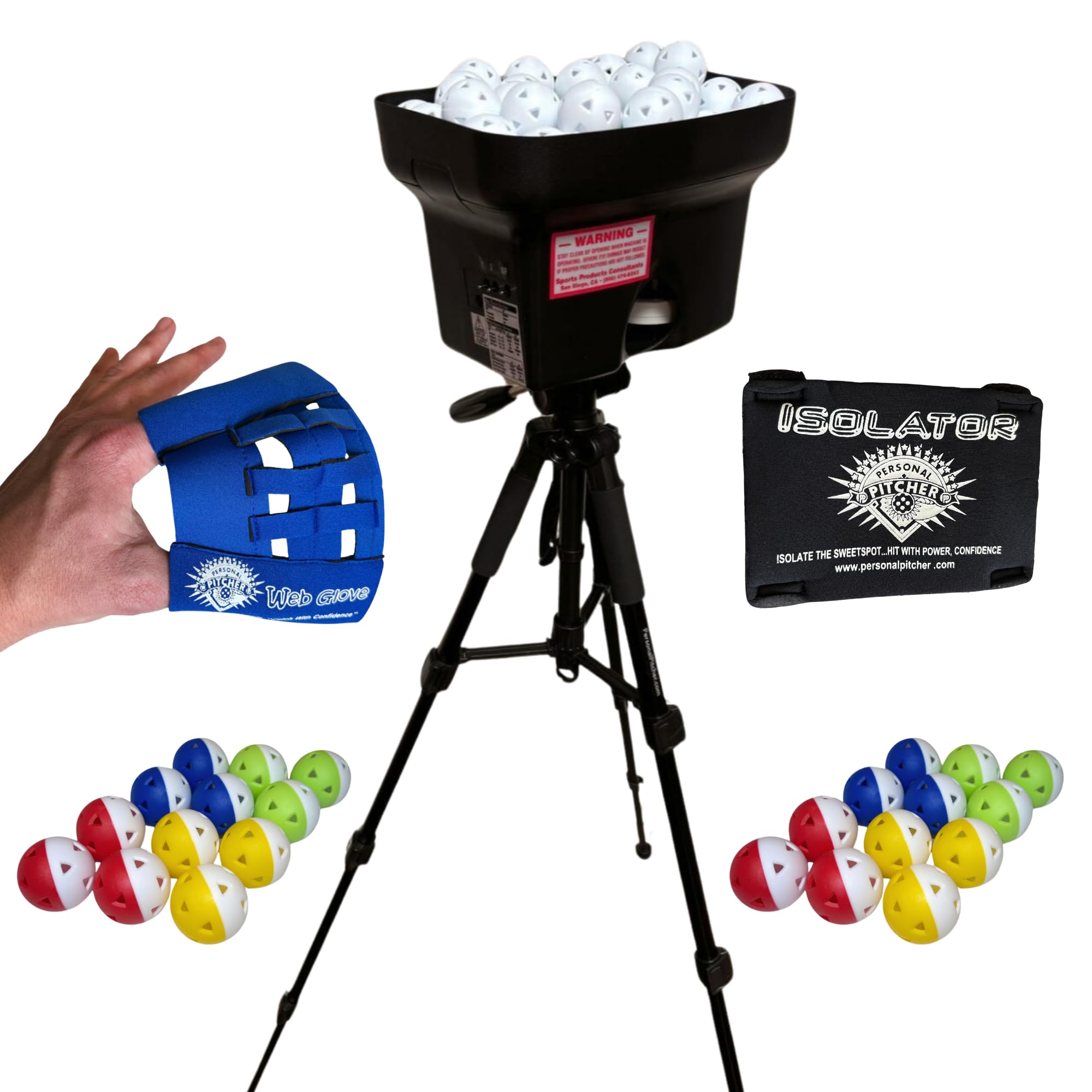
The Personal Pitcher Pro Starter Package is not just a machine — it is a training system. The kit bundles the Pro pitching unit with a tripod, WebGlov for catching mechanics, an Isolator Pad that audibly confirms sweet-spot contact, and two dozen focus balls that vary in speed and location. The machine itself is battery-powered and designed around plastic dimpled balls, making it ideal for backyard use without worrying about net or fence damage.
The auto-feeder rotates balls into the launch path, and users report consistent delivery once the tripod is set correctly. One review notes that the spinning feeder occasionally stops mid-session and requires a power cycle to restart. Customer service responsiveness from company owner Chris is highlighted across multiple reviews as exceptional — replacement parts ship quickly when issues arise.
The Isolator Pad is the secret weapon here. It straps to the bat’s sweet spot and produces an audible pop on solid contact, giving instant feedback without a batting cage. For players stuck in the tee-only rut, this system bridges the gap to live pitch tracking. The 9-pound package weight makes it the most portable premium option on this list.
Why it’s great
- All-in-one training kit with feedback tools
- Lightweight and battery-powered for true portability
- Strong owner support and replacement parts availability
Good to know
- Occasional feeder jam requires a reset
- Uses only plastic dimpled balls, not regulation baseballs
- Premium price for a system that still uses lite balls
3. Heater Sports Junior Baseball Pitching Machine

The Heater Junior has been a staple in youth baseball circles since 2003, and the design has held up because it focuses on a narrow but critical job: delivering consistent batting practice for ages 7-10. The speed range of 15 to 48 MPH at a regulation distance gives coaches granular control over the pace, and the 12-ball automatic feeder delivers a ball every 10 seconds for efficient station-based practice.
The machine runs on a 1/4-horsepower DC motor that drives a single air-filled tire. Users report that the tire must be inflated to 40 PSI for consistent pitches, even though the factory sticker says 20-22 PSI. The feeder works reliably with yellow dimpled balls but jams frequently with harder regulation baseballs. This is a crucial distinction — buy the Heater Junior if you plan to use dimpled practice balls exclusively.
Durability is solid, with one user logging 2000-2500 balls over 16 months before replacing the original tire with a solid rubber alternative. The tripod stand provides good stability on grass but can shift on dirt surfaces. The disassembly for storage is straightforward, making it a practical choice for parents running backyard practice for multiple kids.
Why it’s great
- Ideal speed range (15-48 MPH) for young hitters
- Auto feeder enables efficient group practice
- Proven durability with simple maintenance
Good to know
- Requires manual tire inflation to 40 PSI for consistency
- Feeder jams with regulation baseballs
- Machine moves on dirt surfaces during use
4. Heater Sports Slider Lite 360 Pitching Machine

The Slider Lite 360 earns its place by offering a feature rarely seen at its price point: a pivot head that throws actual curveballs. The rotating wheel mechanism tilts to impart spin, allowing hitters to practice reading breaking balls without needing a live pitcher. The machine pitches lite balls up to 80 MPH at a 46-foot distance, which translates to a faster reaction-time drill for older youth players.
Build quality is mixed. The plastic housing and tubular steel legs keep the unit lightweight at 13 pounds, but several reviews mention durability concerns. One user reported motor burnout after fewer than ten uses with a young child, while another has run the machine for six consecutive summers with heavy use. The variance suggests that consistent placement and ball type (white softee balls only, not yellow hard dimpled balls) directly impact lifespan.
Speed control is analog via a potentiometer, and there are known reports of the speed dial failing to adjust — though Heater’s customer service replaced those units at no cost. The auto-feeder does jam with balls that are too large, so stick with the recommended Heater lite balls. For the price, the curveball capability alone makes it worth considering for families who want to introduce breaking-ball recognition early.
Why it’s great
- Pivot head throws realistic curveballs
- Lightweight and easy to move (13 lbs)
- Pitches up to 80 MPH for reaction training
Good to know
- Speed potentiometer can fail; customer service replaces
- Motor longevity varies widely in user reports
- Only works reliably with specific softee balls
5. Furlihong 6902BHA Rechargeable Toss Machine

The Furlihong 6902BHA solves a different problem than traditional pitching machines. It is a vertical toss machine, not a wheel-driven launcher. It lobs balls upward from an adjustable height (1.2 to 1.7 meters for baseball, 0.4 to 0.6 meters for softball), simulating a soft toss drill without requiring a second person to feed balls. The built-in rechargeable battery delivers over 300 tosses per charge, making it truly field-portable.
The machine features an extendable ball stacker that holds multiple balls and feeds them automatically every six seconds. Speed settings 1 through 4 control the toss trajectory. This is not designed for live pitching velocity — it is for swing timing and hand-eye coordination. Real users highlight its effectiveness for offseason training, keeping young players engaged with high rep counts without coach fatigue.
Height adjustment is quick and tool-free, and the 11.6-pound weight makes it easy to relocate between the garage, backyard, and practice field. The unit handles both baseballs and softballs without modification, which is a significant advantage over machines locked to one ball type. For families with multiple children playing different sports, this is a smart supplementary tool alongside a standard pitching machine.
Why it’s great
- Rechargeable battery supports remote field use
- Adjustable height covers both baseball and softball
- Eliminates the need for a human soft toss partner
Good to know
- Only soft toss, not live pitching velocity
- Extendable ball holder sold separately
- Plastic construction requires careful handling
6. Jugs Baseball/Softball Tossing Machine

The Jugs tossing machine is a throwback design — a heavy iron action arm that swings upward to toss balls, driven by an internal rechargeable battery that lasts up to eight continuous hours. It holds up to 14 baseballs or 10 softballs and tosses one every five seconds. This is a soft-toss machine, not a speed pitching unit, but the mechanical simplicity translates to exceptional durability. Users report over 1000 tosses with no degradation in performance.
Build quality is a tier above plastic-heavy competitors. The 21-pound weight comes from the iron action bar and reinforced chassis, which keeps the machine planted during use. The battery holds charge across multiple practice sessions — one user reports running it for several team practices before needing a recharge. The trade-off is that the tossing height is fixed at a low-to-mid belt trajectory, and there is no adjustment mechanism to vary launch angle.
Seamed balls can jam in the loading chute because the seams catch on the plastic track. The fix is simple: load balls individually rather than dumping the full hopper. The machine also inches forward during operation, so weighted bases or a rubber mat underneath help keep it in place. For coaches running high-volume, reliable soft toss drills, the Jugs is the most dependable unit on this list.
Why it’s great
- Industry-leading durability with iron action arm
- 8-hour battery life supports multi-session use
- Consistent 5-second toss interval for efficient drills
Good to know
- Seamed balls jam in the chute; load individually
- Fixed toss height — no angle adjustment
- Heavier than plastic competitors at 21 lbs
7. Furlihong 636BH Dual-Wheel Baseball Pitching Machine

The Furlihong 636BH steps into premium territory with a true dual-wheel design. Two counter-rotating wheels pinch the baseball and accelerate it to speeds between 40 and 68 MPH across 10 speed gears. The iron chassis and tripod base weigh 39 pounds, providing the stability needed for consistent pitch location. This is a machine built for serious youth coaches and adult hitters who cannot tolerate wild variation.
The pitch interval and launch angle are both adjustable, giving the operator control over timing and vertical placement. However, the lack of a remote control means you must walk to the machine to change any setting — there is no random mode or programmable sequence. Several user reviews mention that the speed control feels choppy between gears, and after 15-20 practice sessions, accuracy can degrade as wheel wear sets in.
Customer service responsiveness is a concern. One buyer reported a defective auto-feeder plug and had difficulty exchanging due to price fluctuations. Another reviewer, after extended use, called the longevity poor and recommended saving for a higher-tier brand. The 636BH delivers solid performance for amateur use in a basement or garage cage, but buyers should temper expectations about long-term consistency at this price point.
Why it’s great
- Dual-wheel design for improved pitch accuracy
- 10 speed gears cover youth through high school range
- Sturdy iron chassis and tripod for stability
Good to know
- Speed control can feel choppy between settings
- No remote control or random mode
- Accuracy may degrade after 15+ practice sessions
8. Vertura Portable Batting Cage 22x12x8
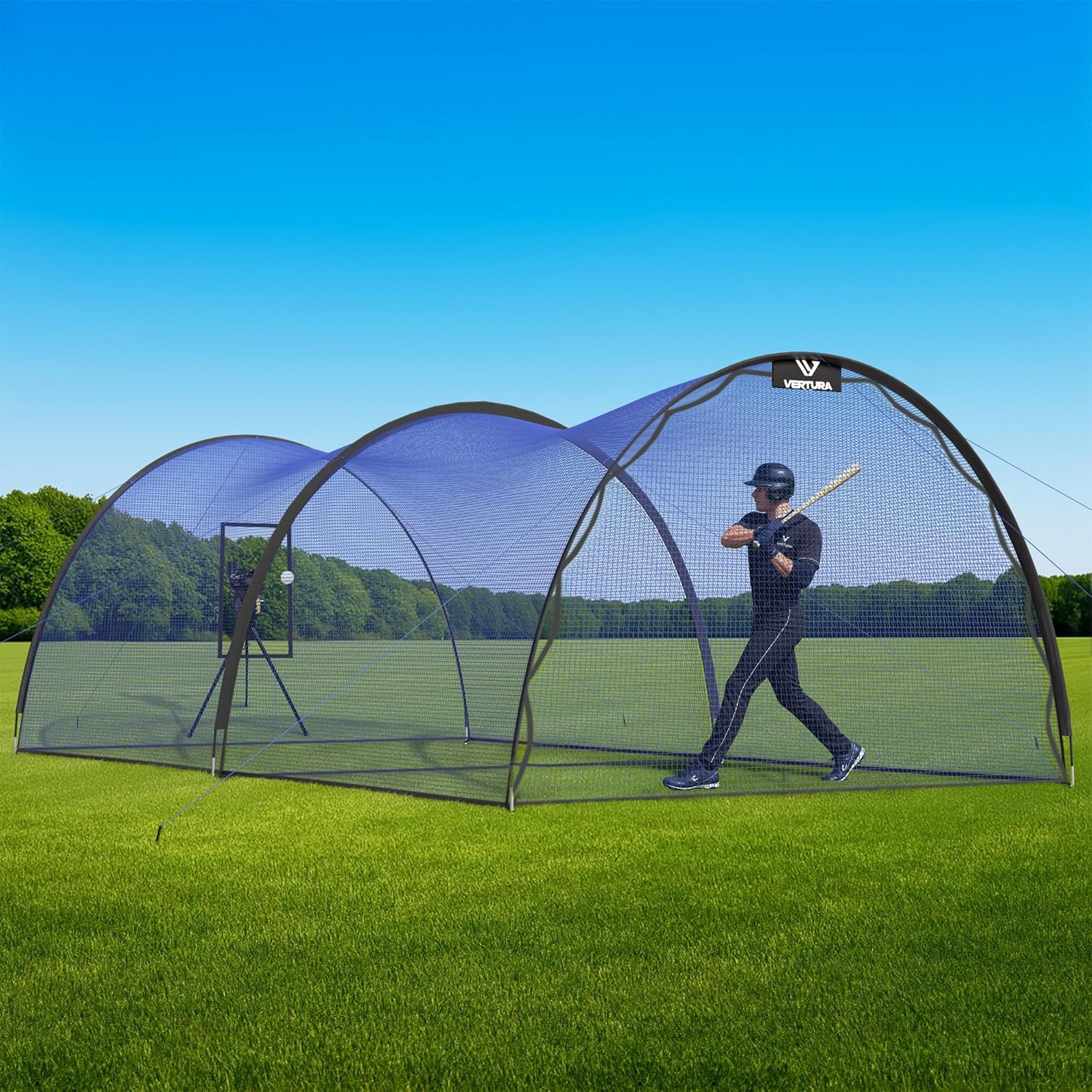
The Vertura batting cage is not a pitching machine itself but the essential infrastructure that enables full machine practice at home. The 22-foot by 12-foot by 8-foot frame provides enough room for a 46-foot pitching distance with a standard home plate setup. The 3-ply blue Oxford netting absorbs hard-hit balls without tearing, and the bright color improves ball tracking against cloudy backdrops.
The frame uses 14mm fiberglass poles rather than standard aluminum or steel, reducing overall weight to 28 pounds while maintaining structural rigidity. Assembly with two to three people takes about an hour, and the kit packs into a carry bag for seasonal storage. The dedicated 3.3-foot by 1.6-foot pitching machine opening and detachable door allow the machine to feed balls from outside the cage or from within.
Users across multiple age ranges (t-ball to college) praise the stability once anchored with the included ground ropes and metal stakes. One review notes that the pitching window lacks a flap cover, which is an easy DIY addition to prevent balls from escaping during machine feed cycles. The fiberglass poles are more susceptible to wind than steel, so the cage is best suited for calm-weather backyards or indoor garage use.
Why it’s great
- Spacious 22x12x8 dimensions for realistic practice
- 3-ply netting absorbs hard hits without tears
- Portable design with carry bag for easy storage
Good to know
- Fiberglass poles are lighter but less wind-resistant than steel
- Pitching opening lacks a flap cover
- Requires 2-3 people for initial assembly
9. LOBSTER Sports Elite Grand Five LE Tennis Ball Machine
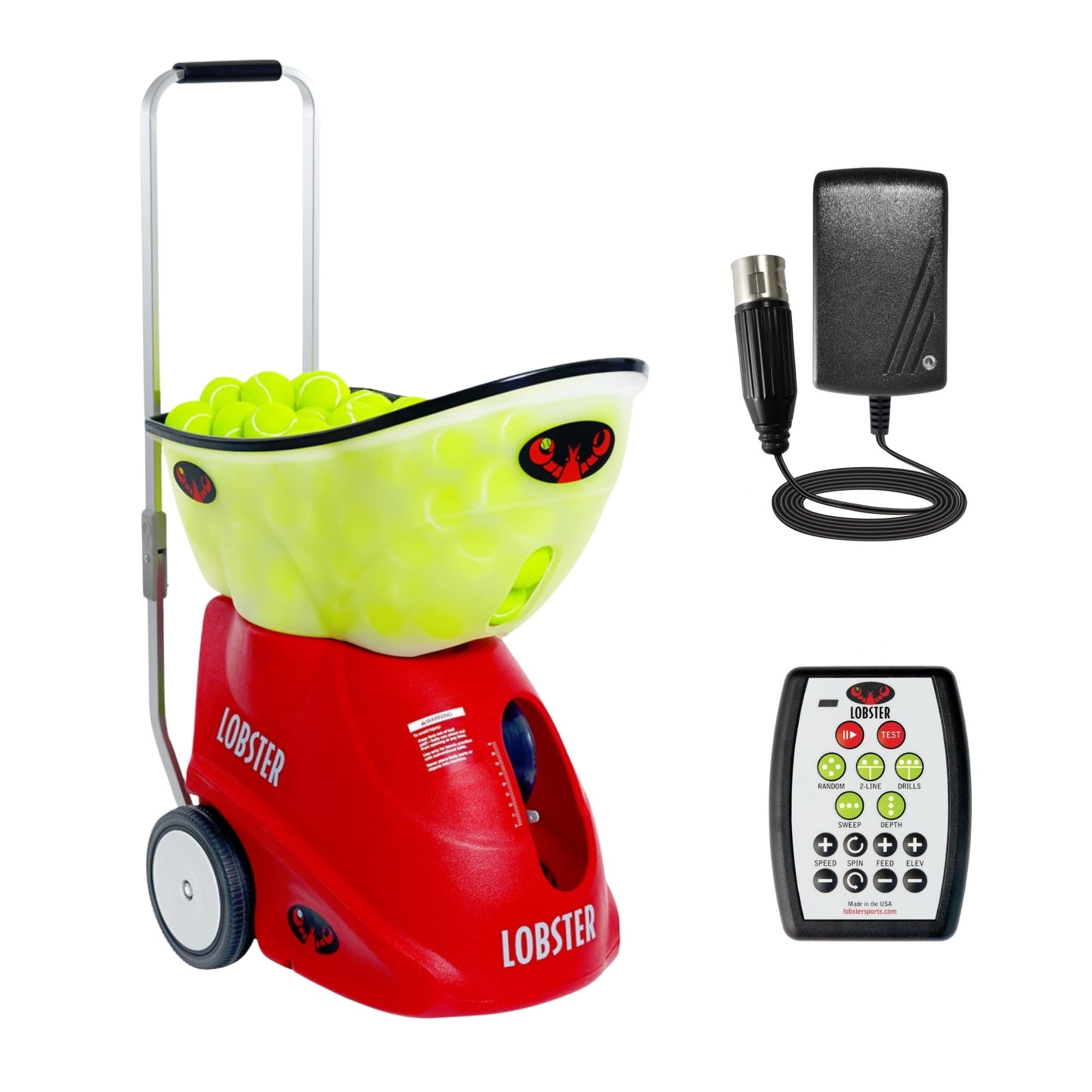
The LOBSTER Elite Grand Five LE is a purpose-built tennis ball machine with capabilities that far exceed the baseball and softball units on this list. It delivers balls at speeds from 35 to 80 MPH with adjustable topspin and backspin, plus electronic elevation control up to 60 degrees for lob drills. The triple oscillation system combines horizontal and vertical random patterns to simulate match play — a feature baseball machines simply do not offer.
The internal rechargeable battery provides 4 to 6 hours of continuous operation. The basin holds around 85 balls. The machine offers 12 preloaded drill programs designed around specific playing styles (grinder, moonballer, baseliner, etc.) plus 12 custom drill slots. Users report consistent placement and spin quality across the speed range, though the top-end 80 MPH with heavy topspin effectively drops to around 60 MPH as the spin slows the ball in flight.
Weighing 42 pounds with awkward lifting handles, the LOBSTER is not a casual backyard setup — it demands a dedicated court space. The battery indicator uses a vague green/blinking/red system without a numeric readout. Some users note that the machine lacks a narrow horizontal sweep for alternating forehand and backhand patterns, only offering full-court random. For the serious tennis player who wants solo practice that mirrors live rally conditions, this is the gold standard.
Why it’s great
- Triple oscillation simulates realistic match play patterns
- Preloaded and custom drill programs reduce setup time
- Wide speed range with adjustable spin for all skill levels
Good to know
- Heavy (42 lbs) with awkward lifting handles
- Battery indicator lacks precise charge level readout
- No narrow horizontal sweep for alternating patterns
FAQ
Can a single pitching machine handle both baseballs and softballs without modification?
Why do some pitching machines only work with dimpled practice balls?
What does MPH at 46 feet mean for actual pitch speed perception?
Final Thoughts: The Verdict
For most users, the best at home pitching machine winner is the PowerNet Launch F-lite because it seamlessly bridges baseball and softball training with consistent speed delivery across a wide age range. If you want a comprehensive training system with built-in feedback tools, grab the Personal Pitcher Pro Starter Package. And for pure youth-focused reliability with proven durability at the lower price point, nothing beats the Heater Sports Junior Baseball Pitching Machine.