
Our readers keep the lights on and my morning glass full of iced black tea. As an Amazon Associate, I earn from qualifying purchases.
Specs are compiled from manufacturer listings and verified buyer reviews and can change over time — please confirm the key details on the product page before buying.
Most home pull-up bars fail for one simple reason: the wall they bolt into. A doorframe bar wobbles, a drywall anchor strips, and a cheap bracket bends on the fifth rep. The real question isn’t how much weight the bar claims to hold—it’s whether your wall can hold the bar. This guide focuses on the mounting reality, the grip texture you can actually feel, and the honest capacity that matters for your bodyweight workouts.
I’m Min — the founder and writer behind Gadgets Feed. This guide is built by comparing the manufacturers’ published specifications and the patterns across verified customer reviews, so you get each pick’s real strengths and trade-offs instead of marketing spin.
From beefy wall-anchored steel to a 3.5-pound travel clamp, these picks cover every legitimate way to add an at home pull up bar to your space without the gym membership.
Our Picks at a Glance


How To Choose The Best At Home Pull Up Bar
The first decision is structural: will this bar bolt into your wall studs, or does it clamp onto your door frame? Wall-mounted bars are the only choice if you want to do kipping pull-ups, muscle-ups, or hang gymnastics rings, because they transfer your weight into the lumber behind the drywall. Doorway clamp bars take seconds to mount and leave zero holes, but they demand a solid, non-hollow frame and they limit how aggressively you can swing.
Match the capacity to your real bodyweight, not your ego
The “maximum weight recommendation” on the box is the engineering limit of the steel, not the guarantee for your wall. A 500-pound-rated bar is pointless if you bolt it into drywall without hitting a stud. Before you buy, find your studs with a cheap magnetic finder and confirm the bar’s width lines up with the 16-inch or 24-inch spacing in your wall. If the bar is 48 inches wide and your studs are 16 inches apart, the holes will line up cleanly—that alignment is half the installation battle.
Grip texture decides whether your hands slip mid-set
Chrome bars look nice in photos but get slick the moment your palms sweat. Look for knurled steel, which has a diamond-pattern texture pressed into the metal, or powder-coated finishes that stay grippy when wet. Foam-padded handles are comfortable for light sets but can compress and rotate during heavy hangs. For daily training, textured metal beats soft foam almost every time—you want friction where your hands meet the bar, not cushion.
Clearance from the wall changes your whole workout
A bar that sits only a few inches off the wall forces your knees to swing forward on every rep. Bars with deeper brackets—14 inches or more—give you room for full-range pull-ups, leg raises, and toes-to-bar movements without scraping your knuckles. Deeper mounts take up more floor space, so measure your hallway or garage before falling in love with a 30-inch-deep rig.
Quick Comparison
| Model | Best For | Weight Capacity | Mount Type | Grip Positions | Amazon |
|---|---|---|---|---|---|
| XMARK Commercial Wall Mount★ Best Overall | Serious home gyms | 850 lb | Wall Mount | Multi (parallel + angled) | Amazon |
| PROIRON Doorway BarBest Value Doorway | No-drill doorframes | 440 lb | Doorway Mount | Single + EVA foam | Amazon |
| Kipika Wall MountVersatile Multi-Grip | Multi-grip variety | 600 lb | Wall Mount | 5 (incl. ball finger) | Amazon |
| Ultimate Body Press Wall Mount | Doorway-adjacent walls | 275 lb | Wall Mount | 3 | Amazon |
| ECOTRIC 46″ Wall Mount | Garage gyms, tall users | 500 lb | Wall Mount | Single wide | Amazon |
| Yes4All Heavy Duty Wall Mount | Rings & muscle-ups | 500 lb | Wall Mount | Single + 1.25″ bar | Amazon |
| Luckyone Multi Dip Station | Dips + pull-ups combined | 440 lb | Wall Mount | Multi | Amazon |
| Titan Fitness Adjustable Depth | Adjustable clearance | 400 lb | Wall Mount | Single 50″ + rings | Amazon |
| Duonamic Eleviia Portable | Travel & rentals | 220 lb | Doorway Mount | Single adjustable | Amazon |
In-Depth Reviews
1. XMARK Commercial Wall Mounted Multi Grip Pull Up Bar
Our pick — over 4.5★ from 300+ verified ratings; the strongest balance of quality and price.
The wall-anchored beast that shrugs off a full yank.
If you want the closest thing to a commercial gym rack in your garage, this is it. The welded steel frame spans 50.25 inches with an 850-pound capacity, ensuring rock-solid stability for any home lifter. You never think about the bar bending; you just train. The parallel and angled handles let you hit neutral-grip pull-ups that are gentler on your shoulders, plus wide and close variations.
You can trust this bar to stay put: buyers report trying to shake it loose from the wall with zero success—”I’ve attempted to yank it from the wall and I can’t even get a squeak or the tiniest movement out of the bolts,” as owners put it. The knurled (diamond-textured) handles keep your grip secure even with sweaty palms, so you won’t slip mid-rep. Its 48″ width matches standard stud spacing, so you can line it up without a stud finder. Plan for a two-person install, but the result is a bar that feels bolted into the building itself.
The honest trade-off is that solidity comes with weight and permanence. This bar weighs 4.76 kg and is rated for serious training, so it’s a commitment—you’re not moving it between rooms. Durability gets some mixed chatter, with occasional reports of bolts snapping under heavy use, but the overwhelming consensus is that this is a buy-once, train-for-years piece of steel.
Why It Earns The Crown
- Commercial-grade 850 lb capacity means zero wobble under any bodyweight
- Knurled handles deliver a vice-like grip even when hands get slick
- 48″ width aligns with standard stud spacing for a clean install
Who Should Pass
- Renters can’t take it with them—this is a permanent wall fixture
- Requires two people and proper tools for installation
- Occasional reports of bolts failing under extreme loads
The Verdict: Buy this if you own your space and want a permanent, rock-solid training station that handles everything from beginner pull-ups to advanced weighted hangs.
The One Caveat: It’s a heavy, permanent install—best for a dedicated garage gym, not a temporary setup.
2. PROIRON Door Pull Up Bar Doorway Frame Chin Up Bar
The doorway clamp that cures a cranky spine.
This is the no-drill option done right. It clamps onto your door frame using a spring-loaded extrusion that squeezes the upper and lower edges when you hang, with oversized non-slip textured pads gripping the trim so the bar can’t rotate or slide. At just 2.1 kg, it’s the featherweight of the doorway category, yet it still rates for 440 pounds—a 1.9x gap behind the XMARK’s wall-mounted 850-pound rating, but plenty for most home workouts.
The full EVA foam handle wraps the entire bar, which is a real comfort win if calluses are your pet peeve. Owners mention using it for spinal decompression, praising the secure grip that delivers a deep stretch. You can assemble and disassemble it in seconds without a screwdriver, and the two built-in spirit levels (bubble levels) make sure your first install isn’t crooked.
The catch is the frame itself. It only fits doorways between 28.3 and 38.2 inches wide, and it absolutely won’t work on hollow or glass doors. The double gear lock keeps the bar from rotating, but if your trim is weak or rounded, the clamping pressure has nothing to bite into. This is a bar for standard, solid interior doorways—measure before you buy.
Easy Win: The best balance of price and function for renters who want a real pull-up bar without leaving a single hole.
Frame Limits: skip it if your door frame is hollow, glass, or outside the 28.3–38.2 inch width range.
3. Kipika Heavy Duty Wall Mounted Doorway Pull Up Bar
Five grips, one steel tube, and a neat extra finger grip.
Where most wall bars give you two or three hand positions, this one serves up five: wide, narrow, neutral, hammer, and a ball finger grip for training climbing and martial-arts hand strength. The foam handles are soft enough to prevent blisters, and the 1 3/10″ steel tubing supports up to 600 pounds with a 6-hole mounting pattern that customers note feels far more planted than a 4-hole competitor.
At 4.76 kg, this bar is a 2.3x heavier presence on the wall than the PROIRON doorway clamp—but that weight is exactly why it feels so stable. Buyers who switched from freestanding bars describe the difference as night and day, calling it “very sturdy and works great” once mounted. The 6-inch wall-to-bar spacing gives you enough room to do full-range-of-motion pull-ups without your knuckles scraping the wall.
Installation is the true dividing line here. The hole spacing runs 14.5 inches, which reviewers point out is not stud-compatible with standard 16-inch stud layouts—one owner mounted it to a hardwood board with T-nuts to make it work. A few note the mounting can be tricky, so plan on a trip to the hardware store for a mounting board if your studs don’t cooperate.
Grip Lover’s Pick: The widest variety of hand positions in this lineup, including the unusual ball finger grip for grip-strength work.
Mounting Reality: The 14.5″ hole spacing means most buyers need a plywood backer board—budget for extra lumber and fasteners.
4. Ultimate Body Press Wall Mounted Doorway Pull Up Bar

The 1.25-inch steel bar that turns a doorway into a gym.
This is the hybrid pick—it mounts to the wall but is designed to live right above your door frame, giving you the rigid performance of a mounted bar with the space-saving footprint of a doorway unit. The all-welded steel frame uses thick 1.25-inch tubing that stands a full 4.25 inches off the wall, which is enough clearance for full range-of-motion reps without banging your knees.
Buyers rave about how well it handles daily use, with one jiu-jitsu practitioner noting the wider-than-standard grip strengthens his grip for grappling. The slotted bolt holes are a clever touch—they solve variations in door size so you can fine-tune the fit before tightening. It’s backed by a 10-year warranty against manufacturer defects, which tells you the company expects this bar to outlast your current workout phase.
The honest limitations come down to grip and weight. At 275 pounds, the capacity is lower than the XMARK’s 850 or the Kipika’s 600, so very heavy lifters should look elsewhere. The smooth bar surface draws mixed feedback—it can get slippery with sweaty hands, so some owners wrap athletic tape around the grip area. The size also runs slightly narrow for broad-shouldered users doing wide-grip work.
What Shines
- Slotted bolt holes make installation forgiving on imperfect door frames
- 10-year warranty is the strongest guarantee in this lineup
- 4.25″ wall clearance supports full-range pull-ups
What To Know
- 275 lb capacity is the lowest among the wall-mounted picks here
- Smooth steel grip needs tape or chalk once palms get sweaty
Reach For It If: You want a wall-mounted bar that fits in a doorway and comes with a 10-year warranty, so you are covered for the long haul.
Look Elsewhere If: You’re over 275 pounds or you insist on a knurled, textured grip surface.
5. ECOTRIC 46″ Wall Mounted Pull Up Chin Up Bar

A 33-inch reach from the wall for kippers and tall lifters.
If you’re a taller athlete or you like to kip (swing your legs for momentum), this bar’s 33-1/4 inches of wall clearance is the feature that sells it. Most wall bars give you 6 to 14 inches; this one thrusts you far enough out that your knees and shins never clip the wall on dynamic movements. The 11-gauge steel frame and 500-pound capacity support everything from beginner pull-ups to advanced toes-to-bar.
Buyers describe it as “a great alternative” to far pricier rigs, with thick steel and professional-looking welds. It installs either vertically or horizontally, mounts to concrete or wood studs, and the brackets are adjustable in width to match your actual stud layout. A 5’7″ female lifter reported excellent results for strict strength work and toes-to-bar, while taller users appreciate the extra reach.
The recurring gripe is the included hardware—shoppers say bolts that break during installation and suggest replacing them with stronger lag screws from a hardware store before you start. A few also note the paint finish scratches easily when threading the bar through the bracket holes. The bar itself is rock solid; it’s the accessories that need an upgrade.
Deep Reach Advantage: The 33-1/4″ clearance gives you more room than any other bar here, so you can do kipping pull-ups and loop push-ups without hitting your head or the wall.
Hardware Caveat: Plan to swap the stock bolts for heavier-duty lag screws before mounting—buyers report breakage during install.
6. Yes4All Heavy Duty Wall Mounted Pull Up Bar

A 30-inch-deep steel shelf for rings, TRX, and muscle-ups.
The 32-inch bracket depth provides ample clearance for rings, straps, and muscle-up practice. You can hang gymnastic rings for ring dips and muscle-ups, attach ab straps for hanging leg raises, or loop a TRX system over the 50-inch bar. The 1.25-inch powder-coated bar stays grippy when wet, and its 500-pound capacity supports weighted training.
Buyers who mounted it into brick or concrete report rock-solid stability, with one specifically noting it handled his 275 pounds without issue. The powder-coated finish gets consistent praise for its textured, non-slip feel. The bracket height sits at 31 inches with a 32-inch depth, so you get substantial room to maneuver under the bar.
The package is where this bar trips people up. Several owners mention missing hardware, lag screws that are too short for thick walls, and drywall anchors that are basically useless—you must hit studs or use proper masonry anchors. One frustrated owner replaced everything with 3/8″ x 3.5″ lag bolts and called it perfect. The bar itself is excellent; just budget for better fasteners and check your box contents before you start drilling.
Built For Accessories
- 32″ depth clears room for rings, straps, and muscle-up practice
- Powder-coated 1.25″ bar stays grippy when hands sweat
- 500 lb capacity supports weighted pull-ups
Expect To Buy Hardware
- Stock lag screws run short for thick walls
- Missing hardware and drywall anchors reported in some boxes
Make The Call: This is the pick for CrossFit-style athletes who want to hang rings and strap systems, not just do pull-ups.
Plan Ahead: Order longer lag bolts in advance—the included hardware is the weak link in an otherwise excellent bar.
7. Luckyone Multifunctional Wall Mounted Pull Up Bar with Dip Station

One wall mount for pull-ups, dips, leg raises, and boxing.
This is the multitasker of the bunch—a wall-mounted unit that includes dip handles so you can train your chest and triceps without a separate piece of equipment. The heavy-duty steel frame with four strong hooks and high-density non-slip grips supports up to 440 pounds and handles pull-ups, chin-ups, dip station work, leg raises, and even boxing drills. Customers note it takes about five minutes to assemble and mount, with eight included concrete anchors.
The value story here is strong: instead of buying a pull-up bar and a dip station separately, you get both in one wall footprint. A 220-pound buyer called it strong and well-built, and the black-and-red finish matches most home gym gear. The instructions are mostly visual, so the assembly is straightforward even if you skip the manual.
The main compromise is placement. The bar mounts close to the wall, and reviewers point out it’s “too close to the wall” for some movements—you’ll want to mount it on a concrete or solid brick wall, not drywall, to feel fully safe. A few users found the lower dip hooks need clearance from the wall to work correctly, and one solved it with wooden wedges to angle the pads. This is a solid unit for a concrete garage or basement wall.
Two-In-One Value: A rare wall-mounted bar that doubles as a legitimate dip station, saving both wall space and money.
Wall Requirement: Mount only on concrete, solid brick, or solid tile—hollow brick and drywall are deal-breakers for this unit.
8. Titan Fitness Adjustable Depth 52″ Wall Mounted Pull Up Bar
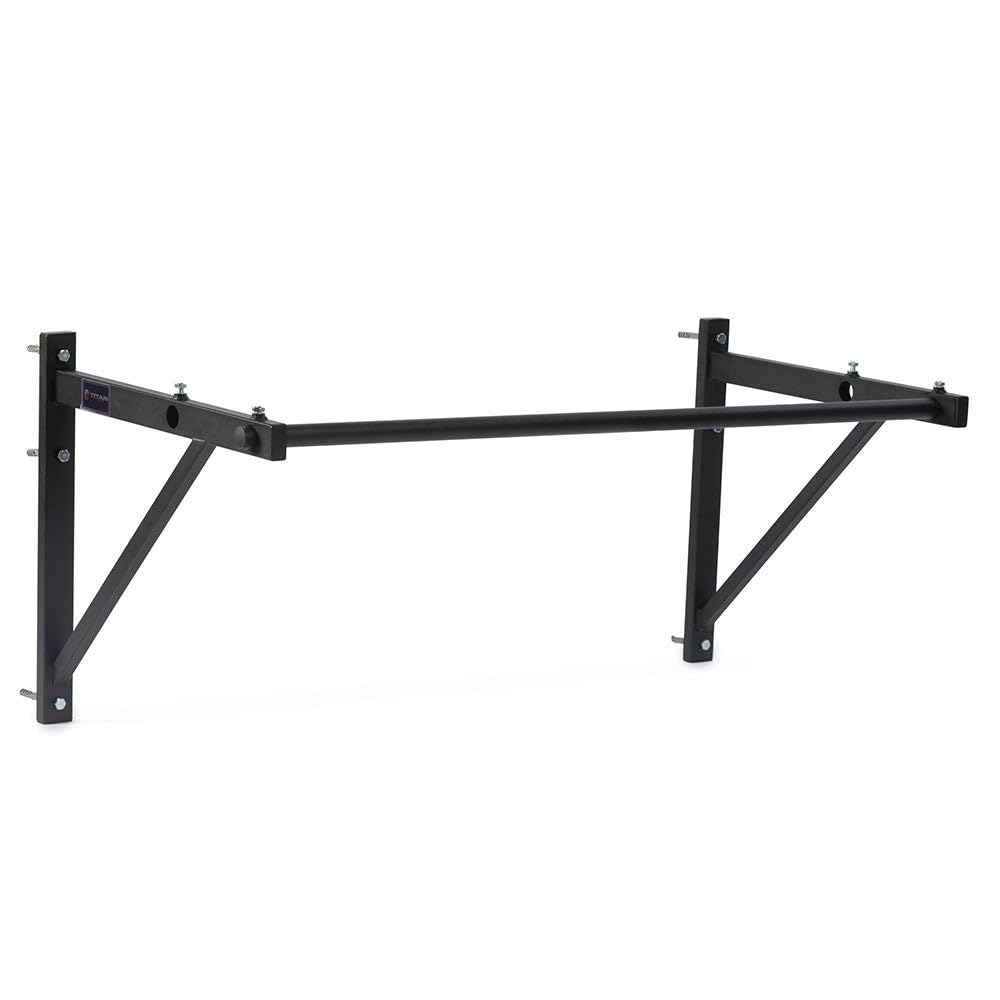
Pick your protrusion—14 or 22 inches off the wall.
The defining trick of this Titan bar is the adjustable bracket depth. You choose between 14 inches from the wall for compact spaces or 22 inches for movements that need extra clearance like kipping pull-ups or ring work. The 50-inch bar with a 32mm powder-coated grip suits wide and close grips, and the 11-gauge steel frame holds 400 pounds.
Buyers repeatedly describe it as “a beast” that’s heavy-duty and easy to install with basic tools—a stud finder, level, and impact driver. One owner runs it with TRX straps and resistance bands, calling it versatile after five months of daily use. The set screws that hold the bar prevent it from spinning mid-set, which is a small but welcome detail. The included mounting hardware gets positive marks, a rare vote of confidence in a category where cheap bolts are the norm.
The trade-off is the bare-bones instructions. Several shoppers say they needed YouTube to figure out the mounting process, and the bar must be bolted into studs and leveled carefully. One unit arrived slightly bent but was still fully usable. If you’re comfortable with basic DIY, this is a fantastic adjustable option; if you want hand-holding, pick a bar with clearer instructions.
The Flexible Choice
- 14″ or 22″ depth adapts to your space and exercise style
- Set screws keep the bar from rotating during explosive reps
- Positive feedback on the included mounting hardware
Know Before You Buy
- Instructions are minimal—plan to watch an installation video
- Must hit studs and level perfectly to feel secure
Pick It For: The rare ability to change your bar’s distance from the wall based on today’s workout—rings one day, wall-hugging pull-ups the next.
pass on it if: You want a tool-free, out-of-the-box install with picture-perfect instructions.
9. Duonamic Eleviia Portable Doorway Pull Up Bar

A 3.5-pound clamp that travels in a carry-on.
Everything about this bar is designed around portability. It weighs 3.5 pounds (1.6 kilos) and comes fully assembled, so it slips straight into a carry-on bag for hotel workouts or office desk hangs. The aerospace composite material delivers a 220-pound capacity in a lightweight frame, and the thermoplastic coating protects door frames from marks. The brand claims a 7.92-second, tool-free installation with no screws or marks left behind.
Buyers who travel for work call it a lifesaver, with one noting it’s survived two-plus years of use and held steady even with an added 35 pounds of weight. The silicone inserts grip the frame securely without damage, and the adjustable grip width fits standard doorways. It handles pull-ups, chin-ups, and even ring dips, making it far more versatile than its compact size suggests.
The cost is the sticking point. This is the priciest bar in this lineup on a per-pound basis, and buyers openly note cheaper alternatives exist for a permanent home install. It’s also a doorway clamp, which means it won’t work on hollow or glass doors, and the 220-pound capacity has less headroom than the wall-mounted options. Buy it for the portability, not for the value-per-dollar—that’s the trade-off you’re paying for.
Road Warrior’s Friend: The only truly portable bar here, ready in seconds with zero installation and zero damage.
Price Premium: You pay a significant premium for the lightweight engineering—fine for travelers, overpriced for a stationary home setup.
Understanding the Specs
Weight Capacity vs. Wall Strength
The maximum weight recommendation tells you what the steel can hold—like the XMARK’s 850 pounds or the PROIRON’s 440—but your drywall and studs have their own limits. A 500-pound-rated bar bolted into drywall without a stud is weaker than a 275-pound bar screwed into a solid stud. Always find your studs (the vertical wooden beams behind drywall) and confirm the bar’s hole spacing aligns with them before you trust any capacity number.
Grip Positions and Knurling
Multi-grip bars offer parallel and angled handles alongside the standard straight bar, letting you change your hand position to target different muscles and reduce shoulder strain. “Knurling” is the diamond-pattern texture pressed into the steel—it’s what keeps your hands from slipping when you sweat. Some bars use foam or EVA padding for comfort, but bare knurled or powder-coated steel generally gives you a more secure, non-slippery grip during heavy sets.
Wall Clearance and Depth
Wall clearance is the distance from the wall to the bar itself. A shallow 4-6 inch mount works for strict pull-ups but makes dynamic movements like kipping or leg raises awkward. Bars with 14 to 33 inches of clearance, like the Titan’s adjustable depth or the ECOTRIC’s 33-1/4 inches, give your body room to move without your knees hitting the wall. Deeper bars need more floor space, so consider where you’re mounting before you choose.
Mount Types: Wall vs. Doorway
Wall-mounted bars bolt into studs or masonry, making them the only type stable enough for kipping, muscle-ups, and ring work. Doorway clamp bars, in contrast, use spring-tensioned pads to squeeze the door frame, so they need no tools or holes—ideal for renters and travelers—but they require a solid, non-hollow frame and a doorway width within their specified range (like the PROIRON’s 28.3 to 38.2 inches). Pick wall-mounted if you own the wall and want a permanent setup; choose a clamp bar if you need a temporary solution you can take down easily.
Material and Finish
Almost every serious bar is alloy steel, but the gauge (thickness) determines the rigidity. Powder-coated finishes resist corrosion and provide a textured, non-slip surface that stays grippy when wet, while chrome or glossy finishes look sleek but get slick with sweaty palms. If you train outdoors or in a humid garage, powder coating is the finish that will hold up over years of use.
Hardware Quality
The bolts and anchors included in the box often determine the real-world success of your install. Several bars in this lineup—like the ECOTRIC and Yes4All—get excellent reviews for the steel but mixed feedback on the included lag screws, with buyers recommending stronger replacements. Budget for heavier 3/8-inch lag bolts into studs, and verify your mounting hardware matches the wall type before you drill.
FAQ
Will a pull-up bar damage my door frame or wall?
How do I know if my wall can support a wall-mounted bar?
Can I use a doorway pull-up bar if my door frame is hollow or glass?
What is the difference between a doorway bar and a wall-mounted bar for pull-ups?
What does the weight capacity rating really mean?
Is a multi-grip pull-up bar worth the extra cost?
How much wall clearance do I need for comfortable pull-ups?
Are the included mounting bolts strong enough?
Can I hang gymnastics rings or a TRX system from a pull-up bar?
How do I measure my doorway to see if a clamp bar will fit?
Final Thoughts: The Verdict
For the buyer who owns their space and wants zero-compromise stability, the XMARK Commercial Wall Mount is the clear winner with its 850-pound capacity and rock-solid stud alignment. If you need no-drill convenience for a standard doorframe, the PROIRON Doorway Bar delivers 440 pounds of capacity at a fraction of the weight, plus the comfort of a full EVA foam grip. And for the traveler who wants to train in any hotel room, the Duonamic Eleviia packs down to 3.5 pounds with a 7.92-second setup—the crowd favorite among frequent flyers for its portability and non-marking clamp. Match the mount to your wall, and you’ll never skip a pull-up again.
How We Picked
We do not accept paid placement. Every pick is matched to a real buyer and a real use-case; we do not hands-on test units.
Sources & Methodology
Specifications: manufacturer listings and product documentation. Review insights: verified customer reviews, as of August 2026. Pricing: not shown on this page (it changes often); check the current price via the retailer link.
As an Amazon Associate, Gadgets Feed earns from qualifying purchases. This does not affect which products we feature.