
Owning your data has never been more critical. An at home server puts you in complete control, transforming how your household stores files, streams media, and manages backups. You stop paying recurring subscriptions and start building a private, secure digital foundation that adapts to your family’s growing needs.
I’m Min — the co-founder and writer behind Gadgets Feed. I’ve spent countless hours dissecting the technical specifications and real-world performance of today’s home server hardware to separate genuine capability from marketing hype.
Whether you need a media powerhouse for 4K transcoding or a low-power workhorse for Docker containers, this guide breaks down the top contenders to help you choose the perfect at home server for your specific requirements.
How To Choose The Best At Home Server
Selecting the right home server hinges on understanding your primary workload. A Docker and media streaming setup demands a different hardware profile than a dedicated file backup machine. Focus on the processor, RAM capacity, network speed, and storage expandability to match your intended use.
Processor and Memory — The Foundation of Responsiveness
The CPU handles all the heavy lifting, from transcoding a 4K video stream to running multiple Docker containers. An Intel Celeron or N-series chip is sufficient for basic file sharing, but a more robust Intel Core or AMD Ryzen processor is needed for Plex transcoding and virtualization. Similarly, while 4GB of RAM may run a simple NAS, 16GB or more with ECC support becomes essential for running VMs and ensuring data integrity under load.
Network Connectivity and Storage Bays — Your Data Highway and Garage
A single 1GbE port can become a bottleneck if multiple users stream or backup simultaneously. Look for dual 2.5GbE or faster 10GbE ports to future-proof your transfer speeds. The number of drive bays directly dictates your total storage ceiling; a 2-bay unit is a starting point, while a 4-bay or 6-bay system offers the flexibility to expand your capacity and run more complex RAID configurations like RAID 5 or RAID 6.
Quick Comparison
On smaller screens, swipe sideways to see the full table.
| Model | Category | Best For | Key Spec | Amazon |
|---|---|---|---|---|
| Synology DS225+ | NAS | Private Cloud & Backups | Intel CPU, 2-Bay, 282 MB/s Read | Amazon |
| ZimaBoard 2 832 | SBC / Mini Server | Homelab & Light Docker | Intel N150, 8GB DDR5, Dual 2.5GbE | Amazon |
| Asustor AS5402T | NAS | High-Speed Media Server | Intel N5105, 4x M.2 NVMe Slots | Amazon |
| UGREEN NAS DH4300 Plus | NAS | User-Friendly Entry NAS | 4-Bay, 8GB LPDDR4X, 2.5GbE, 4K HDMI | Amazon |
| LincStation N2 | NAS | All-SSD Storage & Unraid | Intel N100, 10GbE, 6-Bay (4x NVMe) | Amazon |
| ZimaBoard 2 1664 | SBC / Mini Server | Advanced Homelab & Routing | Intel N150, 16GB DDR5, Dual 2.5GbE | Amazon |
| GEEKOM A5 Mini PC | Mini PC | Multi-OS & Light VM Host | AMD Ryzen 5 7430U, 16GB RAM | Amazon |
| Synology DS425+ | NAS | Multi-User Team Productivity | 4-Bay, 2.5GbE, 278 MB/s Read | Amazon |
| HP ProLiant DL360p Gen8 | Rackmount Server | Virtualization Lab | 2x Xeon E5-2640, 64GB RAM | Amazon |
| TrueNAS Mini X+ | NAS | ZFS Storage & Data Integrity | 8-Core Atom, 32GB ECC, 7 Bays | Amazon |
| HPE ProLiant MicroServer Gen10+ | Micro Server | Compact Enterprise-Grade | Xeon E-2224, 4 LFF Bays, iLO5 | Amazon |
In‑Depth Reviews
1. Synology DS225+ Private Cloud Media Server

The Synology DS225+ sets the gold standard for an entry-level home server thanks to its polished DiskStation Manager (DSM) operating system and an Intel quad-core CPU that handles hardware transcoding for Plex media streams. It delivers read speeds up to 282 MB/s, which is fast enough for simultaneous 4K streaming and automated photo backups from multiple devices.
DSM’s intuitive interface makes RAID setup, user authentication, and app installation accessible even if you are new to networking. The DS225+ also supports Docker containers for expanded functionality, though its 2-bay form factor limits total raw capacity compared to larger units. Third-party drives like Seagate IronWolf work without compatibility warnings.
For a protected multi-layered backup strategy, the DS225+ combines RAID 1 redundancy, automated cloud syncs, and snapshot technology. The 3-year warranty provides peace of mind, and the compact chassis runs cool and quiet for 24/7 operation in a living room or home office.
Why it’s great
- Polished and beginner-friendly DSM software ecosystem.
- Intel CPU with hardware transcoding for smooth 4K media playback.
- Fast 282 MB/s sequential reads support multi-user environments.
Good to know
- Only 2 drive bays limit total storage expansion potential.
- 4GB RAM is sufficient for basic tasks but may limit heavy Docker usage.
2. ZimaBoard 2 832 x86 Home Server
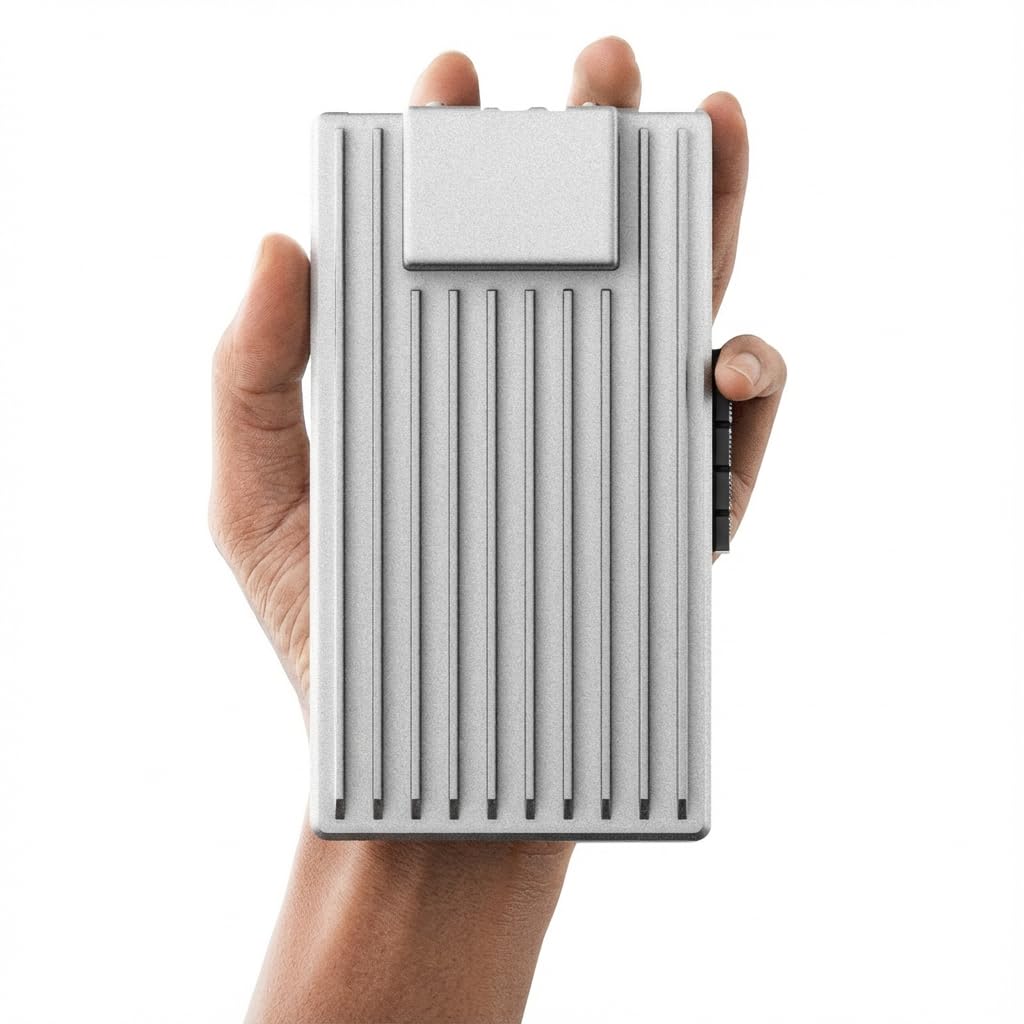
The ZimaBoard 2 832 is a purpose-built single-board x86 server that provides a fanless, low-power platform for 24/7 operation. Its Intel N150 quad-core processor consumes minimal energy while offering enough grunt for Docker containers, Pi-hole ad blocking, and a basic pfSense firewall.
The real differentiator is the native PCIe 3.0 x4 slot, which allows you to add a 10GbE network card, an NVMe adapter, or even a GPU for AI workloads down the line. This expansion capability puts it leagues ahead of typical ARM-based SBCs like the Raspberry Pi. It also includes dual 2.5GbE ports and dual SATA 3.0 ports for direct drive connectivity.
ZimaOS is preinstalled for a clean private cloud experience, but the board also supports TrueNAS, Proxmox, and Ubuntu Server. The passive heatsink keeps the CPU under 50°C even in unconditioned spaces, though the initial setup documentation can be sparse for first-time users.
Why it’s great
- Fanless design with excellent passive cooling for silent 24/7 operation.
- PCIe 3.0 x4 slot offers genuine hardware expansion for 10GbE or NVMe.
- Dual 2.5GbE ports with AES-NI support for routing and VPN applications.
Good to know
- 32GB eMMC storage is very limited and requires external or SATA drives for data.
- Documentation is thin, and some SATA cables may be packed inside the box rather than listed.
3. Asustor AS5402T 2-Bay NAS

The Asustor AS5402T packs an impressive hardware punch for a 2-bay NAS, featuring an Intel N5105 quad-core processor and an extraordinary four M.2 NVMe slots. These NVMe slots can be used for caching to drastically boost IOPS performance or as independent flash storage for applications and VMs.
Dual 2.5GbE ports enable link aggregation for high-bandwidth file sharing among multiple users. The included 4GB of DDR4 RAM is upgradeable to 16GB, and the HDMI 2.0b output supports direct 4K media playback on a connected TV. The unit runs stable and quiet, handling multiple Docker containers and Plex transcoding without frequent reboots.
The Asustor Data Master (ADM) software is robust but slightly less polished than Synology’s DSM. However, the superior hardware specifications at this price point make the AS5402T a compelling choice for users who prioritize raw performance over a refined interface.
Why it’s great
- Four M.2 NVMe slots for extreme caching or SSD-only pools.
- Dual 2.5GbE ports with link aggregation for high-speed networking.
- HDMI 2.0b output for direct 4K media playback on a display.
Good to know
- ADM software interface is functional but not as intuitive as Synology DSM.
- Only 2-bay for 3.5-inch drives, limiting maximum raw storage capacity.
4. UGREEN NAS DH4300 Plus 4-Bay

The UGREEN NAS DH4300 Plus is an entry-level 4-bay NAS designed for users migrating from cloud storage or external hard drives. It supports up to 128TB of total capacity and includes an NFC-enabled quick-connect feature for setup. The Ugos Pro operating system provides an intuitive interface for file management, photo backups, and media streaming.
Its high-performance processor and 8GB of LPDDR4X RAM allow for smooth multitasking, and the 2.5GbE port delivers transfer speeds around 312 MB/s under ideal conditions. The AI-powered photo album can recognize and categorize people, objects, and pets, making it easy to find specific memories. An HDMI 2.0 port allows direct 4K video output.
Docker is supported for app expansion, but virtual machines are not. The chassis can amplify HDD vibration noise; some users add acoustic foam for quieter operation. Overall, this is a solid, cost-effective private cloud solution for households that want straightforward storage without recurring fees.
Why it’s great
- User-friendly app setup with NFC and an intuitive Ugos Pro OS.
- AI-driven photo management with semantic search and object recognition.
- 4-bay design supports up to 128TB for massive media archives.
Good to know
- Does not support virtual machines; limited to Docker containers.
- Chassis can amplify HDD noise; acoustic foam may be needed for quiet environments.
5. LincStation N2 6-Bay NAS
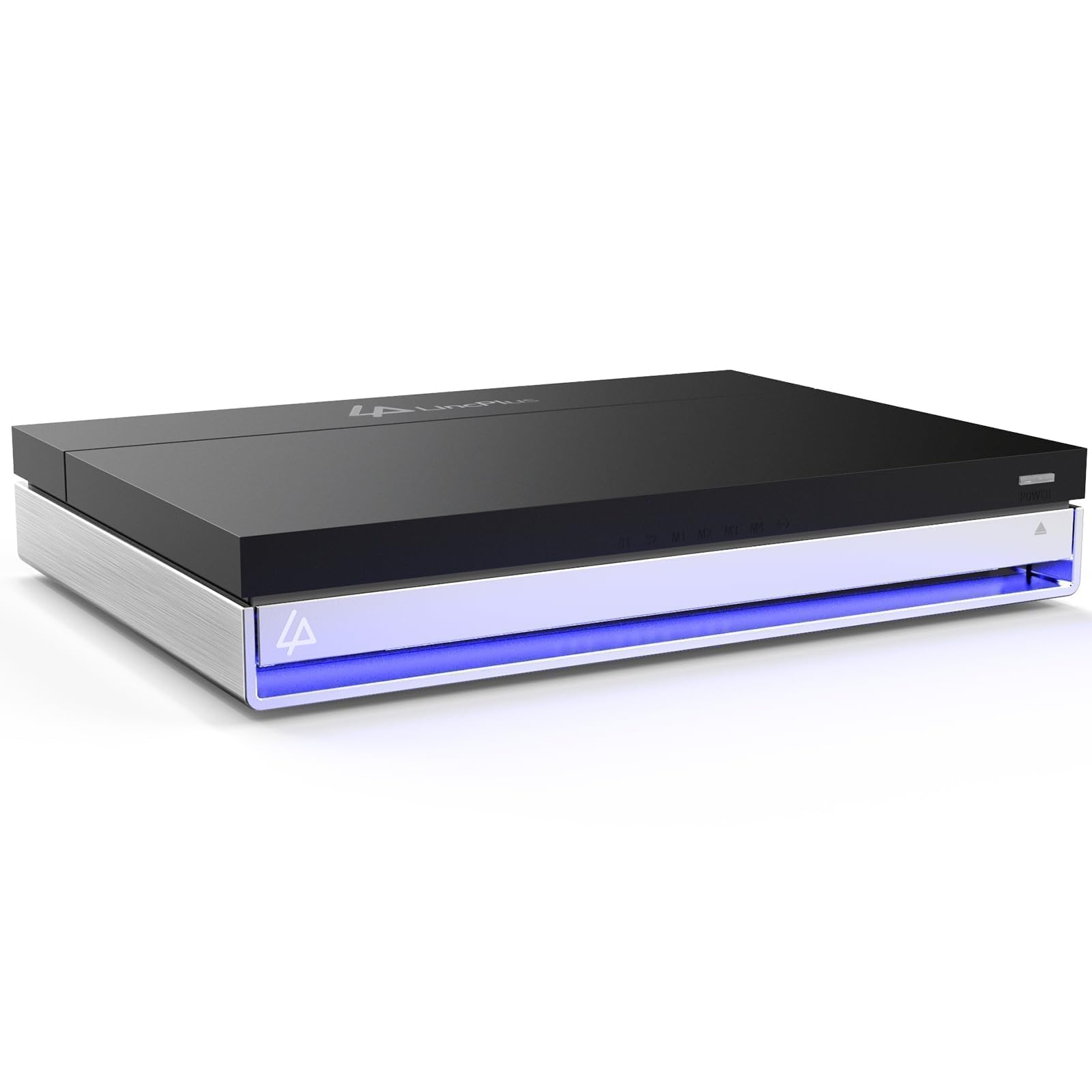
The LincStation N2 is a uniquely configured 6-bay NAS that pairs 2 traditional SATA bays for 2.5-inch drives with 4 M.2 NVMe slots for blazing-fast SSD storage. This allows you to mix high-capacity SATA SSDs with ultra-fast NVMe drives for a tiered storage approach. It comes with an included Unraid OS starter license, which offers flexibility to use drives of different sizes in a single array.
Its built-in 10 Gigabit Ethernet port is a standout feature at this price, quadrupling the throughput of standard 2.5GbE connections for lag-free editing of large video files. The Intel N100 processor and 16GB of LPDDR5 RAM provide ample performance for Plex, Jellyfin, and Docker workloads.
The unit is whisper-quiet when populated with SSDs, and the metal enclosure acts as an effective heatsink. The main limitation is that it supports 2.5-inch drives only, so you cannot use standard 3.5-inch HDDs without an external USB enclosure.
Why it’s great
- Native 10GbE port for rapid file transfers well beyond 1GbE speeds.
- Flexible 6-bay config with 4x NVMe and 2x SATA for hybrid storage.
- Includes official Unraid license for easy multi-drive pooling and cache setups.
Good to know
- Does not support native 3.5-inch HDDs; uses 2.5-inch form factor drives only.
- PCIe lane limitations can cap individual NVMe drive speeds.
6. ZimaBoard 2 1664 x86 Home Server
The ZimaBoard 2 1664 is the higher-spec sibling of the 832 model, doubling the RAM to 16GB of DDR5 and the internal storage to 64GB eMMC. This extra memory makes it significantly more capable for running multiple Docker containers, a pfSense firewall, and a nextcloud instance simultaneously without running out of headroom.
It retains the same powerful feature set: a full PCIe 3.0 x4 expansion slot, dual 2.5GbE ports, and dual SATA 3.0 connectors. Users report rock-solid stability running pfSense with Wireguard VPN throughput reaching 150 Mbps, handling 10TB of data transfers without a hiccup. The fanless design and large passive heatsink allow it to survive in unconditioned spaces like garages or barns.
While the ZimaOS interface is clean and ad-free, advanced users often switch to Ubuntu Server or Proxmox for more granular control. The small onboard eMMC is only enough for the OS; all user data must live on attached SATA drives or an NVMe SSD installed via the PCIe slot.
Why it’s great
- 16GB DDR5 provides ample room for multiple virtualized services.
- PCIe slot allows for 10GbE or NVMe expansion beyond built-in SATA ports.
- Fanless and rugged enough for 24/7 operation in dusty or hot environments.
Good to know
- 64GB eMMC is only suitable for the OS; data storage requires external drives.
- Initial setup process can be unclear for users unfamiliar with Linux networking.
7. GEEKOM A5 Mini PC
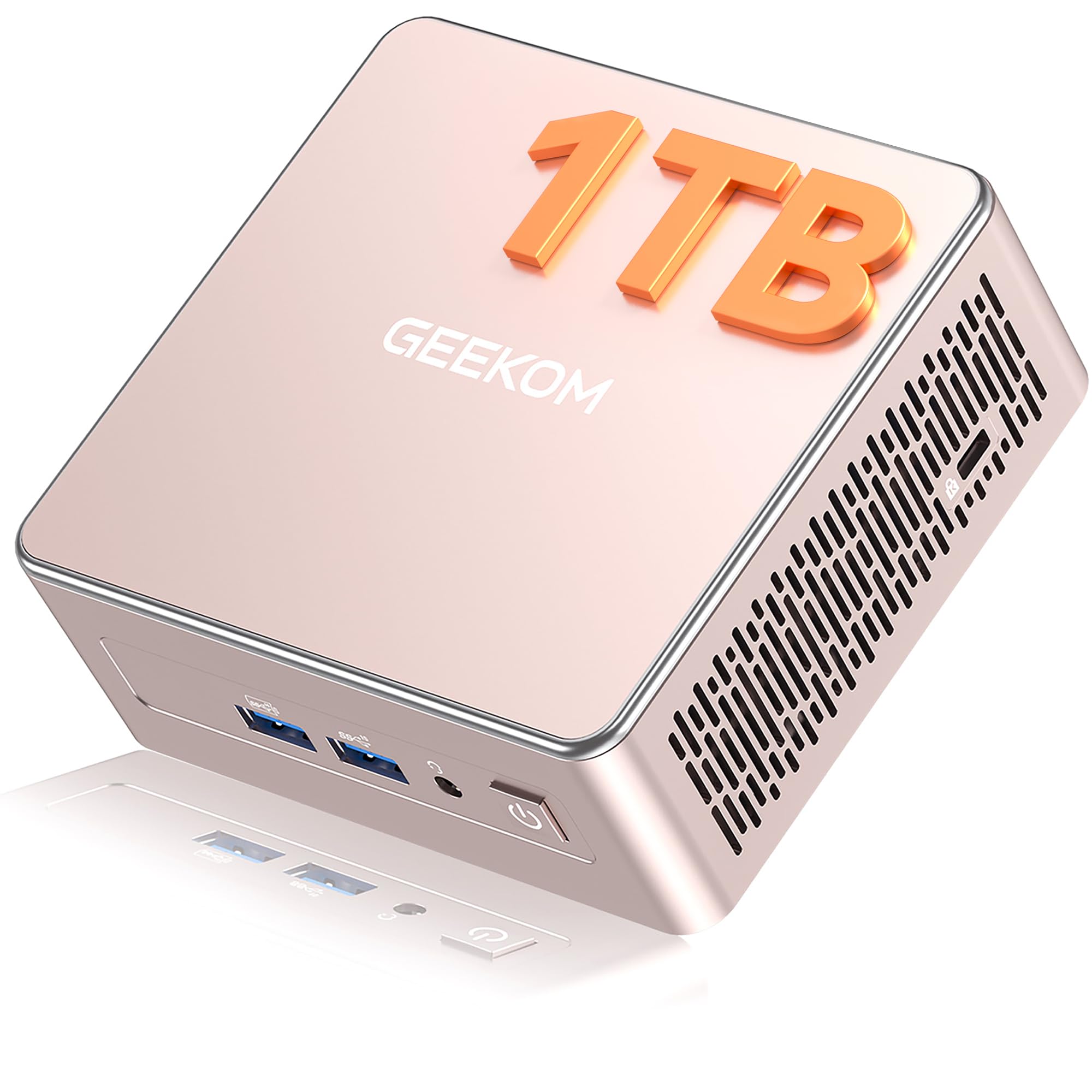
The GEEKOM A5 is a compact Windows 11 Pro mini PC that can serve as an incredibly versatile home server. Powered by an AMD Ryzen 5 7430U processor with 6 cores and 12 threads, it has enough computational muscle to run multiple virtual machines, handle light video editing, and stream 4K content simultaneously. It comes with 16GB of DDR4 RAM and a 1TB PCIe NVMe SSD.
Connectivity is a strong point: it features 2 HDMI and 2 USB-C ports capable of driving up to 4 displays (including one at 8K), along with Wi-Fi 6 and Bluetooth 5.2 for wireless peripherals. The internal storage is expandable via an extra M.2 2242 slot and a 2.5-inch SATA bay, allowing a total of up to 10TB. The reinforced ABS+PC shell and metal mid-frame provide professional build quality for 24/7 operation.
The GEEKOM A5’s system runs Windows 11 Pro, but it is fully Linux-compatible, making it a flexible foundation for a home server running Proxmox, Ubuntu Server, or TrueNAS Scale. The 3-year warranty offers solid long-term protection, and the unit’s low noise output makes it unobtrusive in an office or living room.
Why it’s great
- Powerful AMD Ryzen 5 processor for virtualization and heavy multitasking.
- Expandable storage up to 10TB with dual M.2 and 2.5-inch SATA bays.
- Supports 4 display outputs with 8K resolution via USB-C.
Good to know
- Pre-installed Windows 11 Pro may require manual setup for server tasks.
- Fans become audible under sustained heavy load or stress testing.
8. Synology DS425+ Private Cloud 4-Bay NAS
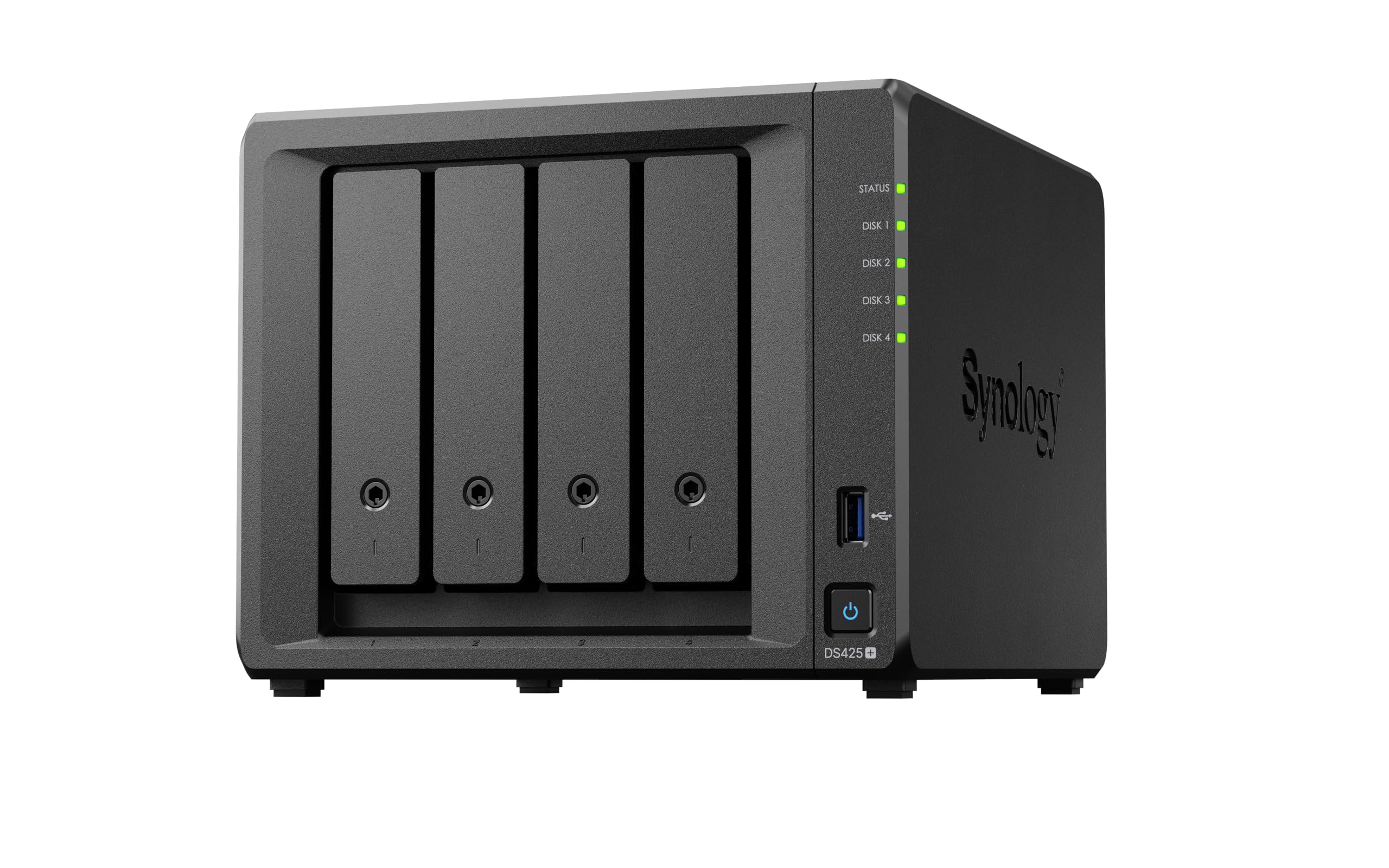
The Synology DS425+ extends the DS225+ experience to a 4-bay chassis, making it suitable for team productivity and centralized media hubs. Its 278 MB/s read speed supports concurrent access from over 10 users, and the DSM OS offers granular access controls and audit logs for managing shared company documents.
The unit supports multi-layered data protection through RAID redundancy, automated backups, and snapshot technology. It can also monitor up to 30 IP cameras for a professional surveillance system. The hardware supports up to 80TB of raw storage (using four 20TB drives), and third-party drives like Seagate IronWolf work after a minor SSH compatibility check.
Synology’s ecosystem is mature and rich with first-party apps for photos, drive syncing, and media streaming. The primary drawback is that the DS425+ ships with only 2GB of RAM, which feels restrictive for a 4-bay unit. Owners often upgrade to 8GB or add an SSD read cache to unlock its full potential.
Why it’s great
- Industry-leading DSM software with mature apps and granular user controls.
- 4-bay design allows for RAID 5 or RAID 6 configurations up to 80TB.
- Supports 30 IP cameras and multi-client simultaneous access.
Good to know
- Only 2GB of RAM standard; an upgrade to 8GB is almost mandatory for serious use.
- Some users report compatibility hiccups with non-Synology branded SSDs.
9. HP ProLiant DL360p Gen8 1U RackMount Server (Renewed)

The HP ProLiant DL360p Gen8 is a renewed enterprise rackmount server that provides extreme hardware density for a home lab. It comes equipped with dual 6-core Intel Xeon E5-2640 processors (12 cores, 24 threads total), 64GB of PC3-10600R ECC RAM, and eight 300GB 10K SAS drives in a small form factor. This hardware is ideal for running Hyper-V, Proxmox, or ESXi with multiple virtual machines.
The P420i RAID controller supports both SAS and SATA drives, and the server includes four Gigabit Ethernet NICs for network aggregation. The iLO remote management chip enables out-of-band monitoring, although the license for the full remote console may need to be purchased separately. The unit also has two PCIe slots (one x8 half-height, one x16 full-height) for adding a 10GbE card or a GPU.
The trade-off for this power is noise and heat. During boot, the fans spin up to 55-60% speed, sounding like a jet engine; at idle, they quiet down to the level of a desk fan. This is not a device for a quiet living room. The renewed condition can show cosmetic wear, but the internal hardware generally functions as described.
Why it’s great
- Dual Xeon processors with 24 threads provide immense VM compute capacity.
- Includes 8x 300GB SAS drives, 64GB ECC RAM, and hardware RAID controller.
- iLO management and dual PCIe slots enable significant expandability.
Good to know
- Very loud during boot and under load; not suitable for quiet environments.
- Older Gen8 hardware consumes more power than modern alternatives.
10. TrueNAS Mini X+ Compact ZFS Storage Server
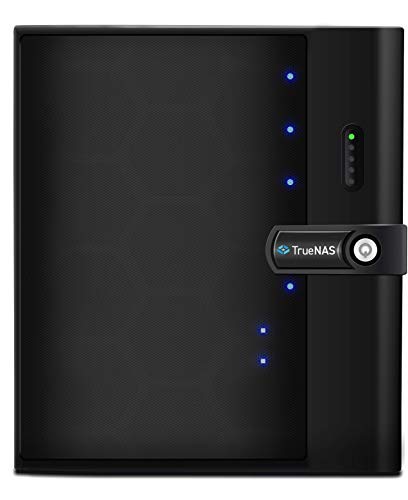
The TrueNAS Mini X+ is a pre-built appliance designed specifically for users who want the power and data integrity of the ZFS filesystem without the complexity of building a custom server. It features an 8-core Intel Atom processor, 32GB of ECC DDR4 RAM, and a versatile 5+2 drive bay configuration (five 3.5-inch bays plus two 2.5-inch SSD bays) in a quiet mini-tower form factor.
ECC memory is a critical feature for ZFS, as it protects against silent data corruption that can occur with standard non-ECC RAM. The dual 1/10 Gigabit Ethernet ports provide high-speed connectivity for both office and home networks. TrueNAS Community Edition supports Windows, macOS, and Linux clients and syncs with cloud services like AWS and Dropbox.
The system runs cool and quiet thanks to Nanoxia fans, and remote management via IPMI allows you to control the server without a monitor or keyboard. The main caveat is that ZFS pool expansion is limited; you cannot easily add a single drive to a RAID-Z array, so careful planning is required. The premium price reflects the robust build quality and US-based support.
Why it’s great
- ECC memory and ZFS filesystem provide enterprise-grade data integrity.
- Compact 7-bay design with IPMI for headless remote management.
- Dual 10GbE networking supports high-speed backup and media workflows.
Good to know
- ZFS pool expansion is rigid; plan all drives upfront to avoid rebuilds.
- Higher upfront investment compared to entry-level Synology or QNAP units.
11. HPE ProLiant MicroServer Gen10+

The HPE ProLiant MicroServer Gen10+ is a compact, professional-grade micro server that brings enterprise features to a small footprint. It supports an Intel Xeon E-2224 processor, 16GB of ECC memory, and four Large Form Factor (LFF) drive bays that accept standard 3.5-inch hard drives. Its half-height design compared to the previous generation allows it to be placed horizontally or vertically.
HPE iLO 5 provides robust remote management with Silicon Root of Trust for security. The server includes four onboard Gigabit Ethernet NICs and one PCIe x16 expansion slot for adding a 10GbE card, GPU, or M.2 adapter. It runs exceptionally quiet and consumes only around 12W at idle with a single HDD, making it a low-impact addition to a home office.
The primary limitations are the single PCIe slot and the 180W external power supply, which restrict high-power GPU or high-core Xeon upgrades. The Xeon E-2224 is a capable processor for a NAS or light server, but its lack of integrated GPU (iGPU) means it cannot handle hardware transcoding for Plex without an additional graphics card. Firmware updates require an HP account and can be cumbersome.
Why it’s great
- Enterprise build quality with iLO 5 remote management and ECC memory support.
- Compact and quiet design with ultra-low 12W idle power consumption.
- Four LFF bays support large 3.5-inch drives for massive storage.
Good to know
- No integrated GPU; hardware transcoding requires a discrete graphics card.
- Single PCIe slot and 180W power supply limit expansion potential.
FAQ
Do I need a 2-bay or 4-bay NAS for my family’s media?
Can I use a mini PC like the GEEKOM A5 as a home server?
What is the difference between a NAS and a home server?
How much storage capacity do I realistically need for a home server?
Final Thoughts: The Verdict
For most users, the at home server winner is the Synology DS225+ because of its polished software, reliable hardware, and effortless setup for both media streaming and backups. If you want blazing NVMe speeds and 10GbE networking, grab the LincStation N2. And for a deep virtualization lab with maximum expandability, nothing beats the HP ProLiant DL360p Gen8.