
High sodium intake is a silent strain on your health, and the first step to controlling it is knowing exactly what’s coming out of your tap. An at-home test removes the mystery by delivering a quantitative sodium reading in minutes rather than waiting on a mail-in lab report. The right kit gives you actionable data to decide on filtration, water softening adjustments, or simply peace of mind.
I’m Min — the co-founder and writer behind Gadgets Feed. I’ve spent numerous hours cross-referencing lab standards, strip sensitivities, and real-user verification reports to separate kits that produce reliable trace-level sodium readings from those that waste your time.
Whether you’re on well water, curious about municipal supply, or monitoring a new softener system, selecting the right best at home sodium test kit depends on sensitivity range, test count, and how easily the color chart translates to a decipherable number.
How To Choose The Best At Home Sodium Test Kit
Not all test kits report sodium the same way. Some include it as a secondary reading on a multiparameter strip, while others embed it within a broader panel of metals and minerals. Your buying decision hinges on three specific factors that directly impact the usefulness of that sodium number.
Sodium Detection Range and Sensitivity
The most common sodium test strips cover a range from roughly 0 to 500 parts per million (ppm). For context, the EPA secondary maximum contaminant level recommends keeping sodium under 60 ppm for taste, but health-concern thresholds start around 200 ppm. Kits with a finer granularity at the low end (10–20 ppm increments) let you identify gradual increases from a water softener long before the water tastes salty.
Multiparameter Value vs. Single-Use Focus
A dedicated sodium strip usually trades off by not testing other contaminants. Many of the best multiparameter kits bundle a sodium pad alongside hardness, chlorine, pH, iron, and lead. If you only care about sodium, a focused strip may be simpler to read, but the multiparameter route gives context — high sodium paired with high hardness often points to a failing softener.
Color Chart Readability and Timing
Every strip-based test relies on you matching a color change to a printed chart within a strict timing window. Kits that use distinct, saturated color blocks for sodium (rather than pale pastels) dramatically reduce misreads. Poor lighting can shift your perceived result by a full tier, so a kit that works well under standard kitchen lighting is worth prioritizing.
Quick Comparison
On smaller screens, swipe sideways to see the full table.
| Model | Category | Best For | Key Spec | Amazon |
|---|---|---|---|---|
| Varify 17in1 Complete | Premium | Comprehensive insight + bacteria | 17 parameters, 100 strips + 2 bacteria tests | Amazon |
| AESCULIX 23 in 1 | Premium | Broadest parameter panel | 23 parameters, 158 test strips | Amazon |
| HEVEIS 21-in-1 | Mid-Range | Bacteria tests + record cards | 21 parameters, 120 strips + 4 bacteria tests | Amazon |
| HYCHEK 21 in 1 | Mid-Range | High strip count for frequent retesting | 21 parameters, 145 strips + 4 bacteria tests | Amazon |
| TESPERT 16 in 1 | Mid-Range | Quick 30-second screening | 16 parameters, 125 test strips | Amazon |
| HydroHawk 16-in-1 | Budget-Friendly | Entry-level multiparameter value | 16 parameters, 100 test strips | Amazon |
| Palinoia 22 in 1 | Budget-Friendly | Highest strip count at entry price | 22 parameters, 130 test strips | Amazon |
In‑Depth Reviews
1. Varify 17in1 Complete Drinking Water Test Kit
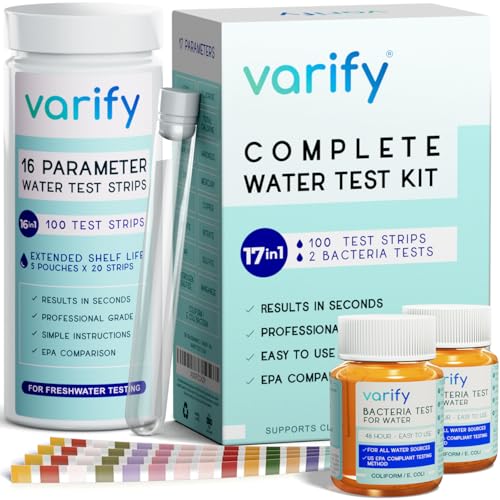
The Varify kit earns the top spot because it bundles a dedicated sodium readout within a 17-parameter strip and includes two separate bacteria tests — an extra layer most multiparameter kits skip. The strips come in five individually foil-sealed pouches of 20, which preserves reagent freshness far better than a single canister that gets exposed to humidity each time you open it.
Real-world testing from users confirms the sodium pad produces consistent color shifts at the low end (around 20–40 ppm), making it easier to spot a rising trend from a water softener before it reaches problematic levels. The color chart uses saturated blocks rather than washed-out gradients, so you get a clearer read under standard kitchen LED lighting. The bacteria tests require 48 hours but add genuine value if you’re on well water.
One tradeoff: the package includes 100 test strips, but the 2 bacteria tests are single-use. For households that want to test sodium weekly and bacteria quarterly, the bundle covers roughly six months of routine monitoring. The included pipette and vial also make sample collection from a well spigot cleaner.
Why it’s great
- Sealed foil pouches extend strip shelf life significantly
- Bacteria tests included for well-water safety screening
- Sodium pad readable at low ppm increments
Good to know
- Only 2 bacteria test kits — one-time use after opening
- Hardness reading can be impacted by softener if aerator not removed
2. AESCULIX 23 in 1 Water Test Kit
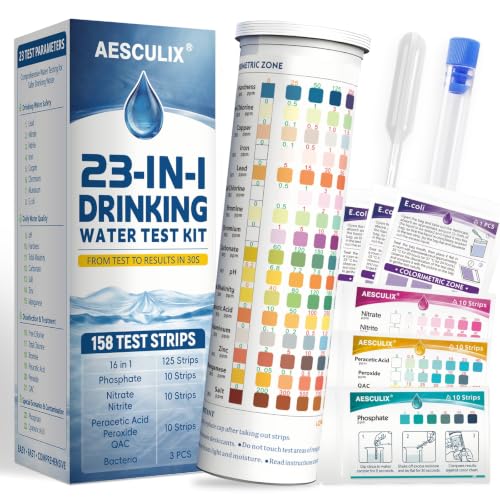
With 23 parameters tracked across 158 strips, the AESCULIX kit gives you the widest net for catching unexpected contaminants alongside sodium. The sodium chloride detection pad is clearly separated on the strip from the hardness and chlorine pads, reducing the risk of cross-color bleed when reading the results.
Users consistently note that the included pipettes and test tubes make sample collection from well heads or rain barrels less messy compared to strips that require direct submersion. The 30-second wait time is standard, but the chart’s sodium gradient uses distinct color transitions (from pale cream to deep orange) that resolve well even in slightly dim pantries.
The 158-strip count is generous enough for weekly testing across an entire year, but the bacteria test is limited to a general screening rather than a dedicated E. coli culture. If you need speciation of bacterial colonies, you’ll still need a lab follow-up. The kit works well as a high-volume early warning system.
Why it’s great
- Highest parameter count in the roundup (23 tests)
- 158 strips support year-round weekly monitoring
- Included pipettes and test tubes for precise sampling
Good to know
- Hardness blotchiness reported by some users
- No individual foil pouches — strip canister only
3. HEVEIS 21-in-1 Home Drinking Water Testing Kit

The HEVEIS stands apart because it includes four separate bacteria test kits — twice what most competitors bundle — making it the strongest choice for well owners who need quarterly bacterial screening alongside routine sodium checks. The sodium test on the multiparameter strip covers a 0–500 ppm range with a clearly differentiated middle band that helps you spot 150–200 ppm readings without squinting.
Each purchase also comes with a laminated color comparison card and a physical record card, which solves the common frustration of having to juggle a paper chart while holding a timer. Users on spring and well water report that the strips consistently correlate with follow-up lab work for sodium and total hardness, giving them confidence to adjust softener settings without guesswork.
The 120-strip count plus 4 bacteria tests represents strong value, but the bacteria tests require a longer incubation time (48 hours) and a separate sample vial. The instructions are clear, but the process is more involved than a single dip-and-read strip. Plan to set aside time for the bacterial culture setup.
Why it’s great
- 4 bacteria test kits for quarterly well monitoring
- Laminated color comparison card included
- Record card for tracking sodium trends over time
Good to know
- Bacteria test requires 48-hour incubation
- Color matching for nitrate/chlorine can be subtle in dim light
4. HYCHEK 21 in 1 Accurate Drinking Water Testing Kits
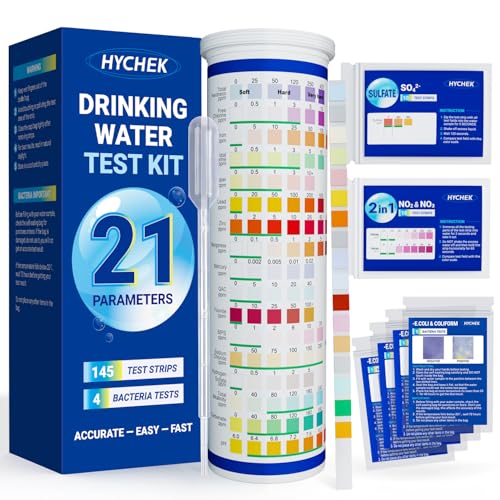
The HYCHEK kit delivers the second-highest strip count in the roundup at 145 strips, paired with the same 4 bacteria test setup as the HEVEIS. The sodium pad uses a distinct orange-to-red color shift that most testers found easier to read than the more common yellow-to-orange gradient used by other brands.
Users specifically noted that dipping and reading within the 15-second window (rather than the 30-second standard) reduces the chance of over-development on the sodium pad, which can skew results toward a higher reading if left too long. The bottle-top color chart is printed with large type that doesn’t require reading glasses to interpret, a small but meaningful detail for routine use.
The main drawback reported is that the color chart could be more granular — the sodium increments jump in 50 ppm steps above 100 ppm, which makes fine-tuning a water softener to a specific target tricky. For a simple pass/fail screening, it works perfectly.
Why it’s great
- Large-print color chart for easy reading
- 15-second dip time reduces over-development errors
- 145 strips + 4 bacteria tests for extended use
Good to know
- Sodium increments jump to 50 ppm above 100 ppm
- Chart could be slightly more refined for precision work
5. TESPERT Drinking Water Test Strips 125ct 16 in 1
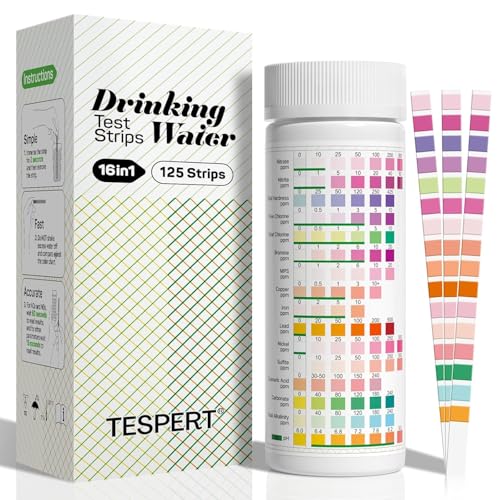
TESPERT focuses on speed — the entire read cycle completes in 30 seconds, and the sodium indicator reaches its final color by the 25-second mark, giving you a five-second buffer before the pad begins to drift. The company claims over 30 years of water testing experience, and the instructions reflect that depth with specific notes about keeping the strip horizontal to prevent color running across pads.
The 16-parameter strip covers the basics (hardness, chlorine, pH, iron, lead, nitrate, nitrite, copper, plus sodium chloride) without overwhelming you with rarely-used tests. Users frequently mention that the color chart is among the easiest to interpret, with the sodium pad using a clean white-to-yellow-to-orange progression that doesn’t bleed into neighboring pads.
One limitation is that the lead test on these strips has a detection floor of 15 ppb, which TESPERT itself notes may not be sensitive enough for some well water scenarios. For sodium specifically, the strip works well, but if you need ultra-low lead detection, you may want a separate kit for that parameter.
Why it’s great
- Fast 30-second read cycle with a 5-second buffer
- Clean, non-bleeding color progression for sodium
- Detailed instructions from an established brand
Good to know
- Lead detection floor is 15 ppb — not lab-grade
- Color matching can be tricky in low light without a white background
6. HydroHawk 16-in-1 Drinking Water Test Strips (100 Pack)
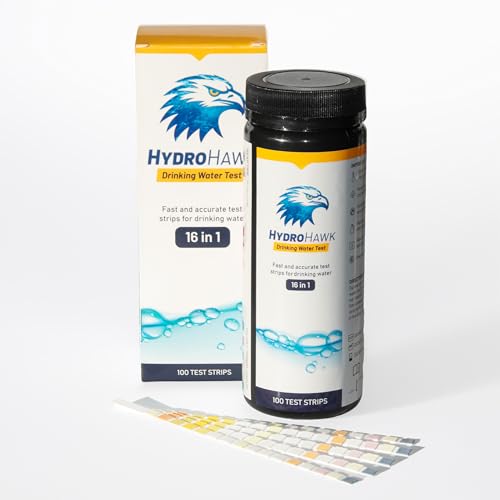
The HydroHawk kit is the entry-level multiparameter option that still covers sodium chloride alongside 15 other common parameters. It uses a double-sealed package (plastic wrap over the foil canister) plus desiccant packs to keep strips dry — a detail often missing from budget-tier products that leads to premature strip degradation.
Users consistently praise the consistency of the sodium readings across multiple strips from the same batch. The standard 60-second read time is longer than some competitors, but the extra time allows the sodium pad to reach a stable color that doesn’t continue shifting for another 30 seconds, giving you a wider window to compare against the chart.
The main compromise is the color chart itself — the shades for hardness and nitrate are quite close, and the sodium pad sits in the middle of the strip, making it slightly harder to isolate compared to strips that place it at the end. It’s a solid pick for casual monitoring where absolute precision is secondary to regular trend-tracking.
Why it’s great
- Double-sealed packaging with desiccant for strip longevity
- 60-second window allows stable color development
- Consistent batch-to-batch reading accuracy
Good to know
- Sodium pad placement in the middle of the strip harder to isolate
- Hardness reading can appear blotchy on some strips
7. Palinoia 22 in 1 Drinking Water Test Kit 130 Strips
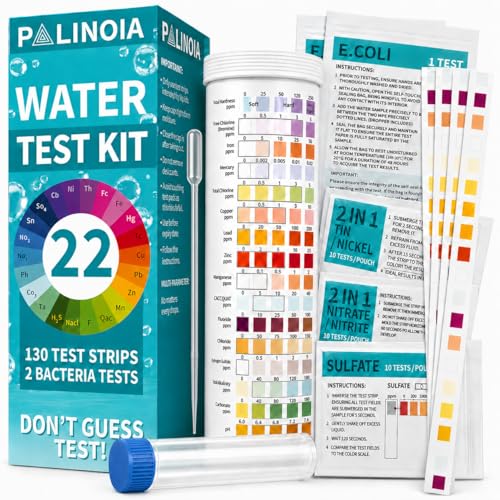
The Palinoia kit packs an astonishing 22 parameters onto a single strip while still including a legible sodium pad. With 130 strips, it offers the highest total test count in the roundup at an entry-level price, making it the most economical option for large households or rental property managers who test multiple sources.
The 15-second read time is among the fastest here, and users who verified results against professional lab tests reported strong correlation on sodium, hardness, and chlorine readings. The lightweight packaging and small vial make it genuinely portable for testing at cabins, RVs, or on vacation rentals where you don’t trust the local water quality.
The tradeoff for cramming 22 tests onto one strip is that the color pads are smaller and packed more tightly together. Some users found it difficult to read all 22 pads in the recommended time without missing the sodium window. Focusing on the 5–6 parameters you care about most (sodium, hardness, chlorine, pH, lead, iron) and ignoring the rest is the practical approach.
Why it’s great
- Highest parameter-to-price ratio on the market
- 130 strips support frequent testing across multiple locations
- 15-second read time is the fastest available
Good to know
- 22 pads on one strip can feel cramped and hard to read quickly
- No foil pouches — single canister only
FAQ
What is considered a safe sodium level in drinking water?
Can water softener salt increase my sodium test reading?
How long do water test strips stay accurate for sodium detection?
Final Thoughts: The Verdict
For most users, the best at home sodium test kit winner is the Varify 17in1 Complete because it combines a reliable sodium pad with bacteria testing and sealed foil pouches that preserve strip accuracy. If you want the widest parameter panel for top-to-bottom water analysis, grab the AESCULIX 23 in 1. And for the best value with the most bacteria tests included for well owners, nothing beats the HEVEIS 21-in-1.