
Our readers keep the lights on and my morning glass full of iced black tea. As an Amazon Associate, I earn from qualifying purchases.
Specs are compiled from manufacturer listings and verified buyer reviews and can change over time — please confirm the key details on the product page before buying.
Finding live termites in your wall or a mud tube on your foundation is one of those homeowner moments where you need a fast, effective fix—not a marketing pitch. The real question is whether a foam that fills tunnels, a bait that spreads through the colony, or a liquid barrier spray around your home’s base actually stops the infestation. This guide breaks down each approach by the product’s physical action, the key spec that determines effectiveness, and what real buyers found after using it.
I’m Min — the founder and writer behind Gadgets Feed. This guide is built by comparing the manufacturers’ published specifications and the patterns across verified customer reviews, so you get each pick’s real strengths and trade-offs instead of marketing spin.
if you need a targeted spot treatment for an active colony or a perimeter defense, these are the most reliable at home termite treatment options available today on the market.
Quick Picks
- Bayer Premise Foam Termiticide — Best Overall
- Ortho Home Defense MAX Termite Killer — Large Perimeter
- Bifenthrin Plus-C Insecticide — Versatile Spray
- BioAdvanced Termite Killer Granules — Granule Barrier
- BASF Trelona Compressed Termite Bait — Colony Bait
- Cyper TC Termite-1 Gallon — Heavy-Duty Barrier
- Bora-Care Termiticide and Fungicide Concentrate — Wood Treatment
How To Choose The Best At Home Termite Treatment
Termite treatments generally fall into a few categories: liquid barrier concentrates you mix and spray around the foundation, foam that expands into wall voids and tunnels, bait systems termites carry back to the colony, and wood treatments that soak into lumber to prevent future attack. The right choice depends on whether you have visible active tunnels, are treating soil before building, or need a preventative ring around the house.
Active Ingredient and Mode of Action
The spec that matters most is the active ingredient and its mode of action. Bifenthrin and cypermethrin are contact poisons that create a barrier termites cannot cross without dying; they work fast but only kill what touches the treated zone. Novaluron and disodium octaborate tetrahydrate (found in Bora-Care) are slower—the first stops molting so the colony starves, the second penetrates wood fibers and poisons termites that eat or tunnel through it. To collapse the colony, you need a non-repellent or a bait that foragers carry back to the nest.
Application Surface and Reach
Foam is the only format that fills the actual airspace inside a mud tube or a hollow wall, so it reaches termites where liquid sprays cannot. Liquid concentrates cover huge outdoor perimeters (up to 4,500 square feet for the BioAdvanced granules) but require you to dig a trench or soak the soil. Bait cartridges like the BASF Trelona need stations placed in the ground near activity; they demand patience because the termites must find and feed on the bait before the colony dies over several weeks. Wood treatments like Bora-Care are best applied during construction or exposed framing because they soak into the lumber and last for the life of the wood.
Quick Comparison
| Model | Best For | Active Ingredient | Format | Coverage / Quantity | Amazon |
|---|---|---|---|---|---|
| Bayer Premise Foam | Spot-treating active wall tunnels | Imidacloprid | Foam | 18 oz aerosol can | Amazon |
| Ortho Home Defense MAX | Liquid barrier around foundation | Bifenthrin | Concentrate | 16 fl oz makes ~16 gal | Amazon |
| Bifenthrin Plus-C | Indoor/outdoor general pest spray | Bifenthrin | Liquid concentrate | 16 fl oz | Amazon |
| BioAdvanced Granules | Dry outdoor barrier | Bifenthrin | Granules | 9 lb / up to 4,500 sq ft | Amazon |
| BASF Trelona | Bait system for subterranean colony | Novaluron (IGR) | Bait cartridge | 6 cartridges | Amazon |
| Cyper TC Termite | Large area soil barrier | 25.3% Cypermethrin | Liquid concentrate (oil-based) | 1 gallon | Amazon |
| Bora-Care | Wood treatment / prevention | Disodium octaborate tetrahydrate | Liquid concentrate | 1 gal covers ~800 sq ft | Amazon |
In‑Depth Reviews
1. Bayer Premise Foam Termiticide

The expanding foam that fills termite tunnels where sprays cannot travel.
This is the only at-home treatment that physically fills the airspace inside a wall void or mud tube, reaching termites wherever they hide. The foam consistency means you inject it through a drilled hole and it expands into the galleries, coating insects and wood with the active ingredient imidacloprid. Buyers report that after applying it to a 12-foot wall area, hundreds of dead termites appeared within two days, with no activity for months afterward.
Unlike liquid sprays that only coat the surface they hit, the foam gets into every crack and hollow space, making it ideal for active infestations inside framing, baseboards, or window sills. The 18-ounce can goes a long way because you are not drenching the area—the foam expands as it leaves the nozzle. It also kills carpenter bees and ants, adding versatility for other wood pests.
The catch is that this is a spot treatment, not a whole-house perimeter solution. If termites are in a different wall or if you have a large colony underground, you may need to drill multiple injection points or follow up with a bait system. It also requires a foam gun or the included nozzle to avoid spitback—reviewers recommend short presses and checking that the tip is clear before you start.
Colony killer: The foam reaches hidden termites in wall voids, kills within days, and reviewers report months of inactivity after a single application—ideal for anyone with a localized active infestation inside the home.
Reach for this if: you see mud tubes on a baseboard or find termites in a specific wall section and want a precise, self-expanding chemical treatment that hits the colony directly.
Look elsewhere if: you need a wide perimeter barrier or a long-term prevention plan around the entire foundation—a liquid spray or bait system fits that job better.
2. Ortho Home Defense MAX Termite Killer Concentrate

The liquid barrier stays active in soil for years, not weeks.
Ortho’s MAX formula uses bifenthrin, a non-repellent insecticide that termites cannot sense, so they walk through it and die rather than avoid the treated area. The manufacturer claims it provides up to 5 years of control in treated soil when used in a trenching application around the home’s foundation. It also works on carpenter ants, carpenter bees, and other wood-destroying pests, making it a broad-spectrum option. One reviewer who used it in a foundation crack applied it three times over ten days and noted it “works great on ants” and completely eliminated a minor termite outbreak.
At only 0.5 pounds for the 16-ounce bottle, this is a lightweight concentrate—you mix it with water in a garden sprayer and apply it around wooden structures, wood piles, tree stumps, and stored lumber. The liquid volume of 16 fluid ounces is small, but it dilutes to a much larger quantity of finished spray. Buyers emphasize making sure you get the “MAX” version, because the regular formula is noticeably weaker—”the max is really really good whereas the regular is just barely so so.”
The trade-off is that you must dig a trench or use a rod-injection tool to get the chemical deep enough into the soil for a true barrier. A surface spray alone will not last five years. Also, Ortho does not sell this in Massachusetts, New York, or Rhode Island due to state restrictions, so check your local regulations.
Long-term barrier
- Non-repellent bifenthrin kills termites that cross the treated zone
- Up to 5 years of control in a proper trench application
- Lightweight concentrate mixes into gallons of finished spray
Application effort
- Requires digging a trench or rod-injection for best results
- Not for sale in MA, NY, or RI
- Surface-only spray won’t achieve the 5-year claim
Best for: homeowners who want a long-lasting perimeter defense and are willing to do a trench application once. skip it if: you cannot dig a trench or live in a restricted state—look at the BioAdvanced granules for a less labor-intensive outdoor barrier.
3. Bifenthrin Plus-C Insecticide
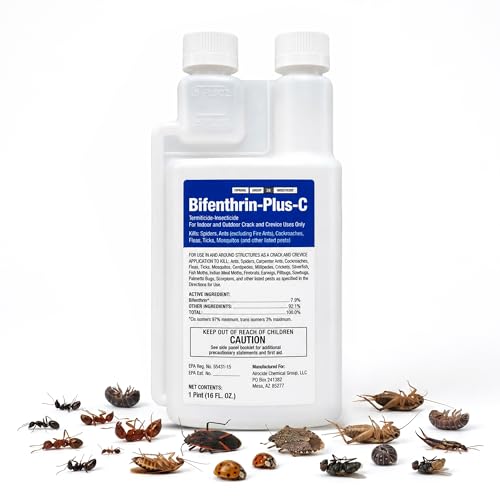
A concentrated bifenthrin formula that tackles termites, roaches, and wasps with one mix.
This product uses the same active ingredient (bifenthrin) as the Ortho MAX but in a separate formulation that you can use both indoors and outdoors. The “Plus-C” label indicates it includes an additional synergist that boosts the bug-killing power without increasing the chemical load. It is a liquid concentrate that mixes with water in a sprayer, designed for full-home coverage including gardens, patios, and living spaces. The claim of being a “pet and family-safe formula” with low odor makes it practical for indoor baseboard spraying where termites might emerge from the wall.
What sets this apart from the Ortho MAX is the explicit label for indoor use against roaches and wasps alongside termite treatment. If you have a mixed pest problem—termites in the basement plus a roach or wasp issue elsewhere—this single bottle covers all of them. It is also positioned as a professional-grade option that eliminates the need for an expensive exterminator, though no customer reviews are available yet to confirm real-world results.
The downside is the lack of EPA claims for long-term soil barrier control—this is more of a general-purpose knockdown spray than a dedicated termite colony eliminator. For an active termite infestation in walls, the Bayer Premise Foam will reach deeper, and for a multi-year soil barrier, the Ortho MAX is better documented.
Multi-pest workhorse: If termites are just one item on your pest list and you want a single concentrate that handles roaches, ants, wasps, and termites with one tank-mix, this fits that bill neatly.
Reach for this if: you need a versatile spray for both indoor and outdoor use, targeting termites plus other home-invading insects. Look elsewhere if: your sole concern is eliminating an established termite colony—dedicated termiticides like foam or bait will perform better.
4. BioAdvanced Termite Killer Granules
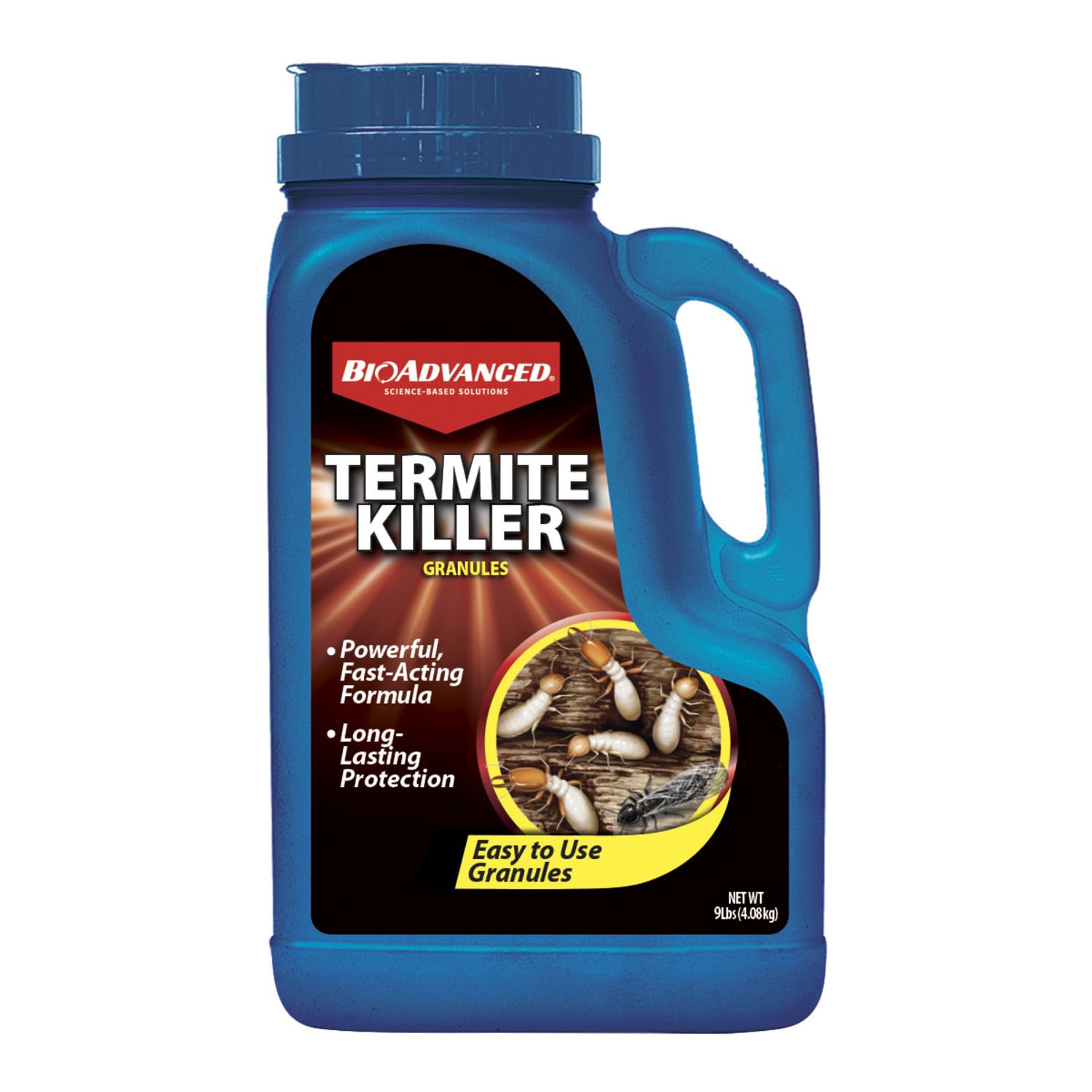
Dry granules you simply sprinkle around the house and water in—no mixing, no spraying.
This is the easiest at-home termite treatment on the list for outdoor perimeter protection. You open the 9-pound bottle and toss the BB-sized granules by hand under shrubs, along the foundation, and around wooden structures. Then you spray water over them to activate the bifenthrin, and the product creates a contact-kill barrier that lasts up to 30 days. The total coverage is 4,500 square feet, which is a large area for a single bottle. One buyer mentioned they use it every year and it “has kept termites away better than what the company I use to pay to treat.”
Buyers also appreciate that you do not have to touch the granules directly—the bottle lets you sprinkle without skin contact, though a few reviewers suggest wearing a mask because there is fine powder near the bottom. The granules also control ants, centipedes, cockroaches, and digger wasps, which is a bonus for anyone tired of seeing ants around the foundation. One month after application, a reviewer noted no more ants in the area where they placed the granules, saying “so far I am happy with the effectiveness and value.”
The limitation is the 30-day protection window—you need to reapply monthly during termite season, unlike the 5-year claim of the Ortho MAX concentrate. It also only kills on contact, so termites that are already inside your walls are not affected by a perimeter granule treatment. This is strictly a preventative outdoor barrier, not a cure for an active interior infestation.
No-muss barrier
- Ready-to-use granules with no mixing or sprayer required
- Covers 4,500 sq ft per 9-pound bottle
- Effective against ants and other listed insects, not just termites
Short window
- Only 30 days of protection before reapplication needed
- Kills on contact only—does not reach termites inside the home
- Fine powder near bottom requires a mask during application
Best for: homeowners who want a simple, low-effort monthly preventative barrier around the foundation. pass on it if: you need to kill termites already inside the walls or want a longer-lasting chemical barrier.
5. BASF Trelona Compressed Termite Bait

Bait cartridges that stop termite molting so the colony starves and collapses.
The Trelona system uses novaluron, an insect growth regulator (IGR) that prevents termites from molting properly. When foraging termites carry the bait back to the nest and share it through grooming and casual contact, the entire colony slowly dies off because young termites cannot shed their exoskeleton to mature. This mode of action is fundamentally different from contact-kill sprays—it does not repel termites, so they keep feeding on the bait until the colony is gone. The box contains six compressed bait cartridges designed for use with compatible in-ground stations.
This is the only product on the list certified by the EPA (Specification Met: EPA), which means it has gone through field testing for efficacy against subterranean termites. It is not for sale in several states—AK, AL, CA, GA, HI, MA, PA, TN, WA, UT, NY—likely due to local regulations on bait systems or the active ingredient. The bait works through ingestion, grooming, and contact, so it does not require you to find every tunnel—you just place the stations near termite activity and wait for the foragers to find them.
The disadvantages are that it takes time (weeks to months) and requires the termites to actually discover the bait before it works. If your termite colony is small or not actively foraging near the stations, the bait may sit untouched. It is also a specialized product with no customer reviews available in the provided data, so real-world outcomes from DIY users are harder to gauge compared to the foam or granules.
Slow-acting but thorough: The IGR mechanism targets the colony’s reproduction cycle rather than killing on contact, which means the entire nest dies rather than just the scouts—ideal for a subterranean infestation where you cannot reach the main colony.
Reach for this if: you have a subterranean termite problem and are willing to wait for the bait to spread through the colony for total elimination. Look elsewhere if: you need immediate kill results or live in a restricted state—the Bayer foam or Ortho liquid concentrates work much faster.
6. Cyper TC Termite-1 Gallon

The oil-based concentrate with the highest active ingredient percentage on this list.
At 25.3% cypermethrin, this is the most concentrated termiticide in the lineup. Cypermethrin is a synthetic pyrethroid that creates a persistent chemical barrier in soil—termites that cross the treated zone absorb a lethal dose. The oil-based formula at 1 gallon provides a high volume of raw concentrate, which you dilute and apply as a perimeter trench or soil injection. The manufacturer’s claim is simple: it creates a barrier that prevents pests from crossing. The item weight is 8.31 pounds, which is the heaviest product in this guide—the Ortho MAX’s weighs 0.5 pounds—reflecting both the gallon volume and the oil carrier.
This is a professional-grade product that you can buy without a license, but it comes with restrictions: it cannot be shipped to CT or NY. The oil base means it mixes differently than water-based concentrates—you need to read the label carefully to get the right dilution ratio for trenching versus spot treatment. There are no customer reviews available in the provided data, so buyer experiences are not captured here.
The catch is that 8.31 pounds of oil-based concentrate is heavy and messy to handle, and the 25.3% cypermethrin concentration demands careful measuring to avoid over-application. It also only kills on contact and creates a barrier—it does not transfer between termites like the Trelona bait, so the colony may simply avoid the treated zone if they sense the chemical (cypermethrin is slightly repellent to termites).
High-concentration barrier: If you are treating a large perimeter area and want the strongest chemical wall available without hiring a pro, this gallon jug gives you the highest active ingredient percentage on the list.
Best for: experienced DIYers who want a large volume of high-concentration termiticide for a big outdoor trench treatment. it’s not for you if: you are new to termite chemicals, dislike handling oil-based liquids, or live in CT or NY—choose the Ortho MAX for a more user-friendly barrier concentrate.
7. Bora-Care Termiticide and Fungicide Concentrate
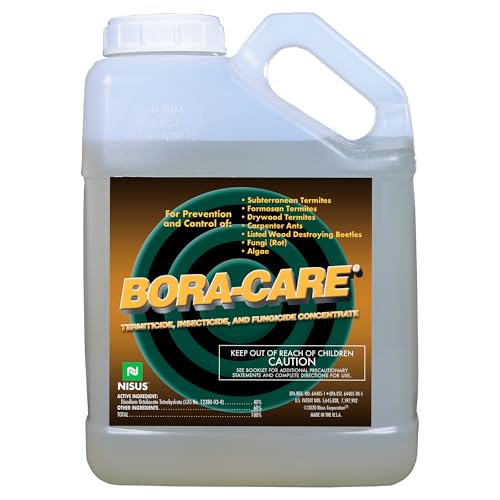
The borate treatment that soaks into wood and stays active for the life of the lumber.
Bora-Care uses disodium octaborate tetrahydrate, a boron-based compound that penetrates deep into wood fibers through a surface application. Once inside the wood, it kills termites, carpenter ants, wood-boring beetles, and decay fungi that try to eat or tunnel through it. The claim is that it protects the structure for the life of the wood—this is not a temporary barrier but a permanent treatment of the wood itself. The 1-gallon concentrate covers approximately 800 square feet of wood surface when applied as a 2-foot band treatment.
This is the only product on the list that is labeled as environmentally friendly and safe for use near lakeside homes because it does not involve pumping chemicals into the ground. It is designed for both new construction and existing homes, applied during the dried-in phase for whole-house protection against dry wood and subterranean termites. The active ingredient is also used as a fungicide, so it protects wood from rot at the same time—a double benefit that no other product here offers.
The major limitation is that it only protects the wood you actually apply it to. It does not create a soil barrier and it will not kill a termite colony that is living underground—it only prevents termites from consuming the treated wood. For an active infestation in a wall, you would need the Bayer Premise Foam first to kill the current colony, then Bora-Care on exposed framing as a long-term preventative. There are no customer reviews in the provided data, so real-world feedback on application difficulty is unavailable.
Lifetime wood protection
- Penetrates wood fibers to kill termites and prevent future attack
- Environmentally friendly—no soil contamination
- Dual action against termites and decay fungi
Surface-limited
- Only protects wood you physically apply it to—no soil barrier
- Does not kill existing underground colonies
- Best applied during construction or exposed framing
Best for: homeowners who are building, remodeling, or have exposed framing and want the wood itself to be permanently termite-proof. look elsewhere if: you need to stop an active infestation right now—treat with foam or liquid barrier first, then consider Bora-Care for long-term protection.
Understanding the Specs
Active Ingredient Percentage
This is the percentage of the actual killing chemical in the concentrate. Higher numbers (like the 25.3% cypermethrin in Cyper TC) mean more killing power per ounce, but they also require careful dilution—you cannot just dump it on the soil. Lower percentages (like the bifenthrin in Ortho MAX) are easier for beginners because the risk of over-application is smaller. The trade-off is that a high-percentage concentrate gives you more total treatment per dollar if you are covering a large area, but it is harder to measure accurately.
Format: Foam vs. Liquid vs. Granule vs. Bait
Foam is the only format that travels through wall voids and fills termite tunnels, so it reaches insects where sprays cannot. Liquid concentrates (Ortho MAX, Bifenthrin Plus-C, Cyper TC) mix with water to create a ground barrier or surface spray. Granules (BioAdvanced) are dry and activate when you water them, making them the easiest to spread but the shortest-lived. Baits (BASF Trelona) require termites to find and eat the active ingredient, which takes weeks but can wipe out the whole colony.
FAQ
Will any of these products kill the entire termite colony or just the ones I see?
Do I need to drill holes in my walls to use the Bayer Premise Foam?
How long does a liquid barrier treatment like Ortho MAX actually last?
Can I use the BioAdvanced Granules indoors or in my crawlspace?
What is the difference between bifenthrin and cypermethrin for termite control?
Is Bora-Care safe to use around pets and children once it dries?
Why are some of these products not sold in certain states like NY, CA, or MA?
How do I know if I have termites versus carpenter ants?
Can I mix two different termiticides together for stronger coverage?
How often do I need to reapply these treatments?
Final Thoughts: The Verdict
Across the board, the at home termite treatment winner is the Bayer Premise Foam because it fills wall voids and termite tunnels directly, kills within days, and real buyers confirm months of no activity after a single application. If you want a long-term perimeter barrier that lasts years, grab the Ortho Home Defense MAX. And for preventing future infestations in exposed framing or new construction, the standout is the Bora-Care wood treatment.
How We Picked
We do not accept paid placement. Every pick is matched to a real buyer and a real use-case; we do not hands-on test units.
Sources & Methodology
Specifications: manufacturer listings and product documentation. Review insights: verified customer reviews, as of July 2026. Pricing: not shown on this page (it changes often); check the current price via the retailer link.
As an Amazon Associate, Gadgets Feed earns from qualifying purchases. This does not affect which products we feature.