
The single biggest lie in bottled water marketing is that it comes from a mountain spring. Most of it is just tap water that has been filtered. The difference between bad tap water and great drinking water is a good filter that removes the chlorine, lead, and sediment your municipality can’t or won’t. An at-home filter transforms your relationship with your sink, making hydration effortless and eliminating the plastic waste that comes with jugs and bottles.
I’m Min — the co-founder and writer behind Gadgets Feed. I’ve spent countless hours dissecting the filtration technologies, flow rates, and contaminant removal certifications that separate a true performer from a glorified carafe.
The right system depends on your water source, your budget, and your counter space, and I’ve combed through the specs to find the absolute best at home water filters for every type of household.
How To Choose The Best At Home Water Filters
Not all filters are created equal. A basic carbon pitcher will tackle chlorine taste, but it won’t touch fluoride or heavy metals. Before you buy, you need to understand what’s actually in your water and what each filter technology can remove. The contaminants you care about most will dictate the system you need.
Filtration Technology: Carbon, RO, or Something in Between
Activated carbon block filters are the most common and affordable. They excel at removing chlorine, sediment, and volatile organic compounds that cause bad taste and odor. They do not lower total dissolved solids (TDS). Reverse osmosis (RO) systems are the heavy hitters, using a semi-permeable membrane to remove up to 99% of TDS, including lead, arsenic, fluoride, and PFAS. Modern RO systems add a remineralization stage to restore beneficial minerals, solving the “flat water” problem. For most households with decent municipal water, a high-quality carbon block filter is sufficient. For those on well water or with specific contamination concerns, an RO system is the safer choice.
Certifications: The Difference Between a Claim and a Guarantee
Any filter can claim to remove lead. The ones that matter are certified by NSF International or IAPMO to specific standards. NSF/ANSI 42 covers aesthetic effects like taste and odor. NSF/ANSI 53 covers health-related contaminants including lead, mercury, and VOCs. NSF/ANSI 401 covers emerging contaminants like pharmaceuticals and PFOA/PFOS. A genuine certification mark means the filter has been independently tested to remove the stated contaminants at the levels claimed. If a product doesn’t mention NSF or IAPMO certification, the removal claims are marketing, not science.
Capacity and Flow Rate: How Fast and How Long
Pitcher filters typically have a capacity between 40 and 100 gallons per filter. Under-sink systems can go 20,000 gallons between replacements. Flow rate matters for daily use: a pitcher might take 10 minutes to fully filter, while a direct-connect countertop unit can deliver 2 gallons per minute. For a family of four, a slow drip filter becomes a daily frustration. For a single person, a pitcher’s slower pace is rarely an issue. Match the capacity to your household’s water consumption to minimize filter changes and avoid running dry.
Quick Comparison
On smaller screens, swipe sideways to see the full table.
| Model | Category | Best For | Key Spec | Amazon |
|---|---|---|---|---|
| Waterdrop T3-T RO | Under-Sink RO | Maximum contaminant removal | 220 GPD, 7-stage remineralization | Amazon |
| SimPure V7 | Under-Sink | Low-maintenance, high-flow filtration | 1.6 GPM, 20,000-gallon filter life | Amazon |
| Frizzlife DS99 | Countertop | Tool-free install with no drilling | 2 GPM, 0.5 micron dual-stage | Amazon |
| Clearly Filtered Pitcher | Pitcher | Premium contaminant coverage in a pitcher | NSF 42/372, targets 365+ contaminants | Amazon |
| Waterdrop ED01W | Electric Pitcher | Instant filtered water from a countertop pitcher | 1-second dispense, 200-gallon filter | Amazon |
| ZeroWater 32-Cup | Dispenser | Zero TDS for ultra-pure taste | 5-stage ion exchange, TDS meter included | Amazon |
| Brita Large 10-Cup | Pitcher | Budget-friendly, easy entry to filtered water | NSF 42 certified, 40-gallon filter life | Amazon |
In‑Depth Reviews
1. Waterdrop T3-T 7-Stage Reverse Osmosis
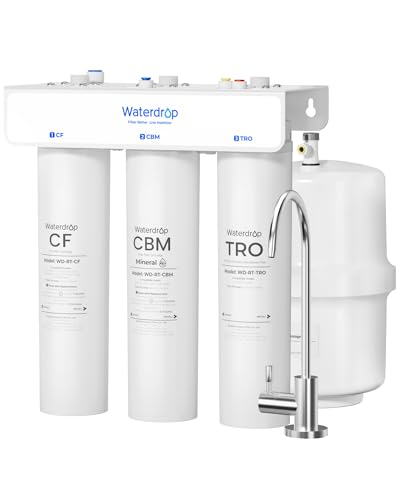
This is the most complete solution in the lineup. The Waterdrop T3-T is a tankless reverse osmosis system that produces 220 gallons per day — nearly three times the output of a standard 75 GPD RO system. That means you can fill five 16.9-ounce water bottles in about one minute, making it ideal for families or anyone who refills bottles constantly. The 7-stage filtration includes a sediment filter, carbon block, RO membrane, and a remineralization cartridge that adds back potassium, calcium, sodium, and magnesium. The water comes out with a crisp, clean taste that rivals premium bottled water, without the flatness typical of RO.
Installation takes about 30 minutes with the simplified water lines, though you will need to drill a hole in your countertop for the dedicated faucet. The system operates without electricity and features a 2:1 pure-to-drain ratio, wasting significantly less water than older RO models. A family of three can save roughly 225 gallons of water per month compared to conventional systems. The all-in-one filter design means you twist and replace individual cartridges in seconds — no housing removal or mess. The CF filter lasts 6 months, the CBM filter lasts 12 months, and the TRO filter lasts up to 24 months, keeping long-term costs reasonable.
The smart NFC technology lets you tap your phone for filter replacement reminders, so you never guess when a swap is due. The compact footprint saves up to 40% more under-sink space than traditional tank-based systems, measuring just 12.6 x 6.1 x 14.69 inches. For anyone concerned about PFAS, heavy metals, fluoride, or simply wanting the highest level of filtration available, this is the definitive choice.
Why it’s great
- 220 GPD output eliminates wait time for refills
- Remineralization stage restores beneficial minerals for better taste
- 2:1 pure-to-drain ratio reduces water waste dramatically
Good to know
- Requires drilling a hole for the faucet installation
- Higher upfront investment than pitcher-style filters
2. SimPure V7 Under Sink Water Filter

The SimPure V7 is the under-sink filter that makes you wonder why anyone would pay for a plumber. Installation takes roughly three minutes with a direct-connect design that taps into your cold water line using included 3/8-inch and 1/2-inch converter fittings. No drilling, no extra holes, no professional tools. The 5-stage composite filtration uses double-sediment membranes, premium KDF-55, and double-activated carbon blocks to achieve 0.5 micron accuracy. It effectively reduces lead, chlorine, bad tastes, and odors while preserving beneficial natural minerals — it does not lower TDS, which is ideal for those who want cleaner water without stripping everything out.
The housing is machined from food-grade 304 stainless steel, a significant upgrade over the plastic housings found on most filters at this level. Plastic housings can crack or chemically degrade over time; the V7’s steel construction will outlast your cabinets. The slim profile measures just 3.6 inches in diameter and 12 inches tall, leaving the rest of your under-sink space free for a garbage disposal, dishwasher hose, or storage. The flow rate is a genuinely impressive 1.6 gallons per minute, filling an 8-ounce glass in about three seconds with zero lag.
Each filter cartridge lasts up to 12 months or 20,000 gallons, which works out to roughly one change per year for most households. That makes the long-term cost per gallon nearly negligible. The system works on standard municipal tap water and is also popular for RVs and rental properties where drilling isn’t an option. It’s not certified by NSF, but third-party testing confirms its reduction rates, and the build quality speaks for itself.
Why it’s great
- 3-minute tool-free installation with no drilling required
- 304 stainless steel housing is far more durable than plastic alternatives
- 1.6 GPM flow rate fills glasses instantly
Good to know
- Not NSF certified; removal claims are based on third-party lab tests
- Does not lower TDS for those wanting ultra-pure water
3. Frizzlife DS99 Countertop Water Filter
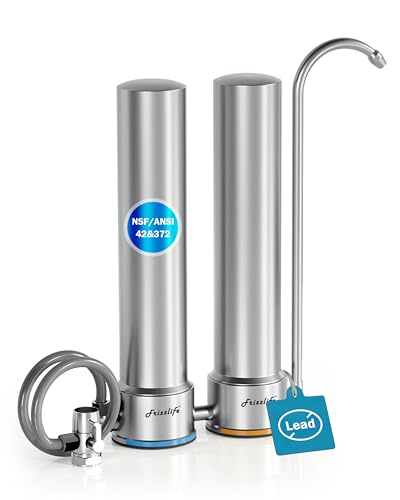
The Frizzlife DS99 is the countertop filter that solves the biggest problem with under-sink systems: installation fear. You attach the provided hose directly to your existing sink faucet using one of the six included adapters, and you’re done. The system sits on your counter next to the sink and takes up about as much space as a tall coffee mug, measuring 7.28 x 2.76 x 12.8 inches. A simple switch lets you alternate between filtered and unfiltered tap water, so you can use unfiltered water for washing dishes while drinking only the filtered supply.
The 8-stage filtration uses a first stage with a high-grade PP membrane and activated coconut shell carbon block blended with KDF, followed by a second stage with 0.5 micron precision combining carbon block and lead-removal ingredients. This dual-stage approach reduces lead, chlorine, fluoride, heavy metals, VOCs, and bad taste while retaining essential minerals. The flow rate hits 2 gallons per minute at 60 PSI, which is the fastest in this roundup — an 8-ounce cup fills in about 2 seconds. The entire system is built with food-grade 304 stainless steel housings that are 1mm thick and have passed 100,000 water hammer tests and 10,000 pulse tests.
Each first-stage filter lasts up to 8 months, and the second-stage filter lasts up to 12 months or 8,000 gallons. Replacement is simple: you swap only the inner core cartridges, not the stainless steel housings, which reduces plastic waste. The system produces zero waste water and requires no electricity. It’s ideal for renters, RVs, offices, and anyone who wants serious filtration without permanent modifications. The only catch is compatibility — you need to check your faucet thread size against the supplied adapters, though Frizzlife will send additional adapters if yours doesn’t fit.
Why it’s great
- 2 GPM flow rate is the fastest among all products reviewed
- Installation requires no tools, no drilling, and no permanent changes
- NSF 42 & 372 certified for genuine contaminant reduction
Good to know
- Faucet thread compatibility must be verified before purchase
- Countertop footprint may be inconvenient for cramped kitchens
4. Clearly Filtered Filtered Water Pitcher
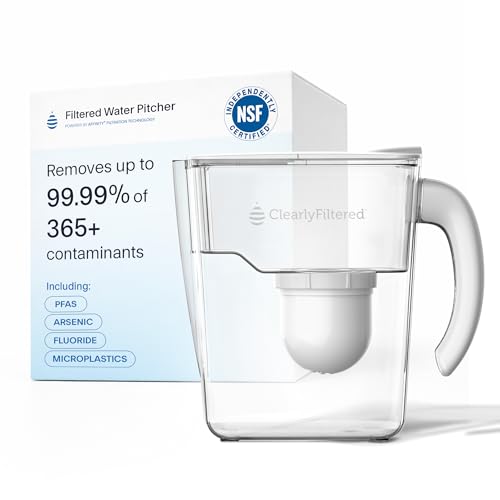
Most pitcher filters are a compromise — they improve taste but leave you unprotected against the scary stuff like fluoride, PFAS, and arsenic. The Clearly Filtered Pitcher is the exception. Using proprietary Affinity Filtration Technology, it targets over 365 contaminants at up to 99.99% removal, including fluoride, lead, PFOA/PFOS, microplastics, chlorine, and perchlorate. Independent third-party lab testing backs every claim, and the pitcher is NSF/ANSI 42 and 372 certified. This is basically a countertop RO system in a carafe form factor.
The pitcher holds 80 fluid ounces (10 cups) and is built from medical-grade Tritan plastic that is BPA-free, BPS-free, and non-leaching. The ergonomic handle and spill-resistant water dam make pouring easy, and the easy hinge fill lid simplifies refilling. It fits on standard refrigerator shelves. The filter lasts 100 gallons, which works out to about four months of daily use for a family. That’s respectable for a pitcher, though the replacement filters are more expensive than generic options — a necessary trade-off for the level of protection this provides.
The filtration speed is noticeably slower than the electric Waterdrop ED01W or the direct-connect Frizzlife, taking about 17 minutes to fully filter a full reservoir. This is the one area where the technology shows its limits. But for health-conscious users who want to remove fluoride and microplastics without installing an under-sink system, this is the best pitcher on the market. The medical-grade materials also mean you’re not leaching chemicals into your water from the container itself.
Why it’s great
- Targets 365+ contaminants including fluoride, PFAS, and microplastics
- NSF certified and third-party tested for genuine removal rates
- Medical-grade Tritan construction prevents chemical leaching
Good to know
- Slow filtration speed — about 17 minutes per full reservoir
- Replacement filters are significantly more expensive than standard carbon filters
5. Waterdrop ED01W Electric Water Filter Pitcher
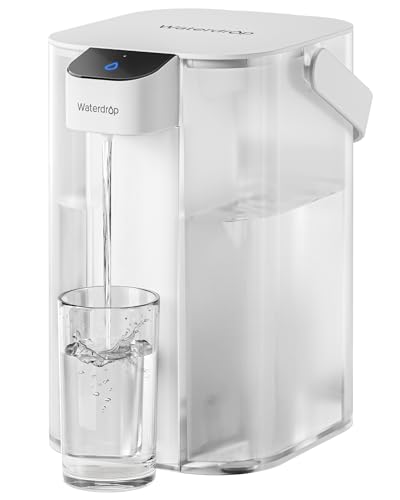
The Waterdrop ED01W is the answer to everyone who has ever stood waiting for a gravity-fed pitcher to drip. This is an electric pitcher that uses a rechargeable battery and a pump to deliver filtered water on demand in less than one second. Touch the dispense button and it pours instantly, just like a fridge dispenser but sitting on your counter. The 15-cup reservoir holds ample water for daily drinking, and the 200-gallon filter life means you change it about every three months — double the lifespan of most pitcher filters.
The filtration uses a 0.5 micron premium carbon block that is NSF/ANSI 42, 53, 401, and 372 certified, reducing over 45 contaminants including chlorine, lead, microplastics, mercury, and benzene. Third-party testing confirms reduction of PFOA and PFOS. Importantly, the ED01W does NOT lower TDS, so if you’re on well water with high mineral content, this will improve taste without stripping the water completely. The built-in rechargeable battery lasts up to 30 days on a full charge and charges via USB Type-C, making it portable enough to take to the office or on a road trip.
The design is compact at 12.52 x 12.17 x 7.76 inches and fits easily on a kitchen counter, coffee stand, or office desk. Clear indicator lights show filter replacement and low battery status. The only operational quirk is that you must fill it only to the max line to avoid leaks from the dispensing mechanism. The carbon block filter is highly effective, but it is not a TDS reducer — buyers expecting zero-solids water should look at the Waterdrop TDS reduction model instead. For speed, certified filtration, and countertop convenience, this is a category leader.
Why it’s great
- Dispenses filtered water in under one second with one-touch operation
- 30-day rechargeable battery with USB-C charging for portability
- NSF certified to reduce 45+ contaminants including lead and microplastics
Good to know
- Does not lower TDS — not suitable for those wanting zero-solids water
- Must be filled to the max line to prevent dispensing leaks
6. ZeroWater 32-Cup 5-Stage Water Filter Dispenser

The ZeroWater 32-Cup dispenser is the pitcher category’s answer to people who want the purity of distilled water without the cost or complexity of an RO system. It uses a 5-stage ion exchange filtration that is IAPMO certified to reduce lead, chromium, PFOA/PFOS, and mercury. The defining feature is the included TDS meter, which gives you an immediate digital readout of total dissolved solids in your water. You fill the top reservoir, let it filter through, and the water that comes out can read 0 ppm TDS — something no standard carbon filter can achieve.
The 32-cup capacity is the largest in this roundup, making it ideal for families, offices, or anyone who goes through water quickly. The sliding hatch for dispensing is a clever design touch that works better than the flip lids on most Brita-style pitchers. The filter life is where you need to pay attention: with high-TDS water (300-400 ppm), a single filter may last only 2 to 3 weeks, which drives the annual replacement cost to over . In low-TDS municipal water areas, filters can last 2 to 3 months, making the cost much more palatable.
The taste is objectively the cleanest of any non-RO filter in this list. Water that was 500 ppm comes out at 3 ppm or lower, and the difference is immediately noticeable — almost sweet, ultra-pure. Some users find the water tastes “flat” because the minerals are removed; adding a pinch of mineral drops solves that. The filtration is slow, as gravity must pull water through the dense 5-stage matrix. For those who absolutely must see zero on the TDS meter and have water that makes ice cubes look cloudy, this is the only pitcher that delivers.
Why it’s great
- Capable of reducing TDS to 0 ppm for ultra-pure water
- Includes a free TDS meter for instant water quality verification
- 32-cup capacity is the largest dispenser on this list
Good to know
- Filter life is short with high-TDS water, leading to high replacement costs
- Slow filtration rate and water may taste flat without added minerals
7. Brita Large 10-Cup Water Filter Pitcher
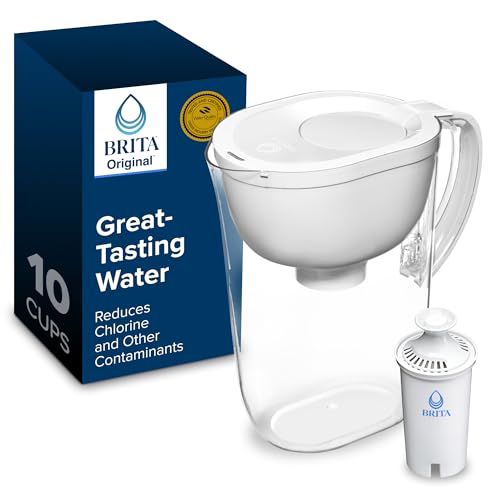
The Brita Large 10-Cup pitcher is the entry point for anyone new to filtered water. It is the simplest, most widely available, and most affordable option in this guide. The BPA-free plastic pitcher holds 10 cups of water — enough to fill three 24-ounce reusable water bottles — and fits on standard refrigerator shelves. The easy-fill locking lid prevents spills, and the redesigned reservoir cap solves the leak issues that plagued older Brita models. The ergonomic handle makes pouring comfortable even when full.
The filtration is basic but effective for its purpose. The standard filter reduces chlorine taste and odor, and it’s NSF/ANSI 42 certified for reducing zinc, copper, mercury, and cadmium. Each standard filter lasts 40 gallons or about two months. The Longlast+ filter option extends that to 120 gallons or six months, giving you an upgrade path without changing the pitcher. Brita claims that switching from bottled water to their pitcher replaces up to 1,800 single-use plastic bottles per year, which is a meaningful environmental impact for a product that costs what it does.
Where this pitcher falls short is contaminant coverage. It does not reduce lead, fluoride, PFAS, or most heavy metals. It will not lower TDS. It’s a taste-and-odor filter, not a health-protection system. For users on reasonably clean municipal water who just want the chlorine taste gone and don’t want to overthink it, this is the classic solution. The filters are cheap, widely available at grocery stores, and the pitcher itself is durable enough to last years. It’s the entry-level standard for a reason.
Why it’s great
- Lowest upfront cost and widely available replacement filters
- NSF 42 certified for chlorine taste and odor reduction
- Fits standard refrigerator shelves and pours easily
Good to know
- Does not reduce lead, fluoride, PFAS, or lower TDS
- Standard filter lasts only 40 gallons before replacement is needed
FAQ
How often should I replace my water filter?
Will a water filter remove fluoride from my tap water?
What is the difference between a countertop and under-sink water filter?
Final Thoughts: The Verdict
For most users, the best at home water filters winner is the SimPure V7 because it delivers under-sink filtration with a 1.6 GPM flow rate, a stainless steel housing that will never crack, and a 20,000-gallon filter life that makes replacements a once-a-year event. If you want the absolute highest contaminant removal and a dedicated RO system, grab the Waterdrop T3-T for its 7-stage filtration and remineralization. And for a no-install, countertop solution with the fastest flow we tested, nothing beats the Frizzlife DS99.