
Every home welder buyer knows the moment a trailer frame snaps or a lawn mower deck cracks — the repair shop quote makes you consider buying new instead. The gap between “I should learn to weld” and “I just burned through a project” is exactly where the right machine lives. An at-home welder isn’t a toy; it’s the difference between paying a pro an hour and fixing your own gate, tractor, or exhaust in your driveway.
I’m Min — the co-founder and writer behind Gadgets Feed. I’ve spent weeks analyzing the IGBT inverter architectures, duty cycles, and arc stability curves across the to range to find which machines actually deliver clean beads without burning up your home circuit.
Whether you’re patching a roto-tiller tine or building a fence from raw steel, choosing the right equipment starts here. This guide is built to help you find the best at home welder for your shop, garage, or farm.
How To Choose The Best At Home Welder
Selecting the right machine means matching your power source, metal thickness, and skill level to the welder’s process type, amperage ceiling, and duty cycle. A 90-amp flux-core unit that runs on a 15-amp household outlet is a very different tool from a 200-amp multi-process machine that requires a 220V circuit and handles 1/4-inch steel in a single pass.
Process Type: Flux Core vs. MIG vs. Stick vs. TIG
Flux-core MIG (FCAW) is the most forgiving entry point for home users — it requires no gas bottle, handles outdoor wind, and penetrates dirty metal well. Standard MIG (GMAW) needs a shielding gas but produces cleaner beads with less spatter. Stick welding (SMAW) works on thick, rusty plates but demands more skill to start and maintain the arc. Lift TIG is a bonus on multi-process machines for thin stainless or carbon steel, though it lacks the precision of a dedicated TIG rig.
Power and Voltage: 110V vs. 220V Amperage Limits
A 110V welder is limited to roughly 140–160 amps in practice due to the 15- or 20-amp breaker capacity. That’s enough for up to 1/8-inch steel with flux core or stick. If you plan to weld 1/4-inch or thicker plate regularly, you need a dual-voltage machine that can plug into a 220V outlet and deliver 180–250 amps. Dual-voltage models with auto-sensing input simplify moving between a garage and a shop with different outlets.
Duty Cycle and Thermal Management
The duty cycle tells you how long the welder can run at a given amperage before it needs to cool. A 20% duty cycle at 140 amps means 2 minutes of welding followed by 8 minutes of idle. Home users rarely weld continuously for more than a minute, but machines with aluminum heatsinks, copper-wound transformers, and dual fans run cooler longer. IGBT inverter technology improves efficiency and reduces weight compared to traditional transformer-based welders.
Wire Feed and Control Features
Synergic control automatically matches wire feed speed to amperage, which dramatically simplifies setup for beginners. Manual voltage and feed-speed knobs give experienced welders the ability to fine-tune the arc. Adjustable inductance shapes the puddle for better wet-out on thin metal. Burn-back adjustment prevents the wire from sticking to the puddle after releasing the trigger. Multi-process machines typically offer 2T/4T trigger modes for long welds without holding the switch.
Quick Comparison
On smaller screens, swipe sideways to see the full table.
| Model | Category | Best For | Key Spec | Amazon |
|---|---|---|---|---|
| FEMEROL 250A 6-in-1 | Multi-Process | Aluminum & thick plate | 250A / 60% duty cycle | Amazon |
| Bestarc 145A MIG | Multi-Process | RV mods & home projects | 145A / 4-in-1 synergy | Amazon |
| YESWELDER 160A MIG | Multi-Process | Automotive & fabrication | 160A / smart synergy | Amazon |
| AZZUNO 200A MIG | Multi-Process | Mid-duty farm work | 200A / 8.0mm capacity | Amazon |
| HITBOX 140A | Multi-Process | Outdoor flux core | 140A / 3-in-1 / 6.6 lb | Amazon |
| ARCCAPTAIN MIG 200A | Multi-Process | Precision & spot welding | 200A / 6-in-1 / burn-back | Amazon |
| Forney 271 140 MP | Multi-Process | Entry-level & ranch use | 140A / 3-in-1 / all-metal | Amazon |
| Lincoln Electric 90i FC | Flux Core | Sheet metal & portability | 90A / 15 lb / infinite dial | Amazon |
| Saker Portable Welder | Stick | Light weekend repairs | 20-120A / 5-level / 80 rods | Amazon |
In‑Depth Reviews
1. FEMEROL 250A 6-in-1 MIG Welder

The FEMEROL 250A is the only unit in this roundup that delivers a genuine 60% duty cycle at maximum output, which means you can run a 14.0mm mild steel plate without the machine begging for a cooldown break. The 6-in-1 capability covers gas MIG, flux core, stick, lift TIG, spot welding, and spool gun compatibility — the latter being essential if you ever plan to weld aluminum. The synergic control automatically sets wire feed speed when you select wire diameter and material, and the adjustable inductance lets experienced users shape the puddle for better fusion on thin sheet.
Real-world testing shows this machine puts out roughly 230–245 amps at the torch, enough for 1/2-inch plate with proper prep. The 9.5-foot cables give decent reach without dragging the machine across the floor. The screen flash after shutdown is a normal capacitor discharge, not a defect. The continuous fan is loud but keeps the IGBT inverter cool during extended sessions.
On 110V, it caps around 160 amps, which still handles 1/4-inch steel comfortably. The barbed gas inlet requires an adapter for standard C25 tanks, and the spool holder geometry is awkward with 10-pound spools. The two-year warranty and responsive email support offset these quirks for home users who want premium capacity without a Miller or Lincoln budget.
Why it’s great
- True 250A output with 60% duty cycle handles thick plate and aluminum
- Synergic MIG with inductance control suits both beginners and pros
- Spool gun compatibility enables aluminum welding without a separate machine
Good to know
- Continuous fan operation is louder than on-demand systems
- Barbed gas inlet requires an adapter for standard MIG fittings
- 110V plug is undersized for the machine’s peak draw
2. Bestarc 145A 4-in-1 MIG Welder
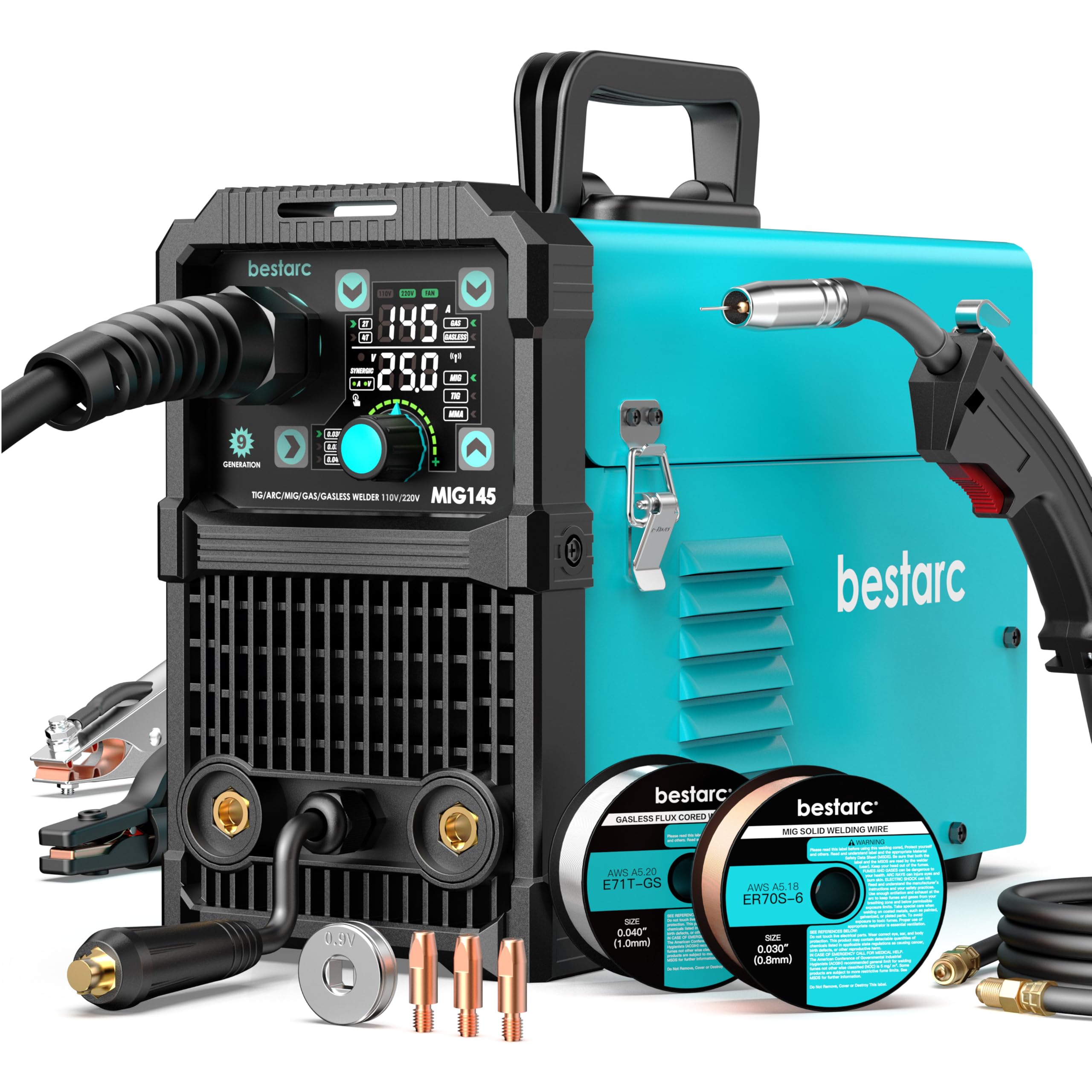
The Bestarc 145A packs synergic control into a compact 13.7-pound package, automatically matching wire feed speed to your selected amperage so you can focus on the puddle instead of dial-twiddling. The 4-in-1 capability covers solid MIG with gas, flux-core MIG, lift TIG, and stick welding. The large LED display shows your settings clearly even with a welding helmet on, and the dual-voltage auto-sensing means you can move from a garage 110V outlet to a shop 220V circuit without touching a switch.
At 145 amps, this machine handles up to 1/4-inch mild steel comfortably on 220V, while 110V output is sufficient for 1/8-inch sheet and auto-body panels. The IGBT inverter delivers a stable arc with noticeably less spatter than the Harbor Freight Titanium 125 it’s often compared against. The unit comes with a shoulder strap and a 2-meter gas hose, plus both a 0.030-inch solid wire and 0.040-inch flux-cored wire to get started immediately.
The stick welding mode maxes out around 130 amps, which limits heavy rod use, and the MIG torch lead on early units was a short 5.5 feet — later production runs extended it to a more usable length. The manual is sparse, and the spool tension spring is stiffer than ideal, but for the price point, the arc quality and multi-process versatility are hard to beat for home DIYers and RV modders.
Why it’s great
- Synergic control eliminates guesswork for beginners learning MIG
- Auto-sensing dual voltage works seamlessly across different power sources
- Compact, lightweight design with shoulder strap for portability
Good to know
- Stick welding output limited to 130A — not ideal for heavy 7018 rods
- Early units shipped with a short MIG torch lead
- Manual lacks detailed setup guidance for first-time users
3. YESWELDER 160A 4-in-1 MIG Welder
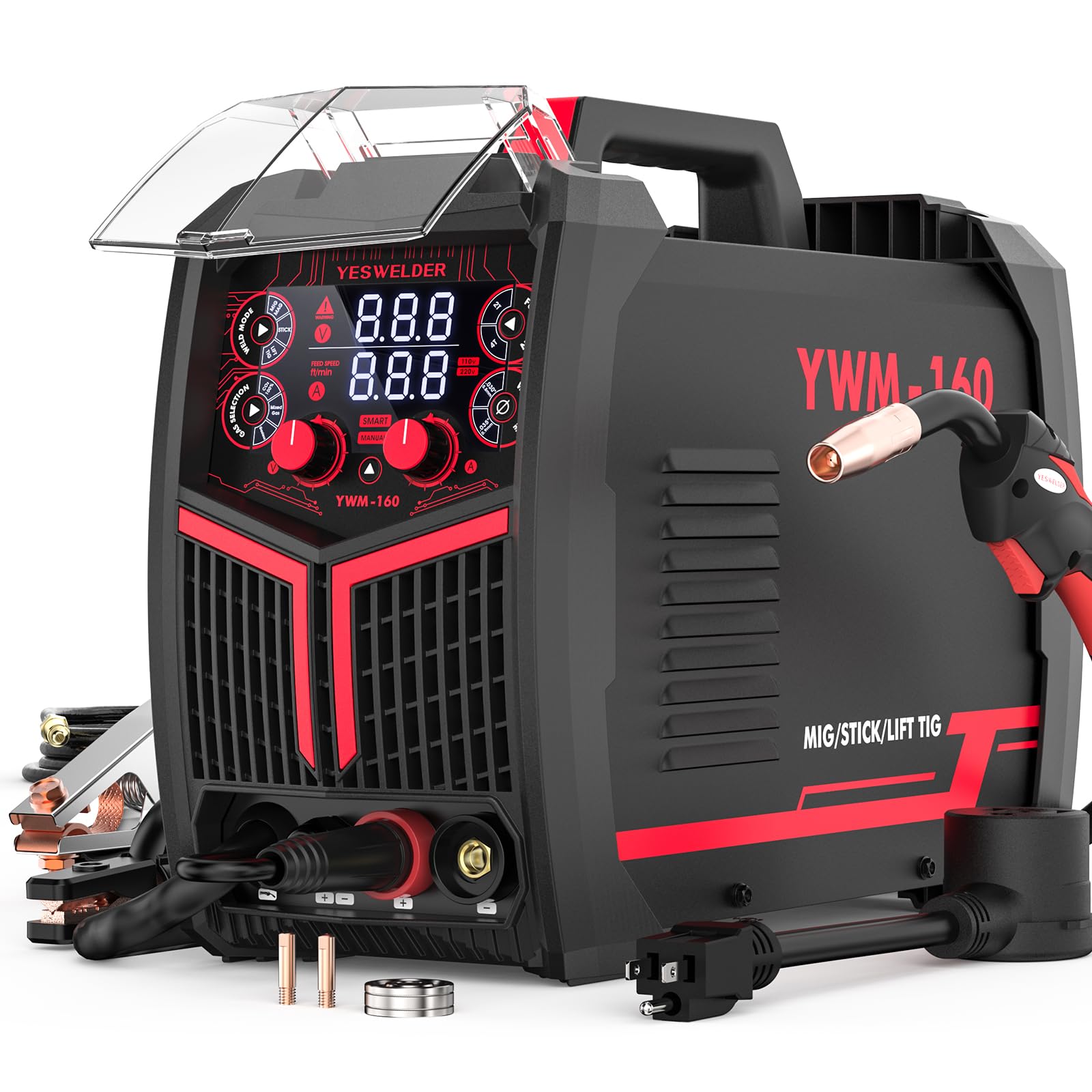
YESWELDER’s 160A machine separates itself with a true dual-mode control system: smart synergic mode that auto-matches wire speed when you dial in amperage, plus a full manual mode for experienced welders who want independent voltage and feed-speed tuning. The 4-in-1 capability spans flux-core MIG, gas MIG, lift TIG (torch sold separately), and stick welding. The large LED digital display is among the most legible in this class, and the 110V/220V dual-voltage input is auto-sensing with a front-panel indicator.
On 220V, the 160A output penetrates 3/16-inch steel in a single pass with clean, low-spatter results using ER70S-6 solid wire and C25 gas. The smart mode works well with 0.030-inch and 0.035-inch wire, and the machine accepts both 2-pound and 10-pound spools without adapter modifications. The unit weighs 19.4 pounds and includes a 220V-to-110V adapter, gas hose, drive roller, and a MIG torch with spare tips.
Stick welding with 6013 electrodes produces a stable arc, though 6010 rods may require more practice to maintain. The safety protections — over-current, over-load, over-heating, and automatic voltage fluctuation compensation — give peace of mind for home users running on older wiring. The included protective wear and flux-core wire are decent quality, but the stick welding arc initiation takes patience compared to dedicated stick machines.
Why it’s great
- Smart and manual control modes accommodate beginners and pros in one machine
- Legible LED display is readable even with a dark welding helmet
- Comprehensive safety protections for older home electrical systems
Good to know
- Lift TIG torch is not included, adding cost for that process
- Stick arc initiation can be finicky with certain electrode types
- Weight is manageable but heavier than ultra-portable flux-core-only units
4. ARCCAPTAIN 200A 6-in-1 MIG Welder
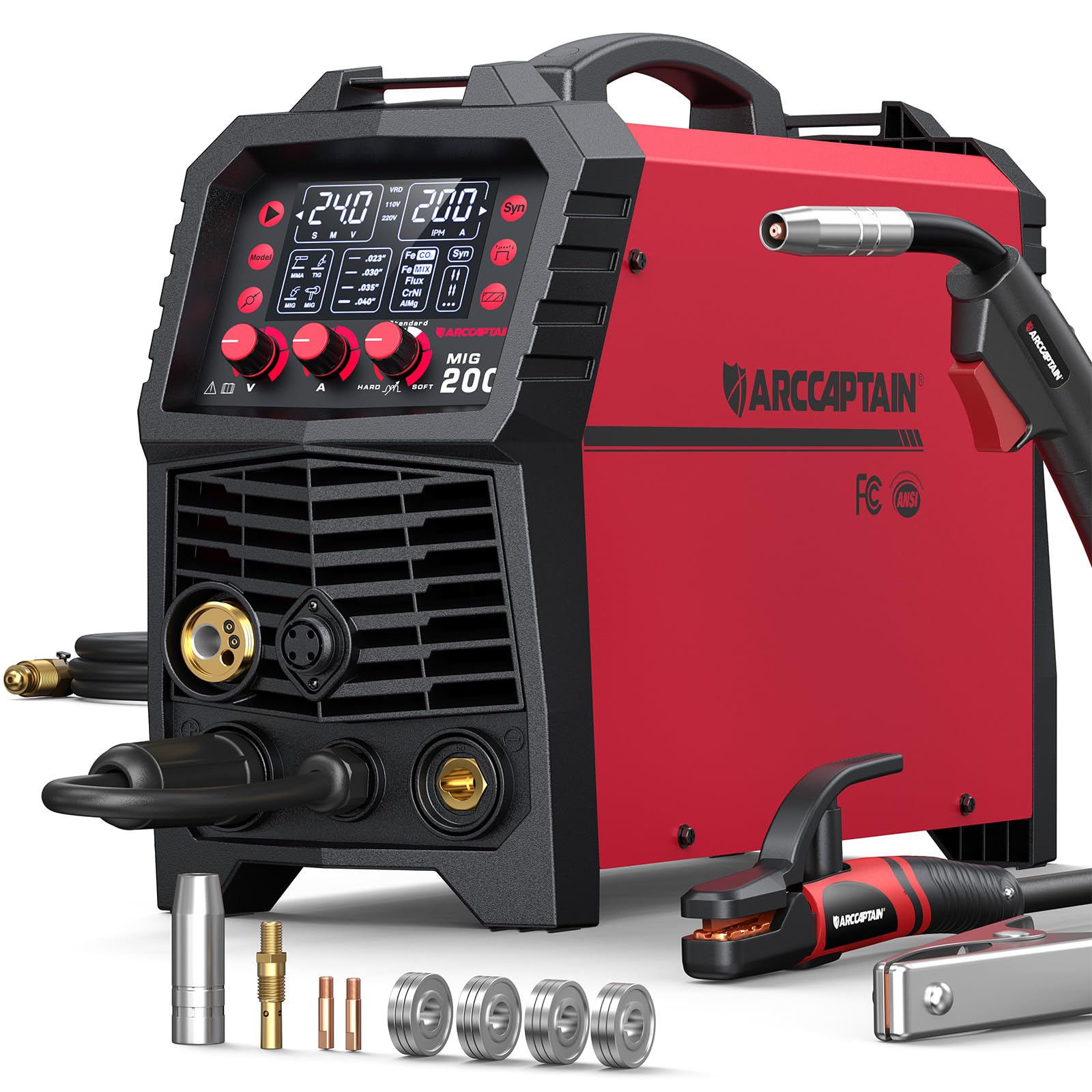
The ARCCAPTAIN MIG200 packs professional-level features into a 200-amp, 6-in-1 chassis that includes gas MIG, flux core, stick, lift TIG, spot welding, and spool gun compatibility. The synergic digital control automatically sets voltage and wire feed based on wire diameter and gas selection, while the dedicated burn-back adjustment prevents the wire from fusing to the puddle when you release the trigger. The large LED screen uses a human-computer interaction design that’s genuinely readable without removing your helmet — a small ergonomic win that pays off in reduced neck strain from repeated helmet flips.
The 2T/4T trigger modes allow continuous welding without holding the switch, and the 10 preset memory slots store parameter groups for repeat jobs like exhaust hangers, fence brackets, or trailer repairs. The fan runs only on demand, keeping noise levels down compared to the continuous-fan FEMEROL. The unit comes with a shoulder strap and handle, making it reasonably portable for farm and outdoor maintenance work.
On 110V, the machine runs well on a 30-amp generator with 0.030-inch flux-core wire, producing clean beads on 1/8-inch steel. The power cable is thinner than ideal and heats up noticeable during extended 220V sessions. The 110V wiring is designed with a 220V adapter cable, which feels like an afterthought. The manual misses key details like the 1-amp-per-0.001-inch thickness guideline, but the customer support team is responsive via email.
Why it’s great
- Burn-back adjustment and spot welding modes elevate precision beyond basic MIG units
- On-demand fan operation keeps the shop quiet during short weld cycles
- 10 memory presets store repeatable settings for common projects
Good to know
- Power cable runs warm on 220V — upgrade if you plan heavy sessions
- 110V adapter cable design feels like an afterthought for wiring layout
- Manual lacks basic setup recommendations for thickness-to-amp ratios
5. HITBOX 140A 3-in-1 Flux Core Welder
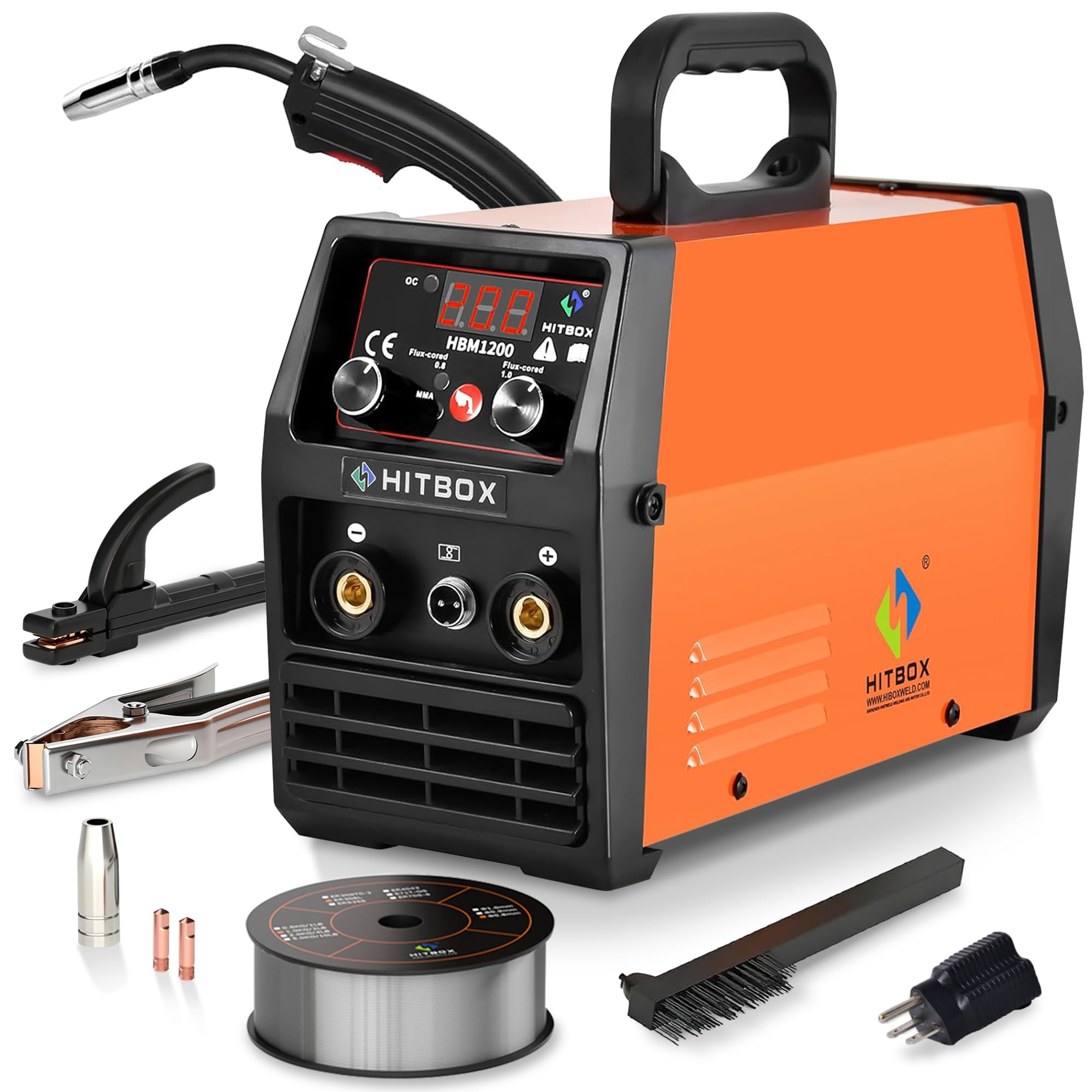
The HITBOX 140A is built for one dominant scenario: outdoor welding where wind would blow away a shielding gas. The flux-core MIG mode requires no gas bottle, so you can weld in a breezy driveway, on a farm field, or inside a barn without worrying about porosity. The 3-in-1 capability adds stick and lift TIG, though the TIG torch is not included. The machine’s standout physical spec is its weight — 6.6 pounds — making it the lightest multi-process welder in this guide and genuinely pocket-portable for mobile repairs.
The dual-voltage auto-sensing works across 110V and 220V without manual switching, and the synergic control automatically matches wire feed speed to your amperage selection. The IGBT inverter uses copper windings and dual aluminum heatsinks with a 5,000 RPM fan that moves 46 CFM of air, pulling heat out rapidly. ETL certification and IP21S rating mean it’s been tested for safety and dust ingress resistance. On 110V, it burns through 1/8-inch steel cleanly; on 220V, it handles 1/4-inch plate with deep penetration.
The ground clamp uses soft metal that warps after repeated use, and the 220V adapter requires an uncommon outlet type not typically found in home garages. The MIG wire spool is slightly too large for the wire feed mechanism, causing minor drag. Stick welding on 110V at half amperage still produces solid beads. The 2-year warranty and responsive US-based support make this a low-risk entry for homeowners who prioritize portability and outdoor readiness over raw amperage.
Why it’s great
- Ultra-light 6.6-pound design eliminates the need for a welding cart
- Flux-core mode runs in windy outdoor conditions without gas shielding
- ETL certified with IP21S rating for safety and dust resistance
Good to know
- Ground clamp uses soft metal that deforms under heavy clamping pressure
- 220V adapter plug is an uncommon outlet standard
- Wire spool size creates occasional drag in the feed mechanism
6. AZZUNO 200A 4-in-1 MIG Welder

The AZZUNO 200A hits a sweet spot for home users who need enough power to weld 5/16-inch mild steel without jumping to the -plus tier. The 4-in-1 capability covers flux-core MIG, gas MIG, lift TIG, and stick, and the synergic control automatically sets voltage and wire feed when you select wire diameter. The machine accepts both 2-pound and 10-pound spools of 0.030-inch through 0.040-inch wire, and the IGBT inverter maintains a stable arc with low spatter on both 110V and 220V.
On 220V, the 200-amp output penetrates 8.0mm steel in a single pass with clean results. The stick welding mode runs E6013 electrodes well for general repair work. The built-in overload and overheat protection systems prevent damage during extended sessions. The membrane keypad and digital readouts are clear, and the unit includes a gas hose and drive roller for solid wire setups.
The manual is notoriously poor — features like the synergic mode calibration are poorly explained, and the gas inlet uses a 1/4-inch hose barb instead of a standard 5/8-18 fitting, requiring an adapter for C25 tanks. The wire feed speed is displayed in meters per minute rather than inches per minute, which takes adjustment if you’re used to imperial units. Customer support is responsive, with one user receiving a replacement unit double-boxed quickly. The build quality feels solid for the price, with stable arc performance that surprises experienced hobbyists.
Why it’s great
- 200-amp output on 220V welds 5/16-inch steel in a single pass
- Synergic control simplifies settings for flux-core and gas MIG modes
- Customer support has a strong track record for replacement and troubleshooting
Good to know
- Manual is poorly translated and lacks detailed setup guidance
- Gas inlet uses a 1/4-inch barb fitting instead of standard MIG connector
- Wire feed speed displayed in meters per minute, not inches per minute
7. Lincoln Electric 90i FC Weld-PAK

The Lincoln Electric 90i FC is the smallest, lightest flux-core-only welder in this guide at 15 pounds with a carrying shoulder strap and protective metal case. Its inverter design produces noticeably smoother weld characteristics than the traditional transformer-based flux-core machines that dominated home garages for decades. The infinite voltage dial (1–10) replaces the rocker-switch voltage steps of older models, allowing fine-tuning that matches thin sheet metal exactly. The machine welds up to 1/4-inch steel on standard 120V household power.
This machine is optimized for 14–18 gauge sheet metal, making it ideal for car restoration, HVAC duct repair, and stainless steel table frames. The cold feed switch lets you change wire spools safely without hot-wire accidents. The flux-only torch lacks a gas shield, which gives better visibility of the puddle but requires careful contact-tip-to-work distance management. The machine is tiny enough to stow in a milk crate and carry to a job site without breaking a sweat.
The downsides are classic Lincoln: no handle (just the shoulder strap), limited to 1-pound spools only, and no MIG or multi-process capability — this is strictly a flux-core wire feeder. The current price is higher than many multi-process machines with similar output, so you’re paying for the brand’s reliability, support network, and weld quality rather than versatility. For dedicated sheet-metal work, it’s arguably the best tool for the specific job.
Why it’s great
- Infinite voltage dial provides precise tuning for thin-gauge sheet metal
- Ultra-portable 15-pound design with shoulder strap and metal case
- Cold feed switch enables safe spool changes without live-tip risk
Good to know
- Flux-core only — no MIG, TIG, or stick capability
- Limited to 1-pound wire spools, requiring frequent changes
- No handle on the case — the strap is your only carrying option
8. Forney 271 140 MP Multi-Process

Forney’s 140 MP is the entry-level champion for first-time welders who want a multi-process machine without the multi-process headache. The 3-in-1 design covers MIG (flux-core or gas), DC TIG, and stick welding, with a three-position switch that changes processes cleanly. The infinite voltage and wire feed speed adjustments allow precise tuning, and the simple start feature lowers the arc initiation voltage for less electrode sticking — a huge confidence builder for beginners learning 6013 rods on 1/8-inch steel.
The all-metal case is a differentiator in a market flooded with plastic-clad welders. It survives being tossed in a truck bed and bumped against steel beams. The unit runs on a standard 120V 20-amp circuit and works well with generators, making it suitable for farm and ranch use where power availability varies. Included accessories are a 10-foot MIG gun, 8-foot electrode holder, 8-foot ground clamp, and a 20-amp to 15-amp adapter for older outlets.
The MIG gun feels flimsy compared to the robust rest of the machine, and there’s no 220V option — you’re capped at 140 amps on 120V. Stick welding with Lincoln 1/8-inch 6011 rods is possible but requires a 20-amp circuit to avoid breaker trips. Users frequently report better results with 6013 rods. The machine is heavier than inverter-based competitors at 25.8 pounds, but the build quality and Forney’s parts availability make it a sound long-term investment for homeowners who want to learn properly.
Why it’s great
- All-metal case construction is rugged enough for farm and job site abuse
- Simple start feature reduces electrode sticking for beginners learning stick welding
- Generator-friendly 120V design works where dedicated 220V isn’t available
Good to know
- No 220V input — limited to 140 amps maximum output
- Stock MIG gun feels less durable than the rest of the machine
- Weighs 25.8 pounds, significantly more portable inverter-based alternatives
9. Saker Portable Stick Welder with 80 Rods
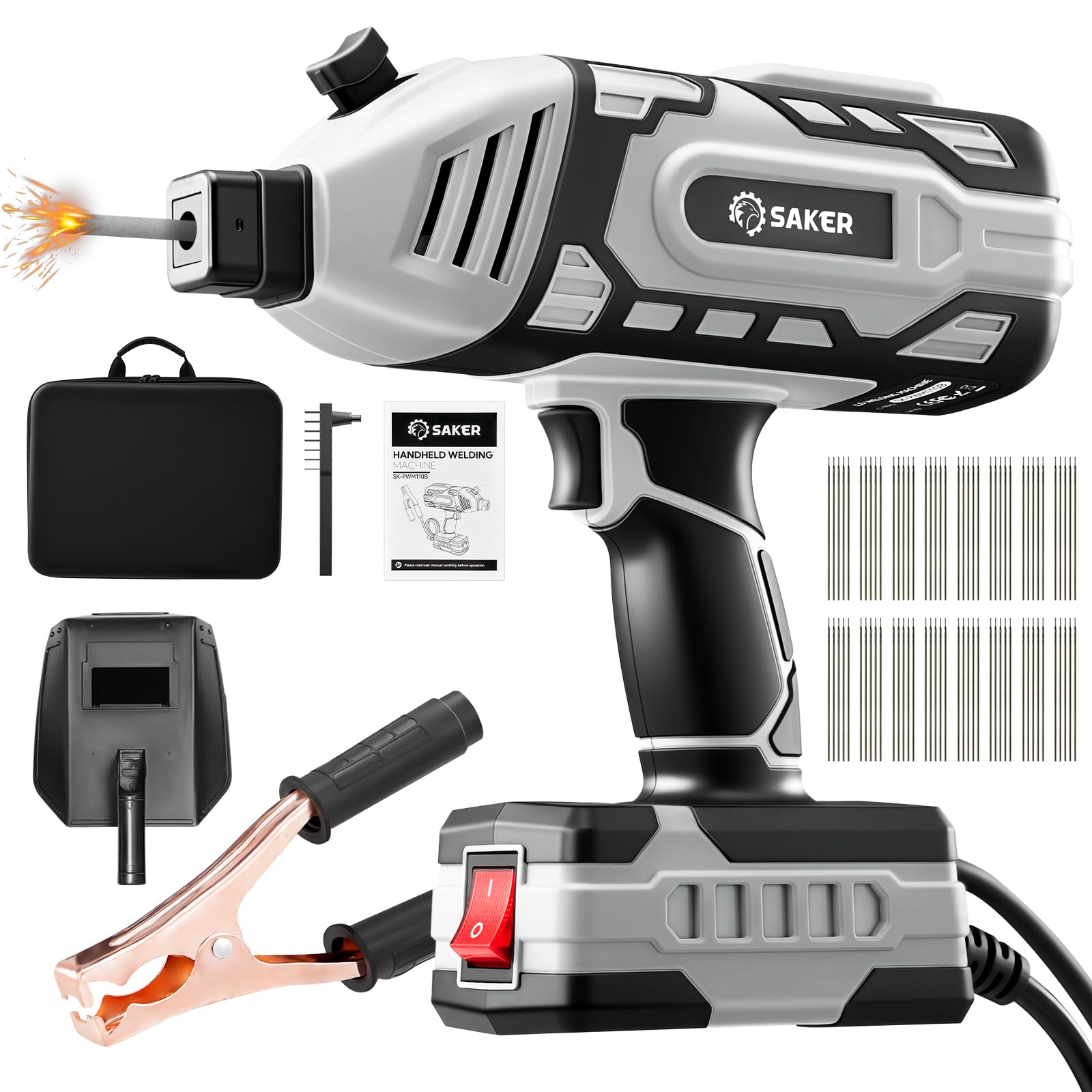
The Saker Portable Welder is the budget-tier entry that proves you don’t need to start stick welding. The handheld unit weighs just 1.7 kilograms (3.75 pounds) and outputs 20 to 120 amps across five current levels, which is enough for light metal repairs like mower exhausts, lawn chair frames, and tractor brackets. The IGBT inverter technology provides stable arc performance at a price point where most competitors use older transformer designs.
The complete starter kit is the real differentiator: 80 welding rods, a helmet, a welding brush, and a storage case are all included, so you’re ready to strike an arc within minutes of unboxing. The 110V plug-and-play design works with standard US household outlets, and the 8.89-pound total package weight makes it genuinely portable for roadside repairs or outdoor jobs. Users report successful welds on fence rails powered by a side-by-side gas generator.
The included welding helmet is functional but cheap. This is not a machine for building trailers or structural fabrication. It is, however, exactly what it claims to be: a low-cost entry point for weekend repairs and learning the basics without a painful financial commitment.
Why it’s great
- Complete kit with 80 rods, helmet, and case — ready to weld out of the box
- Ultra-light 3.75-pound handheld design eliminates the need for a cart
- IGBT inverter delivers stable arc at a budget-friendly entry cost
Good to know
- 120-amp max output limits you to light-gauge repairs only
- Low duty cycle means frequent cooldown breaks on longer projects
- Included helmet is functional but basic — upgrade for better visibility
FAQ
Can I weld aluminum at home with a budget multi-process MIG welder?
What gauge extension cord do I need for a 110V welder on a 20-amp circuit?
Is flux-core welding as strong as gas MIG welding for home projects?
How do I know if my home’s electrical panel can handle a 220V welder?
What thickness of steel can I weld with a 140-amp machine on 110V?
Final Thoughts: The Verdict
For most users, the best at home welder winner is the Bestarc 145A because its synergic control, dual-voltage flexibility, and clean arc performance represent the best balance of capability and value for a home shop. If you need to weld aluminum or thick structural plate regularly, grab the FEMEROL 250A. And for pure outdoor portability and the absolute lightest carry weight, nothing beats the HITBOX 140A.