
That shudder when your torque converter locks up at highway speeds isn’t a death sentence for your transmission — it’s a clear signal that friction modifiers and seal conditioners have broken down inside your gearbox. Whether you’re chasing a slow drip on the garage floor or a hard 1-2 shift that jerks the whole cabin, the right additive can extend the life of an aging automatic transmission without dropping the pan. This category is crowded with snake oil and genuine chemistry, so knowing which active ingredients — molybdenum, esters, or high-viscosity polymer bases — actually solve your specific symptom is the difference between a fix and a rebuild.
I’m Min — the co-founder and writer behind Gadgets Feed. I’ve spent hundreds of hours cross-referencing real customer results, technical data sheets, and transmission professional endorsements to isolate the additives that deliver measurable improvements in shift quality, leak reduction, and friction control.
Whether you are chasing torque converter shudder, slow-moving fluid leaks, or harsh gear engagement, this guide to the best atf additive breaks down the seven top-rated solutions by the exact symptom they treat best.
How To Choose The Best ATF Additive
An ATF additive is not a one-size-fits-all cure. Pouring a stop-leak bottle into a transmission that shudders under load will not fix the friction mismatch, and adding a friction modifier to a fluid leak merely delays the inevitable seal failure. Match the product chemistry to your exact transmission complaint by understanding the three core additive families and what they actually do inside your valve body.
Friction Modifiers vs. Seal Conditioners
Friction modifiers — like Lubegard’s molybdenum-based Instant Shudder Fixx — adjust the coefficient of friction between the torque converter clutch and the turbine hub. If your transmission shudders at steady throttle between 25 and 40 mph, this is the chemistry you need. Seal conditioners — like ATP’s AT-205 Re-Seal — work differently: they use ester-based polymer swelling agents that penetrate and rehydrate dried-out rubber seals and o-rings. If you see drips under the bellhousing or around the pan gasket, a seal conditioner is the correct starting point, not a friction modifier.
Viscosity and Cold-Weather Performance
Some additives — particularly stop-slip formulas like Rislone High Mileage — contain high-viscosity polymer bases (rated SAE 20W-50 in the case of Rislone) that thicken the existing ATF to mask clearances caused by worn clutch packs. This can improve engagement in a high-mileage transmission, but in cold climates the increased viscosity may delay fluid circulation on start-up, leading to momentary pump cavitation. If you live where winter temperatures drop below freezing, a micro-lubricant like zMAX, which does not measurably alter fluid viscosity, is the safer long-term choice.
Compatibility Exclusions You Cannot Ignore
The majority of ATF additives on this list explicitly exclude CVT (Continuously Variable Transmission) and, in some cases, DCT (Dual-Clutch Transmission) or Ford Type F applications. Pouring a standard automatic transmission stop-leak into a Nissan CVT can cause belt slip and irreversible pulley damage because CVT fluid requires a precisely controlled friction curve that typical modifiers destroy. Always verify that the product packaging or spec sheet lists your transmission type as compatible before you pour.
Quick Comparison
On smaller screens, swipe sideways to see the full table.
| Model | Category | Best For | Key Spec | Amazon |
|---|---|---|---|---|
| ATP Automotive AT-205 Re-Seal (2 Pack) | Seal Conditioner | Leaking seals & gaskets | 8 oz per bottle, treats 6-qt capacity | Amazon |
| zMAX Transmission Formula (2 Pack) | Micro-Lubricant | Shift smoothness & wear reduction | Micro-lubricant soaks into metal surfaces | Amazon |
| Lubegard DR TRANNY Instant Shudder Fixx (3 Pack) | Friction Modifier | Torque converter shudder | 6 fl oz total, molybdenum disulfide base | Amazon |
| K&W Trans-X Automatic Transmission Stop Leak | Stop Leak / Cleaner | Minor leaks & varnish removal | 32 fl oz, also cleans sludge & gums | Amazon |
| Lubegard 19610 Instant Shudder Fixx (Single) | Friction Modifier | Immediate torque converter shudder fix | 2 oz concentrated moly-based additive | Amazon |
| Rislone High Mileage Transmission Stop Slip | Viscosity Improver | Minor slippage in high-mileage transmissions | 32 fl oz, SAE 20W-50 viscosity grade | Amazon |
| Bar’s Leaks HDC Radiator Stop Leak Tablet | Cooling System Sealant | Radiator & water pump leaks | Tablet form, 60g per 6-tablet pack | Amazon |
In‑Depth Reviews
1. ATP Automotive AT-205 Re-Seal Stops Leaks, 8 Ounce Bottle (2 Pack)

ATP’s AT-205 Re-Seal uses an ester-based polymer technology that does not thin the fluid or rely on particulate fillers to plug leaks. Instead, it penetrates rubber seals and gaskets, causing controlled swelling that restores the original seal geometry. The 2-pack treats up to 12 quarts, making it cost-effective for larger cooling system capacities or for treating both the engine and transmission simultaneously. Real-world reports from owners of Audi S8 V10s, BMW X5Ms, Dodge Ram 1500s, and Ford Explorers confirm that AT-205 stopped active leaks — from valve cover gaskets to front main seals — within 100 miles of driving.
What makes this product unique among stop-leak chemistries is its broad compatibility: it can be added to conventional and synthetic engine oils, ATF, gear oil, power steering fluid, and hydraulic oil. It also does not contain petroleum distillates, so there is no risk of over-swelling or embrittling the seals over time. The 8-ounce bottle treats a 6-quart capacity, which means a single bottle covers most passenger-car transmissions, and the 2-pack provides a full treatment for a transmission plus a power steering system.
On the downside, AT-205 is a proactive conditioner rather than a reactive plug — it will not seal a mechanically damaged seal or a cracked bellhousing. It requires several driving cycles to fully swell the rubber, so the leak does not stop instantly. For transmissions with multiple weeping points or high-mileage hardening of all seals, this is the safest foundational additive before addressing any other symptom.
Why it’s great
- Rejuvenates multiple seal types without clogging narrow fluid passages
- Compatible with all common transmission and engine fluids
- Proven results on high-mileage European and domestic vehicles
Good to know
- Seal swelling requires multiple heat cycles; not an instant fix
- Ineffective against mechanical damage like cracked housings
2. zMAX Transmission Formula 2 Pk – Automatic and Manual Transmission Fluid Additive

zMAX uses a micro-lubrication technology that carries lubricant molecules into the microscopic pores of metal surfaces inside the transmission, creating a permanent boundary layer that reduces friction between gears, bearings, and the hydraulic circuit. This mechanism does not alter the viscosity of the ATF, so it poses zero risk of pump cavitation in cold climates or delayed engagement. The 6-ounce bottle is designed to treat a single transmission fluid change, and the 2-pack covers two services or a single treatment for larger-capacity units. Real-world users report that hard 1-2 and 2-3 shifts on vehicles like the 2014 GMC Acadia and 2016 Ford Taurus SHO resolved within 30 to 100 miles of driving.
The product’s effect on cleaning varnish from solenoids is an important secondary benefit. When varnish deposits build up on the valve body bores, they cause delayed or harsh shifts by restricting spool valve movement. zMAX’s detergent package dissolves that varnish slowly over the first thousand miles, restoring the original shift timing. Unlike friction modifiers that mask the symptom by changing the clutch coefficient, zMAX addresses the root mechanical clearance issue.
The main limitation is that zMAX does not address fluid leaks or seal shrinkage — it is purely a lubricity and cleaning additive. If your transmission already drops fluid, pair this with a seal conditioner like ATP AT-205. Also, zMAX is not compatible with CVT transmissions, so verify your transmission type before purchase.
Why it’s great
- Metal-surface micro-lubrication reduces wear without altering fluid viscosity
- Cleans varnish from valve body solenoids for consistent shift timing
- Proven results on modern high-performance and high-mileage transmissions
Good to know
- Does not seal leaks or condition rubber seals
- Not compatible with CVT transmissions
3. Lubeguard DR TRANNY INSTANT SHUDDER FIXX – 3 PACK

This is the 3-pack version of the same Lubegard Instant Shudder Fixx formula that transmission professionals voted as a top product. Each 2-ounce packet delivers a concentrated dose of molybdenum disulfide, a solid lubricant that bonds to the torque converter clutch plate and alters the coefficient of friction to eliminate the shudder that occurs when the clutch applies under light throttle. The 3-pack is ideal for households with multiple vehicles exhibiting the same symptom, or for a single treatment on a larger transmission that requires more than one packet. Real-world results from owners of a 2012 Honda CRV, a Ford Focus at 181,000 miles, and a 2008 Toyota RAV4 confirm that the shudder stopped within the first few miles of driving.
What distinguishes this product from single-dose alternatives is the value per treatment and the versatility of the molybdenum chemistry. Because molybdenum disulfide creates a mechanical barrier rather than chemically altering the ATF, the effect persists through multiple heat cycles and can last for years in some applications. The multipack also allows for periodic re-treatment as the original coating wears off, which is a valid maintenance strategy for high-mileage vehicles with worn torque converter clutches.
It is crucial to note that this product is explicitly not for use in Ford Type F (1986 and earlier), CVT, or DCT transmissions. Additionally, while the pack of three is convenient, each packet must be used individually — do not combine multiple packets in a single treatment unless you have confirmed your transmission’s fluid capacity exceeds 12 quarts.
Why it’s great
- Multipack provides long-term supply for multiple vehicles or re-treatments
- Molybdenum disulfide creates a durable, heat-stable friction layer
- Transmission professional-endorsed formula with proven track record
Good to know
- Not compatible with Ford Type F, CVT, or DCT transmissions
- Not designed to address fluid leaks or seal issues
4. K&W 402033X6 Trans-X Automatic Transmission Stop Leak & Tune-Up – 32 Fl Oz
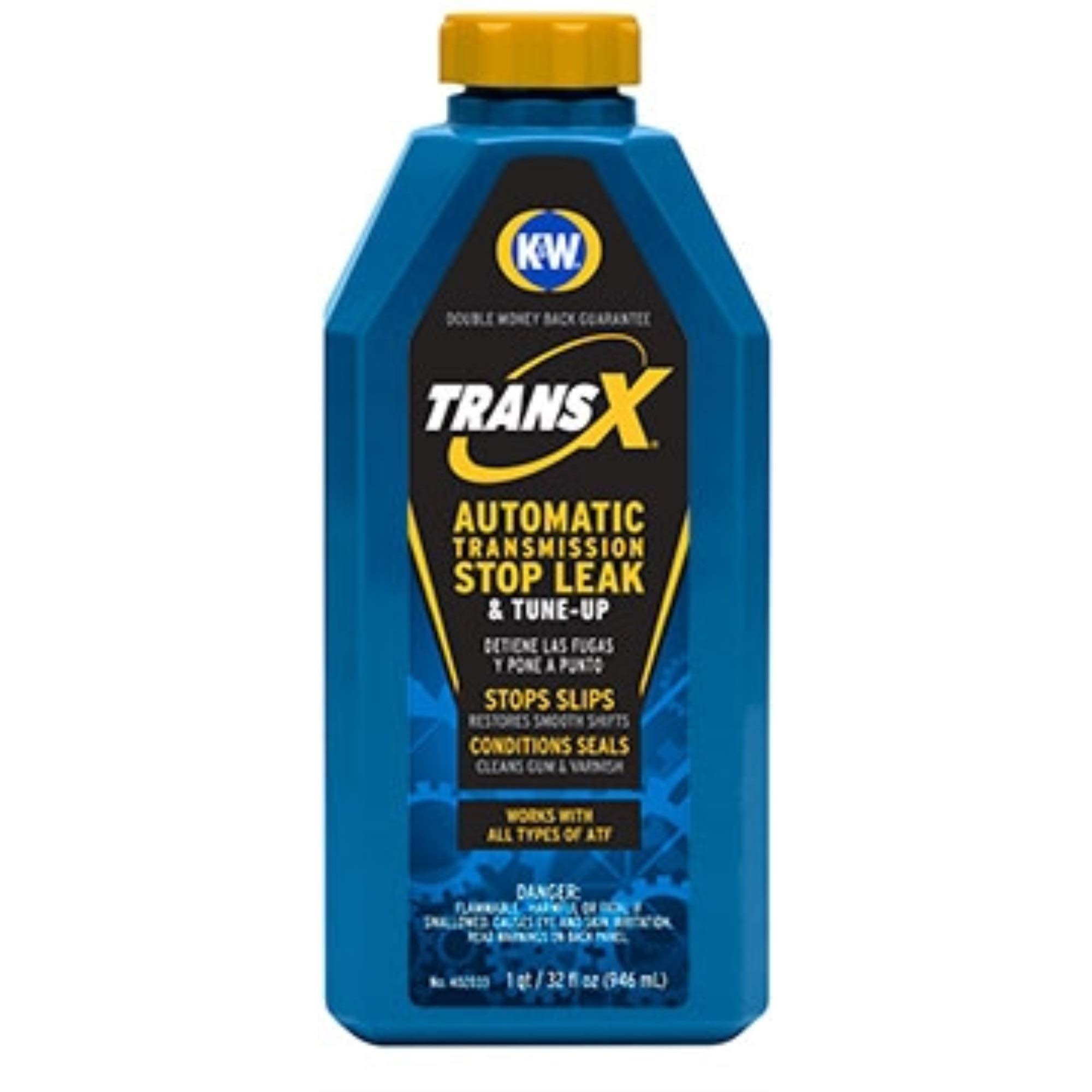
Trans-X from K&W is a two-in-one formula that combines a seal conditioner with a powerful solvent package designed to dissolve sludge, gums, and varnish deposits. The 32-ounce bottle treats a full transmission fluid capacity, and the cleaner-to-conditioner ratio is balanced so that the cleaning agents do not strip away the seal-swelling polymers. Real-world users report success on vehicles as diverse as a 2007 Toyota Vanguard (restored movement after no-movement condition) and a 16-year-old Honda with persistent vibration at 40-50 mph and 80 mph that other additives failed to resolve.
The cleaning action is particularly valuable for transmissions that have accumulated deposits from short-trip driving or infrequent fluid changes. When varnish builds up on the torque converter clutch plate, it creates an uneven friction surface that produces shudder at specific road speeds — exactly the symptom several users reported solving with two successive bottles of Trans-X. The product also extends to power steering and hydraulic systems, making it a versatile addition to a shop inventory.
The primary downside is flammability — Trans-X is highly flammable and must be stored away from heat sources and used with proper personal protective equipment. Additionally, it is not compatible with CVT or manual transmissions, so users must verify their transmission type before use. For heavy varnish accumulation, a single bottle may not be sufficient, and a second treatment after a fluid change is often required.
Why it’s great
- Cleans varnish and sludge while conditioning seals in a single treatment
- Large 32-ounce bottle covers full transmission capacity
- Also effective in power steering and hydraulic systems
Good to know
- Highly flammable — requires proper storage and handling
- Not compatible with CVT or manual transmissions
5. Lubegard 19610 Instant Shudder Fixx, 2 oz.

The single-dose Lubegard 19610 Instant Shudder Fixx is the industry benchmark for torque converter shudder remediation. Its concentrated molybdenum disulfide formulation is temperature-stable up to 600°F and provides four times less wear than standard ATF, according to independent testing. The 2-ounce bottle treats up to 12 quarts of ATF, which covers the vast majority of passenger-car transmissions in a single pour. Real-world results are consistent: owners of 2008 RAV4s, 1999 Town & Country vans, and 2007 BMW 328i E90s report that the shudder stopped within the first few miles of driving after a fluid flush and the addition of this product.
The critical advantage of this product over less refined alternatives is the carrier chemistry. Lubegard uses a synthetic ester base that fully dissolves in ATF without separating or settling in the pan, ensuring that the molybdenum particles are evenly distributed through the valve body and torque converter circuit. This even distribution is essential for preventing hot spots on the clutch plate that can cause inconsistent apply pressure. The product is also voted top by transmission professionals, indicating that shops trust it as the first line of defense before recommending a torque converter replacement.
The main limitation is the small bottle size — at 2 ounces, it is easy to misplace or under-dose if you add it to a transmission without first confirming the fluid capacity. Also, it is not for use in Ford Type F (1986 and earlier), CVT, or DCT applications. If your shudder returns after several months, a second bottle is typically effective, but repeated returns may indicate a mechanically worn torque converter that additive chemistry can no longer compensate for.
Why it’s great
- Concentrated molybdenum disulfide eliminates shudder within miles
- Professionally trusted with proven wear reduction properties
- Synthetic ester carrier ensures even dispersion without settling
Good to know
- Small bottle may be insufficient for transmissions over 12 quarts
- Not compatible with Ford Type F, CVT, or DCT transmissions
6. Rislone High Mileage Transmission Stop Slip with Leak Repair, Pack of 1

Rislone’s High Mileage Stop Slip is a viscosity improver and seal conditioner designed specifically for transmissions that have accumulated over 75,000 miles. The formulation contains a blend of high-viscosity polymers (rated SAE 20W-50) that thicken the existing ATF, reducing the clearance between worn clutch pack plates and restoring hydraulic pressure. The 32-ounce bottle is sufficient to treat most passenger-car transmissions, and the product can be used as a system top-off when fluid is low or as a complete additive during a fluid change. User reports on vehicles like a 1999 Dodge Dakota and a VW Jetta indicate a 40% improvement in shift quality within 200 miles, with some users reporting buttery-smooth engagement after a fluid flush.
What sets Rislone apart from friction-modifier-focused products is its leak repair capability. The seal-conditioning agents in the formula rehydrate dried-out o-rings and gaskets, addressing the fluid loss that often accompanies high-mileage transmission wear. The product also includes anti-wear friction modifiers and extreme-performance additives that reduce slippage, hard shifting, and whining noise. It is compatible with front-wheel drive, rear-wheel drive, all-wheel drive, and four-wheel drive automatic transmissions, as well as manual transmissions — a broader compatibility range than most competitors.
The main consideration is that the viscosity increase can be too aggressive for transmissions in cold climates. At low ambient temperatures, the thickened ATF may flow slowly through the pump and valve body, potentially causing momentary pump cavitation on start-up. Users in northern climates may need to allow extended warm-up periods after adding this product. Also, the stop-slip effect is temporary for mechanical wear — it will not repair a burned-out clutch pack, only mask the symptoms until a rebuild is unavoidable.
Why it’s great
- Thickens worn ATF to restore hydraulic pressure and reduce slip
- Combines seal conditioning with viscosity improvement in one bottle
- Compatible with automatic and manual transmissions
Good to know
- High viscosity can reduce cold-flow performance in winter climates
- Only a temporary fix for worn clutch packs, not a permanent repair
7. Bar’s Leaks HDC Radiator Stop Leak Tablet – 60 Grams, Brown

Bar’s Leaks HDC is a tablet-formulated stop-leak designed for the engine cooling system, not the transmission itself — it seals leaks in radiators, heater cores, water pump seals, and gaskets while also inhibiting rust and corrosion. The tablet format is a unique delivery mechanism: you crush the tablets into a powder, mix with coolant, and add to the radiator. The chemical-based sealant particles circulate through the cooling system and bond to the leak site, forming a flexible seal that withstands normal operating pressure. Real-world results are dramatic: one user with a 2008 Toyota Tundra radiator leak reported the leak stopped after one week without any overheating or heater core clogging, while another user with a Nissan Pathfinder saw the leak reduce after short drives and stop completely after a dinner trip.
While this product is not an ATF additive in the traditional sense, it is included here because a coolant leak into the transmission cooler line or a water pump failure near the transmission housing can mimic transmission fluid loss symptoms. The tablet also conditions the entire cooling system, lubricating water pump seals and controlling electrolysis, which can extend the life of the integrated transmission cooler that many modern vehicles place inside the radiator tank. The 60-gram tablet pack treats standard passenger-car cooling systems with a single dose.
The limitation is that it cannot seal large or mechanically damaged leaks — what one user described as “a gaping hole.” Additionally, it is a temporary fix intended to buy time until a proper radiator replacement, not a permanent repair. Users must crush the tablets into a fine powder for effective suspension in coolant; adding whole tablets may not dissolve properly in all systems.
Why it’s great
- Unique tablet format is easy to store and measure for single treatments
- Conditions entire cooling system including water pump and heater core
- Proven effective on radiator, heater core, and water pump leaks
Good to know
- Requires crushing into powder before adding to coolant
- Temporary fix — does not replace damaged radiators or gaskets
FAQ
Can I use a torque converter shudder fixx in a CVT transmission?
How long does an ATF seal conditioner take to stop a leak?
Will adding a thicker additive damage my transmission pump?
Why does my transmission shudder only at 40 mph and not other speeds?
Final Thoughts: The Verdict
For most users, the best atf additive winner is the ATP Automotive AT-205 Re-Seal because it addresses the most common root problem — dried-out, leaking seals — while remaining compatible with every common automotive fluid. If you need to eliminate torque converter shudder immediately, grab the Lubegard 19610 Instant Shudder Fixx for its proven molybdenum-based friction modification. And for preventing future wear before symptoms appear, nothing beats the zMAX Transmission Formula with its permanent micro-lubrication layer that reduces internal friction without altering fluid properties.