
You are mid-stride, focused on your cadence, but your phone is thumping against your hip, your keys are jangling with every footstrike. That pocket-to-hip bungee cord hasn’t worked in years and you are already searching for offline solutions to a problem every runner knows: how do you carry your absolute essentials—phone, keys, a gel or two—without fighting your own gear for the entire run?
I’m Min — the co-founder and writer behind Gadgets Feed. I have spent hundreds of hours cross-referencing waist-to-band dimensions, stretch specifications, and bounce test results across every major brand to isolate what separates a true athletic fanny pack from an accessory that will shake loose at mile two.
This guide breaks down the zone between breathable mesh panels that wick moisture and the elastic webbing that delivers zero bounce, helping you land on the best athletic fanny pack suited to your training style and body type without wasting time on bulk that slows you down.
How To Choose The Best Athletic Fanny Pack
The market is flooded with generic waist packs that look the part but separate during the first interval. Three specific engineering choices determine if a pack performs or fails: the elastic band’s return tension, the pocket material’s stretch direction, and the buckle’s anti-slip grip. Ignore these and you are buying a sagging pouch.
Band Elasticity & Adjustability Range
A true performance pack uses a high-density elastic band that recovers quickly after stretching. Look for a strap that fits your exact waist measurement with room for compression—a 30-inch waist should not require the strap to be cinched to its absolute limit. A range of 25 to 47 inches is ideal for accommodating base layers and movement without overstretching the elastic fibers.
Pocket Layout & Bounce Prevention
A single large pocket often causes the phone to shift sideways, creating rotational bounce. The better design divides storage into a dedicated phone sleeve against the body, a secondary zippered cavity for gels or keys, and sometimes a third stretch-mesh pocket for quick-access fuel. The pocket material itself must be stretch-woven nylon or spandex-blend that conforms to the phone’s shape, not stiff polyester that amplifies movement.
Moisture Management & Durability
Running produces continuous sweat exposure. A breathable mesh back panel prevents moisture from pooling against your skin, while a water-resistant coating on the phone pocket protects electronics from rain. For long-term durability, examine the zipper track—covered, low-profile zippers resist grit ingress far better than exposed metal teeth. The buckle should be a locking side-release type that cannot pop open under load.
Quick Comparison
On smaller screens, swipe sideways to see the full table.
| Model | Category | Best For | Key Spec | Amazon |
|---|---|---|---|---|
| SPIbelt Original | Mid-Range | Long runs with maximal gear | Expandable pocket (9 x 4 x 2 in) | Amazon |
| Fitletic Ultimate II | Mid-Range | Racing & organizing diabetic supplies | Integrated gel loops & bib toggles | Amazon |
| Gymreapers Stryda | Premium | Hybrid athletes & tempo work | Reflective silver print & sweat-wicking fabric | Amazon |
| WATERFLY Running Belt | Budget | Marathons & triathlons with bib clips | 3.52 oz total weight | Amazon |
In‑Depth Reviews
1. SPIbelt Running Belt Original

The SPIbelt has become a staple among serious runners because it solves the bounce problem through material choice, not brute-force cinching. The 1-inch wide elastic band is made from a nylon/spandex blend that stretches just enough to contour to your waist without creating vertical slack. The pocket expands to 9 x 4 x 2 inches, which comfortably swallows a iPhone 15 Pro Max plus six energy gels—a critical volume for full-marathon fueling without needing a hydration vest.
Real-world testing shows the belt fits waists from 25 to 47 inches, but the sweet spot for zero-bounce performance is a snug fit within the middle 70-percent of that range. The nylon fabric breathes well enough for runs up to a half marathon, and users consistently report that the pocket stays centered without rotating to the small of the back. The No Logo version keeps the look clean, and the woman-owned company backs it with durable construction that holds up to regular laundering.
For anyone who wants a single pack that handles everything from a 5k time trial to a marathon with six gels and a phone, the SPIbelt delivers the most proven balance of capacity and stability. It feels lighter than its rated weight because the pocket is not attached to a rigid frame—it floats on the belt, shifting only with your body, never against it.
Why it’s great
- Expandable pocket fits large phones plus marathon-level fuel loads.
- Soft 1-inch band does not chafe even on sweaty long runs.
- No-bounce design keeps the pocket centered and secure.
Good to know
- Belt size range (25-47 in) may feel tight near the upper limit.
- Best for runs up to 10 miles unless carrying gels in the main pocket.
2. Gymreapers Stryda Running Belt
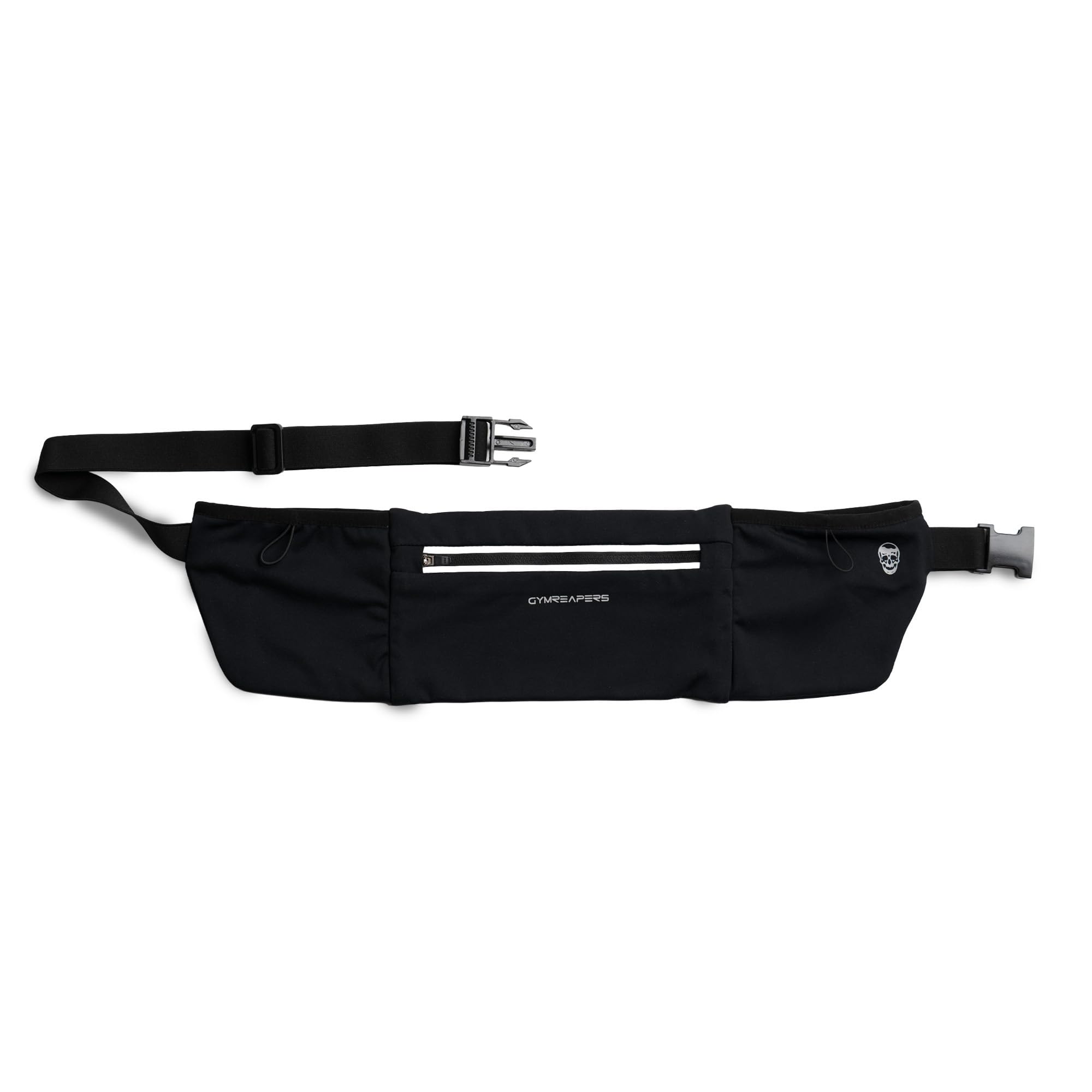
Gymreapers designed the Stryda for the hybrid athlete—someone who moves from deadlifts to 5k repeats without changing gear. The belt uses a thick, stretchable latex-polyester blend that hugs the waist with a tight, compressive feel that eliminates any vertical play. It has a refined center zip pocket plus two side compartments with elastic retention loops, a layout that stops bottles or gels from rattling during high-cadence work.
The fabric is sweat-wicking and treated with a water-repellent finish, which matters when you transition from a rainy outdoor run to a gym floor drenched in moisture. Reflective silver print accents on the zipper and logo improve low-light visibility without looking like a safety vest. The buckle is a locking side-release type that has not popped open in any tested scenario, even when the belt is loaded with a max-sized phone and a 500ml soft flask.
The main con is the strap length—it starts at a minimum 28-inch waist, so if your true waist measures under 28 inches, the belt will not tension properly. Some users with a 32-inch waist report that the excess strap is noticeable. For those within the fit range, though, the Stryda feels more like a compression garment than a fanny pack, staying locked in place through sprints and burpees without adjustment.
Why it’s great
- Compression-grade stretch fabric prevents any bounce during high-intensity intervals.
- Side retention loops secure gels and bottle tops without noise.
- Reflective detailing enhances safety in low light without bulk.
Good to know
- Minimum waist requirement of 28 inches excludes smaller frames.
- Premium pricing reflects material quality but may exceed a casual runner’s budget.
3. Fitletic Ultimate II

The Fitletic Ultimate II proves that a sub-30-dollar pack can perform at a level that rivals premium options. Its key differentiator is the integrated gel loops on the front and the built-in bib toggles for race-day number attachment—features that directly serve runners doing 10k to marathon distances. The main pocket uses a neoprene-like material that resists sweat absorption while maintaining enough stretch to hold an iPhone 16 Pro Max with a slim case.
The internal layout includes a zippered mesh divider and a hidden key pocket with a hook and tether. This matters because diabetic runners and anyone carrying medical supplies have used the Ultimate II to organize insulin pens, glucose meters, and snacks without cross-contamination with sweat-soaked gear. The elastic belt stays flat against the body and does not slide upward over time, a common failure point in cheaper elastic bands.
The tradeoff is pocket depth—the main compartment barely accommodates a large phone, and adding a second gel makes the zipper bulge. It is not designed for ultra-marathon fuel loads. For race-day minimalism, though, the Fitletic Ultimate II offers the best spec-per-dollar ratio in this category, with the longest proven track record of customer satisfaction at this price tier.
Why it’s great
- Gel loops and bib toggles directly support race-day logistics.
- Neoprene main pocket resists sweat and fits large smartphones.
- Hidden key hook with tether prevents losing essential items mid-run.
Good to know
- Main pocket is too shallow for heavy fuel loads.
- Neoprene is not fully waterproof—use a ziplock for heavy rain.
4. WATERFLY Running Belt
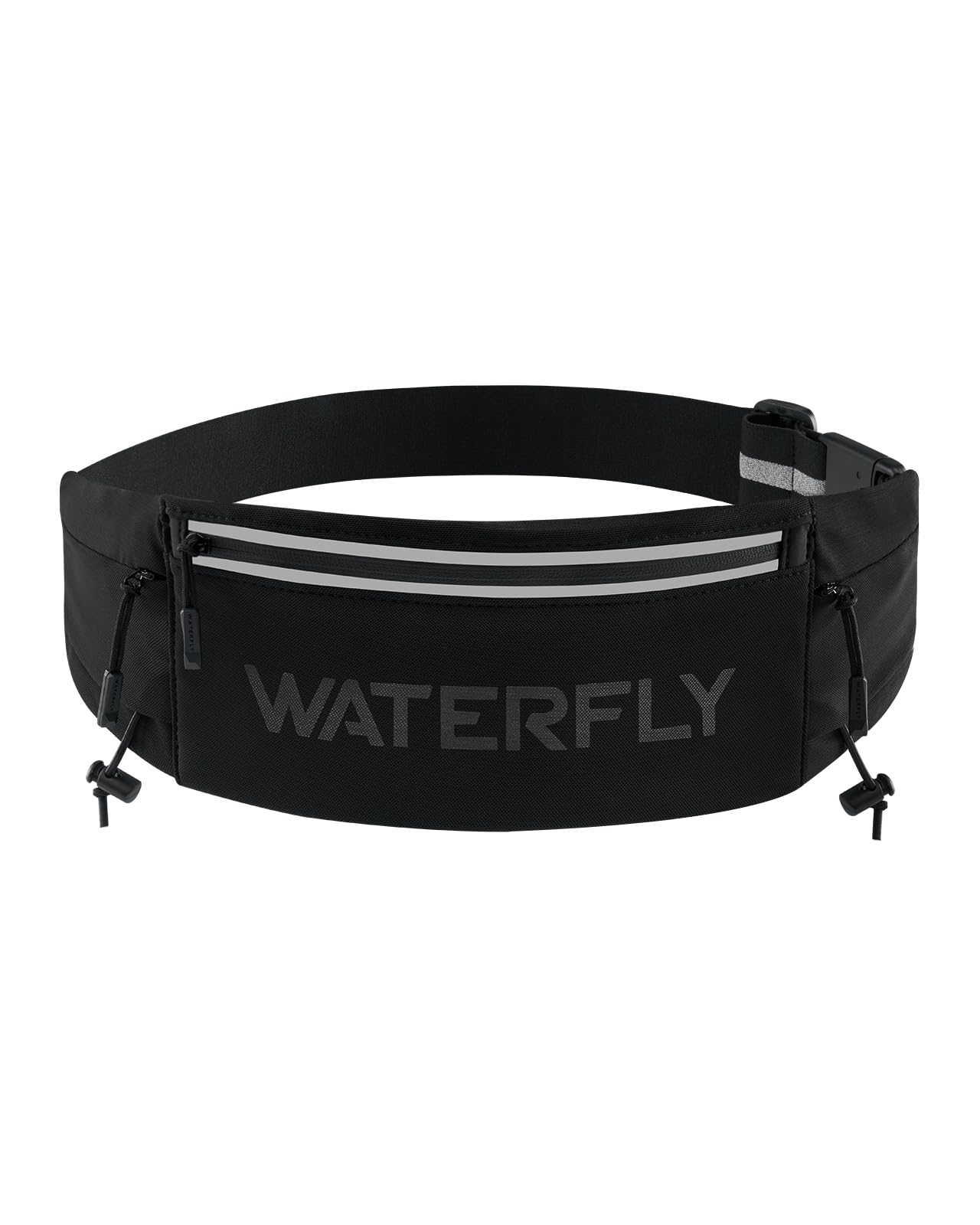
WATERFLY took a direct approach to hot-weather running: use breathable mesh on both the front and back panels to maximize airflow. The back panel uses a high-density, quick-drying mesh that pulls moisture away from the skin, reducing the clammy feel that builds up on a humid long run. The pack weighs only 3.52 ounces, making it the lightest option here, and the elastic band fits waists from 30 to 39 inches with a quick-adjust buckle that does not slip.
The three-pocket system includes a water-resistant phone pocket that fits phones up to 7 inches, plus two side zippered mesh pockets for earphones, gels, or tissues. The included marathon bib clip is a thoughtful addition for race day—no safety pins needed. Reflective strips on the front and back improve visibility for early morning or evening runs without adding visible bulk.
The main limitation is the waist size cap at 39 inches, which excludes larger runners. Additionally, the mesh material, while breathable, has less structural integrity than solid nylon, so heavy phones may cause the pocket to sag slightly over time. For runners who prioritize weight savings and ventilation over maximum pocket rigidity, the WATERFLY delivers exceptional value at a budget-friendly entry point.
Why it’s great
- Breathable mesh front and back panels prevent sweat buildup.
- Ultra-lightweight at 3.52 oz, ideal for race-day minimalism.
- Included bib clip and reflective strips support safe competition use.
Good to know
- Maximum waist fit of 39 inches limits larger runners.
- Mesh construction may not hold heavy phones as securely as solid fabrics.
5. adidas Running Waist Bag
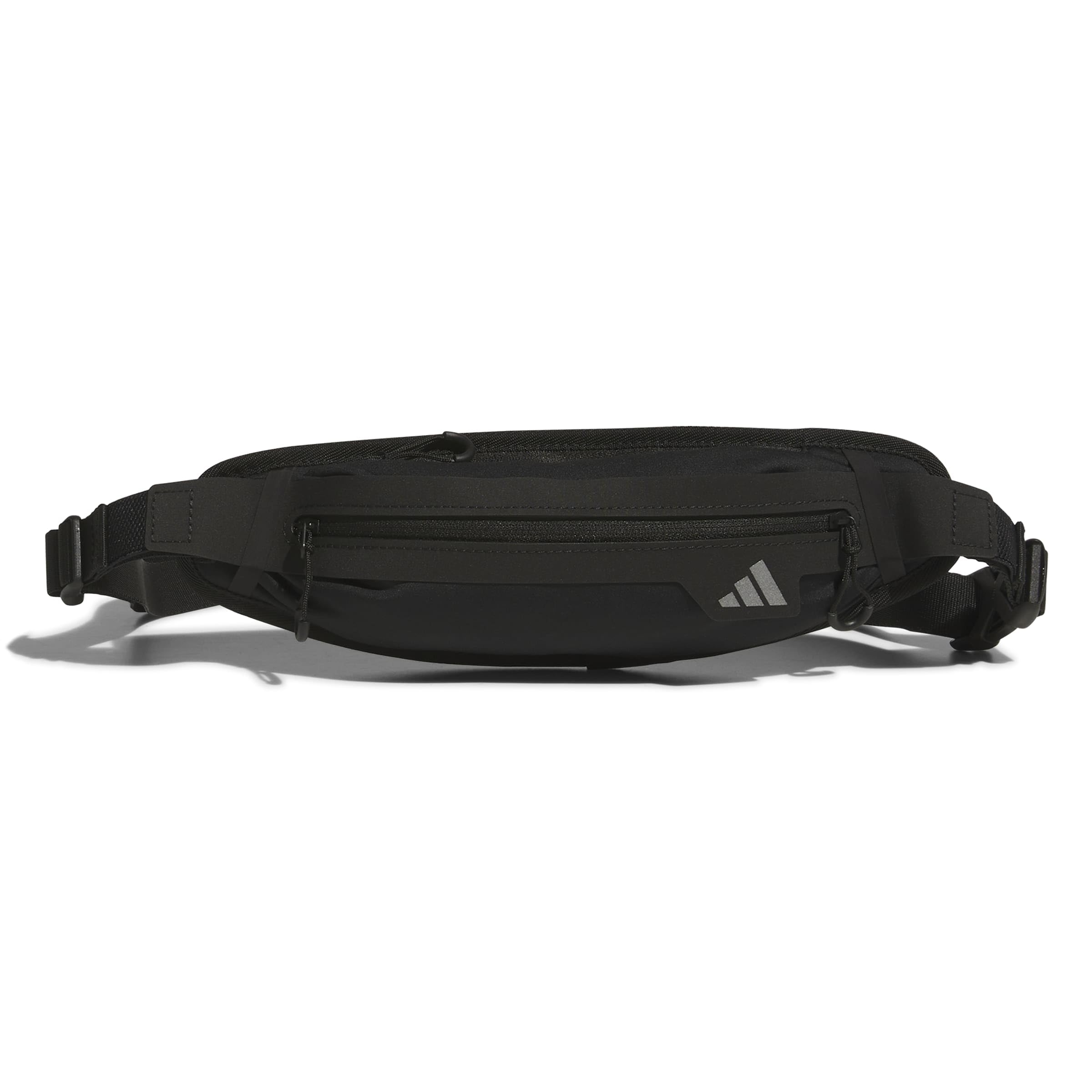
adidas brings its sportswear engineering to the fanny pack category with a 0.75-liter waist bag that prioritizes a low-profile silhouette. The body is 79% polyester and 21% polyurethane interlock fabric, which has a smooth, compressive feel that holds a phone and keys flat against the waist without creating a visible bulge. The single main compartment is ideal for runners who want to carry only the absolute essentials—phone, house key, maybe a credit card—without any extra bulk.
The buckle closure is a simple side-release that is fast to operate one-handed, and the fabric is designed to resist sweat absorption. The strap measures 30 centimeters and is adjustable, though some users report that the strap is excessively long for smaller waists and requires looping back. The double-zipper design allows access from either side, a detail that makes it easy to reach your phone without taking the bag off.
The biggest shortfall is the lack of water resistance—adidas rates it as not water resistant, so rain or heavy sweat can soak through to the contents. The single pocket also means no organization; you are stacking your phone on top of your keys, which can scratch screens. For a clean, minimal carry during a short run or gym session, the adidas bag works perfectly, but it lacks the technical details needed for long endurance work or wet conditions.
Why it’s great
- Compression fabric keeps contents flush against the body with zero bulk.
- Smooth interlock material resists sweat absorption.
- Double-zipper opening allows ambidextrous access.
Good to know
- No water resistance—rain or sweat will reach contents.
- Single pocket offers no separation between phone and keys.
6. Gymreapers Gravestone Crossbody Bag

The Gravestone blurs the line between a running belt and a travel sling. It is built from 900D TPU-coated polyester, giving it a rugged, water-resistant shell that can handle rain and splashes without sweating through the interior. The 1-liter capacity is divided into multiple compartments, including a hidden external quick-access pocket that fits an iPhone Max with a case, an interior mesh divider, and a D-ring for key attachment.
The strap is fully adjustable up to 41 inches and can be worn crossbody, over the shoulder, or around the waist. This flexibility makes it a strong candidate for someone who wants one bag for running, hiking, and travel. The front phone sleeve is a clever addition—you can slide your phone in without opening the main zipper, but it does make the pocket bulge outward noticeably, which can catch on clothing or feel unbalanced during a run.
The biggest downside for running specifically is the non-elastic strap—it does not conform to body movement the way a performance elastic band does. Some users report the bag rides up slightly during a jog. It also includes a heavy metal buckle that adds durability but also weight. For hybrid use where running is occasional rather than the primary activity, the Gravestone is a well-built crossover. For dedicated runners, the non-stretch strap makes it a secondary option.
Why it’s great
- 900D TPU-coated polyester shell is highly durable and water-resistant.
- Multiple carry configurations (crossbody, waist, shoulder).
- Hidden external phone pocket provides quick access without opening the main bag.
Good to know
- Non-elastic strap does not conform to body movement, causing bounce during runs.
- Front phone sleeve makes the bag look bulky and can unbalance the load.
7. Eberlestock Bando Bag

The Eberlestock Bando Bag was designed around the concept of a tactical everyday carry (EDC) system, not specifically as a running belt. Its 420-denier Cordura shell is extremely abrasion-resistant, and the full-zip back pocket is dimensioned to hold a sub-compact firearm like a Glock 19. The main compartment includes an interior mesh zippered pocket and two slip pockets for magazines, tools, or medical supplies.
The adjustable waist belt ranges from 31.5 to 44 inches, making it suitable for larger torsos, and the bag can be worn as a sling pack by extending the strap fully. The main zipper track is robust, though some users note it is not a YKK brand, which may affect long-term smoothness. The overall build is exceptionally rugged—the kind of bag you could drag behind a truck without destroying it.
For running, the Bando Bag is overbuilt. The rigid Cordura does not conform to the body the way stretch nylon does, and the weight is higher than any other pack here. The tactical aesthetic may not match a runner’s look, and the 1-inch depth of the main pocket limits how much you can carry for a marathon. But if your “athletic” activity includes tactical training, hiking with defensive gear, or needing a bombproof EDC that can double as a waist pack, the Bando Bag is uniquely suited.
Why it’s great
- 420D Cordura shell is virtually indestructible under normal use.
- CCW compartment accommodates sub-compact firearms with secure fit.
- Adjustable strap works as a waist belt or sling bag for versatility.
Good to know
- Rigid Cordura does not conform to the body, causing bounce during runs.
- Heavier than dedicated running belts, making it less ideal for race day.
FAQ
Will an athletic fanny pack fit my phone with a case on it?
How do I prevent an athletic fanny pack from riding up during sprints?
Can I wear an athletic fanny pack under my shirt?
Final Thoughts: The Verdict
For most users, the best athletic fanny pack winner is the SPIbelt Original because its expandable pocket and soft 1-inch elastic band provide the most reliable no-bounce experience across the widest range of body types and run distances. If you carry a phone and typically need room for six gels at marathon pace, the SPIbelt handles it without shifting. If you prioritize a compression fit that feels like a second skin during intervals, grab the Gymreapers Stryda. And for race-day minimalism where weight and breathability are everything, the WATERFLY Running Belt is unbeatable at its price.