
Our readers keep the lights on and my morning glass full of iced black tea. As an Amazon Associate, I earn from qualifying purchases.
Specs are compiled from manufacturer listings and verified buyer reviews and can change over time — please confirm the key details on the product page before buying.
You want helicopter rotors to sweep over your head or rain to pelt a tin roof above you — that is the whole point of buying an Atmos AV receiver. But not every model creates that three-dimensional bubble convincingly; some confuse it with plain loudness, and others lock you into a complicated setup process that kills the fun before you watch a single movie. This guide breaks down the real-world performance and honest trade-offs of ten current models, so you pick the one that actually lifts the ceiling off your room.
I’m Min — the founder and writer behind Gadgets Feed. This guide is built by comparing the manufacturers’ published specifications and the patterns across verified customer reviews, so you get each pick’s real strengths and trade-offs instead of marketing spin.
After reading, you will know exactly which atmos av receiver matches your speaker layout, gaming demands, and tolerance for setup quirks — without guessing or overpaying.
Quick Picks
- Denon AVR-S770H 7.2 Ch Home Theater Receiver — Best Overall
- Denon AVR-S970H 8K Ultra HD 7.2 Channel AV Home Audio Receiver — Best Value
- Yamaha RX-A4A AVENTAGE 7.2-Channel AV Receiver — Premium Pick
- Onkyo TX-NR6100 7.2 Channel THX Certified Network AV Receiver — THX Certified
- Sony STR-AN1000 7.2 CH Surround Sound Home Theater 8K A/V Receiver — Virtual Overhead
- YAMAHA RX-V6A 7.2-Channel AV Receiver with MusicCast — Streaming Hub
- Pioneer VSX-935 7.2 Channel Surround Sound Network Receiver Dolby Atmos (2021) — Gaming Entry
- Sony STRAZ1000ES Premium ES 7.2 CH 8K A/V Receiver — ES Series
- JBL MA9100HP 9.2-Channel 8K AV Receiver — 9.2 Channels
- Onkyo TX-SR494 4K Ultra HD Dolby Atmos AV Receiver – 2019 Model — Budget Atmos
How To Choose The Best Atmos AV Receiver
Not every receiver labelled “Dolby Atmos” delivers the same overhead experience. Lock in your speaker layout first, then match the receiver’s channel count, HDMI capabilities, and room-correction system to that plan.
Channel Count: 5.1.2 vs 7.1.2 vs 5.1.4
Think of the first number as your floor speakers, the second as your subwoofers, and the third as your ceiling or upward-firing height speakers. A 5.1.2 setup (five ear-level speakers, one sub, two height channels) is the entry point for Atmos and works in most living rooms. Stepping to 7.1.2 adds rear surrounds, which tightens the bubble behind you. A 5.1.4 setup uses four height speakers — two in front of you and two behind — creating the most convincing rain-above-your-head effect. Choose a receiver with the channel count that matches your room size and your willingness to run speaker wires.
HDMI Version and Gaming Features
If you game on a PlayStation 5 or Xbox Series X, you need HDMI 2.1 inputs that support 4K/120Hz or 8K/60Hz passthrough. Look for VRR (Variable Refresh Rate, which reduces screen tearing) and ALLM (Auto Low Latency Mode, which automatically switches the receiver into a lower-lag state when you launch a game). Receivers with only HDMI 2.0 are fine for movie-only setups but will bottleneck a gaming console’s graphical output.
Room Correction and Calibration
Room correction is the hidden hero: a microphone analyzes your room’s acoustics and adjusts each speaker’s timing and EQ to compensate for furniture, carpet, and odd wall shapes. Onkyo uses AccuEQ, Yamaha uses YPAO, Denon uses Audyssey, and Sony uses D.C.A.C. IX. Some systems measure speaker distance more accurately than others — buyers report that the Sony and Denon systems tend to produce more natural surround pans, while the AccuEQ on some Onkyo models can misread subwoofer distance, requiring manual tweaks.
Virtualization vs Real Height Speakers
Dolby Atmos Height Virtualization and DTS Virtual:X simulate overhead sound using your existing ear-level speakers — no ceiling speakers needed. The illusion is surprisingly convincing for casual listening but never matches the precise object placement that physical height speakers give you. If your room cannot accommodate ceiling or upward-firing speakers, a receiver with good virtualization (like the Denon AVR-S770H or the Sony STR-AN1000) is a solid compromise.
Quick Comparison
| Model | Best For | Channels | HDMI 2.1 / 8K | Room Correction | Amazon |
|---|---|---|---|---|---|
| Denon AVR-S770H | Balanced all-rounder | 7.2 (5.2.2) | Yes | Audyssey | from $449.00Amazon |
| Denon AVR-S970H | Phono + 8K value | 7.2 (5.2.2) | Yes | Audyssey | $849.00$949.00Amazon |
| Yamaha RX-A4A | Premium build + Surround:AI | 7.2 (5.2.2) | Yes | YPAO R.S.C. + 3D | $1,199.99Amazon |
| Onkyo TX-NR6100 | THX-certified loudness | 7.2 (5.2.2) | Yes | AccuEQ | $649.00Amazon |
| Sony STR-AN1000 | Virtual overhead magic | 7.2 (5.2.2) | Yes | D.C.A.C. IX | $1,054.09$1,149.99Amazon |
| YAMAHA RX-V6A | MusicCast multi-room | 7.2 (5.1.2) | Yes | YPAO R.S.C. | $645.99Amazon |
| Pioneer VSX-935 | Value 8K entry | 7.2 (5.2.2) | Yes | — | $539.00Amazon |
| Sony STRAZ1000ES | ES-series fidelity | 7.2 (5.2.2) | Yes | D.C.A.C. IX | $1,498.00Amazon |
| JBL MA9100HP | 9.2-channel expandability | 9.2 (5.1.4 / 7.1.2) | Yes | — | Amazon |
| Onkyo TX-SR494 | Budget Atmos entry | 5.2.2 | No (HDMI 2.0) | AccuEQ | Amazon |
In‑Depth Reviews
1. Denon AVR-S770H 7.2 Ch Home Theater Receiver

The receiver that disappears into your system so the movie takes center stage.
Denon’s AVR-S770H delivers 75W per channel across seven channels — enough to drive a 5.2.2 Atmos layout without strain — and buyers consistently praise the on-screen assistant that walks you through setup. One owner noted that the “easy setup via on-screen assistant” meant they were listening to rich surround in under thirty minutes. Dolby Height Virtualization and DTS Virtual:X let you hear overhead effects even if you skip installing ceiling speakers, which is a major convenience for renters or anyone with a finished ceiling.
On the video side, it supports 8K/60Hz and 4K/120Hz passthrough with VRR, ALLM, and QFT — so if you plug a PS5 or Xbox Series X into it, you get smooth, tear-free gameplay. The built-in HEOS wireless system streams from Spotify, TIDAL, and Pandora to other rooms, and Amazon Alexa handles volume and input switching hands-free. What you do not get here is a phono input for a turntable, so vinyl listeners will need an external preamp.
Compared to the Onkyo TX-NR6100, which owners mention as “much louder than Denon X1700,” the Denon runs noticeably cooler and its Audyssey room calibration integrates subwoofer distance more reliably — fewer manual tweaks required.
The anchor pick for most buyers: If you want a receiver that balances movie immersion, gaming chops, and setup simplicity without pushing your budget to the moon, this is it. Owners who have “never heard my speakers put out the sound like the Denon does” back that up.
Reach for this if… You want a single receiver that handles 5.2.2 Atmos, 8K gaming, and multi-room streaming with minimal frustration.
Look elsewhere if… You need a phono input for a turntable or prefer a more hands-off approach to firmware updates — some customers note occasional HDMI handshake quirks that require unplugging the unit to reset.
2. Denon AVR-S970H 8K Ultra HD 7.2 Channel AV Home Audio Receiver

The same Denon ease-of-use, but with a turntable-friendly phono input and extra headroom.
This is the step-up version of the S770H, and the biggest real-world difference is the 90W per channel (compared to 75W on the S770H) and the built-in phono input for a turntable. Reviewers point out that the phono stage delivers “clear, rich sound for a 5.0 setup” with the “good onboard phono stage” earning specific praise for vinyl playback. The eight HDMI ports — six inputs and two outputs, three of which are 8K-capable — give you room to plug in every console, streamer, and set-top box without a switcher.
One useful detail owners note: the 7.1 setup runs cooler than older Denon gear, with one buyer measuring “80°F vs 90-92°F” on previous units. That means less worry about ventilation in a closed media cabinet. The HEOS multi-room system and Audyssey calibration are identical to the S770H, so the setup experience is just as smooth. The catch: if you use the powered Zone 2 output, it borrows from the rear-surround speaker terminals, limiting your main room to 5.1 instead of 7.1 — a trade-off that matters only if you wanted a full 7.1.2 Atmos layout.
Compared to the Yamaha RX-V6A, which shoppers say has a “dated menu but functional,” the Denon S970H’s on-screen guides and smartphone app make initial configuration noticeably easier for first-time AVR owners.
Turntable and power
- Phono input means no external preamp for vinyl
- 90W per channel gives extra dynamic punch during loud movie scenes
- eARC and 8K processing for future-proof video
The zone-tradeoff to know
- Powered Zone 2 borrows rear-surround terminals, limiting main room to 5.1
- Slight audio lag reported between Zone 1 and Zone 2
The sweet-spot for vinyl-and-movie households: If you spin records and stream Atmos movies with equal passion, the S970H gives you both without compromise — just be clear on if you need full 7.1 or are happy with 5.1 + a second zone.
3. Yamaha RX-A4A AVENTAGE 7.2-Channel AV Receiver

The receiver that thinks — Surround:AI adjusts audio in real time based on what is happening on screen.
Yamaha’s AVENTAGE line is built on a heavier chassis with better vibration damping, and the RX-A4A sits at the balance of the range. Its 7.2-channel output supports a 5.2.2 Atmos layout, but the headliner is Surround:AI — a processing mode that analyzes each scene in real time and adjusts dialogue clarity, surround effects, and bass punch depending on what the content demands. Owners describe the effect as making “the room seems so much bigger,” with particularly good results on action films where the system pushes effects to the correct speakers dynamically.
All seven HDMI inputs support 8K60 and 4K120 at 40 Gbps, with ALLM and VRR for gaming. The YPAO R.S.C. room correction includes 3D multipoint measurement and a low-frequency mode, which buyers find “simple for 5.1, more involved for Atmos” — once dialed in, the calibration rarely needs revisiting. A phono input is included for turntables, and the MusicCast app works with Spotify, TIDAL, Amazon Music HD, and a Sonos system via an additional Port box. The catch: firmware updates require a USB flash drive and some computer know-how — buyers who dislike tedious update procedures should move their router closer to the unit or buy a long Ethernet cable.
At 18.6 kilograms (about 41 pounds), this is the heaviest receiver in this guide, which signals the premium internal construction but also means you want a sturdy shelf.
AI-driven immersion
- Surround:AI adjusts sound per scene in real time
- Phono input for turntables
- YPAO R.S.C. 3D calibration with multipoint measurement
The setup hurdle
- Firmware updates require a USB flash drive — not everyone’s idea of fun
- 5.1.2 Atmos layout only; no 7.1.4 expansion without external amplification
For the enthusiast who wants scene-aware audio: If you have a dedicated media room and want a receiver that actively tunes itself to every explosion and whisper, the RX-A4A justifies its premium with genuine processing intelligence you cannot get from the mid-range picks.
4. Onkyo TX-NR6100 7.2 Channel THX Certified Network AV Receiver
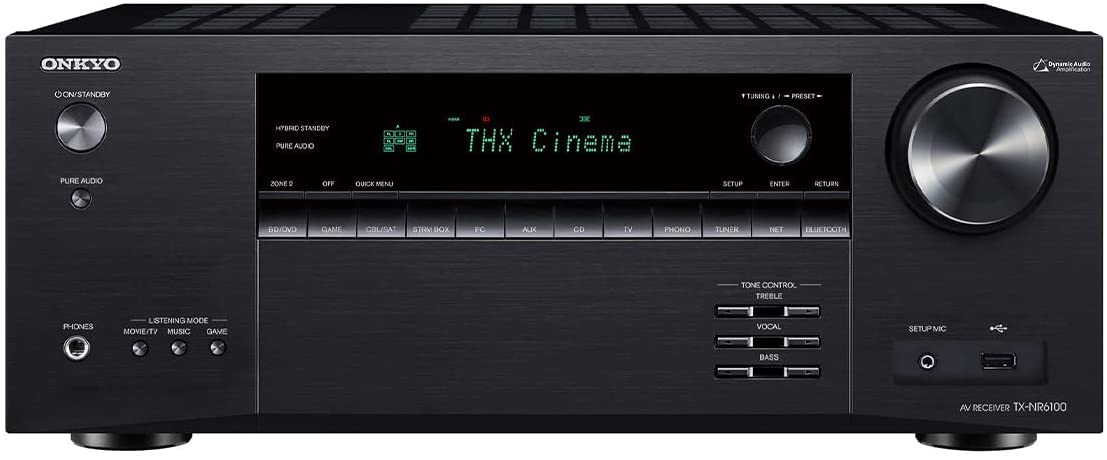
THX certification means it passes the same quality tests cinemas use — at home volume.
The TX-NR6100 is the loudest receiver in this guide for its price tier, rated at 210W per channel under THX Select certification — a standard that ensures it delivers reference-level sound in medium-sized rooms. Buyers confirm it is “much louder than Denon X1700,” and with eight HDMI inputs including three that handle 8K/60Hz and 4K/120Hz at 40 Gbps, it is fully ready for PS5 and Xbox Series X. Beyond gaming, it supports 5.2.2-channel Dolby Atmos and DTS:X, IMAX Enhanced, and discrete Zone 2 audio and video output, meaning you can watch a different source in another room while the main room plays the movie.
The catch is reliability: several buyers report receiving defective units with failed HDMI inputs, and one reviewer noted that “Onkyo had production flaws during pandemic; high risk of defective units from third-party sellers.” If you buy one, verify the seller return policy carefully. The remote is also notably flimsy with no backlight — a minor annoyance when watching in the dark. At 21 inches deep (18.64 inches wide and 10.64 inches high), it is the deepest model in this guide, so measure your cabinet before ordering.
Compared to the Denon AVR-S770H, which runs cooler and has fewer reliability complaints, the Onkyo wins on raw output and THX certification but loses on build consistency and thermal management.
The power-first choice with a caveat: If you prioritize sheer loudness and THX-certified dynamic range above all, the TX-NR6100 delivers performance that buyers call “top performing in its price range” — just budget time for a possible exchange and ensure your cabinet fits its 21-inch depth.
Best for: Home theater fans who want THX-certified sound and plenty of HDMI 2.1 ports for gaming.
skip it if: You want a plug-and-play unit with high reliability from the start, or your media cabinet is shallower than 21 inches.
5. Sony STR-AN1000 7.2 CH Surround Sound Home Theater 8K A/V Receiver

Sony’s 360 Spatial Sound Mapping makes speakers you do not own feel present in the room.
The STR-AN1000 uses Sony’s Digital Cinema Auto Calibration IX and 360 Spatial Sound Mapping to create phantom height and surround channels, so a 5.1 setup can sound convincingly like a 7.1.4 system. Buyers describe the effect as “creating convincing sound from absent speakers” and say it “inspires re-watching movies.” If your room cannot accommodate ceiling speakers or you simply do not want to run wires, this receiver’s virtualization is the most impressive in this guide. Six HDMI inputs support 8K and 4K/120 with HDMI 2.1, and it includes Chromecast built-in, Spotify Connect, Apple AirPlay, and Bluetooth — plus Works with Sonos integration, so it can join an existing Sonos multi-room system.
There are a few quirks. The front display is small and difficult to read from a seating position, and the remote does not show which sound field is active. One reviewer found that “Apple TV 4K Dolby Vision passthrough fails” — a known issue that may require a firmware fix. The STR-AN1000 also lacks a phono input, so vinyl listeners will need an external preamp. At 165W (6 ohms, 1 kHz, 1ch THD 0.9%), it is less powerful per channel than the Onkyo TX-NR6100, but its processing sophistication means it sounds fuller at the same volume level.
Compared to the Sony STRAZ1000ES, which costs significantly more, the STR-AN1000 delivers most of the same 360 Spatial Sound Mapping magic for less, though the ES model includes a backlit remote and better heat management.
Virtual excellence
- 360 Spatial Sound Mapping creates convincing height effects without physical height speakers
- D.C.A.C. IX calibration measures speaker positions and heights accurately
- Integrates with Sonos, Chromecast, AirPlay, and Spotify Connect
Known gaps
- Front display unreadable from seating distance; remote lacks sound-field indicator
- No phono input for turntables
- Dolby Vision passthrough may fail with Apple TV 4K
The virtualization champion: If your room layout rules out ceiling speakers and you rely on virtual height effects, the STR-AN1000 delivers the most convincing phantom overhead Bubble in this price bracket — just accept a few display and passthrough bugbears.
6. YAMAHA RX-V6A 7.2-Channel AV Receiver with MusicCast

A reliable MusicCast hub that powers two 4-ohm speakers without breaking a sweat.
The RX-V6A is a 7.2-channel receiver (5.1.2 Atmos) that shines brightest as the center of a Yamaha MusicCast multi-room system. It streams from Pandora, Spotify, Napster, SiriusXM, TIDAL, Deezer, Qobuz, and Amazon Music HD, and works with Alexa, Google Assistant, and Siri via AirPlay 2. One buyer specifically uses it to “power two 4 ohm front speakers via TV streaming apps,” which confirms it handles lower-impedance speakers without overheating or shutting down — a useful trait for owners of older or high-end speakers that dip below 8 ohms.
Setup is straightforward: one reviewer timed it at “20-25 min” and praised the “superior audio (clear dialogue, dynamic action)” compared to their previous Onkyo TX-NR6050. Seven HDMI inputs include three that support 8K60 and 4K120, plus eARC. A few owners note that the on-screen menu looks dated compared to newer interfaces, but all agree it is functional. The main frustration: eARC does not auto-power the receiver with a Sony TV — you must manually turn the receiver on, after which the TV remote controls volume normally.
At 6.25 inches deep, the RX-V6A is shallower than the Onkyo TX-NR6100 at 21 inches, making it far easier to fit into standard media consoles.
The MusicCast maestro for multi-room fans: If you already own a Yamaha MusicCast speaker or plan to add them, the RX-V6A ties everything together with reliable streaming and solid Atmos performance. The dated menu is a minor trade-off for its streaming flexibility and shallow depth.
Reach for this if… You want a receiver that doubles as a multi-room streaming hub and fits into a standard 7-inch-deep cabinet.
Look elsewhere if… You need a phono input for a turntable or want a snappy, modern on-screen guide — the menu here works but looks last-generation.
7. Pioneer VSX-935 7.2 Channel Surround Sound Network Receiver Dolby Atmos (2021)
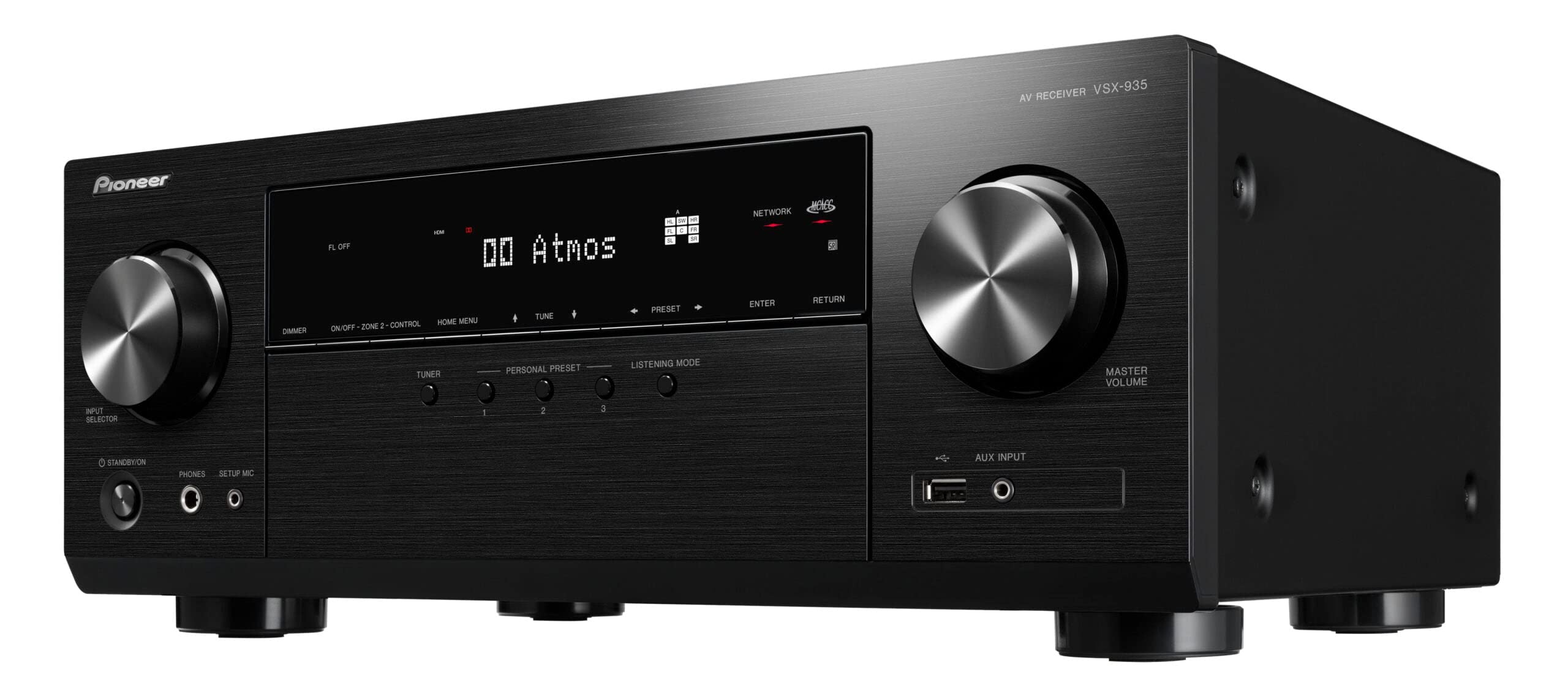
An 8K-ready receiver at a mid-range price, if you are willing to update firmware manually.
The VSX-935 is one of the more affordable receivers in this guide that still supports HDMI 2.1 with 8K passthrough, making it an attractive pick for gamers who want to future-proof without spending flagship money. It supports Dolby Atmos Height Virtualization, DTS:X, and a 7.2-channel layout (5.2.2 Atmos). Buyers generally praise the sound quality — “excellent sound quality, crisp and clear, loud” is a typical review — but nearly every owner points to firmware updates as a pain point. One buyer mentioned that updates are “USB only and both times have failed with error codes.”
Build quality reports are mixed. One customer’s “first unit DOA, replacement worked,” while another reports that “HDMI video fails with computer (snow, black screen, constant refresh).” On the positive side, the receiver works with Audirvana and DSD128 high-resolution audio, and the dual-zone output lets you send different sources to a second room. At 14.56 inches deep, 17.13 inches wide, and 6.81 inches high, it is compact enough for most cabinets. The remote is RF-based and works through walls, which is a nice touch for whole-home setups.
Compared to the Yamaha RX-V6A, which has a more polished MusicCast ecosystem and fewer reliability complaints, the VSX-935 offers similar 8K features at a lower entry price but demands more patience with firmware and possible early hardware failures.
The value 8K option with caveats: If your budget is tight and you need HDMI 2.1 for 8K or 4K/120 gaming, the VSX-935 delivers the core specs. Just be prepared to perform firmware updates via USB — and buy from a retailer with a low-maintenance return policy in case you draw a defective unit.
Best for: Gamers on a budget who want 8K passthrough and are comfortable rolling up their sleeves for firmware updates.
pass on it if: You want a set-and-forget receiver — reliability reports are too inconsistent here for a low-maintenance purchase.
8. Sony STRAZ1000ES Premium ES 7.2 CH 8K A/V Receiver

The ES badge signals better parts, a backlit remote, and a soundstage that rewards critical listening.
Sony’s ES (Elevated Standard) series sits above the standard STR-AN1000, and the STRAZ1000ES justifies the step-up with a sturdy 100W + 100W into 8 ohms (1 kHz, 2ch, THD 0.9%), a backlit remote that buyers appreciate (a direct fix for the STR-AN1000’s non-backlit remote complaint), and improved thermal design — though one reviewer still recommends the “AC Infinity Aircom T10” for ventilation. The 360 Spatial Sound Mapping is identical to the STR-AN1000, but the ES model integrates more smoothly with custom control systems via IP control, making it a favorite among custom installers.
Buyers describe the sound as “the most amazingly sounding receiver you will ever hear,” with the D.C.A.C. IX calibration accurately measuring speaker positions and heights. The auto setup works through a graphical UI, a web browser, or an iPhone app. One detailed review notes that “360SSM fills missing channels” and that “Neural X upmixing is good for music,” suggesting this receiver excels at both movie and music playback. The 6-in/2-out HDMI configuration supports 8K and 4K/120 with HDMI 2.1, and it includes Chromecast built-in, Spotify Connect, Apple AirPlay, and Sonos integration.
The biggest omission: no HDR10+ support, and no QMS or QFT for the most cutting-edge gaming features. If you prioritize the absolute latest HDMI gaming standards, the Onkyo TX-NR6100 or Yamaha RX-A4A may edge ahead on raw video specs. At 13.13 inches deep, 17 inches wide, and 6.24 inches high, it is significantly more compact than the heavy Yamaha RX-A4A (17.38 inches deep).
ES-series refinement
- Backlit remote — a major usability upgrade over the STR-AN1000
- 100W + 100W into 8 ohms provides clean headroom for dynamic soundtracks
- IP control integration for custom smart-home setups
Gaming gaps
- No HDR10+ support; lacks QMS and QFT
- Runs hot — external cooling recommended for closed cabinets
The enthusiast’s Sony pick: If you value Sony’s spatial processing, want a backlit remote, and plan to integrate the receiver into a larger smart-home control system, the STRAZ1000ES delivers premium sound with install-friendly features. Hardcore gamers may miss HDR10+ and the latest HDMI gaming extras.
9. JBL MA9100HP 9.2-Channel 8K AV Receiver

Nine channels of Class D power give you the option to run 5.1.4 or 7.1.2 without external amps.
JBL’s MA9100HP is the only 9.2-channel receiver in this guide, meaning it can drive a 5.1.4 Atmos layout (five ear-level speakers, one sub, four overhead) or a 7.1.2 layout (seven ear-level, one sub, two overhead) from a single chassis — no separate amplifier needed. It uses low-noise Class D amplification, which runs cooler than traditional Class A/B designs. Six HDMI inputs with two outputs support 8K passthrough and eARC, and network streaming works via Apple AirPlay 2 and Google Chromecast.
Owners mention that initial setup can be confusing due to “unresponsive firmware update” that eventually works, and that all configuration tweaks should be made on the TV screen rather than the receiver’s front display, which is minimal. The shallow 15.6-inch depth is a strong advantage for fitting into deeper media consoles without sticking out the back. On the downside, the remote is not backlit — one owner calls this a “major flaw” and says it is “impossible to navigate in the dark.” There is also no onboard AM/FM tuner and no DTS-HD Master Audio downmixing to 2.1, which affects listeners with 2.1-channel setups.
Compared to the Denon AVR-S970H at 7.2 channels, the JBL offers 9.2 channels for a true 4-height-speaker Atmos setup without adding an external amplifier.
The expandability pick for Atmos purists: If you have the space for four height speakers and want a single receiver that drives a 5.1.4 setup natively, the MA9100HP is the most straightforward path. The non-backlit remote and missing downmixing are irritants, not deal-breakers, in a home theater that already has its lights dimmed.
Best for: Home theater builders who want 5.1.4 Atmos in one box without external amps.
it’s not for you if: You need an AM/FM tuner, a backlit remote, or DTS-HD Master Audio downmixing for a 2.1 setup.
10. Onkyo TX-SR494 4K Ultra HD Dolby Atmos AV Receiver – 2019 Model
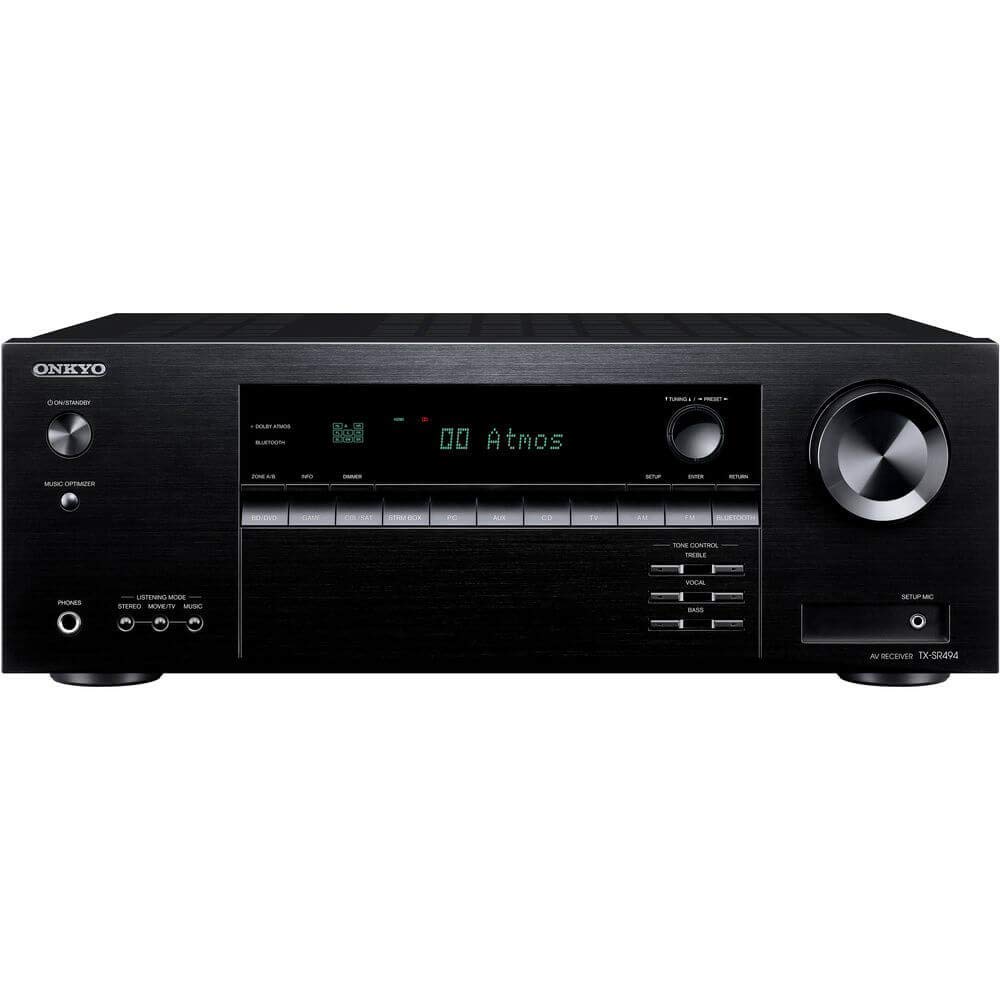
The most affordable way to get 5.2.2 Atmos, but reliability reports warn of early failures.
The TX-SR494 is the budget entry point for Dolby Atmos in this guide, offering a 5.2.2-channel layout (five ear-level, two subs, two height) with 80W per channel. It includes AccuEQ room calibration with AccuReflex, which aligns timing between floor and height speakers for a more coherent sound bubble. Several customers note it is a “great budget receiver with quirks” — the Bluetooth connection is weak with dropouts, the remote layout is poor, and there is no phono input. On the positive side, the front-panel controls for bass, treble, and mid frequencies give you quick tonal adjustments without diving into menus.
The most serious concern: one buyer reports that the unit “developed loud buzzing under a year” and that Onkyo’s customer service charged over for shipping on a warranty repair. After the repair, “image output flickers with static screen.” This pattern — working well initially, failing early — appears in multiple reviews. If you buy this model, use a credit card with extended warranty protection or buy from a retailer that offers an affordable extended service plan.
It only supports HDMI 2.0 (4K/60p, no 8K or 4K/120), which means it is not suitable for next-gen gaming at high refresh rates. If you are building a pure movie-and-TV Atmos setup on a tight budget and accept the reliability risk, the TX-SR494 delivers the core Atmos experience for less than any other model here.
The cheapest Atmos path
- Affordable entry to 5.2.2 Atmos with DTS:X
- Front-panel bass, treble, and mid controls for quick EQ
- AccuEQ with AccuReflex for decent speaker alignment
The reliability concern
- Multiple reports of buzzing/hardware failure within the first year
- HDMI 2.0 only — no 8K or 4K/120Hz gaming
- Weak Bluetooth with dropouts; no phono input
Only if your budget is strict and your risk tolerance is high: The TX-SR494 proves Atmos does not have to cost a fortune, but the pattern of early failures makes it a gamble. Buy with extended warranty protection and be ready to use it.
Understanding the Specs
Channel Count and Layout (X.Y.Z)
The first number (X) is the count of ear-level speakers. The second (Y) is the number of subwoofers. The third (Z) is the number of height or ceiling speakers. A 5.1.2 setup — five ear-level speakers, one subwoofer, two height speakers — is the standard entry point for Atmos. Moving to a 5.1.4 adds two more height speakers for a more convincing overhead bubble. If your receiver cannot drive enough channels, you will need an external amplifier for the extra speakers.
Room Correction Systems
Room correction uses a supplied microphone to measure your speakers’ distances, levels, and equalization in your actual room, then applies filters to compensate for furniture, carpet, and odd wall angles. AccuEQ (Onkyo) includes AccuReflex to time-align floor and height speakers. YPAO R.S.C. (Yamaha) adds multipoint measurement and 3D calibration. Audyssey (Denon) is known for reliable subwoofer distance detection. D.C.A.C. IX (Sony) measures speaker positions and heights, and powers 360 Spatial Sound Mapping. A good calibration makes a bigger difference to sound quality than the amplifier wattage in most rooms.
FAQ
Can I add height speakers later to a 5.1 receiver?
Do I need ceiling speakers for Dolby Atmos, or can I use upward-firing modules?
What is the difference between Dolby Atmos and DTS:X?
Will a 7.2 receiver work with a 5.1.2 speaker setup?
How many HDMI 2.1 inputs do I really need for gaming?
Does a receiver with more watts per channel always sound louder?
Should I buy a 2019 or 2020 model to save money, or stick with current-generation?
What does THX Select certification actually mean?
Can I run a 5.1.4 Atmos setup without an external amplifier?
How important is eARC for an Atmos setup?
Final Thoughts: The Verdict
For most people, the atmos av receiver winner is the Denon AVR-S770H because it delivers balanced Atmos immersion, reliable 8K gaming passthrough, and an easy setup process without stretching into high-end pricing. If you spin vinyl and want a phono input with 90W of headroom, grab the Denon AVR-S970H. And for the enthusiast who demands scene-aware audio from a premium chassis, the Yamaha RX-A4A offers processing intelligence that no other receiver at its price matches.
How We Picked
We do not accept paid placement. Every pick is matched to a real buyer and a real use-case; we do not hands-on test units.
Sources & Methodology
Specifications: manufacturer listings and product documentation. Review insights: verified customer reviews, as of July 2026. Pricing: not shown on this page (it changes often); check the current price via the retailer link.
As an Amazon Associate, Gadgets Feed earns from qualifying purchases. This does not affect which products we feature.
Product prices and availability are accurate as of the date/time indicated and are subject to change. Any price and availability information displayed on Amazon at the time of purchase will apply to the purchase of this product. As an Amazon Associate I earn from qualifying purchases.
CERTAIN CONTENT THAT APPEARS ON THIS SITE COMES FROM AMAZON. THIS CONTENT IS PROVIDED "AS IS" AND IS SUBJECT TO CHANGE OR REMOVAL AT ANY TIME.
Amazon and the Amazon logo are trademarks of Amazon.com, Inc. or its affiliates.