
Our readers keep the lights on and my morning glass full of iced black tea. As an Amazon Associate, I earn from qualifying purchases.
Specs are compiled from manufacturer listings and verified buyer reviews and can change over time — please confirm the key details on the product page before buying.
You want that bubble of sound — rain falling from above, a helicopter sweeping over your head — without cutting holes in your ceiling. That is exactly what Atmos-enabled speakers do: they fire sound upward so it bounces off the ceiling and lands around you. The catch is that your ceiling height, your room layout, and whether you choose add-on modules or a full soundbar system change how well the trick works.
I’m Min — the founder and writer behind Gadgets Feed. This guide is built by comparing the manufacturers’ published specifications and the patterns across verified customer reviews, so you get each pick’s real strengths and trade-offs instead of marketing spin.
If you want movie sound that wraps around you from above, these atmos enabled speakers add height effects without replacing your whole system. This guide picks the ones that truly immerse you, not just get louder.
Our Picks at a Glance


How To Choose The Best Atmos Enabled Speakers
Before you buy, the single biggest question is whether your room can support the “bounce” trick. Up-firing speakers rely on a flat, reflective ceiling at the right height — usually around 8 feet — so if you have vaulted or textured ceilings, you may need wall-mounted height speakers instead.
Match the speaker type to your setup
Add-on modules sit on top of your existing floorstanding or bookshelf speakers and are ideal if you already own a quality pair of mains and an Atmos-capable AV receiver. All-in-one soundbars bundle everything into one bar and are the simpler route if you are starting from scratch with your TV’s built-in audio.
Check your receiver’s crossover and channels
Your AV receiver must decode Atmos and send a dedicated height signal to these speakers. Many modules run a crossover around 100 Hz, meaning they handle only the upper frequencies and rely on your mains and subwoofer for the bass. Count your receiver’s available height channels to know how many modules you can actually connect.
Quick Comparison
| Model | Best For | Type | Woofer Size | Tweeter | Amazon |
|---|---|---|---|---|---|
| Klipsch RP-500SA★ Best Overall | Add-on height for towers | Module | 5.25″ | 1″ Horn | Amazon |
| Klipsch RP-140SABest Value | Budget add-on modules | Module | — | — | Amazon |
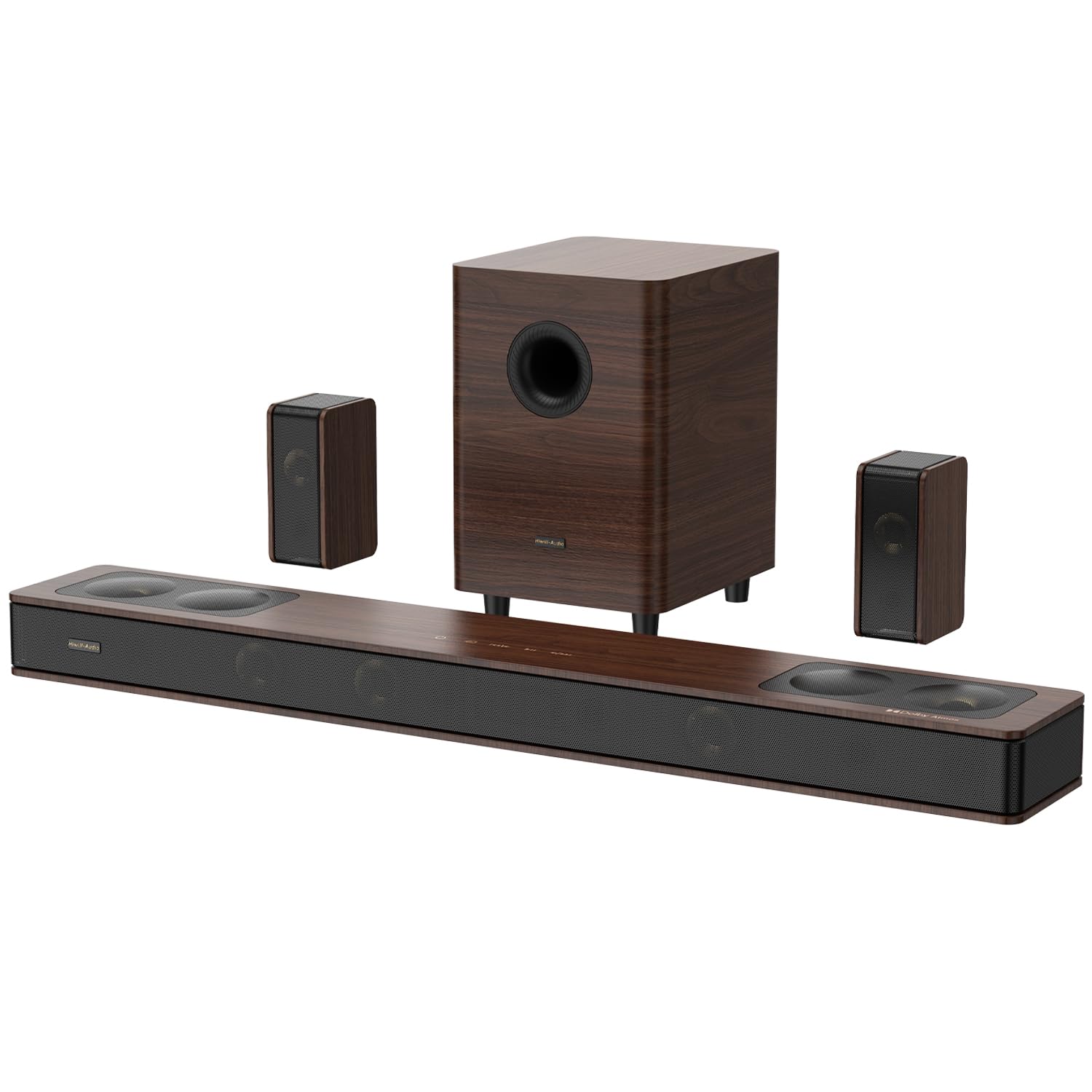
| Hiwill-Audio A534Most Versatile | Full 5.3.4 soundbar | Soundbar System | — | — | Amazon |
| ELAC Debut 2.0 A4.2 | Neutral music-plus-movies | Module | 4″ | 0.5″ | Amazon |
| Samsung S60D | Compact all-in-one bar | Soundbar | — | — | Amazon |
| Polk R900 | Hi-Res height modules | Module | 4″ | 1″ Ring | Amazon |
| SVS Prime Elevation | Direct-firing versatility | Module | 4.5″ | 1″ Dome | Amazon |
| Bose Smart Ultra | One-bar voice-controlled | Soundbar | — | — | Amazon |
| Focal SIB EVO | Complete 5.1.2 speaker set | Full System | 5.25″ | 1″ Silk | Amazon |
In‑Depth Reviews
1. Klipsch RP-500SA Reference Premiere
Our pick — over 4.5★ from 750+ verified ratings; the strongest balance of quality and price.
The crowd favorite that layers crisp, detailed height onto any Klipsch tower setup
This module blends into a Klipsch tower setup so you hear the movie, not the speaker. The 1″ titanium LTS vented tweeter (a lightweight dome that reproduces high frequencies) and the 5.25″ spun copper cerametallic woofer (a stiff cone that handles midrange) are voiced to match Klipsch towers like the RP-8000F, so dialogue and effects stay clear without sounding like an add-on.
You can switch the crossover (the frequency where sound splits between speakers) between Dolby Atmos and surround modes, so one pair does double duty. A keyhole mount on the back lets you hang them on the wall as elevation speakers, which helps if your ceiling is too high or textured for bouncing sound. The scratch-resistant finish keeps them looking clean on top of towers or mounted high, and the 75-watt output rating gives enough power for a lively home theater.
The honest caveat is that up-firing performance depends heavily on your ceiling. On an 8-foot ceiling the effect reads as subtle, and on taller ceilings it is largely lost — buyers report that wall-mounting noticeably improves separation, at the cost of running wires up the wall. The crossover sits at 100 Hz, so these handle only the height frequencies and lean on your mains and sub for everything below.
What wins people over
- Sound quality is the dominant praise — over a hundred owners call it out specifically
- Switchable crossover handles both Atmos and surround roles
- Keyhole mount allows on-wall elevation placement
The trade-offs to know
- Up-firing effect is subtle on tall or vaulted ceilings
- Sealed design limits bass output
- Running wires for wall mounting is a hassle
Reach for these if: you own Klipsch towers and want a matching height layer without replacing your mains.
Think twice if: your ceilings run taller than 8 feet, where the bounce effect fades and wall-mounting becomes mandatory.
2. Klipsch RP-140SA
The budget-friendly module that shines brightest when you mount it high
This is the more affordable Klipsch path into Atmos, and the review consensus is clear: wall-mounting these near the ceiling pointing down beats bouncing sound off the ceiling every time. The simple keyhole mount on the rear means you need no extra accessories — just a screw in the wall and you are set.
Buyers running two pairs — one front, one rear — report the helicopter scene in Mission: Impossible – Fallout feels genuinely rich, and the speakers stay put on top of towers without sliding. The crossover sits at 100 Hz (the point where bass hands off to the subwoofer), with 80 Hz THX possible if your receiver supports it. They work as height or Atmos speakers depending on how you set up your AVR (audio/video receiver).
The catch is that these are purpose-built for height duty only — they are not designed to pull double duty as surround speakers. And while the sound is praised for creating a spherical field, the Atmos effect can feel subtle depending on your room layout; a vaulted ceiling is a genuine problem, in which case wall-mount height mode is the fix.
The smart buy: For the price, this delivers a real height layer if you are willing to mount it on the wall rather than relying on ceiling bounce.
Who should pass: If you want one speaker that does both surround and height, this is not that speaker.
3. Hiwill-Audio Flagship 5.3.4 Soundbar
A whole 5.3.4 theater in a box with four up-firing drivers and wireless rears
This is the one-stop option for anyone who does not already own an AV receiver and separate speakers. The HiCore A534 packs 15 Hi-Fi aluminum-magnesium drivers across the soundbar, subwoofer, and two wireless rear speakers, with up to 800W peak output. Each side of the bar has its own woofer, midrange, tweeter, and up-firing driver, so every frequency gets its own dedicated driver rather than sharing one full-range cone.
The BassCoupling Technology splits duties: two built-in bass drivers inside the bar handle upper bass while the external 6.5″ wired subwoofer focuses on deep sub-bass, reaching down to a 28 Hz extension. HDMI eARC supports up to 37 Mbps bandwidth for full-resolution Dolby Atmos, and you also get Optical, AUX, and BT 5.4 connectivity plus adjustable EQ. True wooden cabinets give it a furniture-grade look.
The trade-off is that the entire system is not truly wireless. The two rear speakers must be plugged into power and attached to each other by a 20-foot cable, which limits where you can place them. The rear channels also run quiet, and the system does not decode DTS — so your Blu-rays with DTS soundtracks will not get the object-based treatment.
The big wins
- Complete Atmos system with four up-firing drivers
- Bass reaches down to 28 Hz for real low-end impact
- eARC delivers full-resolution Dolby Atmos
Know before you buy
- Rear speakers are wired together with a 20 ft cable
- No DTS decoding
- An occasional unit arrives with a buzzing rear speaker
Best suited to: someone building a first Atmos system who wants everything in one box without a receiver.
Look elsewhere if: you need flexible rear placement or you own a DTS-heavy disc collection.
4. ELAC Debut 2.0 A4.2

The neutral-voiced module that blends into the soundscape without calling attention to itself
ELAC’s approach here is different from the horn-loaded Klipsch sound. The custom concentric driver — a 0.5″ polymer tweeter sitting inside a 4″ woven aramid-fiber woofer — delivers a smoother, more extended response with better directivity control. Owners describe the sound as balanced and natural, with no harshness, which makes these a strong match for music listening as much as movies.
These compact modules sit on top of bookshelf or floorstanding speakers, and one owner calls them “small but mighty,” noting they are an easy way to get a 5.1.2 setup (five ear-level channels, one subwoofer, two height channels). Reviewers with ELAC towers report the modules match the same voicing smoothly. On a Denon X3600H with Audyssey calibration (an automatic room-correction system), the height sounds clear from above with an rich bubble in a small room.
The honest limitation is that a single front pair feels incomplete — owners recommend two front plus two back for a true 7.2.4 experience. And like all up-firing designs, a cathedral ceiling is not optimal; one owner with a non-flat ceiling still found them worth buying, just less effective than a flat ceiling would allow.
The neutral choice: If you want Atmos height that does not color the music you love, this balanced voicing is the reason to pick ELAC over the livelier Klipsch sound.
The commitment: To feel complete, budget for four modules, not two.
5. Samsung S60D Soundbar

The single-bar answer for small rooms where you want Atmos without the speaker clutter
This is a 5.0-channel soundbar in an all-in-one design, meaning there is no separate subwoofer box to hide. Built-in subwoofers deliver the bass, and the compact footprint fits easily in a bedroom, study, or small living room. It supports Wireless Dolby Atmos, so you can skip HDMI cables entirely if your TV pairs with it wirelessly.
The big selling point for Samsung TV owners is Q-Symphony, which makes your TV’s speakers and the soundbar work together as one system. Adaptive Sound analyzes each scene in real time to pull out dialogue, and owners confirm voices stay audible even at low volume — a recurring theme across reviews. Game Mode Pro automatically activates with your TV and uses the up-firing drivers and acoustic beam for 3D-tune gaming sound.
The trade-off is physics: a single bar this size cannot produce the same soundstage separation as a full system with separate rears. Owners call it great for a small room where volume and bass are not the priority, and note the bass and separation are minimal by design. Connectivity gets mixed feedback — some owners mention the wireless connection can be finicky, and there is no 3.5mm aux input for older streamers.
Why it works
- Truly all-in-one with built-in subwoofers, no extra box
- Q-Symphony pairs beautifully with Samsung TVs
- Adaptive Sound keeps dialogue clear at low volume
Where it falls short
- Minimal bass and separation due to compact size
- No 3.5mm aux input
- Wireless connection can be finicky at times
Grab this if: you want a tidy single-bar Atmos upgrade for a bedroom or small living room with a Samsung TV.
skip it if: you want thunderous movie bass or a wide surround stage in a large open room.
6. Polk Audio Reserve R900

The certified height module that handles Dolby Atmos, DTS:X, and IMAX Enhanced
Polk’s R900 is a height module with serious certification credentials: Hi-Res Audio, Dolby Atmos Height Virtualization, DTS, DTS:X, DTS Virtual:X, and IMAX Enhanced. That means it is not just an Atmos speaker — it is equipped to handle every major object-based audio format your receiver might throw at it. A 1″ Pinnacle Ring Radiator tweeter and a 4″ Turbine Cone woofer deliver clear highs and rich bass.
What surprises owners is the low end: this height speaker reaches down to 40 Hz, which is unusual for the category, and the AVR sets its crossover at 40 Hz accordingly. It adds real height and dimensionality to a 5.1.2 setup, with owners describing significantly improved sound once placed and configured. The flip switch on the back lets you choose between “topper” placement on top of speakers or “on-wall” mounting, and it adapts automatically.
The aesthetic catch is that the walnut finish may not perfectly match your existing speakers — one owner noted it was not a close enough match to their rti8 fronts. The R900 is designed to complement the Reserve line specifically, so if you are mixing brands, check the finish in person first.
The format-flexible pick: If you watch a mix of Atmos, DTS:X, and IMAX Enhanced content, this is the module that covers every base.
The matching caveat: The walnut finish is tuned for the Reserve line, so it may clash with other brands.
7. SVS Prime Elevation

The do-it-all height speaker that points any direction your room demands
SVS takes a fundamentally different approach than the ceiling-bounce crowd. The Prime Elevation directly radiates full-range sound to the listener, so it does not depend on perfect ceiling conditions to work. That makes it ideal for rooms where reflective “ceiling bounce” designs fall flat — and it can be mounted up or down-firing, side or rear-firing, or directly overhead on the ceiling thanks to the included multi-angle wall bracket.
Inside the acoustically inert cabinet sits a precision-tuned SoundMatch crossover, a 1″ aluminum dome tweeter, and a 4.5″ mid-woofer. Owners call it spectacular with Apple Spatial Audio and note it integrates cleanly with Dirac Live room correction. The frequency response runs down to 50-60 Hz, and the 20° angled baffle makes wall mounting straightforward with standard drywall anchors.
The trade-offs are practical: there are no banana plugs, so you will connect bare wire in the 10-12 gauge range, and the pin connectors take a little practice to align. One owner noted Atmos disables when wireless speakers are connected to the same system, so check your receiver’s configuration.
The standout strengths
- Direct-firing design works without perfect ceiling conditions
- Multi-angle bracket mounts in virtually any direction
- Full-range sound, not just height effects
What to watch
- No banana plugs — bare wire only
- Premium price over basic up-firing modules
- Pin alignment on the bracket takes practice
Choose this for: rooms with tricky ceilings where bounce speakers cannot work, and owners who want one speaker that can be a height, side, or rear surround.
Pass if: you have a flat 8-foot ceiling and want the simplest, cheapest way to add height.
8. Bose Smart Ultra Soundbar

The single bar wrapped in voice control that fills a room with spatial audio
Bose uses six transducers, including two custom-engineered upward-firing dipole speakers, to create the sense of sound coming from every direction — even overhead — all from one compact bar. The Bose TrueSpace technology separates sounds and places them in different parts of the room, and owners consistently describe the result as crisp with impressive spatial effects.
Setup is genuinely plug-and-play: connect via the included HDMI eARC cable or optical cable, and you are running. The A.I. Dialogue Mode balances voice against surround sound so you never miss what characters say, and the ADAPTiQ headset walks you through room calibration in the app. Built-in Amazon Alexa plus Bose Voice4Video lets you control your TV and cable box by voice alone.
The honest catch is that the app-based setup can be frustrating — it requires a phone, a Bose account, and an internet connection, and the ARC auto-on feature needs a setting changed in the app. One owner found the remote nearly useless and the connection unreliable enough to sell the unit. Also, for a bar this size, some owners note it would benefit from a subwoofer for fuller bass.
What impresses
- Six transducers create convincing overhead sound from one bar
- A.I. Dialogue Mode keeps voices ultra-crisp
- Voice control via Alexa and Voice4Video
The frustrations
- Setup requires phone app, Bose account, and internet
- ARC auto-on needs manual app setting
- Bass is light — a subwoofer helps
Ideal for: a minimalist who wants one elegant bar with voice control and solid Atmos effects in a medium room.
Not for: anyone who hates app-dependent setup or wants room-shaking bass right from the start.
9. Focal SIB EVO 5.1.2

The complete Focal 5.1.2 cinema system where the Atmos driver is built right in
This is the full home-cinema package from Focal: a 5.1.2-channel system where the “height” speakers are not add-on modules but complete Sib Evo satellites with a dedicated Atmos driver. Each satellite pairs a 5″ Polyflex woofer with a 1″ silk dome tweeter, and the Atmos-equipped versions add a 3″ full-range Polyflex driver on top aimed at the ceiling. The Cub Evo subwoofer rounds out the low end.
Owners are astonished at what the compact satellites deliver in a large room, calling the sound theater-like with a Yamaha AV receiver. The clamping wire terminals make hookup easy, and the system pairs cleanly with a receiver like the Cinema 70S. One owner expanded to 7.1.2 and still highly recommends the set. The coaxial input and RCA connection keep things simple.
The practical downsides are real. The kit includes only two wall mounts, so a center-channel satellite needs a third mount or a shelf, and the mounts only angle vertically. The Atmos effect is described as weak in a large open space, where it needs higher volume to register. And the design is divisive — even a self-described Focal fanboy calls them “hideous,” so check the aesthetic before committing.
The complete-ecosystem pick: If you want Focal sound throughout, not just in the height channels, this coherent 5.1.2 system delivers it in one box.
The genuine caveats: Only two wall mounts included, and the styling is not for everyone.
Understanding the Specs
Up-Firing vs Direct-Firing
Up-firing modules point drivers at the ceiling and rely on the bounce to create height. This works only with a flat, reflective ceiling around 8 feet tall. Direct-firing speakers like the SVS Prime Elevation aim straight at you and work in any room, but they require wall or ceiling mounting to be placed high.
Crossover and Frequency Response
The crossover determines which frequencies the height speaker handles. Many modules run at 100 Hz, meaning the subwoofer and your mains cover everything below that. Check the frequency response — the Polk R900 reaches down to 40 Hz, while most up-firing modules roll off much higher.
FAQ
Do Atmos enabled speakers work on any ceiling height?
Can I add Atmos modules to any speaker brand?
What is the difference between up-firing and direct-firing Atmos speakers?
How many Atmos speakers do I need?
Will these speakers work with my existing AV receiver?
Do Atmos enabled soundbars need a separate subwoofer?
Is wall-mounting better than placing on top of speakers?
Can I use Atmos speakers for regular surround sound too?
Final Thoughts: The Verdict
Across the board, the winner is the Klipsch RP-500SA because it blends into a Klipsch tower setup while delivering crisp, detailed height effects. If you want a complete all-in-one theater without a receiver, grab the Hiwill 5.3.4 system. And for tricky ceilings where bounce designs fail, the SVS Prime Elevation is the one to reach for.
How We Picked
We do not accept paid placement. Every pick is matched to a real buyer and a real use-case; we do not hands-on test units.
Sources & Methodology
Specifications: manufacturer listings and product documentation. Review insights: verified customer reviews, as of August 2026. Pricing: not shown on this page (it changes often); check the current price via the retailer link.
As an Amazon Associate, Gadgets Feed earns from qualifying purchases. This does not affect which products we feature.