
Few household items are as quietly frustrating as a wall clock that drifts five minutes fast by the end of the month. Atomic wall clocks eliminate that anxiety entirely by syncing to the NIST radio broadcast, staying accurate to within a second for years with zero manual intervention. Whether you need a massive digital display for a workshop or an elegant analog piece for the living room, the core trade-off is always between readability and design language.
I’m Min — the co-founder and writer behind Gadgets Feed. My research process for this guide involved comparing the atomic signal reception stability, LCD contrast ratios, battery life expectations, and feature sets of dozens of models to isolate the seven that actually deliver on their promises.
After hours of spec analysis and cross-referencing real usage reports, the best atomic wall clock choices below represent the strongest performers across display size, feature depth, and build quality for the price.
How To Choose The Best Atomic Wall Clock
Atomic wall clocks simplify life by locking to the national time standard, but the differences in display type, sensor support, and setup complexity can trip up buyers who don’t know what to prioritize. Focus on three factors: how you will read it, where you will place it, and which secondary features you actually need.
Display Readability: Digital vs. Analog
Digital atomic clocks win on raw information density — they can show the time, date, day of the week, indoor temperature, and outdoor temperature simultaneously on a single LCD panel. The critical spec here is digit height: a display with 1.2-inch digits is comfortable across a small bedroom, but you need digits of at least 2 inches for a living room or office. Analog atomic clocks trade that information density for timeless aesthetics, but verify that the hands and numerals offer strong contrast against the dial. Matching the display type to your primary reading distance is the single most important decision.
Atomic Signal Reception and Placement
The WWVB signal from Fort Collins, Colorado is relatively weak, and your clock’s ability to sync nightly depends on antenna placement. Units with a horizontal internal antenna tend to sync faster when placed on a wall facing Colorado. Avoid positioning the clock near large metal surfaces, concrete walls with rebar, or within a few feet of televisions and computer monitors, as these create interference. Budget models may take 24 to 48 hours for initial sync, while premium units often lock within minutes. If you live on the West Coast or in a signal-shadowed basement, look for a model with a manual time-set fallback.
Indoor-Outdoor Temperature Sensors
Many digital atomic clocks include a wireless outdoor sensor that transmits temperature data over 330 feet (100 meters). The practical limitation is that walls and metal siding reduce that range significantly. Sensors use either 433 MHz or 915 MHz frequencies in North America; 915 MHz offers better penetration through walls. If you plan to mount the sensor inside a detached garage or a garden shed, check that the unit supports at least two sensors so you can monitor multiple zones. The temperature update frequency (typically 30 to 60 seconds) determines how quickly you see changes when the sensor is in direct sunlight or shade.
Battery Life and Power Options
Most digital atomic clocks run on 2 to 4 AA batteries and last between 6 and 18 months depending on backlight usage and LCD panel type. Analog atomic clocks with quartz movements often exceed 2 years on a single AA battery. Some premium digital models offer an AC adapter for a constant backlight, which dramatically improves nighttime readability but tethers the clock to an outlet. A low-battery indicator on the display is a worthwhile convenience that prevents the clock from stopping unnoticed.
Quick Comparison
On smaller screens, swipe sideways to see the full table.
| Model | Category | Best For | Key Spec | Amazon |
|---|---|---|---|---|
| La Crosse Technology 512-85937-INT | Premium Digital | Full weather display | 12-hour forecast plus trend arrows | Amazon |
| WallarGe Large Display (B0D9BNSQCS) | Value Digital | Massive readability | 12.8 x 4.9 inch LCD with 8.4 x 3.1 inch digits | Amazon |
| La Crosse Technology 513-1419BL-WA-INT | Mid-Range Digital | Adjustable backlight clarity | Hi/Lo/Off backlight with AC adapter | Amazon |
| Bulova C5004 Atomic Time 2 | Premium Analog | Classic decor integration | 12.4-inch wood frame with quartz sweep movement | Amazon |
| LFF Atomic Clock Large Display (B0BKPXCK7P) | Budget Digital | Simple bedside or office use | 7.48 x 8.66 inch display with 330 ft sensor range | Amazon |
| HODIK Wall Clock (B0FCFKBQJX) | Value Digital | Multi-sensor expandability | Supports up to 3 external sensors | Amazon |
| TIMESS Hybrid (B0CQ1YZ5DT) | Budget Hybrid | Analog face with digital extras | 12-inch analog dial plus LCD calendar and temperature | Amazon |
In‑Depth Reviews
1. La Crosse Technology 512-85937-INT

The La Crosse 512-85937-INT is the most feature-dense atomic wall clock in this lineup, packing a future 12-hour weather forecast, indoor and outdoor temperature with trend arrows, and a full calendar into a clean gray/silver chassis. The 11-inch-wide LCD uses 2-inch-high time digits that are legible well past 25 feet, and the crescendo alarm with a 10-minute snooze function makes it practical for bedside use as well. The atomic sync locks within minutes of inserting the 2 AA alkaline batteries, and the seven USA time zone options (Atlantic to Hawaii) cover the entire contiguous signal range.
The included TX141v3 wireless sensor transmits outdoor temperature data over a 330-foot range with a -40°F to 140°F tolerance, though placement in direct sunlight skews readings — a shaded eastern or northern exposure under an eave delivers the most consistent data. The forecast icon is small enough that you will need to be within 10 feet to read it accurately, but the temperature trend arrows (rising, steady, falling) are visible at a glance across the room. The metal frame gives it a retro-industrial aesthetic that blends into kitchens, home offices, and workshops equally well.
You can also disable Daylight Saving Time adjustment for states like Arizona and Hawaii, and the 12/24 hour format toggle accommodates personal preference. The viewing cone is roughly 30 degrees off-center, so mount it at eye level for best contrast. For buyers who want a single wall clock that covers atomic precision, multi-zone temperatures, and a weather forecast without needing a smartphone app, this is the unit to beat.
Why it’s great
- True 12-hour weather forecast reduces dependency on phone checks
- Sensor pairing is instantaneous and the 330-foot range covers most property layouts
Good to know
- Forecast icon is small and hard to read beyond 10 feet
- Viewing angle is narrower than competing LCD models
2. WallarGe Atomic Clock Large Display (B0D9BNSQCS)
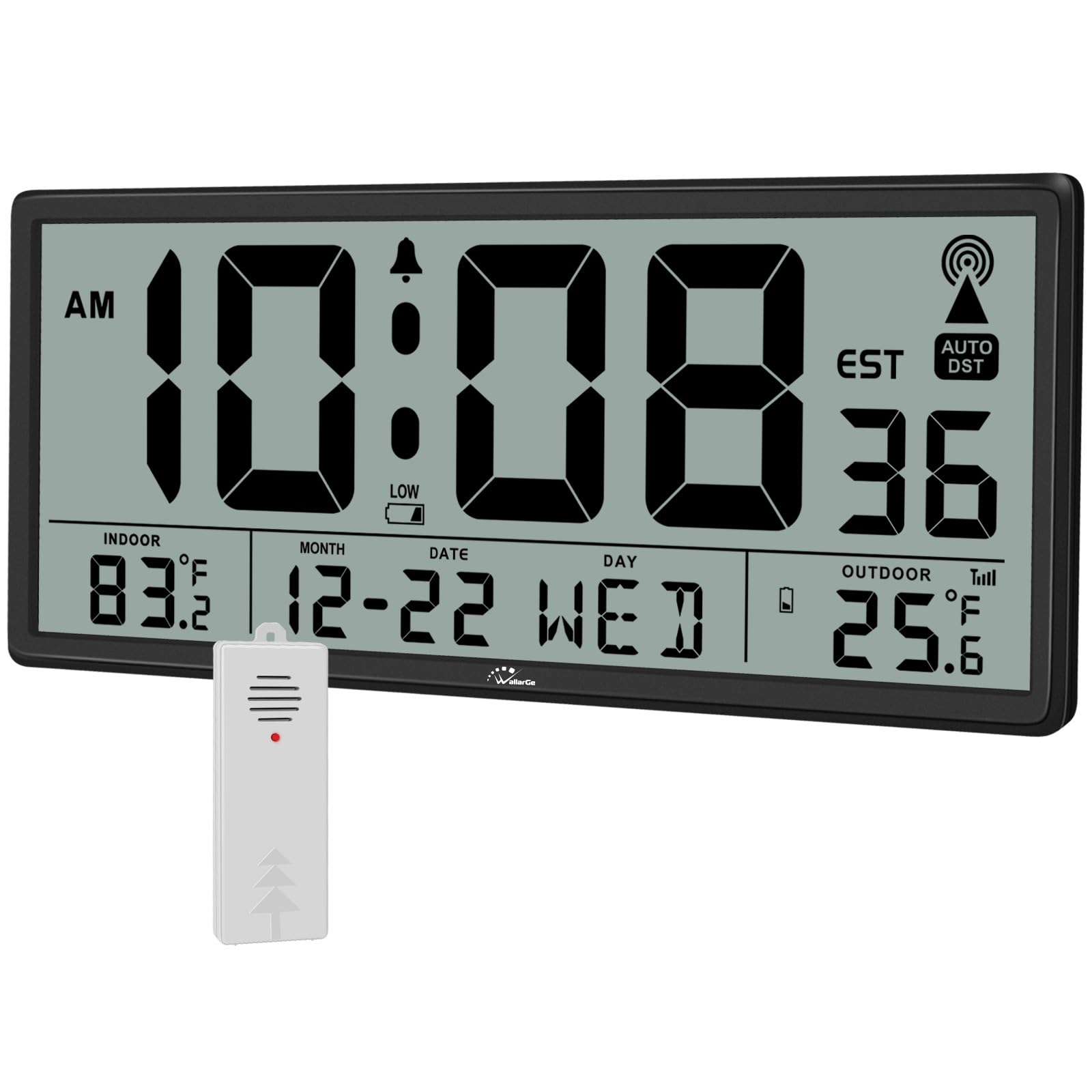
The WallarGe Large Display clock is built around one overriding priority: maximum readability. Its LCD screen measures 12.8 inches wide by 4.9 inches tall, with time digits that are a staggering 8.4 inches wide by 3.1 inches tall — easily the largest in this comparison. The carbon-colored bezel and black dial keep visual distractions minimal, and the display shows the time, date, day of the week, indoor temperature, and outdoor temperature in a single fixed layout. A fold-out stand at the back lets you repurpose it as a desk clock, and the included mounting ruler eliminates measuring guesswork for wall installation.
The atomic signal acquisition is typical for this price tier — the clock searches automatically upon battery insertion and generally syncs within 6 to 12 hours overnight if placed on a wall oriented toward Colorado. The unit consumes 4 AA batteries (not included) and the outdoor sensor uses 2 more, but the battery drain is moderate with the LCD remaining unlit at all times. A low-battery indicator appears on-screen when replacement is due. Both the Celsius/Fahrenheit toggle and the time zone selection are straightforward push-button operations on the back panel.
One downside: there is no backlight, so the display is completely invisible in a dark room. This is a daytime-first clock, best suited for living rooms, home gyms, classrooms, and office spaces where ambient light is present during waking hours. The seconds display runs continuously and provides satisfying real-time precision. If sheer size and boldness of the digits are your primary requirements, the WallarGe delivers more visual weight per dollar than any other entry here.
Why it’s great
- Largest time digits in the guide at nearly 8.5 inches wide
- Mounting template makes wall installation foolproof
Good to know
- No backlight means the display is unreadable in total darkness
- Initial atomic sync can take 12-24 hours depending on location
3. La Crosse Technology 513-1419BL-WA-INT
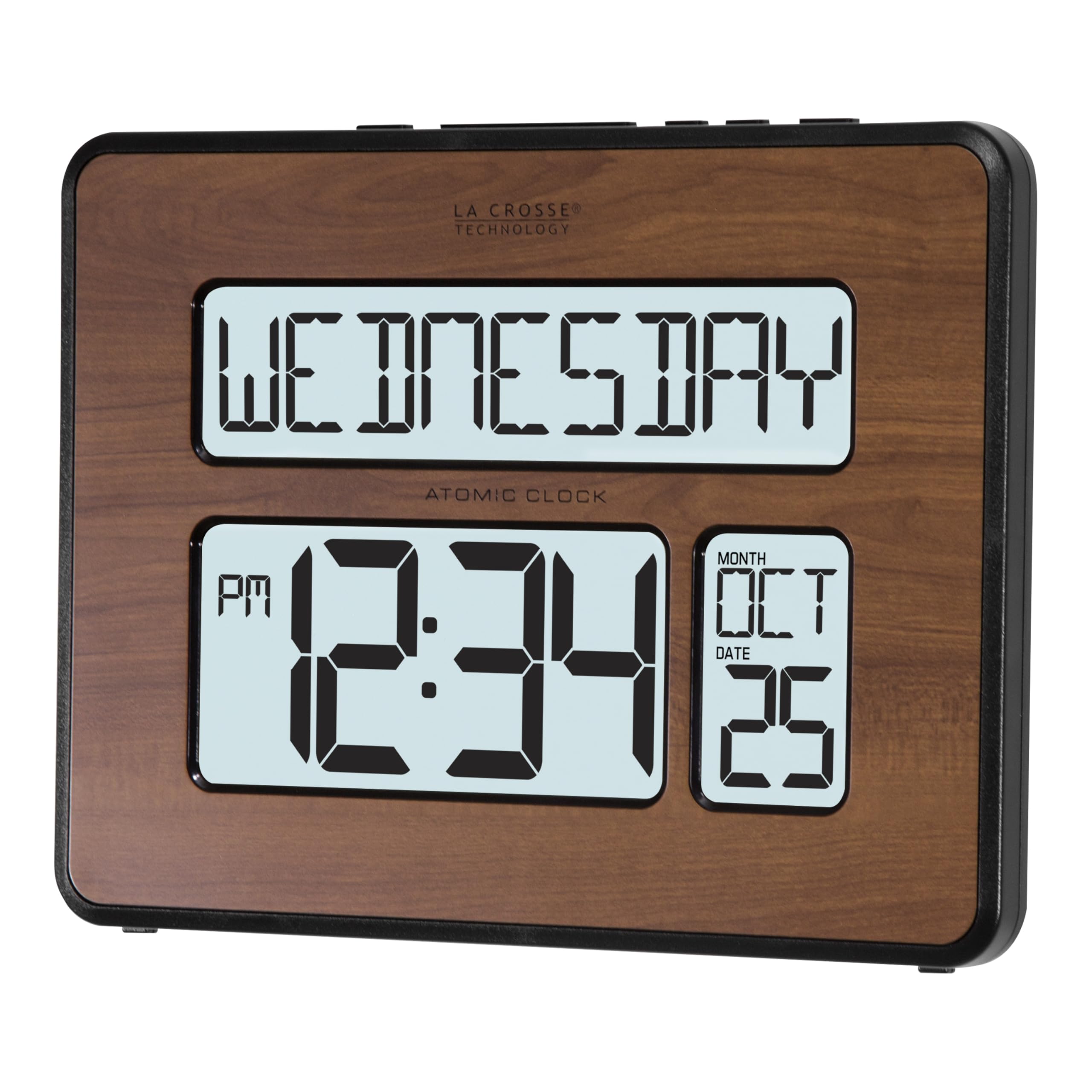
The La Crosse 513-1419BL-WA-INT solves the backlight problem that plagues most LCD atomic clocks by including both an AC adapter for constant illumination and a battery backup for on-demand use. The backlight has three brightness levels (High, Low, Off), and in battery-only mode the light activates momentary when you press the snooze button — a thoughtful compromise for bedroom users who want to check the time at night without a permanent glow. The extra-large digits display the time, full weekday name, date, and indoor temperature in Fahrenheit or Celsius.
The atomic sync is handled by La Crosse’s second-generation receiver, which typically acquires the WWVB signal within 3 to 5 minutes during the initial setup. The wood-grain brown plastic frame has a matte finish that resists fingerprints and blends into traditional decor far better than bare ABS. The 9.84-inch width and 7.48-inch height keep the footprint compact enough for a nightstand or desk, and the integrated alarm clock with crescendo volume works well for moderate sleepers. The single AC adapter cord is roughly 6 feet long, which may require access to a nearby outlet.
Two AA batteries (not included) serve as the backup power source, and the clock retains its time and alarm settings during a power outage. The full 7-day calendar display spells out the day rather than abbreviating it, a detail appreciated by those with vision concerns. The only real compromise is that the backlight in Lo mode can appear dim in bright sunlight, and the viewing angle is somewhat narrow — you need to be roughly centered in front of the display for the best contrast. For bedrooms and living rooms where nighttime readability matters, this La Crosse model is the most practical choice.
Why it’s great
- Three-level backlight with AC adapter eliminates dark-room blindness
- Full weekday spelling instead of abbreviations improves readability
Good to know
- Backlight in Lo setting appears washed out in direct sun
- Viewing angle narrows contrast significantly off-center
4. Bulova C5004 Atomic Time 2

The Bulova C5004 is the only analog atomic clock in this selection, and it serves as a counterpoint to the digital-heavy market. Its 12.4-inch warm brown cherry wood frame and gold-plated bezel create a traditional aesthetic that suits dining rooms, studies, and entryways where an LCD panel would look out of place. The cream dial features bold Arabic numerals and black hands with a continuous sweep quartz movement — no ticking sound, just a smooth glide. The atomic receiver syncs to the NIST signal and automatically adjusts for Daylight Saving Time, and the mechanism runs on a single AA battery that lasts over a year.
Initial sync can be finicky: the instruction manual recommends placing the clock on a wall that faces Colorado, ideally in a high location free of metal obstructions. Some owners report the clock requiring a full overnight period to lock onto the signal the first time. Once synced, however, it stays accurate to within a second indefinitely. The glass face is slightly reflective, so direct afternoon light from a window can create glare that obscures the hands from certain angles. The sound of the sweep second hand is virtually silent — no click or hum even in a quiet room.
The wood frame is actual wood, not painted MDF, and the finish is applied consistently with no visible drips or grain mismatch. At nearly 2 pounds, it feels substantial when hung. The clock ships without a battery, and the time zone and DST settings are configured via a small switch behind the movement. For buyers who want atomic accuracy without a digital aesthetic, the Bulova C5004 is the strongest blend of craftsmanship and precision available in this category.
Why it’s great
- Real wood frame with gold details elevates decor beyond standard plastic
- Sweep second hand is completely silent
Good to know
- Initial signal lock may require overnight patience and optimal placement
- Glass face produces glare in bright indirect light
5. LFF Atomic Clock Large Display (B0BKPXCK7P)

The LFF Atomic Large Display is the entry-level digital option that still manages to deliver a wireless outdoor sensor, a 12/24 hour format, and an alarm with snooze in a single package. The LCD panel measures 7.48 inches wide by 8.66 inches tall, and while the digits are not as massive as the WallarGe, they are still legible from about 20 feet in a normally lit room. The black bezel and simple design keep it visually unobtrusive, and the fold-out kickstand allows tabletop use as an alarm clock. The clock runs on 3 AA batteries and the outdoor sensor on 2 AAA batteries.
The wireless sensor transmits over a 330-foot open-air range, but in practice, passing through two standard interior walls cuts that to roughly 80 feet. The temperature accuracy is rated at ±0.5°F, and the update frequency of 30 seconds means you see temperature changes quickly. A low-battery indicator on the clock screen alerts you before the sensor or clock battery dies. The atomic sync behavior is typical for the budget tier: it searches for the WWVB signal automatically and generally syncs within a few hours on the first night.
The most notable omission is the lack of any backlight — the LFF display relies entirely on ambient light for readability. This limits its usefulness to spaces that have at least some light during the evening. The alarm crescendo feature is moderately loud, adequate for light sleepers but possibly insufficient for heavy ones. If you need an atomic clock with outdoor temperature monitoring on a tight budget and you can accept the no-backlight limitation, the LFF delivers core functionality at a lower entry cost than any other model in this guide.
Why it’s great
- Includes outdoor sensor at a budget price point
- Temperature update every 30 seconds is responsive
Good to know
- No backlight makes it useless in total darkness
- Outdoor sensor range drops significantly through multiple walls
6. HODIK Wall Clock (B0FCFKBQJX)
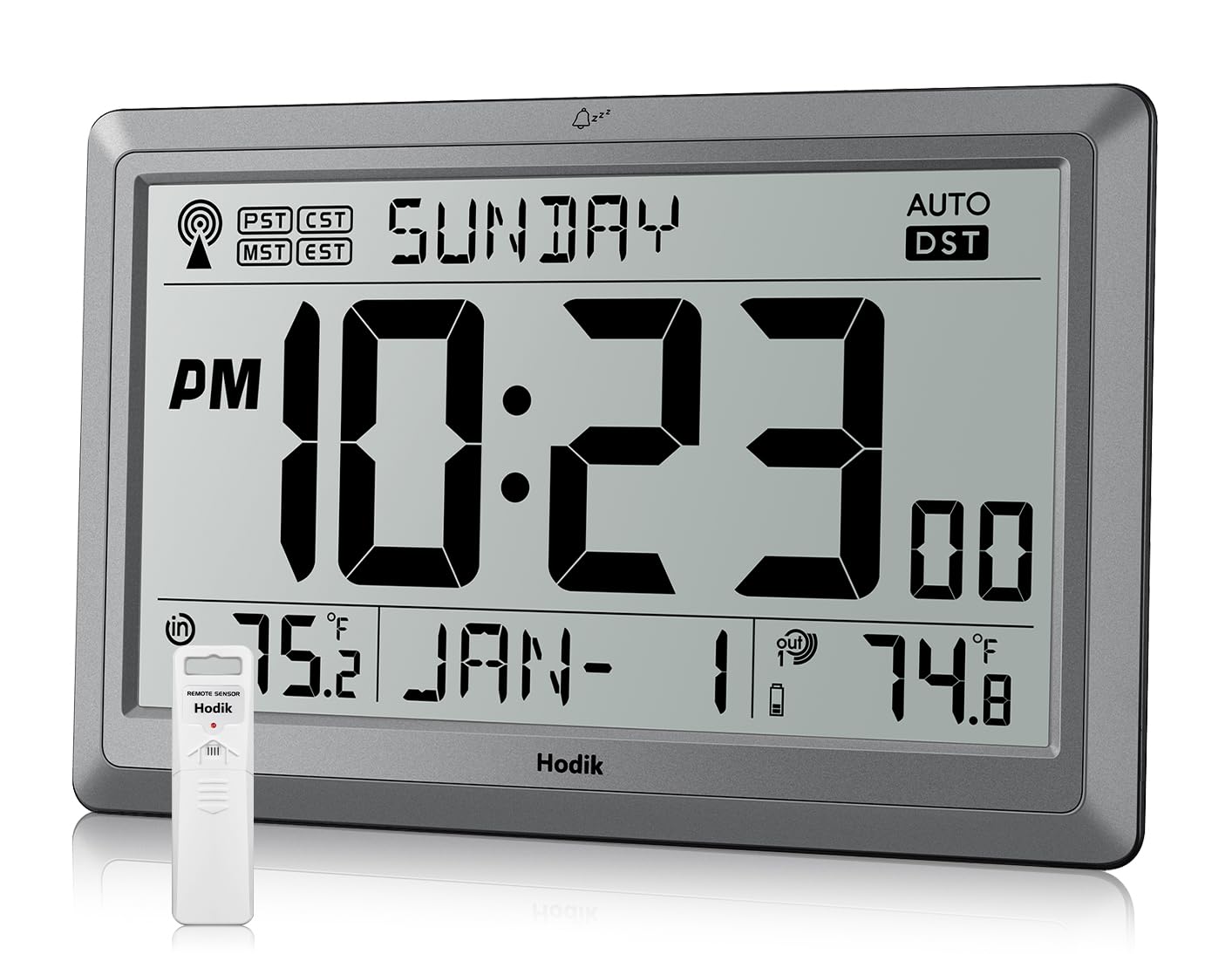
The HODIK Wall Clock differentiates itself by supporting up to three wireless outdoor sensors, making it the most expandable option for monitoring multiple locations — the garage, the backyard, and a detached workshop, for instance. The 10.5-inch LCD panel (9 inches wide by 5.9 inches tall) uses 2.4-inch-tall time digits with 1.2-inch width, which is adequate for rooms up to 25 feet. The silver metal frame gives it a more substantial feel than the all-plastic budget competition, and the two kickstands on the back allow stable tabletop placement.
The atomic sync is notably fast for this price bracket, with the unit locking onto the WWVB signal within one second under favorable conditions. The clock supports four US time zones (PST, MST, CST, EST), auto-DST, and a 12/24 hour format. The indoor temperature sensor has a range of 14.2°F to 122°F, while the outdoor sensor covers -40°F to 158°F with ±0.5°F accuracy. Each additional sensor (sold separately under the UNNI brand) pairs automatically. The display also includes an alarm with snooze and a low-battery indicator.
The main trade-off is the LCD contrast, which is decent but not class-leading — the digits appear slightly gray rather than deep black, and the viewing angle is best dead center. The reflective LCD panel also catches overhead light, which can wash out the display in bright kitchens or sunlit rooms. If multi-zone temperature monitoring is your primary use case and you need a central hub that can aggregate data from three locations, the HODIK offers the most expansion flexibility in this price range.
Why it’s great
- Supports up to 3 wireless sensors for multi-zone monitoring
- Metal frame feels more durable than typical ABS plastic
Good to know
- LCD contrast is average and washes out in bright overhead light
- Viewing angle narrows significantly off-center
7. TIMESS Wall Clock (B0CQ1YZ5DT)

The TIMESS Wall Clock is a hybrid that combines a traditional 12-inch analog face with a small LCD panel that displays the month, date, day, and indoor Fahrenheit temperature. This arrangement satisfies those who want the aesthetic of an analog clock with the convenience of a calendar readout, all within a single package. The blue dial features bold white numerals and clear 15-minute marks, and the piano lacquer frame with an HD glass panel gives it a reflective, furniture-like finish that stands out in kitchens and living rooms.
The analog movement uses a high-quality quartz sweep mechanism — completely silent, no tick noise at all. The LCD panel runs on a separate independent power pathway (the clock uses 2 AA batteries, and the LCD section uses its own set), which ensures the digital display lasts as long as the analog movement without cross-drain. The perpetual calendar automatically corrects for month lengths, so you never need to adjust the date display manually. The temperature can be toggled between Celsius and Fahrenheit by double-pressing the UP button.
The LCD panel itself is relatively small and sits at the bottom of the dial, which some users find hard to read from a distance — the analog time is legible at 20 feet, but the digital date and temperature become difficult to decipher past about 12 feet. The blue color is more vibrant in person than in product photos, which pairs well with neutral wall colors. If you prefer the look of an analog clock but refuse to live without a visible date and room temperature, the TIMESS hybrid is the most tasteful compromise available at this price tier.
Why it’s great
- Analog face with hidden digital LCD avoids the plastic-clinic look
- Quartz sweep movement is genuinely silent
Good to know
- LCD date and temperature are hard to read beyond 12 feet
- Blue color is more vibrant than shown, may not match all decor
FAQ
Why does my atomic wall clock need an overnight period to sync for the first time?
Can I use an atomic wall clock in Hawaii or Alaska?
Does the outdoor sensor need to be in direct line of sight to the clock?
What is the difference between a sweep movement and a tick movement in analog atomic clocks?
Will the atomic clock automatically adjust for Daylight Saving Time if I live in Arizona or Indiana?
Final Thoughts: The Verdict
For most users, the best atomic wall clock winner is the La Crosse Technology 512-85937-INT because it delivers atomic precision, a 12-hour weather forecast, and dual indoor-outdoor temperature tracking in a design that reads clearly from across a room. If you want the largest possible digits for a workshop or gym, grab the WallarGe Large Display. And for a classic analog look with zero electronic clutter, nothing beats the Bulova C5004.