
The challenge with an attendant controlled electric wheelchair isn’t just about moving someone from point A to point B. It’s about giving the caregiver a tool that feels intuitive, reduces physical strain, and offers the same maneuverability you’d expect from a high-end mobility aid. The market is flooded with designs that prioritize the rider’s joystick experience, but the best models in this niche are engineered from the ground up to respond to your push, pulling handle, or remote command with precision and power.
I’m Min — the co-founder and writer behind Gadgets Feed. My research for this guide involved cross-referencing motor wattage, battery chemistry, turning radii, and caregiver-specific features like push-assist torque sensors and telescopic handles across dozens of models to identify the ones that genuinely lighten the load for the person doing the pushing.
After weeks of detailed spec analysis, these are the electric wheelchairs that stand out as the most reliable, powerful, and caregiver-friendly designs available today. This is the definitive guide to finding the best attendant controlled electric wheelchair for your needs.
How To Choose The Best Attendant Controlled Electric Wheelchair
Selecting the right chair for a caregiver to operate requires focusing on a specific set of features that differ from a standard user-driven power chair. You need to balance the chair’s weight, its control interface, and its raw power to ensure it handles both the rider’s comfort and the pusher’s effort.
Push-Assist vs. Remote Control vs. Handle Control
The primary interface for the caregiver defines the entire experience. Push-assist uses force sensors in the handles to detect how hard you’re pushing and adds electric motor power to make it feel almost effortless, ideal for slopes or long distances. A remote control (usually via Bluetooth or RF) allows a caregiver to drive the chair to the user from a distance, perfect for crowded spaces. Handle controls — a small joystick or control pad mounted directly on the push handle — offer a more direct, tactile driving experience for the person walking behind. Prioritize the system that best matches your daily environment and your caregiver’s comfort level with technology.
Weight, Foldability, and Frame Material
If you need to load this chair into a car trunk daily, weight is your primary enemy. Look for sub-50-pound frames made of aviation-grade aluminum or, even better, premium carbon fiber (some models dip to 28-35 lbs). A quick-fold mechanism that collapses in one or two seconds without removing tools is non-negotiable for active lifestyles. Remember that adding batteries adds a few extra pounds, so a model with slide-out side batteries is a major win — you can leave the heavy part in the car and only bring the batteries inside to charge.
Battery Range and Motor Power for the Caregiver
The battery range determines how far you can go without anxiety. A single charge should cover a full day of errands or a visit to a large theme park — typically 15 to 25 miles. Dual-battery systems offer the flexibility to swap a depleted battery on the go. For the motors, look for dual brushless units with a combined wattage of at least 250W each (500W total). This ensures the chair can climb steep ramps and handle grass or gravel without straining, which is critical because a struggling motor means the caregiver has to push harder.
Quick Comparison
On smaller screens, swipe sideways to see the full table.
| Model | Category | Best For | Key Spec | Amazon |
|---|---|---|---|---|
| FreeWink 28lbs Carbon Fiber | Premium | Ultra-light portability | 28 lbs, 28 mi range, 300 lb capacity | Amazon |
| Pride Jazzy Carbon | Premium | Brand reliability & travel | 43.6 lbs, 12 Ah battery, carbon frame | Amazon |
| ROBOOTER X40 | Premium | Auto-folding & remote app | 29.9″ turn radius, 3.7 mph, app control | Amazon |
| Sentire Med Deluxe | Premium | Heavy-duty & rugged terrain | 67 lbs, 600W peak motors, 25 mi range | Amazon |
| Pride Jazzy Ultra Light | Premium | Ultra-light carbon fiber travel | 33 lbs, 20 Ah battery, 3.69 mph | Amazon |
| Porto Ranger Discovery | Premium | High weight capacity (440 lbs) | 50 lbs, 440 lb capacity, 250W motors | Amazon |
| Porto XL Wide Seat | Premium | Wide seat & heavy-duty use | 50 lbs, 440 lb capacity, side batteries | Amazon |
| Paiseec 3-in-1 (W-E3) | Mid-Range | 3-in-1 versatility & push-assist | 49 lbs, 360W motor, 300 lb capacity | Amazon |
| Paiseec 3-in-1 (W3) | Mid-Range | Smart safety & rollator mode | 75 lbs, 265 lb capacity, magnetic encoder | Amazon |
| Aotedor 39 lbs (22 mi) | Mid-Range | Lightweight & dual battery | 39 lbs, 22 mi range, 220 lb capacity | Amazon |
| MUJOCOOKER Remote | Mid-Range | Remote control & all-terrain | 42 lbs, 25 mi range, telescopic handle | Amazon |
| Aotedor 39 lbs (30 mi) | Mid-Range | Extended range & suspension | 39 lbs, 30 mi range, spring suspension | Amazon |
| Aotedor Carbon Fiber 35 lbs | Mid-Range | Carbon fiber strength & 330 lb cap | 35 lbs, 22 mi range, 330 lb capacity | Amazon |
In‑Depth Reviews
1. Paiseec 3-in-1 Electric Wheelchair with Push-Assist (W-E3)
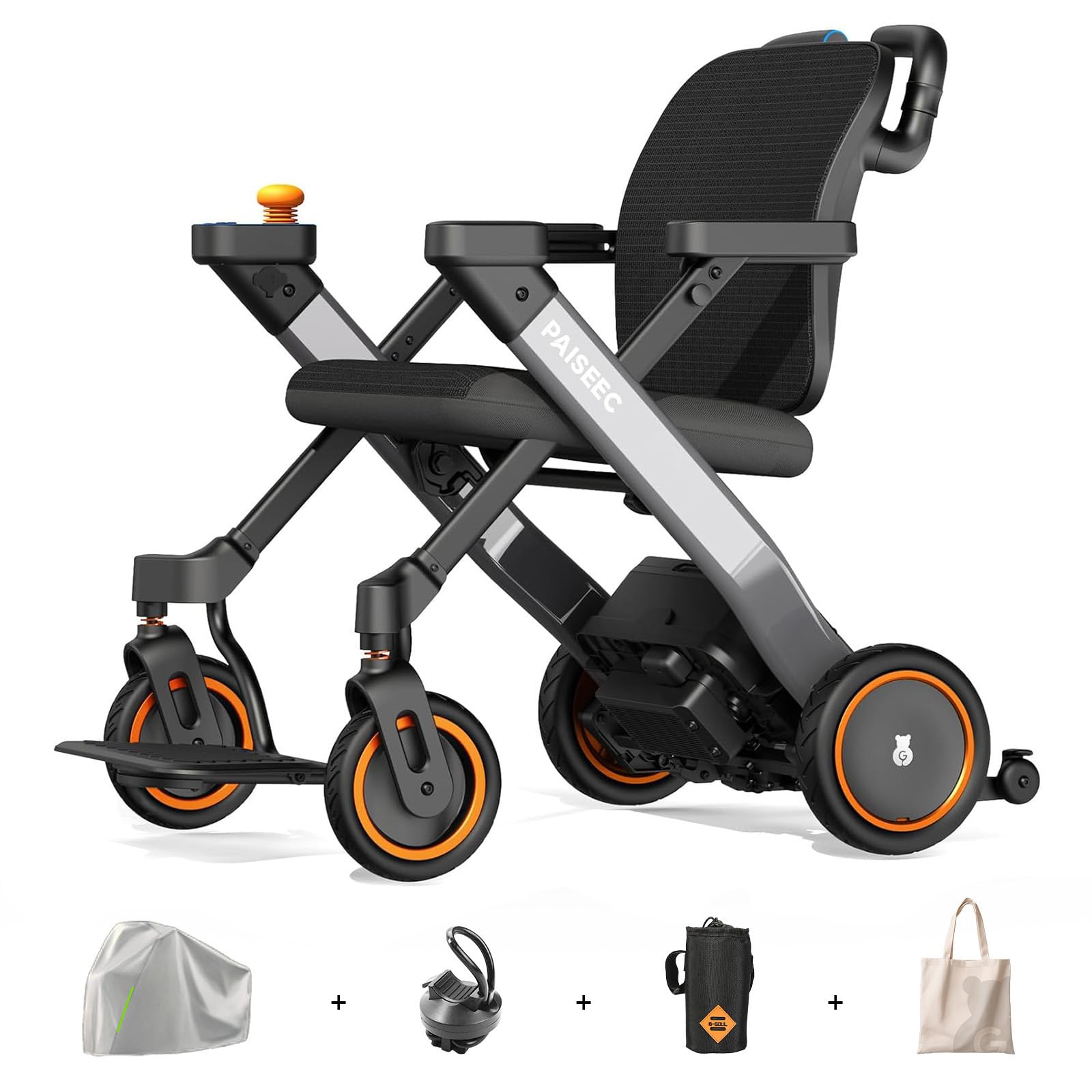
This is the single most versatile attendant-controlled chair on the market right now. The Paiseec W-E3 isn’t just a power wheelchair; it transforms into a smart walker (rollator) and an e-push assist chair. The push-assist mode is the star here — real-time force-sensing handles detect exactly how much effort the caregiver is exerting and deliver an instant electric boost via the 360W brushless motor. This makes pushing up inclines feel like pushing on flat ground. The 9-inch air-filled tires and 3.6 mph top speed mean it handles curbs and grass without missing a beat, while the PAi safety ecosystem includes auto-braking on inclines and steering speed control to prevent tip-overs.
At 49 pounds, the W-E3 is heavy enough to feel solid, yet the 2-second fold (no tools required) makes it genuinely car-friendly. The airline-approved lithium battery delivers solid range for a full day out. The build quality from Paiseec is excellent, with a 3-year frame warranty and 18-month battery coverage that gives peace of mind for a multi-year investment. The seat is large and comfortable, and the adjustable speed settings (0.6 to 3.6 mph) allow a caregiver to dial in exactly the right pace for a crowded indoor space or a leisurely outdoor stroll.
The only real caveat is that the push handles are not height-adjustable, which might cause taller caregivers (over 5’6″) to hunch slightly when pushing in manual mode. Also, the footrest doesn’t fold up, which can be a minor trip hazard. But for a caregiver who wants one device that does everything — electric, walker, and power-assist push — this is the most thoughtful design we’ve seen. The magnetic encoder sensors in the motor provide incredible precision, making tight turns in a restaurant feel effortless.
Why it’s great
- Revolutionary 3-in-1 design with genuine push-assist that drastically reduces caregiver fatigue
- 360W brushless motor with magnetic encoder sensors for smooth, precise control at any speed
- 2-second fold with airline-approved battery and 3-year frame warranty
Good to know
- Push handles are fixed height, not ideal for caregivers over 5’6″
- Footrest does not fold up, creating a minor trip hazard when entering/exiting
2. FreeWink 28lbs Ultralight Carbon Fiber Electric Wheelchair
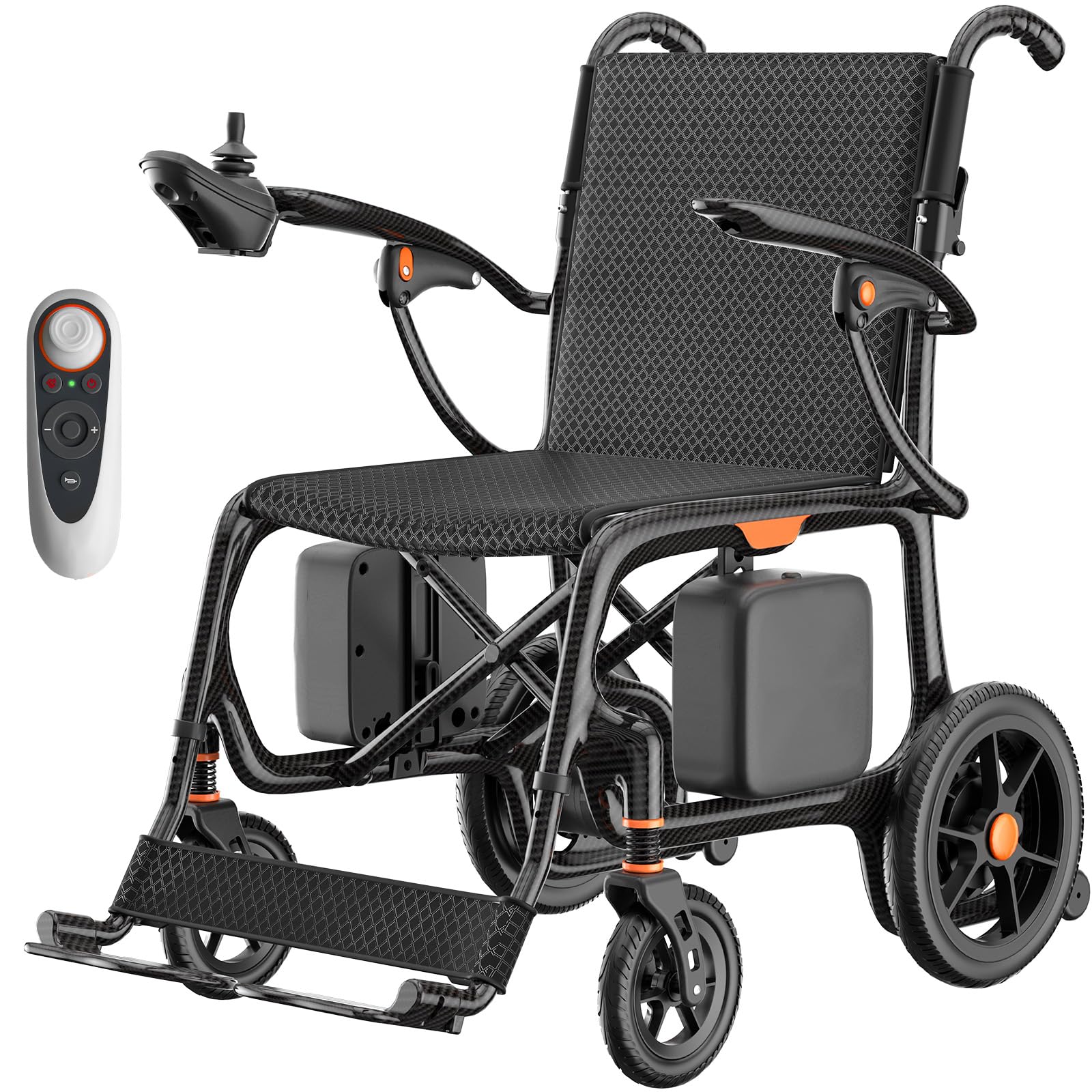
If absolute weight is your primary concern — say you’re a caregiver who needs to load this into a sedan trunk daily — the FreeWink is a revelation. The entire body is 100% carbon fiber, bringing the frame weight down to just 28 pounds (excluding batteries). That’s roughly the weight of a large bag of dog food. Despite this featherlight construction, it still supports up to 300 pounds, thanks to the incredible strength-to-weight ratio of high-modulus carbon fiber. The folding mechanism is a simple pull-in-the-middle action that collapses the chair to the size of two water bottles side-by-side. For a caregiver, this is a game-changer for saving your back.
This model also includes Bluetooth control, meaning a caregiver can drive the chair to the user via a simple remote from up to several meters away. This is incredibly useful in a home setting — you can bring the chair to the bedside without having to physically walk around the bed to maneuver it. The dual 12Ah lithium batteries are wireless and provide a 28-mile range, which is generous for any single day. The 400W motor is surprisingly powerful for such a light chair, offering strong climbing ability (up to 6 degrees) and a very short braking distance. The electromagnetic brake system provides an immediate stop when the joystick is released.
The caveats are minor but worth noting. The seat cushion, while made of breathable sponge, is not the deepest or most plush for all-day use. And at the highest speed setting, the chair can feel fast — the lowest setting is recommended for first-time users or indoor maneuvering. But for portability, it’s unmatched. It fits easily in a small SUV trunk, and the 11-inch solid rear wheels provide stability on uneven pavement. The customer reviews consistently praise the build quality and the fact that it arrives fully assembled. This is a top-tier pick for the traveling caregiver.
Why it’s great
- Unbelievably light 28 lb carbon fiber frame is the easiest to lift and transport on this list
- Bluetooth remote control allows the caregiver to drive the chair to the user hands-free
- 400W motor provides strong climbing torque and a short braking distance
Good to know
- Seat cushion is adequate but not plush for all-day comfort — consider an add-on cushion
- High speed can feel fast indoors; best to start on a low speed setting
3. Pride Mobility Jazzy Carbon Power Chair
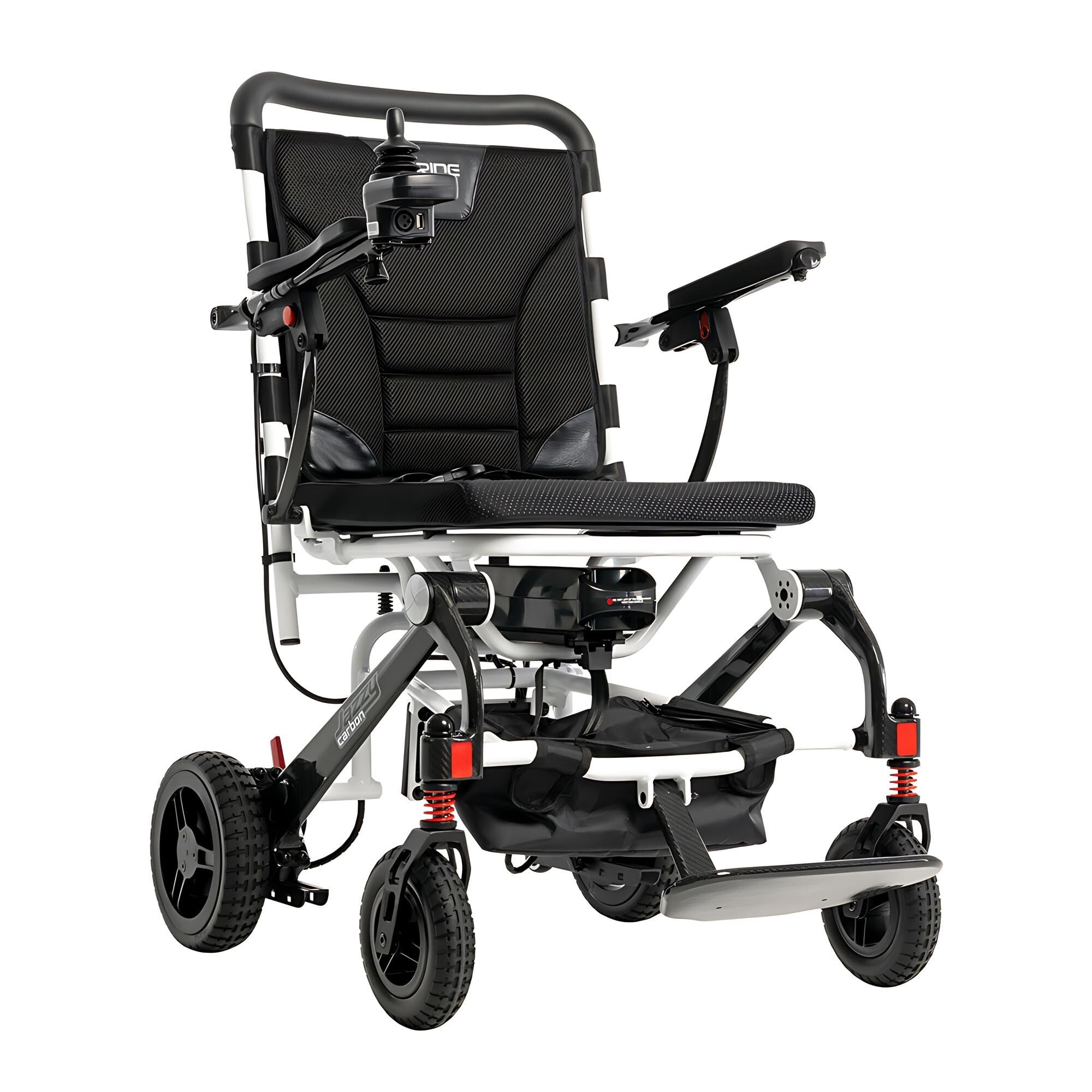
Pride Mobility is a brand name that resonates with durability and quality in the power wheelchair world, and the Jazzy Carbon lives up to that reputation. The standout feature for a caregiver is its compact, foldable base that collapses flat for storage. The carbon fiber frame keeps the weight at just 42.5 pounds — manageable for most caregivers to lift into a trunk. The front suspension is a genuine asset for a smooth ride over cracks in the sidewalk or bumps, which means less vibration being transmitted back through the push handles to the person pushing. The 12 Ah lithium battery provides a solid day’s range, and the free-wheel levers allow the caregiver to disengage the motors and push the chair manually like a standard manual wheelchair.
The padded seat back with a storage pocket is a thoughtful touch for stashing a phone or keys. The removable joystick with a built-in USB charger is a nice convenience feature. The turning radius is tight enough for maneuvering through standard doorways and around furniture. The Jazzy Carbon is FDA Class II registered, which means it meets strict medical device standards, giving both the user and the caregiver confidence in its safety and durability. The ride quality is stable and predictable, with the electromagnetic brakes providing a controlled stop.
Where the Jazzy Carbon falls slightly short is in raw power for very steep slopes. Some users report it struggles on thick carpet or steep inclines, which means the caregiver might need to assist or find an alternative route. The seat cushion is also on the thinner side; for all-day comfort, you’ll likely want to add a gel or memory foam pad. The backup beeper can be loud, but some models offer a way to mute it. Overall, if brand reliability and a smooth, compact travel experience are your priorities, this is a superb choice.
Why it’s great
- Trusted Pride Mobility build quality with FDA Class II medical device registration
- Front suspension provides a noticeably smoother ride over bumps and uneven surfaces
- Free-wheel levers allow easy manual pushing when the battery runs out
Good to know
- Motor struggles on thick carpet or very steep inclines
- Seat cushion is thin; an add-on cushion is recommended for all-day comfort
4. ROBOOTER X40 Intelligent Electric Wheelchair
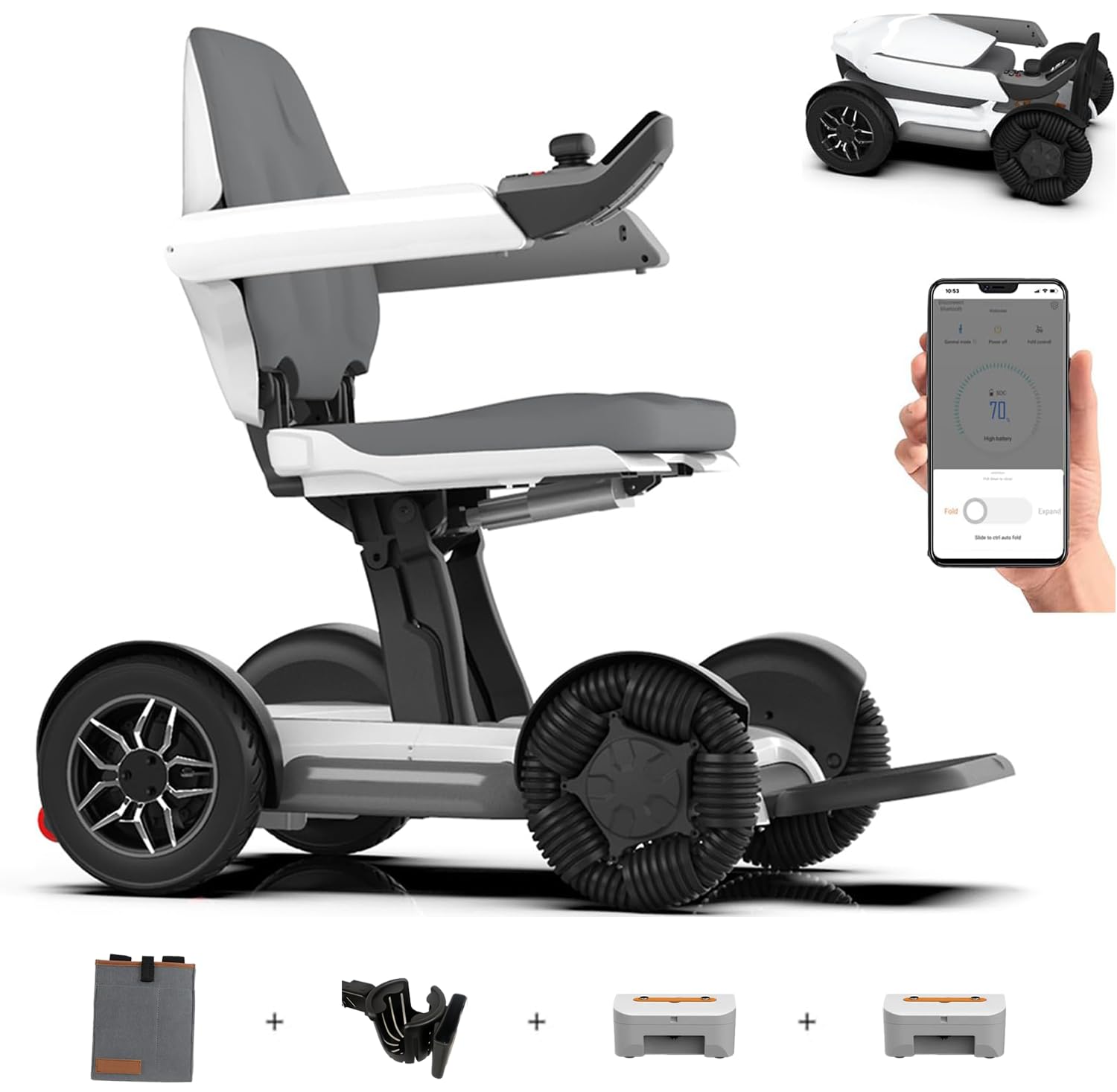
The ROBOOTER X40 is the most technologically advanced option in this lineup, and for a caregiver who wants maximum automation, it’s incredibly appealing. The headline feature is the automatic folding mechanism — with the press of a button (or via the smartphone app), the chair folds itself into a compact shape in 3 seconds. No bending, no lifting heavy parts, no manual latches. The caregiver simply parks the chair, hits the button, and stores it. The X40 also offers a unique straight-line reverse feature and a 360-degree turn-in-place capability (29.9-inch turning radius), making it incredibly nimble in tight spots like an elevator or a crowded pharmacy aisle.
Dual control methods are a major plus: the physical joystick is intuitive, but the Robooter app allows for remote driving, one-tap fold/unfold, mileage tracking, and a battery display. This means a caregiver can remotely “call” the chair from across a room. The dual motors are powerful, offering a top speed of 3.7 mph and the ability to handle obstacles up to 2.4 inches high. The 7.5-mile standard range is a bit short, but Robooter offers a free high-capacity backup battery that extends it to 15.5 miles, which is more respectable. The build feels solid, with a vehicle-level framework and double shock-absorbing springs on the front wheels.
The main downsides are weight and long-term reliability. At 84 pounds (with battery), it is by far the heaviest chair on this list, so a caregiver will not be lifting it into a car trunk. It’s designed more for roll-in access via a ramp or van. Also, some users report wheel bearing wear after 2 years and difficulty finding local repair services. The backup battery is a free offer, but it ships separately. For a caregiver who has a van or a ramp and wants the ultimate in automated convenience, the X40 is a standout. For those who need to lift the chair into a car, look at lighter options.
Why it’s great
- Fully automatic 3-second folding/unfolding via button or smartphone app is unmatched
- 360-degree turn-in-place with a 29.9-inch turning radius for extreme indoor maneuverability
- Robooter app offers remote control, fold, and battery tracking for the caregiver
Good to know
- Very heavy at 84 lbs — requires a ramp or van for transport, not for car trunk lifting
- Some users report wheel bearing wear and limited access to local repair services
5. Sentire Med Deluxe Electric Wheelchair

When your daily route involves gravel paths, grass, cobblestones, and steep slopes, the Sentire Med Deluxe is built for exactly those conditions. This chair is a tank — not in a clumsy way, but in a “conquer anything” way. The dual 300W peak brushless motors (600W combined peak) provide serious torque, allowing this chair to handle inclines that would leave lesser chairs spinning their wheels. The 4 suspension springs and 5-inch ground clearance absorb shocks from uneven terrain, making it a surprisingly comfortable ride off the pavement. The 67-pound weight is higher, but the foldable design (folds like a stroller) and included travel bag make car transport feasible with a strong caregiver.
The battery is a standout: dual lithium polymer batteries deliver a real-world range of up to 25 miles, which is enough for a full day at a theme park or a long outdoor errand without anxiety. The chair is TSA-approved for air travel, and the 400-pound weight capacity means it can accommodate a wide range of users. The joystick is responsive, though it’s not as sensitive as higher-end medical chairs, which is actually a plus for many first-time users — it’s less twitchy. The sharp turning radius makes it surprisingly maneuverable indoors for such a rugged chair. The included accessories (cane hook, cup holder, side bag, backrest pocket) are genuinely useful.
The seat cushion is reported as firm for all-day use, so adding a gel cushion is a common upgrade. The rear-wheel drive means the chair pulls from the back, which gives it great climbing power but can make tight indoor turns a bit wider than front-wheel-drive chairs. The armrests are not adjustable, which can be an issue for taller users or those needing specific support. That said, the sheer durability and power of the Sentire Med Deluxe make it the go-to choice for caregivers who need an all-terrain workhorse that can handle snow, ice, and mud without complaint. The customer service is highly rated for responsiveness.
Why it’s great
- 600W peak dual brushless motors provide unbeatable torque for steep hills and thick grass
- 25-mile battery range with TSA-approved lithium polymer batteries for long outings
- Sturdy 400 lb capacity and suspension springs for comfort on rough terrain
Good to know
- 67 lbs is heavy for car trunk transport; a strong caregiver or ramp is helpful
- Seat cushion is firm; an add-on gel cushion is recommended for all-day comfort
6. Pride Mobility Jazzy Ultra Light Folding Travel Power Chair

Pride’s Jazzy Ultra Light is a direct competitor to the FreeWink in the featherweight category, but it offers a unique battery advantage. The frame is all carbon fiber, weighing in at an astonishing 33 pounds (without battery), making it one of the lightest power chairs available. For a caregiver, this translates to a much easier lift into a car trunk. The stand-out feature is the battery option: you can choose a 10Ah airline-compliant battery for air travel or an optional 20Ah battery for an extended range. The 20Ah battery is not airline-compliant, but it allows for a genuinely long day of use without worrying about recharging.
The Jazzy Ultra Light features a responsive programmable joystick, front suspension for a smooth ride, and a fast folding mechanism that locks into a compact position. The breathable mesh back and seat are a nice touch for airflow, reducing sweat during longer rides. The maximum speed of 3.69 mph is competitive, and the rear-wheel drive provides stable, predictable handling. The build quality from Pride is top-tier, as expected, and the chair is FDA Class II registered. The included accessories like the mesh cup holder and rear lights add convenience and safety.
Potential downsides include the fact that the 20Ah battery, while offering great range, is not allowed on airplanes. Also, some users have reported a motor whine noise, and while customer service is generally good, there are complaints about responsiveness for complex issues. The seat cushion, while breathable, is not the thickest, and taller users (over 6 feet) may find the seat depth a bit short. Despite these issues, the combination of ultra-light weight and excellent battery range options makes this a top pick for the traveling caregiver who wants the latest from a legendary brand.
Why it’s great
- Ultra-light 33 lb carbon fiber frame is amazingly easy to lift and load into vehicles
- Optional 20Ah battery provides exceptional range for a full day of heavy use
- Front suspension and programmable joystick for a customizable, smooth ride
Good to know
- 20Ah battery is not TSA-compliant; you must use the 10Ah battery for air travel
- Some users report motor whine; customer service responsiveness can vary
7. Porto Mobility Ranger Discovery Lightweight Foldable

The Porto Mobility Ranger Discovery is the undisputed champion when weight capacity is the primary driver. It supports up to 440 pounds while keeping its own weight at a very manageable 50 pounds. This is achieved through its high-strength aircraft-quality aluminum alloy frame and smart engineering. For a caregiver, this means you can fit a larger user in a chair that’s still light enough to lift into a car trunk. The chair folds in just 3 seconds and collapses to only 13 inches high — slim enough to fit in tiny compact car trunks. The weather-resistant finish means you don’t have to panic if it starts drizzling.
The dual side batteries are a standout design feature for caregivers. They slide out easily without having to unfold the chair, reducing the lifting weight significantly. You can charge the batteries indoors while leaving the chair in the car. Each battery is made with semi-solid lithium technology, offering a real-world range of up to 20 miles. The 250W dual brushless motors (real-world, not peak) with Posi-Traction provide enormous torque, allowing the Discovery to handle grass, gravel, dirt, mud, and even snow. The 32-inch turning radius is tight enough for indoor use, and the 360-degree joystick is responsive and smooth.
The main criticisms revolve around the steering feel, which some users describe as “jerky” or having dead spots off-center, and the top speed, which is a relaxed 3 mph. The joystick is also fixed and cannot be moved, and the armrests are known to crack over time. The lack of a detailed parts list in the manual makes ordering replacements difficult. However, the 3-year frame warranty and 1-year warranty on motor/controller/battery show Porto’s confidence in their product. If you need to transport a larger individual and want a foldable, weatherproof chair, the Ranger Discovery is the benchmark. The XL Wide Seat version (Product 10) offers even more width for larger users.
Why it’s great
- Incredible 440 lb weight capacity in a sub-50 lb frame — best in class for bariatric users
- Slide-out dual side batteries for convenient charging without unfolding the chair
- Weather-resistant finish and 3-second fold for all-weather, all-terrain use
Good to know
- Steering can feel jerky off-center; requires a slight learning curve for smooth driving
- Top speed is limited to 3 mph, and the joystick is fixed (not adjustable)
8. Porto Mobility Ranger Discovery XL Wide Seat

The Porto Ranger Discovery XL Wide Seat takes everything that makes the standard Ranger great and expands the comfort for larger users. This is the same award-winning engineering — 3-second fold, 50-pound total weight, aircraft-grade aluminum — but with a significantly wider and more accommodating seat. It retains the impressive 440-pound weight capacity, making it one of the very few mid-weight foldable chairs that can accommodate users who need a wider frame. The lift-up armrests and flip-up footrest make getting in and out much easier for users with limited mobility. The weather-resistant finish is a practical everyday advantage.
The dual side slide-out batteries are a key caregiver convenience. You can pop them out without unfolding the chair, charge them indoors, and reduce the carry weight by 8 pounds. The semi-solid lithium battery technology offers up to 20 real-world miles, which is excellent for a full day’s activities. The 250W dual brushless motors with Posi-Traction provide enough torque to climb hills and traverse grass and gravel. The 32-inch turning radius is compact enough for indoor navigation. The chair typically arrives fully assembled, which is a huge time saver.
As with the standard Ranger, the steering can feel a bit jerky and requires some practice to get smooth turns. The top speed is limited (around 3 mph), and replacement parts are expensive (the joystick alone costs around ). Some users have reported the ride being rough on poor surfaces, which can loosen screws over time. The lack of a detailed parts list is a recurring complaint. Despite these quirks, for a caregiver who needs a foldable, high-capacity chair that won’t break their back to lift, the XL Wide Seat from Porto Mobility is the correct answer. The support from their U.S.-based team is generally well-regarded.
Why it’s great
- Generous XL seat width in a 50 lb foldable frame with a 440 lb capacity
- Slide-out side batteries allow for easy charging without moving the heavy chair
- 3-second fold, weather-resistant, and arrives fully assembled
Good to know
- Steering can be jerky; the joystick is not adjustable for position
- Replacement parts are expensive and the manual lacks a detailed parts list
9. Paiseec 3-in-1 Electric Wheelchair with Push-Assist (W3)
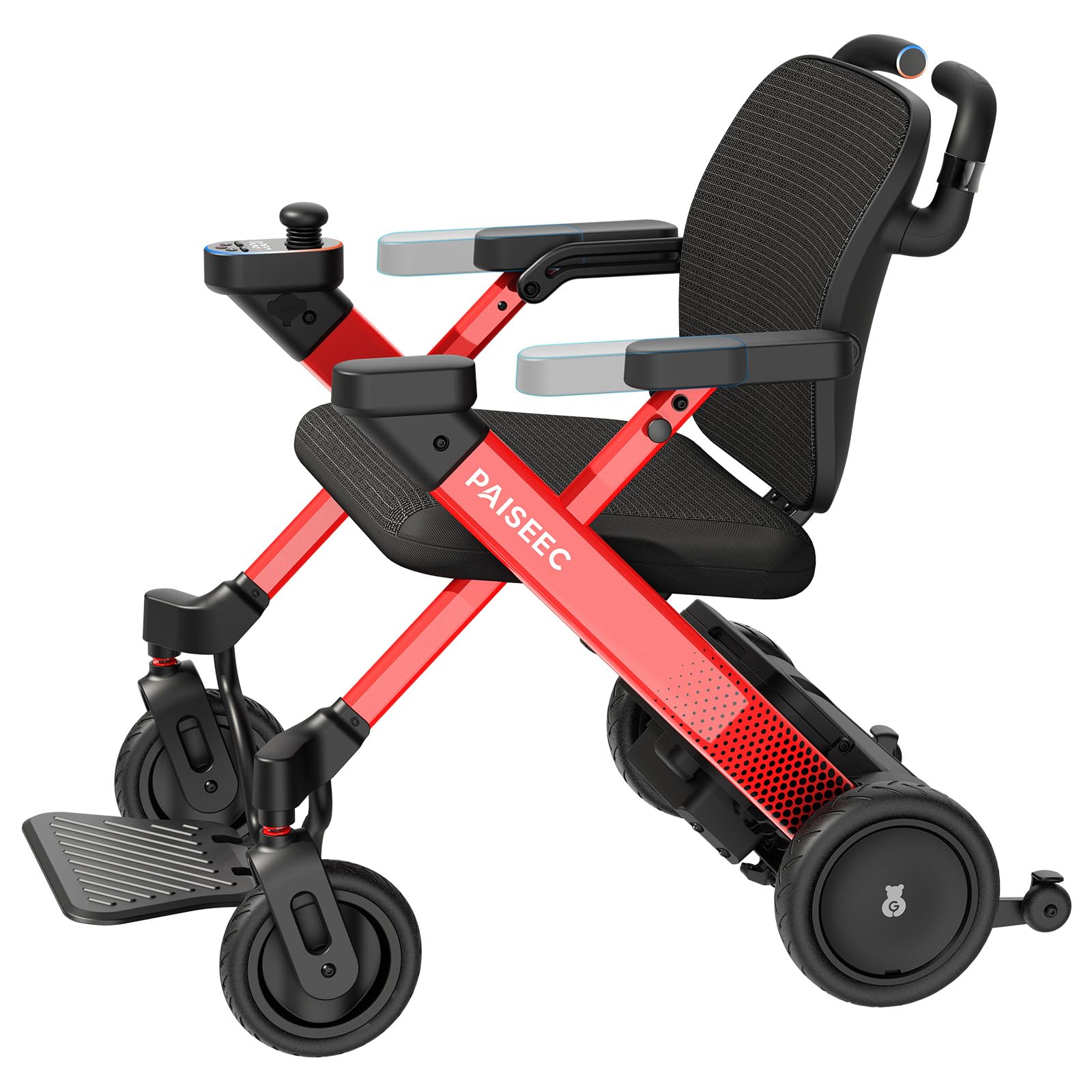
The Paiseec W3 is a sibling to the W-E3 (Product 1), offering the same core 3-in-1 concept (electric wheelchair, smart walker, e-push assist) with a slightly different focus on smart safety and the rollator experience. The intelligent rollator mode is impressive: the system smartly regulates walking speed, offers adjustable resistance, and provides power assists up slopes and stability on descents. This is a fantastic feature for a user who can walk short distances but needs a rest or support for longer halls. The e-push assist mode for caregivers is equally effective, using force sensors in the handles to reduce pushing effort.
The W3 features 10-inch pneumatic tires and a 4-speed system (0.6-3.6 mph), allowing it to handle 1.6-inch curbs and 4-inch ditches with ease. The magnetic encoder motors provide very precise control, translating subtle finger movements on the joystick into exact directional changes. The PAi safety ecosystem includes incline detection, steering overspeed braking, and anti-tip wheels. The build is solid and comfortable, with a generous seat and adjustable armrests. The battery range is rated at 15.6 miles, which is good for most daily use. The 1-year warranty (18 months on battery) is standard.
Key drawbacks mirror the W-E3: the push handles are not adjustable and may be too low for taller caregivers. The weight is listed as 75 lbs on this variant (heavier than the W-E3), making it less portable for car trunk lifts. The footrest plate can also feel like an obstruction when the user is trying to stand. The 265 lb weight capacity is lower than some heavy-duty competitors. For a caregiver who wants a smart, safety-focused 3-in-1 that prioritizes walking assistance and push-assist equally, the W3 is a well-engineered choice, but the weight is a significant consideration for transport.
Why it’s great
- Intelligent rollator mode with adjustable resistance is excellent for users who can walk part-time
- 10-inch pneumatic tires and magnetic encoder motors for all-terrain precision control
- PAi safety system with incline detection and overspeed braking for peace of mind
Good to know
- Push handles are not height-adjustable, potentially uncomfortable for taller caregivers
- At 75 lbs, this version is heavy and less convenient for car trunk transport
10. Aotedor Electric Wheelchair (22 Miles, 39 lbs)
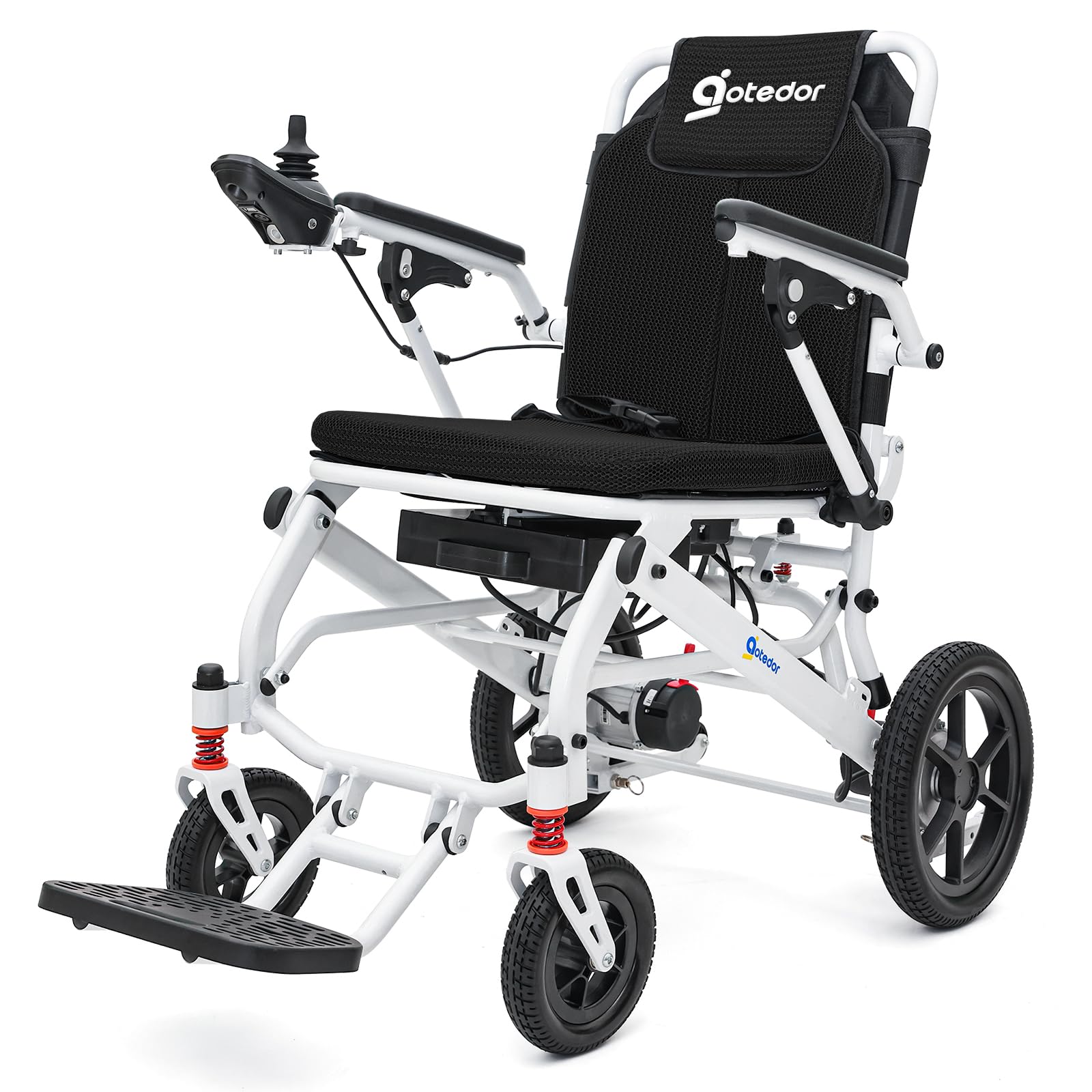
The Aotedor 22-mile model is a fantastic entry point into the market for a caregiver who needs a reliable, lightweight, and highly functional chair without the highest price tag. Weighing just 39 pounds and folding in 3 seconds, it’s extremely easy to lift and store. The aviation-grade aluminum frame supports up to 220 pounds, making it suitable for most adults. The dual 10Ah lithium batteries deliver a genuine 22-mile range, which is more than enough for most days. The dual brushless motors provide smooth, quiet, and efficient performance on flat ground, gentle slopes, and indoor surfaces. The electromagnetic brakes and anti-tip rear wheels provide good basic safety.
What really sets Aotedor apart is their customer support. Multiple reviewers praise their responsiveness, including free replacement toolkits and quick resolution of issues. This is a huge plus for a caregiver who doesn’t want to deal with a non-responsive manufacturer. The chair is comfortable for hours of use, and the white finish is durable and attractive. The free-wheel levers allow the caregiver to disengage the motors and push the chair manually, which is a very handy feature for tight spots or when the battery dies. It’s airline-approved, making it a solid travel companion.
There are some trade-offs at this price point. Some users report that the chair feels a bit heavy despite the 39-pound claim (the total with batteries is higher). The front wheels are on the smaller side, making it difficult to navigate over large thresholds or deep gravel without a jolt. The chair doesn’t lock securely in its folded position, which can be frustrating during transport. The joystick can be sensitive, requiring a delicate touch. For the caregiver on a budget who prioritizes lightweight portability and good range, the Aotedor 22-mile model is an excellent value proposition that punches above its weight in customer service.
Why it’s great
- Excellent value for a lightweight (39 lbs) chair with a 22-mile dual-battery range
- Superb customer service with free replacement parts and responsive support
- Quick 3-second fold and airline-approved for easy travel
Good to know
- Front wheels are small and struggle with large thresholds or deep gravel
- Chair does not lock in the folded position, making trunk storage slightly awkward
11. MUJOCOOKER Remote Control Electric Wheelchair
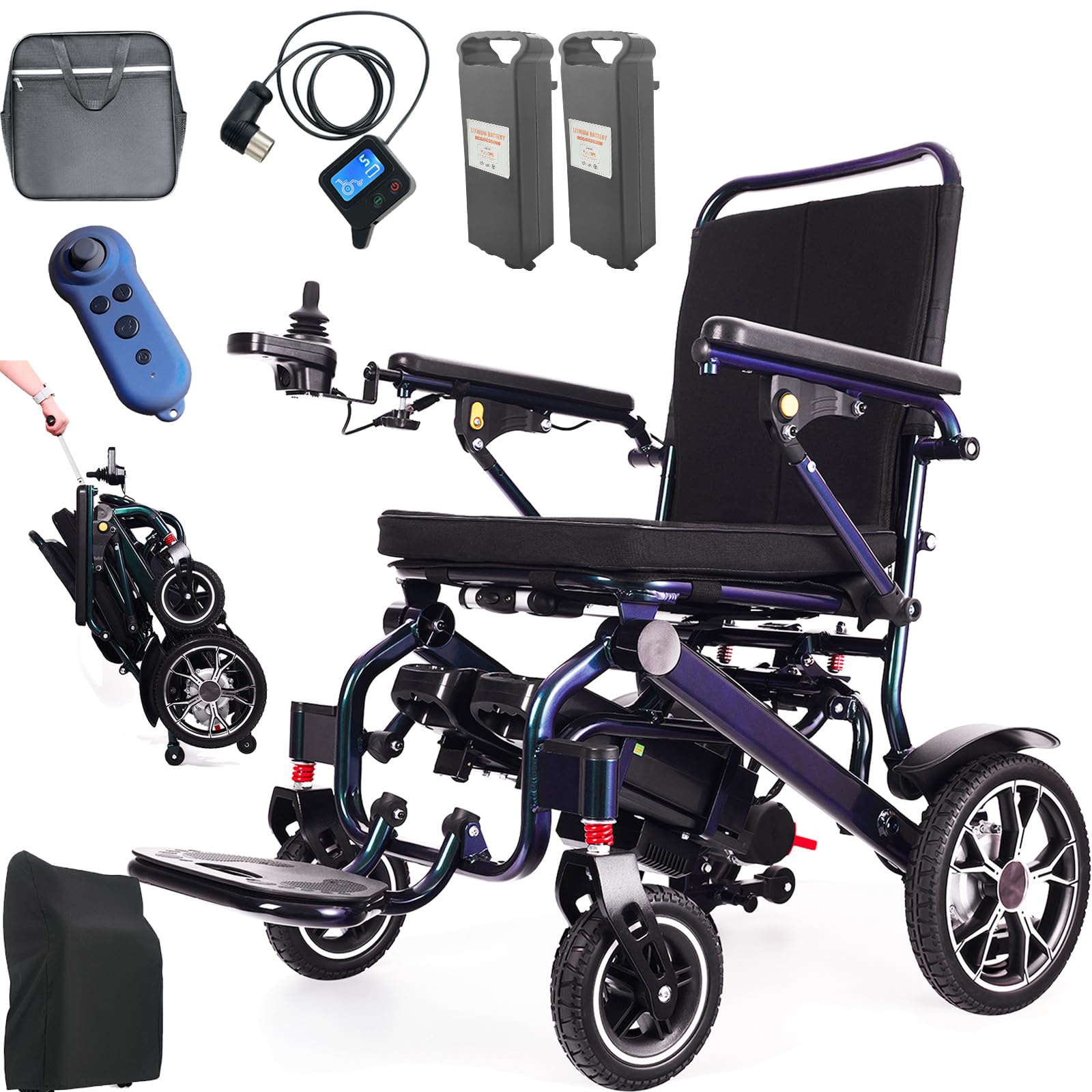
The MUJOCOOKER is a mid-range contender that brings two unique features to the table: a dedicated remote control and a telescopic handle. The remote allows a caregiver to operate the chair from up to 8 meters away, which is longer than most wireless remotes in this class. This is incredibly useful for maneuvering the chair into a tight spot in a home or office before the user sits down. The telescopic handle is another brilliant touch — it extends and retracts like a suitcase handle, allowing a caregiver to pull the chair easily when it’s unoccupied, without bending over. At 42 pounds, it’s relatively light and easy to fold.
The chair is fitted with dual 10Ah lithium batteries that provide a 25-mile range, which is generous. The dual 250W motors provide good traction for all-terrain use (grass, gravel, dirt roads) and the 4 shock absorbers make the ride quite comfortable. The seat is breathable and cushioned, and the controller is adjustable for left or right hand use. It also includes a handy motorized/hand-push mode switch. The unique dark green gradient color is a nice touch for those who want something that doesn’t look like a standard medical device. The included dust cover and backpack add practical value.
The main downsides reported by users involve steering and design quirks. The steering can be overly sensitive, especially when the battery is full, causing the chair to weave. The footrest can sometimes hit the front wheels during tight turns, limiting rotation. The battery port can be difficult to connect to, and the right-side armrest controller can be prone to sticking. The headrest is too short for users over 5’10”. For the price, it’s a feature-rich package with that excellent remote control and telescopic handle, but the driving experience requires a gentle touch and some patience with the quirks.
Why it’s great
- Excellent 8m remote control range and telescopic pull-handle for easy caregiver maneuvering
- 25-mile range from dual 10Ah batteries and 4 shock absorbers for all-terrain comfort
- Unique design and color options with useful included accessories (bag, cover, cup holder)
Good to know
- Steering is overly sensitive when the battery is full, causing a weaving motion
- Footrest can hit the front wheels during tight turns; armrest control can stick
12. Aotedor Lightweight Electric Wheelchair (30 Miles)
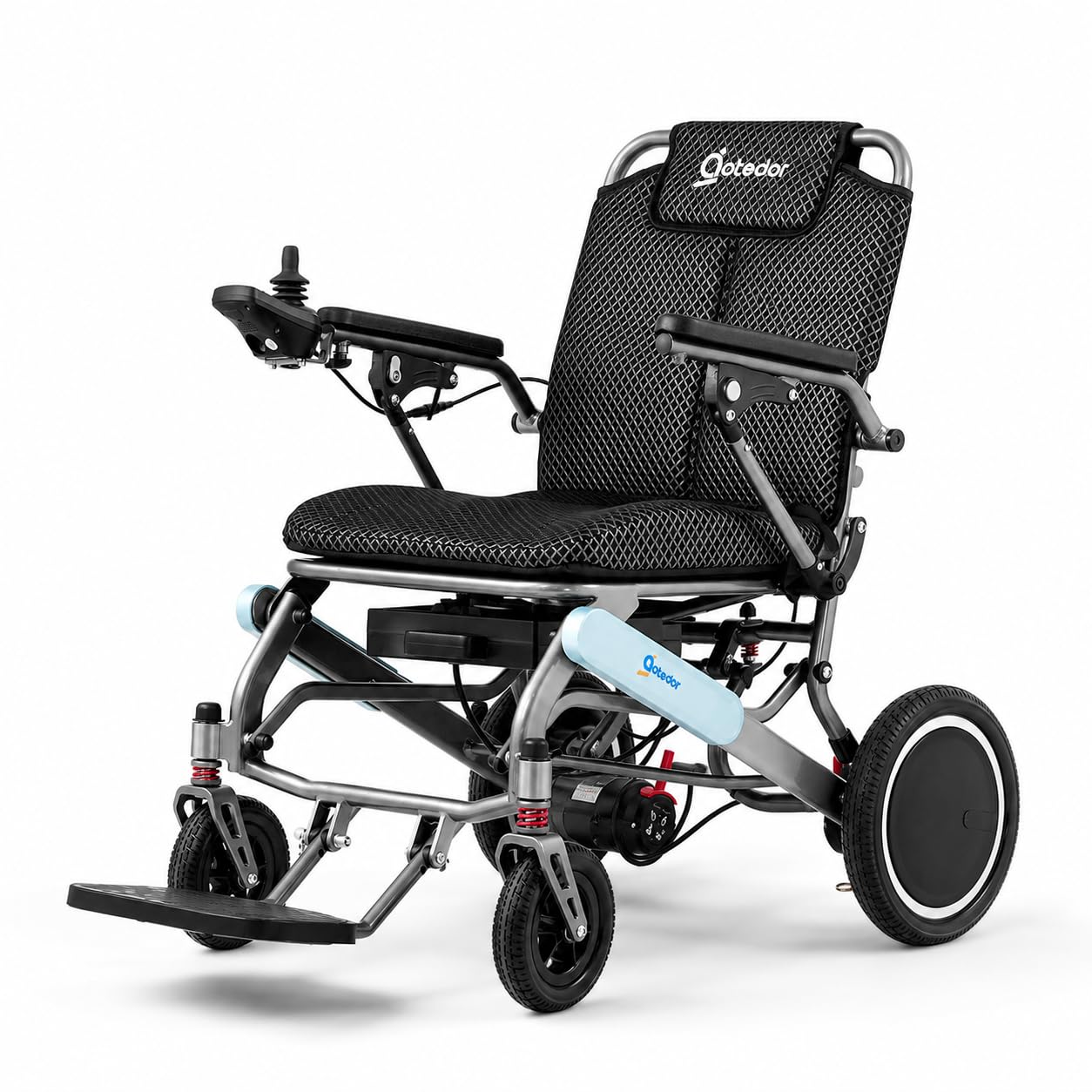
This upgraded Aotedor model takes the excellent 39-pound lightweight frame from its sibling and adds a significant battery and suspension upgrade. The standout spec is the 30-mile range, achieved through dual 12Ah lithium batteries. For a full day of errands, visiting multiple parks, or a long day at a museum, this range eliminates any fear of dying mid-afternoon. The inclusion of spring suspension on top of the dual brushless motors significantly improves ride comfort over sidewalks, pavement, and ramps. This makes it much more pleasant for the rider and reduces the jolts that can feel unsettling.
The chair retains all the excellent features of its sibling: the quick-folding aluminum frame, the ergonomic seat cushion, electromagnetic braking, anti-tip rear wheels, and airline approval. The user-friendly joystick is responsive, and the LCD display on some versions shows speed and battery level clearly. Aotedor’s customer service excellence continues with this model, offering responsive support and replacement parts assistance. For a caregiver looking for the longest possible range without sacrificing lightweight portability, this is the best value option in the Aotedor lineup.
The same trade-offs apply as the 22-mile version: the front wheels are still on the smaller side, which means larger thresholds can be a jolt. The seat, while comfortable, might slant slightly backwards, which some users find disconcerting. And like its sibling, it doesn’t lock in the folded position. There have been some reports of batteries failing after 9-11 months, showing full charge but dying quickly — this is a known failure mode for lithium packs, though Aotedor’s support team has historically addressed it with replacements. If range is your top priority in a lightweight chair, this is the one to beat.
Why it’s great
- Best-in-class 30-mile range from dual 12Ah lithium batteries for all-day use
- Spring suspension system provides a noticeably smoother ride over pavement and ramps
- Maintains a lightweight 39 lb frame with quick-fold design and airline approval
Good to know
- Small front wheels still struggle with large thresholds
- Some users report battery failure after 9-11 months; customer service is generally responsive for this
13. Aotedor 35 lbs Carbon Fiber Electric Wheelchair
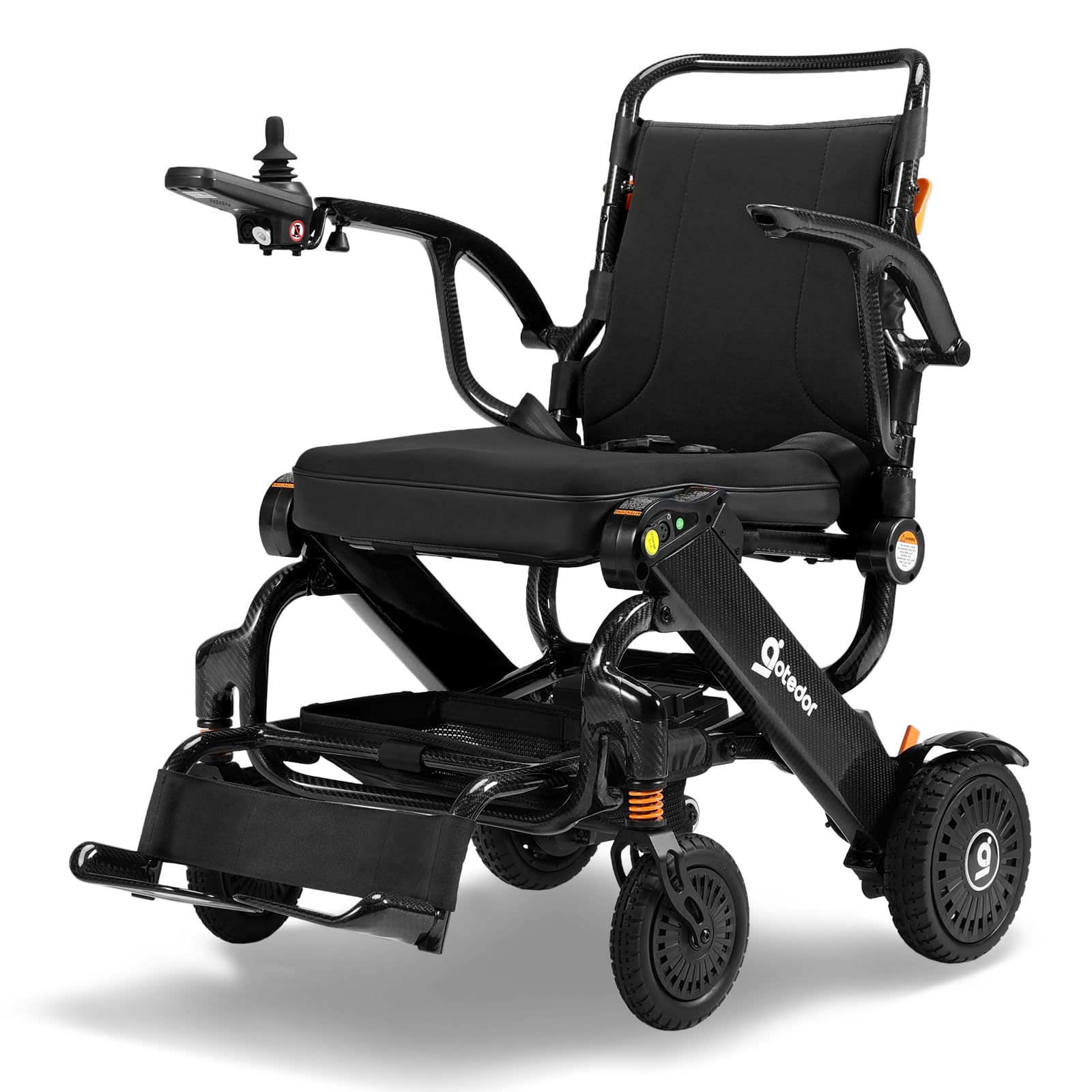
The Aotedor Carbon Fiber model is a significant step up in material quality, offering a full carbon fiber frame that weighs just 35 pounds (without battery) and supports a robust 330 pounds. This is an excellent strength-to-weight ratio. For a caregiver, the 35-pound frame is easy to lift into a car trunk, yet it carries a user much heavier than the standard aluminum Aotedor models. The dual side-mounted batteries are a great design choice — they improve balance by keeping weight low and centered, and they’re easy to remove for charging. The range is 22 miles on a full charge from the two lithium batteries.
The dual motors provide smooth performance across grass, carpet, and ramps. The 360-degree joystick is intuitive, and the LCD display clearly shows speed and battery status. The anti-tip wheels provide confidence on slopes. The folding mechanism is simple and the chair folds as one piece. Reviews consistently praise the customer service as being responsive and helpful, with quick replacement parts when needed. The compact size means it fits nicely under a kitchen table, which is a practical plus for home use. The lift-up armrests make getting in and out easier for the user.
The main drawbacks are that the seat width may feel tight for larger users, and the motors can struggle on moderate inclines — the primary torque is adequate for gentle slopes but not steep hills. The spare battery doesn’t fit in the storage pouch, and the voice/backup beeper can be loud (though it can be disabled). For the price point, it’s a premium-feeling chair with the best material choice (carbon fiber) and a high weight capacity. If you need to lift a chair daily and your user is on the heavier side, this is the optimal blend of lightness and strength.
Why it’s great
- True carbon fiber frame at 35 lbs with a 330 lb capacity — excellent strength-to-weight ratio
- Dual side-mounted batteries improve balance and are easy to remove for charging
- Compact design fits under kitchen tables; excellent customer service support
Good to know
- Seat may be narrow for larger users
- Motor struggles on moderate or steep inclines
FAQ
Can I use a standard joystick wheelchair as an attendant controlled chair?
What is the difference between push-assist and e-push mode?
How do I know if a wheelchair is airline approved?
Can the wheelchair be pushed manually if the battery dies?
What weight capacity do I need for a caregiver to safely push the chair?
Final Thoughts: The Verdict
For most caregivers, the best attendant controlled electric wheelchair winner is the Paiseec 3-in-1 (W-E3) because it integrates genuine push-assist technology with a 3-in-1 design that saves you from buying separate devices. If you need the lightest possible chair for daily car trunk lifting, grab the FreeWink 28 lbs Carbon Fiber. And for bariatric users who need a foldable chair with a 440 lb capacity, nothing beats the Porto Mobility Ranger Discovery.