
Mounting an antenna in your attic solves the problem of feeding every TV in the house with free over-the-air HD channels without a rooftop installation. The real challenge isn’t just choosing an antenna—it’s selecting one capable of splitting a clean signal to multiple televisions while compensating for the signal loss that splitters introduce.
I’m Min — the co-founder and writer behind Gadgets Feed. I’ve spent hundreds of hours researching antenna specifications and real-world signal performance across diverse geographies and installation scenarios to bring you this guide.
After comparing range, gain figures, and built-in amplification across dozens of models, I’ve narrowed down the options to help you find the best attic antenna for multiple tvs for your unique installation.
How To Choose The Best Attic Antenna For Multiple TVs
Selecting the right antenna for an attic installation that feeds multiple televisions requires a different set of priorities than a simple one-TV setup. You need to consider signal loss, available gain, and the type of terrain between your house and the broadcast towers.
Signal Loss and Amplification Requirements
Every coaxial splitter you add to distribute the signal to additional TVs reduces the received signal strength. A standard 2-way splitter introduces about 3.5 dB of loss, a 4-way splitter loses roughly 7 dB, and an 8-way splitter can cost you over 10 dB. An antenna with a built-in preamp or one that pairs well with an inline amplifier compensates for this loss and ensures every connected TV receives a clean, usable signal.
Range and Construction Considerations
Manufacturer range claims—whether 50 miles or 200 miles—are best-case estimates measured in ideal conditions. Your actual reception depends on factors including roof construction, nearby trees, hills, and the height of the attic mount. A metal roof or radiant barrier in your attic can reduce effective range by 50% or more. Directional antennas with higher gain (measured in dBi) are better for targeting a single cluster of towers, while omnidirectional antennas simplify installation if towers surround the house.
Installation Complexity and Future-Proofing
Some antennas arrive fully assembled, while others require you to attach elements and mounting hardware. Attic spaces are tight and hot, so ease of assembly matters. Compatibility with ATSC 3.0 (NextGen TV) ensures the antenna will still work after the broadcast transition. A pre-assembled antenna with an integrated amplifier saves time and delivers a more reliable connection than a passive model with an aftermarket preamp.
Quick Comparison
On smaller screens, swipe sideways to see the full table.
| Model | Category | Best For | Key Spec | Amazon |
|---|---|---|---|---|
| Televes DAT BOSS Mix LR | Long-Range Premium | Fringe reception, compensated splitters | 46 dBi UHF gain with TForce amp | Amazon |
| Five Star Outdoor HDTV Antenna | Value Multi-TV Kit | Complete installation with splitter | 200-mile claim; 11 dB VHF gain | Amazon |
| Televes DiNova Boss Mix | Mid-Range Premium | Smart auto-gain in urban/suburban attics | 34 dBi UHF; TForce intelligent gain | Amazon |
| RCA Compact Outdoor Yagi | Compact Directional | Attic mounting with moderate range needs | 70+ mile range; pre-assembled UHF reflector | Amazon |
| Channel Master Omni+ 50 | Omnidirectional | 360° reception from multiple tower directions | 50-mile range; 360-degree VHF/UHF | Amazon |
| 1byone 360° Omni-Directional | Budget Omnidirectional | Easy no-rotate setup for single TV primary use | 100+ mile claim; built-in pre-amp | Amazon |
| GE Outdoor Yagi Design | Entry-Level Directional | Budget-friendly attic install with included J-mount | 80-mile claim; ATSC 3.0 ready | Amazon |
In‑Depth Reviews
1. Televes DAT BOSS Mix LR 149884
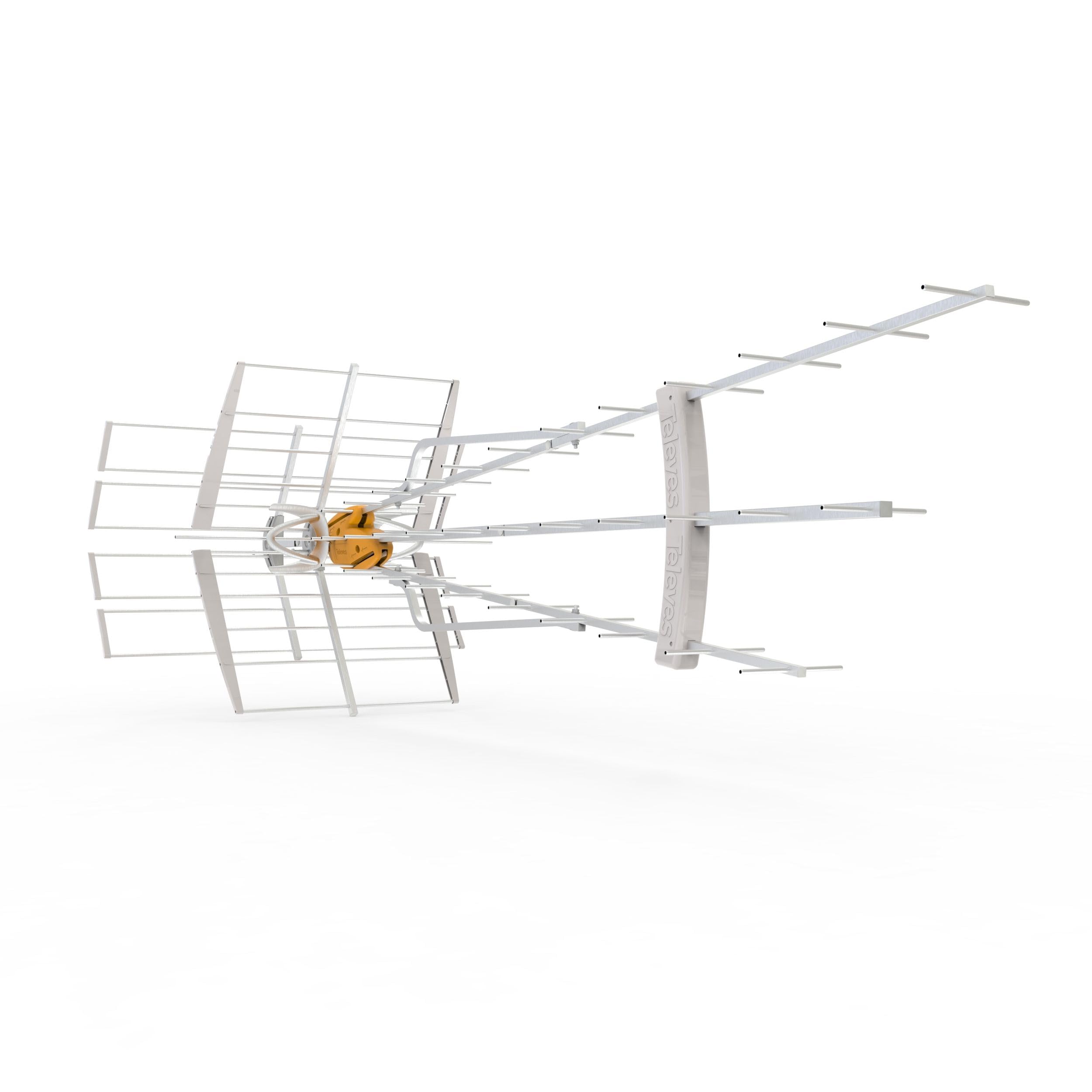
The Televes DAT BOSS Mix LR is engineered for the toughest reception scenarios. Its stacked triple-boom design delivers 46 dBi of UHF gain, which is the highest available in this category, combined with a built-in TForce amplifier that automatically adjusts gain by band. This means when you split the signal to three or four TVs, the preamp compensates for the insertion loss, maintaining a clean picture on every set.
Real-world testing from a fringe location in the Seattle area demonstrated that this antenna eliminated pixelation that plagued previous models and added 16 additional channels. A user 70 miles from broadcast towers in rural Wisconsin reported receiving 37 usable channels with consistent signal quality. The built-in FM/LTE/4G/5G filtering prevents cellular interference from disrupting your reception, a common issue in suburban attics near towers.
Assembly requires attaching elements to the boom, but the included wrench and weather boot simplify the process. The antenna is large—84 inches long—so verify your attic dimensions before purchasing. The UL-listed power inserter supports dual outputs, making it straightforward to power the preamp and still feed multiple TVs through a distribution amplifier or splitter.
Why it’s great
- Highest available UHF gain at 46 dBi for compensating splitter loss
- Integrated TForce amp with band-specific auto-gain control
- 5G/LTE filtering prevents cell tower interference
Good to know
- Large footprint exceeds 84 inches in length
- Premium tier pricing requires larger upfront investment
2. Five Star Outdoor HDTV Antenna

The Five Star antenna stands out because it ships with a TV splitter and J-pole mount, removing the guesswork when setting up a multi-TV configuration. The extended 46-inch element design with 11 dB VHF gain targets distant towers while maintaining a decent front-to-back ratio. One user 45 miles from Houston towers pulled in 128 channels after assembly, demonstrating strong off-axis reception.
During installation, you need to align the VHF vibrator screw heads correctly—the instructions are vague on this point. The antenna handles long coax runs well; a single 80-foot run showed no degradation, though a 175-foot run caused a low-power station to drop out. The unit supports up to four TVs using the included splitter, though adding an aftermarket distribution amplifier is advisable for longer cable runs exceeding 50 feet.
Construction feels robust with a black metal frame and plastic elements. The antenna performs best when mounted at least 15 feet above ground or at the attic peak. Weatherproofing holds up in exposed outdoor installations, though for attic use the J-mount provides an easy attachment point to roof rafters.
Why it’s great
- Includes splitter and mounting hardware for immediate multi-TV setup
- Reliable 11 dB VHF gain compensates for splitter loss
- Budget-friendly entry to 4-TV distribution
Good to know
- Assembly instructions lack clarity on VHF element alignment
- Large physical size requires ample attic space
3. Televes DiNova Boss Mix 144286

The DiNova Boss Mix brings Televes’ TForce intelligent gain control into a more compact, pre-assembled form factor ideal for attic installations where space is limited. The 34 dBi UHF gain and 29 dBi High VHF gain are delivered through a 7-element UHF microstrip array and separate VHF dipole enclosed in a weather-resistant ABS radome. No assembly means you can mount it to a rafter and start scanning within minutes.
Users consistently report clean reception from distances of 50 miles or more. One reviewer 90 miles from a CBS affiliate received a clear signal from an attic mount—an impressive result attributable to the built-in preamp compensating for signal loss. The dual-mode operation lets the antenna pass signals passively if the power inserter fails, so you won’t lose reception entirely during a power outage.
The integrated FM/LTE/4G/5G filtering is particularly valuable for attic installations where cell repeaters or nearby towers could introduce noise. The low-profile white housing blends into rafters and avoids the visual clutter of exposed elements. It’s ready for ATSC 3.0 broadcasts, though you’ll need a compatible tuner to decode NextGen TV signals.
Why it’s great
- Pre-assembled design eliminates assembly time
- Automatic band-specific gain prevents overload from strong local signals
- Compact size fits tight attic spaces
Good to know
- Range limited to around 60 miles compared to larger models
- Mounting fasteners not included, must purchase separately
4. RCA Compact Outdoor Yagi ANT751Z

The RCA ANT751Z is a pre-assembled Yagi antenna that mounts easily in attics with limited headroom. The fold-out UHF reflector and snap-lock elements lock into position without tools, and the entire unit weighs only 2 pounds. Despite its compact size, it delivers up to 70+ mile reception on both VHF and UHF bands, as confirmed by users who installed it in attics with existing coax wiring.
One user in a hilly area 25 miles from towers paired this antenna with a Winegard LNA-200 preamp and received 51 channels with full signal strength, feeding multiple TVs through existing coax without issues. Another user 28-31 miles from transmitters received 79 channels with 80-85% signal strength from an attic-mounted, no-amplifier setup. The RCA Signal Finder app helps you align the antenna using your phone’s compass, saving trips up and down the ladder.
The antenna includes a locking mast clamp and mounting hardware, though you must purchase the coax cable separately. The design is not weather-rated for extreme outdoor exposure, but inside an attic it performs flawlessly. For multi-TV distribution, pairing this antenna with a powered splitter or distribution amplifier is recommended once you exceed two TVs.
Why it’s great
- Tool-free snap-lock assembly saves installation time
- Free RCA Signal Finder app simplifies aiming
- Low weight allows easy mounting to rafters
Good to know
- Coax cable is not included with purchase
- Unpowered; requires external preamp for multi-TV setups
5. Channel Master Omni+ 50

When broadcast towers surround your home, a directional antenna forces you to compromise. The Channel Master Omni+ 50 solves this with a 360-degree design that supports both VHF and UHF bands without requiring manual rotation. The VHF dipole rotates independently and can even be omitted if your local broadcasts are exclusively UHF, a clever design choice for installation flexibility.
Users report dramatic improvements in signal quality compared to flat indoor antennas. One reviewer saw signal strength jump from 60% to 95% and SNR improve from 70% to 98% after switching to the Omni+ 50. In flat Florida terrain with towers under 35 miles, a user pulled in 53 stations and found the antenna survived heavy rain without performance degradation. For multi-TV use, the unit works through a splitter effectively, as demonstrated by a user who fed a second TV via splitter without noticeable signal loss.
The included mounting bracket attaches to walls, mast poles, or existing satellite mounts. The antenna is lightweight and reasonably discreet at 28.75 inches wide. It’s best suited for suburban and urban areas with towers within 50 miles and relatively flat terrain—not for fringe reception zones.
Why it’s great
- True 360° reception eliminates aiming
- Separate VHF dipole for maximum band flexibility
- Lightweight design for easy attic mounting
Good to know
- Limited to 50-mile range; not for deep fringe areas
- Does not include mast or coax cable
6. 1byone 360° Omni-Directional Antenna

The 1byone antenna is designed for simplicity. It connects to a single TV out of the box and includes a 39-foot RG6 coaxial cable, but its built-in pre-amplifier with Smart pass technology makes it feasible to add a splitter for a second TV if your signal is strong. The omnidirectional design captures signals from all directions without the need for a rotor, simplifying installation in attics where you may not have easy access to rotate the antenna later.
Real-world performance varies by location. A Manhattan user reported 60 channels including major networks in 15 minutes, while an LA user initially received 124 channels but saw the count drop as weather and placement shifted. The unit is not waterproof—one user’s outdoor unit failed after two years due to water ingress in the preamp—so attic installation is the ideal environment for longevity. Users 20-30 miles from towers consistently report 40-60 channels with strong HD quality.
The antenna comes with a 2-year warranty, and the manufacturer recommends using only one antenna per television for best results. If you plan to distribute to multiple TVs, add a powered distribution amplifier after the antenna to boost the signal before the splitter. The moisture-proof and flame-retardant materials are well-suited for attic environments.
Why it’s great
- Includes 39ft RG6 coax for immediate installation
- Built-in preamp with 4G/LTE filtering
- No assembly required, truly plug-and-play
Good to know
- Not waterproof; must be used in dry attic or protected location
- Designed for single TV output; splitting may reduce channel count
7. GE Outdoor Yagi Design 33685

GE’s Yagi-style antenna is a trusted entry point for cord-cutters starting with an attic installation. The rugged construction includes a weather-resistant mounting bracket and J-mount, and the antenna is ATSC 3.0 ready, meaning it will work with NextGen TV tuners as those broadcasts roll out. With a claimed 80-mile range, this antenna suits users with towers within 30-40 miles who need a reliable directional solution.
Customer feedback shows effective performance in various environments. One user mounted the antenna on a shed 10 feet high in Seattle and received solid picture quality with no pixelation, while another installed it under a concrete tile roof 35 miles from towers and reported no signal loss even during storms. The antenna does require assembly and the included instructions are sparse—users recommend using a phone app to find tower directions before tightening the mast clamp.
For multi-TV distribution, the signal is strong enough to pass through a splitter if you use a low-loss splitter (5.5 dB or less) and are within reasonable range of broadcast towers. Some users paired this antenna with a Winegard LNA preamp to compensate for longer cable runs. GE backs this model with a limited-lifetime replacement pledge and free U.S.-based technical support, which reduces the risk of buying a passive antenna for a multi-TV setup.
Why it’s great
- ATSC 3.0 ready for future broadcast standards
- Includes J-mount and weather-resistant bracket
- Lifetime replacement pledge from a major brand
Good to know
- Assembly required with sparse instructions
- No built-in amplifier; external preamp recommended for multi-TV use
FAQ
Can I connect an attic antenna to 4 TVs at once?
How does a metal roof affect attic antenna performance?
What is ATSC 3.0 and do I need it for multi-TV setups?
Final Thoughts: The Verdict
For most users, the best attic antenna for multiple tvs winner is the Televes DAT BOSS Mix LR because its 46 dBi UHF gain and intelligent TForce amplifier compensate for the signal loss of a multi-TV splitter while proving reliable in fringe reception areas. If you want a complete kit with included splitter and J-mount, grab the Five Star Outdoor HDTV Antenna. And for a compact, no-assembly installation where towers surround your home, nothing beats the Channel Master Omni+ 50.