
Our readers keep the lights on and my morning glass full of iced black tea. As an Amazon Associate, I earn from qualifying purchases.
Specs are compiled from manufacturer listings and verified buyer reviews and can change over time — please confirm the key details on the product page before buying.
If your upstairs feels like a sauna by mid-afternoon, the problem is usually radiant heat — the sun baking your roof and pouring that warmth straight down into your living space. Attic insulation rolls that use reflective foil are the fix: they bounce that heat back out before it ever reaches your ceiling. The difference isn’t subtle; Owners routinely report 15–30°F drops in attic temperature after stapling up a radiant barrier.
I’m Min — the founder and writer behind Gadgets Feed. This guide is built by comparing the manufacturers’ published specifications and the patterns across verified customer reviews, so you get each pick’s real strengths and trade-offs instead of marketing spin.
You need attic insulation rolls that cut heat transfer without a fight, whether you are covering every rafter or just one hot wall. The right pick depends on the material, the square footage it covers, and the R-value (a measure of how well it resists heat flow) you need.
Our Picks at a Glance


How To Choose The Best Attic Insulation Rolls
Radiant barrier rolls are not like fluffy fiberglass batts. They don’t slow heat conduction much; instead, they reflect the sun’s radiant energy away from your living space. That makes them a superb first layer under a hot roof, but a poor replacement for the thick insulation already lying on your attic floor.
Perforated or solid foil — it matters
Perforated foil has tiny holes that let moisture vapor pass through, which is why it is the go-to for stapling under rafters — it won’t trap humidity against your roof decking. Solid (non-perforated) foil acts as a vapor barrier with near-zero permeability, so it suits attic floors or walls where you want to stop moisture, not just heat.
Reflectivity and fire rating are the real specs
Look for a reflective value of 95% or higher — that number tells you how much radiant heat the surface throws back. A Class A / Class 1 fire rating means the material meets building-code standards for surface burning, which matters if a local inspector will be checking your work.
Quick Comparison
| Model | Best For | Coverage | Material Type | Fire Rating | Amazon |
|---|---|---|---|---|---|
| RadiantGUARD Xtreme★ Best Overall | Whole-attic rafter installs | 1000 sq ft | Aluminum (reinforced) | Class A / Class 1 | Amazon |
| Reflectix BP24050Most Versatile | Windows, RVs, garage doors | 600 sq in roll | Aluminum, Polyethylene | — | Amazon |
| AES 500 sqft White SolidBright Finish Pick | Retrofit attic floor coverage | 500 sq ft | Aluminum | ASTM C1313 | Amazon |
| SmartSHIELD 5mm Foam Core | Ducts, water heaters, walls | 24″ x 50 ft | Polyethylene foam + Aluminum | Class 1 / Class A | Amazon |
| Reflectix BP48050 | Wide-span rafter coverage | 48″ x 50 ft | Polyethylene (PE) | — | Amazon |
| SmartFOIL 4ft x 250ft | Barns and metal buildings | 1000 sq ft | Aluminum | Class A (E84) | Amazon |
| US Energy Solid White Scrim | Tear-proof exposed walls | 1000 sq ft | Aluminum | Class A / Class 1 | Amazon |
| US Energy Perforated | Low-roof DIY installs | 1000 sq ft | Aluminum | Class A / Class 1 | Amazon |
| US Energy Double Bubble 400 | Metal buildings, extreme heat | 400 sq ft | Aluminum + Air bubbles | Class A / Class 1 | Amazon |
In‑Depth Reviews
1. RadiantGUARD Radiant Barrier Xtreme
Our pick — over 4.5★ from 750+ verified ratings; the strongest balance of quality and price.
The heavy-duty champion that drops attic temps by 30 degrees and keeps them down.
This is the roll for a serious whole-attic project. It blocks 95% of radiant heat gain, and its commercial-grade build weighs in at 28 lbs — noticeably heavier than many rivals, which is a direct sign of denser, tougher material. Owners who measured with thermometers saw real results: a 15°F temp drop under the installed area, and One attic reading showed the west-facing roof at 140°F while the material itself stayed at 108°F.
Installation is a straightforward staple-gun job on the underside of your rafters, and you’ll want a second pair of hands because the 4-ft-wide foil is stiff to maneuver. The reinforced aluminum resists tearing and holds staples well, so you can reposition a sheet without wrecking it. One owner described the effect as “like putting shade over their entire house” — and that kind of whole-home consistency is exactly what this roll delivers.
It meets and exceeds ASTM C1313 certification with a Class A / Class 1 fire rating, so it satisfies most building codes. That matters if an inspector will ever look at your attic. The trade-off is a heavier, stiffer material that is more awkward in tight crawl spaces — a two-person job, not a quick afternoon solo task.
What Wins People Over
- Dense 28 lb commercial build that resists tearing and punctures
- Class A / Class 1 fire rated, meeting ASTM C1313 standards
- Measured 15°F drops under the installed area
Where It Tests Patience
- Stiff 4-ft foil is awkward to handle solo in tight spaces
- Perforated but low-breathability — treat it as a vapor barrier
Reach for this if: you want one certified, heavy roll to do the whole attic at once.
Grab a helper: the stiffness that makes it durable also makes it a two-person install.
2. Reflectix BP24050 Bubble Pack Insulation
The cut-to-fit roll that tames windows, RVs, and garage doors with zero mess.
While the RadiantGUARD above is built for rafters, this Reflectix roll shines everywhere else. Its bubble-pack core sandwiched in aluminum makes it flexible enough to cut with shears and press into window frames, and Buyers report a 20°F difference when using it to block out car-camping windows. One RV owner fitted it to every window to keep heat out and cold in, calling it an “excellent product.”
This 24-inch-wide by 50-foot roll is the compact option — far less coverage than the 1000 sq ft giants, but perfect for targeted jobs. Its real strength is temperature control, and it stays in place without adhesive, which owners appreciate. For garage-door insulation, it is easy to handle and install, though one buyer admitted their expectations ran a bit high on just how much heat it would stop.
Because it is flexible bubble wrap rather than stiff foil, it won’t span wide open rafters as cleanly. Think of it as your go-to for windows, RVs, camper vans, and metal door panels — the spots where a rigid 4-ft sheet simply won’t fit.
Best-in-slot versatility: cut it with household shears, no special tools, and it stays put without adhesive.
Keep expectations in check: it helps, but owners note it is not a dramatic whole-home fix.
Grab this for: windows, RVs, and garage doors where you need flexible, cut-to-fit coverage.
Skip it for: wide-open attic rafters where a stiff 4-ft barrier covers more ground faster.
3. AES 500 sqft White Solid Radiant Barrier
The white-faced foil that turns a dark attic into a clean, bright space.
Most radiant barriers are silver on both sides, but this AES roll has one brilliant white face — and that matters more than you’d think. Owners who installed it in garages and remodeled spaces rave that it makes the room “feel clean and bright,” a genuine bonus if your attic doubles as a workshop. The white side also hides the ugly fiberglass beneath it.
This is a solid, non-perforated foil that reflects 99% of radiant heat and carries ASTM C1313 certification. In brutal Texas heat — 105°F outside — One owner used it on 25 windows and reported their house felt dramatically cooler with lower AC use. Another measured their attic at 155°F on the uncovered side versus 113°F where the foil was installed, a 40-degree spread worth chasing.
Because it is solid rather than perforated, it acts as a vapor barrier, so it is best laid over the attic floor or on walls rather than stapled tight under rafters where moisture needs to escape. It cuts cleanly, but you will want a sharp razor — this material does not tear easily, which is exactly the durability you want.
A two-in-one finish: reflects 99% of radiant heat while brightening the space it lines.
Plan placement: solid foil means vapor can’t pass, so keep it off sealed roof decks.
Choose this if: you want a bright, clean-looking barrier for a garage, shed, or attic floor.
Think again if: your rafters need a breathable perforated layer to avoid trapping moisture.
4. SmartSHIELD 5mm Foam Core Reflective Insulation

The foam-core roll that reflects heat, blocks vapor, and deadens sound in one.
This is not a flimsy foil sheet — it is a 5mm closed-cell polyethylene foam sandwiched between pure aluminum on both sides. That structure gives it three jobs at once: it reflects 97% of radiant energy, stops vapor and condensation, and works as a sound deadener. Owners have wrapped AC air handlers with it to stop summer sweating, repaired HVAC ductwork, and insulated cold bathroom walls, all with one roll.
The foam core delivers an R-value up to 15.67 with a single layer, climbing to 21.10 with two — real conductive insulation, not just reflection. That makes it a smarter pick than plain foil for spots like ducts, water heater tanks, and walls where you want actual thermal resistance, not just radiant reflection. One owner noted it “worked great to repair my duct work” and was thinner yet delivered more R-value than what it replaced.
It is Class 1 / Class A fire rated and non-toxic, so it won’t irritate skin, eyes, or throat during install. The trade-off is that a foam core is bulkier to store than flat foil, and it costs more per square foot — you are paying for insulation, not just a reflective surface.
Why It Earns Its Spot
- R-value up to 15.67 with one layer, 21.10 with two
- Reflects 97% of radiant energy while blocking vapor
- Class 1 / Class A fire rated, non-toxic, non-allergic
The Honest Catch
- Foam core costs more than flat foil by the square foot
- Bulkier to handle and store than a thin foil roll
Best for: ducts, water heaters, walls, and crawl spaces where you need insulation plus a vapor block.
Not the cheapest: you pay a premium for the foam core’s conductive R-value.
5. Reflectix BP48050 Square Edge Bubble-Pack

The 48-inch-wide bubble roll that covers more rafters per pass with zero itch.
This is the bigger sibling of the Reflectix BP24050 above, doubling the width to 48 inches so you cover twice the area per strip. That wider format makes it a smarter fit for actual attic rafters, especially if you are installing on 16-inch or 24-inch centers. The construction pairs two outer layers of 96-percent reflective film with heavy gauge polyethylene bubbles at a nominal 5/16-inch thickness.
Owners consistently praise how fast it goes up. One completed 10 windows in about 30 minutes, cutting each piece 1 inch larger than the frame and pressing it in with no tape needed — the room cooled 8°F the same day. Another reported a 25% reduction in electrical bills, and a chicken coop owner saw a single layer dramatically drop the temperature under a metal roof.
Unlike cheaper foils that arrive with the silver coating already peeling, this Reflectix build holds up — owners specifically note the foil does not delaminate, even after sun exposure. You only need a staple gun, utility knife, tape measure, and safety glasses. The honest limitation is that bubble wrap is still mostly a reflective barrier, not heavy conductive insulation for extreme climates.
Speed demon: wide format plus easy cutting means 10 windows done in about 30 minutes.
Foil stays put: no delamination even in sun, unlike cheaper brands.
Pick this if: you want wide rafter coverage with fast, itch-free installation.
Know the limit: it reflects heat brilliantly but adds little conductive R-value.
6. SmartFOIL 4ft x 250ft Industrial Radiant Barrier

Tear-proof perforated foil built for barns, metal buildings, and rough handling.
If your project involves a pole barn, metal building, or poultry house, this is the industrial-grade roll to grab. It is perforated and breathable so moisture can escape, and both sides reflect 95% of radiant heat. Owners ran a half-attic test and saw 130°F on the uncovered side versus 106°F under the foil — a 24°F drop that cut their AC usage noticeably.
The material meets or exceeds ASTM C1313 standards with a Class A fire rating, and it is tear and puncture proof while still cutting easily with utility scissors. An 82-year-old owner reported handling it with no problems, which says a lot about how manageable the install is. It staples to rafters, lays over attic floors, or wraps a house as extra insulation.
Heat reduction results do vary — one owner saw a 20-degree drop while another measured only 8-10 degrees. That spread is worth knowing before you buy: results depend heavily on your roof, ventilation, and how carefully you install it. But for a 1000 sq ft roll at this tier, it delivers strong radiant control for large commercial-style spaces.
Built for abuse: tear-proof perforated foil that still cuts clean with scissors.
Results vary: measured drops range from 8 to 24 degrees depending on your setup.
Go with this for: barns, metal buildings, and poultry houses needing breathable radiant control.
Expect variation: your attic’s ventilation will shape how big a drop you actually see.
7. US Energy Solid White Scrim Radiant Barrier
The scrim-reinforced white foil that holds a 20-ft length without a single tear.
This roll takes durability to another level. It is a 5-layer reflective shield — two outer layers of 99% aluminum foil bonded to Mylar with an interwoven nylon scrim for strength. Owners mention it can hold the weight of a 20-ft length without tearing, which makes it vastly easier to handle than flimsy foils that rip the moment you stretch them.
The white face serves double duty: it reflects heat while brightening whatever space it covers. One owner used it to cover 6-inch fiberglass in a garage and found the white surface made the whole room feel cleaner and more lit. In a metal building test, an R-15 ceiling measured 119°F bare but just 80°F once insulated — a 39°F difference that shows what this material can do when paired with proper insulation.
It blocks 97% of radiant heat and carries a Class 1 / Class A fire rating, while the solid construction gives it near-zero vapor permeability (0.0 perms), so it functions as a true vapor barrier. The only nitpick from owners is that the roll runs slightly short of a true 50 feet — not a dealbreaker, just worth knowing when you plan your layout.
Nearly impossible to tear: the nylon scrim lets one person manage long, heavy runs.
Bright finish bonus: the white face cleans up and brightens garages and workshops.
Best for: garages, workshops, and exposed walls where you want a clean white vapor barrier.
Watch your cuts: the roll runs marginally short of 50 feet, so plan your layout accordingly.
8. US Energy Perforated Radiant Barrier

The stiff, easy-to-cut roll that makes low-roof attic installs a solo project.
This radiant foil (a reflective barrier that bounces heat back) stands out because it is stiffer than most rivals, so it stays put instead of flopping around in a cramped attic. Owners say that stiffness makes it easier to handle in low-roof spaces. One DIYer reports covering an entire ranch-house attic with a low roofline in about an hour, which shows how forgiving the material is to work with.
At 99.7% reflective value with a 1000 sq ft roll (250 feet by 4 feet wide), it is built for serious coverage. It is double-sided, tear-resistant, and cuts easily with utility scissors. The perforated design lets vapor pass through, so it is safe to staple directly under rafters without trapping moisture against your roof decking. A fabric mesh between the foil layers is what keeps it from ripping, even when an electric stapler fights you.
Owners note noticeable cooling on hot days and describe it as easier to work with than other radiant shields they have tried. It meets ASTM fire and smoke requirements with a Class A / Class 1 rating, and the maker says it is made in the USA. The only genuine complaint is that it is not thick — but that thinness is exactly what makes it so easy to handle and cut.
What Owners Rave About
- 99.7% reflective value across a full 1000 sq ft
- Stiff enough to manage solo in a low-roof attic
- Fabric mesh prevents tearing, even under a stapler
Know Before You Buy
- Very thin material — that is why it is so easy to cut
- Cooling is noticeable but not dramatic on mild days
Reach for this if: you are a solo DIYer tackling a low-roof attic and want a forgiving material.
Set expectations: it helps most on scorching days when radiant heat is at its peak.
9. US Energy Double Bubble Reflective Foil 400
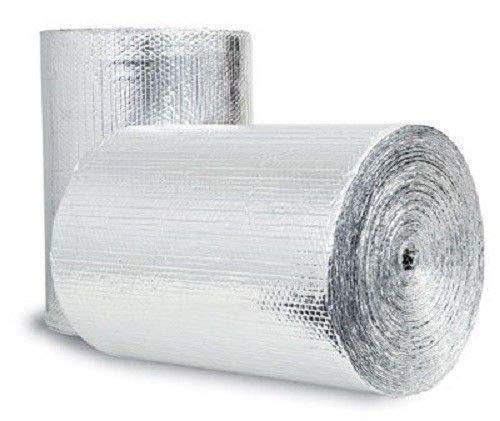
The 6mm double-bubble blanket built for metal buildings baking in direct sun.
When the heat is truly brutal, single-layer foil hits its limit — and that is where this double-bubble roll steps in. It sandwiches two layers of air bubbles between double-sided aluminum foil at 6mm thick, giving it real insulating depth on top of reflecting more than 95% of solar heat. In a Florida conex trailer with no AC, one owner watched interior temps drop from 120°F to about 90°F — a 30-degree swing that made the space livable.
On a metal building with no shade, the results were even more dramatic: ceiling temperature dropped from 160°F down to 100-105°F, with walls adding another 50°F of reduction. That is the kind of performance you want when your roof is a giant heat collector. The 400 sq ft roll (100 feet by 48 inches) is smaller than the 1000 sq ft giants, but the thicker construction means you may not need as much of it.
It is Class 1 / Class A fire rated, weatherproof, and waterproof, with an R-value range of R8-24 depending on your installation. Owners have used it to wrap furnace areas in attics, cutting down dust from blown-in insulation, and to line crawl-space ceilings as an extra vapor barrier. The honest trade-off is cost — this thicker material runs pricier per square foot, and opinions split on whether the value matches for milder climates.
Extreme-heat specialist: a 30-degree drop in an uninsulated metal trailer tells the story.
Premium material, premium price: double bubble costs more, and value opinions split.
Choose this for: metal buildings, conex trailers, and RVs baking in unrelenting sun.
Weigh the cost: it is the priciest per square foot, so milder climates may not need this much shield.
Understanding the Specs
Reflective percentage — the number that matters most
This tells you how much radiant heat the surface throws back instead of absorbing. A barrier that blocks 95% of radiant heat is doing its job; a 99% or 99.7% rating is marginally better but rarely the deciding factor in real-world comfort. What matters more is installing it correctly with an air gap so the foil can actually reflect.
Perforated vs. solid construction
Perforated foil has tiny holes that let water vapor escape, making it the right choice for stapling under roof rafters where moisture needs to breathe. Solid foil is a vapor barrier with near-zero permeability, better suited for attic floors and walls where you want to stop moisture entirely. Pick based on where the roll will live, not just how shiny it is.
Fire rating and ASTM certification
A Class A / Class 1 fire rating means the material meets building-code standards for how it behaves in a fire. ASTM C1313 is the specific standard for radiant barrier classification, covering surface emittance, corrosivity, tear resistance, and more. If a local inspector will check your work, choose a roll that explicitly states it meets these standards.
Roll coverage and weight
Coverage is listed in square feet — a 1000 sq ft roll (4 feet by 250 feet) handles a whole house, while a 500 sq ft roll suits a garage or small attic. Weight signals density: a 28-pound commercial roll is far tougher than a lightweight foil. Heavier means more durable but also harder to maneuver solo in tight spaces.
FAQ
Will radiant barrier rolls actually lower my attic temperature?
Perforated or solid foil — which should I buy?
Can I install radiant barrier over my existing fiberglass insulation?
How many rolls do I need for my attic?
Is a radiant barrier the same as traditional insulation?
Do I need special tools or protective gear to install it?
Will a radiant barrier help in winter too?
What does Class A / Class 1 fire rating mean for my attic?
Can I use attic insulation rolls for windows and RVs too?
Final Thoughts: The Verdict
For the majority of shoppers, the attic insulation rolls winner is the RadiantGUARD Xtreme because its dense 28 lb commercial build and Class A / Class 1 certification make it the most reliable whole-attic solution. If you want a flexible roll for windows, RVs, and garage doors, grab the Reflectix BP24050. And for metal buildings baking in extreme sun, the US Energy Double Bubble 400 is the one to reach for — its 6mm double-bubble core delivered a 30-degree drop in brutal trailer heat.
How We Picked
We do not accept paid placement. Every pick is matched to a real buyer and a real use-case; we do not hands-on test units.
Sources & Methodology
Specifications: manufacturer listings and product documentation. Review insights: verified customer reviews, as of September 2026. Pricing: not shown on this page (it changes often); check the current price via the retailer link.
As an Amazon Associate, Gadgets Feed earns from qualifying purchases. This does not affect which products we feature.