
Our readers keep the lights on and my morning glass full of iced black tea. As an Amazon Associate, I earn from qualifying purchases.
Specs are compiled from manufacturer listings and verified buyer reviews and can change over time — please confirm the key details on the product page before buying.
Living in a rural area, you know the struggle: the indoor antenna you bought picks up two channels, and your internet is too slow to stream much of anything. An antenna placed in your attic is the fix, because it gets you above obstructions and closer to the broadcast towers — it typically pulls in far more channels than a tabletop model ever could. We sorted through the long-range, attic-friendly options (rated for at least 60 miles of range) to find the ones that actually deliver in open country.
I’m Min — the founder and writer behind Gadgets Feed. This guide is built by comparing the manufacturers’ published specifications and the patterns across verified customer reviews, so you get each pick’s real strengths and trade-offs instead of marketing spin.
The best attic tv antenna for rural areas balances raw range with a design that fits above your ceiling and still grabs a clean signal.
Our Picks at a Glance


How To Choose The Best Attic TV Antenna For Rural Areas
Rural reception is a different game than city living. Towers are few, far apart, and often hidden behind hills or trees. Your attic antenna needs to be aimed right, sized right, and paired with the right cable to pull in the stations you actually want. Here is what to check before you buy.
Directional vs. omnidirectional: know your towers
A directional (Yagi) antenna looks like a ladder with rods and must be pointed at the broadcast towers. It concentrates all its power in one direction, so it reaches farther — a real asset when your local towers sit 40, 50, or 80 miles away. An omnidirectional antenna takes everything in from a 360-degree circle, which is handy when your towers are spread out, but it gives up range because the signal is split every direction. If all your channels come from one cluster of towers, choose a directional model.
UHF vs. VHF: the quiet spec that decides everything
Modern antennas split broadcasts into two bands. UHF (channels 14 and up) is where most stations live, and nearly every antenna handles it well. VHF (channels 2 through 13) is trickier — it travels farther but needs longer rods to catch. In rural areas, the strongest signals often come from VHF towers, so an antenna with real, dedicated VHF elements (not a cheap stub) is worth hunting for.
Amplified or passive: when to boost
An amplifier (also called a preamp) strengthens the signal right at the antenna. It helps when you have a long cable run from the attic to your TV, or when you split the signal to two sets. But an amp cannot invent signal that isn’t there — and too strong an amp on a close, strong signal can actually overload and ruin reception. Several of our picks reach the TV fine without one, so treat a built-in amp as a bonus, not a requirement.
Quick Comparison
| Model | Best For | Range | Direction | VHF/UHF | Amazon |
|---|---|---|---|---|---|
| GE Outdoor HD TV Antenna★ Best Overall | Best Overall – rural all-rounder | 80 miles | Directional (Yagi) | VHF + UHF | Amazon |
| Yeceny Digital Amplified AntennaRural Riser | Powered range & dual TVs | 150 miles (ad claims 200) | 360° rotating | UHF / VHF | Amazon |
| AUDIOVOX RCA ANT705ZCompact Classic | Compact attic install | 65 meters (~71 yards) | Directional | High-VHF + UHF | Amazon |
| 1byone Omni-Directional | Set-and-forget signal | 100+ miles | 360° omni | VHF + UHF | Amazon |
| Channel Master Omni+ 50 | Passive reliability, RV/attic | 50+ miles | 360° omni | VHF + UHF | Amazon |
| Antennas Direct Element | Tough rural Yagi | 60+ miles | Uni-directional | VHF + UHF | Amazon |
| Five Star Outdoor Antenna | Budget long-distance reach | 200 miles | Multi-directional | VHF + UHF | Amazon |
| ClearStream 5 Hi-VHF | Weak-channel specialist | 65+ miles (VHF) | Multi-directional | Hi-VHF + UHF | Amazon |
In‑Depth Reviews
1. GE Outdoor HD Digital TV Antenna
Our pick — over 4★ from 650+ verified ratings; the strongest balance of quality and price.
The rural workhorse that pulls in free 4K-ready channels from 80 miles out.
If your rural towers sit in one direction, 30 to 60 miles away, this GE Yagi-style model is the crowd favorite because it pulls in channels reliably. Owners on a rural mountain peak more than 40 miles from broadcast cities report getting 34 free stations, and an attic install under a concrete tile roof at 35 miles delivers four towers with no pixelation. It is rated for signals up to 80 miles away, with a spec sheet listing a 200-channel capability.
The physical footprint is the honest trade-off. At 37 inches long, 26.5 inches wide, and 19 inches tall, this is a big antenna, and while it fits in an attic, the size gets mixed feedback in reviews and some call the build a touch flimsy. The assembly directions also come in for complaints, though most say the actual construction is straightforward. Pair it with a good RG6 quad cable and aim it high, and you get the classic outcome described across review pages: picture quality that beats cable, in storms included.
It is also future-proofed for the next broadcast standard. The GE is NEXTGEN TV (ATSC 3.0) compatible, so you can receive that newer over-the-air format — superior picture and sound, richer color, faster refresh rates — as soon as it reaches your area. And with a limited-lifetime replacement pledge behind it, this is the safest long-term bet on the list for a household cutting the cord for good.
What earns the top spot
- Dependable 80-mile reach that actually delivers 34+ channels in hilly, rural spots
- 4K Ultra HD-ready and NEXTGEN TV (ATSC 3.0) compatible for the future
- Backed by a limited-lifetime replacement pledge from a trusted brand
Know before you mount it
- A large frame — make sure your attic has the clearance
- Assembly instructions are confusing; set aside time to work through them
Your best all-rounder: the GE earns the top slot if your towers sit in one direction 30 to 80 miles away and you want a set-and-forget antenna with room to grow.
Think twice if: your attic is cramped or low — this unit needs real space, so measure your rafters before committing.
2. Yeceny Digital Amplified HDTV Antenna
The powered rotator that spins to find signal without you climbing into the attic.
This Yeceny antenna solves a genuinely rural frustration: figuring out which direction to point the antenna. Instead of climbing up to tweak the angle, you press a button on the included wireless remote and a built-in 360-degree motor rotates the whole unit until the signal locks. It supports two TVs at the same time with no splitter required, and the package includes a 60-foot RG6 coaxial cable so you can run it from the attic straight to your living room.
The amplifier (a built-in low-noise preamp) does real work here — buyers report it boosted their channel count from about 35 up to 80, and another location pulled in 48 channels from stations 40 miles away. The catch is that long-range claims get fuzzy: the listing says 200 miles, the packaging says 150+ miles, and the spec sheet lists a 150-mile max range, so treat 150 miles as the honest figure. Range stays the most-discussed issue, and it is mixed — one buyer at 60 miles got nothing during the day until fiddling with it, though others report great results in the first 40 to 50 miles.
It also handles cable management well, with a snap-together assembly that needs no tools for a roughly 30-minute setup. The rotating motor and rotator work reliably, and the unit is weather-resistant with a lightning protection system. Just know the plastic body is clearly budget-tier — the snap joints want gentle handling, and a loose cable can hurt the signal, so leave it slack.
Why the rotator wins
- Remote-controlled 360° rotation for aiming from the couch
- 60-ft RG6 cable and dual-TV output included for easy attic runs
- Amplifier lifted one buyer’s channels from ~35 to 80
Approach with care
- Advertised 200-mile range doesn’t match the 150-mile spec or packaging
- Plastic build feels cheap; handle the snap joints gently
Pick this for flexibility: its rotating head is the answer if your towers sit in different directions or you want to fine-tune from inside.
Think twice if: you expect 150+ miles — the realistic balance is closer to 50 miles from the towers.
3. AUDIOVOX RCA Attic Heavy Duty Antenna
A featherweight 3-pound antenna that quietly fixes tricky VHF reception.
If your rural problem is specifically weak high-VHF channels (the low-numbered stations that travel farthest and hit hills hardest), this compact RCA model deserves a closer look. It is the smallest physical package on our list — just 9.5 inches long, 2.6 inches wide, and 19 inches tall — making it the easiest to wedge up into a low attic. Owners mention it pulling in high-VHF channels that a UHF-only Yagi missed entirely, which is exactly the gap many rural setups fall into. Its reception quality is the standout, with one buyer reporting 100% VHF and UHF signal strength and another jumping from 23 to 79 channels after mounting it.
Compared with the big GE above, this is a fundamentally different tool. The GE’s 37-inch frame is nearly four times longer than this unit’s 9.5-inch length, making the RCA far easier to fit in tight attics. That compactness is the entire pitch: it is made for tight spaces, and buyers even run it on campers, with one mounting it on a flagpole near Albany, New York and pulling in 35+ channels. It also survived 50-mile-per-hour winds on that camper, a solid durability signal.
The honest limitations: at 65 meters of rated range (~71 yards), this is a short-range specialist, not a 100-mile monster. Buyers consistently find it best at around 35 miles from the towers, ideally with a clear sightline. One buyer received an open-box unit missing hardware, so inspect the box on arrival. It also comes with a J-pole that makes mast mounting a little awkward — most simply install it in the attic and aim it.
Why it stands out
- Catches high-VHF channels that UHF-only antennas miss entirely
- Ultra-compact 9.5″ frame fits low attics and even campers
- 3.0 lb weight makes it a one-hand install
Keep in mind
- Short 65-meter range caps it at roughly 35 miles
- Included J-pole makes mast mounting awkward
Reach for this if: your attic is tight and your missing channels are the low-numbered VHF stations that bigger antennas overlook.
Look elsewhere if: your towers sit much farther than 35 miles — this is a closer-range specialist.
4. 1byone Omni-Directional TV Antenna

The no-aiming-needed design that grabs channels from every direction at once.
If your stations are scattered across the compass, the 1byone is built for you — its 360-degree omnidirectional pickup means you never rotate, aim, or run a remote control to find signal. Just mount it high in the attic, plug in the included 32-foot RG6U cable, and run a channel scan. For boxes in a metro area with towers within 10 to 30 miles, reviewers report 118 to 130+ crisp channels, and the ease of install is among the most-praised aspects of this model.
The trade-off is that omnidirectional reception trades away reach. The advertised 100+ mile range is optimistic for an omnidirectional unit — reviews show the reliable zone is roughly 30 miles or less. Channel count is mixed: in a dense city the count is huge, but one buyer saw it drop from 124 channels down to 70 mostly-shopping channels after moving, and some rural locations report barely getting network affiliates. It also supports only one TV, so if you want a second set you will need a splitter, which divides the signal.
A built-in pre-amplifier and a 4G LTE filter help fight mobile-phone interference and long-cable signal loss — genuinely useful in rural areas where 4G towers are everywhere. It is made of moisture-proof, flame-retardant materials, and the 2-year warranty is a nice safety net. For RV or marine use it is a strong candidate, since it doesn’t care which way it points.
Best when towers surround you: this one shines if your channels come from multiple directions within about 30 miles, and you hate the idea of aiming.
Who should pass: if your nearest towers are 40+ miles away, the omnidirectional design simply can’t reach as far as a aimed Yagi.
5. Channel Master Omni+ 50

The smartly-engineered passive antenna that skips the amplifier and still locks signal.
Channel Master is a name serious cord-cutters trust, and the Omni+ 50 shows why. It is a passive antenna — no amplifier in the path — which matters more than most buyers realize. An amplifier on a strong signal can overload it and wreck reception, which is why one South Florida owner got 122 channels only after removing the preamp. The Omni+ 50 also handles both UHF and VHF with a separate rotatable VHF dipole, so you get true all-band coverage without pointing a giant Yagi at one tower cluster. The 50+ mile range is honest for flat terrain, with one buyer pulling in channels up to 60 miles away.
Compared with the ambitious 200-mile claims on the Five Star or the 150-mile Yeceny below and above, the Channel Master is refreshingly realistic — and it pays off in dependability. The most-praised aspects across its reviews are channel count and build quality; buyers frequently mention getting 53 to 88 channels with outstanding reception and no pixelation. It ships with a mounting bracket for a wall, mast pole, or an existing satellite mount, and it is rated for indoor, outdoor, roof, attic, or RV installs. The 28.75-inch by 9-inch frame is a middle ground — compact enough for an attic, sturdy enough to survive a Florida downpour.
The flip side: some find the 50-mile cap limiting compared with directional rivals, and the mast isn’t included, so an attic full of joists may require a quick pole purchase. A couple of customers note that very extreme fringe ranges sag — one reported it’s “not for long-distance like unidirectional” at the edges. Pair it with a Channel Master preamp if you have a long cable run, but for most attic installs, this one stands alone.
Built to last: largely metal construction, rotatable VHF element, and a smart passive design make this the premium pick for buyers who want reliability over raw range.
The only catch: it tops out around 60 miles on flat ground, so truly remote mountain homesteads should look to a directional model.
6. Antennas Direct Element Uni-Directional

The 44.5-inch-long directional that shrugs off wind, hail, and heavy rural interference.
For rural buyers whose towers sit in one tight cluster, the Antennas Direct Element is engineered to outperform a conventional Yagi. It is a uni-directional antenna with a 60+ mile range rating, and it comes with all-weather mounting hardware designed for an existing mast or an attic. The build quality is a genuine standout — buyers call it “built tough enough to withstand wind and hail” on the Colorado plains, and one owner ran four of them on a 40-foot tower aimed north, south, east, and west to pull 100+ channels. At 44.5 inches long but only 2.6 pounds, it is big but light, so a single pair of hands can manage the attic install.
What really wins people over here is channel reception and a wide beam. One attic install on a PVC pipe, with no amplifier, solved years of windy-weather UHF problems and pushed signal to two TVs plus a Tablo DVR over 100 feet of RG6. The wide beam caught a station sitting 55 degrees off-axis, which a narrow Yagi would have missed. At 25 miles from towers with heavy tree cover, a rural owner found it beat far more expensive amplified antennas — with zero amplification needed and every channel crisp.
Be honest about its limits, though: this is a directional antenna, so it shines only when your towers share one general direction. One review puts it plainly — at 32 miles with mature trees in the way, the signal got weak and unwatchable in wind no matter the height. Trees and terrain remain the enemy. It also has a 4K 8K UHD and NEXTGEN TV compatibility, so it is future-proof for the next broadcast standard.
The rural specialist: if your towers are in one direction and you want a tough, amp-free antenna that reaches 60+ miles, this is the sharpest tool on the list.
Know its weakness: heavy tree cover and obstacles can defeat even this one — it needs a relatively clear path to the towers.
7. Five Star Outdoor HDTV Antenna

The value pick that reaches 200 miles on paper and 50+ miles in real rural homes.
This Five Star antenna is the value play of the list — the one to grab when you want serious range without a premium price tag. It is rated up to 200 miles and supports four TVs, which makes it a tempting option for a whole house. In practice, the numbers hold up remarkably well: a buyer in a rural area 50 miles from the stations assembled it in minutes, set it on the porch, and got 77 channels immediately after indoor antennas had failed completely. Another pulled in 128 OTA channels from 45+ miles away near Houston, and a third got 60 channels from towers 45 miles out even with a 2,500-foot mountain in the way.
What makes it a rural favorite is the multi-directional design and the included kit — you get the antenna, mounting bracket, J-pole, and a TV splitter in the box, plus a 40-foot coax cable in some setups. It handles VHF and UHF, and the extended 46-inch length gives it a larger receiving surface than many rivals. It is also ATSC 3.0 ready, so it can receive the newer broadcast format as it arrives. The value-for-money praise is constant in its reviews, and the easy-install experience is among the most-mentioned aspects.
The catch is the 200-mile claim. That number is technically on the box, but real-world results top out around 50 to 60 miles, and buyers acknowledge that trees, obstacles, and weather make the 200-mile figure pure marketing. Channel count and reception are both praised but reception is explicitly mixed — expect weather and wind to cause occasional channel dropouts, and know that the lightweight metal frame can sway in a stiff breeze. It is lightweight and easy to install, which is a plus in an attic, but the trade-off is that it moves in wind.
Why it’s the value champ
- Real-world 50+ mile reach that beat indoor antennas for rural buyers
- Kit includes bracket, J-pole, splitter, and coax for a full install
- ATSC 3.0 ready and supports up to 4 TVs
The honest limitations
- The 200-mile spec is marketing — expect 50 to 60 miles in practice
- Lightweight build sways in wind, causing occasional channel dropouts
Grab it for the price: if you want a big-range antenna that actually delivers around 50 miles without spending for a premium brand, this is the pick.
skip it if: you demand premium build quality or need a 200-mile reach — neither is on the table here.
8. Antennas Direct ClearStream 5 Hi-VHF
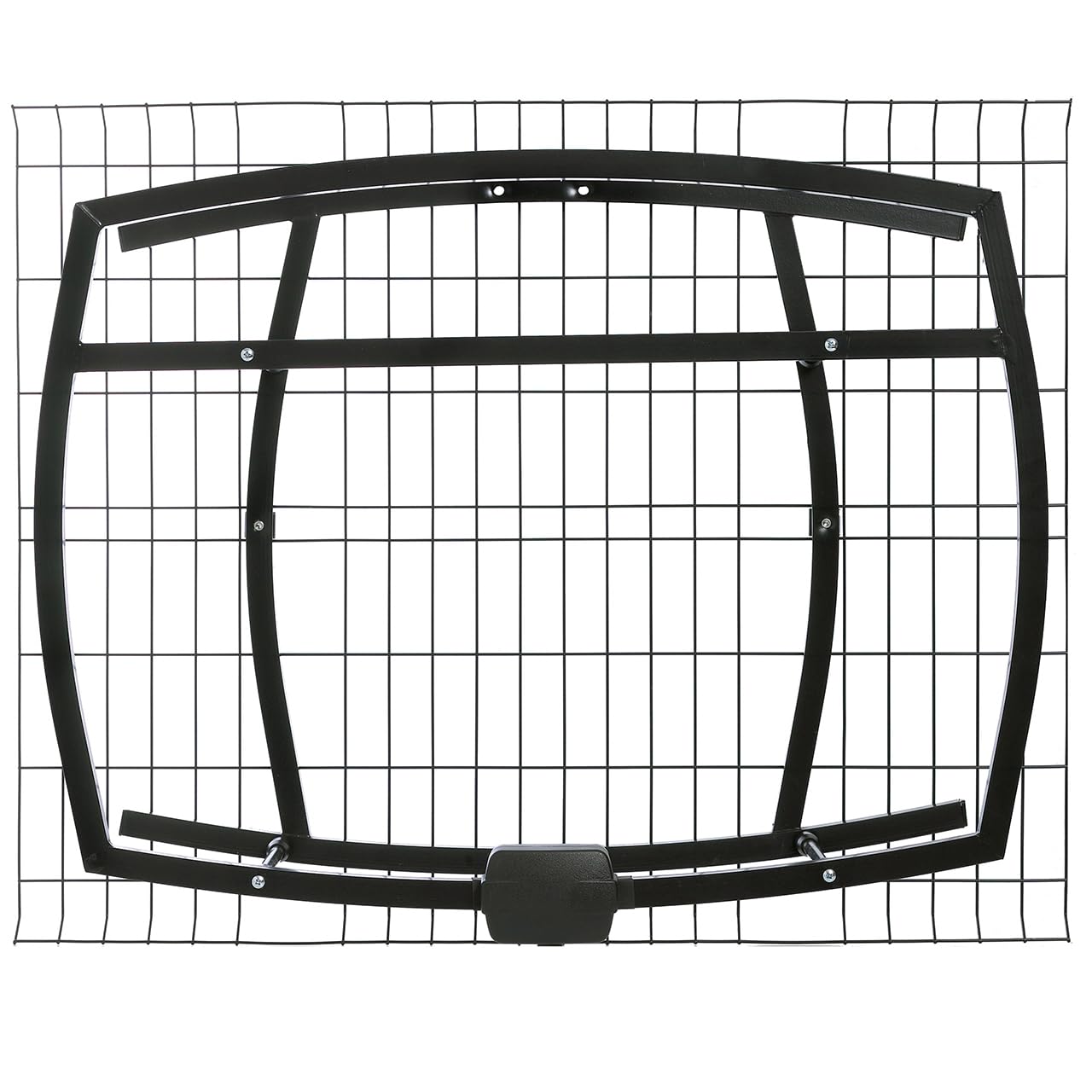
The Hi-VHF specialist that rescues the low-band channels rural homes actually need.
If your rural dead zone is specifically the low-numbered VHF channels (2 through 13), the ClearStream 5 is the specialist you want. It is rated for 65+ miles on Hi-VHF — the band many antennas ignore — and 35+ miles for UHF stations. Reviewers point out VHF signals at up to 47 miles away with 60% to 90% strength, and one owner saw their problem VHF channels jump from 80% to 100% signal. The reliability and signal quality are the most-praised aspects here by a wide margin, and the unit’s reflector adds forward gain to fight the interference that causes pixelation.
At 22.8 inches tall, 28.4 inches wide, and 3.4 pounds, it is a substantial but manageable frame that fits in most attics. The multi-directional design means it doesn’t need rotation, and the included J-mount makes an attic install straightforward — one buyer mounted it in a garage and got steady VHF/UHF reception from towers 18 to 29 miles away. It is also 4K 8K UHD and NEXTGEN TV compatible, so it is ready for the next broadcast standard.
The honest trade-off is that it is built around VHF, and distant UHF is just “OK” per multiple owners — one noted it actually lost 2 UHF channels after install. The box also lacks a VHF/UHF combiner, so combining it with a separate UHF antenna takes extra parts. Long-term durability is a mild question mark, with one owner reporting internal corrosion after about 5 years outdoors in a wet climate. Since the manufacturer’s materials list it as suitable for attic installs, that risk mostly disappears when it is protected above your ceiling.
The VHF fixer: if the channels you are missing are the low-band VHF stations and you don’t need extreme UHF reach, this is the cleanest solution.
One caveat: expect only average results on distant UHF — this unit trades UHF depth for VHF strength.
Understanding the Specs
Range and the 200-mile myth
A “200-mile” range is a marketing number, not a promise. Broadcast towers send signals over the horizon, and real-world reception is set by terrain, trees, your home’s building materials, and how high the antenna sits. Read range as a ceiling, not a guarantee: a 50-mile-rated antenna can beat a 200-mile-rated one if the setup is better. The useful number is what owners in similar terrain actually pull in.
VHF and UHF bands
TV signals arrive in two bands. UHF (channels 14+) is where most stations live, and every antenna here handles it. VHF (channels 2-13) travels farther and punches through hills better, but it needs longer physical elements to capture. If your missing channels are low-numbered, check whether an antenna has true VHF support — it is the difference between a complete channel lineup and a frustrating gap.
FAQ
Why should I put my TV antenna in the attic instead of the living room?
Will an “80-mile” or “200-mile” antenna really reach that far?
Do I need an amplifier for an attic antenna?
What is the difference between a directional and an omnidirectional antenna?
What does NEXTGEN TV (ATSC 3.0) mean for me?
Can one antenna feed multiple TVs in my house?
My attic has a metal roof, does that block the signal?
How do I aim a directional antenna without a signal meter?
Final Thoughts: The Verdict
For most rural users, the attic tv antenna for rural areas winner is the GE Outdoor HD TV Antenna because it pairs a dependable 80-mile reach with 4K and NEXTGEN TV readiness at a price that won’t scare anyone off. If you want the convenience of aiming from the couch, grab the Yeceny with its rotating remote-control head. And for a tight attic where low-band VHF channels are the missing piece, the RCA ANT705Z quietly solves what bigger antennas can’t.
How We Picked
We do not accept paid placement. Every pick is matched to a real buyer and a real use-case; we do not hands-on test units.
Sources & Methodology
Specifications: manufacturer listings and product documentation. Review insights: verified customer reviews, as of August 2026. Pricing: not shown on this page (it changes often); check the current price via the retailer link.
As an Amazon Associate, Gadgets Feed earns from qualifying purchases. This does not affect which products we feature.