
Nothing kills a day on the trails faster than that telltale steam puffing from under the seat. An overheating ATV forces you to stop, wait, and worry about head gasket damage — especially when you’re deep in the woods on a technical climb. The fluid coursing through your radiator is the single most cost-effective upgrade you can make to keep the engine alive and the ride moving.
I’m Min — the co-founder and writer behind Gadgets Feed. I’ve spent countless hours analyzing thermal transfer specs, boiling point margins, and corrosion inhibitor packages so you don’t have to read a hundred product labels yourself.
This guide breaks down the best fluids by formulation chemistry and real-world temp drop claims so you can confidently choose the right atv radiator fluid for your machine.
How To Choose The Best ATV Radiator Fluid
Choosing the right fluid comes down to three factors: your typical riding temperature range, whether you want a drop-in ready mix or a concentrated additive, and how much corrosion protection your existing cooling system needs. Ignore the color of the fluid — focus on the chemistry and the boiling point.
Ethylene Glycol vs. Propylene Glycol
Ethylene glycol (EG) is the standard in most OEM fluids. It offers excellent freeze protection and high boiling point when mixed 50/50, but it’s toxic to pets and wildlife. Propylene glycol (PG) is less toxic and used in products like Engine Ice — it reduces operating temperatures more effectively but offers weaker freeze protection at the same ratio. For deep-winter riding, stick with EG. For summer trail riding and racing, PG delivers better temp drops.
Pre-Diluted vs. Concentrate
Pre-diluted 50/50 fluids (like Red Line Supercool or the Cyclemax Yamalube-compatible pack) pour straight into the radiator with zero guesswork. Concentrated additives (like Maxima Cool-Aide) require you to measure and mix with distilled water, offering more customization for extreme conditions but demanding careful measurement. A wrong ratio can actually reduce heat transfer — so read the label before pouring.
Waterless Coolant: The Permanent Option
Waterless coolants like EVANS Powersports contain zero water, which means no corrosion, no electrolysis, and no cavitation erosion. They also have a much higher boiling point (over 375°F). However, they require a complete system flush to remove every trace of water before installation. Once in, they last indefinitely — making them ideal for race machines and desert rigs where you cannot afford a coolant change mid-season.
Quick Comparison
On smaller screens, swipe sideways to see the full table.
| Model | Category | Best For | Key Spec | Amazon |
|---|---|---|---|---|
| Engine Ice TYDS008-03 | Propylene Glycol | Temperature Drops | Boil-over at 256°F | Amazon |
| EVANS Powersports | Waterless | Eliminating Corrosion | Boil-over above 375°F | Amazon |
| Red Line 81215 Supercool | 50/50 Pre-Dilute | Universal Fit | Temp reduction up to 20°F | Amazon |
| Engine Ice TYDS008C | Propylene Glycol | Bulk / Multi-Vehicle | Boil-over at 256°F (4-pack) | Amazon |
| BRP XPS (Case of 6) | OEM Pre-Mix | Can-Am / Ski-Doo Owners | 1 QT per bottle, case of 6 | Amazon |
| CYCLEMAX 4-Pack | OEM-Compatible | Yamaha YAMALUBE Replacement | 60/40 pre-dilute ratio | Amazon |
| Maxima Cool-Aide (12-Pack) | Concentrated Additive | Racing / Custom Mixes | Treat rate: 3% concentrate | Amazon |
In‑Depth Reviews
1. Engine Ice TYDS008-03 High Performance Coolant, 0.5 Gallon, 3 Pack

Engine Ice sits in the sweet spot of the ATV radiator fluid market because it uses propylene glycol chemistry instead of standard ethylene glycol. This formulation pulls heat away from the engine core more aggressively — independent lab testing shows an average operating temperature drop of 10 to 20 degrees Fahrenheit compared to traditional green coolant. The three-pack arrives ready-to-use with deionized water, so there is no measuring or mixing required. The phosphate-free OAT technology also provides long-term protection against corrosion and scale buildup inside the radiator channels.
Real-world owners on sport quads and utility machines consistently report fans cycling less frequently and slower heat rise during technical, low-speed crawling. A Can-Am X3 owner noted a 30-degree drop by combining Engine Ice with an APR radiator shield. The critical trade-off is freeze protection: this fluid only guards down to -7°F, which is marginal for sub-zero winter riders. If you ride in genuine arctic conditions, a standard EG mix may still be better for the coldest months.
For the vast majority of ATV owners who ride in moderate to hot climates, the temperature suppression alone justifies the premium over generic parts-store coolant. The reduced toxicity of propylene glycol is also a genuine benefit for riders who frequently flush systems near campsites or watering holes. This three-pack gives you enough volume to run two full ATV flushes or one large UTV system.
Why it’s great
- Delivers 10-20°F temp drop consistently across multiple vehicle types
- Propylene glycol formula is less toxic than standard EG coolant
- Pre-mixed with deionized water for instant out-of-box use
Good to know
- Freeze protection limited to -7°F — not ideal for extreme winter riding
- Higher cost per gallon compared to conventional green antifreeze
2. EVANS Coolant Powersports Waterless Engine Coolant (Gallon, 1 Pack)

EVANS Powersports is not a coolant in the traditional sense — it contains zero water, which completely eliminates the root cause of nearly every radiator failure: corrosion, electrolysis, liner pitting, and water pump cavitation erosion. The boiling point exceeds 375°F, meaning your engine can climb a sand dune at full throttle in 110°F desert heat without a single bubble of vapor lock. Race teams have trusted this chemistry for years precisely because it removes the water variable from the thermal equation.
Installation demands discipline. You must drain all water-based coolant, then use EVANS Prep Fluid to flush every trace of moisture from the system — the manufacturer explicitly warns against mixing with any water. One Suzuki Boulevard rider solved chronic highway overheating by switching, reporting the fan rarely turns on even in summer traffic. The payoff is a permanent fluid: EVANS does not degrade or need replacement like water-based coolants, so a single fill can last the life of your engine if you keep the system sealed.
The obvious limitation is cost and commitment. A single gallon covers most ATV systems but costs more per fill than conventional coolant. And if you ever need to top up on the trail, you cannot just pour in water or standard antifreeze — you must carry EVANS or risk contamination. This makes it best suited as a premium, long-term solution for a dedicated machine you plan to keep for years.
Why it’s great
- Zero water means zero corrosion, cavitation, or electrolysis inside the system
- Over 375°F boiling point eliminates vapor lock in extreme heat
- Permanent fill — never needs replacement if system remains sealed
Good to know
- Requires complete system flush with prep fluid before installation
- Cannot mix with water or standard coolant — must carry EVANS for trail top-ups
3. Red Line 81215 Supercool Performance Antifreeze/Coolant, 1 Gallon

Red Line has a reputation among automotive enthusiasts for building track-ready lubricants and fluids, and the 81215 Supercool continues that tradition in ATV-compatible packaging. This is a 50/50 pre-diluted formula that maximizes cooling system performance by improving heat transfer efficiency — real-world users report operating temperature reductions of up to 20 degrees Fahrenheit over standard OEM coolant. The cavitation corrosion and erosion protection package is especially valuable for high-revving ATV engines that vibrate hard enough to churn air pockets into the coolant stream.
The formulation is universal: it works in gas and diesel engines and is safe for cast iron, aluminum, and brass systems regardless of coolant color. One Florida rider towing a heavy load with a built Durango reported a 15-degree drop compared to store-brand antifreeze even in high humidity. The five-year or 150,000-mile service life means you can install this and essentially forget about it through multiple riding seasons.
The single practical downside is that this is designed primarily for automotive use, so some ATV-specific tests like side-by-side thermal cycling under extreme vibration are less documented than products built exclusively for powersports. However, for riders who want the broadest possible compatibility (ATV, UTV, truck, car) from a single gallon, Red Line Supercool delivers proven thermal performance at a mid-range price point.
Why it’s great
- Up to 20°F temp reduction with enhanced heat transfer chemistry
- 5-year / 150,000-mile service life for long-term use
- Safe for all engine metals and coolant colors in gas and diesel engines
Good to know
- Primarily designed for automotive — less ATV-specific thermal cycle testing
- Individual gallon size may not fill larger UTV systems without a second bottle
4. Engine Ice TYDS008C High Performance Coolant, Case of 4

This is the same Engine Ice formula from the three-pack above but packaged as a case of four half-gallon bottles (256 total fluid ounces). The bulk configuration is ideal for households with multiple liquid-cooled vehicles — motorcycles, ATVs, UTVs, and even side-by-sides. The propylene glycol chemistry delivers the same 10-20°F temperature reduction that makes Engine Ice the most popular aftermarket coolant in powersports forums. OAT technology prevents silicate dropout and scale deposit, keeping radiator tubes clear over multiple flush cycles.
Users consistently report the most dramatic improvements on machines that previously suffered from chronic heat soak in slow-speed terrain. A Harley owner noted all his “toys” — bike, SxS, and tractor — ran at least 15 degrees cooler after switching. A Can-Am X3 owner who tried multiple cooling solutions found this finally solved his overheating in a single fill. The lower toxicity compared to ethylene glycol is a recurring reason for brand loyalty among riders who flush systems outdoors or near animals.
The case format makes this a commitment — you are buying four bottles upfront. That volume makes sense for a two-ATV household or a single UTV that needs a large capacity fill plus a spare quart for top-ups. The freeze protection ceiling of -7°F remains the same as the smaller pack, so deep-winter riders should evaluate whether they need a winter-specific mix for the coldest months. For everyone else riding in spring through fall, this is the most cost-effective way to buy the best-performing propylene glycol fluid on the market.
Why it’s great
- Bulk case reduces per-bottle cost for multi-vehicle owners
- Proven 10-20°F temp reduction with less toxic propylene glycol
- OAT formula resists silicate deposits over multiple seasons
Good to know
- Large upfront purchase — only practical if you need multiple bottles
- -7°F freeze point insufficient for sustained sub-zero winter riding
5. BRP Ski-Doo Can-Am XPS Pre-Mix Antifreeze/Coolant Quart, Green (Case of 6)
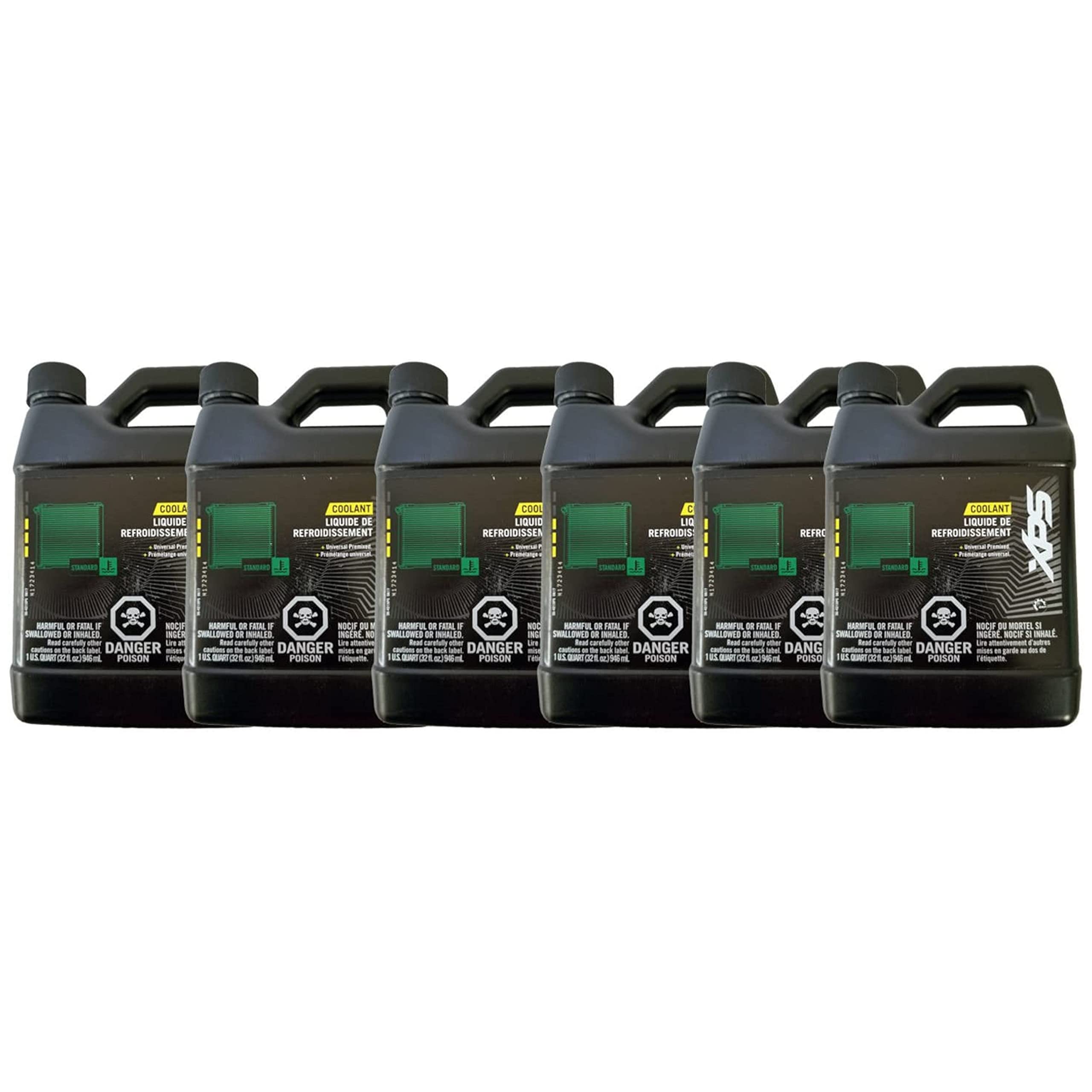
If you own a Can-Am ATV or a Ski-Doo snowmobile, this XPS Pre-Mix is the exact fluid BRP engineers validated for Rotax engines. The anti-corrosive additive package is specifically tuned for the aluminum and magnesium alloys used in those powerplants, which means zero guesswork about chemical compatibility. Each quart is pre-mixed and ready to pour directly into the reservoir — no water, no measuring, no ratio calculations. The case of six gives you generous coverage for a full system drain-and-fill plus several top-ups throughout the season.
BRP owners appreciate the peace of mind that comes with OEM-spec fluid. A full system flush with generic coolant can leave residue that interacts unpredictably with the Rotax water pump seal material. Using the factory formulation eliminates that risk entirely. The quart size is also convenient for trail-side top-ups — you can stash two bottles in a cargo box without taking up the space of a full gallon jug.
The limitation here is brand lock-in. This fluid is formulated for BRP products and while it will technically work in other engines, you are paying a premium for OEM validation that only benefits Rotax engines. For non-BRP owners, the value proposition weakens. Additionally, the case format means you are committing to six quarts — if you only need a single fluid change, you will have leftover bottles that must be stored properly.
Why it’s great
- Factory-engineered for Rotax engines in Can-Am and Ski-Doo vehicles
- Pre-mixed and ready to use in convenient quart bottles
- Anti-corrosive additives matched to BRP aluminum and magnesium alloys
Good to know
- Brand-specific — optimized only for BRP products, less value for others
- Case of 6 may exceed what a single ATV needs for one flush
6. CYCLEMAX Four Pack Compatible with Yamaha Yamalube Pre-Diluted Anti-Freeze
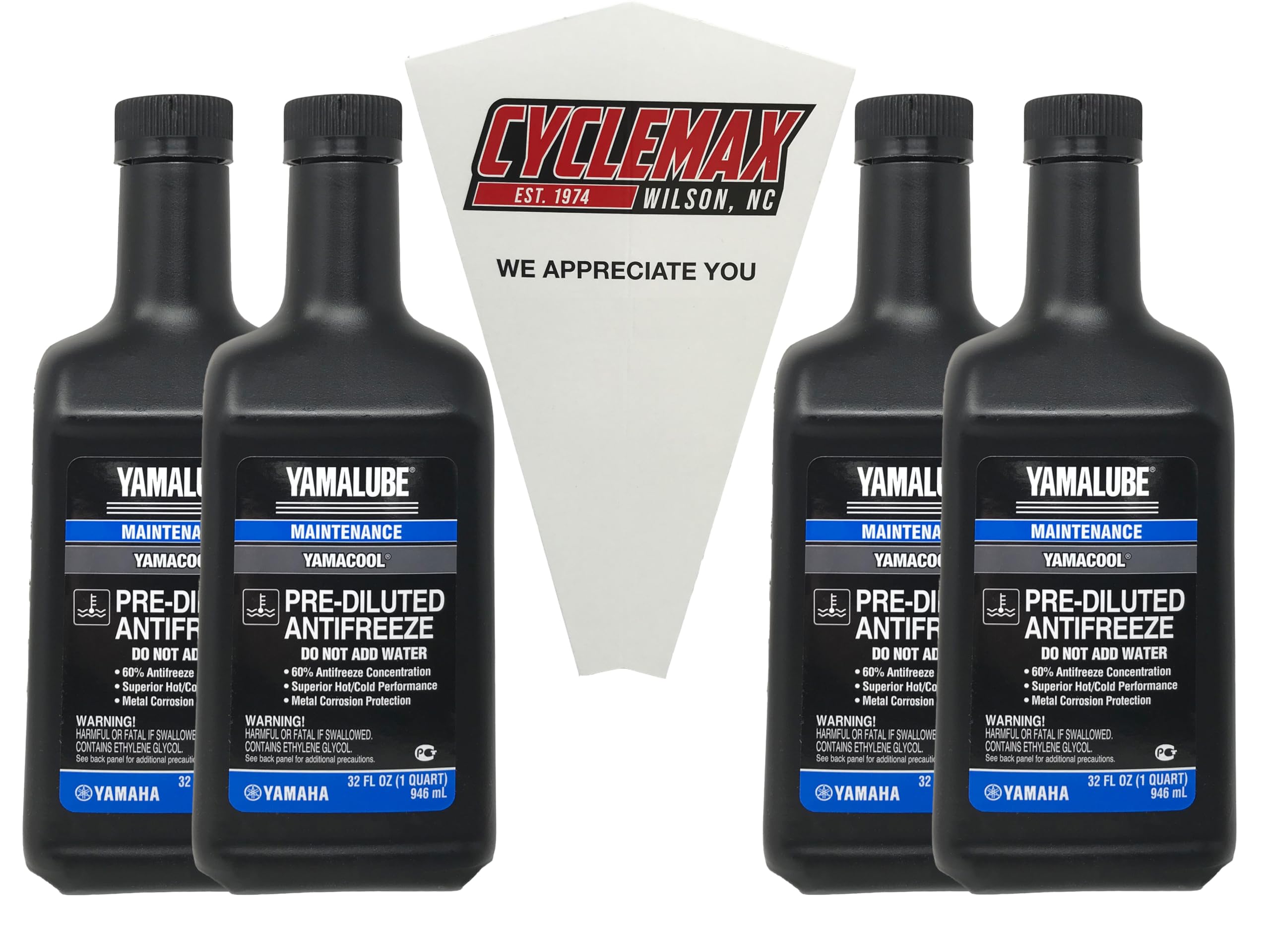
Cyclemax offers a direct alternative to Yamaha’s YAMALUBE ACC-YAMAC-BL-32 at a lower per-quart cost. The pack includes four quarts of pre-diluted ethylene glycol antifreeze and a disposable funnel — everything you need for a full drain-and-fill on a standard Yamaha ATV. The 60/40 coolant-to-water ratio leans slightly more concentrated than the common 50/50 blend, providing marginally better freeze protection without requiring you to mix anything yourself.
Customer feedback highlights the value proposition — owners of Yamaha Grizzly, Kodiak, and Wolverine models report this as an indistinguishable substitute for the branded OEM fluid at a noticeably lower total cost. The included funnel eliminates the need to hunt for a spare piece of equipment when you are already elbow-deep in a radiator drain. The ethylene glycol base includes a bittering agent (denatonium benzoate) for safety, reducing the risk of accidental ingestion by children or pets.
The obvious catch is shipping reliability. Multiple buyers note that one bottle in the four-pack occasionally arrives damaged or leaking due to handling — the plastic quart jugs are not the most robust packaging. If you can source this locally, you avoid that risk entirely. The formula is also a straightforward EG coolant with no advanced OAT or propylene glycol enhancements, so it will deliver standard thermal performance rather than the temperature drops promised by Engine Ice or EVANS.
Why it’s great
- Direct OEM-equivalent for Yamaha YAMALUBE at a lower cost per quart
- 60/40 pre-dilute ratio provides extra freeze margin out of the bottle
- Includes a disposable funnel for a complete DIY flush kit
Good to know
- Quart bottles may leak or break in transit due to thin plastic packaging
- Standard EG formulation — no advanced cooling additives for temp reduction
7. Maxima CS84916-12PK Cool-Aide Concentrated Motorcycle/ATV Racing Coolant
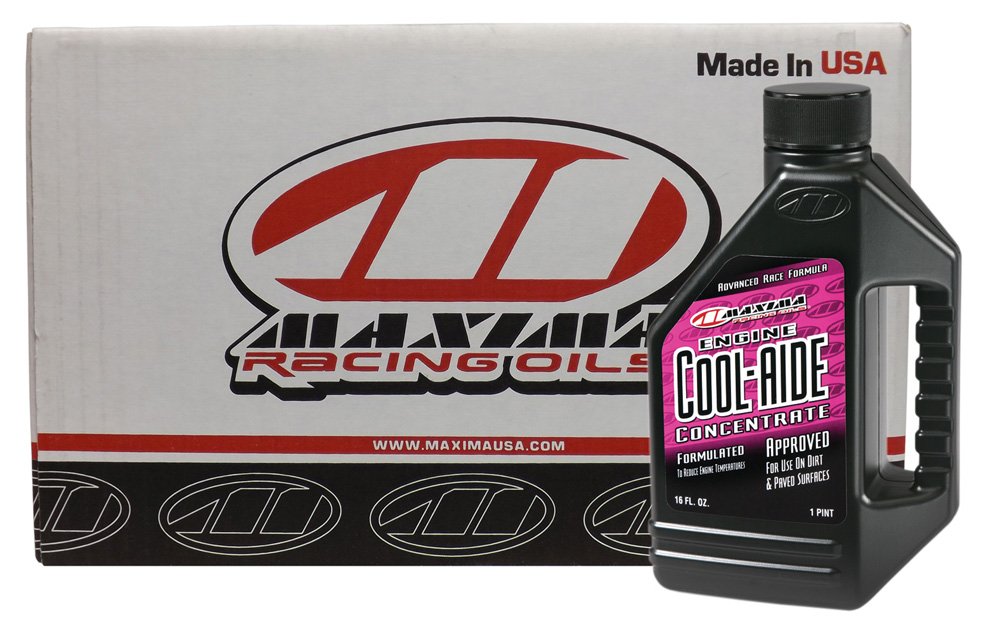
Maxima Cool-Aide is not a drop-in replacement coolant — it is a highly concentrated additive designed to be mixed with your existing water and antifreeze at a 3% treat rate. The formulation improves surface contact on heated engine passages, pulling heat away from cylinder walls more efficiently than water alone. It is glycol-, nitrate-, amine-, and borax-free, making it compatible with virtually any base coolant chemistry. The case of 12 16-ounce bottles provides enough concentrate for roughly 48 gallons of mixed coolant, making this a fleet-friendly option for shops or serious riders.
Racers love Cool-Aide because it is approved for use on paved surfaces and is 100% biodegradable in its unused form. The concentrate format allows you to dial in the additive level based on your specific engine load — weekend trail riders can use the minimum 3% treat, while hardcore desert racers can bump it slightly higher for aggressive heat rejection. One track rider reported an observable temperature drop immediately after the swap, noting the gauge reading lower than the previous brand on the same circuit.
The major caveat is that Cool-Aide offers zero freeze protection on its own. It is a performance enhancer, not a primary coolant. If you use it, you must still maintain proper antifreeze concentration for your climate. A small number of users also report no noticeable difference, which could be due to improper dilution or a healthy cooling system that already operates within spec. This is an additive for fine-tuning, not a fix for a clogged radiator or failed water pump.
Why it’s great
- Concentrated additive maximizes heat transfer without changing base coolant chemistry
- 100% biodegradable in unused form and approved for paved race use
- 12-pack provides massive value for multi-bike or racing teams
Good to know
- Provides zero freeze protection — requires proper antifreeze for your climate
- Results vary significantly based on dilution accuracy and system condition
FAQ
Can I mix different brands of ATV radiator fluid in the same system?
How often should I change the radiator fluid in my ATV?
Does the color of ATV coolant indicate anything useful?
Final Thoughts: The Verdict
For most users, the atv radiator fluid winner is the Engine Ice TYDS008-03 because the propylene glycol chemistry delivers measurable 10-20°F temperature drops while being less toxic than standard coolant and easier to use than waterless alternatives. If you want absolute corrosion elimination and a permanent fill, grab the EVANS Powersports. And for budget-conscious Yamaha owners who just need a reliable OEM-compatible replacement, nothing beats the CYCLEMAX 4-Pack.