
Our readers keep the lights on and my morning glass full of iced black tea. As an Amazon Associate, I earn from qualifying purchases.
Specs are compiled from manufacturer listings and verified buyer reviews and can change over time — please confirm the key details on the product page before buying.
If you are chasing every last degree of cooling for a hot CPU or a flagship GPU, the case you choose matters as much as the cooler on the chip. A glass-fronted tower can choke your components; an airflow-focused case with a mesh front panel lets them breathe. This guide compares the best airflow ATX cases on the market, focusing on front-panel ventilation, included fans, and real-world compatibility.
I’m Min — the founder and writer behind Gadgets Feed. This guide is built by comparing the manufacturers’ published specifications and the patterns across verified customer reviews, so you get each pick’s real strengths and trade-offs instead of marketing spin.
We break down 9 top-rated models to help you find the right atx case for airflow, from budget-friendly mesh towers to premium dual-chamber showpieces.
Our Picks at a Glance


How To Choose The Best ATX Case For Airflow
Choosing a case for airflow isn’t just about picking the one with the most fans. You need to look at the whole system: how air gets in, how it moves across your components, and how it gets out. A well-ventilated case keeps your CPU and GPU cooler, which can help them maintain higher boost clocks during gaming or heavy workloads.
Mesh Front Panels Are the Foundation
The single biggest factor in airflow is the front panel. A solid glass or metal front blocks intake fans, no matter how fast they spin. Look for a mesh or perforated steel front that lets fans pull in air freely. This is the defining feature of any true airflow case.
Fan Size, Speed, and Air Pressure
Bigger fans move more air at lower speeds, meaning less noise. A 140mm fan is generally better than a 120mm fan for this reason. Fan speed, measured in RPM (revolutions per minute), tells you how fast the blades spin, but it doesn’t tell you how much air they push. That’s measured in CFM (cubic feet per minute). Static pressure, measured in mm-H2O (millimeters of water column), is how well a fan can push air through a dense mesh or a radiator.
Component Clearance and Radiator Support
Make sure your case can hold your parts. Check the maximum GPU length in millimeters so your graphics card fits. If you plan to use a liquid cooler, verify the radiator size it supports on the top and front. A case that supports a 360mm radiator gives you a lot of flexibility for high-end cooling.
Quick Comparison
| Model | Best For | Max GPU Length | Pre-Installed Fans | Max Radiator Support | Amazon |
|---|---|---|---|---|---|
| MONTECH XR Panoramic★ Best Overall | Showcase Builds | 40-series GPUs | 3x 120mm ARGB | 360mm (Top) | Amazon |
| Lian Li V100-ATXTop Performer | High-End Compatibility | 420mm | 4x 120mm ARGB | 360mm (Top) | Amazon |
| LIAN LI LANCOOL 207Best Value | GPU-Focused Cooling | 410mm | 2x 140mm & 2x 120mm | 360mm (Top) | Amazon |
| CORSAIR 4000D RS Frame | Modular Customization | Large GPUs | 3x RS PWM Fans | 360mm (Multi) | Amazon |
| MONTECH AIR 903 MAX | High Airflow Value | 400mm | 4x 140mm PWM | 360mm (Front/Top) | Amazon |
| be quiet! Pure Base 501 | Quiet Operation | Full-Size GPUs | 2x 140mm Pure Wings 3 | 360mm (Front) | Amazon |
| NZXT H7 Flow | Large Radiator Support | Large GPUs | 3x 120mm Fans | 420mm (Front) | Amazon |
| NZXT H9 Flow | Dual-Chamber Showcase | High-End GPUs | 4x Fans (3x 140mm, 1x 120mm) | 420mm (Top/Front) | Amazon |
| Lian Li Lancool 216 | Ultra-Quiet High Airflow | 392mm | Dual 160mm & 1x 140mm | 360mm (Top/Bottom) | Amazon |
In‑Depth Reviews
1. MONTECH XR Panoramic
Our pick — over 4.5★ from 750+ verified ratings; the strongest balance of quality and price.
A panoramic tempered-glass showcase that doesn’t strangle your components on airflow.
The MONTECH XR is the crowd favorite for good reason — it delivers a premium, show-off look without sacrificing cooling. It comes with 3 pre-installed ARGB fans spinning up to 1500 RPM, with two reverse-blade units on the side and one regular fan at the rear. That setup pulls cool air in across your GPU and pushes hot air out the back efficiently. Buyers report it as a “Spacious, builder-friendly ATX mid-tower” that makes cable management easy with clear instructions.
What makes this case special is how much it fits for the size. It supports a 360mm radiator at the top and accommodates high-end 40-series GPUs, so you are not boxed in if you upgrade later. Over a hundred owners praise the clean look and component showcase. The tempered glass is a fingerprint magnet, though, and the push-in glass clips take a gentle touch to install.
Cooling performance depends on your setup — an i9 13th-gen chip will still want a 360mm AIO to stay cool. The structure is rigid and solid, and it includes everything you need like zip ties, screws, and mounts for HDDs and SSDs. For a first-time builder or an enthusiast wanting a clean, airy build, this is an outstanding value.
What wins people over: The design is the headline here — 108 owners call it out as the top reason to buy, with value for money a close second.
The honest trade-off: The glass is a fingerprint magnet and some noisy fan behavior shows up when you push it hard; a custom fan curve quiets it down.
Reach for this if: you want a showpiece build with strong airflow, RGB fans, and room for a 360mm AIO without spending a fortune.
Look elsewhere if: you are noise-sensitive — the stock fans can get loud without tuning.
2. Lian Li V100-ATX
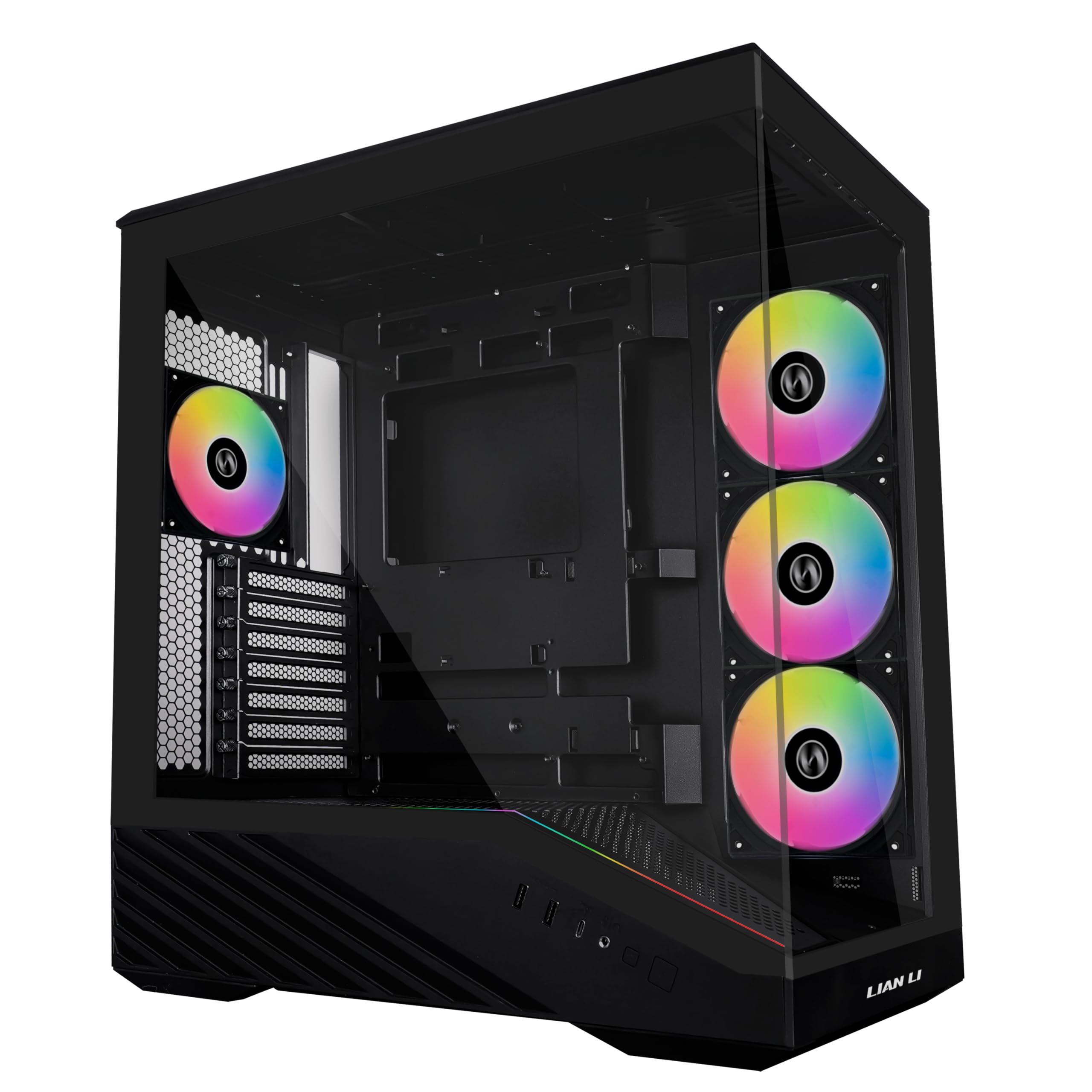
A pillarless-glass stunner with four RGB fans and class-leading GPU room for big air-cooled rigs.
The Lian Li V100 is built for builders who want both looks and serious component clearance. It ships with 4 pre-installed PWM-controlled 120mm ARGB fans, and the integrated 26-LED ARGB strip syncs with your motherboard for full-spectrum color. It also carries an integrated 26-LED ARGB strip for full-spectrum color control, making the interior pop through the pillarless glass.
Compatibility is this case’s a neat extra. A 360mm radiator fits on top, and the four internal bays double the storage options of the LANCOOL 207. Owners praise the labeled parts and tool-less side panels for fast, easy access.
You get strong airflow with quiet stock fans, so your GPU stays in the mid-high 60s°C under heavy 1440p gaming. Cable management gets tight if you add a hub, and storage is basic: one HDD and one 2.5″ SSD slot. Because the design is open and pillarless, sound isolation is poor, so you will hear your system under load. For a budget-friendly case with premium looks and 420mm of GPU clearance, it’s a solid pick.
Why the 4-fan setup wins
- Four ARGB PWM fans push strong airflow, with a max fan speed of 1800 RPM
- Hydraulic bearing fans keep noise at 26.5-30.8 dBA
- Pillarless glass gives a clear showcase view
Where it gets cramped
- Cable area behind the tray is tight with hubs
- Only one HDD and one 2.5″ SSD slot
Pick this for: a high-end GPU up to 420mm, a clean RGB showcase, and excellent quiet airflow.
Note the limits: storage is minimal and sound isolation is thin due to the open design.
3. LIAN LI LANCOOL 207
A compact mid-tower that stuffs four fans and a GPU anti-sag bracket into a clever front-PSU layout.
The LANCOOL 207 rethinks the ATX layout to squeeze maximum cooling into a smaller frame. It puts the power supply at the front, which frees up space below the motherboard for two 120mm PWM fans that blow directly under the GPU. A pre-installed GPU anti-sag bracket keeps even massive graphics cards level, preventing long-term sag damage.
This case is all about keeping your graphics card cool. The two front 140x140x30mm ARGB fans reach up to 1900 RPM with an infinity mirror center, and the two bottom fans spin up to 1950 RPM. That’s a 27% higher max fan speed than the MONTECH XR above. Owners who downsized from full towers report their RTX 5080 fits perfectly with room to spare, and the front-PSU design makes cable routing clean and easy.
It supports graphics cards up to 410mm and a 360mm radiator on top. Build quality is sturdy SECC steel, and the tool-less panels make access simple. The catch: the front fans can hum or resonate, though a fan curve or rubber gaskets fix it, and the 2 internal bays offer limited storage. For the price, it’s an exceptional value for GPU-focused builds.
The standout feature: The dual bottom fans under the GPU provide cooling no other case in this list matches for graphics cards.
Who it’s not for: Builders wanting lots of internal drive bays — the front-PSU layout caps you at 2.
Reach for this if: you run a hot, powerful GPU and want direct, dedicated cooling plus a compact footprint.
skip it if: you need more than two internal drive bays for storage.
4. CORSAIR 4000D RS Frame

A case that lets you slide fans anywhere with the InfiniRail system and swap panels as your rig evolves.
The CORSAIR 4000D RS Frame is built for tinkerers. Its FRAME modular system means you can upgrade the motherboard tray or swap the front I/O panel later — a case that changes with your build. The InfiniRail mounting system lets you slide fans anywhere on the front or roof, mounting fans up to 200mm, so you target airflow exactly where you need it.
It ships with 3 CORSAIR RS PWM fans, which support daisy-chainable 4-pin PWM connections and a Zero RPM mode for near-silent operation at low loads. The 3D Y-pattern airflow front panel is perforated in a low-obstruction path for cool air, and you can remove the internal side panel to mount fans for extra cooling. Owners praise the flexible layout and clean cable management, with 64 highlighting the design.
One big draw is the radiator support: it fits 360mm radiators in three locations — top, front, and side. It also supports reverse connector motherboards like ASUS BTF and MSI Project Zero for a cable-free look. The glass panel is tricky to remove upright and the motherboard tray has minor flex, but the build quality and modularity are excellent for the price.
The flexibility payoff
- InfiniRail slides fans to any position on front and roof
- Supports 360mm AIO in three locations
- Zero RPM mode for silent low-load operation
Small quirks to know
- Glass panel is hard to remove safely upright
- No rubber grommets on some wire routes
This is for: enthusiasts who love customizing fan layouts and want a case that can grow with new parts.
Think twice if: you want a simple, fixed-layout case — the modular system adds setup complexity.
5. MONTECH AIR 903 MAX

Four 140mm fans and a 51% ventilation rate make this the airflow barnstormer of the list.
The MONTECH AIR 903 MAX throws everything at cooling. The metal front panel boasts a 51% ventilation rate, meaning over half the front is open mesh for air to flood in. It comes with 3x HP140 ARGB fans and 1x HP140 fan in the rear, all 140mm and PWM-controlled, with an LED/PWM controller that delivers 21 lighting effects.
This case supports 360mm AIO coolers at both the front and top, and gives you 180mm of clearance for tall CPU tower coolers. It accommodates graphics cards up to 400mm long and 190mm wide, so even the biggest RTX 40-series cards slide in easily. First-time builders find it easy with a tool-less HDD cage and magnetic dust filters.
The main trade-off is noise — the stock fans are loud at default settings. A custom fan curve makes it silent, and the RGB is a fun touch. It’s a very large mid-tower with about 5 inches of unused front space, so it won’t suit a small desk. For raw airflow per dollar, this is one of the best values on the market.
The thing everyone raves about: Case quality leads the praise — 94 owners call it out — with value for money and airflow close behind.
The honest catch: The front fans are powerful but loud; set a custom fan curve or accept the noise.
Reach for this if: you want max airflow with four 140mm fans and room for a 360mm AIO up top.
Look elsewhere if: your desk is small — this is a large tower with generous front overhang.
6. be quiet! Pure Base 501 Airflow

A stealthy, sound-dampened tower that draws cool air from almost every direction while staying whisper-quiet.
The be quiet! Pure Base 501 is for anyone who hates fan noise. It includes 2 preinstalled Pure Wings 3 140mm PWM fans with airflow-tune blades that cut turbulence and noise. The side panels carry sound-dampening material, and the design pulls cool air from nearly all directions — a design owners praise for its effective cooling.
The case supports up to three front fans or a 360mm radiator, and up to three top fans or a 240mm radiator. The PCIe slots rotate 90° for vertical GPU mounting, with an optional riser cable to prevent GPU sag. It features a front I/O with USB 3.2 Gen. 2 Type C and dual Type A ports for fast access.
Build quality is excellent — owners note the captive screws, foam dampening, and silent fans. It supports 6 storage drives, so it’s practical for builds with multiple drives. The front USB ports lack a flared entry making them hard to insert, and one owner reported a dead port. For a quiet, minimalist, German-engineered case, this is a top pick.
The strongest trait: Quiet operation is the headline — 10 owners call it out, and quality leads with 14 mentions.
The trade-off: The front USB ports are tight to insert and one port can arrive dead — a minor QC quibble.
Reach for this if: you want a low-key, near-silent build with vertical GPU mounting and 6-drive storage support.
Not ideal if: you want RGB — this is a clean, non-flashy design by nature.
7. NZXT H7 Flow

A spacious mesh tower that swallows a monster 420mm front radiator and three intake fans from the start.
The NZXT H7 Flow is for builders who plan big. It supports up to a 420mm radiator in the front and a 360mm on top, giving you enormous liquid-cooling headroom. It comes with three front-mounted 120mm fans for solid out-of-the-box cooling, and the high-performance mesh panels boost intake and exhaust while filtering dust.
A standout feature is the dedicated GPU cooling — it supports three bottom-mounted 120mm fans that blow directly on your graphics card while keeping a narrow mid-tower footprint. Owners mention installing 10 fans and feeling the airflow improve noticeably. The cable management system uses wide channels, built-in hooks, and included straps for easy routing.
The mesh on every panel is a big draw for airflow purists. The build quality is sturdy, and one owner fit an Arctic 420 AIO in the front without issues. The included fans are 3-pin (non-PWM), so you can’t control their speed precisely, and there are no dust filters on all intakes. It is a large case — one owner calls it a full tower in size — so measure your space.
What wins people over: Overall quality leads the praise — 54 owners call it out — with space and airflow close behind.
The honest catch: The stock 3-pin fans lack PWM control, and there are no dust filters on every intake.
Reach for this if: you plan a huge custom loop or a 420mm radiator and want a roomy, mesh-paneled mid-tower.
pass on it if: you need precise fan control from the included fans or a compact footprint.
8. NZXT H9 Flow
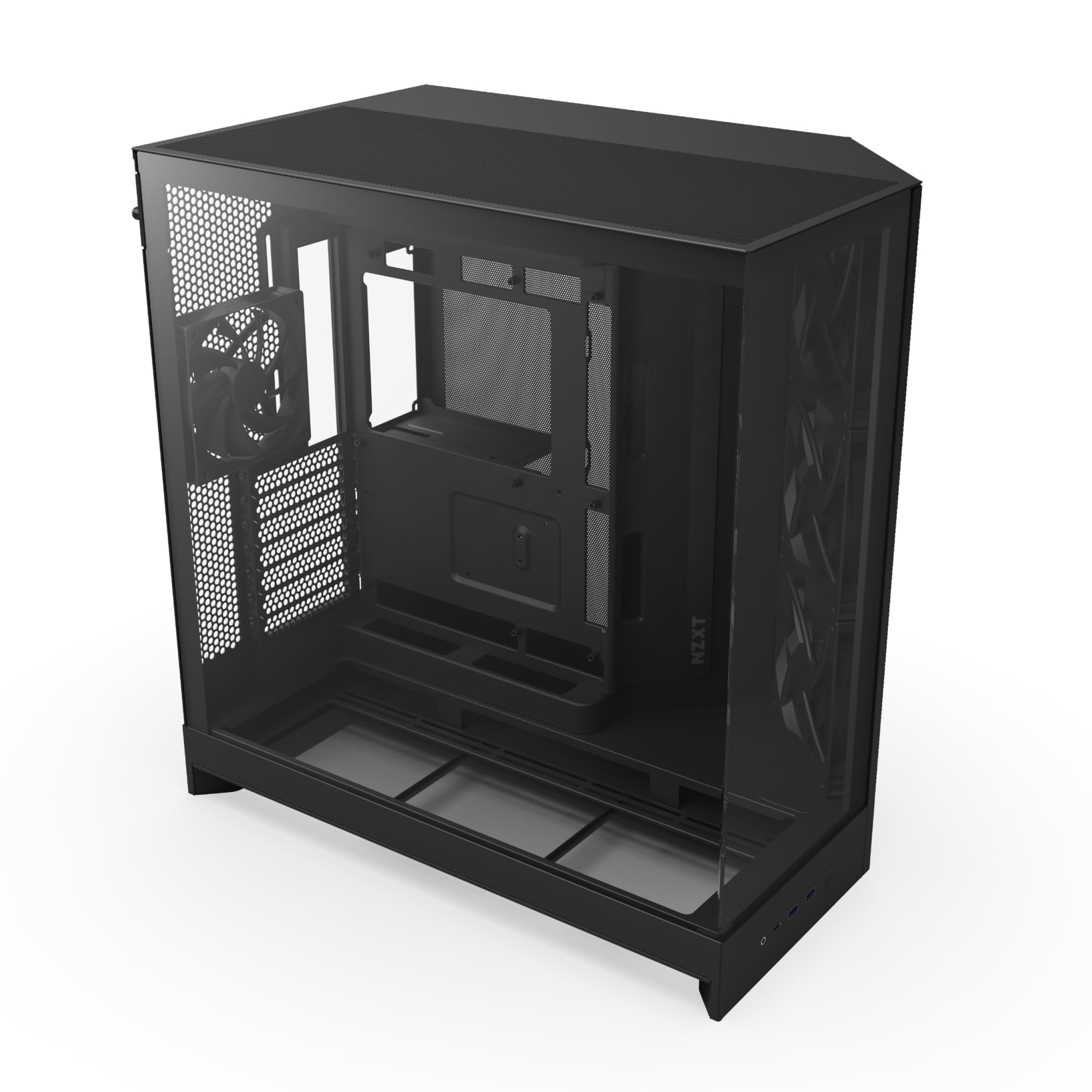
A panoramic aquarium-style case with a dual-chamber layout and a 10-fan ceiling for extreme airflow.
The NZXT H9 Flow is a dual-chamber showpiece. It separates the main components from the PSU and drives, improving thermal performance and making cable management far easier. The panoramic, wraparound tempered glass showcases every detail while the perforated steel panels and angled front-right fans keep things cool.
The airflow capacity is enormous — it supports up to nine 140mm fans across the top, front-right, and bottom, plus one 120mm fan in the rear. It ships with three F140Q (CV) fans in the front-right and one F120Q (CV) fan in the rear. It fits up to a 420mm radiator on the top and front-right, with plenty of room for high-end GPUs like the RTX 5090.
One owner says it fixed overheating and reboots in Cyberpunk with an RTX 5090. The design earns the most praise — 53 owners single it out — and the spaciousness is a close second at 41. The stock fans are louder than premium fans, and there’s no GPU support bracket included. For a high-airflow showcase, this is an incredible value.
The big wins
- Dual-chamber layout makes cable routing easy
- Supports 420mm radiator on top and front-right
- Back-connect ready for ASUS BTF and MSI Project Zero boards
Consider these
- No GPU support bracket included
- Stock fans run louder than premium aftermarket options
Reach for this if: you want a panoramic showcase with massive 10-fan airflow and easy dual-chamber cable management.
Look elsewhere if: you want a quiet stock setup or need a pre-installed GPU anti-sag bracket.
9. Lian Li Lancool 216

Giant dual 160mm intake fans push a monstrous 118.85 CFM with almost no noise at all.
The Lian Li Lancool 216 is the airflow king of quiet. Its two front 160mm fans — the largest in this list — produce an astounding 118.85 CFM of airflow with 3.10mmH2O of static pressure, moving massive volumes of air at low, quiet speeds. A third 140mm fan in the rear handles exhaust. The fine mesh front and top panels let that air flow freely in and out.
It isn’t just about the fans. The case is highly adjustable, letting you set the motherboard configuration to Air-Cooling Mode or Water-Cooling Mode. It supports up to a 360mm radiator on the top and bottom, an ATX motherboard, a GPU up to 392mm, and up to ten 120mm fans. The removable top radiator bracket and relocatable front I/O module make it beginner-friendly.
Customers note quieter operation and a 32°C idle, beating the Fractal Torrent XL on thermals. One owner saw temperature drops of at least 10°C. Three Velcro straps behind the tray and two above the PSU chamber simplify cable routing. The catch: the GPU placement in air-cooling mode is awkward, the 160mm fans are proprietary, and there’s no fan hub — plus the screw holes are small.
The standout spec: Dual 160mm fans at 118.85 CFM give this the highest raw airflow of any stock config in the list.
Who it’s not for: Builders who want a fan hub or standardized 120mm fans — the 160mm units are proprietary.
Reach for this if: you run an air-cooled build and want maximum quiet airflow with massive, slow-spinning fans.
it’s not for you if: you plan to swap in aftermarket fans — the proprietary 160mm mounts lock you into the stock units.
Understanding the Specs
Fan Speed (RPM) and Static Pressure
Fan speed, measured in RPM (revolutions per minute), tells you how fast the blades spin. A higher RPM generally means more airflow, but also more noise. Static pressure, measured in mm-H2O, is how well a fan pushes air through restrictive obstacles like dense mesh filters or the fins of a radiator. For a mesh-front case, you want fans with decent static pressure to pull air through the panel effectively.
Maximum GPU Length and Radiator Size
GPU length in millimeters is the maximum graphics card that fits. Measure your card before buying — modern high-end cards can exceed 300mm. Radiator size (like 240mm, 360mm, or 420mm) tells you the largest liquid cooler that fits, usually on the top and front. A 360mm radiator is a good standard for high-performance CPUs.
FAQ
What makes a case good for airflow instead of just having fans?
Is a 140mm fan better than a 120mm fan for airflow?
What does static pressure (mm-H2O) mean for my case fans?
Will my GPU fit in an airflow-focused mid-tower case?
Is a 360mm radiator worth it for a high-end CPU?
Do more pre-installed fans mean a better airflow case?
What does a dual-chamber design do for airflow?
Are tempered glass panels compatible with good airflow?
Final Thoughts: The Verdict
If you want one dependable pick, the atx case for airflow winner is the MONTECH XR because it balances a premium tempered-glass look, three ARGB fans, and a 360mm radiator mount at a price that feels like a steal. If you want the ultimate quiet airflow with giant 160mm fans, grab the Lian Li Lancool 216. And for a dual-chamber panoramic showcase with a 10-fan ceiling, the NZXT H9 Flow is the one to reach for — the crowd favorite with nearly a thousand owners behind it.
How We Picked
We do not accept paid placement. Every pick is matched to a real buyer and a real use-case; we do not hands-on test units.
Sources & Methodology
Specifications: manufacturer listings and product documentation. Review insights: verified customer reviews, as of August 2026. Pricing: not shown on this page (it changes often); check the current price via the retailer link.
As an Amazon Associate, Gadgets Feed earns from qualifying purchases. This does not affect which products we feature.