
Our readers keep the lights on and my morning glass full of iced black tea. As an Amazon Associate, I earn from qualifying purchases.
Specs are compiled from manufacturer listings and verified buyer reviews and can change over time — please confirm the key details on the product page before buying.
Buy the case that already has the fans, the GPU clearance, and the cable room you need — not the one with the prettiest product photo. Most ATX builds go wrong in the same three places: a graphics card that will not fit, a radiator that will not mount, and a front panel that chokes the air your parts need. Every pick below is an ATX case that supports a standard ATX motherboard, so you can shop with confidence that the board you own will screw straight in.
I’m Min — the founder and writer behind Gadgets Feed. This guide is built by comparing the manufacturers’ published specifications and the patterns across verified customer reviews, so you get each pick’s real strengths and trade-offs instead of marketing spin.
You will see exactly which cases ship with fans, which ones swallow a 420mm graphics card, and where each one asks you to compromise. Read on for the atx case picks that fit real parts, real desks, and real upgrade plans.
Our Picks at a Glance


How To Choose The Best ATX Case
The first thing to settle is what your parts actually measure. An ATX case can look enormous in a photo and still refuse a long graphics card or a tall air cooler, so you want the case’s own published limits in front of you before you click buy. Write down three numbers from your build sheet: your card’s length, your cooler’s height, and the length of your power supply.
Clearance beats looks every time
A case that lists support for GPUs up to 420mm will take a big card without you removing drive cages or trimming brackets. Cooler height works the same way — 178mm of headroom clears most large tower coolers, while a tighter ceiling can force you into a low-profile design you did not want. Power supply length matters too, because a long unit can foul a bottom fan mount.
Fans and radiators: count what comes in the box
You can skip buying fans and an evening of cable work if your case arrives with four or five fans already fitted and wired. Others ship empty by design, so you pick every fan yourself. Radiator support (the mounting space for a liquid-cooling radiator) is the other half of the cooling story. A 360mm radiator mount at the front or top lets you plan liquid cooling now or later, so a 360mm radiator fits without a rebuild. A case with only a 240mm side mount will limit you if you change your mind.
Glass, mesh, and the airflow question
A tempered glass front panel looks superb and blocks air. A ventilated mesh front panel feeds the fans but shows less of your build. Many ATX cases now split the difference with a pillarless glass wrap on the front and side plus fan mounts on the side and bottom, so you get the view and the airflow. Pick the panel you will actually look at: mesh for airflow, glass for the view.
Quick Comparison
| Model | Best For | Form Factor | Included Fans | Max GPU | Amazon |
|---|---|---|---|---|---|
| Lian Li V100-ATX★ Best Overall | Best Overall | Mid Tower | 4 x 120mm ARGB PWM | 420mm | Amazon |
| MONTECH AIR 903 MAXAirflow Champion | Airflow-First Builds | Mid Tower (E-ATX) | 4 x 140mm PWM | 400mm | Amazon |
| Thermaltake View 380 TGGlass Showcase | Hidden-Connector Boards | Mid Tower | 4 x 120mm ARGB | 415mm | Amazon |
| CORSAIR 4000D RS Frame | Modular Upgrade Path | Mid Tower | 3 x RS PWM | — | Amazon |
| Antec C8 | Triple-Radiator Builds | Full Tower (E-ATX) | None (case only) | — | Amazon |
| CORSAIR 3500X RS ARGB | Panoramic Display Builds | Mid Tower | 3 x RS120-R ARGB | — | Amazon |
| Lian Li LANCOOL 217 | Quiet Wood-Finish Builds | Mid Tower | 5 x PWM (incl. 2 x 170mm) | — | Amazon |
| MONTECH King 95 PRO | Curved-Glass Showcases | Mid Tower | 6 x ARGB | 420mm | Amazon |
| Antec Performance 1 FT | Full-Tower Headroom | Full Tower (E-ATX) | 3 x PWM | 370mm | Amazon |
In‑Depth Reviews
1. Lian Li V100-ATX Mid-Tower PC Case
Our pick — 4.5+★ from 650+ verified ratings; the strongest balance of quality and price.
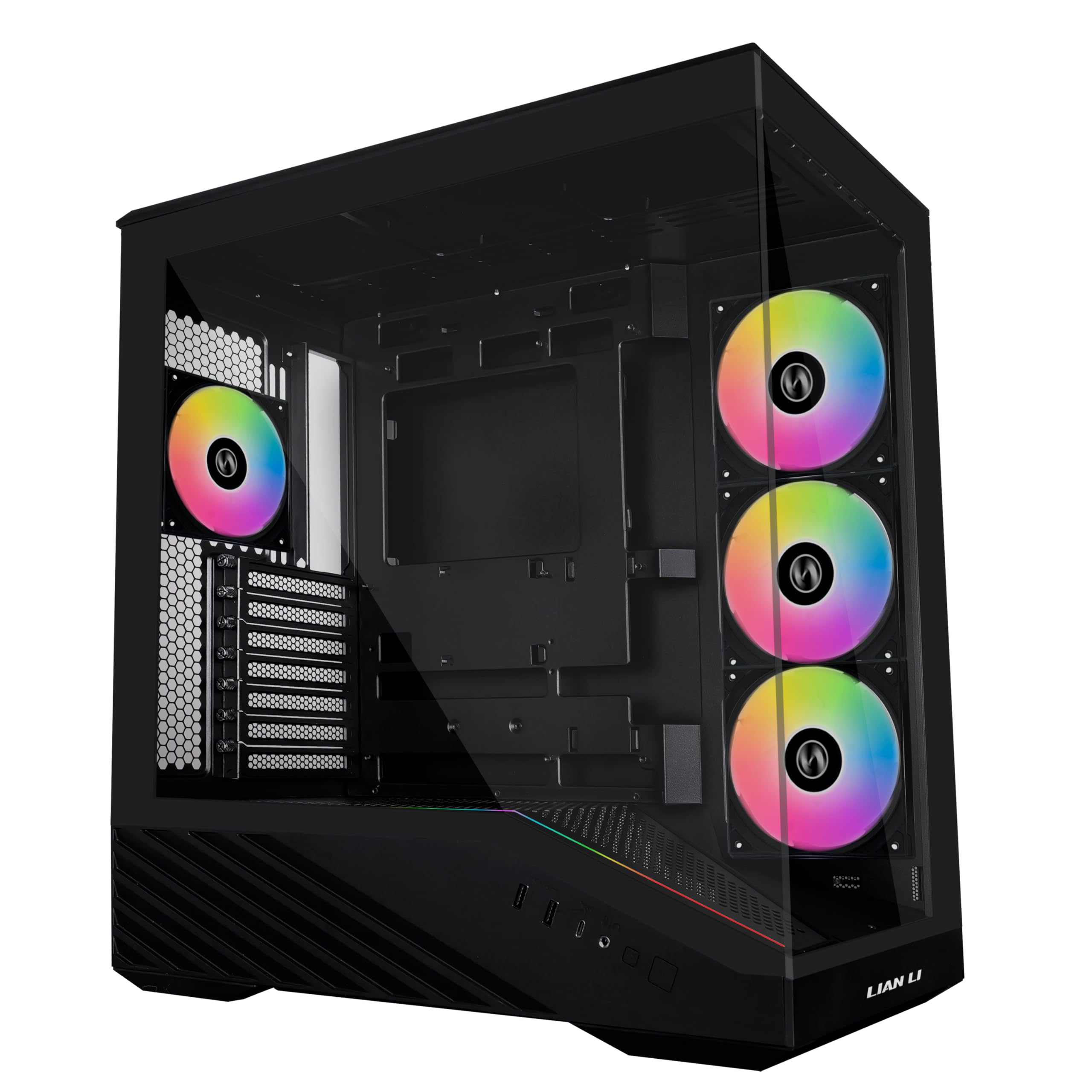
The fish-tank build that arrives with its fans already fitted and wired.
Four 120mm PWM-controlled ARGB fans come pre-installed — PWM meaning the fan speed is controlled by the motherboard rather than fixed, so they can slow down when your system is idle. Lian Li rates those fans at 1800 RPM, moving 61.47 to 60.4 CFM of air at a noise level of 26.5 to 30.8 dBA. That is a cooling package you do not have to buy separately.
Clearance is where this case earns its place. It takes graphics cards up to 420mm, CPU coolers up to 178mm, and a 360mm radiator at the top. It also supports back-connect ATX and Micro-ATX motherboards, which means boards with their power connectors on the rear can hide their cables for a cleaner interior. Both side panels are tool-less, so you open it up without hunting for a screwdriver.
Inside there is a 26-LED ARGB strip that syncs with your motherboard software, plus four internal bays. Design is clearly the thing that wins people over here, and the look under the side glass is what buyers keep circling back to. The honest catch is airflow through a glass-walled case depends on your fan curves — plan your intake and exhaust deliberately rather than assuming the glass does the work. As a package it is the crowd favorite, sitting at 4.5+ stars across 600+ ratings.
Where it pulls ahead
- 420mm GPU and 178mm cooler clearance covers big builds
- Three radiators of 360mm fit, so liquid cooling is planned for
- Four ARGB PWM fans and a 26-LED strip in the box
- Tool-less side panels and back-connect board support
The honest caveat
- It has 4 internal bays against the AIR 903 MAX’s 2, but more drives means more cable planning
- Glass panels show dust, so keep the front filter clean
Built for: anyone who wants the case, fans, and lighting settled in one purchase with room for a long card.
Pass if: you already own a full set of fans and would rather spend the money on a chassis body.
2. MONTECH AIR 903 MAX E-ATX Mid-Tower PC Case
Mesh up front, four 140mm fans inside, and no glass wall between your parts and the air.
This is the case you buy when airflow is the whole point. A ventilated mesh front panel (a perforated grille that lets air straight through) feeds the fans, and the chassis measures 478 x 230 x 493 mm. Three 140mm HP140 ARGB PWM fans sit at the front, and one 140mm PWM fan handles rear exhaust. PWM means the fan speed is controlled by the motherboard, and ARGB means addressable RGB lighting you can set per LED. Those fans are 14 centimeters across, against the 12 centimeters in the Thermaltake View 380, so each sweep moves more air at lower RPM (revolutions per minute, how fast the fan spins).
It swallows larger boards than most mid-towers: E-ATX, ATX, Micro-ATX, and Mini-ITX all fit. Graphics cards run up to 400mm, CPU coolers up to 180mm, and power supplies up to 240mm in length. Radiators up to 360mm mount front and top. At 9.14 kg it is heavier than the CORSAIR 4000D RS Frame at 8.2 kg, which mostly tells you how much steel and glass you are lifting onto the desk.
The one number that catches people out is storage: two internal bays, against the Lian Li V100’s four. If you run a pair of large drives that is fine; a four-drive archive will not fit. What wins people over is simply the build quality for the money, and the front-panel I/O is generous — one USB Type-C, two USB 3.0, plus mic and audio jacks.
Fan-first thinking: four PWM fans already fitted means your cooling budget is spent inside the case price, not bolted on afterwards.
Drive-count check: plan around two internal bays before you commit — this chassis trades storage slots for airflow volume.
Reach for it if: you want maximum air through a mesh front and already know your drive count is small.
Look elsewhere if: you keep four or more drives spinning and need the bays to hold them.
3. Thermaltake View 380 TG ARGB ATX Case
Pillarless glass on two sides — the case equivalent of an open display cabinet.
Thermaltake builds this one as a dual-chamber design with pillarless front and side tempered glass, which means no vertical frame bar cutting across the corner of your view. Four hydraulic-bearing 120mm ARGB Lite fans are pre-installed, so the lighting and baseline airflow are handled. The hydraulic bearing is a fan hub design built to run quietly over long sessions.
The headline feature is hidden-connector motherboard support, listed for hidden-connector boards from ASUS and MSI. If you own one of those, the power and front-panel cables route behind the board instead of across it, and the glass stays clean. Maximum radiator size is 360mm and maximum graphics card length is 415mm, so a long card plus liquid cooling both fit. Front I/O gives you one Gen.2 USB 3.2 Type-C, two USB 3.0, and HD audio.
Cable management is the split verdict on this chassis — plenty of owners find the space ample, others want more. Given the dual-chamber layout there is room to work, but route deliberately rather than stuffing. It measures 17.4 by 11.22 by 16.14 inches and weighs 15.3 pounds, which is 8.1 pounds lighter than the Antec C8 at 23.1 pounds. Design is what carries it, and a 3-year warranty backs the package.
Why the glass wins: a pillarless dual-panel wrap shows off the whole interior, and the hidden-connector support keeps the cables out of the shot.
Route with intent: the cable-management space divides opinion, so plan runs before you close the panels.
Made for: a hidden-connector ASUS or MSI build that will be looked at more than it is upgraded.
Think twice if: you want a big open cable channel without planning your runs first.
4. CORSAIR 4000D RS Frame Mid-Tower PC Case

A chassis built to be taken apart and rebuilt, one module at a time.
CORSAIR’s FRAME system is the reason to look here. The motherboard tray, the front I/O panel, and other modules can be swapped rather than replaced, so the case can follow your build instead of being retired by it. Three RS PWM fans come pre-installed at the front, with daisy-chainable 4-pin PWM connections and Zero RPM mode for near-silent running at low load.
The InfiniRail system is a steel multi-point fan mount. You slide the rail to position fans up to 200mm at the front or 140mm in the roof, instead of living with fixed screw holes. A 3D Y-pattern perforated steel front panel feeds air in with minimal restriction. It fits multiple 360mm radiators and is listed as compatible with reverse-connector boards from ASUS BTF, Gigabyte Project Stealth, and MSI Project Zero.
Dimensions run 19.17 by 9.41 by 19.13 inches at 8.2 kg. Set that beside the Thermaltake View 380 at 17.4 by 11.22 by 16.14 inches and you can see the shape difference: this one is deeper and narrower, the Thermaltake wider and shorter. Case quality and interior space are what buyers talk about, and there are three internal bays. The catch is that the modular idea only pays off if you actually plan to swap modules later.
What the FRAME buys you
- Swappable tray and I/O panel extend the case’s useful life
- InfiniRail slides to take fans up to 200mm
- Three RS PWM fans with daisy-chain and Zero RPM mode
- Reverse-connector board support across three brands
skip it if
- You build once and never touch it — you pay for modularity you will not use
- The deeper 19.17-inch footprint needs desk depth
Best match: tinkerers who upgrade in stages and want the chassis to keep pace with them.
Not needed for: a one-and-done build where the module swapping will never happen.
5. Antec C8 Full-Tower E-ATX PC Case
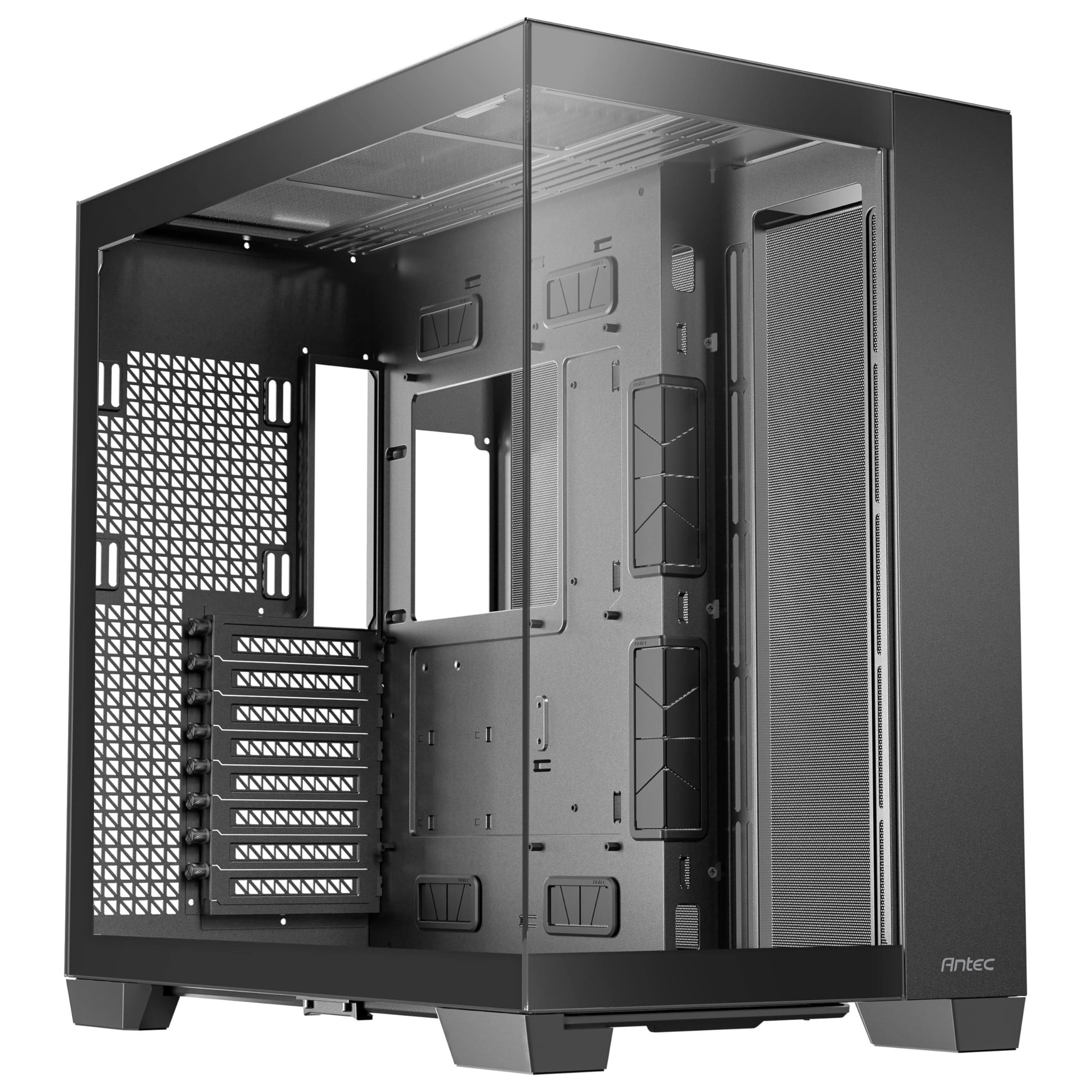
An empty, enormous canvas for a triple-radiator water build.
Antec ships this one with no fans at all — that is not an oversight, it is the point. You are buying a full tower (the largest standard case size) with smooth-edge glass on the front and side, so your build stays on show. A dual-chamber layout separates the power supply and wiring from the board, which keeps cables out of the main view. The space supports three 140mm fans or two 160mm fans on top and on the bottom. It takes thick 360mm radiators on top, bottom, and side at the same time, so a custom loop fits on three faces.
The full cut-out at the bottom takes interchangeable 120mm and 140mm fan brackets, so you can shift bracket sizing rather than being locked in. Motherboards from E-ATX down to ITX fit, alongside 2x 3.5-inch HDD and 4x 2.5-inch SSD storage and 8 expansion slots. Cooling options reach up to 10 fans.
Design and appearance are the praise it collects, along with the room for three 360mm radiators and the cable space behind. Build time is short for a case this large; one build wrapped up in under an hour. The mixed note is size — buyers who wanted something smaller feel it. Remember that fan cost is still ahead of you.
The water-cooling play: same-time thick 360mm radiators on top, bottom, and side is the spec that separates this from every mid-tower here.
Budget the fans: an empty case means the fan bill comes later, so factor that into the plan.
Right for: custom-loop builders who want radiator volume and will pick every fan themselves.
Wrong for: anyone hoping to plug in and go, or short on desk space for a full tower.
6. CORSAIR 3500X RS ARGB Panoramic Mid-Tower PC Case
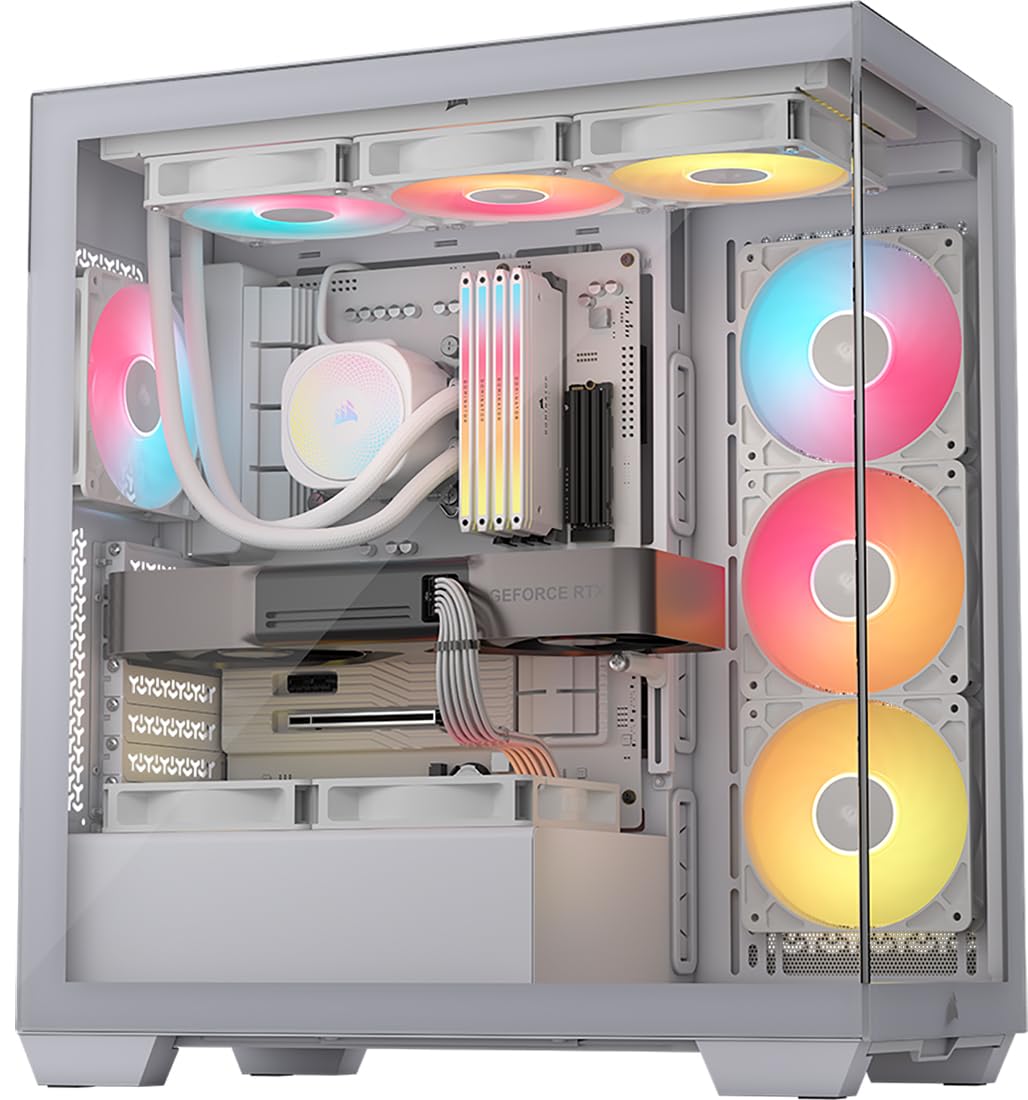
The white wraparound-glass case that treats your parts as the display.
A wraparound glass aesthetic is the whole idea here, and the removable front and side panels make it easy to get inside before and after the build. Three RS120-R ARGB fans come pre-installed, controlled through a +5V ARGB header on your motherboard. Only those three fans are included — the other components in the product photos are not part of the box.
Cooling capacity is larger than the glass suggests. Side, roof, and power-supply fan mounting points accommodate up to 10x 120mm fans, so you are not giving up airflow for the look. Motherboard support runs from Mini-ITX to EATX. It is also validated for reverse-connection boards — ASUS BTF, MSI Project Zero, and Gigabyte Project Stealth — so the back-side cabling stays hidden behind the glass. Radiators go up to 360mm, and storage runs to up to 10 drives.
The layout is 19.92 by 18.11 by 9.45 inches at 9.02 kg in white. Note that the listed width reflects the panoramic orientation rather than a conventional tower’s front-to-back depth. Interior space and the extra room behind the motherboard for cables are the practical wins, and the build quality is what gets noticed. The honest trade-off: white surfaces and open glass both show dust, so a regular wipe keeps it looking new.
Showcase logic: wraparound glass plus reverse-connector support means the inside of the case is the feature, not a place you hide.
Upkeep: a white finish and large glass panels reward a quick dusting now and then.
Choose it when: the build is going on display and you want a white panoramic finish with ten 120mm fan mounts.
Choose another if: you want a closed, dust-resistant front rather than open glass on two faces.
7. Lian Li LANCOOL 217 ATX Mid-Tower PC Case

Two enormous 170mm front fans and a walnut panel — cooling with a living-room finish.
Five fans come pre-installed: two 170x30mm front fans, two 120mm reversed-blade fans, and one 140mm fan at the rear. The 170mm front fans are the headline — 17 centimeters across, bigger than the 14 centimeters in the MONTECH AIR 903 MAX — and they push a large volume of air at low speed. Reversed-blade fans pull air in while showing their good face, which keeps the side view tidy.
Fan mounting is tool-less, and the two front fans can be raised into what Lian Li calls CPU mode, directing airflow straight at the processor. Two power buttons are fitted, which is handy when the case sits under or beside a desk and you approach it from different sides. The dual power-supply mounting options let you fit the unit facing front or rotate it for easier cable work, up to 220mm in length. Back-connect motherboards are supported.
The wood is genuine, offered in dark walnut or light beech. That is also where the split views land: the walnut finish can be on the fragile side, so treat the panel with care during the build. Noise level draws mixed reactions too, which makes sense for five fans you can tune. Storage sits at five internal bays, and the chassis takes ATX boards only, not E-ATX.
what separates it
- Two 170mm front fans plus three more, all pre-installed
- Tool-less fan mounting with a raised CPU-mode position
- Dual PSU orientation for easier cable routing
- Genuine walnut or beech panel options
Worth knowing
- The wood panel needs a careful hand — it can chip
- ATX and below only, so E-ATX boards are out
Suits you if: the PC lives in a shared room and you want five pre-fitted fans with a wood finish that blends in.
Skip if: you are building on an E-ATX board or want a panel you can knock about.
8. MONTECH King 95 PRO Curved Dual-Chamber ATX PC Case

Six fans, a ten-port controller, and a curved glass corner — wired and lit from the start.
Curved 4mm tempered glass wraps the front and side, paired with 0.8mm metal panels, and the glass panels release quickly without a screwdriver. Inside, six fans are pre-installed: two 140mm RX140 side fans, three 120mm RX120 bottom fans, and one 120mm AX120 rear fan. All of them connect to the included 1-to-10-port controller, so you are not buying a hub separately.
The dual-chamber layout keeps the power supply and wiring away from the motherboard and graphics card, with defined routing space between them. A patented side fan bracket carries the side cooling. Hardware clearance is generous: graphics cards up to 420mm, CPU coolers up to 175mm, ATX power supplies up to 185mm, and seven PCIe slots. Storage planning reaches five 3.5-inch HDDs or eight 2.5-inch SSDs.
Radiators go up to 360mm on top, 240mm on the side, and 120mm at the rear, and a premium mesh panel is included if you would rather have airflow than glass at the front. The dual-chamber design is what the cable-management praise centres on. Buildability and interior space are the other strengths. The one thing to plan is radiator size on the side, which tops out at 240mm rather than 360mm.
Why the layout works: dividing the chambers gives you a clean main compartment, and the bundled ten-port controller runs all six fans.
Radiator ceiling: top gets 360mm but the side stops at 240mm, so map your loop before buying.
Pick it for: a curved-glass showcase where you want six fans and the controller included in one box.
Consider the C8 instead if: you need thick 360mm radiators on three faces at once.
9. Antec Performance 1 FT Full Tower E-ATX PC Case

A full tower that reads out its own temperatures while you work.
Most cases ask you to open monitoring software to check thermals. This one puts a temperature display on the chassis itself, and Antec’s iUnity feature reports PC spec data at a glance. Three PWM fans are pre-installed, and two cable covers are included to tidy the routing. Dual 4mm tempered glass side panels show the build off from both faces.
It is a genuine full tower with the space to match: E-ATX, ATX, Micro-ATX, and ITX boards all fit, with room for graphics cards up to 370mm. Storage reaches four internal bays across 3.5-inch and 2.5-inch drives. A Type-C 10Gbps port sits on the front I/O, which is fast enough for external drives and card readers. Dimensions run 20.55 by 9.06 by 20.55 inches at 12.55 kg.
Case quality is by far the loudest praise this chassis collects, with size, buildability, and cable management all close behind. Panels are simple to remove and there is room for power supplies and future upgrades. Compare its 370mm GPU limit with the MONTECH King 95 PRO’s 420mm and you can see the trade: this case offers height and drive bays rather than the longest card clearance. An occasional unit is reported with a panel that needs a careful reseat.
The case for it
- Built-in temperature display and iUnity spec readout
- Four internal bays in a full-tower shell
- Type-C 10Gbps front port
- Dual 4mm tempered glass side panels and cable covers included
Weigh it up
- 370mm GPU clearance trails the 420mm cases here
- A tall, heavy tower on the desk, so measure the space
Works best for: a workstation build where monitoring temps at a glance and drive capacity matter.
Look past it if: the longest graphics cards are on your shortlist.
Understanding the Specs
GPU and Cooler Clearance
A graphics card length figure like 420mm tells you the longest card that physically slides into the case. Subtract a little for front fan thickness if a radiator sits up front. CPU cooler height works the same way — 178mm of headroom clears big tower coolers, while 175mm is only slightly tighter. Measure your own parts before ordering.
Fan Size and Airflow
A 140mm fan moves more air per turn than a 120mm fan at similar noise, which is why larger fans show up in quiet builds. Airflow figures in CFM measure air volume moved per minute, and dBA measures noise. PWM fans let the motherboard control speed, so they run slow and quiet when idle.
Radiator Support
A 360mm radiator mount takes three 120mm or two 140mm fans along one edge. Cases list top, front, side, and bottom mounts separately, so check each position — a case with a 360mm top mount may only offer 240mm at the side. Thick radiators need extra depth, which is why some full towers list support for thick 360mm units on three faces.
Back-Connect and Reverse-Connector Boards
Some newer motherboards move their power and front-panel connectors to the back of the board. A case with back-connect support has cut-outs and routing room for those cables, so the glass side stays clean. Check that your board is named on the case’s compatible list before relying on the feature.
FAQ
Will my ATX motherboard fit in a mid-tower case?
How do I know a long graphics card will fit?
Do I need to buy extra fans for the Antec C8?
What is a back-connect or reverse-connector motherboard?
Is a full tower worth it over a mid-tower?
Can a 360mm radiator fit in these cases?
How much noise do the pre-installed fans make?
Does case size affect airflow and cooling?
How many drives can each of these cases hold?
Do I need a special power supply for a full tower?
Final Thoughts: The Verdict
For most builds, the atx case that makes the most sense is the Lian Li V100-ATX. It arrives with four ARGB PWM fans already wired, so you skip a separate fan purchase. It takes a 420mm graphics card and stays well clear of a 178mm cooler, so big parts drop in without a fight. If you would rather have a mesh front and larger 140mm fans pushing air, reach for the MONTECH AIR 903 MAX. And for a custom water loop that needs thick 360mm radiators on three faces, the Antec C8 gives you the space to plan it.
Whichever you pick, check your own GPU length, cooler height, and power supply length against the case’s published limits before ordering. Checking those three numbers against the case’s published limits prevents most ATX case returns.
How We Picked
We do not accept paid placement. Every pick is matched to a real buyer and a real use-case; we do not hands-on test units.
Sources & Methodology
Specifications: manufacturer listings and product documentation. Review insights: verified customer reviews, as of November 2026. Pricing: not shown on this page (it changes often); check the current price via the retailer link.
As an Amazon Associate, Gadgets Feed earns from qualifying purchases. This does not affect which products we feature.