
Our readers keep the lights on and my morning glass full of iced black tea. As an Amazon Associate, I earn from qualifying purchases.
Specs are compiled from manufacturer listings and verified buyer reviews and can change over time — please confirm the key details on the product page before buying.
Choosing an ATX mid tower case means balancing your graphics card’s cooling needs, the motherboard space you require, and how much glass you want to look through. The right case balances cooling, cable management room, and aesthetics to fit your build without compromise. This guide compares top contenders using real-world specs and verified owner reports.
I’m Min — the founder and writer behind Gadgets Feed. This guide is built by comparing the manufacturers’ published specifications and the patterns across verified customer reviews, so you get each pick’s real strengths and trade-offs instead of marketing spin.
No single case fits every builder, so we have broken down the options by cooling, layout, and features to help you find the right atx mid tower case for your next build.
Our Picks at a Glance


How To Choose The Best Mid Tower Case
The biggest mistakes are choosing a case too small for the GPU or one that restricts airflow for looks. Measure your components first, then verify the case’s clearances and airflow path.
Match the Case to Your Components
GPU clearance is the most critical spec to check. Modern graphics cards are long and thick, so a case needs enough horizontal space (often 340mm or more) to fit them without bending cables. You also need to check the CPU cooler height if you are using a large air cooler, as it can conflict with the side panel.
Airflow Beats Everything
Heat silently degrades performance components, so prioritize airflow. Look for a mesh front panel over a solid glass one, and check how many fans come pre-installed versus how many you must buy. A case with included PWM (pulse width modulation) fans that adjust speed automatically is often a better deal than an empty chassis that requires extra spending.
Consider Your Cable Management Skills
Behind the motherboard tray, you need depth to hide power supply cables. Dual-chamber cases dedicate an entire rear section to cables and storage, making clean builds easier for beginners, while traditional layouts rely on well-placed Velcro straps and rubber grommets.
Quick Comparison
| Model | Best For | Max GPU Length | Pre-installed Fans | Motherboard Support | Amazon |
|---|---|---|---|---|---|
| Lian Li V100★ Best Overall | RGB Showcase | 420mm | 4x ARGB PWM | ATX, M-ATX, ITX | Amazon |
| DARKROCK EC2Best Value | Budget Mesh | 340mm | 1x Rear | ATX, M-ATX, ITX | Amazon |
| MONTECH XRValue Glass | Panoramic Value | — | 3x ARGB PWM | ATX, M-ATX, Mini-ATX | Amazon |
| Corsair 3500X | Spacious Glass | — | None | Mini-ITX to EATX | Amazon |
| Antec C5 | Fan-packed Dual Chamber | — | 7x ARGB PWM | E-ATX, ATX, M-ATX, ITX | Amazon |
| Lian Li LANCOOL 216 | High-Airflow E-ATX | 392mm | 2x 160mm, 1x 140mm | E-ATX, ATX, M-ATX, ITX | Amazon |
| NZXT H7 Flow | Large Airflow Tower | — | 3x 120mm Front | ATX, M-ATX, ITX | Amazon |
| MONTECH King 95 PRO | Curved Glass Display | — | 6x ARGB PWM | ATX, M-ATX, ITX | Amazon |
| HYTE Y70 Touch Infinite | Integrated Screen Display | — | None | ATX | Amazon |
In-Depth Reviews
1. Lian Li V100-ATX Mid-Tower PC Case
Our pick — over 4.5★ from 500+ verified ratings; the strongest balance of quality and price.
The RGB-rich case that shows off the build while keeping temps in check
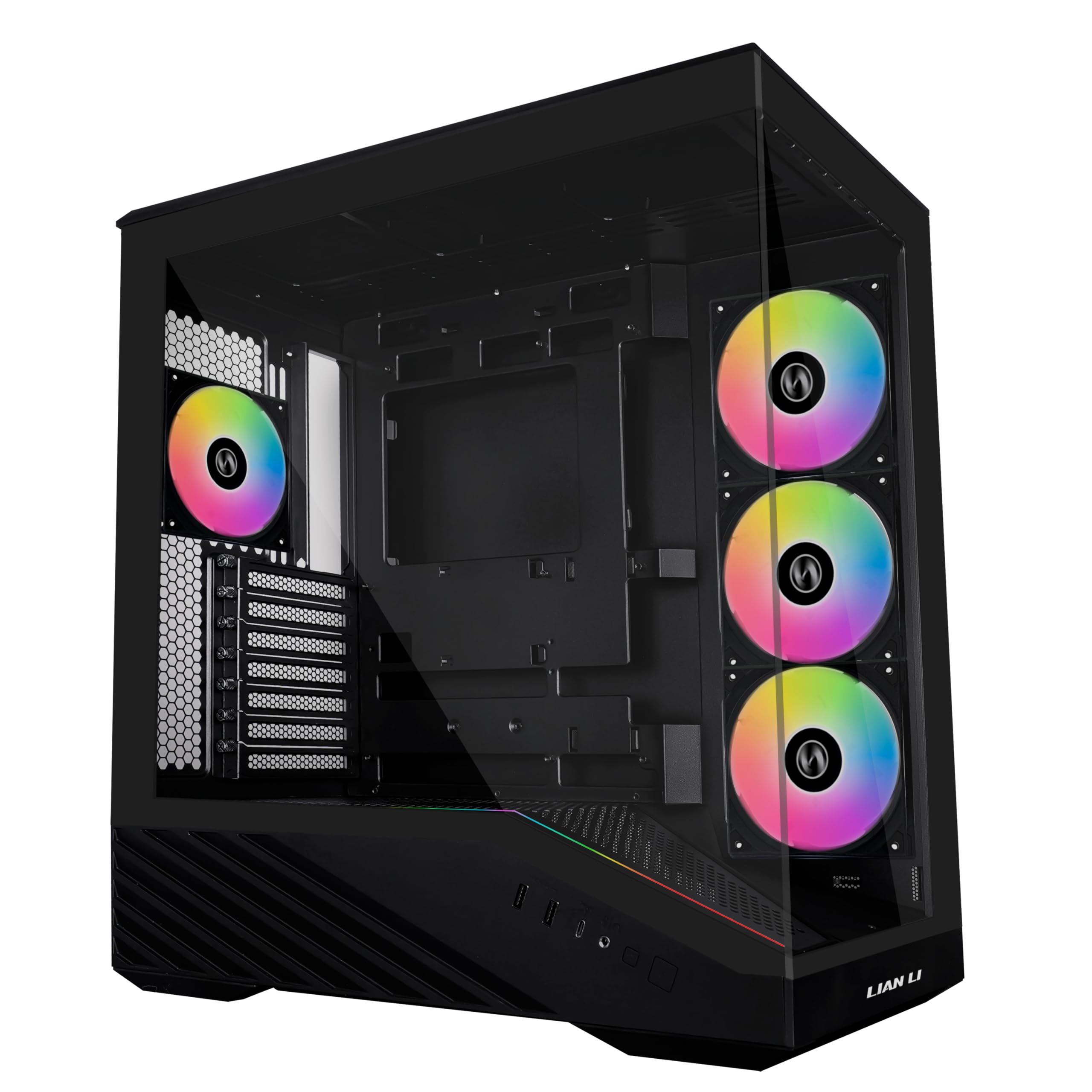
The V100 includes four daisy-chainable ARGB fans that spin up to 1800 RPM, moving a strong 61.47-60.4 CFM of air to keep components fresh. Those four fans, combined with an integrated 26-LED ARGB strip, make this a visual centerpiece that syncs with your motherboard’s software.
This case has some of the most generous clearances in its class, fitting GPUs up to 420mm and CPU coolers up to 178mm, which means even the largest modern cards slide in without a fight. Buyers report GPU temps in the mid-high 60s under heavy load, confirming the thermal design handles high-end hardware. The pillarless glass design and easy tool-less side panels make frequent internal access simple.
The trade-off is that storage is basic, limited to one HDD and one 2.5″ SSD slot, and the rear cable space feels cramped if you have a non-modular power supply. It cools and looks great, but you will want a modular PSU to keep the rear tidy.
Why It Wins
- Top GPU clearance at 420mm beats the DARKROCK EC2 which only fits up to 340mm
- Four pre-installed fans deliver higher max airflow than the MONTECH XR’s trio
- Tool-less side panels speed up the assembly process
Compromises To Know
- Only offers a single 3.5″ and a single 2.5″ drive bay for storage
- Top-mounted AIO coolers can block access to RAM
- Open design means less sound isolation under heavy load
Best for: builders who want a showpiece case with strong pre-installed cooling and room for flagship GPUs.
Look elsewhere if: you need multiple HDD bays for mass storage.
2. DARKROCK EC2 ATX Mid Tower
A budget mesh panel that lets air flow freely without skimping on the basics
The EC2 focuses on the essentials: a meshed front panel for efficient airflow, magnetic dust filters on the top and bottom, and a tempered glass side panel. It is Type-C ready, so you can run modern USB-C connections from your motherboard to the front I/O panel.
Space is a strong point here, supporting GPUs up to 340mm in length and power supplies up to 200mm (though this GPU clearance is notably shorter than the Lian Li V100’s 420mm allowance). Owners mention it fits 6x120mm fans and a 3-slot GPU, recommending a 90° adapter for extra clearance. The four internal bays and tool-less drive access give you flexibility for storage.
The honest catch is that the metal panels are thin and can bend easily, and the top fan mount is awkward if your CPU power connector sits in the way. This is a value-focused chassis that is easy to build in, provided you handle it with care.
Solid budget bet: sturdy enough for daily use, magnetic dust filters stay easy to clean.
Fit-note: 340mm GPU cap means triple-fan flagship cards may not fit; check lengths first.
3. MONTECH XR Panoramic High Airflow
Compact dimensions that still swallow a complete high-end gaming setup
The XR pairs a panoramic tempered glass view with three pre-installed ARGB fans: two reverse-blade units on the side for intake and one regular-blade fan at the rear for exhaust. All three spin up to 1500 RPM, which is quieter than the Lian Li V100’s 1800 RPM ceiling but still ample for most builds.
Despite its compact frame, it fits high-end 40 series GPUs and a 360mm radiator at the top, making it a solid pick for a powerful yet smaller desk footprint. Owners highlight the easy cable management with grommets and the tool-free magnetic glass panel that simply pushes back into place. The mesh panels on the front, top, and bottom keep dust out while letting heat escape.
The number one complaint is fan noise, with some buyers finding the pre-installed units audible outside a room and the RGB too bright for their taste. This is a value glass case for those who love the fish-tank aesthetic and can tolerate a bit of fan hum.
Great value display: the glass view and included fans cost a fraction of premium rivals.
Noise-sensitive? plan to swap the fans or run them at low RPM.
4. CORSAIR 3500X Mid-Tower ATX

The glass showcase that gives your components the room to breathe
The 3500X is all about the view, offering a wraparound glass aesthetic that lets you see every component from the front and side. It is validated for ASUS BTF and MSI Project Zero reverse-connection motherboards, so you can hide cables behind the board for an ultra-clean look.
You can keep your components cool without giving up the glass panel look, thanks to mounting points on the side, roof, and PSU shroud that hold up to 10x 120mm fans. For liquid cooling, you can fit radiators up to 280mm and 360mm in the roof and a 360mm in the side, so you have plenty of options. This case also supports motherboards from Mini-ITX (the smallest common size) up to EATX (the largest), making it among the most versatile in this guide.
The major caveat is that it ships with no fans included, so you must factor that into your budget. Owners also note that 3.5″ drive support is lacking, relying instead on the two SSD slots behind the motherboard for storage expansion.
Empty canvas: ideal if you already own fans or want to pick your exact RGB setup.
Storage check: limited to two SSD mounts, which is fine for most gamers.
5. Antec C5 ARGB Mid-Tower

Out-of-the-box airflow with seven fans so you can skip the extras
You won’t need to buy extra fans for the C5—it ships with seven ARGB PWM fans (addressable RGB fans with pulse-width modulation, which lets you control speed) already installed. Six of these are reverse-blade units, designed to pull air in without showing their frames, so the full-view, fish-tank style case with a smooth front and side panel looks clean while keeping your GPU and CPU temperatures low.
Its dual-chamber design separates the power supply and cables into a dedicated rear compartment, which customers note makes cable routing much simpler. The wide layout easily fits an ATX board, supports a 280mm AIO on the top, and a built-in ARGB and PWM fan controller keeps everything synced. Owning this case means no extra fan purchases are needed, saving both money and build time.
The notable downside is that cable management received negative feedback from some owners—the space exists, but routing is not always intuitive. The front and side glass panels also snap off and on with a bit of awkward force, but this does not affect daily use.
The Setup
- Seven pre-installed ARGB fans with a built-in controller
- Dual-chamber interior for tidy cable storage
- Fits E-ATX, ATX, M-ATX, and ITX motherboards
Watch Out For
- Cable routing channels need careful planning to look clean
- Glass panels require firm pressure to detach
Ideal for: those who want maximum airflow and RGB without buying extra fans.
Consider elsewhere: if you plan a custom loop requiring a 360mm radiator on top.
6. Lian Li LANCOOL 216

Massive front fans that push serious air through a sturdy steel frame
The LANCOOL 216 arrives with two oversized 160mm ARGB fans at the front and a 140mm fan at the rear, creating a pressure system that pulls in plenty of fresh air. The heavy-duty steel frame and 4.0mm tempered glass give it a premium, solid feel that owners consistently describe as rock-solid.
You can adjust the motherboard’s position up or down thanks to the modular I/O (input/output ports), letting you tune airflow whether you’re using air or liquid cooling—a flexibility most cases lack. It also fits GPUs up to 392mm long, so it’s one of the few mid-towers that natively accommodate the largest NVIDIA 4000 series cards. For storage, you get dedicated mounts for up to eight drives total: 2x 3.5″ HDD (hard disk drives) plus 6x 2.5″ SSD (solid-state drives).
The included Velcro straps, cable clips, and a removable top radiator bracket with a seal plate make building and cable routing straightforward and leak-proof even with smaller radiators. This is a spacious, well-thought-out case for those who prioritize thermals above all else.
Cooling-focused: the 160mm front fans move more air at lower noise than smaller 120mm alternatives.
One gripe: the flat black power button blends into the frame and can be hard to find.
7. NZXT H7 Flow

A tall, mesh-covered tower where every panel works to ventilate the hardware
The H7 Flow comes with three front-mounted 120mm fans for effective out-of-the-box cooling, and its high-performance mesh panels boost airflow for intake and exhaust while filtering dust. Reviewers point out installing up to ten fans total, with noticeably improved airflow after the upgrade.
This chassis devotes attention to GPU thermals, supporting three bottom-mounted 120mm fans that feed cool air directly to the graphics card. It can handle the largest cooling setups, with support for up to a 420mm radiator in the front and a 360mm radiator in the top, making it a top-tier choice for high-wattage CPUs and GPUs.
The main drawback is that the included front fans use 3-pin connectors, meaning they run at a fixed speed rather than adjusting via PWM control. Owners also note the instruction manual is minimal and that it lacks dust filters on some intakes, so you may need to clean the interior more frequently.
The Upside
- Massive 420mm radiator support in the front for serious liquid cooling
- Dedicated bottom fan mounts that cool the GPU directly
- Wide cable channels and hooks make routing easy
The Downside
- Fans are 3-pin, not PWM, so they lack automatic speed control
- Users describe it as full-tower-sized despite the mid-tower label
Grab it if: you are running a hot CPU/GPU combo and want maximum radiator support.
Ignore it if: your desk space is tight and you prefer a compact footprint.
8. MONTECH King 95 PRO

A dual-chamber chassis with a striking curved glass front that turns desks into displays
The King 95 PRO is built around its looks, featuring a sturdy curved tempered glass front that flows into the side panel for an unobstructed view of the components inside. It ships with six pre-installed ARGB PWM fans (2x 140mm and 4x 120mm) and a fan hub, so cooling and lighting are ready from the first boot.
Its dual-chamber layout is what buyers rave about for cable management, as the power supply and excess cables hide in a separate rear compartment. The case offers eight internal bays for storage, a spacious interior that accommodates large GPUs and 360mm radiators, and patented side fan mounts for additional airflow. Despite its heavy weight, owners find the all-steel and glass build reassuringly solid.
The biggest trade-offs are physical size—it takes up a quarter of a desk—and the fact that the fan hub is not controlled via the motherboard, limiting speed adjustments. It is a statement piece for builders who want the premium look without the premium price tag.
Visual centerpiece: the curved glass and six RGB fans create a premium showcase look.
Space warning: measure your desk carefully; this is a large footprint chassis.
9. HYTE Y70 Touch Infinite

A dual-chamber showpiece with a built-in display for system stats and wallpapers
The Y70 Touch Infinite is a premium dual-chamber ATX chassis that stands out with a 14.9″ integrated LCD touchscreen running a 682 x 2560 (2.5K) resolution at 60Hz with 10-point multi-touch. Owners use the screen for system monitoring, Discord, and Spotify widgets, making it as much a desk accessory as a PC case.
Its dual-chamber interior separates the PSU and cables, offering plenty of space for large video cards, and it includes a luxury PCIe 4.0 riser cable for massive 4-slot vertical GPU mounting. The case supports up to ten fans and accepts a 360mm radiator on the side (125mm thick) and an adjustable mount on top (68mm thick) for serious liquid cooling.
The catch is threefold: it ships with no fans included, it is heavy, and the premium price is justified only if you value the integrated screen. Owners note that the vertical mount may slightly restrict GPU airflow and dense dust filtration is less comprehensive than mesh-focused rivals, but for a centerpiece build, few cases match its wow factor.
Perfect for: builders who want an interactive display built into the chassis for a futuristic desk setup.
skip it if: you are on a budget or prefer maximum airflow over an integrated screen.
Understanding the Specs
GPU Clearance (in millimeters)
This tells you the maximum length of graphics card that fits inside without hitting the front fans or radiator. A case with 340mm clearance fits most dual-fan cards, while 400mm+ is required for the current generation of massive triple-fan flagship GPUs like the RTX 4090.
Fan Speed and Airflow (RPM and CFM)
When choosing fans, you’ll see two key numbers: RPM (revolutions per minute, or how fast the fan spins) and CFM (cubic feet per minute, or how much air it moves). the balance is higher CFM at lower RPM—that means more cooling with less noise. Fan size also matters: larger 140mm or 160mm fans tend to push more air quietly than 120mm fans, so you can keep your system cool without a loud hum.
Motherboard Form Factor
ATX is the standard size for most builds, offering the best balance of expansion slots and features. E-ATX boards are wider and offer more PCIe slots, but require a case with extra width clearance to fit. Check the label to ensure your motherboard physically fits inside the chassis you choose.
FAQ
What is the difference between an ATX mid tower and a full tower case?
Will a large graphics card like an RTX 4080 fit in a mid tower case?
What does PWM mean on a PC case fan?
How many fans do I need in a mid tower case?
What is the benefit of a dual-chamber PC case layout?
Is tempered glass safe for a PC case?
What does Type-C Ready mean on a case?
Can a mid tower case fit a 360mm radiator?
Should I worry about the weight of a PC case?
How important is a mesh front panel for airflow?
Final Thoughts: The Verdict
For most people, the atx mid tower case winner is the Lian Li V100 because it weds the best GPU clearance (420mm) with four solid fans and a stunning glass display. If you want a case that balances airflow and price without needing to buy extra fans, the Antec C5 delivers seven pre-installed units from the start. And for those who want a high-airflow tower with room to grow into serious liquid cooling, the Lian Li LANCOOL 216 is the one to reach for.
How We Picked
We do not accept paid placement. Every pick is matched to a real buyer and a real use-case; we do not hands-on test units.
Sources & Methodology
Specifications: manufacturer listings and product documentation. Review insights: verified customer reviews, as of September 2026. Pricing: not shown on this page (it changes often); check the current price via the retailer link.
As an Amazon Associate, Gadgets Feed earns from qualifying purchases. This does not affect which products we feature.