
If your home studio, podcast booth, or even your living room has that hollow, cavernous sound that makes speech muddy and music thin, you aren’t fighting the source—you’re fighting the surface. Uncontrolled sound reflects off hard walls and flat surfaces, creating comb filtering, flutter echo, and a smear across the frequency band that no software can fully repair. An audio diffuser panel is the physical cure, absorbing excess energy and scattering the rest to tighten transients and bring clarity back into the space.
I’m Min — the co-founder and writer behind Gadgets Feed. I research acoustic treatment across residential, professional, and budget-conscious setups to pinpoint which material densities, thicknesses, and mounting methods actually deliver on their claims without breaking the bank or requiring construction skills.
This guide compares seven real-world options, weighing polyester fiber density against panel coverage and adhesive practicality, so you can confidently choose the right best audio diffuser panel from entry-level squares to expansive wall-filling kits.
How To Choose The Best Audio Diffuser Panel
Buyers often assume thicker is always better, or that any soft material will fix echo. In reality, the material composition, the surface area coverage, and the ease of installation are the three pillars that separate a dead-sounding room from a well-treated one. Below is what to look for.
Polyester Fiber vs. Acoustic Foam
Acoustic foam (open-cell polyurethane) absorbs poorly below 1kHz and often degrades or discolors over time. Polyester fiber, by contrast, offers a higher density-to-thickness ratio, is chemically inert, resists moisture and mildew, and achieves an NRC of 0.85 or higher even at thicknesses around half an inch. For music and speech frequencies, fiber is the superior choice.
Coverage Ratio and Placement
A single panel behind a desk does little. The rule of thumb is to cover at least 15–20% of the total wall and ceiling area in a small room to hear meaningful echo reduction. Larger panels (47 x 23 inches) provide fewer seams and more uniform absorption per installed square foot compared to 12×12-inch tiles.
Adhesive and Mounting Method
Self-adhesive backings save time on smooth, painted walls, but they can fail on textured ceilings or in humid environments. Peel-and-stick panels are easy for renters but may pull paint. For permanent installations, contact adhesive spray or 3M Command strips offer better holding power. Mechanical fasteners (brad nails, screws) are ideal for slat-style panels with solid backs.
Quick Comparison
On smaller screens, swipe sideways to see the full table.
| Model | Category | Best For | Key Spec | Amazon |
|---|---|---|---|---|
| TONOR Dual-Layer Thickened | Dual-Layer | Maximum Echo Suppression | 0.72-inch thickness | Amazon |
| TONOR Wood Slatwall Panels | Slatwall | Decorative High-Density Coverage | Wood veneer + MDF + polyester | Amazon |
| UMIACOUSTICS 6 Pack | Veneer Finish | Large-Space Aesthetic Treatment | 47.2 x 23.6 inches per panel | Amazon |
| Soon Global Arcadian Vortex | Art Panels | Decorative Feature Walls | 23.62 x 23.62 inches + groove pattern | Amazon |
| 5 Pack Acoustic Panels 47.2×23.6 | Large Panel | Budget Room-Sized Kits | 0.35-inch thickness | Amazon |
| Lebenforce 22 Pack Self-Adhesive | Self-Adhesive Tile | Appliance Noise Reduction | 0.4-inch thickness, 12×12 tiles | Amazon |
| AudioSilk 4 Pack ROOM KIT | Studio Grade | Flutter Echo Reduction | NRC up to 0.91, recycled PET | Amazon |
In‑Depth Reviews
1. TONOR Dual-Layer Thickened Acoustic Wall Panels

The TONOR Dual-Layer panels are the thickest in this list at 0.72 inches, using a two-layer polyester fiber structure that traps more sound energy than single-layer alternatives of similar weight. At 47.2 x 23.6 inches per sheet, each panel covers roughly 7.7 square feet, meaning a 4-pack covers over 30 square feet—enough to address first-reflection points in a medium-sized home studio or control room.
Users report a noticeable reduction in vocal reverb and a tighter low-mid response after placing these on rear walls and side reflection points. The self-adhesive backing holds well on smooth painted drywall, but reviewers note the sticky pads are aggressive and may pull paint during removal. The reinforced corner edges protect the panels during shipping, a detail that matters for larger sheets.
One reviewer using these in an apartment with thin walls said loud neighbor voices and bass bleed were “significantly muffled,” while another cut them to fit around a furnace and washer setup, cutting compressor noise roughly in half. The ribbed design looks more like textured wall art than standard foam, making it viable for living rooms as well as studios.
Why it’s great
- Dual-layer 0.72-inch density achieves strong broadband absorption
- Generous per-panel coverage reduces installation seams
- Includes reinforced corners for shipping protection
Good to know
- Self-adhesive backing can damage paint on removal
- Not effective as total sound isolation — treats echo, not transmission
2. TONOR Wood Slatwall Panels
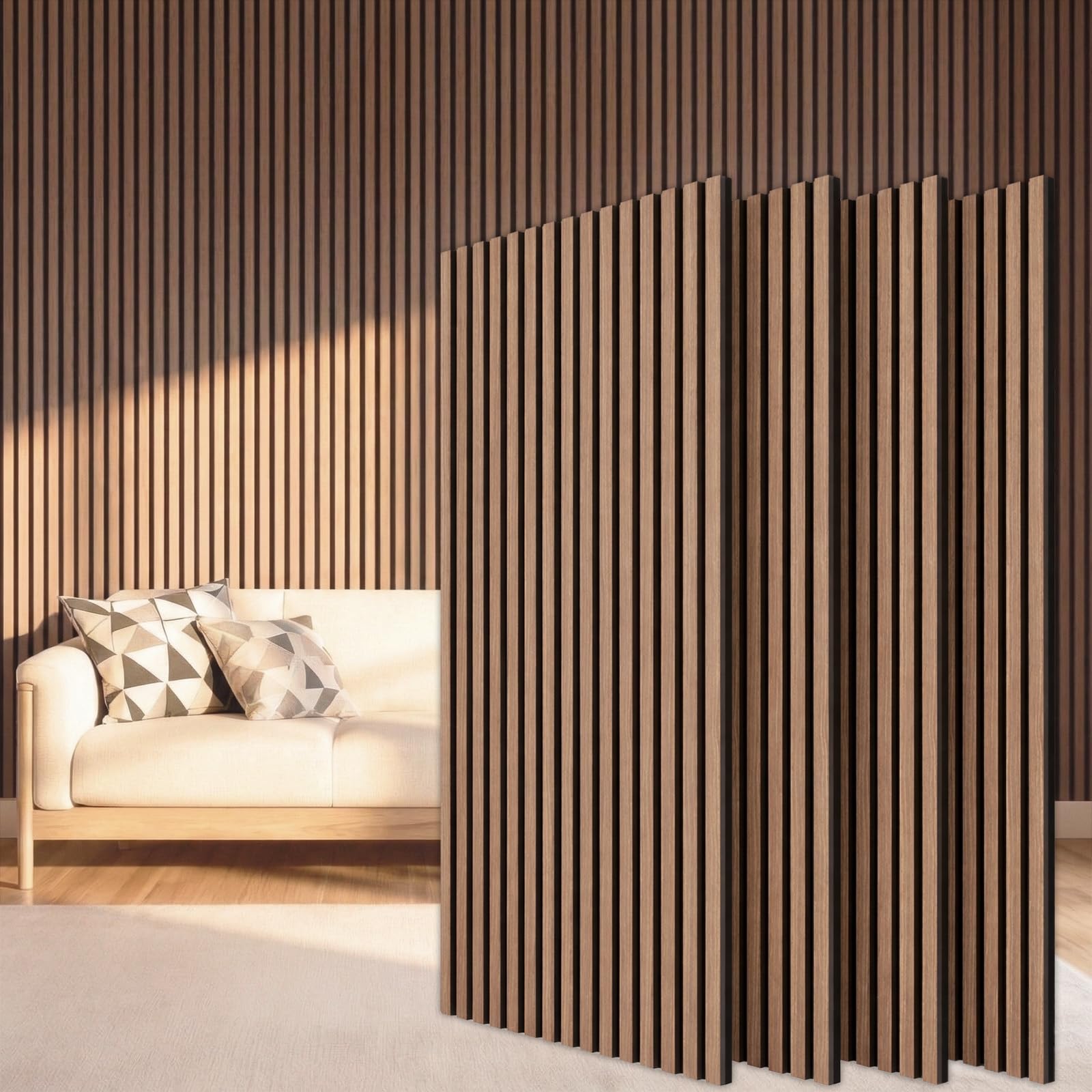
The TONOR Wood Slatwall Panels combine high-density polyester fiber with a medium-density fiberboard (MDF) core and a real wood veneer surface. This rigid construction gives them a premium furniture-grade feel that no single-layer fiber panel can match. Each panel measures 47.2 x 23.6 inches with a total thickness of 0.39 inches, and the 4-pack covers 31 square feet.
The slat design scatters sound across the alternating wood and felt strips, acting as a hybrid absorber-diffuser. Early reflections are reduced while the room retains some natural liveliness—ideal for home theaters or listening rooms where total deadness is undesirable. The kit includes screws for drywall mounting, but the weight (6.17 pounds per panel) means adhesive alone is insufficient.
Reviewers praise the visual transformation: one used three panels to create an accent wall in a laundry room and was impressed by both the look and the noise reduction from washer vibrations. Another buyer used a jigsaw to cut around light switches, though the wood strips are adhered only at the ends, so cutting near edges required a staple gun to re-secure loose slats. The veneer blends well with walnut or darker wood furnishings.
Why it’s great
- Real wood veneer provides high-end visual appeal
- Hybrid slat design absorbs and diffuses simultaneously
- Kit includes screws and hardware for permanent mounting
Good to know
- Requires screws or nails — adhesive alone is not safe
- Slats are only bonded at ends, requiring extra care when cutting
3. UMIACOUSTICS 6 Packs Acoustic Panel

The UMIACOUSTICS 6 Pack delivers 6 panels at the 47.2 x 23.6 inch format, covering over 46 square feet—more than any other single kit in this comparison. The walnut-colored wood-look veneer is not real wood; it is a flexible polyester fiber sheet with a printed veneer surface, which makes it bendable and easy to cut with a utility knife.
The sound absorption coefficient is rated for mid-to-high frequencies (above 3kHz), and reviewers confirm a clear reduction in echo during speakerphone calls and podcast recordings. One user mounted them with 3M Command strips and found the hold secure after 6–7 months on sheetrock. Another used an 18-gauge brad nailer with six nails per panel and reported zero sagging.
The main trade-off: the veneer surface is not as durable as real wood. A reviewer noted that cutting the panels generated black felt dust that was messy and required cleanup. The packaging also received criticism—boxes arrived dented, though the panels themselves were undamaged. At this price point, you are paying for large surface coverage with a convincing wood aesthetic rather than premium materials.
Why it’s great
- Six-panel kit covers the most area in one purchase
- Flexible polyester fiber cuts easily and bends for curved walls
- Veneer finish looks convincing at a fraction of real-wood cost
Good to know
- Cutting creates messy black felt dust
- Veneer is printed — not real wood slat
4. Soon Global Acoustical Wall Panels – Arcadian Vortex
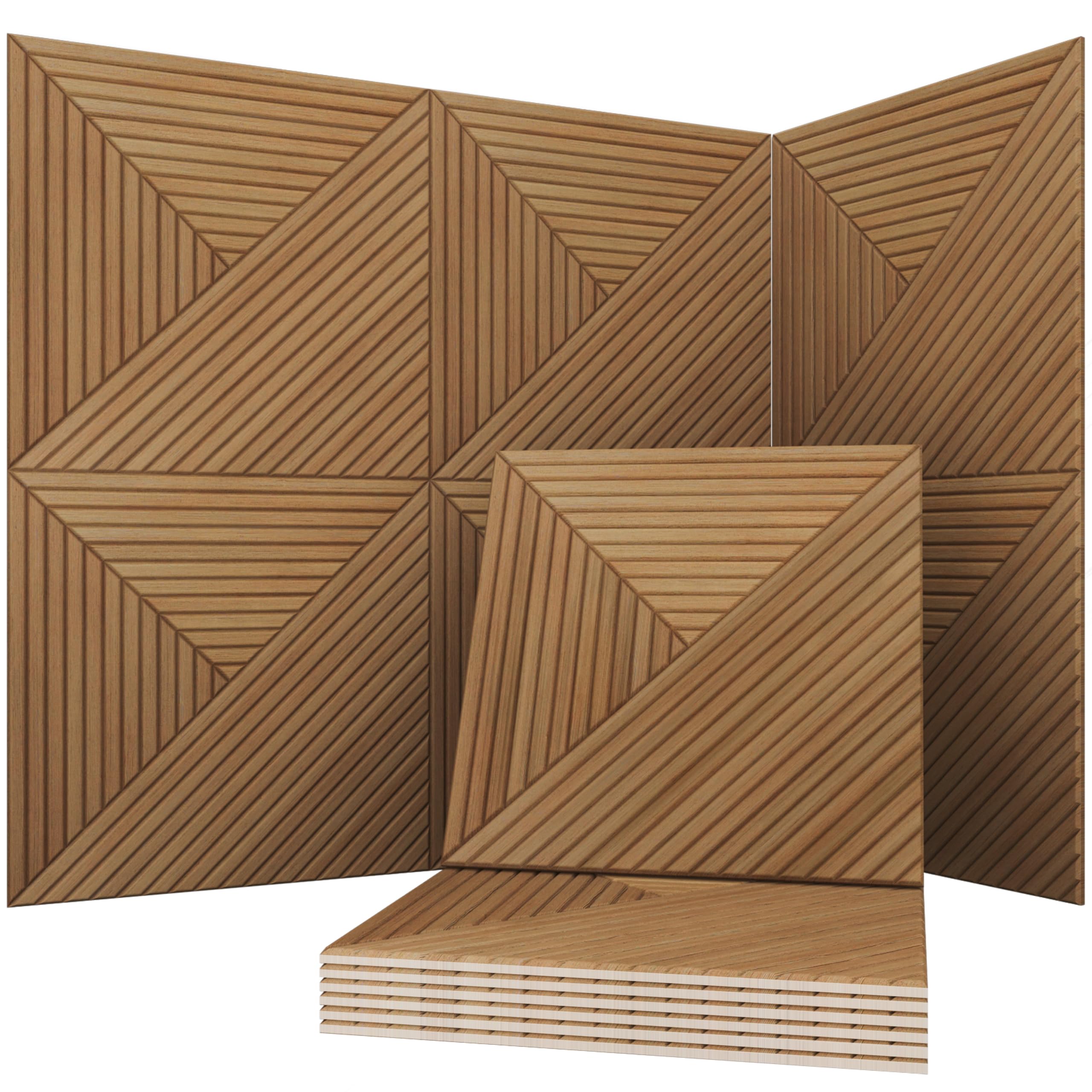
The Soon Global Arcadian Vortex panels approach absorption as wall art. Each of the six panels measures 23.62 x 23.62 inches, forming a square tile format with a continuous groove pattern that creates a unified geometric design across adjoining panels. The realistic wood-texture print and linear channels not only scatter high-frequency reflections but also make the wall surface a visual focal point.
The panels are made from high-density polyester fiber with a flame-resistant rating, which adds safety in home theater or recording booth applications. The adhesive squares included in the box are transparent double-sided pads designed for tool-free installation. Reviews confirm the strong initial hold, though one user reported that a ceiling installation failed after a few months, with panels falling off one by one. The included adhesive appears adequate for vertical walls but insufficient for overhead mounting in higher temperatures.
Creative buyers have arranged these in custom patterns, and the 432-square-inch-per-panel size allows flexible configurations. The continuous groove design requires careful alignment to maintain the flowing visual across panels, but the end result is a feature wall that doubles as acoustic treatment. For rooms where aesthetics are as important as echo reduction, this is the most design-forward option in the list.
Why it’s great
- Continuous groove pattern creates a unified design wall
- Flame-resistant polyester fiber adds safety
- Tool-free adhesive mounting for vertical surfaces
Good to know
- Included adhesive may not hold on ceilings long-term
- Smaller square format requires more pieces per room
5. 5 Pack Acoustic Panels, 47.2 x 23.6 x 0.35 Inch
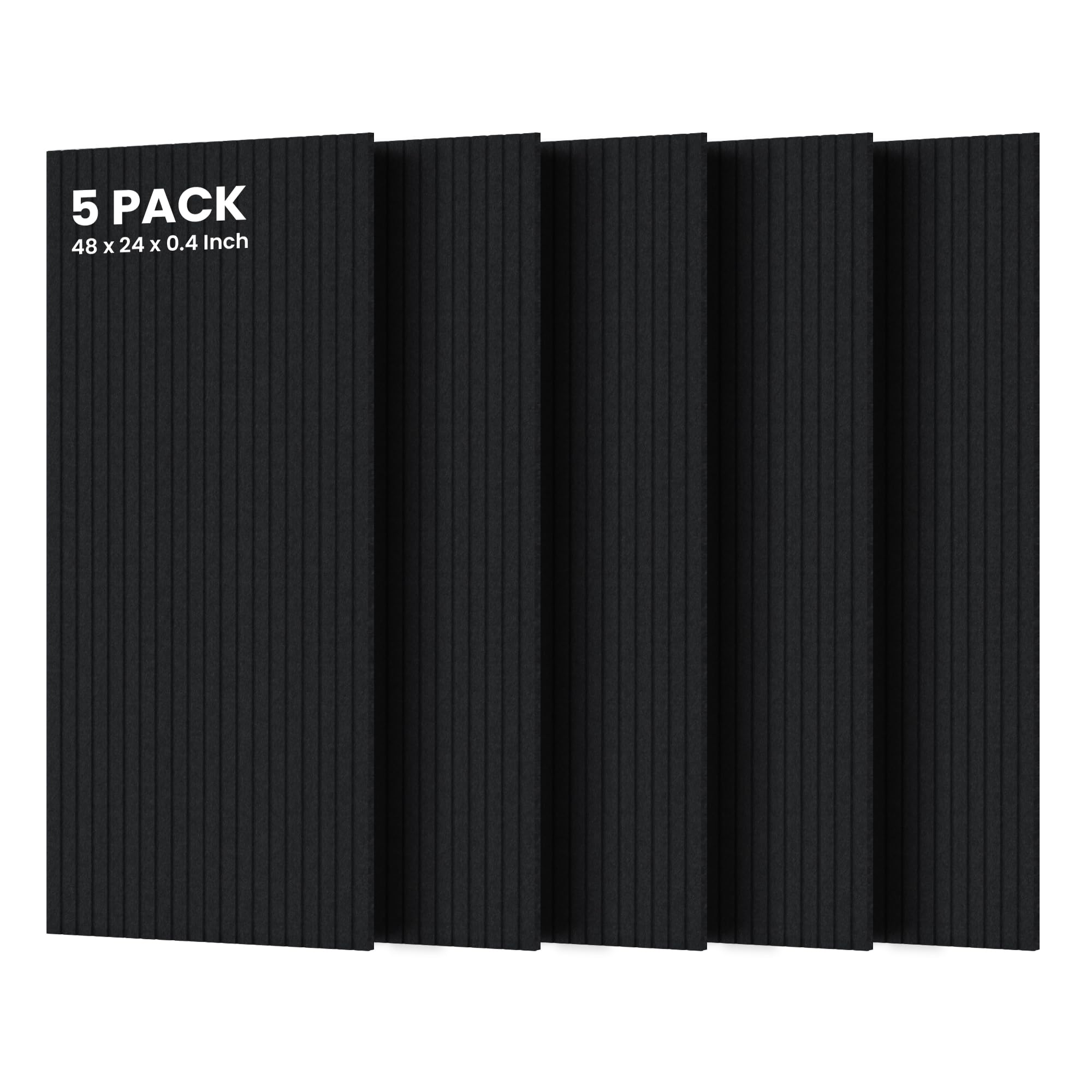
This 5-pack from a third-party manufacturer offers the largest total surface area per dollar in this roundup, with five massive 47.2 x 23.6 inch panels. The 0.35-inch thickness is thinner than most competitors, but the manufacturer claims a sound absorption coefficient above 0.9 for frequencies over 3000 Hz thanks to the cocoon-shaped polyester fiber structure produced via a high-tech hot-pressing process.
Users confirm meaningful echo reduction in apartment settings, especially for cutting down slap echo and improving speech clarity during calls. The lightweight panels weigh only about 2 kg per square meter, placing minimal load on walls. The issue reported most consistently is the included double-sided tape squares: they measure only 1-inch across, and the backing is frustratingly difficult to peel. Multiple reviewers recommend buying a separate roll of double-sided tape to save time during installation.
The vertical striped design looks clean and modern, and the panels are compatible with construction adhesive for permanent installation. For a budget-conscious buyer who plans to cover a large wall or ceiling without breaking the budget, the value per square inch is unmatched—just budget an extra few dollars for better tape.
Why it’s great
- Five large panels cover more surface than any other sub- option
- Lightweight polyester fiber minimizes wall load
- Sound absorption above 0.9 NRC for high frequencies
Good to know
- Included tape squares are undersized and hard to peel
- 0.35-inch thickness is less effective at low frequencies
6. Lebenforce 22 Pack Self-Adhesive Acoustic Panels

The Lebenforce 22 Pack uses the 12 x 12 inch tile format with a self-adhesive backing, making it the most flexible option for piecemeal coverage. The 0.4-inch thickness and polyester fiber construction are solid for their class, and the 22-square-foot coverage (21.27 sq. ft. specifically) means you can treat multiple small zones without committing to giant sheets.
Reviewers found creative applications beyond wall echo reduction: several placed these behind refrigerators and washing machines to stop compressor vibration noise from transmitting through shared walls. One 3D printer owner installed seven panels around a Bambu P1S to eliminate a high-pitched whine from the enclosure. The adhesive is extremely sticky, so careful positioning is required—respositioning will pull paint.
The texture and finish are plain black, making these a purely functional choice rather than a decorative one. They cut cleanly with a box cutter and leave no dust, and the lack of odor means they can be used indoors immediately. For targeted noise-spot treatment or covering small appliances, this pack offers the most flexible layout options.
Why it’s great
- 22 tiles allow granular, customizable placement
- Strong self-adhesive backing holds on smooth vertical surfaces
- Effectively dampens appliance vibration noise through walls
Good to know
- Adhesive is aggressive and not repositionable
- Plain aesthetic is not design-friendly for living areas
7. Acoustic Panels, 4 Pack ROOM KIT, Large, 46″ x 23″, Natural

The AudioSilk ROOM KIT is purpose-built for recording and mixing environments, with an NRC rating of up to 0.91 and a material composition of 100% post-consumer recycled PET—no formaldehyde or chemical off-gassing. Each panel measures 45.7 x 22.8 x 0.4 inches, which is slightly smaller than the 47-inch panels but still generously sized for covering first-reflection zones.
Reviewers who installed these behind studio monitors noted a “significant tightening of vocal recordings” and shorter reverb tails in the mid-range. The panels are lightweight at 10.43 pounds for the 4-pack and can be mounted with 3M Command strips for removable installations or with spray contact adhesive for permanent setups. Unlike foam, these panels do not sag, shrink, or peel over time.
The natural color is warm without being distracting, and the fabric-like surface resists dust buildup. The kit includes free acoustic treatment advice from the manufacturer, covering measurement techniques and placement strategies for different room geometries. For serious home studio owners or podcasters who want professional-grade absorption without the chemical smell of traditional foam, this is the most technically sound choice.
Why it’s great
- NRC of 0.91 outperforms most foam at half the thickness
- Eco-friendly recycled PET with zero chemical off-gassing
- Free professional advice on room acoustics measurement and panel placement
Good to know
- Mounting hardware (strips/tape) not included
- Some users prefer thicker panels for heavier low-end absorption
FAQ
Will an audio diffuser panel stop sound from leaving the room?
How many panels do I need for a typical 12×12 foot room?
Can I cut polyester fiber panels to fit odd spaces?
Final Thoughts: The Verdict
For most users, the best audio diffuser panel winner is the TONOR Dual-Layer Thickened Acoustic Wall Panels because the 0.72-inch dual-layer design delivers the thickest absorption in a convenient self-adhesive format, handling both mid-range reflections and problematic low-mid buildup in one kit. If you want a premium aesthetic that doubles as furniture-grade wall decor, grab the TONOR Wood Slatwall Panels. And for the most square-footage per dollar with solid high-frequency performance, nothing beats the 5 Pack Acoustic Panels 47.2×23.6.