
A weak subwoofer turns explosions into thuds and bass lines into mud. The difference between a home theater that feels alive and one that falls flat often comes down to a single box handling frequencies below 80Hz. Choosing the right powered subwoofer means matching driver size, amplifier wattage, and cabinet design to your room dimensions and listening habits—not just picking the biggest cone you can afford.
I’m Min — the co-founder and writer behind Gadgets Feed. I’ve spent hundreds of hours cross-referencing frequency response curves, amplifier topologies, and real customer measurements to separate the subs that actually deliver clean, deep bass from those that just claim to.
Whether you are outfitting a dedicated theater room or adding low-end punch to a desktop stereo, this guide ranks the best powered subwoofers by real-world performance. Use it to find the best audio home subwoofer for your space and budget.
How To Choose The Best Audio Home Subwoofer
Picking a subwoofer is about pairing the right driver, amplifier, and cabinet type to your room size and listening goals. The cheapest sub that shakes the floor might actually sound sloppy, while a carefully tuned model can deliver tight, articulate bass without rattling the walls.
Driver Size and Amplifier Power
Driver diameter (8, 10, 12, or 13 inches) directly influences how much air the subwoofer can move. Larger cones generally produce deeper bass at higher volumes, but the amplifier’s RMS wattage determines whether the driver can sustain that output without distortion. An 8-inch sub with 70W RMS works well for a desktop setup, while a 12-inch driver paired with 325W RMS can pressurize a medium-to-large living room. Always compare RMS power, not peak ratings — peak numbers are marketing figures that rarely reflect sustained performance.
Sealed vs. Ported Cabinets
Sealed (acoustic suspension) cabinets deliver tighter, more accurate bass with a gradual roll-off below the tuning frequency. They excel at music reproduction and are more forgiving with placement near walls. Ported (bass reflex) cabinets extend low-frequency output further, producing more rumble for explosions and movie soundtracks, but they can sound boomy if the port tuning interacts poorly with the room. Ported subs also require more careful placement — typically away from corners — to avoid one-note bass.
Connectivity and DSP
The subwoofer must integrate with your existing gear. LFE input (single RCA from an AV receiver’s subwoofer pre-out) is standard for home theater. Stereo RCA and speaker-level inputs allow connection to stereo amplifiers without a dedicated subwoofer output. Digital signal processing (DSP) — including parametric EQ, adjustable crossover, and phase control — lets you tune the sub to your room. Smartphone app control, found on premium models, makes this tuning much easier than crawling behind the cabinet to adjust knobs.
Quick Comparison
On smaller screens, swipe sideways to see the full table.
| Model | Category | Best For | Key Spec | Amazon |
|---|---|---|---|---|
| SVS SB-3000 | Premium Sealed | Reference-level music & movies | 800W RMS / 13-in driver | Amazon |
| SVS SB-1000 Pro | Premium Sealed | App-controlled tuning in compact size | 325W RMS / 12-in driver | Amazon |
| Klipsch R-101SW | Mid-Range Ported | Punchy home theater bass | All-digital amp / 10-in driver | Amazon |
| BIC America PL-200II | Mid-Range Ported | House-shaking output on a budget | 250W RMS / 12-in driver | Amazon |
| Audioengine S8 | Premium Compact | Desktop stereo & near-field listening | 250W peak / 8-in down-firing driver | Amazon |
| Dayton Audio CS1000 | Mid-Range Sealed | Clean bass in small-to-medium rooms | 180W RMS / 10-in driver | Amazon |
| Fluance DB10 | Mid-Range Ported | Wall-friendly front-ported placement | 10-in long-throw driver | Amazon |
| Edifier T5s | Budget-Friendly | Desktop & small-room deep bass | 70W RMS / 8-in long-throw driver | Amazon |
| Rockville Rock Shaker 8 | Budget-Friendly | Entry-level upgrade for small speakers | 200W RMS / 8-in driver | Amazon |
In‑Depth Reviews
1. SVS SB-3000 Subwoofer
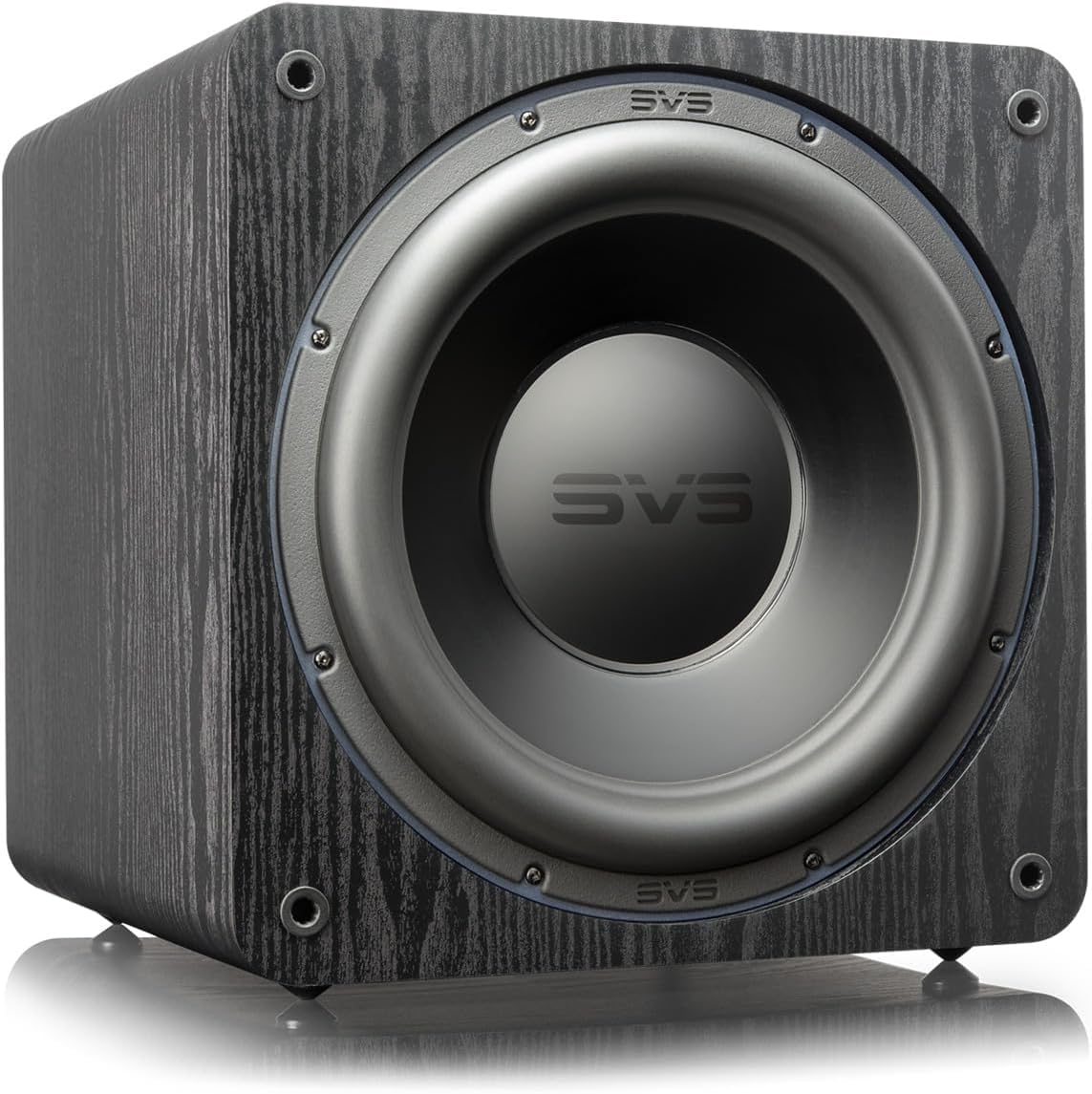
The SVS SB-3000 sets a reference standard for sealed subwoofers in the premium tier. Its 13-inch high-excursion driver, powered by a 800W RMS Sledge STA-800D2 Class-D amplifier, delivers punishing low-frequency output down to 20Hz while maintaining tight transient control. The sealed cabinet eliminates port chuffing and allows flexible placement near walls without compromising sound quality.
What truly separates the SB-3000 from cheaper subs is the 50MHz Analog Devices Audio DSP paired with SVS’s smartphone app. You can adjust crossover frequencies, parametric EQ, polarity, and room gain from your listening position, with real-time feedback between the app and the rear-panel interface. Users report audible output at 20Hz, with a smooth curve down to 28Hz before roll-off, making it equally capable for movie LFE and music reproduction.
The build quality — extra-thick MDF front baffle and rigid internal bracing — ensures the cabinet remains acoustically inert even at reference volumes. While the SB-3000 lacks the bottom-octave rumble of a similarly priced ported sub, its speed and accuracy are unmatched for music. At half the price of competing brands with similar DSP features, it represents exceptional price-to-performance value.
Why it’s great
- App-controlled DSP with parametric EQ and presets
- Sealed cabinet enables near-wall placement
- Low distortion and tight bass down to 20Hz
Good to know
- Bluetooth streaming requires separate adapter
- Ported alternatives offer more low-end rumble for movies
2. SVS SB-1000 Pro Subwoofer
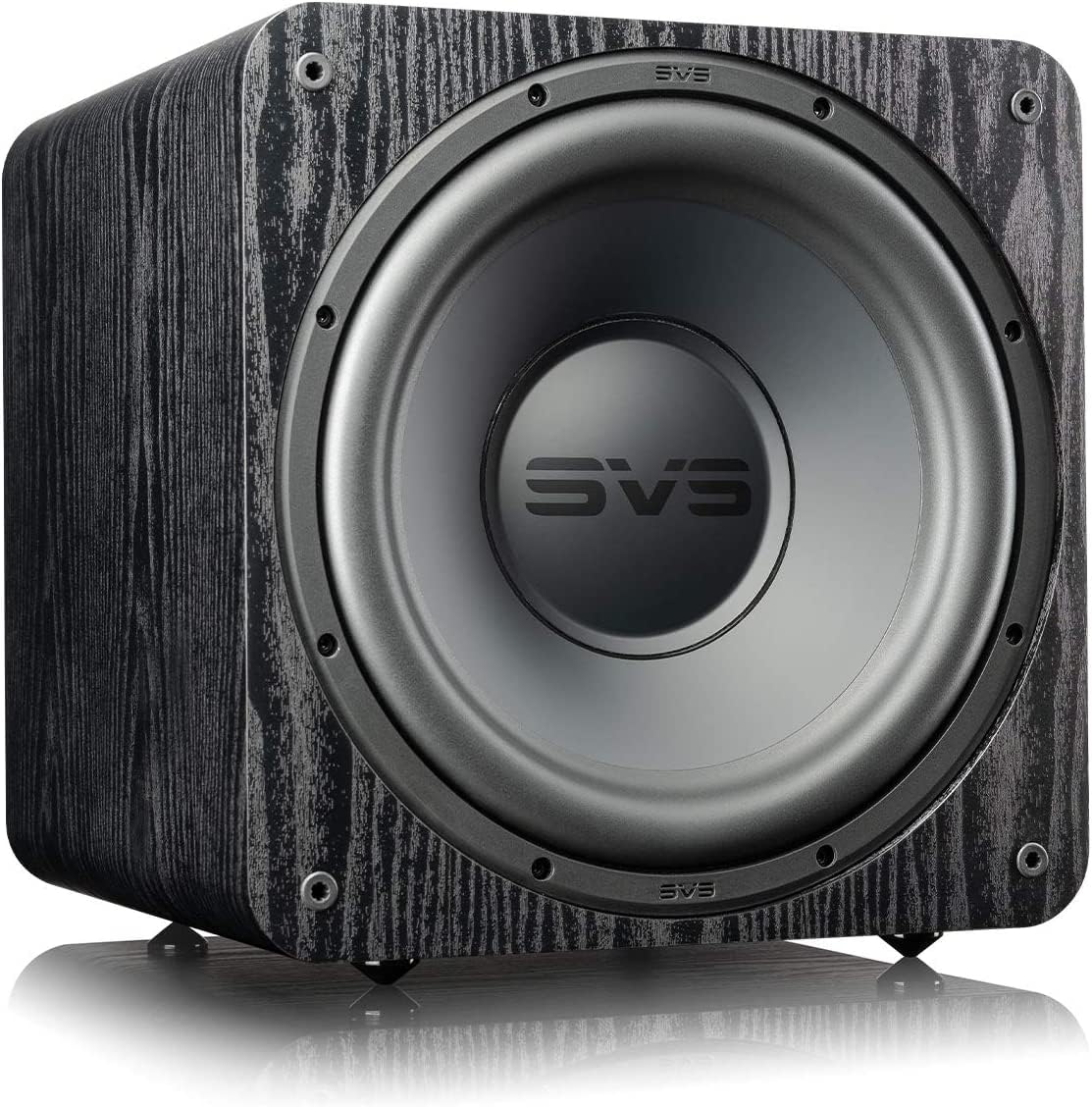
The SVS SB-1000 Pro packs the same DSP-driven app control found in the SB-3000 into a smaller, more affordable sealed cabinet. Its 12-inch high-excursion driver and 325W RMS Sledge STA-325D amplifier deliver accurate bass extension to 20Hz, making it one of the few compact subs capable of true subsonic output. The 50MHz Audio DSP renders frequency response with pinpoint accuracy and allows parametric EQ tuning from your phone.
Users praise the SB-1000 Pro for its tight, articulate bass that suits music as well as movies. The sealed design maintains speed and precision — no port chuffing or one-note boominess. The smartphone app lets you adjust volume, crossover, and custom presets from your seat, a feature usually reserved for much more expensive subs. Auto on/off convenience works reliably, and the compact cabinet fits into spaces where 12-inch ported subs cannot.
For near-field desktop or small-room setups, the SB-1000 Pro is nearly perfect. The only trade-off is that for larger rooms or those who prioritize extreme low-end rumble for blockbuster movies, the ported PB-1000 Pro might be a better match. Still, this subwoofer delivers performance that challenges models costing twice as much, especially for music lovers.
Why it’s great
- Smartphone app for full DSP control
- Fast, accurate sealed bass ideal for music
- Compact size fits under desks or in cabinets
Good to know
- Ported sibling offers more movie rumble
- Log volume falloff limits it to near-field applications
3. Klipsch Reference R-101SW Subwoofer

The Klipsch Reference R-101SW brings mid-range home theater bass to life with a 10-inch spun-copper thermoformed crystalline polymer woofer and a built-in all-digital amplifier. The driver design minimizes cone breakup and distortion, delivering cleaner low-frequency output than many plastic-cone subs in the same price band. A front-firing configuration makes placement more flexible than rear-ported alternatives.
Equipped with low-pass crossover and phase controls, the R-101SW integrates easily with any AV receiver via line or LFE inputs. Customer feedback highlights its ability to handle deep bass in action movies without rattle or pop, outperforming cheaper bundled subwoofers by a wide margin. The cabinet fits into smaller footprints while still producing enough output for medium-sized rooms.
One common observation is that the R-101SW sounds significantly better than its price suggests, with some users reporting it outperformed subs costing three times more. It does not, however, offer the app-based DSP tuning found on SVS models. For buyers building a Klipsch speaker system, the matching aesthetics and voicing are a nice bonus.
Why it’s great
- Light, stiff spun-copper woofer reduces distortion
- All-digital amp ensures efficient power delivery
- Front-firing driver simplifies room placement
Good to know
- No smartphone app for tuning
- Not designed for sub-28Hz performance
4. BIC America PL-200II Acoustech Subwoofer

The BIC America PL-200II is a front-firing, dual-flared ported subwoofer built for room-filling output. Its 12-inch poly-injected long-throw woofer and 250W RMS BASH amplifier produce peak power of 1,000 watts, with frequency response rated from 21 Hz to 200 Hz (±3 dB). The dual flared ports minimize turbulence noise, allowing cleaner bass at higher volumes.
Users consistently report house-shaking bass at 50% volume levels, especially in the 30-40Hz range. The cabinet features a piano gloss lacquer finish that looks more expensive than it is. Manual controls for volume and crossover give you full tuning authority, and the front porting allows placement closer to walls than rear-ported designs. For a 12-inch sub at this price point, the PL-200II outputs bass that competes with models in the premium tier.
However, the PL-200II shows its limits below 25Hz, where port chuffing and output drop-off become noticeable. Mid-bass clarity can also sound slightly muddy compared to more refined sealed designs. It is best suited for home theater use where explosive impact matters more than musical precision, and for users willing to experiment with placement to tame boominess.
Why it’s great
- High output (110dB sensitivity) for large rooms
- Front-ported design allows flexible placement
- Sub-25Hz extension for deep movie bass
Good to know
- Not the fastest or most accurate for music
- Gloss finish shows fingerprints easily
5. Audioengine S8 Powered Subwoofer

The Audioengine S8 is purpose-built for desktop and near-field listening. Its 8-inch down-firing driver and 250-watt amplifier produce tight, clean bass that integrates seamlessly with bookshelf speakers like Audioengine’s A2+ or A5+. The down-firing design couples with the floor to reinforce low frequencies, and the sealed cabinet keeps response accurate rather than boomy.
A sleep mode auto-powers the subwoofer after 15 minutes of inactivity, saving energy without sacrificing readiness. Connectivity is straightforward with stereo RCA inputs and outputs, allowing daisy-chaining to powered speakers without a separate receiver. Users rave about the S8’s ability to transform desktop systems, adding palpable bass for music, gaming, and movies without distortion or muddiness.
Where the S8 falls short is raw output for large rooms. Its 8-inch driver and 250-watt peak power are designed for near-field or small-to-medium spaces, not for pressurizing a living room. The lack of app-based DSP may also frustrate users who prefer parametric EQ control from their listening position.
Why it’s great
- Down-firing design improves placement flexibility
- Compact footprint fits under most desks
- Auto sleep mode conserves power automatically
Good to know
- Limited output for larger rooms
- No smartphone app for tuning
6. Dayton Audio Classic CS1000 Subwoofer
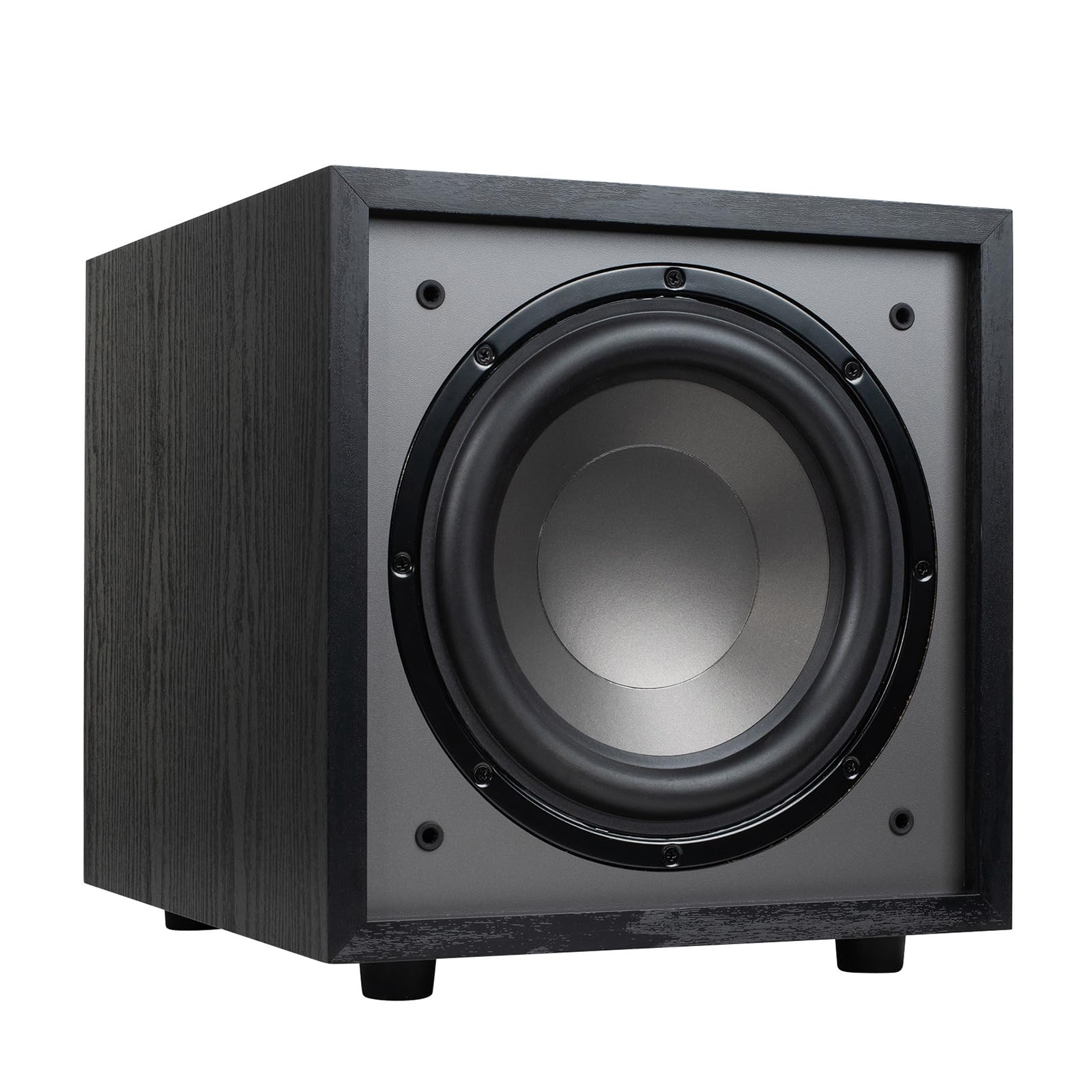
The Dayton Audio Classic CS1000 is no-nonsense subwoofer engineering from a brand respected for quality drivers. Its 10-inch driver and 180W RMS Class-D amplifier produce clean, tight bass without boominess or distortion, thanks to a rigidly braced MDF cabinet. Frequency response extends to 28 Hz, providing solid foundation for music and movies in small-to-medium rooms.
Connectivity includes stereo RCA, LFE, and speaker-level inputs, plus auto-on convenience for easy integration with any receiver or amplifier. A swappable black grille allows minor aesthetic customization, and the compact footprint (13.5 x 16 x 14.37 inches) fits under furniture easily. The 5-year warranty is unusually generous at this price tier.
Customer feedback emphasizes the CS1000’s value, noting it outperforms subs costing twice as much in terms of accuracy and build quality. Some users report that the screws on the woofer and amplifier plate can vibrate loose over time — a simple fix with thread-locking compound. It is not designed for extreme output or sub-28Hz extension, but for clean, musical bass in a living room or office, it is exceptional.
Why it’s great
- Rock-solid cabinet construction with 5-year warranty
- Flexible inputs including LFE and speaker-level
- Tight, clean bass suited for music reproduction
Good to know
- Not designed for high-volume theater output
- Screws may need threadlocker to prevent loosening
7. Fluance DB10 Subwoofer

The Fluance DB10 is a front-firing, front-ported powered subwoofer optimized for rooms where rear-port clearance is unavailable. Its 10-inch long-throw driver and specially tuned Class-D amplifier produce bass down to 38 Hz, with a warm, distortion-free character that suits both music and home theater. The engineered MDF cabinet with finely tuned bass port delivers sound that reviewers consistently call clean for the price.
Auto power-on detects signal from your audio source, making setup truly plug-and-play. The front porting design allows the DB10 to sit flush against a wall, which is a huge advantage for smaller rooms or entertainment centers with limited depth. Customers note that the subwoofer pairs perfectly with Fluance’s own bookshelf speakers but also integrates well with JBL, Polk, and other brands.
Where the DB10 shows its budget roots is in sub-40Hz extension — it trails off noticeably below 35 Hz, so it cannot reproduce the deepest movie LFE effects without help. Crossover set at 80Hz is ideal for blending with satellite speakers. A 15-hour break-in period is recommended for driver suspension to loosen up.
Why it’s great
- Front-ported design allows near-wall placement
- Auto power-on for convenient, hands-free operation
- Warm, distortion-free sound at moderate volumes
Good to know
- Limited sub-40Hz extension
- Requires break-in period for best performance
8. Edifier T5s Powered Active Subwoofer
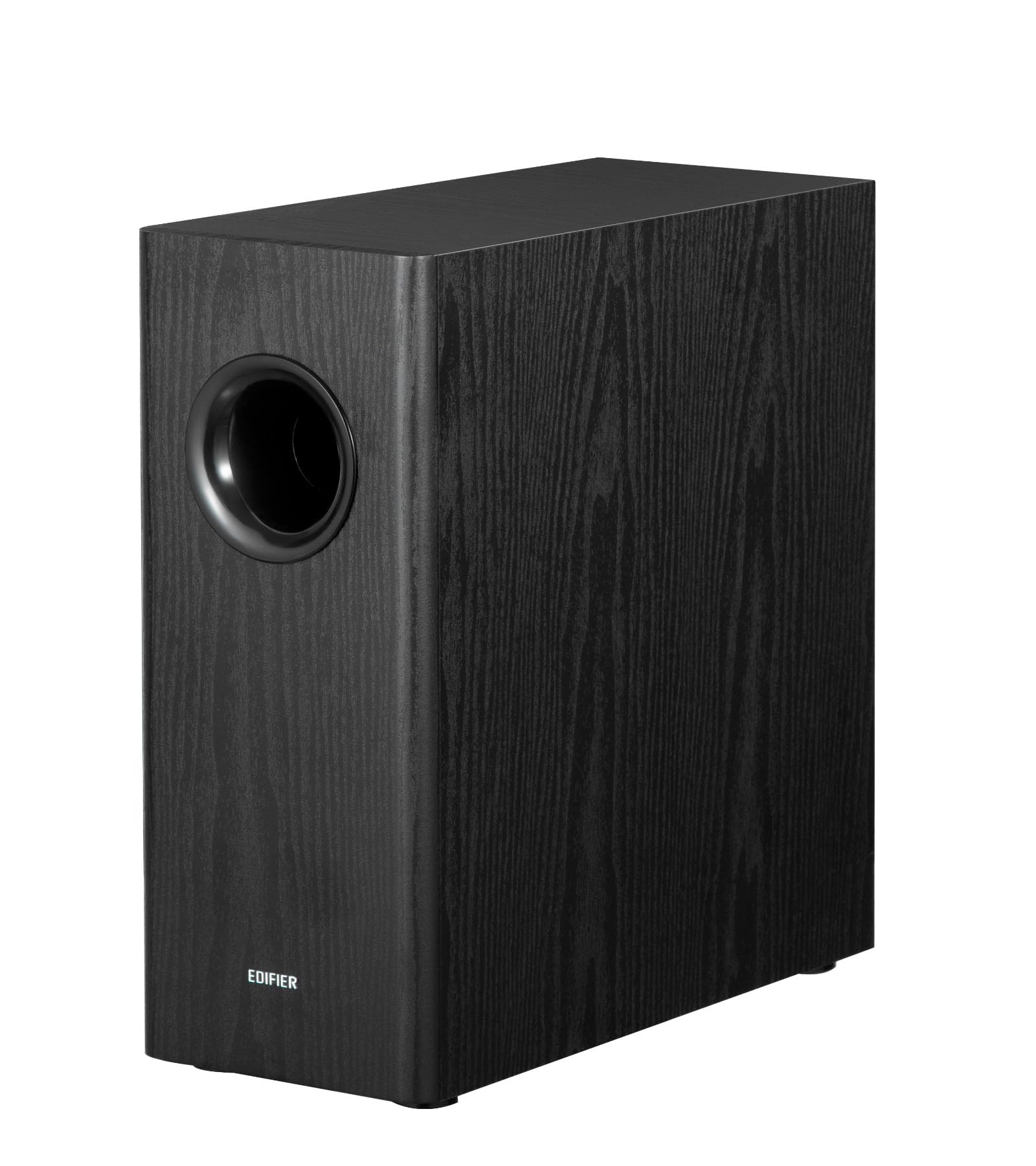
The Edifier T5s is an 8-inch active subwoofer engineered specifically for augmenting desktop speakers and small-room stereo setups. Its Class-D amplifier delivers 70W RMS to the long-throw woofer, achieving deep bass extension down to 35 Hz. The slim vertical cabinet (6.69 inches wide) fits into tight spaces where traditional boxy subs cannot.
Precision controls include a low-pass filter adjustable from 30Hz to 160Hz, along with a 0°/180° phase selector for seamless blending with your main speakers. Connectivity is flexible — RCA inputs for systems with subwoofer outputs, or you can run speakers in series through the T5s when no sub-out is available. The 18mm MDF cabinet with front-firing driver and right-firing acoustic port minimizes resonance for clean, tight bass.
Users pairing the T5s with Edifier R1700BTs or other bookshelf speakers report a dramatic improvement in low-end presence. It is not intended for room-shaking home theater performance — the 70W RMS rating means its output is limited, and it cannot cleanly reproduce sub-35Hz tones. But within its intended use case as a desktop or small-room companion, it offers excellent value.
Why it’s great
- Slim vertical design fits tight desktop spaces
- Adjustable low-pass filter and phase control
- Series wiring option for systems without sub out
Good to know
- Limited to 70W RMS — not for large rooms
- Cannot reproduce sub-35Hz tones cleanly
9. Rockville Rock Shaker 8 Subwoofer

The Rockville Rock Shaker 8 is one of the most affordable powered subwoofers available, yet it delivers 200W RMS through an 8-inch high-excursion driver with a Y30 magnet and 1.5-inch 4-layer voice coil. The Class-D amplifier and MDF wood cabinet with fire-resistant poly fill help produce cleaner bass than expected at this price point. RCA and speaker-level inputs and outputs provide easy integration with most receivers and amplifiers.
Customer feedback is generally positive, calling it a night-and-day improvement over small speakers alone. It integrates well with turntable setups and basic home theater systems, offering tight, controlled bass that outperforms units costing two to three times more. The compact dimensions (11.8 x 13.8 x 15 inches) make it easy to place in living rooms or offices.
The trade-offs are visible in build quality — the cabinet is noticeably light and thin, and the crossover knob is unmarked, making precise adjustments difficult. Initial bass can sound boomy, though some users found improvement by swapping in a higher-quality power cord. It is built to a price point, so long-term reliability may vary, but for someone on a strict budget wanting any low-end extension at all, this subwoofer delivers.
Why it’s great
- Exceptional value for entry-level budgets
- RCA and speaker-level inputs for flexible connectivity
- Compact size fits small rooms and desks
Good to know
- Unmarked crossover knob complicates fine-tuning
- Build quality is light and basic at this price
FAQ
Do I need a subwoofer if my speakers already have good bass?
How do I determine the right subwoofer size for my room?
Should I buy a sealed or ported subwoofer for music?
Can I connect a powered subwoofer to a stereo receiver without a subwoofer output?
How does DSP app control improve subwoofer performance?
Final Thoughts: The Verdict
For most users, the best audio home subwoofer winner is the SVS SB-3000 because its combination of 800W RMS power, app-controlled DSP, and fast sealed response serves both music and movies without compromise. If you want app-based tuning in a compact, budget-friendly package, grab the SVS SB-1000 Pro. And for deep, rumbling home theater output at a mid-range price, nothing beats the BIC America PL-200II.