
The bottleneck in your vocal chain isn’t the microphone—it’s the preamplifier hidden inside the box you plug it into. A weak or noisy preamp can make a high-end XLR condenser sound thin and distant, while a well-designed unit with enough clean gain can make a humble dynamic mic punch well above its weight, broadcasting every transient with authority.
I’m Min — the co-founder and writer behind Gadgets Feed. I’ve spent months dissecting the technical architecture of the current interface market, cross-referencing specs like equivalent input noise (EIN), dynamic range, and THD+N to identify which models deliver genuine high-definition capture versus those relying on marketing hype.
Every recommendation here is built on measurable performance metrics and thousands of user-reported reliability data points, ensuring you land on the right audio interface for xlr mic for your studio, podcast booth, or mobile rig.
How To Choose The Best Audio Interface For XLR Mic
Matching an interface to your XLR microphone is about more than just plugging in a cable. Dynamic microphones like the Shure SM7B demand high gain (often 60 dB or more) without introducing noise, while condenser microphones require robust 48V phantom power that stays clean under load. Your choice depends on your microphone’s impedance and your monitoring workflow.
Preamp Gain and Equivalent Input Noise (EIN)
The two numbers that define preamp quality are the maximum gain measured in decibels and the EIN measured in dBu. A preamp with 56 dB of gain and an EIN of -129 dBu will deliver a much cleaner signal from a low-output dynamic mic than a unit offering 50 dB with -125 dBu. The lower the EIN, the less hiss you’ll hear in quiet passages.
Phantom Power Integrity
Not all 48V phantom power is created equal. Cheaper interfaces can sag voltage under load, causing condenser microphones to sound dull or lose headroom. Look for interfaces that specify their phantom power current capacity per channel (typically 5 mA to 10 mA); higher-rated units support more demanding large-diaphragm condensers without instability.
Quick Comparison
On smaller screens, swipe sideways to see the full table.
| Model | Category | Best For | Key Spec | Amazon |
|---|---|---|---|---|
| Focusrite Scarlett Solo 4th Gen | Mid-Range | Versatile home studio recording | 24-bit / 192 kHz, 2 vocal presets | Amazon |
| Solid State Logic SSL 2 MKII | Premium | Crystal-clear vocal capture with tone shaping | 32-bit / 192 kHz AD/DA, Legacy 4K | Amazon |
| Universal Audio Volt 2 | Premium | Vintage saturation and LUNA integration | 24-bit / 192 kHz, UA 610 preamp mode | Amazon |
| Motu M2 | Premium | Best headphone output and DAC purity | ESS Sabre32 Ultra DAC, 120 dB dynamic range | Amazon |
| Shure MV7i Smart Microphone | Premium | All-in-one mic with built-in interface | Dynamic capsule, 60 dB preamp, 48V phantom | Amazon |
| Focusrite Scarlett Solo 3rd Gen | Mid-Range | Reliable budget-friendly recording | 24-bit / 192 kHz, Air mode | Amazon |
| M-AUDIO AIR192x4 VSPro | Mid-Range | Complete starter bundle value | 24-bit / 192 kHz, 2.59 ms latency | Amazon |
| Shure MVX2U | Budget | Ultra-portable XLR to USB solution | 60 dB gain, 48V phantom, zero-latency monitor | Amazon |
| Arturia MiniFuse 1 | Budget | Compact travel interface with USB hub | 192 kHz, 1 combo input, 5-year warranty | Amazon |
In‑Depth Reviews
1. Focusrite Scarlett Solo 4th Gen
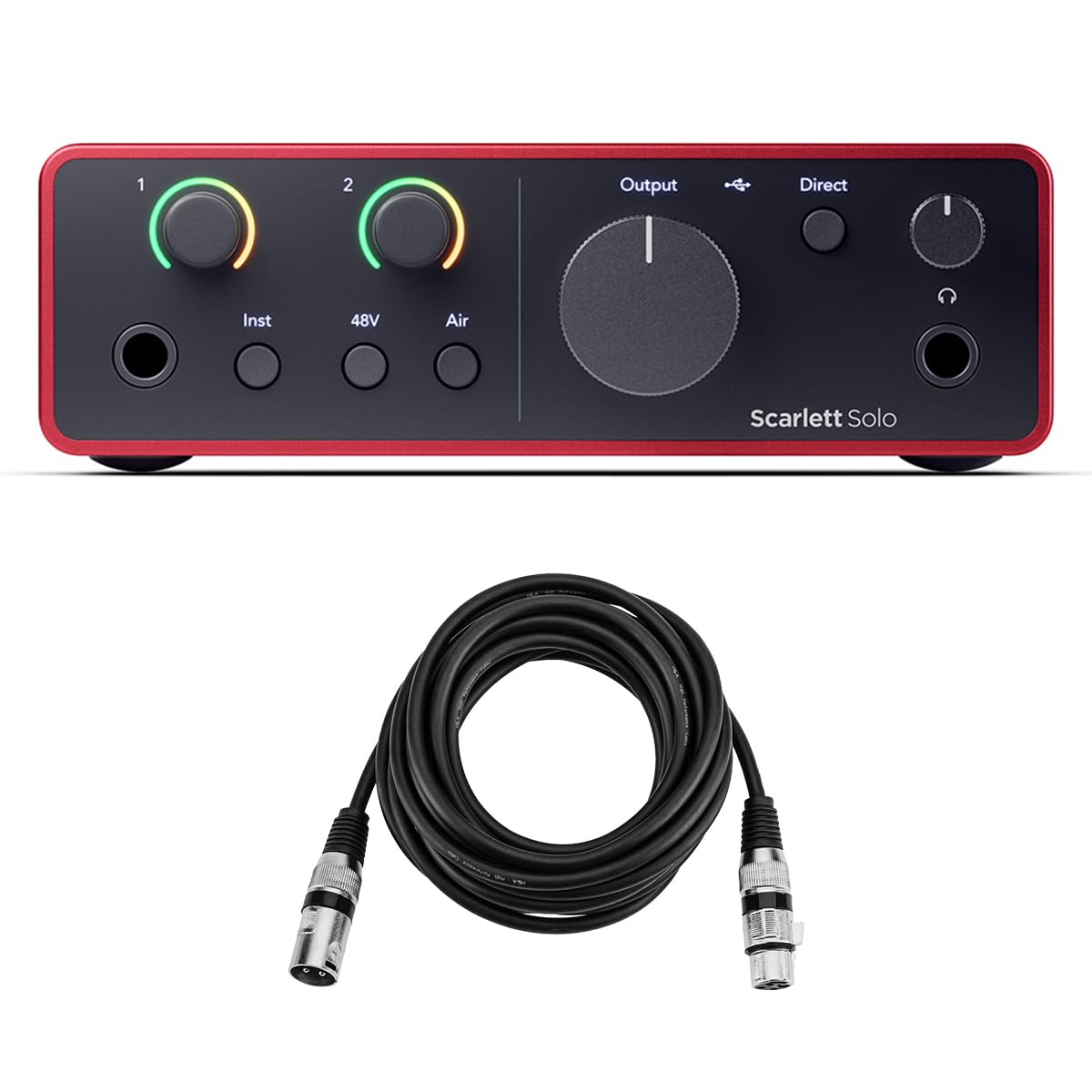
The 4th generation introduces switchable vocal presets that intelligently shape the preamp response for spoken-word and singing applications, going beyond the simple Air mode of previous generations. Its preamp stage delivers an exceptionally low noise floor, making it suitable for capturing quiet vocal passages without introducing audible hiss into the signal chain.
The included bundle adds a 10-foot XLR cable, removing the need for a separate accessory purchase on day one. The USB-C bus-powered design ensures the unit draws power directly from your laptop or desktop, and the headphone output now features its own dedicated volume knob with sufficient swing to drive monitoring headphones up to 250 ohms.
Connectivity covers one combo XLR/TRS input with 48V phantom power, one instrument input, balanced line outputs, and a headphone output. The metal chassis feels sturdy for desk or travel use, and the gain halo rings provide a visual reference for input level without forcing you to watch software meters.
Why it’s great
- Built-in vocal presets tailor preamp curve for different mic types
- Crystal-clear preamps with very low EIN for clean capture
- USB-C bus-powered and includes XLR cable in the box
Good to know
- Sensitive gain knobs require careful adjustment to avoid jumps
- Newbie documentation sparse; download full manual online
2. Solid State Logic SSL 2 MKII

The SSL 2 MKII is built around 32-bit AD/DA converters that deliver a larger dynamic window for capturing XLR sources, and the Legacy 4K button injects a carefully modeled analog saturation based on SSL’s legendary 4000 series consoles. Engaging 4K adds a subtle harmonic presence to vocals, giving them a sense of forwardness without requiring post-production EQ tweaks.
The dual XLR preamps offer a flat noise floor that voice actors and podcasters will appreciate, and the built-in high-pass filter intelligently cuts sub-80 Hz rumble before it hits the converter stage. The headphone amplifier is powerful enough to drive higher-impedance studio headphones with clarity, and the loopback feature routes your computer audio back through the interface for live stream mixing.
Constructed with a stainless-steel chassis that feels denser than most competitors at this tier, the unit includes MIDI I/O on 5-pin DIN jacks for synth integration. Setup is straightforward on both Windows 11 and macOS, with no driver-related dropouts reported in the field.
Why it’s great
- Legacy 4K analog enhancement adds vocal presence naturally
- 32-bit converters provide headroom for dynamic peaks
- Built-in high-pass filter cuts rumble before ADC stage
Good to know
- Larger and heavier than compact competitors
- Not true 32-bit float recording (32-bit D/A converter only)
3. Universal Audio Volt 2

The Volt 2 emulates the classic UA 610 tube preamp circuitry through a Vintage mode switch, applying a gentle, musical saturation that fattens up thin-sounding XLR microphones without adding harshness. This is particularly effective on dynamic mics that can sound dry, as the analog circuit imparts a round, compressed character reminiscent of mid-century studio chains.
The unit captures at 24-bit / 192 kHz resolution and includes a free download of LUNA’s recording environment, which mimics analog tape and console workflows. The preamps are quiet enough for sensitive condenser microphones, and the 48V phantom power maintains steady voltage even when both channels are active with high-demand microphones.
A compact metal enclosure houses one XLR/TRS combo input, one instrument input, balanced outputs, and a headphone jack with independent level control. USB bus power keeps the rig mobile, and the unit is compatible with Mac, Windows, iPadOS, and iOS devices via the appropriate adapters.
Why it’s great
- Vintage mode adds analog saturation to dull-sounding XLR mics
- Bundled LUNA DAW provides tape-emulation workflow
- Stable phantom power for demanding condenser mics
Good to know
- Requires external power supply for iPad/iPhone use
- Plugin setup process requires time and account registration
4. Motu M2

The Motu M2 integrates ESS Sabre32 Ultra DAC technology, a component typically reserved for interfaces costing several times more, resulting in a measured 120 dB dynamic range on the outputs and an EIN of -129 dBu on the microphone inputs. This translates to a black background when monitoring, with no audible electronic noise floor masking subtle vocal details.
The headphone output is genuinely powerful, delivering enough current to drive 250-ohm headphones like the Beyerdynamic DT990 Pro to satisfying levels without a dedicated headphone amplifier. The full-color LCD display shows real-time level metering for both input channels, giving you a precise visual of your XLR signal before it hits the DAW.
USB-C bus power drives the unit, and the loopback channel pairs well for streaming and podcast workflows. The preamps are transparent by design, offering no coloration but capturing exactly what the microphone outputs.
Why it’s great
- ESS Sabre32 DAC delivers studio-grade clarity on outputs
- Headphone jack drives high-impedance cans effortlessly
- Full-color LCD meters for precise input level visualization
Good to know
- Requires users to understand sample rate settings for stable performance
- Included USB-C cable quality can cause dropouts; upgrade recommended
5. Shure MV7i Smart Microphone

The MV7i combines Shure’s broadcast-optimized dynamic capsule with a built-in audio interface that includes an XLR/¼-inch combo input for a second microphone or instrument. This eliminates the need for a separate interface box for dual-source streaming, condensing your entire vocal chain into one all-metal device with a 60 dB preamp stage.
Auto Level Mode continuously adjusts gain in real-time based on your distance from the mic and room acoustics, which is particularly useful for podcasters who move during recording. The custom LED touch panel provides tap-to-mute functionality and a visual level display with 16.8 million color options for studio aesthetics.
The built-in Voice Isolation Technology and real-time denoise processing reduce background rumble before the signal hits your computer, making it suitable for untreated rooms. Dual-channel output via USB-C allows simultaneous capture of the internal capsule and the external XLR source as separate tracks.
Why it’s great
- One device replaces both microphone and audio interface
- Auto Level Mode maintains consistent volume without manual gain riding
- Second XLR/¼-inch input for dual-source streaming
Good to know
- Some settings require MOTIV Mix software for configuration
- No Stream Deck toggle for reverb; manual software control needed
6. Focusrite Scarlett Solo 3rd Gen

The 3rd Gen Scarlett Solo remains a benchmark for entry-to-mid-range XLR recording because of its consistent preamp performance and the Air mode, which applies a high-frequency shelf modeled after the Focusrite ISA transformer preamp. This brightens dull microphones naturally, bringing clarity to vocals without sounding brittle or phasey.
The Gain Halo meters provide an intuitive level indicator on the input knob, turning green for good signal and amber to warn of clipping. The converters support 24-bit / 192 kHz for high-definition archiving, and the loopback function allows you to capture your computer’s audio alongside your XLR input for podcasting.
The metal chassis has a proven track record of durability, with users reporting reliable operation over several years of heavy use. The included software bundle includes Ableton Live Lite, Pro Tools Intro, and the Hitmaker Expansion suite, giving you production tools immediately upon setup.
Why it’s great
- Air mode adds clarity to flat-sounding XLR microphones
- Inexpensive entry point with proven long-term reliability
- Gain Halo provides instant visual input level confirmation
Good to know
- USB-C to USB-A cable included, not USB-C to USB-C
- 3rd Gen lacks the vocal presets found in the 4th Gen
7. M-AUDIO AIR192x4 VSPro

The AIR192x4 VSPro includes a Nova condenser microphone, shock mount, XLR cable, and HDH40 headphones, making it a complete starter ecosystem for anyone building their first XLR-based recording rig. The interface itself delivers a round-trip latency of only 2.59 milliseconds, which is fast enough for real-time monitoring through software effects without perceptible delay.
The crystal preamps on the AIR192x4 are specified with ultra-pristine AD converters that handle 24-bit / 192 kHz resolution without frequency roll-off at the high end. The single XLR/TRS combo input accommodates both condenser and dynamic microphones, while the instrument input accepts high-impedance sources like electric guitar pickups.
Software inclusions span MPC Beats, Ableton Live Lite, the Creative FX Collection, and the Xpand!2 virtual instrument, providing a substantial library of sounds and processing tools. The headphone output has independent level control, allowing separate monitor mix adjustment without affecting the main outputs.
Why it’s great
- Complete bundle with condenser mic, headphones, and XLR cable
- 2.59 ms latency supports real-time software monitoring
- Strong software bundle for immediate production capability
Good to know
- Bundled Nova microphone quality is acceptable for beginners but not pro-grade
- USB connectivity failure reported in some units after extended use
8. Shure MVX2U

The MVX2U shrinks an entire XLR audio interface into a form factor barely larger than a pack of gum, connecting directly to your microphone’s XLR output or sitting inline with a standard XLR cable. Despite its size, it delivers a staggering 60 dB of clean gain, enough to drive a Shure SM7B without the need for an external inline booster like a Cloudlifter.
The ShurePlus MOTIV companion app unlocks a full suite of processing including gain staging, EQ curves, compression, and a high-pass filter, all stored on the device itself so your settings travel with the interface. The zero-latency 3.5mm headphone jack provides real-time monitoring of the incoming XLR signal with no audible delay.
48V phantom power is available for condenser microphones, and the USB-C output powers the unit directly from a computer or USB power adapter. The dual mounting options — direct mic attachment or inline cable mount — make it the most space-efficient way to add an XLR channel to a mobile streaming or field recording setup.
Why it’s great
- 60 dB gain handles low-output dynamics without a booster
- Built-in DSP saves EQ and compression settings onboard
- Minimal footprint clips directly onto the microphone body
Good to know
- Only 48 kHz maximum sample rate, no 96 kHz or 192 kHz
- App configuration required for full DSP control; no hardware knobs
9. Arturia MiniFuse 1
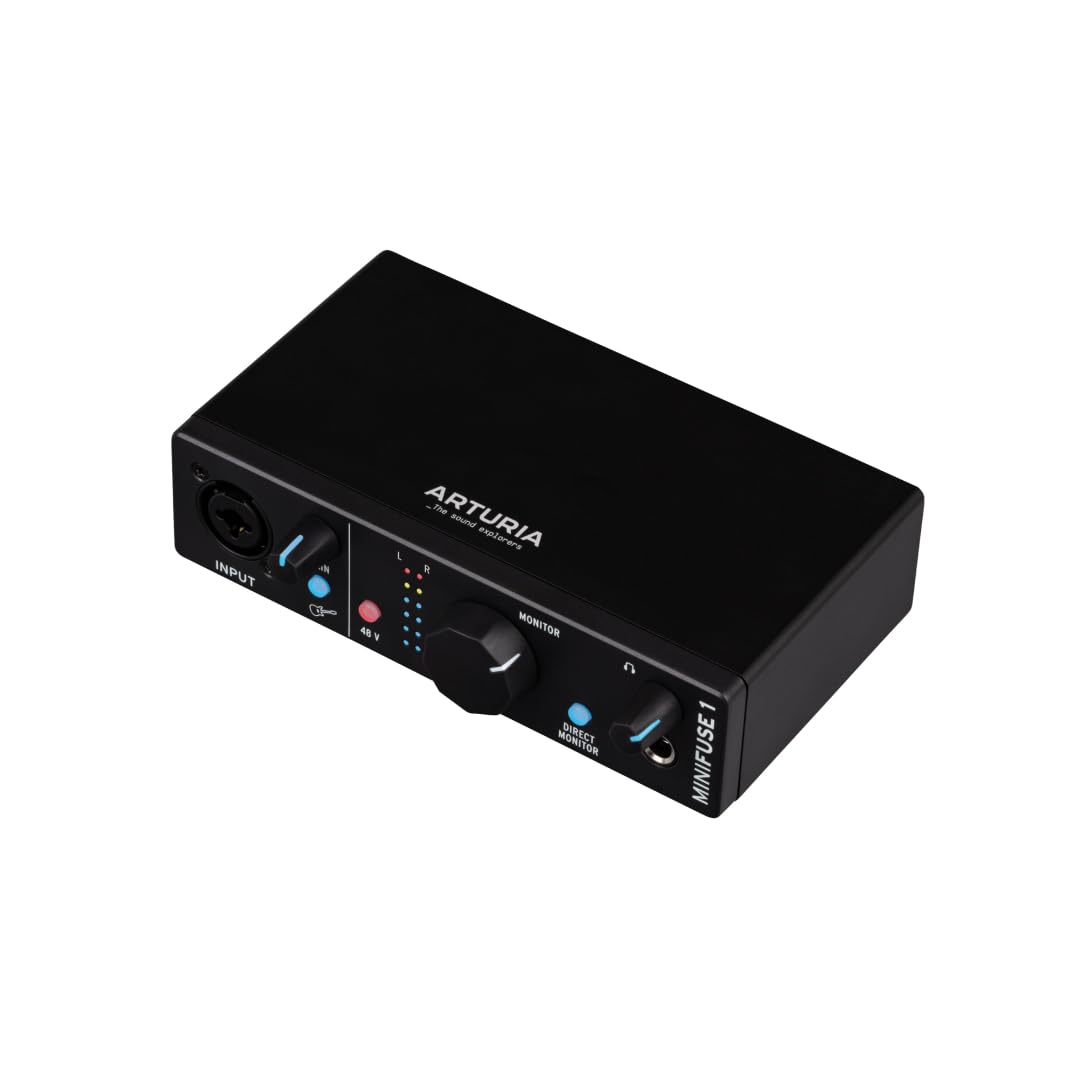
The MiniFuse 1 punches into the entry-level XLR interface market with a rare feature: a built-in USB-A hub port that provides 250 mA of power for connecting a MIDI controller, dongle, or flash drive without consuming an additional port on your computer. The single combo input accepts both XLR and ¼-inch TRS/TS connections and includes 48V phantom power for condenser mics.
The unit supports sample rates up to 192 kHz, which is higher than most competitors at this price tier, and the preamp delivers a transparent sound with sufficiently low noise for general recording and podcasting. The 5-year warranty is one of the longest protections available, signaling confidence in the component selection and assembly process.
5-pin MIDI input and output jacks are present for connecting synthesizer and controller gear, a rarity on single-input interfaces. The loopback feature captures computer audio alongside your XLR input, and the included software bundle covers Ableton Live Lite, Analog Lab Intro, and Guitar Rig 6 LE for immediate creative use.
Why it’s great
- Built-in USB hub port frees up computer connections
- Full MIDI I/O included on a single-channel device
- 5-year warranty is best-in-class for this price tier
Good to know
- Headphone output not ideal for low-impedance IEMs
- Combo input only, no dedicated instrument input for high-Z sources
FAQ
Do I need an interface with 192 kHz sample rate for podcasting?
Can a dynamic XLR mic work without phantom power?
What is the minimum preamp gain I should look for with a Shure SM7B?
Final Thoughts: The Verdict
For most users, the audio interface for xlr mic winner is the Focusrite Scarlett Solo 4th Gen because it combines the most useful vocal processing features, clean preamps at a price that undercuts many competitors, and a reliable build that handles daily recording sessions without hesitation. If you want the purest DAC conversion and headphone output for pristine monitoring, grab the Motu M2. And for a completely cable-minimal mobile setup, nothing beats the Shure MVX2U.