
Recording vocals, tracking a guitar riff, or producing a podcast at home demands an audio interface that captures every nuance without introducing noise or latency. The wrong choice leaves you fighting hum, hiss, and driver dropouts instead of focusing on your craft.
I’m Min — the co-founder and writer behind Gadgets Feed. I’ve spent countless hours dissecting specs like dynamic range, EIN, sample rates, and preamp gain across hundreds of models to separate genuine studio-grade hardware from marketing fluff.
Whether you’re a solo musician, a multi-mic podcaster, or a producer building a project studio, finding the best audio interface under 1000 means balancing channel count, converter quality, and workflow features that actually serve your specific recording needs.
How To Choose The Best Audio Interface Under 1000
Choosing an interface in this bracket means prioritizing between transparent preamps, I/O flexibility, and DSP power. The right pick elevates your studio without demanding a mortgage payment.
Channel Count and Preamp Quality
The number of mic preamps dictates how many sources you can record simultaneously — think vocalist, guitarist, and a podcaster all at once. Look for EIN ratings below -127 dBu and gain ranges above 56 dB to handle everything from ribbon mics to loud drum overheads without noise.
Converters and Dynamic Range
The A/D and D/A converters define how much detail survives from your analog signal to your DAW. A dynamic range above 114 dB on inputs and above 118 dB on outputs is the sweet spot for professional-grade clarity across this price tier.
Connectivity and Future-Proofing
USB-C provides bus power and universal compatibility. ADAT expansion ports let you add eight more channels later without replacing the interface. Many premium models now include onboard DSP for near-zero latency monitoring with reverb and compression.
Quick Comparison
On smaller screens, swipe sideways to see the full table.
| Model | Category | Best For | Key Spec | Amazon |
|---|---|---|---|---|
| Focusrite Scarlett 18i16 4th Gen | Premium | High-input songwriting and production | 122 dB dynamic range | Amazon |
| MOTU UltraLite-mk5 | Premium | Multi-output mixing and surround | 125 dB analog output dynamic range | Amazon |
| Universal Audio Apollo Solo | Premium | Real-time UAD plugin tracking | UAD SOLO Core DSP processing | Amazon |
| Zoom PodTrak P8 | Mid-Range | Multi-host podcast recording | 6 XLR inputs, 6 headphone outs | Amazon |
| MOTU M4 4×4 | Mid-Range | Home studio with live monitoring | ESS Sabre32 DAC, 192kHz | Amazon |
| Audient EVO 8 | Mid-Range | Quick-setup recording and streaming | SmartGain auto-level, JFET instrument input | Amazon |
| MOTU M2 2×2 | Mid-Range | Solo artist and vocal tracking | ESS Sabre32 Ultra DAC, 120 dB dynamic range | Amazon |
| Universal Audio Volt 2 | Mid-Range | Portable recording with vintage tone | Classic 610 preamp emulation with Vintage mode | Amazon |
| Focusrite Scarlett Solo 3rd Gen | Budget-Friendly | First-time recording and podcasting | Air mode, 192kHz converters | Amazon |
In‑Depth Reviews
1. Focusrite Scarlett 18i16 4th Gen
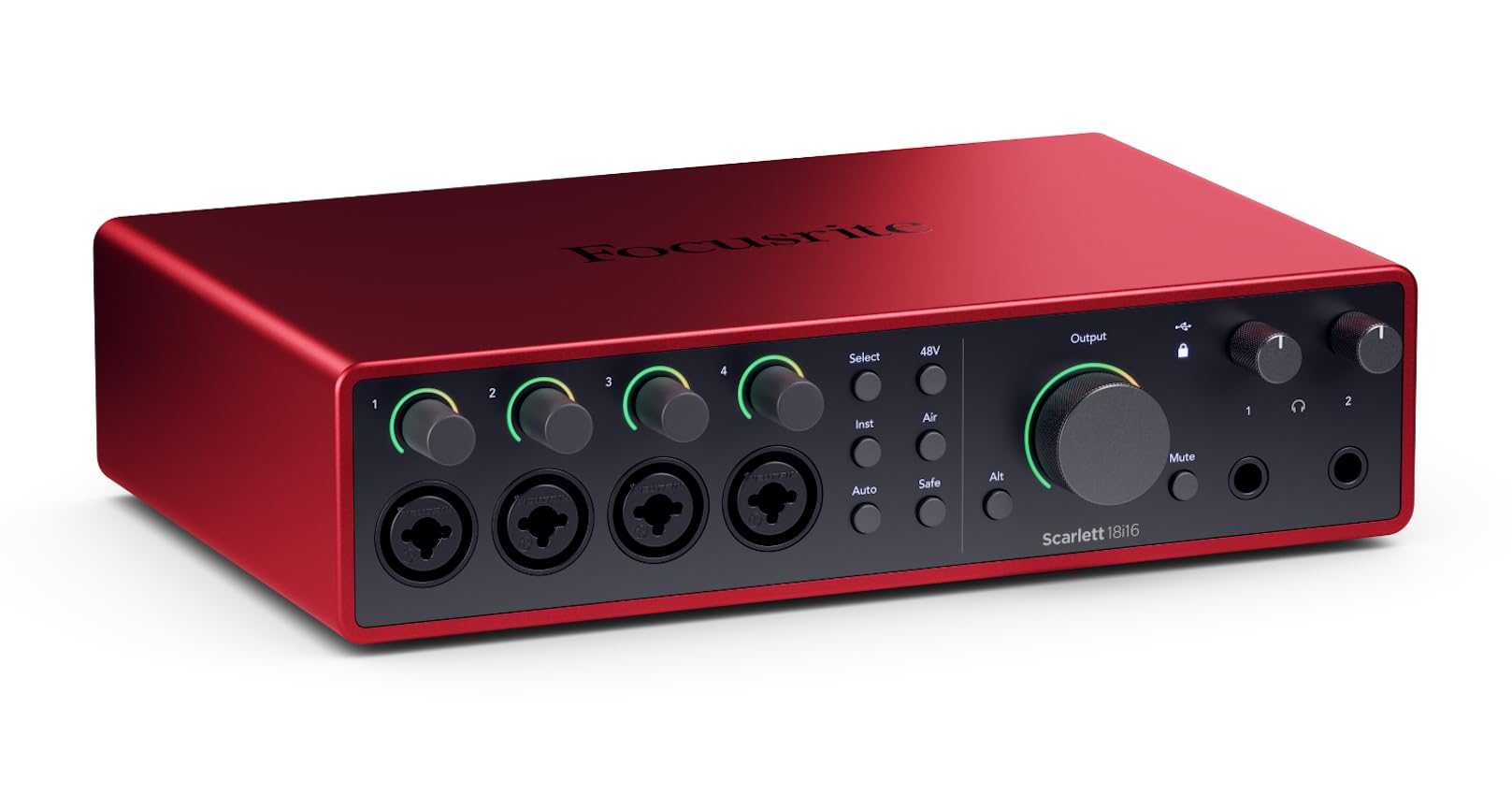
The Scarlett 18i16 4th Gen sits at the intersection of pro connectivity and accessible cost. Its 18 inputs and 16 outputs include four mic preamps, eight line inputs, ADAT, S/PDIF, and MIDI — enough to build a serious studio rig without needing a patchbay. The fourth-generation preamps deliver 69 dB of gain, which easily powers dynamic mics like the SM7B without an extra booster.
Focusrite borrowed converter technology from its RedNet range, offering 122 dB of dynamic range on the outputs. That’s the kind of headroom that keeps transients clean even when mixing busier arrangements. The Air mode now includes Presence and Harmonic Drive options, adding either high-frequency sheen or saturation that mimics classic console character.
Auto Gain and Clip Safe are genuinely useful workflow tools — Auto Gain sets levels in seconds, and Clip Safe monitors the signal and adjusts gain in real time to prevent distortion. It ships with Pro Tools Intro, Ableton Live Lite, Cubase LE, and the Hitmaker Expansion suite, so you can start recording immediately.
Why it’s great
- Massive I/O count with ADAT expandability
- 122 dB dynamic range and 69 dB preamp gain
- Auto Gain and Clip Safe simplify setup
Good to know
- External power supply required, not bus-powered
- Heavier chassis at 3.83 pounds
2. MOTU UltraLite-mk5

The UltraLite-mk5 is one of the most densely featured interfaces under the premium cap. It packs 18 inputs and 22 outputs into a half-rack chassis, with two combo XLR/TRS inputs, six analog inputs, ten analog outputs, ADAT, S/PDIF, and MIDI. That’s enough to run a 5.1 or 7.1 surround setup or handle a small band’s live stream.
The analog outputs deliver 125 dB of dynamic range — among the best in this list — and the ESS Sabre32 DAC ensures pristine stereo imaging and low jitter. MOTU’s optimized drivers keep latency under 3 ms at a 32-sample buffer, which is critical for monitoring through plugins during tracking.
The onboard DSP mixer, CueMix 5, lets you apply reverb, 4-band parametric EQ, and dynamics to both inputs and bus mixes, all without taxing your computer’s CPU. It retains settings in memory, so you can use it as a standalone mixer even without a computer connected, making it a powerful tool for live applications.
Why it’s great
- 125 dB dynamic range on outputs
- DSP mixer with reverb, EQ, and dynamics
- Can function as a standalone mixer
Good to know
- Short included USB cable
- White OLED display can be hard to read in bright conditions
3. Universal Audio Apollo Solo Heritage Edition

The Apollo Solo Heritage Edition brings UA’s flagship technology to a compact, bus-powered chassis. The UAD SOLO Core chip lets you track through vintage compressors, equalizers, and reverb with near-zero latency — think Teletronix LA-2A compression or Pultec EQ on the way in. The Heritage Edition bundle includes five premium plugins valued at over .
Unison technology transforms the preamp’s impedance and gain staging to electrically match the hardware it emulates — plugging into a Neve-style Unison preset changes the input stage to behave like the real console. The best-in-class headphone amplifier delivers clean output for high-impedance headphones, important for critical monitoring.
Apollo Solo supports Logic Pro, Pro Tools, Cubase, Ableton Live, and runs UAD plugins via VST, AU, and AAX formats. The free LUNA Recording System integrates deeply with Apollo hardware for tape-style workflow. Note that the Thunderbolt cable is not included, and Windows users report driver challenges with new OS releases.
Why it’s great
- Real-time UAD plugin tracking with near-zero latency
- Unison preamp emulation from Neve, API, Avalon
- Includes premium Heritage Edition plugin bundle
Good to know
- Windows driver support can lag behind macOS updates
- Requires Thunderbolt cable, not included
4. Zoom PodTrak P8
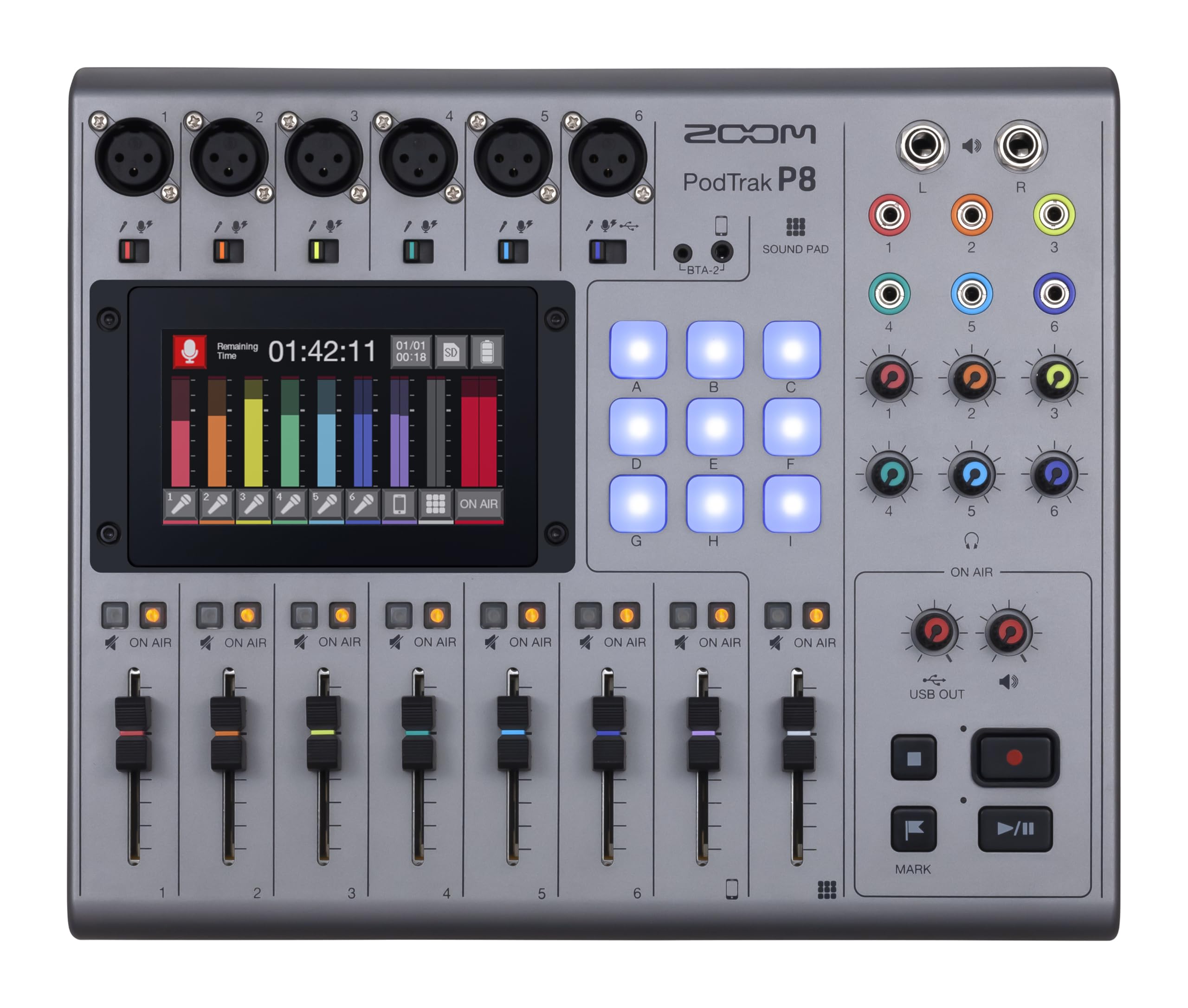
The PodTrak P8 is not your typical desktop interface — it’s a complete podcast production studio built into a portable mixer. It features six XLR inputs with separate preamps and six headphone outputs, each with independent volume control. The built-in Mix-Minus function prevents echo when recording phone calls and remote guests, a feature that matters in every podcast session.
The 4.3-inch color touchscreen gives you direct control over mic preamp sliders, EQ, compression, de-essing, noise reduction, and limiters. Nine multi-colored sound pads across four banks give you access to 36 sound clips such as intro music and jingles. You can record up to 13 tracks simultaneously onto an SD card.
It functions as a 13-in/2-out USB audio interface for live streaming and recording, and it runs on four AA batteries for up to two hours of portable operation. The full-color LCD makes real-time adjustments intuitive without diving into a DAW, which is essential for live podcast taping.
Why it’s great
- Six independent headphone outputs with separate mixes
- Built-in Mix-Minus for remote guest calls
- Portable battery-powered operation
Good to know
- Not ideal for music production; more niche for podcasting
- Onboard preamps are clean but not as detailed as studio-grade units
5. MOTU M4 4×4

The MOTU M4 provides professional-grade conversion and expandability at a mid-range price point. It uses the same ESS Sabre32 Ultra DAC technology found in high-end interfaces costing thousands, offering excellent dynamic range and low distortion. The two mic preamps are quiet and natural, with enough headroom for condenser mics in untreated rooms.
The four inputs and four outputs include two combo XLR/TRS, two TRS line inputs, four TRS line outputs, and S/PDIF digital I/O. The front panel has an LCD screen with precise level metering — perfectly usable for checking signals at a glance. The physical direct monitoring knob blends input and playback signals without latency.
A dedicated loopback output facilitates streaming and podcast workflows without extra routing. The bus-powered USB-C connection works with Mac, Windows, and iOS. The headphone output is strong enough for 250-ohm headphones like the Beyerdynamic DT990 Pro, though users note a slight dead zone in the volume knob’s first 25% of rotation.
Why it’s great
- ESS Sabre32 Ultra DAC for high-fidelity conversion
- Hardware direct monitoring with no latency
- Dedicated loopback output for streaming
Good to know
- Volume knob has a dead zone in the first 25%
- Pitch-shift bug reported with Windows fast startup enabled
6. Audient EVO 8

The EVO 8 packs four mic preamps, a JFET instrument input, and two headphone outputs into a compact chassis about the size of a hardcover book. The JFET input is the standout feature — it uses a field-effect transistor circuit that gives DI’d guitar and bass a punchy, tube-like tone that many interfaces lack.
SmartGain auto-sets input levels at the touch of a button, playing a short burst of audio and adjusting gain automatically to a healthy recording level without hitting the ceiling. This is genuinely useful for live-room recording where you can’t constantly watch meters. The preamps provide clean, transparent gain with low noise across the full range.
The control knob is multifunctional — it syncs with your DAW and OS for volume or scroll control, and the interface integrates seamlessly with all major DAWs. The unit is so light that it can lift from a desk when heavy XLR cables push down on the front; a small block underneath solves the issue. The chassis lacks RF shielding, so keep cell phones away to avoid interference.
Why it’s great
- SmartGain auto-levels quickly and accurately
- JFET instrument input adds warmth and punch
- Four mic preamps in a compact, portable form factor
Good to know
- Lightweight chassis can lift from desk due to XLR cable weight
- Unshielded design catches cellphone interference
7. MOTU M2 2×2

The MOTU M2 stands out in the 2×2 category because of its ESS Sabre32 Ultra DAC, which delivers 120 dB of dynamic range on the outputs. That’s competitive with interfaces twice its price and provides a black background for critical mixes. The mic preamps measure -129 dBu EIN, meaning exceptionally low self-noise even with high gain settings.
The two combo XLR/TRS inputs accept mic, line, or instrument sources. The headphone output, powered by the same ESS technology, provides loud, clean output that drives 250-ohm headphones without an external amplifier. The LCD screen displays real-time level metering for both inputs, which is rare in the 2×2 bracket.
Users consistently note that the M2 outperforms the Scarlett Solo in headroom and clarity, especially with high-impedance headphones. The bus-powered USB-C connection works with Mac, Windows, and iOS. One quirk: some units experience pop or crackle at lower sample rates, which is usually resolved by setting the DAW to 48 kHz and using a quality USB-C cable.
Why it’s great
- ESS Sabre32 DAC with 120 dB dynamic range
- -129 dBu EIN for ultra-quiet preamps
- Drives high-impedance headphones without external amp
Good to know
- Some users experience pops at low sample rates
- No ADAT expansion for future channel growth
8. Universal Audio Volt 2

The Volt 2 brings UA’s classic 610 vacuum tube preamp character to a modern, bus-powered interface. The Vintage mode adds a switchable circuit that emulates the 610’s rich, musical saturation — it rounds off harsh transients and adds harmonics that flatter vocals and acoustic instruments. The preamps capture every detail up to 24-bit/192 kHz with clean converters.
The bundled software package includes Ableton Live Lite, Melodyne, the Marshall and Ampeg plug-ins, and a full suite of virtual instruments. It works with Mac, Windows, iPad, and iPhone via USB-C. The build is robust with a metal chassis that feels solid on a desk or in a bag.
The headphone output is adequate for monitoring but won’t drive high-impedance headphones as loudly as the MOTU M2. USB bus power means no extra power supply to carry, but an external power supply is required when using iPad or iPhone via a Lightning adapter. Users consistently love the accessible price point paired with the 610 tone.
Why it’s great
- Vintage 610 preamp emulation adds musical warmth
- 24-bit/192 kHz converters with clean quality
- Includes Ableton Live Lite and Melodyne
Good to know
- Headphone output lacks power for high-impedance cans
- External power required for iPad/iPhone use
9. Focusrite Scarlett Solo 3rd Gen

The Scarlett Solo 3rd Gen is the most accessible entry point in this guide without sacrificing recording quality. The third-generation preamps provide a brighter, more open sound than earlier versions, and the switchable Air mode adds clarity to acoustic guitar and vocals by boosting the high frequencies. The single XLR and single instrument input cover a singer-songwriter’s core needs.
The converters support 24-bit/192 kHz resolution, preserving detail for modern production workflows. Gain Halos provide visual feedback — green for good level, amber for approaching clipping, red for overload — making it nearly impossible to record distorted audio accidentally. The two balanced outputs deliver clean monitoring for studio speakers.
Users consistently praise the sturdy metal build and reliability over long periods. The included software suite (Pro Tools Intro, Ableton Live Lite, Cubase LE, and the Hitmaker Expansion) provides professional tools out of the box. Bus-powered USB operation makes it easy to move between desktop and laptop setups. The lower channel count is the main trade-off for multi-source recording.
Why it’s great
- Air mode adds high-frequency clarity for vocals and acoustics
- Gain Halos prevent clipping visually
- 192kHz converters and bus-powered operation
Good to know
- Only one microphone preamplifier limits multi-mic sessions
- Headphone output is weaker than MOTU M2
FAQ
Do I need ADAT expansion on my audio interface?
What sample rate should I record at for professional results?
Is bus-powered or externally powered better for an interface?
What does direct monitoring do and why does it matter?
Final Thoughts: The Verdict
For most users, the audio interface under 1000 winner is the Focusrite Scarlett 18i16 4th Gen because it combines professional-grade 122 dB dynamic range, 69 dB of preamp gain, and extensive I/O including ADAT all at a price that leaves room for a good microphone. If you want pristine converter quality and DSP reverb for latency-free monitoring, grab the MOTU UltraLite-mk5. And for real-time UAD plugin tracking with classic analog character, nothing beats the Universal Audio Apollo Solo Heritage Edition.