
Whether you are tracking vocals, miking a guitar cabinet, or recording a live band, the preamps and converters inside your interface define the entire sonic foundation. A poor preamp injects a high noise floor, while low-quality converters smear transients and limit your headroom during mixing. Choosing a box built around excellent analog circuitry and modern converter chips is the difference between a recording that sounds boxed-in and one that breathes with clarity.
I’m Min — the co-founder and writer behind Gadgets Feed. I study the technical schematics, published dynamic range figures, and customer-reported driver reliability across every major interface release to separate genuine engineering upgrades from marketing features.
This guide walks through the current lineup of interfaces built for serious home and project studios, from compact mobile units to multi-channel production centers, to help you find the best audio interface for your specific recording workflow and performance needs.
How To Choose The Best Audio Interface
The ideal interface for your studio balances preamp quality, I/O count, converter resolution, and software bundle completeness against your budget. Understanding the core specs prevents you from overpaying for features you will never use or buying a unit that bottlenecks your microphone’s true potential.
Preamps: The Noise Floor Battle
The preamp is the first active stage your mic signal hits. The critical spec is the gain range, measured in dB. Budget interfaces max out around 55–56 dB of gain, which can be insufficient for low-output dynamic mics like the Shure SM7B. Premium interfaces push past 60 dB or even 76 dB, allowing you to drive a passive ribbon or dynamic mic without an external cloudlifter. The second number is E.I.N. (Equivalent Input Noise), expressed as a negative dBV value — the more negative, the cleaner the preamp. Look for -129 dBV or lower for truly silent backgrounds.
Converters: Bit Depth and Sample Rate
The analog-to-digital and digital-to-analog converters determine the dynamic range and frequency response of your recordings. 24-bit/96 kHz is the modern professional standard, providing roughly 144 dB of theoretical dynamic range. 24-bit/192 kHz offers marginal gains in the ultrasonic range but increases file sizes and CPU load significantly. 32-bit/192 kHz converters, found on the newest flagship units, prevent clipping at the ADC stage entirely, letting you set gain loosely and fix levels later without noise penalties.
Connectivity and Driver Reliability
USB-C interfaces dominate the bus-powered, mobile-friendly segment, while Thunderbolt offers the lowest round-trip latency for large session sizes. Driver quality is arguably more important than the connector type. Class-compliant USB interfaces work plug-and-play with macOS and iOS but often require proprietary ASIO drivers on Windows for low-latency operation. Brands that ship frequent firmware updates and maintain stable Windows 11 drivers earn an edge for PC users.
Quick Comparison
On smaller screens, swipe sideways to see the full table.
| Model | Category | Best For | Key Spec | Amazon |
|---|---|---|---|---|
| Focusrite Scarlett 4i4 4th Gen | Premium/Studio | Multi-input recording with MIDI | 120dB dynamic range; 2 XLR/4 line I/O | Amazon |
| RØDE RØDECaster Duo | Premium/All-in-One | Podcast/streaming production center | 76 dB gain; -131.5 dBV E.I.N. preamps | Amazon |
| SSL 2 MKII | Mid-Range | Classic console sound with modern clarity | 32-Bit / 192 kHz AD/DA; Legacy 4K | Amazon |
| MOTU M4 | Mid-Range | Transparent recording with loopback | 4-in/4-out; 192 kHz; LCD metering | Amazon |
| Audient EVO 8 | Mid-Range | Compact multi-channel recording | 4 preamps; 1 JFET instrument input | Amazon |
| Behringer UMC1820 | Value/Expandable | Full band tracking via ADAT expansion | 18×20 I/O; Midas preamps; ADAT | Amazon |
| Focusrite Scarlett Solo 3rd Gen | Entry/Mid | Single vocalist or solo instrumentalist | 192 kHz converters; switchable Air mode | Amazon |
| Universal Audio Volt 2 | Entry/Mid | Vintage analog character on a budget | UA 610 preamp emulation; 192 kHz | Amazon |
| IK Multimedia iRig Pro Duo I/O | Entry/Portable | Mobile recording with iPhone/iPad | USB/Lightning/AA battery; MIDI I/O | Amazon |
In‑Depth Reviews
1. Focusrite Scarlett 4i4 4th Gen
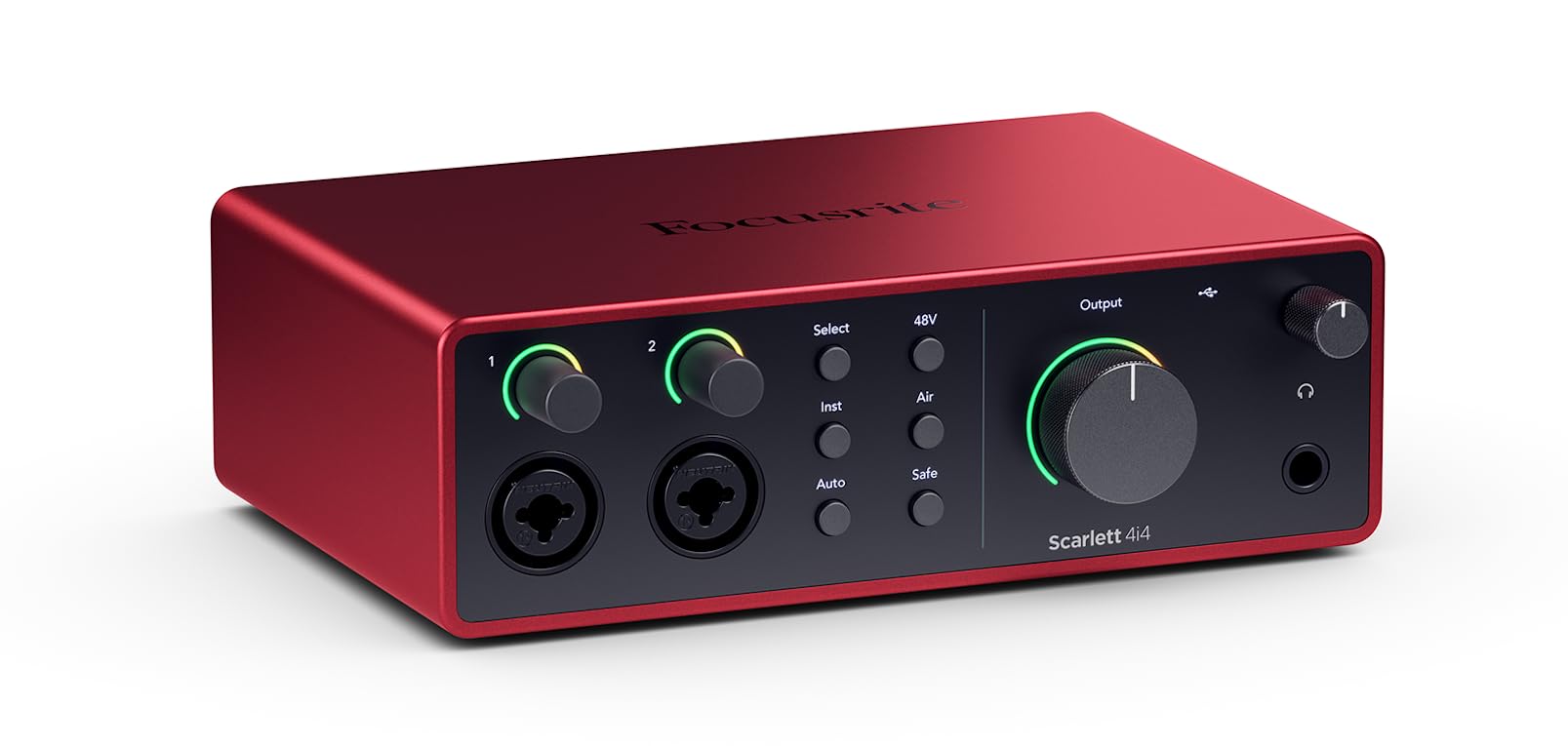
The Scarlett 4i4 4th Gen sets a new benchmark for the mid-range studio interface by matching the 120 dB dynamic range of Focusrite’s flagship RedNet converters. The two 4th gen mic preamps deliver a clean 69 dB of gain, easily driving demanding dynamic mics without an external booster, while Air mode adds a high-frequency lift that pushes vocals and acoustic guitars forward in the mix without harshness.
Auto Gain and Clip Safe work seamlessly together during fast sessions: Auto Gain dials in a healthy level from your initial strum or vocal phrase, and Clip Safe catches any subsequent peaks without stopping your take. Four line outputs give you separate monitor feeds for cue mixes or outboard gear routing, and MIDI I/O keeps synths and drum machines integrated without an extra hub.
The included Hitmaker Expansion bundle — featuring Pro Tools Intro, Ableton Live Lite, and Cubase LE — provides a full production suite out of the box. The 4i4 is powered by the included USB-C 5V 3A supply, which eliminates the bus-power worries that plagued earlier Scarletts when connected via USB hubs.
Why it’s great
- 120 dB dynamic range matches flagship pro studio converters
- Auto Gain and Clip Safe eliminate take-ruining distortion
- Dedicated power supply ensures stable operation with any USB hub
Good to know
- Only two XLR inputs; inputs 3–4 are 1/4″ TRS only
- Requires a high-impedance headphone for best monitoring clarity
2. RØDE RØDECaster Duo
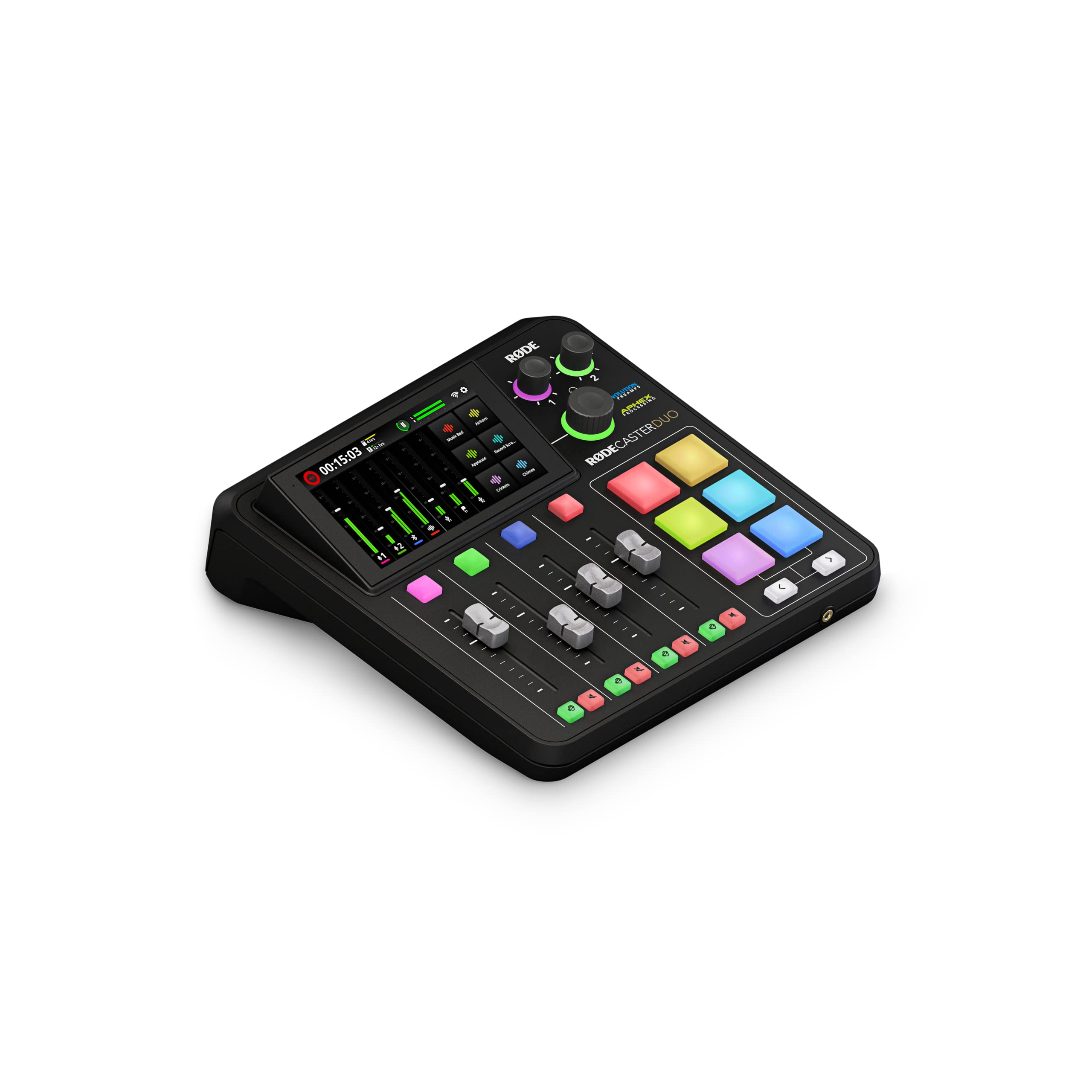
The RØDECaster Duo is less a traditional audio interface and more of a fully integrated broadcast console for podcasters and content creators. Its Revolution Preamps provide an immense 76 dB of gain with a staggeringly low -131.5 dBV E.I.N., meaning even a ribbon microphone connected directly produces a usable, silent signal without an external preamp or cloudlifter.
The four broadcast-quality faders control two microphone channels and two virtual audio channels for system sound or music playback, all of which can be routed independently to four separate audio tracks over USB. The 5.5-inch touchscreen handles effects routing, and the six SMART pads trigger sound effects, jingles, or MIDI commands. APHEX processing — including Aural Exciter and Big Bottom — adds polish during live streams without post-production.
The Duo can function as a standalone recorder to an SD card, removing the need for a computer during field interviews. The headphone output drives high-impedance monitoring cans adequately. Some users report a steep learning curve with the internal routing matrix, and the unit relies heavily on firmware updates to address occasional startup freezes.
Why it’s great
- 76 dB preamp gain drives any mic silently without external boosters
- Four-track independent USB streaming for complex workflows
- Standalone SD card recording eliminates computer dependency
Good to know
- Internal routing has a learning curve for traditional DAW users
- Occasional firmware-related boot issues reported on early units
3. SSL 2 MKII

The SSL 2 MKII brings the iconic Solid State Logic console sound to a bus-powered 2×2 format with 32-bit/192 kHz AD/DA conversion. Its dual mic preamps are exceptionally clean, delivering a flat frequency response that captures source material neutrally, while the Legacy 4K enhancement button injects harmonic sheen and presence — the same color that defined countless hit records on SSL 4000 series consoles.
The redesigned ALPS pots and stainless steel chassis feel dense and premium, and the headphone amplifier offers enough current to drive high-impedance studio headphones with authority. The high-pass filter on both input channels is a practical addition for voice-over and podcast work, cutting low-end rumble from HVAC or booth noise before it hits the AD converter. Stereo loopback simplifies live streaming capture from a second application.
The included SSL Production Pack bundles Native FX plugins and a generous collection of virtual instruments, covering the first several months of production. The 5-pin MIDI I/O is a welcome inclusion for hardware synth users who also want a classic console sound signature on their recordings.
Why it’s great
- 32-bit/192 kHz converters provide headroom far beyond 24-bit interfaces
- Legacy 4K button adds instant harmonic presence without plugins
- High-pass filter on each channel eliminates rumble before conversion
Good to know
- Not a true 32-bit float recording path; AD/DA is 32-bit fixed point
- Bus power may be insufficient with some USB-C hubs
4. MOTU M4

The MOTU M4 is engineered around the ESS Sabre32 Ultra DAC, the same conversion chip found in high-end audio interfaces costing three times as much. The result is a signal path with vanishingly low jitter and a dynamic range that makes the preamps sound almost invisible — what goes in comes out exactly as it should, without coloration, hiss, or distortion down to -114 dBu.
The LCD meters on the top panel provide precise visual feedback for gain staging, which is particularly valuable when recording classical or acoustic sources where crest factor matters. Loopback audio is handled in hardware with a dedicated switch, making it trivial to route a DAW mix into a Zoom call or streaming application without software routing tools.
Both headphone outputs have their own independent mix, allowing the engineer and the performer to hear different cue mixes simultaneously. The front-panel 48V switches are physically separate per channel, preventing the accidental pop that occurs when phantom power is wired to both channels through a single switch.
Why it’s great
- ESS Sabre32 Ultra DAC for ultra-low distortion and jitter
- LCD meters provide precise visual gain staging for dynamic sources
- Independent headphone mixes let engineer and artist monitor differently
Good to know
- Volume knobs have a small dead zone in the first 25% of rotation
- Headphone amp is slightly weaker under bus power compared to DC-powered units
5. Audient EVO 8

The Audient EVO 8 packs four EVO preamps and a discrete JFET instrument input into a chassis smaller than a typical hardcover book. The JFET DI input emulates the round, warm saturation of a classic valve preamp for direct guitar and bass recording, making it stand out in a market where most DIs use simpler op-amp designs. The four preamps share a 58 dB gain range with a noise floor low enough to capture quiet sources without audible hiss.
SmartGain is the standout feature: press the button, play your instrument or speak at performance volume, and the interface automatically sets all four input gains to an optimal level, reading the crests without clipping. SmartGain works impressively fast and accurately, saving time during multi-mic setups. The dual headphone outputs each have their own mix, and the single control knob doubles as a USB volume controller for the DAW.
The housing is notably light, and the included USB-C cable’s stiffness can tilt the front if not secured, a minor physical quirk. The EVO 8 runs bus-powered over USB-C and is compatible with macOS, Windows, and iPadOS without driver installations.
Why it’s great
- Discrete JFET DI input delivers warm, amp-like saturation for guitars
- SmartGain automatically sets all four preamp gains in one button press
- Ultra-compact form factor easily fits in a laptop bag
Good to know
- Chassis is so light that cable weight can lift the front edge
- Maximum sample rate is 96 kHz, not 192 kHz
6. Behringer UMC1820

The UMC1820 is an 18-input, 20-output USB 2.0 interface built around eight MIDAS-designed mic preamps — the same preamp topology found in MIDAS consoles used on world tours. The MIDAS preamps deliver up to 60 dB of clean gain with a characteristic slight roundness in the low-mids that sits well in dense mixes. The ADAT I/O allows expansion with a second 8-channel converter, bringing total inputs to 16 simultaneous analog sources plus digital returns.
The rack-mountable form factor makes it ideal for permanent studio integration. The included USB 2.0 connection is sufficient for 18 channels at 48 kHz, though the maximum sample rate tops out at 96 kHz rather than 192 kHz. The preamps handle 48V phantom power individually switchable in pairs, and the high-impedance instrument inputs are located on channels 1 and 2.
Windows ASIO drivers are stable and offer lower latency than many competitors at this price tier, according to user benchmarks. The unit lacks loopback or onboard DSP effects, remaining a straightforward, no-frills I/O hub that relies on DAW-side processing. The headphone amplifier drives standard 32-ohm headphones adequately but does not push 250-ohm cans to high SPL.
Why it’s great
- Eight MIDAS console preamps provide professional-grade headroom
- ADAT expandability allows up to 16 simultaneous analog inputs
- Rack-mountable enclosure fits permanent studio racks cleanly
Good to know
- Maximum sample rate is 96 kHz, not suitable for 192 kHz sessions
- No loopback or onboard DSP for streaming without a DAW
7. Focusrite Scarlett Solo 3rd Gen

The Scarlett Solo 3rd Gen is the most widely recommended entry-level interface for a reason: its mic preamp includes a switchable Air mode that emulates the high-frequency lift of Focusrite’s classic ISA transformer-based console, adding presence and clarity to vocals. The single instrument input offers high-headroom for guitar and bass, accepting hot passive and active pickups without distortion.
The 24-bit/192 kHz converters are legitimate studio-grade, exceeding the resolution of many competitors that cap at 96 kHz in this budget tier. The metal chassis is surprisingly sturdy for its weight, surviving years of transport and desk abuse. The included software bundle — Pro Tools Intro, Ableton Live Lite, Cubase LE, and the Hitmaker Expansion — is the richest package available at this price, covering everything from tracking to mastering.
Setup is plug-and-play on Mac, while Windows requires the Focusrite Control driver for full low-latency ASIO operation. The unit is bus-powered from a single USB-C port, making it a reliable travel companion for mobile recording sessions.
Why it’s great
- Air mode adds authentic transformer-based high-frequency lift
- 192 kHz converters exceed the resolution of most entry-level rivals
- Complete software suite includes multiple full-featured DAWs
Good to know
- Single instrument input limits simultaneous guitar/line recording
- Windows requires proprietary ASIO driver for low-latency performance
8. Universal Audio Volt 2

The Universal Audio Volt 2 channels the musical heritage of UA’s iconic 610 tube preamp through its Vintage mode, which adds a rich, warm saturation to vocal and instrument tracks. When Vintage mode is engaged, the preamp introduces a subtle second-harmonic coloration that rounds off harsh transients — an effect that normally requires expensive outboard gear or DSP plugin purchases.
The converters operate at 24-bit/192 kHz and use a low-jitter clock design that keeps stereo imaging stable and focused. The included LUNA DAW is a free, feature-complete recording environment that emulates the workflow of an analog tape console, complete with built-in tape saturation and summing. The Volt 2 also includes a curated bundle of UAD plugins and instruments, giving beginners a professional plugin library from day one.
The chassis features a real wooden inlay on the top panel, a rare aesthetic touch in the interface market. The Volt 2 requires an external USB-C power supply for stable operation, especially when phantom power is active, which slightly reduces portability compared to bus-powered competitors.
Why it’s great
- Vintage mode adds 610 preamp tube harmonic saturation to any source
- LUNA DAW included for an analog-console-style recording workflow
- Real wood inlay gives the unit a premium aesthetic
Good to know
- Requires external USB-C power supply for phantom power operation
- Not bus-powered, reducing mobile convenience slightly
9. IK Multimedia iRig Pro Duo I/O

The iRig Pro Duo I/O is a dedicated mobile audio interface for iOS and Android devices, offering a unique triple-power option: USB bus power, two AA batteries, or an optional PSU. This flexibility allows field recording in locations that lack wall outlets. The ClassA mic preamps deliver 48V phantom power and extended gain range in a chassis weighing only 7 ounces.
The dual Neutrik combo inputs accept XLR and 1/4″ connections, plus two additional RCA line inputs for connecting external mixers or synth modules. Direct monitoring with zero-latency lets the performer hear themselves without delay while recording on a phone or tablet. The included Lightning, USB-C, and USB-A cables mean no adapter hunting out of the box.
MIDI IN/OUT via breakout cables turn the unit into a functional MIDI interface for controlling iPad synths or sequencing hardware. At a maximum sample rate of 48 kHz, the converters prioritize compatibility over high-resolution headroom, which is a practical tradeoff for mobile video and podcast workflows where file size and real-time processing matter more than ultrasonic bandwidth.
Why it’s great
- AA battery power enables field recording without a computer connection
- Comes with Lightning, USB-C, and USB-A cables for direct device connection
- MIDI I/O breakout cables add MIDI interface capability
Good to know
- Maximum sample rate is limited to 48 kHz
- RCA line inputs are unbalanced, prone to noise over long cable runs
FAQ
Do I need a 192 kHz sample rate for home recording?
What is the difference between bus power and external power supply?
Can I use an audio interface for gaming and streaming?
Final Thoughts: The Verdict
For most users, the best audio interface winner is the Focusrite Scarlett 4i4 4th Gen because it combines 120 dB dynamic range, 4th Gen preamps with Auto Gain and Clip Safe, and MIDI I/O in a well-built package with an industry-leading software bundle. If you want the classic console sound of SSL, grab the SSL 2 MKII. And for an all-in-one podcast production hub, nothing beats the RØDE RØDECaster Duo.