
Our readers keep the lights on and my morning glass full of iced black tea. As an Amazon Associate, I earn from qualifying purchases.
Specs are compiled from manufacturer listings and verified buyer reviews and can change over time — please confirm the key details on the product page before buying.
Setting up karaoke at home, running sound for a small band, or making announcements over a crowd—you need one box that takes your mics and music sources and powers your passive speakers (speakers that need an external amp) without extra gear. The right mixer amplifier does both jobs, and this guide sorts the best by what they actually do well, so you can match the gear to your gig without decoding spec-sheet jargon.
I’m Min — the founder and writer behind Gadgets Feed. This guide is built by comparing the manufacturers’ published specifications and the patterns across verified customer reviews, so you get each pick’s real strengths and trade-offs instead of marketing spin.
You might need a compact unit for a living room or a rack-ready powerhouse for a venue—either way, these audio mixer amplifier picks are the ones owners actually trust for reliable, clear sound.
Our Picks at a Glance


How To Choose The Best Audio Mixer Amplifier
An audio mixer amplifier combines two jobs into one box: it blends several audio sources (microphones, music players, instruments) and then boosts that combined signal enough to drive passive speakers that don’t have their own built-in power. This saves you from buying a separate mixer and a separate amplifier, which simplifies wiring and saves space.
Match Channels to Your Sources
Count up everything you need to plug in at once. Every microphone and instrument needs its own channel, so a 4-channel unit handles two wireless mics and a music source, while an 8-channel board gives you room for a full band. If you plan to grow your setup, buying a few extra channels now avoids an upgrade later.
Understand Real Power vs. Peak Power
Manufacturers list two wattage figures. Peak power is the absolute maximum the amp can hit in a burst, while RMS (or continuous) power is what it delivers steadily during normal use. For matching speakers and judging loudness, look at RMS per channel at a specific ohm load—like 250W x 2 at 8 ohms—because that tells you what you actually hear.
Check for Phantom Power and Effects
If your microphones are condenser types (the sensitive kind used in studios), they need 48V phantom power to operate, so confirm the mixer provides it on the XLR inputs. For vocals, built-in effects like reverb and echo make singers sound better with zero extra pedals or outboard gear.
Quick Comparison
| Model | Best For | Channels | RMS Power | Weight | Amazon |
|---|---|---|---|---|---|
| Rockville RPM80BT★ Best Overall | Versatile gigs & karaoke | 8 | 500W (250W x 2) | 24 lbs | Amazon |
| GTD Audio 10-ChannelMuscle Pick | High-power live events | 10 | 2000W RMS @ 4 ohms | — | Amazon |
| Behringer PMP4000Portable Pro | Portable band & event sound | 16 | 2 x 800W | 22.9 lbs | Amazon |
| Viprh 2000W Stereo Amp | Home theater & car use | 2.0 | 400W (2000W peak) | 7 lbs | Amazon |
| BOMGE 6-Channel | Compact home karaoke | 6 | 100W + 100W peak | 1350 g | Amazon |
| Aveek 150W x2 | Plug-and-play karaoke | 4 | 150W*2 | 2 kg | Amazon |
| Rockville RPM45 | Small bands & presentations | 4 | 225W x 2 @ 8 Ohm | 19 lbs | Amazon |
| MAD OWL 8-Channel | Value-minded DJ setups | 8 | 300W RMS per channel | — | Amazon |
| Pyle PT8050CH | Multi-room home audio | 8 | 4000W peak | — | Amazon |
| GTD Audio 16-Channel | Churches & community groups | 16 | 2000W RMS @ 4 ohms | 26 lbs | Amazon |
| Behringer PMP6000 | Pro bands & larger venues | 20 | 2 x 800W | 28.9 lbs | Amazon |
In‑Depth Reviews
1. Rockville RPM80BT Powered 8-Channel Mixer/Amplifier
Our pick — 4.5★ from 400+ verified ratings; the strongest balance of quality and price.
The 8-channel workhorse that runs a full show without breaking a sweat.
If you need one box to handle a live band, a karaoke night, or a studio session, this Rockville leads because it packs real utility into every input. It delivers 500W RMS (250W x 2 @ 8 Ohm) and 2400W peak, which is enough to drive a pair of passive speakers with clarity for a small to medium venue without an external amp. Owners praise the rugged chassis for surviving regular load-in and load-out abuse.
Connectivity is where this unit shines: 8 XLR inputs, 8 1/4″ TRS inputs, RCA AUX, RCA REC output, USB, Bluetooth, and 1/4″ line outputs. That means you can run two wireless mics, a PC, and a phone streaming music all at once. Each channel gets its own bass, treble, and reverb control, plus a 5-band master EQ and adjustable echo and delay effects for polishing vocals, so you are not stuck with a one-size-fits-all sound.
Buyers report it still runs strong years later, citing easy connectivity and ample power. The trade-off is that the reverb effect can sound like talking in a bathroom shower if you push it hard, and a few users wanted more output headroom than the 500W RMS provides. At 24 pounds and 11.8″D x 19.7″W x 7.2″H, it is not a featherweight, so plan for a sturdy spot in your setup.
versatile powered mixer
- 8 channels handle a full band or multiple mics plus music sources
- Bluetooth and USB make wireless phone streaming easy
- Built-in 48V phantom power for condenser mics
- Rugged build quality that survives years of gigs
basic feature set
- Reverb effect sounds unnatural at high settings
- 24-pound weight is heavy for frequent transport
- Learning curve to balance output volume levels
the flexible pick: Reach for this if you need a do-everything board for small gigs, karaoke, and recording where one box must handle many sources.
pass if pro: You need extreme raw volume for a large venue—its 500W RMS is solid for small rooms but not stadium-filling.
2. GTD Audio 10 Channel Professional Powered Mixer
A serious power plant that makes a 2000W RMS statement for live events.
For those who need serious headroom, the GTD Audio 10-channel delivers a staggering 6000W maximum output with 2000W average RMS at 4 ohms—that is 20% more peak power than the Viprh’s 2000W peak. At 8 ohms, it still pushes 3000W maximum and 1000W RMS, so it can drive large passive speaker cabinets for a venue event without strain. The 10 mic/line channels include 48V phantom power for condenser mics and an onboard 16-type professional effects processor.
Each channel gets a 3-band EQ, and the main output adds a 7-band graphic EQ, so you can shape the mix precisely. Owners call it “a beauty” with “plenty of PWR,” and several say they would buy more. The 6 built-in studio-grade mic preamps give you clean gain for vocal clarity, which makes it a strong fit for a church or a community stage.
The honest catch is that streaming quality gets weaker feedback—one user found the main output clear but the monitor out lacked power for Facebook streaming. It is a tool built for amplifying live sound, not for polished broadcast. If your priority is raw, clean volume for a room full of people, this delivers.
the live-sound workhorse: Grab this for medium-to-large venues where you need massive, clean power to drive multiple passive speakers.
not for small gigs: Monitor output is underpowered for streaming, so treat it as a live-audio tool, not a broadcast interface.
3. Behringer Europower PMP4000 Powered Mixer
Class-D technology packs 1600 watts into a board that travels light.
The Behringer PMP4000 uses Class-D amplifier technology to deliver 2 x 800 watts of stereo power (1600 watts in bridged mode) at nearly half the weight of conventional powered mixers—just 22.9 pounds. That makes it a favorite for bands and event hosts who haul gear frequently. The 16-channel section gives you 8 mono and 4 stereo channels plus a separate CD/Tape input/output, so you can run a full band plus background music.
Sound-shaping is handled by a studio-grade 24-bit stereo FX processor with 100 presets covering reverb, chorus, flanger, delay, and pitch shifting. Owners mention it filled a 450-person event cleanly with Peavey PR-15s and suits conference rooms and small-to-medium venues. The flexibility across various inputs and outputs gets consistent praise.
The main trade-off is power—some users find it “little under powered” for large passive mains and recommend it for monitors instead. If your gigs are club-sized rather than arena-sized, this is a versatile, portable board. It is the crowd favorite for value, backed by a loyal following.
best for mobile bands: Choose this if you need a powerful, lightweight board that is easy to transport for parties, weddings, and small venue shows.
The Catch: For very large passive speaker stacks, step up to the PMP6000 for more headroom.
4. Pyle 8-Channel Wireless Bluetooth Power Amplifier

A rack-ready receiver that turns whole-house speaker systems into one smart zone.
If you have in-wall or ceiling speakers scattered through a house, the Pyle PT8050CH is built for that exact job. It provides 4000W of peak power for multi-speaker setups with 4-8 ohm impedance, and customers note driving up to 6 350-watt speakers with ease. One buyer with 8 ceiling-mounted speakers had the whole system running in about 15 minutes after plugging in wires and connecting Bluetooth from their phone.
You get 9 inputs on the front panel: 3 pairs of RCA audio in, 2 1/4″ microphone jacks, AUX 3.5mm, USB, and an SD card slot. A voice priority button automatically lowers the background music when you speak into Mic1—so your announcements cut through clearly. The chassis (18.89″D x 11.22″W x 3.93″H) mounts into standard equipment racks, and Bluetooth pairing takes seconds.
The value-for-money praise is strong, with owners calling it “outstanding value” that surprisingly drives outdoor and Klipsch towers. The trade-offs are that it has a single tone knob rather than separate bass and treble, no subwoofer connector, and one owner reported reliability issues after a power cycle. For distributed home audio, it is a cost-effective hub.
the smart-home hub: Best for controlling multiple rooms of speakers from your phone with Bluetooth, ideal for whole-house installations.
who should pass: Audiophiles seeking fine-tuned tone control or a dedicated subwoofer output will want a more feature-rich receiver.
5. GTD Audio 16 Channel Professional Powered Mixer

Sixteen inputs and 6000W of peak power for ambitious setups that need room to grow.
For a church, school, or community group with many speaking mics and music inputs, the GTD Audio 16-channel doubles the input capacity of its 10-channel sibling while keeping the same brawny power—6000W max, 2000W RMS at 4 ohms. All 16 mic/line channels have 48V phantom power (voltage that powers condenser mics without a separate supply), so you can run a full choir of condenser mics. At 26 pounds and 24″D x 13.5″W x 6″H, it is a substantial console best left on a table or rack.
A church buyer called it a smart low-cost pick that “performed very well” with enough inputs for everyone. The 3-band EQ per channel plus a 7-band graphic EQ on the main output gives you fine control to tame room acoustics. The 16-type onboard professional effects processor covers reverb and delay for vocal polish.
The recurring knocks are shipping damage (bent knobs and faders) and a right speaker outlet that failed on one unit. Quality and value get positive marks, but treat the faders gently. This is a lot of console for the money if you need the channel count.
for groups and worship: Ideal when many microphones need to be live at once, with a 7-band graphic EQ to shape the room sound.
the practical note: Inspect carefully on arrival—shipping can bend knobs—and avoid overdriving the system to protect it.
6. Viprh 2000W Stereo Audio Amplifier
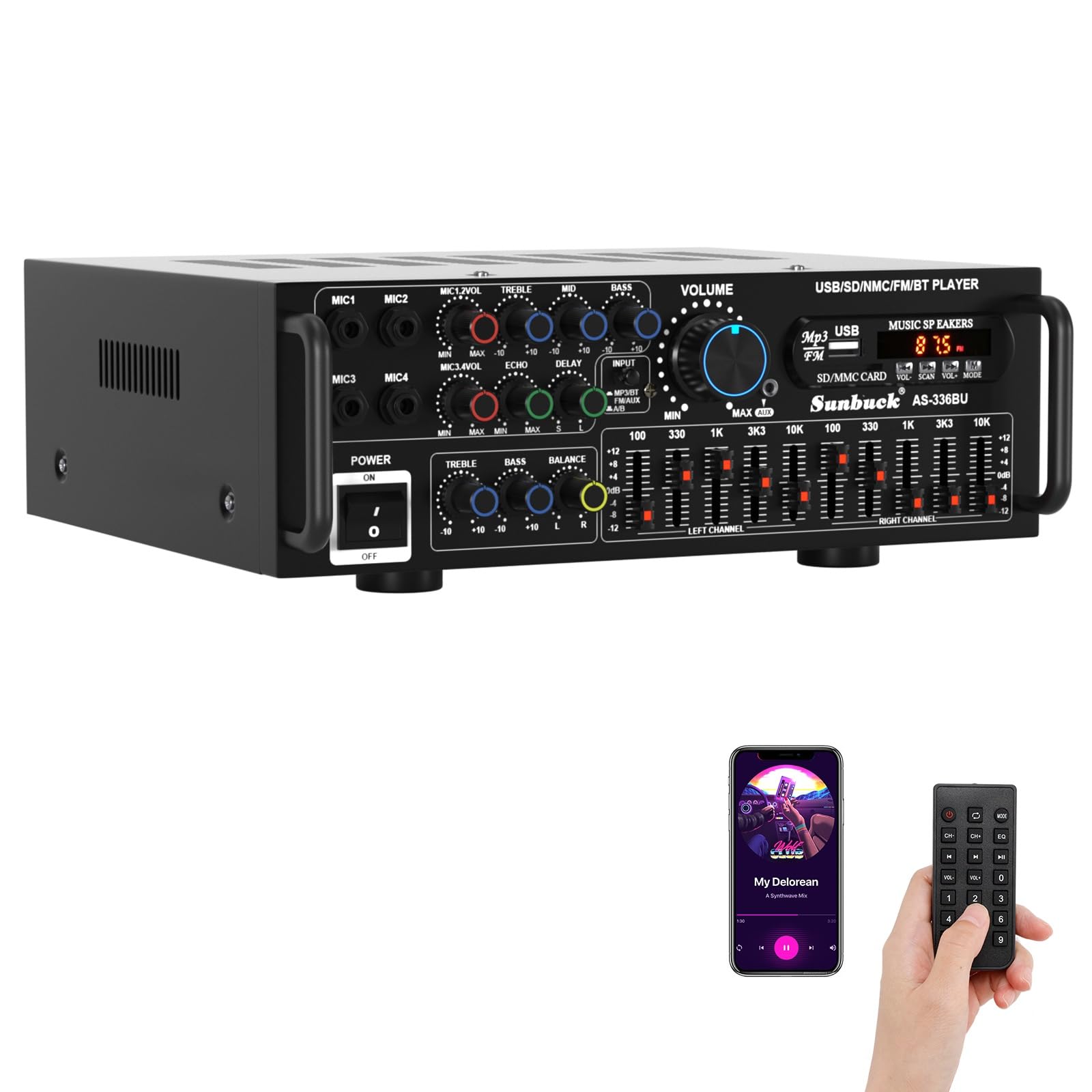
The featherweight 7-pound amp that brings 400W of rated power to home and car rigs.
Weighing just 7 pounds—a 3.4x gap versus the Rockville RPM80BT’s 24 pounds—this Viprh amp is the portable pick for moving between home theater and car audio setups. It delivers 400W rated power with 2000W peak, supporting 4-16Ω speakers, and a 2.0-channel layout that makes it a straightforward replacement for an older receiver. Owners driving 2 pairs of passive cabinets found it runs the 4-ohm load “easily.”
For karaoke, it has 4 microphone inputs with individual reverb and delay controls plus a 5-band EQ mixer. Connectivity covers AUX/DVD inputs, USB/SD card playback, and Bluetooth streaming, with a LINE output to add a subwoofer later. The dual-voltage design—AC 110V for home, DC 12V for car—makes it a genuinely versatile box, and the compact 11.4″ x 9.4″ chassis fits tight spaces.
Reviewers point out it “pushes 2-1600 watt speakers with no problem” and delivers “great volume no white noise.” The honest limits: it is analog-only (no optical fiber input) and has no built-in subwoofer, so bass depends entirely on your speakers. One unit arrived damaged in shipping, so inspect the box on delivery. For a light, flexible amp that does home and car duty, this is a strong entry-level value.
the portable value: Perfect for someone who wants one small amp for home theater, car audio, and backyard parties without heavy gear.
look elsewhere if: You need a digital optical input or a dedicated subwoofer output—this is a clean, simple analog amp.
7. Behringer Europower PMP6000 Powered Mixer

Twenty channels and dual FX processors make this the do-everything board for serious bands.
The PMP6000 takes everything great about the PMP4000 and expands it: 20 channels (12 mono, 4 stereo) plus separate CD/Tape I/O, and two studio-grade 24-bit stereo FX processors instead of one. That means you can run reverb on the vocals and a separate delay on the instruments simultaneously. It still delivers 2 x 800W of Class-D power (1600W bridged) at 28.9 pounds—far lighter than conventional powered mixers of this output.
The standout feature set wins consistent praise: owners highlight the 12 preamped XLR channels, the intuitive color-coded knobs, and the FBQ feedback detection system that identifies and tames howling frequencies automatically. For a 5-piece band playing to 200-250 people indoors and out, it replaced two separate mixers and amps with one clean, simple setup. The FX quality on reverb and echo is described as beating outboard units like the Yamaha SPX900.
Reliability is the recurring theme—one owner reports it still functions like new after 5 years. The 1-star outlier exists, but the overwhelming consensus is a reliable, feature-packed board. The only real drawback is size: at 28.9 pounds, it is the heaviest here, so a carry case is recommended. For a band that wants it all, this is the flagship.
the band’s flagship: Choose this for pro-level flexibility—dual FX, Speakon-compatible outputs, and enough channels for a full band plus stereo sources.
consider this: The higher weight and price make sense only if you need 20 channels and dual effects; smaller setups get by fine with the PMP4000.
8. Rockville RPM45 Powered 4-Channel Mixer Amplifier

The 4-channel favorite that punches above its weight for small bands, praised by hundreds.
The RPM45 delivers the highest volume on this list, pairing a user-friendly design with 1800W peak power (225W x 2 RMS at 8 ohms) in a rugged wooden enclosure that weighs 19 pounds. Small bands favor it—one owner calls it ideal for a four-piece rock/metal band, while another uses it to revive old speakers. The 4 XLR and 1/4″ TRS inputs cover mics and instruments, with USB and RCA AUX for music sources.
Owners rave about the build quality: the mixing console is well-built, has simple controls, and the built-in MP3 player with independent volume is a convenient bonus. The cooling fan keeps it reliable during extended sessions, though it is audible and can be “problematic in small spaces.” Ease of use is a consistent theme—the channel layout is clear and the controls are straightforward enough for a first-time buyer.
The honest split is sound quality: praise is strong in open spaces, but some call it underpowered for live gigs and better as a practice amp. It includes +15V phantom power (not the standard 48V), so check your condenser mics. If you need a simple, proven 4-channel board, this is a safe, well-reviewed choice for the price.
the reliable starter: Best if you want a proven, easy-to-use mixer for a small band, practice space, or presentations with a built-in MP3 player.
the fair caveat: Expect fan noise in quiet rooms and treat it as a small-venue tool—it is not built for large live audiences.
9. MAD OWL 8-Channel Power Mixer Amplifier

A value-heavy 300W-per-channel board that owners call a solid budget workhorse.
For an entry-level or backup mixer, the MAD OWL delivers 300W RMS per channel at 8 ohms—enough to throw serious power into tower or PA speakers. Owners say it’s “every bit as good as my high priced mixers,” running two weddings and a Christmas party with praised bass response. The 8 input channels support headphone, instrument, mic, line, and XLR inputs, with a 5-band master EQ and 48V phantom power.
The built-in 16 DSP digital reverb effects let you call up different vocal and instrument presets to shape your mix. Connectivity is flexible: Bluetooth and USB flash drive inputs let you mix phone or MP3 sources with live mics. The value-for-money praise is consistent, and owners note the manual faders and PFL/balance buttons have an old-school, durable feel—though they take time to learn.
The significant caveat is reliability: one owner reported the unit failed after about 7 months of use and started smoking, which is a rare but serious event that demands attention. Given that, this is best treated as a backup or entry-level rig rather than a daily driver. The power and price are right; just keep expectations realistic for long-term abuse.
the budget backup: Great value for an extra setup or backup board with strong power and DSP effects.
who should skip: If you need a main mixer for frequent, heavy use, spend more on a proven workhorse—this one has occasional reliability reports.
10. Aveek 150W x2 Powered Amplifier Mixer
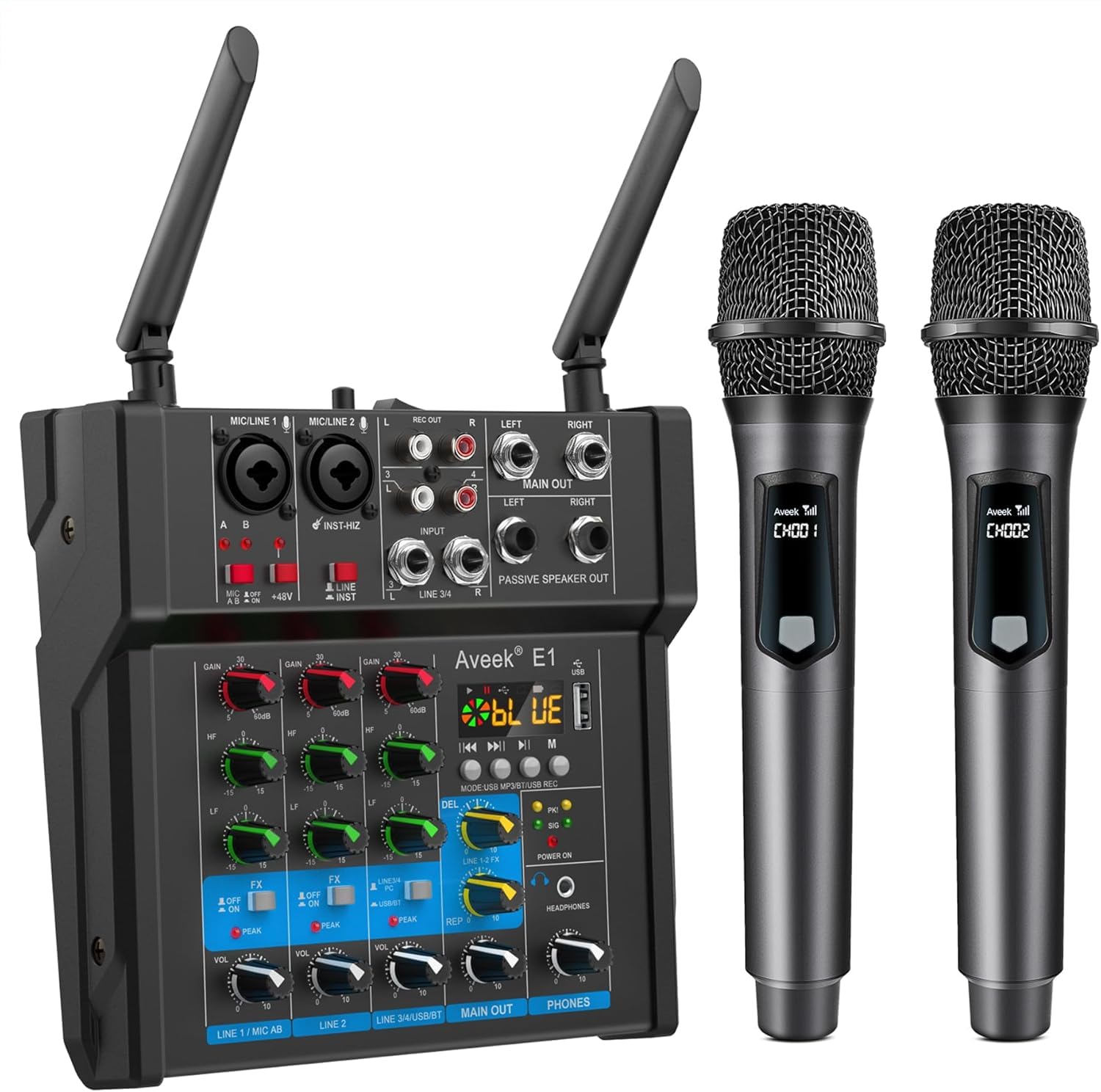
The all-in-one karaoke kit that comes with wireless mics ready to sing.
For a complete karaoke setup from the start, the Aveek includes two handheld dynamic wireless microphones with rechargeable batteries—charge for 3-4 hours and they work for 5-6 hours, with a transmission range of 60m (200ft) in open space. Owners praise the microphone quality most, making this a strong plug-and-play value. The built-in amplifier delivers 150W*2 RMS (40Wx2 per channel) and directly drives 6, 8, or 10-inch passive speakers without an extra amp.
Connectivity covers modern and classic sources: a USB audio interface for recording to a USB stick, Type-C for PC or phone audio, Bluetooth streaming, and 2 XLR inputs with 48V phantom power for studio condenser mics. A 3.5mm headphone jack lets you monitor the mix. Owners call it “best bang for the money” and a great starter for home karaoke, though the echo controls are described as weak—it sounds better with the FX off.
The practical limitations: Bluetooth, USB stick playback, and stereo channel input cannot run simultaneously—you pick one. And if your TV lacks RCA, you need a digital-to-analog converter. The microphone quality and value are the story here; just don’t expect pro-grade effects or processing.
the instant karaoke kit: Ideal for a family or beginner who wants wireless mics, speaker drive, and phone streaming in one simple box.
the reality check: The echo effects are underwhelming and inputs are limited to one source at a time—perfect for casual use, not pro mixing.
11. BOMGE 6-Channel DJ Powered Audio Mixer Amplifier

The pint-sized 6-channel unit that karaoke hosts call a weekly workhorse.
If space is tight, this BOMGE is the compact gem: at 7.3″D x 8.9″W x 2.2″H, it is 62% more compact than the Rockville RPM80BT’s footprint, and at 1350g it is a true grab-and-go board. It packs 6 channels (4 mic/line, 2 stereo, plus 2 RCA), each with gain, high, bass, and FX effect control, and 100W + 100W peak power to drive a pair of passive bookshelf speakers without a separate amp. It delivers 100W + 100W peak to accommodate 2 sets of speakers, simplifying your wiring.
Karaoke hosts love the form factor: “Use this little mixer weekly for my Karaoke shows! Works great! Very compact. Effect and volume knobs work great!” Each channel has independent 48V phantom power for condenser mics, and the built-in Bluetooth (15ft range), USB, and FM radio with a long antenna give you plenty of music sources. The built-in sound card even lets you record your mix to a PC or USB disk.
The honest split is quality control: while some units work perfectly, others arrived with no sound at all—a frustrating lottery. The feature set is also “geared mainly for home use,” despite pro labeling. For a home karaoke setup where space is precious, it is a great value; for reliability, check it immediately on arrival.
the space-saver: Best for a small apartment or home theater where a full-size mixer won’t fit, with karaoke-friendly effects and recording.
the risk: Quality control is inconsistent—test it right away, and be prepared to return a unit if it arrives silent.
Understanding the Specs
RMS vs. Peak Power
RMS (Root Mean Square) is the continuous power an amplifier can deliver safely over time—this is the number that matters for matching speakers and predicting real loudness. Peak power is the brief maximum burst the amp can hit. For example, a mixer rated 500W RMS (250W x 2) delivers 250 watts to each of two speakers continuously, which is what you actually hear as volume.
Phantom Power and XLR Inputs
Condenser microphones require 48V phantom power to work—a voltage sent from the mixer through the XLR cable to power the mic’s internal electronics. Dynamic mics (like most handheld stage mics) don’t need it, so only engage phantom when using condensers. A mixer that offers 48V phantom power on its XLR inputs lets you use both mic types without extra gear.
FAQ
What is the difference between an audio mixer and an audio mixer amplifier?
How much power do I need for a small venue karaoke setup?
What does 48V phantom power do and do I need it?
Can I connect my TV to a powered mixer for karaoke?
What is the difference between 4-ohm and 8-ohm speakers?
Do I need separate speakers with a powered mixer amplifier?
What is the difference between the Behringer PMP4000 and PMP6000?
Can I use an audio mixer amplifier in my car?
How many channels do I really need?
What does a built-in effects processor do?
Final Thoughts: The Verdict
For most buyers, the audio mixer amplifier winner is the Rockville RPM80BT because its 8 channels, Bluetooth, and 500W RMS power cover everything from karaoke to small gigs, and the build quality has proven itself over years of use. If you want a lightweight, portable pro board for a band, grab the Behringer PMP4000 with its 1600W Class-D power and 100 FX presets at just 22.9 pounds. And for a venue that needs maximum input flexibility, the Behringer PMP6000 with 20 channels and dual effects processors is the one to reach for.
How We Picked
We do not accept paid placement. Every pick is matched to a real buyer and a real use-case; we do not hands-on test units.
Sources & Methodology
Specifications: manufacturer listings and product documentation. Review insights: verified customer reviews, as of August 2026. Pricing: not shown on this page (it changes often); check the current price via the retailer link.
As an Amazon Associate, Gadgets Feed earns from qualifying purchases. This does not affect which products we feature.