
A home studio’s audio chain lives or dies at the mixer. You can own a world-class microphone and a pristine interface, but if the mixer injects noise, muddies the stereo image, or clips on a transient, every recording downstream suffers. The right unit gives you clean gain staging, flexible routing for mics and line sources, and a monitoring path you can trust for critical headphone mixes.
I’m Min — the co-founder and writer behind Gadgets Feed. This guide is the result of cross-referencing spec sheets, analyzing preamp EIN ratings, tracing signal paths through auxiliary buses, and reading hundreds of real-user recordings to separate marketing hype from measurable performance.
After comparing nine models across a wide price spectrum, one clear front-runner emerged as the best audio mixer for home studio environments where clean preamps, flexible connectivity, and reliable USB recording matter most.
How To Choose The Best Audio Mixer For Home Studio
A home studio mixer has to balance analog warmth with digital flexibility. You are not just summing audio — you are shaping the signal before it ever hits your DAW. The wrong choice adds noise or limits your routing. Focus on the three areas that actually define your workflow.
Preamps and Signal‑to‑Noise Ratio
The preamp is where the signal first meets electronics. Look for published EIN figures around -128 dBu or lower — that number tells you how much noise the preamp adds when gain is cranked. Mackie’s Onyx and Allen & Heath’s GS‑Pre preamps are benchmarks in this space. A clean preamp lets you record quiet sources like acoustic guitar or spoken word without audible hiss.
Channel Count and Routing Flexibility
Count how many microphones, instruments, and stereo line sources you need to connect simultaneously. A 4-input mixer works for a solo podcaster with one mic and a backing track, but a band recording scratch tracks or a multi-mic podcast needs 6 channels minimum. Aux sends matter: one aux lets you create a separate headphone mix for a guest; two auxes let you send a monitor mix plus a separate FX loop to a reverb unit.
USB / Audio Interface Integration
In 2025, a mixer without a built-in USB interface feels incomplete. The key spec is sample rate (48 kHz is standard, 96 kHz or 192 kHz offers headroom for pitch-shifting and time-stretching) and channel routing. Some mixers send only the stereo master mix over USB. Higher-end models let you record individual channels live — a huge advantage for editing and mixing later. Look for USB-C connectivity and class-compliant drivers for latency-free operation without installing third-party software.
Quick Comparison
On smaller screens, swipe sideways to see the full table.
| Model | Category | Best For | Key Spec | Amazon |
|---|---|---|---|---|
| Mackie ProFX6v3+ | Analog / Digital Hybrid | Best Overall – streaming & recording | 24‑bit / 192 kHz USB‑C interface | Amazon |
| Allen & Heath ZEDi-10 | Analog with 4×4 USB | High‑fidelity recording & hybrid workflow | 96 kHz / 4‑in‑4‑out USB interface | Amazon |
| Yamaha MG10XU | Analog with FX | D‑Pre preamps & 24‑effect processing | SPX digital effects engine | Amazon |
| Behringer FLOW 8 | Digital Mixer | App‑controlled digital mixing on a budget | 60 mm faders + FLOW App control | Amazon |
| RØDE RØDECaster Duo | All‑in‑One Production Studio | Podcast / streaming dedicated workstation | Revolution Preamps (–131.5 dBV EIN) | Amazon |
| Allen & Heath CQ-12T | Digital Mixer | Professional touch‑screen control & IEM mixing | 7″ capacitive touchscreen + 16×16 USB | Amazon |
| Numark M6 USB | DJ Mixer | DJ performance & party mixing | Replaceable crossfader with slope control | Amazon |
| Mackie 402VLZ4 | Compact Analog | Ultra‑compact backup or simple submixer | Onyx mic preamps in 4‑channel format | Amazon |
| Pyle PMXU46BT | Analog with Bluetooth | Budget entry point with wireless streaming | Bluetooth input + 4‑channel analog mixer | Amazon |
In‑Depth Reviews
1. Mackie ProFX6v3+ 6‑Channel Mixer
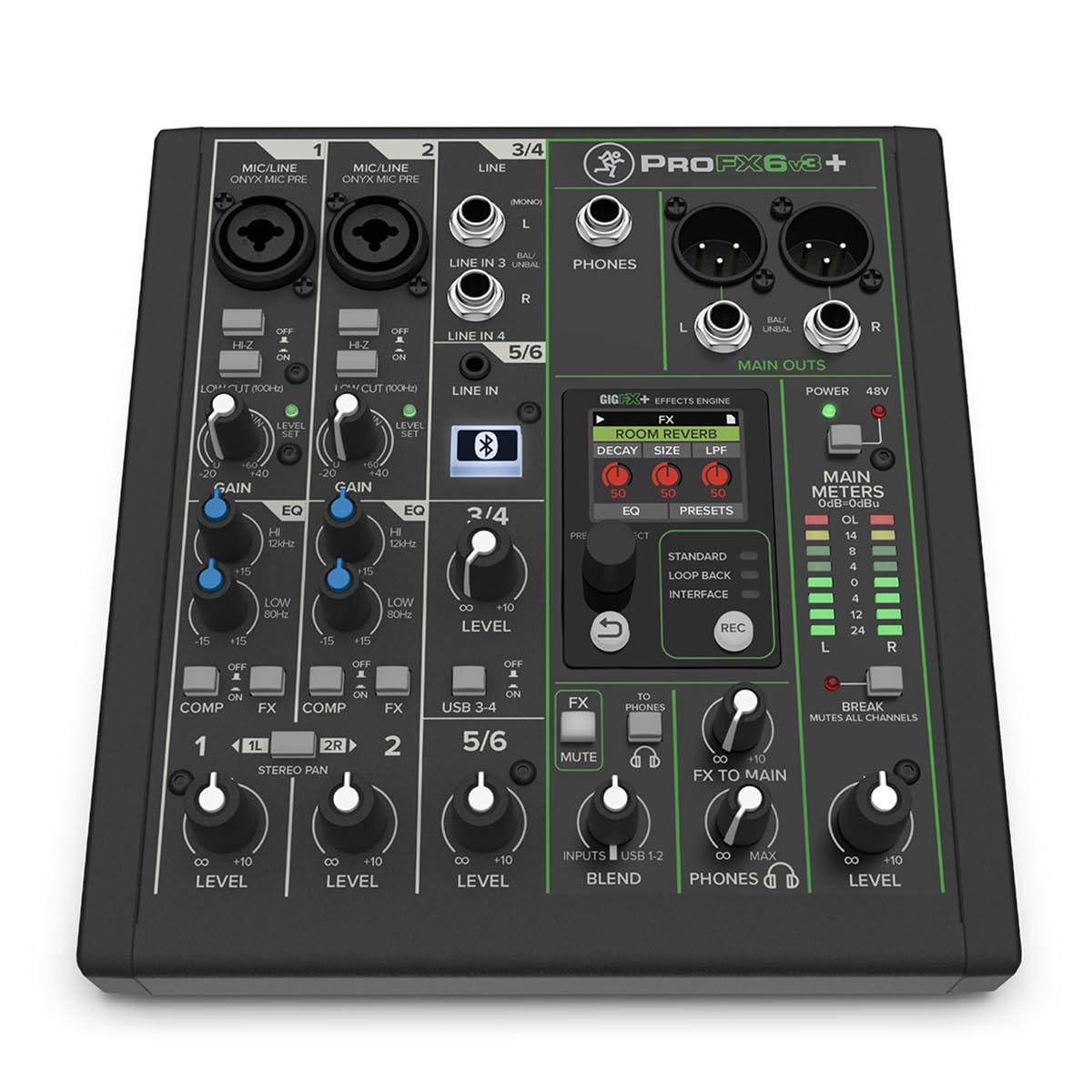
The ProFX6v3+ hits a rare sweet spot: it delivers genuine 24‑bit / 192 kHz recording fidelity over USB-C, combining the tactile immediacy of an analog mixer with the digital routing now required for streaming. The GigFX+ engine puts 12 editable effects — reverb, delay, chorus, compression — on a color LCD, letting you dial in a room sound or vocal slap without external rack gear. Onyx preamps are Mackie’s calling card, and here they maintain the same low-noise, high-headroom character found in the company’s larger consoles.
Bidirectional Bluetooth with Mix Minus is a standout feature for podcasters. You can bring a caller in via smartphone while keeping their audio out of the stream mix — no external adapters needed. Loopback mode routes your computer audio alongside the live mixer signal, making it trivial to add backing tracks or sound effects during a live broadcast. The compact footprint (8.4 x 2.9 x 7.5 inches) fits on a crowded desk without forcing you to rotate between studio recording and content creation setups.
Where this mixer truly separates itself from cheaper alternatives is the onboard one‑button compression on channels 1 and 2. Rather than overcomplicating the dynamics section, Mackie provides a single threshold setting that tames vocal peaks without distortion. The 100 Hz low-cut filter on every mono input further cleans up rumble from air conditioning or desk vibrations. If you need a single device to handle recording, streaming, and live monitoring, this is the most versatile analog/digital hybrid in its class.
Why it’s great
- 192 kHz USB-C interface with Loopback for streaming
- GigFX+ effects engine with editable presets via color LCD
- Onyx preamps with 1‑knob compression and low-cut filters
Good to know
- Only one aux send limits complex headphone mix setups
- Power supply is external, adding one more brick to your desk
2. Allen & Heath ZEDi-10 Hybrid Mixer

Allen & Heath builds the ZEDi-10 around GS‑Pre preamps derived from their GS-R24 studio console, and you can hear the difference on a dynamic microphone like an SM7B: the noise floor stays silent even with 50 dB of gain applied. The 4×4 USB interface streams at 96 kHz, giving you four discrete input channels to your DAW — you can record two microphones and a stereo keyboard simultaneously and edit each track independently later.
The MusiQ 3‑band EQ on every channel uses frequency points that actually make musical sense: a low shelf at 80 Hz, a sweepable mid at 600 Hz or 2.5 kHz depending on channel, and a high shelf at 12 kHz. You can carve out room for vocals without guesswork. Two Hi‑Z inputs accept electric guitar or bass directly, saving the cost of external DI boxes. The 100 Hz high-pass filter on every mono channel cuts proximity effect and footfall noise before they reach your recording.
Monitoring flexibility sets the ZEDi-10 apart from mixers that force you to choose between hearing the DAW return or the live inputs. Separate controls for the headphone amp (borrowed from XONE DJ mixers) let you blend the main mix with the USB return, aux send, and FX send. The build quality is pro-grade — each pot is chassis-mounted, and Neutrik connectors handle years of cable insertion. For a home studio that demands clean multi-track recording without upgrading to a separate audio interface, this is the most cost-effective path.
Why it’s great
- 96 kHz 4×4 USB for multitrack recording straight to DAW
- GS‑Pre preamps deliver exceptionally low noise and high headroom
- Hi‑Z inputs and MusiQ EQ tailored for instrument recording
Good to know
- No onboard digital effects — you’ll rely on DAW plugins
- USB 2.0 (B‑type) rather than USB‑C means an adapter may be needed for new laptops
3. Yamaha MG10XU 10‑Channel Mixer

Yamaha’s MG10XU pairs D‑Pre mic preamps — the same discrete Class-A design found in their professional consoles — with a 10‑channel layout that accommodates four mono mic inputs, three stereo line channels, and a dedicated aux send. The D‑Pre circuit delivers a flat frequency response with minimal coloration, which is ideal if you prefer to add character in the mix rather than committing to a preamp’s sonic signature. 1‑knob compressors on the mono channels give you fast dynamic control without menu-diving.
The built-in SPX digital effects engine offers 24 presets ranging from hall reverb to multi-tap delay. While you cannot edit the parameters deeply from the front panel, the presets are genuinely usable for live monitoring or scratch recordings, and they eliminate the need for an external reverb unit in a small setup. Class-compliant USB 2.0 connectivity streams the master mix to your computer at 48 kHz, making it a straightforward interface for recording into any DAW without driver installation.
Build quality is classic Yamaha: the chassis is steel, the faders glide smoothly, and every jack feels solid. The 3‑band EQ on mono channels uses fixed frequencies (high at 10 kHz, mid at 2.5 kHz, low at 100 Hz) that work well for general-purpose vocal and instrument shaping. The main downside is that the USB interface sends only the stereo mix, not individual channels — so if you need multi-track recording, you will still need a separate audio interface. For a producer who wants a reliable analog mixer with decent room reverb and a simple USB recording path, this remains a benchmark option.
Why it’s great
- D‑Pre preamps deliver clean, transparent gain with negligible noise
- 24 SPX effects provide instant reverb/delay without external gear
- 10‑channel format with 1‑knob compressors on all mono inputs
Good to know
- USB output is stereo only — no multi-track recording
- Power supply is external, not IEC mains cable
4. Behringer FLOW 8 Digital Mixer

The FLOW 8 is Behringer’s first serious foray into the digital mixer space for home studios, and it brings genuinely useful features at a price that undercuts most competitors. Two Midas-designed mic preamps provide low-noise gain with 48 V phantom power, while the FLOW App (iOS/Android) offers wireless control over channel levels, EQ, effects, and the built-in 4‑band parametric EQ on the main output. The 60 mm channel faders are a rarity in this price bracket and give you precise tactile control that rotary knobs cannot match.
EZ‑Gain is a time-saving tool for beginners: press a button, speak or play at performance level, and the mixer automatically sets optimal gain for each channel. The two independent FX processors (reverb, delay, chorus) are fully editable via the app and can be routed to individual mixes. USB bus power means you can run the FLOW 8 from a standard 5V power bank — a huge advantage for remote recording sessions or mobile podcast setups where wall outlets are scarce.
The learning curve is real, however. The default gain structure is set to zero on every channel out of the box, so your first session requires pairing the app and adjusting every channel manually. Bluetooth pairing also demands a manual mode switch rather than automatic detection. The headphone amplifier is not powerful enough to drive high-impedance studio headphones (above 150 ohms) to loud levels. But for a solo musician or podcaster who wants digital flexibility, real faders, and wireless app control without spending premium money, the FLOW 8 delivers exceptional functionality per dollar.
Why it’s great
- Wireless app control with parametric EQ and editable FX processors
- 60 mm physical faders and USB bus power for portable operation
- EZ‑Gain automatically sets optimal recording levels
Good to know
- Steep initial setup; app pairing and gain staging require manual steps
- Headphone amp struggles with high-impedance headphones above 150 ohms
5. RØDE RØDECaster Duo
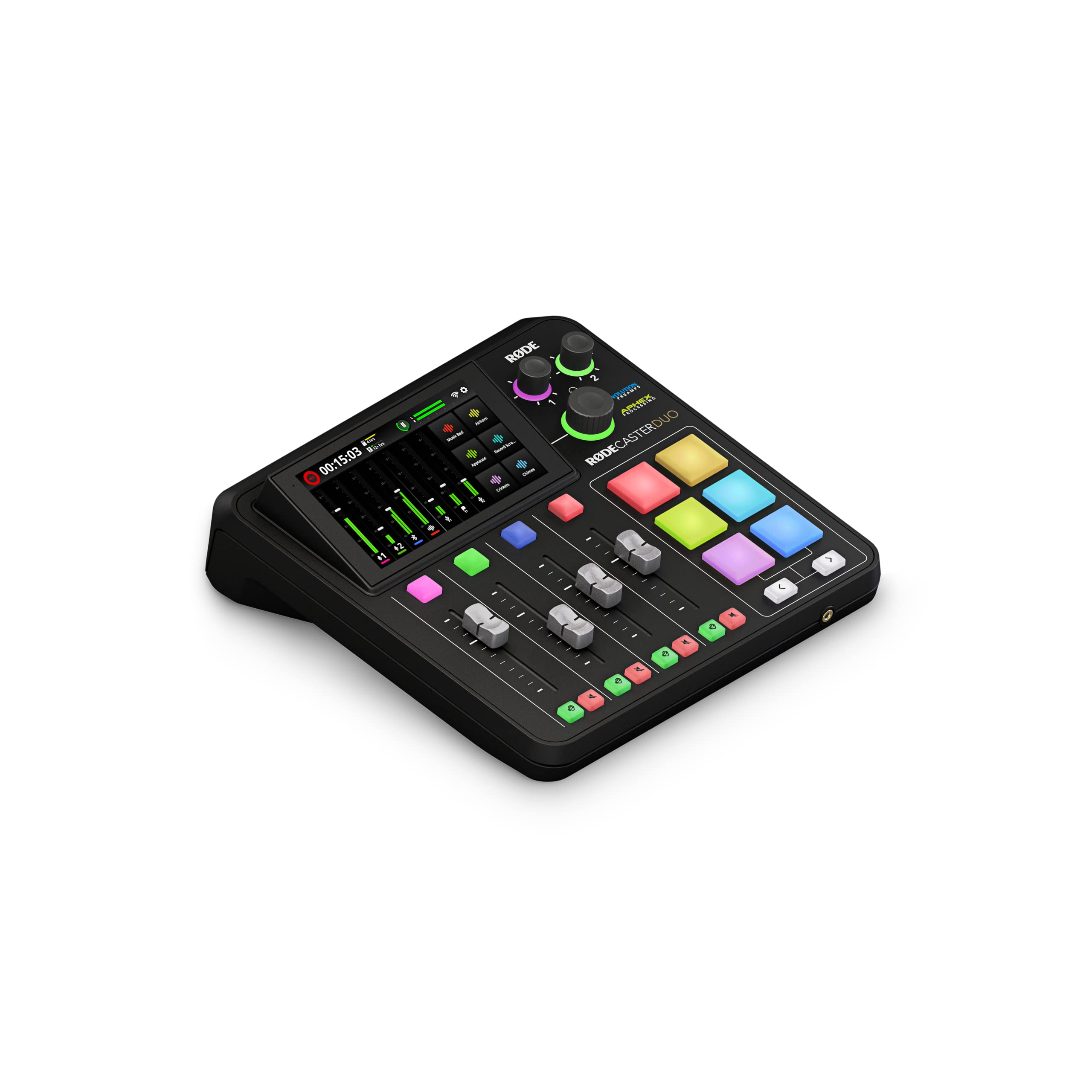
The RØDECaster Duo is not a traditional analog mixer — it is a fully integrated digital production console designed specifically for podcasting and content creation. Its Revolution Preamps achieve an EIN of -131.5 dBV with 76 dB of clean gain, meaning you can run a passive ribbon microphone or an SM7B without a Cloudlifter and still have no audible hiss. Four broadcast-quality faders control independent audio channels, and the high-resolution touchscreen provides haptic feedback for navigating effects, routing, and recording parameters.
APHEX processing is the headline feature for audio quality. The Aural Exciter restores high-frequency detail that gets lost in lossy codecs, while the Big Bottom processor adds low-end weight without muddiness. These are not gimmicks — they are studio-proven algorithms that genuinely improve the perceived clarity of spoken word audio. Six SMART pads with bank switching let you trigger sound effects, jingles, or MIDI commands during a live show. The built-in recording engine saves directly to an SD card or USB drive, giving you a redundancy path independent of your computer.
Where the Duo stumbles is reliability. Multiple user reports describe freezing issues at the loading screen and software bugs that cause channel muting to fail. RØDE’s support will replace units under warranty, but the frequency of these issues makes it difficult to recommend for mission-critical live broadcasts without a backup plan. The setup process is also not intuitive — connecting Bluetooth or configuring the app for the first time can require firmware updates and multiple attempts. If you can tolerate occasional quirks for the best preamp noise floor and APHEX processing in a compact format, the Duo delivers sonically.
Why it’s great
- Revolution Preamps with -131.5 dBV EIN — cleanest gain in class
- APHEX Aural Exciter and Big Bottom for broadcast-ready vocal processing
- Compact all-in-one form factor with SD card recording and SMART pads
Good to know
- Software stability issues reported — freezing and channel muting bugs
- Steep learning curve for setup and Bluetooth/app configuration
6. Allen & Heath CQ-12T Digital Mixer

The CQ-12T is Allen & Heath’s most accessible digital mixer for home studios that need professional-level routing without a rack of outboard gear. The 7-inch capacitive touchscreen is responsive and well-organized, letting you access channel EQ, dynamics, and effects from a single interface that does not require a laptop. The 16×16 USB interface streams multi-track audio directly to your DAW, while the SD card slot allows simultaneous 16-track recording — a safety net for live sessions where computer crashes would be catastrophic.
With 10 microphone/line inputs (five of which are combo jacks) plus a stereo line input, the CQ-12T handles a full band recording session or a multi-mic podcast with ease. The built-in effects include reverb, delay, chorus, and modulation, all adjustable via the touchscreen. Six output buses let you create independent in-ear monitor mixes for up to four performers, each with their own EQ, compression, and effects routing. The Auto Gain function analyzes input levels and sets gain automatically — accurate enough to trust for live sound, not just recording.
One notable limitation: mute groups, DCAs, and mute assignments affect all outputs rather than being output-specific. This means muting a channel in the live PA mix will also mute it in the monitor mix and the recording. For venues where the FOH engineer needs separate control from the monitor world, this is a genuine workflow restriction. The 8.85-pound weight makes it heavier than most compact mixers, but the metal chassis and Neutrik connectors inspire confidence for regular transport. If you need a powerful digital mixer with multi-track USB recording and a touchscreen interface, the CQ-12T delivers near-console-level capability.
Why it’s great
- 16×16 USB multi-track interface plus SD card recording
- 7-inch responsive touchscreen with intuitive channel control
- 6 output buses for independent IEM monitor mixes
Good to know
- Mute groups and DCAs affect all outputs, not individual mixes
- Heavier than analog equivalents at nearly 9 pounds
7. Numark M6 USB 4‑Channel DJ Mixer

The Numark M6 USB is a 4-channel DJ mixer first and a home studio mixer second. It is designed for beat mixing and turntable performance, with a replaceable crossfader, slope control for adjusting fader curve, and dedicated cue buttons per channel. The 3‑band EQ (treble, mid, bass) on each channel gives you enough tonal control to re-EQ tracks from different sources. The USB interface streams the master mix to your computer for recording sets, but it does not offer multi-track recording — you capture the stereo output only.
Build quality is surprisingly robust for the price point. The all-metal chassis withstands the physical punishment of DJ transport, and the radiant LED monitoring facilities give you clear visual feedback on levels. Record and booth outputs via RCA let you send separate mixes to a recorder and monitor speakers — useful for practice sessions where you want to record your mix without disturbing a live feed. The microphone input is basic but functional for announcements over music.
This mixer is not a solution for recording vocals or instruments with critical preamp quality. The mic preamp is noisy compared to dedicated studio mixers, and there are no phantom power options for condenser microphones. The faders on some units develop crackle after extended use, and the lack of built-in effects means you will need external processing for reverb or delay. For a DJ who needs a budget 4-channel mixer with USB recording and robust build, the M6 USB is a capable workhorse. For a home studio focused on recording or podcasting, look elsewhere.
Why it’s great
- Replaceable crossfader with slope control for DJ performance
- 3‑band EQ per channel and dedicated cue control for beat mixing
- USB recording of master mix and robust all-metal chassis
Good to know
- No phantom power — incompatible with condenser microphones
- Faders may develop crackle after extended use; no built-in effects
8. Mackie 402VLZ4 4‑Channel Mixer

The Mackie 402VLZ4 is a 4-channel analog mixer that exists for one reason: to deliver clean, simple summing without any digital complexity. Its Onyx mic preamps are the same circuit design found in Mackie’s much larger consoles, offering low noise, high headroom, and 48 V phantom power. The analog signal path is completely passive after the preamp — no A/D converters, no latency, no digital artifacts. For a submixer that feeds signals into a primary audio interface, or for a simple two-mic recording setup with a stereo line input, this unit excels at staying out of the way.
The chassis is all-metal and weighs only 2.5 pounds, making it the most portable option in this guide. The high-headroom line inputs handle +20 dBu without distortion, so you can connect hot signals from synthesizers or drum machines without clipping. Improved RF rejection is built into the inputs, which matters for live streaming setups where wireless microphones and Wi-Fi routers generate interference. The 3-band EQ (bass, mid, treble) with sweepable mid on channel 1 gives you more tonal shaping than most compact mixers offer.
The trade-offs are significant. There is no USB interface at all — the 402VLZ4 outputs only analog via RCA and 1/4-inch jacks. You will need a separate audio interface to digitize the signal for your computer. The headphone output is tied to the main mix and cannot be used for an independent cue mix. There are no effects, no Bluetooth, no digital routing. For a home studio that already owns a quality interface and needs a compact analog submixer for specific inputs, the 402VLZ4 is built to a professional standard. For a first mixer that needs to connect directly to a computer, it is simply the wrong tool.
Why it’s great
- Onyx mic preamps with clean gain and 48 V phantom power
- Ultra-compact, all-metal chassis at 2.5 pounds for portable use
- High-headroom line inputs (+20 dBu) handle hot synth signals
Good to know
- No USB interface — requires external digitization for computer recording
- Headphone output mirrors main mix; no independent cue monitoring
9. Pyle PMXU46BT 4‑Channel Mixer

The Pyle PMXU46BT throws an impressive feature sheet for its price point: Bluetooth streaming, USB audio interface, four channels with XLR/1/4-inch combo jacks, 48 V phantom power, and a 12-segment output level meter. For a beginning podcaster or home musician who needs a single box to mix microphones, instruments, and wireless audio from a phone, this mixer checks every box on paper. The Bluetooth input lets you stream backing tracks or interview callers wirelessly, and the USB connectivity means you can record the master mix into Audacity or GarageBand without a separate interface.
The analog front end is functional rather than spectacular. The preamps are usable for spoken word and rehearsal recording, but the noise floor is noticeably higher than the Mackie or Yamaha options — expect audible hiss at higher gain settings, especially with dynamic microphones. The 3-band EQ (high, mid, low) provides basic tonal shaping, and the aux send/return gives you the option to add external effects. The 6.84-pound weight suggests a plastic chassis that is less durable than metal competitors, but it has held up for multiple users in church and light gigging scenarios.
The downsides center on reliability and signal chain integrity. The USB connection requires occasional reinsertion to maintain synchronization, and the potentiometers on some units arrived slightly bent out of the box. The stereo output is unbalanced via RCA, so long cable runs pick up interference. There is no independent headphone mix routing — the headphone output mirrors the main mix. For a home studio on a tight budget that needs Bluetooth streaming capability and basic recording functionality, the PMXU46BT works. For anyone chasing clean preamps, low noise, or professional-level recording fidelity, the difference is audible from the first take.
Why it’s great
- Bluetooth input for wireless backing tracks and phone callers
- USB interface records master mix to computer without extra gear
- 4-channel layout with 48 V phantom power at a very low entry cost
Good to know
- Higher preamp noise floor compared to Mackie and Yamaha alternatives
- USB connection can lose sync; potentiometers may arrive slightly bent
FAQ
Why do my recordings sound noisy even with the mixer at low gain?
Can I record individual tracks from a mixer directly into my DAW?
What is the difference between an analog mixer and a digital mixer for home studio use?
Final Thoughts: The Verdict
For most home studio users, the best audio mixer for home studio is the Mackie ProFX6v3+ because it combines Onyx preamps, 192 kHz USB-C recording, and streaming-ready Loopback and Bluetooth features in a compact, affordable package that handles recording, streaming, and live monitoring equally well. If you need pristine multi-track recording without an external interface, grab the Allen & Heath ZEDi-10 for its 96 kHz 4×4 USB and GS‑Pre preamps. And for a podcast or content creation workstation with the cleanest preamps in this test, nothing beats the RØDE RØDECaster Duo if you are willing to accept its software quirks.