
A pair of audio monitor speakers is the single most critical investment for anyone who needs to hear the truth in a recording. Unlike consumer speakers that color and flatter the sound, a proper studio monitor reveals every flaw, every sibilant, and every bit of mud in your mix. Choosing the wrong set means you will chase corrections that do not exist and miss problems that do.
I’m Min — the co-founder and writer behind Gadgets Feed. I have spent hundreds of hours analyzing frequency response curves, amplifier topologies, waveguide designs, and driver materials to separate the genuinely flat from the merely marketed as flat.
Whether you are building a home studio, upgrading your production setup, or editing podcasts with critical ears, the best audio monitor speakers give you the transparency you need to make confident creative decisions without second-guessing your room or your gear.
How To Choose The Best Audio Monitor Speakers
Picking a studio monitor is not like picking a Bluetooth party speaker. You are buying a reference tool, and the wrong choice can derail your mixes for years. The three variables that matter most are driver configuration, amplifier architecture, and connectivity.
Driver Size and Cabinet Design
A 5-inch woofer offers the most balanced response for typical desktop nearfield use, extending low enough for bass-heavy genres without overwhelming a small room. A 6.5-inch driver gives deeper low-end reach but demands more distance from the rear wall to avoid boomy bass buildup from the port. Ported cabinets extend bass response but require careful placement relative to walls.
Amplifier Topology and Power
Class-D amplifiers are now standard in monitors under per pair — they run cooler and lighter than traditional Class-AB designs while delivering enough clean headroom for nearfield listening. Look for at least 30 watts per channel. Bi-amplification, where separate amp sections drive the woofer and tweeter, yields noticeably better clarity and transient response.
Inputs and Room Correction
XLR and ¼-inch TRS balanced inputs reject hum over long cable runs and are the professional standard. Some modern monitors offer DSP-based room tuning or onboard EQ switches to compensate for boundary effects when you place speakers on a desk or near a wall — these features save you from needing expensive acoustic treatment for minor frequency bumps.
Quick Comparison
On smaller screens, swipe sideways to see the full table.
| Model | Category | Best For | Key Spec | Amazon |
|---|---|---|---|---|
| JBL 305P MkII (Pair) | Mid-Range | Accurate mixing with wide sweet spot | 82W total Class-D, 5-inch woofer | Amazon |
| Yamaha HS5 (Pair) | Premium | Neutral, uncolored reference monitoring | 70W bi-amp, 5-inch cone woofer | Amazon |
| ADAM Audio T5V (Single) | Premium | Revealing high-frequency detail via U-ART tweeter | U-ART tweeter, 5-inch woofer | Amazon |
| JBL 306P MkII (Pair) | Mid-Range | Extended bass response for larger rooms | 82W total Class-D, 6.5-inch woofer | Amazon |
| KRK Classic 5 (Pair) | Mid-Range | Versatile nearfield with bass boost option | Bi-amped, 5-inch glass-aramid woofer | Amazon |
| KRK RP5G5 ROKIT 5 (Pair) | Premium | DSP room tuning and Class-D efficiency | DSP-driven EQ, 5-inch Kevlar woofer | Amazon |
| Edifier S1000MKII (Pair) | Premium | Versatile powered bookshelf with Bluetooth aptX HD | 120W total Class-D, 5.5-inch woofer | Amazon |
| Edifier S2000MKIII (Pair) | Premium | Audiophile nearfield with planar tweeters | 130W tri-amped, planar tweeter, 5.5-inch woofer | Amazon |
| Micca PB42X (Pair) | Budget | Entry-level desktop monitoring on a tight budget | 30W total Class-D, 4-inch carbon-fiber woofer | Amazon |
In‑Depth Reviews
1. JBL 305P MkII (Pair)

The JBL 305P MkII is the rare monitor that nails both accuracy and headroom at a price that undercuts most competitors by a significant margin. Its patented Image Control Waveguide delivers a wide, forgiving sweet spot that lets you hear panning and depth without locking you into a single listening position — a real advantage when you are leaning back to assess a mix from across the desk.
Dual 41-watt Class-D amplifiers drive the 5-inch woofer and tweeter separately, giving you 82 watts of bi-amped power that stays clean well past conversation-level volumes. The Slip Stream port reduces low-frequency turbulence, so the bass remains tight and defined rather than puffing out at higher SPL. Boundary EQ and HF trim switches let you compensate for desk or wall placement without touching your audio interface.
Owners consistently report that these monitors reveal mix problems they missed on their previous speakers — sibilant vocals, muddy low-mids, and phase issues become immediately apparent. The build quality is robust, with a thick MDF cabinet and proper XLR/TRS inputs that reject hum over long cable runs.
Why it’s great
- Exceptionally wide sweet spot for off-axis listening
- Bi-amped Class-D design eliminates distortion at moderate levels
- Boundary EQ and HF trim switches adapt to imperfect room acoustics
Good to know
- Requires separate XLR or TRS cables (not included)
- Bass response rolls off steeply below 50 Hz
2. Yamaha HS5 (Pair)

The Yamaha HS5 is the gold standard for vocal and acoustic mixing precisely because it refuses to flatter anything. Its 45-watt LF and 25-watt HF bi-amp system delivers 70 watts of amplification that stays ruthlessly neutral across a 54 Hz to 30 kHz frequency response — no hyped lows, no rolled-off highs, just the raw signal as your interface sends it.
The 5-inch cone woofer and 1-inch dome tweeter are housed in a heavy, resonance-resistant MDF cabinet that weighs substantially more than its size suggests. XLR and TRS inputs accept balanced or unbalanced signals, and the rear-panel room control switches let you cut bass buildup in 2 dB increments when you place the monitors against a wall or in a corner.
Audio engineers and podcast editors consistently report that their mixes translate better to headphones, car stereos, and earbuds after switching to the HS5. The tradeoff is that these monitors will mercilessly expose poor recording technique — which is exactly what a reference monitor should do.
Why it’s great
- Industry-standard neutral frequency response for mix translation
- Sturdy MDF cabinet minimizes cabinet coloration
- Room control switches compensate for boundary effects
Good to know
- Requires a quality audio interface with balanced outputs
- Bass extension is modest; a subwoofer is helpful for EDM or hip-hop
4. ADAM Audio T5V (Single)
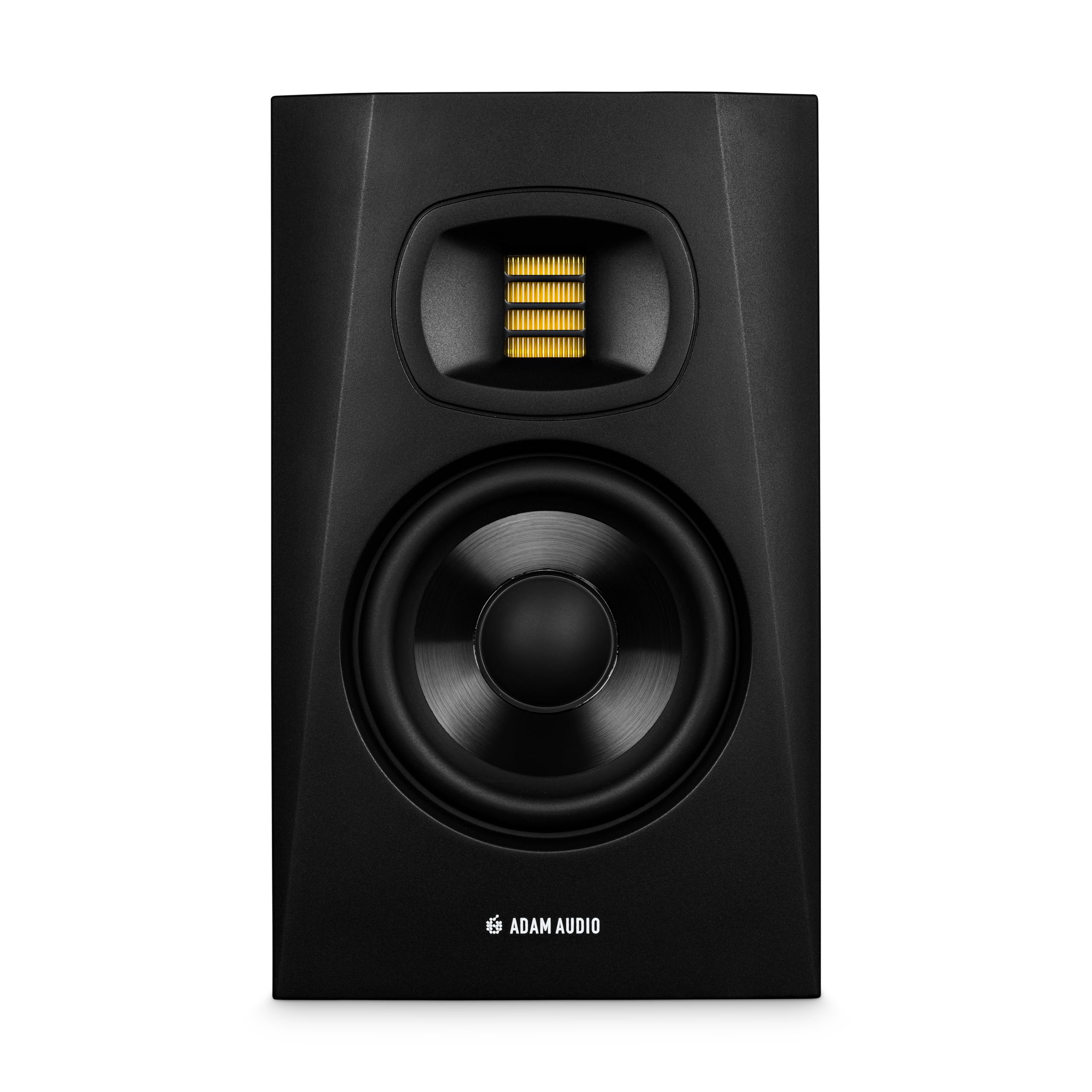
The ADAM Audio T5V brings Berlin-engineered ribbon-tweeter technology — the U-ART folded-ribbon driver — to a price point where most competitors still use soft-dome tweeters. This tweeter produces exceptionally detailed high-frequency reproduction up to 25 kHz, letting you hear sibilance, reverb tails, and high-hat articulation with a clarity that dome tweeters cannot match.
The 5-inch woofer is paired with a rear-firing bass reflex port and a beveled cabinet that reduces edge diffraction. DSP-based high- and low-shelf filters give you four adjustment points to adapt the monitor to your room’s acoustics, which is rare at this tier. Note that the T5V is sold as a single speaker, so you will need to buy two for stereo monitoring.
Users moving from KRK or lower-tier monitors report an immediate sense of openness and separation — instruments that previously blurred together now occupy distinct positions in the stereo field. If you mix acoustic, classical, or vocal-heavy genres where high-frequency detail is critical, the T5V is a standout choice.
Why it’s great
- U-ART folded-ribbon tweeter delivers unmatched high-frequency detail
- DSP-based room EQ filters allow precise acoustic adaptation
- Beveled cabinet reduces diffraction for cleaner imaging
Good to know
- Sold individually; a stereo pair costs significantly more
- Rear port requires careful placement away from walls
5. JBL 306P MkII (Pair)

The JBL 306P MkII is essentially the same amplifier and waveguide design as its 5-inch sibling but with a larger 6.5-inch woofer that extends low-frequency response by roughly 10 Hz. This extra reach makes it a better fit for mixing genres that depend on sub-bass information — EDM, trap, hip-hop — without needing a separate subwoofer for basic reference work.
The dual 41-watt Class-D amplifiers produce the same 82 watts total, but the larger cone area moves more air, giving you noticeably more headroom before compression or distortion sets in. The patented Image Control Waveguide remains intact, preserving the wide sweet spot that makes the 305P so effective. Boundary EQ and HF trim switches are also present, giving you room-flexible placement.
Users upgrading from 5-inch monitors consistently note that the 306P reveals low-frequency details that were previously inaudible — kick drum decay, sub-bass harmonics, and bass guitar finger noise become clear. The tradeoff is that the larger cabinet demands more desk space and at least 8 to 12 inches of clearance from the rear wall to prevent bass bloat.
Why it’s great
- Extended low-end response for bass-heavy genre mixing
- Larger woofer provides greater headroom before distortion
- Boundary EQ and HF trim adapt to room placement
Good to know
- Requires more desk space and rear-wall clearance than 5-inch monitors
- Bass can become boomy if placed too close to walls
6. KRK Classic 5 (Pair)

The KRK Classic 5 revives the sound signature that made the original Rokit series a staple in project studios worldwide — a slightly warm low-mid response with a smooth top end that is forgiving of poorly recorded sources. The 5-inch glass-aramid composite woofer delivers tight, controlled bass, while the 1-inch soft-dome tweeter with optimized waveguide extends to 35 kHz for articulate highs.
A flat low-frequency adjustment switch gives you the option of a neutral response or a +2 dB bass boost that adds weight without becoming bloated. This flexibility is useful when you are tracking in an untreated room and want a bit of musicality to keep sessions enjoyable, then switching to flat for critical mix decisions. XLR and ¼-inch TRS inputs handle balanced connections cleanly.
Longtime KRK users will recognize the familiar voicing — slightly less aggressive in the upper mids than competing monitors, which makes extended listening sessions less fatiguing. The tradeoff is that the Classic 5 is not as ruthlessly revealing as the Yamaha HS5 or the ADAM T5V, so you may need to check your mixes on a secondary reference.
Why it’s great
- Forgiving voicing reduces listening fatigue during long sessions
- Flat/bass boost switch adapts to tracking versus mixing
- Glass-aramid composite woofer delivers controlled low-end
Good to know
- Less revealing than strictly neutral monitors like the HS5
- RCA input not included; requires XLR or TRS cables
7. KRK RP5G5 ROKIT 5 (Pair)

The fifth-generation KRK ROKIT 5 introduces DSP-driven room tuning via a smartphone app — a feature previously reserved for monitors costing twice as much. You input your room dimensions and desired listening position, and the DSP adjusts the speaker’s EQ curve to compensate for common acoustic problems like bass buildup from nearby walls or treble attenuation from wide dispersion.
Hardware upgrades include a new 1-inch silk dome tweeter with improved phase response and a low-diffraction baffle that reduces edge reflections for cleaner stereo imaging. The Class-D amplifiers run cooler and more efficiently than previous generations, and the brick-wall limiter protects the drivers from accidental overdrive. XLR and ¼-inch TRS combo inputs accept any balanced source.
Critically, the app-controlled EQ allows you to audition different voicings — flat, mix, create, and focus — without reaching behind the speakers. This is a genuine workflow improvement for producers who switch between composition, tracking, and mixing within a single session. The Kevlar woofer retains the punchy transient response that KRK is known for.
Why it’s great
- DSP room tuning via smartphone app adapts to untreated rooms
- Multiple voicings switchable without manual adjustments
- Low-diffraction baffle improves stereo imaging
Good to know
- DSP introduces slight latency; not ideal for real-time monitoring
- App setup required to access full tuning capabilities
8. Edifier S1000MKII (Pair)

The Edifier S1000MKII blurs the line between audiophile bookshelf speaker and studio monitor by combining a 120-watt Class-D amplifier with a 5.5-inch aluminum alloy midbass driver and a 1-inch titanium dome tweeter. Its frequency response of 45 Hz to 40 kHz is wider than most pure monitors in its class, with bass that is surprisingly deep for a 5.5-inch driver.
What sets the S1000MKII apart from traditional monitors is its input flexibility — Bluetooth 5.0 with Qualcomm aptX HD, optical, coaxial, and dual RCA inputs let you switch between a computer interface, a TV, a turntable, and a phone without any re-patching. The included remote control handles volume, input switching, bass, and treble adjustment from your listening position.
Owners praise the S1000MKII for its ability to serve as both a nearfield monitor for video editing and a living-room music system. The titanium tweeter delivers crisp high frequencies without sounding brittle, and the aluminum woofer stays tight even at higher volumes. If you need one pair of powered speakers for multiple use cases, the S1000MKII is a compelling option.
Why it’s great
- Versatile inputs including Bluetooth aptX HD and optical
- Deep bass extension from 5.5-inch aluminum woofer
- Remote control for volume and input switching
Good to know
- Titanium tweeter can sound slightly bright in untreated rooms
- Not as analytically flat as dedicated studio monitors
9. Edifier S2000MKIII (Pair)
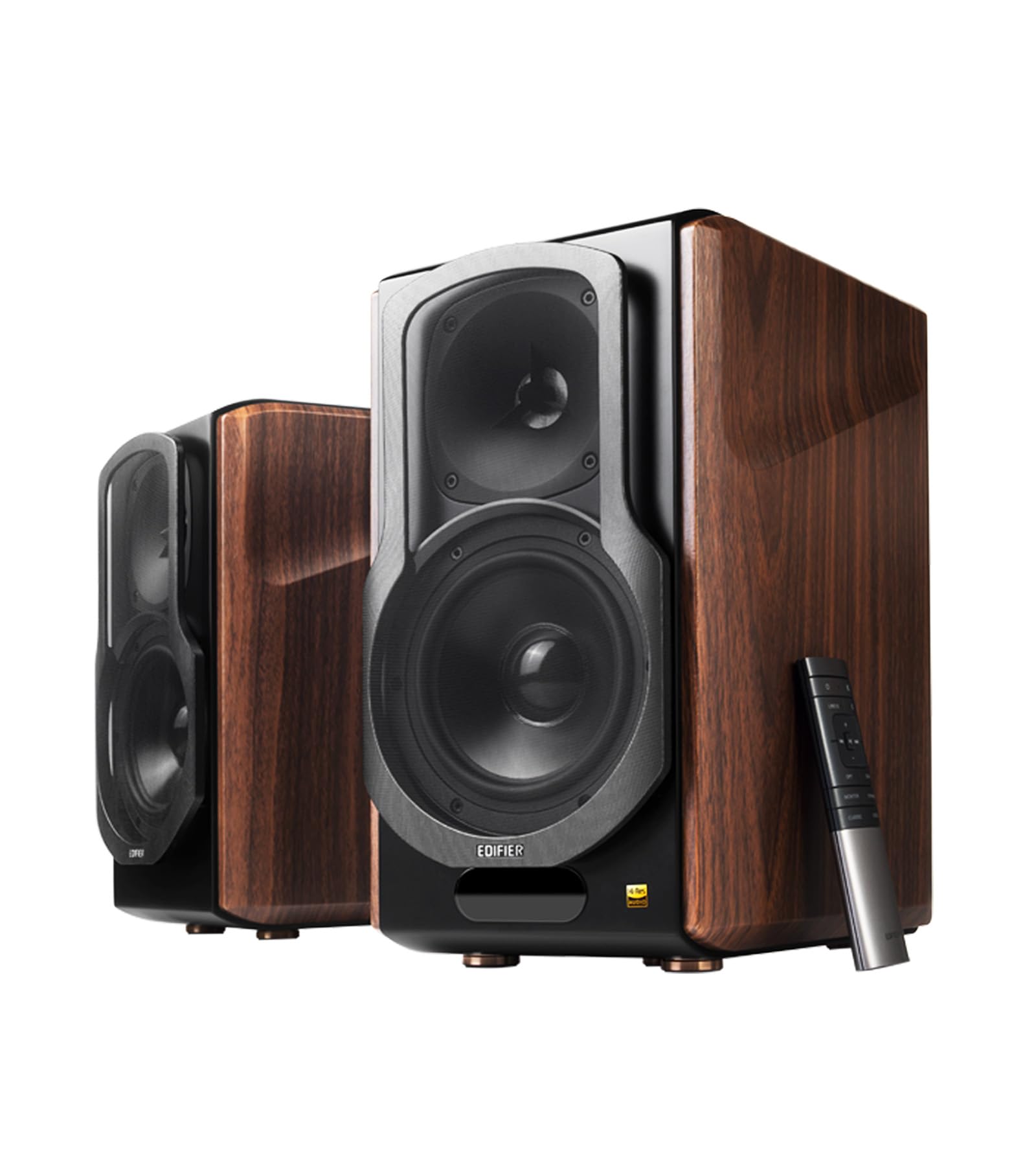
The Edifier S2000MKIII represents the top of Edifier’s active speaker lineup, featuring a tri-amped architecture that dedicates separate amplifier channels to each driver — 50 watts for the planar diaphragm tweeter and 40 watts for each of the 5.5-inch aluminum diaphragm woofers. The result is 130 watts of total power with exceptionally low intermodulation distortion.
The planar diaphragm tweeter is a significant upgrade over conventional dome designs, offering faster transient response and lower distortion across the high-frequency range. The low-end is handled by a rear-firing bass reflex port tuned to deliver tight, articulate bass down to 45 Hz without the bloat that plagues many ported designs. Input options include Bluetooth 5.0 with aptX HD, optical, coaxial, and RCA.
Users consistently describe the S2000MKIII as having an enormous soundstage for its size, with instruments placed precisely across a wide stereo field. The tri-amped design gives it a level of clarity and separation that rivals passive speaker pairs costing significantly more. If you want reference-grade detail with the convenience of built-in amplification and wireless streaming, the S2000MKIII is hard to beat.
Why it’s great
- Tri-amped design minimizes intermodulation distortion
- Planar diaphragm tweeter delivers fast, detailed highs
- Wide input compatibility including Bluetooth aptX HD
Good to know
- Heavy at 40 lbs total; requires sturdy desk or stands
- Remote control is hard to read in low light
3. Micca PB42X (Pair)

The Micca PB42X proves that you do not need a massive budget to get a genuinely useful nearfield monitor. Its 4-inch balanced woven carbon-fiber woofer and silk dome tweeter are driven by a built-in Class-D amplifier that delivers 15 watts per channel — modest on paper but clean enough to fill a desktop listening environment without distortion at moderate volumes.
The ported enclosure extends bass response down to roughly 80 Hz, after which the roll-off is graceful rather than abrupt. Vocal clarity is excellent for the price, with natural mids and articulate high frequencies that outperform many powered speakers costing twice as much. RCA inputs and a front-panel volume knob keep setup simple — no interface required for basic use.
Users consistently note that the PB42X benefits from being elevated off the desk — inexpensive foam isolation pads reduce bass coupling and clarify the midrange. A subwoofer is recommended for full-range music, but for dialogue-heavy content like podcasts, audiobooks, and vocal mixing, the PB42X delivers surprising accuracy at an entry-level price.
Why it’s great
- Exceptional vocal clarity and natural midrange for the price
- Built-in Class-D amplifier eliminates need for external receiver
- Includes all cables — truly plug-and-play
Good to know
- Limited bass extension; subwoofer recommended for full-range music
- 15W per channel is not enough for large rooms or high SPL
FAQ
Do I need an audio interface to use powered studio monitors?
What is the difference between a studio monitor and a bookshelf speaker?
Should I place my monitors vertically or horizontally?
Final Thoughts: The Verdict
For most users, the best audio monitor speakers winner is the JBL 305P MkII (Pair) because it delivers a wide sweet spot, bi-amped Class-D amplification, and room-tuning EQ at a price that leaves room for an audio interface and cables. If you want a ruthlessly neutral reference for mix translation, grab the Yamaha HS5 (Pair). And for high-frequency forensic detail that reveals every sibilant and reverb tail, nothing beats the ADAM Audio T5V.