
Our readers keep the lights on and my morning glass full of iced black tea. As an Amazon Associate, I earn from qualifying purchases.
Specs are compiled from manufacturer listings and verified buyer reviews and can change over time — please confirm the key details on the product page before buying.
You do not need the flashiest pair of speakers. You need a pair that tells you the truth about your mix, so the bass kick you hear in your room is still there on a phone speaker. That is the whole job of the audio monitors in this guide. Each pick here earns its place because owners describe how it translates their work across real listening spaces.
I’m Min — the founder and writer behind Gadgets Feed. This guide is built by comparing the manufacturers’ published specifications and the patterns across verified customer reviews, so you get each pick’s real strengths and trade-offs instead of marketing spin.
From compact desktop monitors to full-range studio workhorses, each pair below earns its place on a real-world use case. Here is how to sort the best audio monitors for your room and your workflow in one read.
Our Picks at a Glance


How To Choose The Best Audio Monitors
The smartest buying move is to match the pair to the room you actually have. A bigger woofer is not automatically better if it sits on a narrow desk against a wall. Start with driver size and placement, then work outward to inputs and tuning.
Driver size and where the speaker sits
A 5-inch woofer (the main cone that moves air for lows and mids) suits a desk or small room. A 6.5-inch or 8-inch driver pushes more low end, which helps fill a larger space but can overwhelm a corner. Port position matters too: a front-firing port lets you push the cabinet near a wall, while a rear port needs breathing room behind it.
The waveguide and the balance
A waveguide is the shaped horn around the tweeter that spreads high frequencies across your desk. A wider spread means you can shift your head and still hear a balanced stereo image. That matters for long mix sessions where you are not locked in one spot.
Room tuning controls
Small knobs or switch filters adjust the highs and lows to fight a boomy corner or a hard wall. A high-pass filter rolls off deep bass you do not need. An acoustic-space setting tells the speaker it is near a wall or corner. These controls let one pair work in rooms that are less than ideal.
Inputs and how you connect
Balanced XLR and TRS jacks carry a clean signal over longer cable runs. Unbalanced RCA is fine for short runs to consumer gear. If you mix on a laptop with no audio interface, Bluetooth or USB can be a practical shortcut for casual listening between sessions.
Quick Comparison
| Model | Best For | Driver Size | Power | Inputs | Amazon |
|---|---|---|---|---|---|
| ADAM Audio T5V★ Best Overall | Detailed highs on a desk | 5 inches | — | XLR, 1/4″ TRS, RCA | Amazon |
| PreSonus Eris Studio 5Best Value | Small home studios | 5.25 inches | 80 W | XLR, TRS, RCA | Amazon |
| Pioneer DJ DM-50DBest for DJs | DJ sets on a desktop | 5 inches | — | Auxiliary | Amazon |
| PreSonus Eris 5 Bluetooth | Wireless listening and casual mixing | 5.25 inches | 100 W | TRS, RCA, Aux, Bluetooth 5.0 | Amazon |
| KALI AUDIO LP-6 V2 | Loud, clean full-range work | 6.5 inches | 80 W | TRS, RCA, XLR | Amazon |
| KALI AUDIO LP-UNF | Tiny rooms and nearfield detail | 4.5 inches | — | TRS, Bluetooth, RCA, USB | Amazon |
| Edifier MR5 | 3-way detail with app tuning | 5 inches | 110 W RMS | Aux, Bluetooth, RCA, TRS, XLR | Amazon |
| Yamaha HS5 Pair | Honest mixes in mid rooms | 5 inches | 70 W | XLR | Amazon |
| Neumann KH 80 DSP | Reference-grade nearfield | 4 inches | — | Combo jack | Amazon |
| Yamaha HS8 Pair | Large rooms and low end | 8 inches | 120 W | XLR | Amazon |
| IK Multimedia iLoud MTM MKII | Built-in room correction | — | 200 W | Aux, USB, XLR | Amazon |
In‑Depth Reviews
1. ADAM Audio T5V Studio Monitor
Our pick — 4.5+★ from 350+ verified ratings; the strongest balance of quality and price.
The pair that reveals high-end detail other monitors smear over
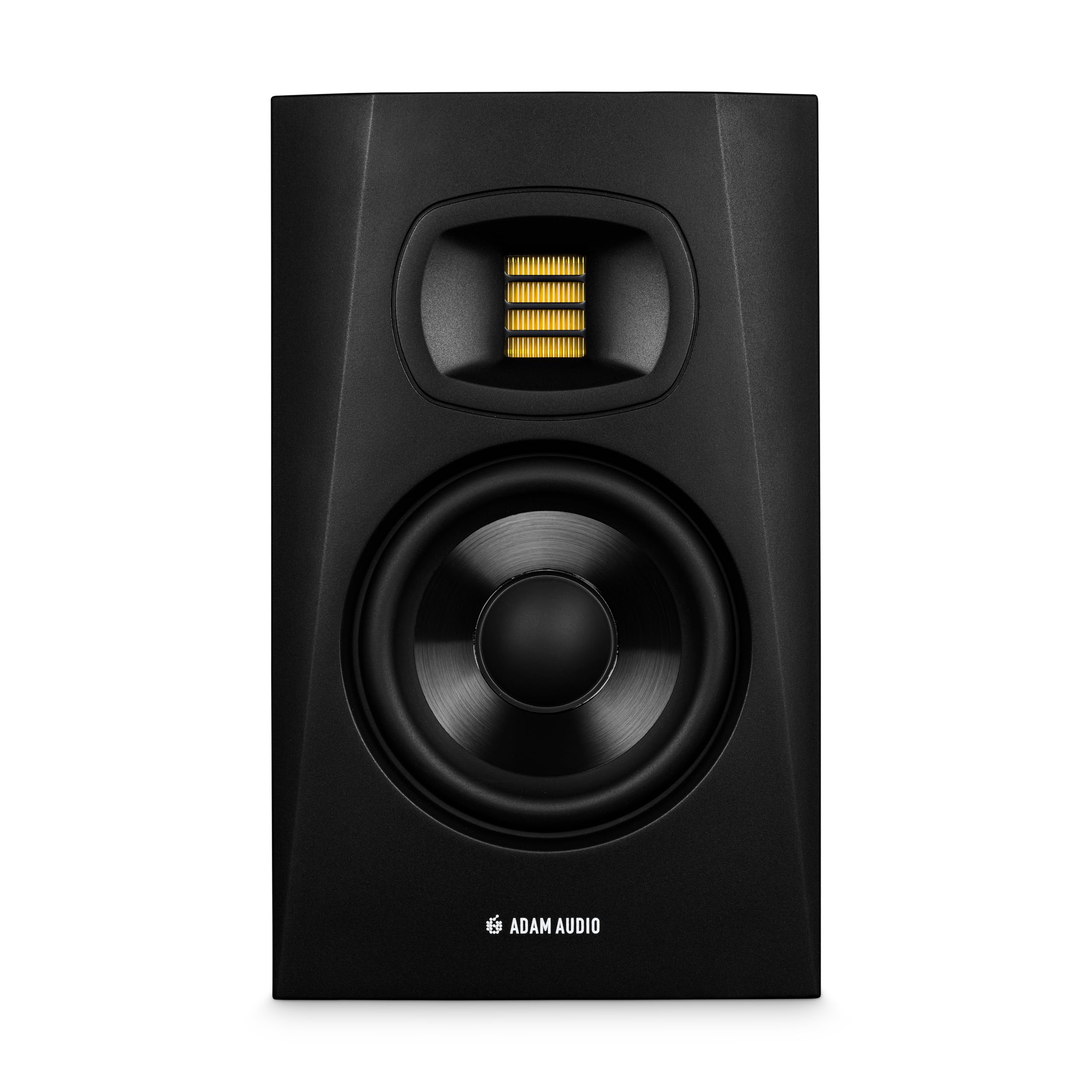
If your mixes fall apart on bright speakers, the T5V is the place to start. Its signature high-frequency design is built around a U-ART tweeter (a folded-ribbon high-frequency driver) fed through an HPS waveguide to spread the highs evenly across the high-frequency spectrum. The result is detail you can actually mix on, from a podcast edit to a guitar track.
The 5-inch woofer keeps the cabinet small enough for limited space. A beveled cabinet and a rear-firing bass reflex port (a rear-facing air vent that shapes low end) mean you can still place it where a desk allows, as long as it has breathing room behind it. High- and low-shelf DSP filters (built-in tone-shaping controls) adjust the sound for a boomy corner or a hard wall.
What wins people over is simply the sound. Owners describe the highs as crisp and the bass as enough to hear a kick drum thump. Value keeps coming up too, with plenty of buyers saying it feels like more speaker than the outlay suggests. It ships as a pair, and the analog connections cover XLR, 1/4″ TRS, and RCA so it drops into most rigs.
What earns the top slot
- Waveguide spreads highs for a balanced off-axis image
- DSP shelf filters tailor the sound to a tricky room
- XLR, TRS, and RCA cover both studio and home gear
Worth knowing before you buy
- Rear port needs space behind the cabinet for clean bass
- The revealing top end exposes a harsh, unpolished mix
The honest call: a first serious monitor for a tight desk, built for producers who want to hear the detail their mix is hiding.
It gives you more: the highs are not for a mud-loving ear, so if you want a warm, forgiving sound you will fight this one.
2. PreSonus Eris Studio 5 5.25-inch 2-Way Active Studio Monitors with EBM Waveguide
A compact monitor built to fill a small home studio without crowding the desk
This one earns its keep on placement flexibility. The front-firing acoustic port pushes air out the front, so you can tuck the cabinet against a wall without choking the low end. That alone makes it an easier fit for the small rooms and home setups owners keep describing.
You get a wider balance, so shifting in your chair still leaves a solid stereo image. That comes from the custom-tuned EBM waveguide (a shaped horn that guides the highs), which spreads them over a wide 120˚ horizontal by 60˚ vertical window. A 1-inch silk-dome tweeter handles the top, and the 5.25-inch woven-composite woofer covers the low end down to 48 Hz (48 vibrations per second, deep enough to hear a bass kick).
Precise tuning is where this box punches above its class. You get HF and Midrange controls, a highpass filter, and an Acoustic Space control with flat, -2, and -4 dB settings to compensate for a speaker near a wall or corner. It delivers up to 102 dB SPL (sound pressure level, the loudness measure) from 80 W of Class AB biamplification, and connections include balanced XLR, balanced ¼-inch TRS, and unbalanced RCA.
Where the value sits: owners say it changes how they hear their own work, and the desk footprint stays small enough to disappear. Few monitors this small pack HF, midrange, highpass, and acoustic-space controls.
The honest limit: this listing is for a single monitor, so a stereo pair means buying two. If you want full-range depth, plan to add a subwoofer down the line.
Reach for it if: you have a tight room and one wall behind the desk, and you want room-correction controls without paying premium money.
Look elsewhere if: you expect a matched stereo pair in one box — this ships solo.
3. Pioneer DJ DM-50D 5-inch Active Desktop Monitor Speakers, Pair, Black
Punchy low end voiced for the DJ booth, not the mastering suite
Here is a monitor tuned for a different job than a straight mixing reference. The 5-inch active drivers are voiced by the DJ audio team to bring punchy, defined low frequencies, so kicks and basslines hit with presence on a desktop. If your sessions are part DJ set, part production, this voicing suits the room.
The built-in amplification is the practical win. These are active speakers, meaning the amp lives inside each cabinet, so you plug your gear straight in with no separate amp to buy or wire. DSP tuning keeps the sound clear and balanced for mixing, producing, and DJ work alike. It comes as a matched pair ready to drop onto a desk or into a small room.
The pitch in one line: fuller bass for desktops and small rooms, with the electronics handled for you.
Suits you if: DJing and casual producing share one desk, and you want low end with punch without extra gear.
Think twice if: you need a strictly neutral mastering reference — this one leans into a livelier low end.
4. PreSonus Eris 5 Bluetooth Powered Desktop Studio Monitors Pair 100W Black

The pair that mixes your music and plays your movies from the same desk
Some monitors are built for one job; this pair handles several. It carries 100 W of Class D power, split 50 W per speaker, so you get plenty of volume without losing tonal balance. That makes it as comfortable running a movie night as it is tracking your next song.
This is the louder-powered sibling of the Eris Studio 5, with 100 W on tap here against that box’s 80 W (watts, the power driving the speakers). The 5.25-inch woven-composite woofers cover the low end, and the 1-inch silk-dome tweeters spread a wide balance for a solid stereo image. Bluetooth 5.0 with a 10-meter range lets you stream from a phone or tablet without a cable, so you can check a mix from across the room.
Connections are generous: ¼-inch TRS balanced inputs for pro gear, unbalanced RCA for consumer electronics, and a front-panel ⅛-inch stereo aux for a phone. A built-in headphone amp with a front output lets you work privately. High and Low Acoustic Tuning controls dial the pair into your room.
Why it stands out
- 100 W total gives headroom for movies and mixing alike
- Bluetooth 5.0 streams wirelessly across a 10-meter range
- Front headphone output means quiet sessions with no rewiring
What to weigh
- Long-term reliability gets mixed feedback, so treat them with care
- Room tuning is basic compared with DSP-heavy rivals
The easy pick for: a single desk that switches between producing, gaming, and movie nights without re-cabling.
Less ideal if: you demand precise, filter-by-filter room correction — this pair keeps controls simple.
5. KALI AUDIO LP-6 V2 6.5″ Project Lone Pine Powered Studio Monitor
Big-driver clarity and serious loudness for the producer who needs headroom
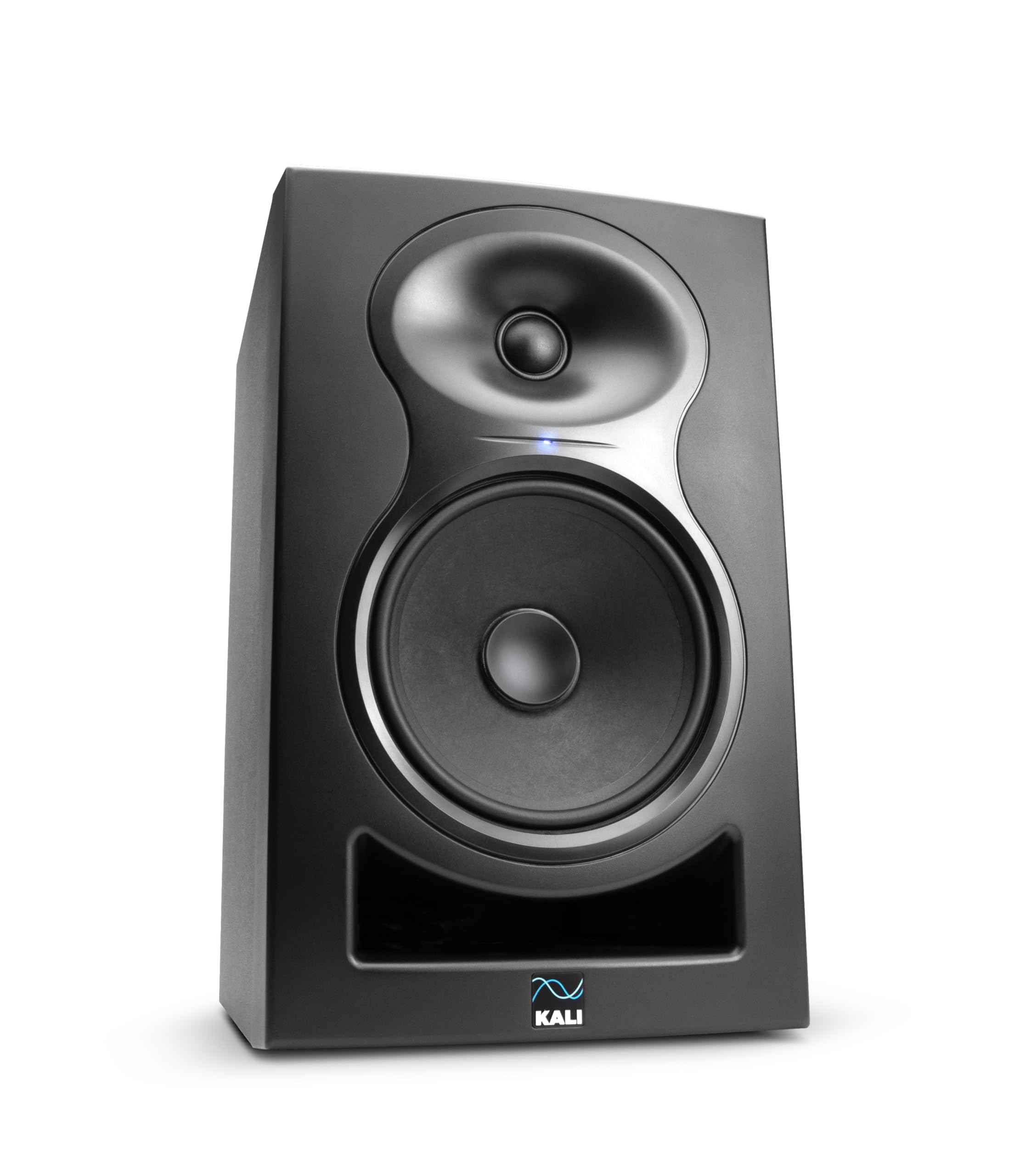
If you need a monitor that stays clean when pushed, the LP-6 V2 leads on two counts. Its 6.5-inch driver is meaningfully larger than the 5-inch cone on the ADAM T5V, which moves more air for low end. Its 115 dB max SPL also runs ahead of the 102 dB of the PreSonus Eris Studio 5, so it holds together in a louder, bigger room.
The single monitor is bi-amped, meaning 80 watts split between the 1-inch tweeter and the 6.5-inch driver. That covers a 47 Hz to 21 kHz range. A 2nd-gen DSP system works toward a flat frequency response, so what you hear tracks your mix without boosts or suppressions. The front port lets air exit at uniform velocity, backed by a 12 dB noise-reduction move aimed at stopping chuffing and hiss.
An updated boundary EQ keeps the sound steady whether the cabinet sits on a stand, near a wall, or on your desk. It takes TRS, RCA, and XLR inputs and comes as a single speaker. Owners describe an accurate translation they trust, alongside strong value. Volume is the more divided topic, so expect plenty of loudness but judge the level you need against your room.
The standout spec: a 6.5-inch driver and 115 dB ceiling in one box, which is a lot of low-end movement and loudness for the outlay.
The catch: this is one speaker, not a pair, and the front port still wants some clearance to breathe.
It clicks if: you want the punch of a larger woofer and the headroom to fill a real room, and you are fine buying a single cab at a time.
Down the list if: desk space is tiny — a 6.5-inch cabinet simply takes more real estate.
6. KALI AUDIO LP-UNF Ultra Nearfield Monitor System – Black
Ultra-nearfield monitors that turn a cramped corner into a real listening spot
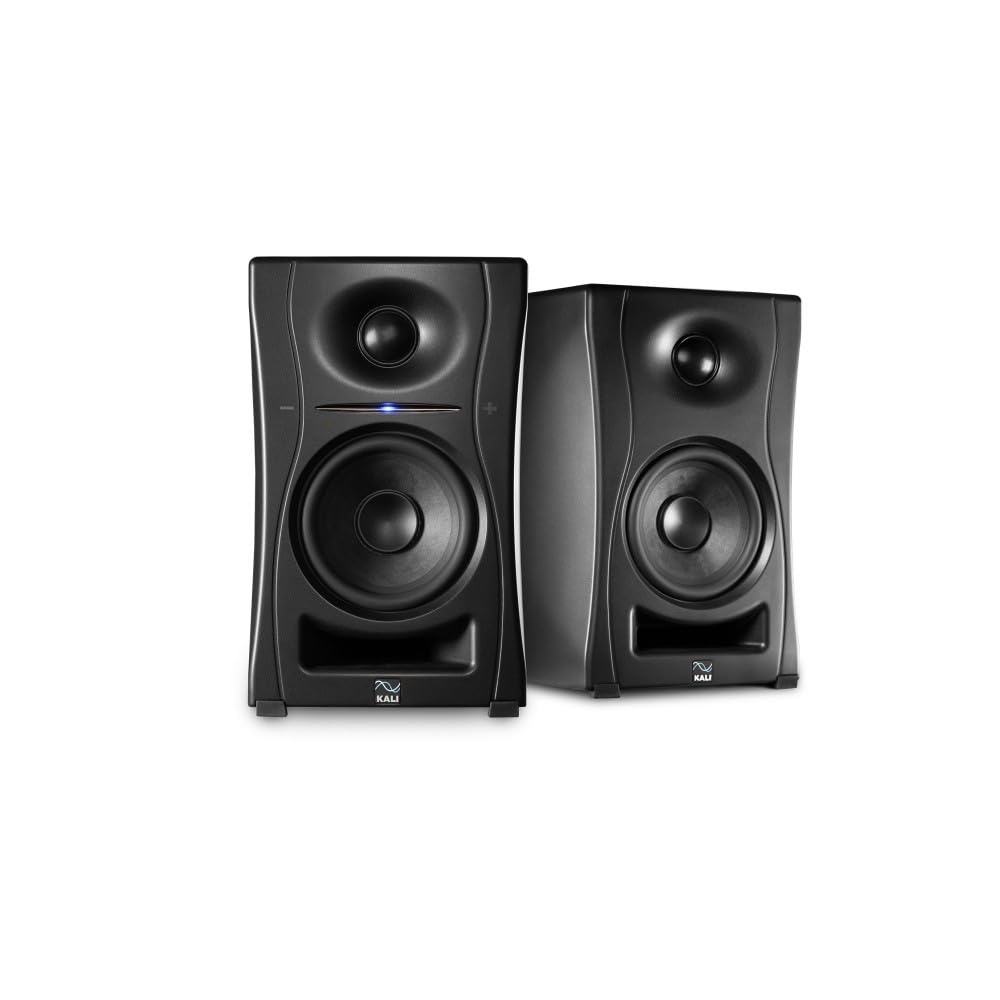
This is the pick for a room too small for anything bulky. The LP-UNF is an ultra-nearfield pair with 4.5-inch powered drivers and a 1-inch tweeter, sized to sit close to your ears without eating the desk. A 3D imaging waveguide handles the stereo picture at close range, and a boundary EQ keeps the low end honest when the cabinet is placed near a wall.
Connectivity is where it bends toward modern setups. It takes ¼-inch TRS, RCA, and USB, plus Bluetooth with a 10-meter range for streaming from a phone or tablet. A touch-sensitive volume slider runs across the top, so level changes are a swipe away. Owners say the 4.5-inch pair holds a wide frequency response better than its footprint suggests.
The controls reward a bit of patience. Dip-switches on the back let you shape the sound to your room, which owners appreciate. The touch slider is the one to test early: some find it less precise than a knob, so set expectations there rather than treating it as a flaw.
Built for: a tiny room or a shelf, where you want nearfield detail and wireless convenience in one small pair.
Hold off if: you need tactile, knob-style level control for fast, repeatable adjustments.
7. Edifier MR5 2.0 Studio Monitor Bookshelf Speakers, 110W RMS, Black

A three-way design that splits the work across dedicated drivers
Vocals and instruments stay clean and detailed here, because the mids get their own driver. Most monitors in this guide are two-way; the MR5 goes three-way, so separate drivers each handle their own slice. A 3-way active crossover system (a circuit that splits sound between drivers) pairs a 5-inch long-throw woofer with a 3.75-inch mid driver and a 1-inch silk-dome tweeter, spanning a 46Hz–40kHz frequency response (46 Hz to 40,000 Hz, well past what your ears hear).
The digital side is unusually deep. It supports 24-bit/96kHz audio both wired and wirelessly over LDAC (a high-resolution Bluetooth codec), so streaming does not have to mean a big drop in quality. Bluetooth 6.0 handles stability and multi-point connection. Rear knobs give you High/Low Frequency adjustments, while the EDIFIER ConneX App adds room compensation with Low Cut-Off, Desktop Control, and Acoustic Space presets.
Power comes from a 110W RMS Class D amplifier delivering 101 dB peak SPL, enough for near-field work or filling a mid-sized room. Inputs cover XLR, TRS, RCA, and AUX, and a front-panel 3.5mm headphone output lets you listen privately. MDF cabinets reduce resonance and a dimpled tweeter waveguide keeps the sound steady across a wider listening area. Owners reward the three-way driver separation with praise for its clarity and detail.
The detail edge: three dedicated drivers and a 46Hz–40kHz range give you more separation between bass, mids, and highs than a two-way can offer.
The trade-off: the tuning runs through the app, so some buyers will miss plain analog knobs for quick, repeatable tweaks.
Go for it if: you want high-resolution streaming and three-way separation from one app-tunable pair.
Pass if: you would rather adjust in the app days — you want physical simplicity first.
8. Yamaha HS5 Pair 2-Way Bass-Reflex Bi-Amplified Nearfield Studio Monitors

A pair that tells you the honest truth, even when the truth stings
The HS5 has a reputation as a reference you can rely on for the plain, unfiltered version of a mix. Owners describe honest sound that surfaces the imperfections in a track. Each monitor runs 70W in a 2-way bass-reflex bi-amplified design, with a dedicated amp for the woofer and another for the tweeter. That keeps the response flat across the spectrum.
Two response controls let you adapt each speaker to rooms of different shapes and sizes. Ultra-responsive woofers use large, carefully selected magnets to keep distortion low with a well-defined bottom end at any output level. A carefully designed port reduces the air vortex that causes unwanted noise, which helps keep the low end clean.
Why pros reach for it: the flat, honest voicing makes it easy to trust what you hear, and owners call it a satisfying investment with strong performance and build.
One thing to plan for: honest sound means a rough mix sounds rough here. If you want flattery, this is the wrong pair.
Right for: a producer who wants a trustworthy reference and is not chasing a pretty sound.
Not for: casual listeners who want warmth and a flattering tone.
9. Neumann KH 80 DSP 4-Inch Powered Studio Monitor
A four-inch reference with DSP brains, aimed at serious rooms
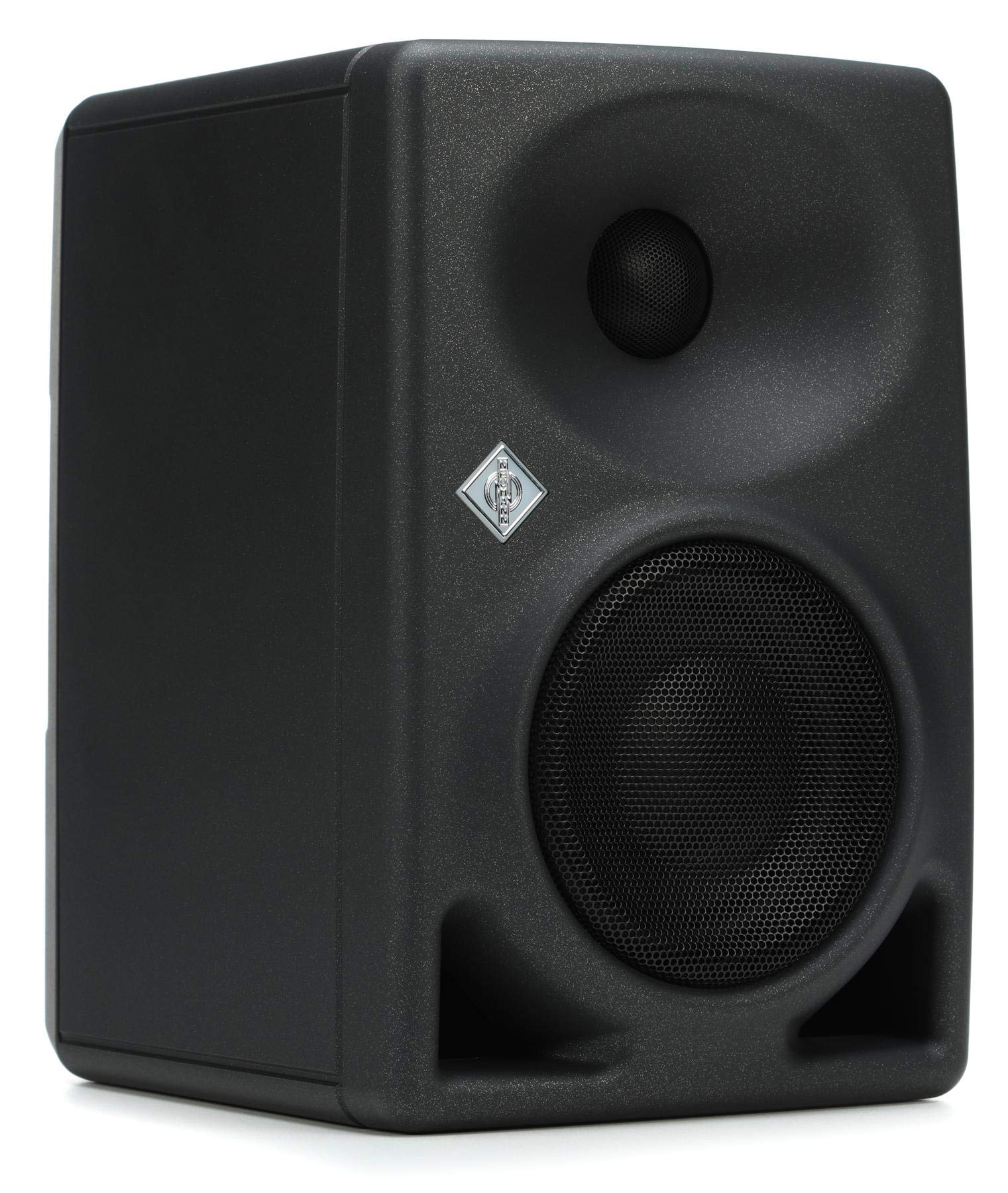
This is the most professionally aimed monitor on the list. It is an active 4-inch nearfield with DSP control, packed into a compact polycarbonate-composite cabinet. A Mathematically Modeled Dispersion waveguide (a precisely calculated horn around the tweeter) shapes the sound spread, and it is built for reference work across project studios, broadcast, post production, and home setups.
What you are paying for is accuracy and control rather than peak loudness. The DSP engine gives digital handling of the response, and the cabinet is built to sit in demanding monitoring environments. A combo jack handles the input, and the box ships with a power cable, user manual, and mounting-hardware kit.
Best for: a project or post-production room that needs a precise nearfield reference and digital control.
Keep looking if: you want big-driver low end from a single box — this four-inch cabinet is built for accuracy, not rumble.
10. Yamaha HS8 8-Inch Powered Studio Monitor Pair – Black

Eight inches of low-end authority for a room that can take it
If your room is on the larger side, the HS8 brings the depth the smaller boxes cannot. Its 8-inch cone woofer and 1-inch dome tweeter run on a 75W low-frequency plus 45W high-frequency bi-amp system, for 120W of power amplification. The reward is a 38Hz–30kHz frequency response, so the deepest bass and the finest highs both make it into the room.
Large magnets in an Advanced Magnetic Circuit design keep control over that big cone. The pair comes as two monitors with a power cable and manual in each box, though XLR cables are not included, so budget for those separately.
The draw: an 8-inch driver and 120W of bi-amped power give real depth for a bigger room.
Before you commit: a big cabinet needs space and sturdy stands, and you will supply your own XLR cables.
Suits: a larger studio where you want true low-end extension and the power to fill the space.
Skip if: your desk is small — the 8-inch cabinet will dominate it.
11. IK Multimedia iLoud MTM MKII (Pair Plus ARC mic) Compact Studio Monitor
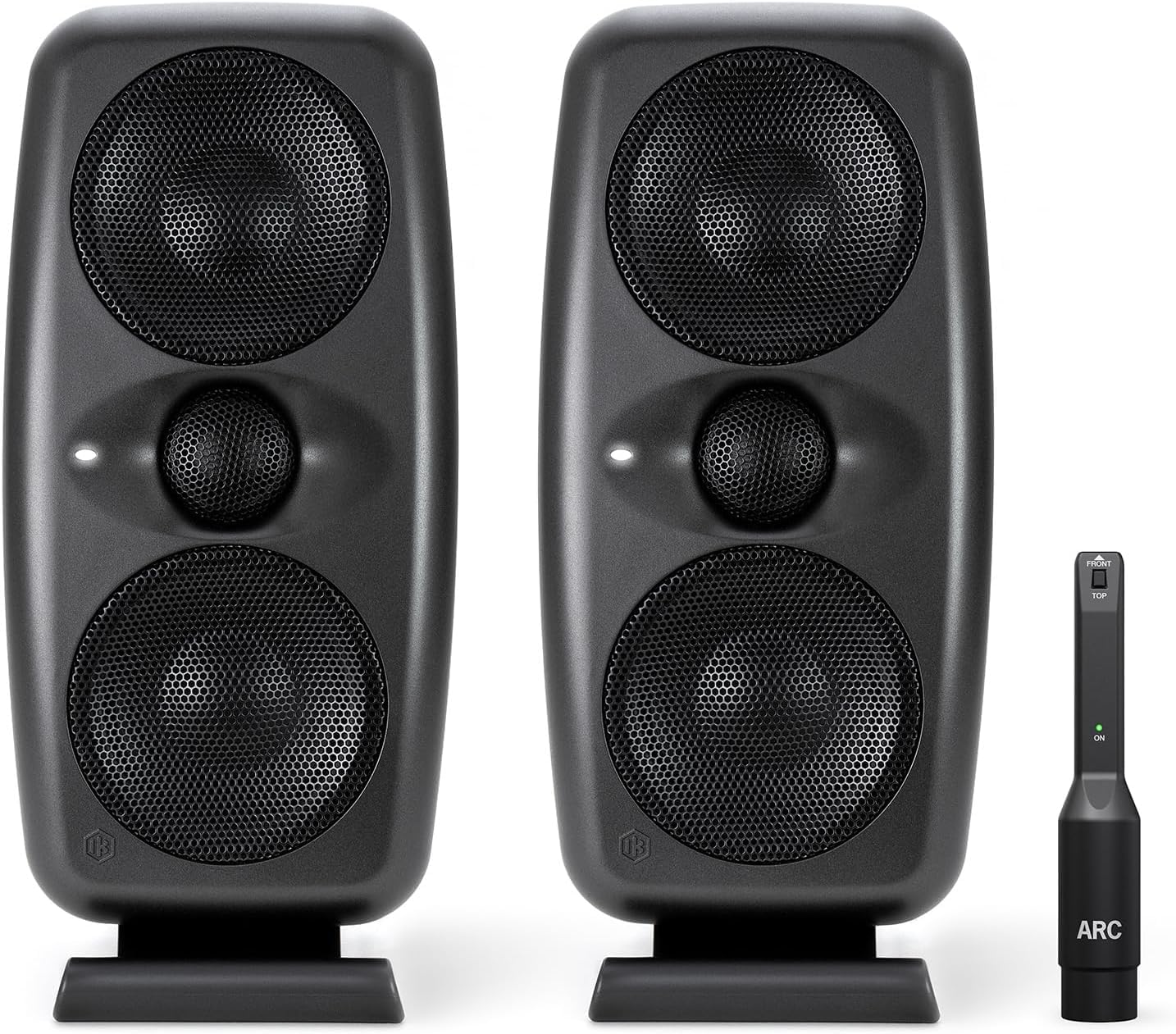
The compact pair that corrects your room before you mix in it
Built-in room correction is the reason this one earns a slot. The MTM MKII ships as a pair with an ARC mic and uses built-in ARC room correction, so you can calibrate the monitors to the room you mix in. It pushes an ultra-flat range from 36 Hz to 32 kHz, with 200W of power behind it. For a compact pair, that is a lot of full-spectrum control.
Precise time alignment works toward linear phase sound, which cuts phase distortion and ear fatigue over long sessions. That supports accurate imaging and a natural tone for mixing, mastering, and detailed work. ARC X software emulates a range of top monitors and reference systems, so you can test a mix across different monitoring setups and check it translates.
Owners praise the calibration and built-in DSP first, and say the deep, punchy bass holds up in small and medium studios. Mounting is flexible, with desktop stands and mic stand mount points, plus auxiliary, USB, and XLR connections. It handles small and medium rooms well, though you are paying for the tuning brain as much as the drivers.
Ideal for: a room with acoustic quirks where you want automatic correction and mix-checking built into the monitors.
Second-guess it if: you want the simplest possible setup — the calibration software adds a step before you mix.
Understanding the Specs
Driver Size and Low End
The woofer size is the main cone that moves air for lows and mids. A 5-inch woofer suits a desk, while a 6.5-inch or 8-inch driver pushes more low end for a larger room. Bigger is not always better: a large cone in a small corner can sound boomy. Match the driver to the space you actually mix in.
Max SPL and Power
SPL (sound pressure level) is the loudness a monitor can reach, and power in watts is what drives it. Higher max SPL like 115 dB helps a monitor stay clean at louder levels in a bigger room. Wattage alone does not guarantee clarity — check the whole design, since a bi-amped box splits power between tweeter and woofer.
Waveguides and balance
A waveguide is the shaped horn around the tweeter that spreads high frequencies. A wide spread like 120˚ horizontal keeps a balanced image as you move. This matters for long sessions where you are not frozen in one spot.
Room Correction Controls
High and low shelf filters, acoustic-space settings, and DSP-based tuning fight a boomy corner or a hard wall. Some monitors add app-based or automatic room correction. These controls let one pair work in a room that is less than ideal.
FAQ
Do I need a pair or will a single monitor work?
Can I place monitors against a wall in a small room?
What is a waveguide and why does it matter?
Do I need a separate amplifier for these monitors?
How do Bluetooth monitors compare to wired ones for mixing?
What size driver suits my room?
Can these monitors correct for a bad room?
Which inputs should I look for on a studio monitor?
How long do studio monitors typically last?
Are studio monitors good for everyday listening and movies?
Final Thoughts: The Verdict
For most people chasing the best audio monitors, the ADAM Audio T5V is the one to start with: its waveguide and DSP tuning make a tight desk work, and the crowd has rewarded it as a favorite. If room correction matters more than anything, the IK Multimedia iLoud MTM MKII calibrates your space for you. And if you need three-way detail and high-resolution streaming, the Edifier MR5 is the pair to reach for — its depth of detail is why it holds up as the premium choice here.
How We Picked
We do not accept paid placement. Every pick is matched to a real buyer and a real use-case; we do not hands-on test units.
Sources & Methodology
Specifications: manufacturer listings and product documentation. Review insights: verified customer reviews, as of November 2026. Pricing: not shown on this page (it changes often); check the current price via the retailer link.
As an Amazon Associate, Gadgets Feed earns from qualifying purchases. This does not affect which products we feature.