
Our readers keep the lights on and my morning glass full of iced black tea. As an Amazon Associate, I earn from qualifying purchases.
Specs are compiled from manufacturer listings and verified buyer reviews and can change over time — please confirm the key details on the product page before buying.
That low 60Hz hum or high-pitched whine coming from your speakers isn’t just annoying—it’s the sound of a ground loop, where your audio gear and power outlets fight over electrical ground. This guide breaks down the best ways to kill that noise for good, focusing on the small transformer boxes that fix it at the source without coloring your sound.
I’m Min — the founder and writer behind Gadgets Feed. This guide is built by comparing the manufacturers’ published specifications and the patterns across verified customer reviews, so you get each pick’s real strengths and trade-offs instead of marketing spin.
Whether you’re chasing alternator whine in your car or studio monitor hiss at your desk, the right audio noise filter is a plug-and-play fix that restores clean, quiet signal paths without rack gear or rewiring.
Our Picks at a Glance


How To Choose The Best Audio Noise Filter
An audio noise filter is a small box that sits in your signal chain and uses an internal transformer to physically isolate the ground between two pieces of gear. This breaks the ground loop—the electrical circuit that lets hum and buzz leak into your audio—so your sound stays clean. Before you buy, match the filter to the cables and connectors your gear actually uses.
Match the Connector to Your Gear
Filters come in three main connection flavors: XLR for professional microphones and studio monitors, RCA for home theater and car stereos, and 1/4-inch for instruments and mixers. Pick the one that matches your setup’s weak link, or look for a multi-connector unit that accepts both XLR and 1/4-inch. The right connector means a true plug-and-play fix with no adapter juggling.
Decide Between Mono and Stereo Channels
A single-channel filter cleans one audio path, while a two-channel unit handles a stereo pair or a single balanced signal. If you’re fixing a subwoofer hum, you might need two units (one per input) or a dual-channel box. Count the signal paths your noisy gear uses, then match the channel count so you filter everything without killing the signal.
Weigh Feature Extras That Actually Matter
Beyond the core transformer, look for a ground lift switch on instrument DI boxes—it gives you a quick way to kill hum without swapping cables. For studio gear, a filter with a flat frequency response and low insertion loss keeps your tone intact. For car audio, a universal RCA unit that handles full-range sound from 20Hz to 20kHz preserves deep bass and crisp highs while silencing alternator whine.
Quick Comparison
| Model | Best For | Connectors | Channels | Power | Amazon |
|---|---|---|---|---|---|
| Donner Special-Ⅰ DI-Box★ Best Overall | Instruments & Stage | 1/4″ & XLR | Single | Passive | Amazon |
| BESIGN Ground Loop Isolator (5-Pack)Best Value | Versatile 3.5mm Use | 3.5mm | Single | Passive | Amazon |
| Blue Jeans Cable IsolatorPro-Grade Pick | Subwoofer & HiFi | RCA | Single | Passive | Amazon |
| Sescom IL-19-SS | XLR Mic Lines | XLR | Single | Passive | Amazon |
| ART DTI | Multi-Connector Studio | XLR, 1/4″, RCA | Dual | Passive | Amazon |
| SIUNIMAS Pro RCA Isolator | Home Theater & DJ | RCA | Dual | Passive | Amazon |
| WisWinDa RCA Noise Filter | HiFi & Subwoofer | RCA | Single | Passive | Amazon |
| PYLE-PRO PHE300 | Studio Monitors | 1/4″ TRS | Dual | Passive | Amazon |
| DS18 NF1 | Car Audio RCA | RCA | Single | Passive | Amazon |
In‑Depth Reviews
1. Donner Special-Ⅰ Professional Hi-Performance Passive DI-Box
Our pick — over 4.5★ from 550+ verified ratings; the strongest balance of quality and price.
The stage-ready problem-solver that splits your signal clean while its ground lift switch silences hum.
The Donner’s defining trick is its Ground Lift switch—flip it and you instantly break the ground loop that causes most hum and buzz. It’s a passive DI box, so it needs no power supply, and it converts your unbalanced instrument signal into a low-impedance balanced mic-level signal, which is exactly what your mixer or interface wants to receive. The internal Donner LAB-S1 transformer isolates the input from the output, and that transformer is the heart of its hum-killing ability.
At 7.87 inches long, it fits easily in a gig bag, and the thick metal build holds the XLR cable tight even when knocked around. Buyers report it fixes severe interference in high-end setups—including MOTU interfaces and OWC cables—via the ground lift, leaving clean, quiet recordings with plenty of headroom and negligible tone impact. It handles guitars, basses, and keyboards, making it a true all-rounder for any musician’s rig.
What also wins people over is its value: it delivers pro-level noise cancellation and durability for a fraction of what premium DI boxes cost, with one buyer noting it splits the signal cleanly for re-amping or amp-plus-clean setups. The trade-off is that internally it’s just a small transformer, so some might find the oversized metal chassis more than necessary, but that same heft is exactly what gives it its road-worthy feel.
studio-grade isolation
- Ground lift switch eliminates hum and buzz from ground loops
- Passive design with Donner LAB-S1 transformer needs no power
- Compact and sturdy—fits in a gig bag and holds cables tight
budget build
- Oversized chassis for what is internally a small transformer
- Best matched with a balanced XLR input for full effect
pro use: you play guitar, bass, or keys live or in a home studio and want a passive, plug-and-play hum fix with a ground lift safety net.
casual setups: you only need to silence a subwoofer RCA connection—this is built for instruments and balanced XLR outputs, not consumer home theater.
2. BESIGN Ground Loop Noise Isolator with 3.5mm Audio Cable (5-Pack)
A five-pack of pocket-sized isolators that wipe out hiss on any 3.5mm device, from laptops to game consoles.
The BESIGN’s standout appeal is brute utility: you get five tiny, portable isolators, so you can fix every noisy connection in your house at once. It’s a passive box—no battery, no button, no setup—just plug it inline between your phone, tablet, or laptop and any speaker, and the hiss, buzz, and interference from ground loops disappear. It even works with a Bluetooth receiver or hands-free car kit when grounding issues persist.
You can kill the classic laptop-to-mixer hum and gaming PC static in seconds with this filter, and it works naturally with a Nintendo Switch or an ATEM Mini (a compact video switcher for streaming) in a small streaming or recording setup. The built-in 3.5mm cable (the standard headphone jack size) means you won’t need to hunt down adapters, though some users do add a 3.5mm-to-RCA adapter to reach older stereo inputs. Most owners mention it removed the majority of static, and a few even liked that it slightly boosted volume and bass in the process.
The thing everyone raves about is the sheer noise-level improvement—it’s the most-discussed win by a wide margin, with effectiveness right behind it. The catch is that it’s not a perfect, absolute filter for everyone: a minority report slightly muffled audio or a faint remaining hiss at high volumes, and occasional units have failed within a month. But at this price for five, the value is undeniable for anyone chasing multiple ground loop gremlins.
desktop fix: you have several 3.5mm devices—phones, laptops, consoles—that each need a quick, no-tools hum fix.
long runs: you’re running a professional studio with XLR or 1/4-inch balanced lines; this is a consumer-grade 3.5mm tool, not a rack solution.
3. Blue Jeans Cable Audio Isolation Transformer
A hi-fi purist’s fix that kills subwoofer hum with zero audible cost to your bass.
Owners describe the Blue Jeans Cable isolator as “perfectly fixing” their issue with 0 perceptible signal quality loss—rare praise for a noise filter. It’s a passive RCA isolation transformer (a device that breaks the electrical ground path between components) built specifically for subwoofers or full-range audio, and its reputation rests on eliminating 60Hz hum (the low-frequency buzz from AC power) without sacrificing a single note of deep bass. The package includes an instruction sheet that walks you through diagnosing hum even if it’s not a ground loop, plus a return envelope for easy confidence.
Assembled in Seattle, this unit solves the classic problem of a subwoofer humming when your PC and AV gear sit on different electrical circuits. Customers note it eliminated hum under CPU/GPU load and killed the standby hum when a receiver was off, all while leaving no audio impact. It’s a single-channel box, so a home theater with left, right, and sub inputs may need three units—a cost consideration some flag—but the no-signal-loss result is what keeps hi-fi fans coming back.
Functionality and noise-level reductions are the twin reasons this one earns its place, with sound quality a close third—owners consistently note their system returned to its original state. The honest trade-off is price: it costs more than budget RCA filters, and one owner had a unit fail after four months due to AM interference. But if you’ve been chasing a hum that cheap filters couldn’t fully erase, this is the one that ends the hunt.
audiophile pick: you run a hi-fi or home theater setup and refuse to trade any bass or clarity for silence.
tight budgets: you need stereo coverage in one box—the single-channel design means multiple units for a full left-and-right fix.
4. Sescom IL-19-SS Inline Professional Audio Hum Eliminator

An inline XLR savior that slides into a mic line and turns 60-cycle buzz into clean recording.
The Sescom IL-19-SS is a no-frills inline transformer built into a high-impact ABS thermoplastic housing—a small, round, black canister that goes straight between your XLR microphone and your recorder or mixer. It’s the kind of tool that press-conference audio engineers call a “life saver” for cleaning up buzzing before it hits your recording. There are no switches, no batteries, and no knobs; you just plug it in line and the hum disappears.
Its Dynamic Structured Shielding (a layered foil-and-braid barrier inside the cable) rejects the 60Hz electrical hum that plagues long or poorly routed mic cables. Owners use it to clean up everything from press conference audio boxes to 12V DMX decoder chains (DMX is the lighting control signal), and the verdict is consistent: it reduces hum to get a clean recording, and it works “like magic” on buzzing that other fixes couldn’t touch. At 2.4 ounces, it won’t drag down a cable run or add bulk to a portable kit.
Functionality and build quality are the two things owners praise most, each earning equal mentions. The honest limit is that it’s a single-channel device and it needs XLR connectors on both ends—so it’s strictly for balanced mic lines, not RCA home stereo. An occasional unit has cut audio completely, so it’s worth testing immediately, but for most XLR users this is a tiny, effective fix.
guitar rigs: you’re an event producer, podcaster, or venue engineer chasing buzz in XLR microphone lines.
flexible needs: your hum is on RCA or 1/4-inch gear—this inline design only works with male-to-female XLR connections.
5. ART DTI Dual Transformer Isolator Hum Eliminator

A rack-ready dual-channel isolator that speaks every connector language your studio owns.
The ART DTI is the Swiss Army knife of hum eliminators because its two transformer-isolated channels accept XLR female balanced, 1/4-inch TRS unbalanced, and RCA phono jacks on the input—and mirror all three on the output. That means it slots into nearly any signal path in your studio, from a mic pre to a synth to a tape deck, without hunting for adapters. It’s a chassis-mount unit, so it’s built to sit in a rack or on a desk as a permanent part of your rig.
Technically, it’s a serious piece: frequency response runs 10Hz to 50kHz at +/-.5dB, with THD at.01% typical—so it’s transparent enough for studio monitoring, not just consumer fix-it duty. Reviewers point out it eliminates ground-loop hum in studio broadcast setups while keeping sound clean and rich, and its versatility is exactly what earns it praise. The dual-channel design means you can fix a stereo pair or two independent mono lines in a single box, which is a real space-saver.
Value for money and versatility are the two things owners highlight most. The honest caveats: some report slight bass distortion below 50Hz on very loud signals, and a couple of units have failed after weeks or months, so longevity is a bit of a lottery. If you need one box that covers every connector type, this is the definitive pick.
two sources: your setup mixes XLR, 1/4-inch, and RCA gear and you want a single dual-channel box that handles it all.
single input: you’re only fixing a single subwoofer hum and don’t need the multi-connector flexibility or the studio-grade spec sheet.
6. SIUNIMAS Pro RCA 2 Channels Ground Loop Isolator
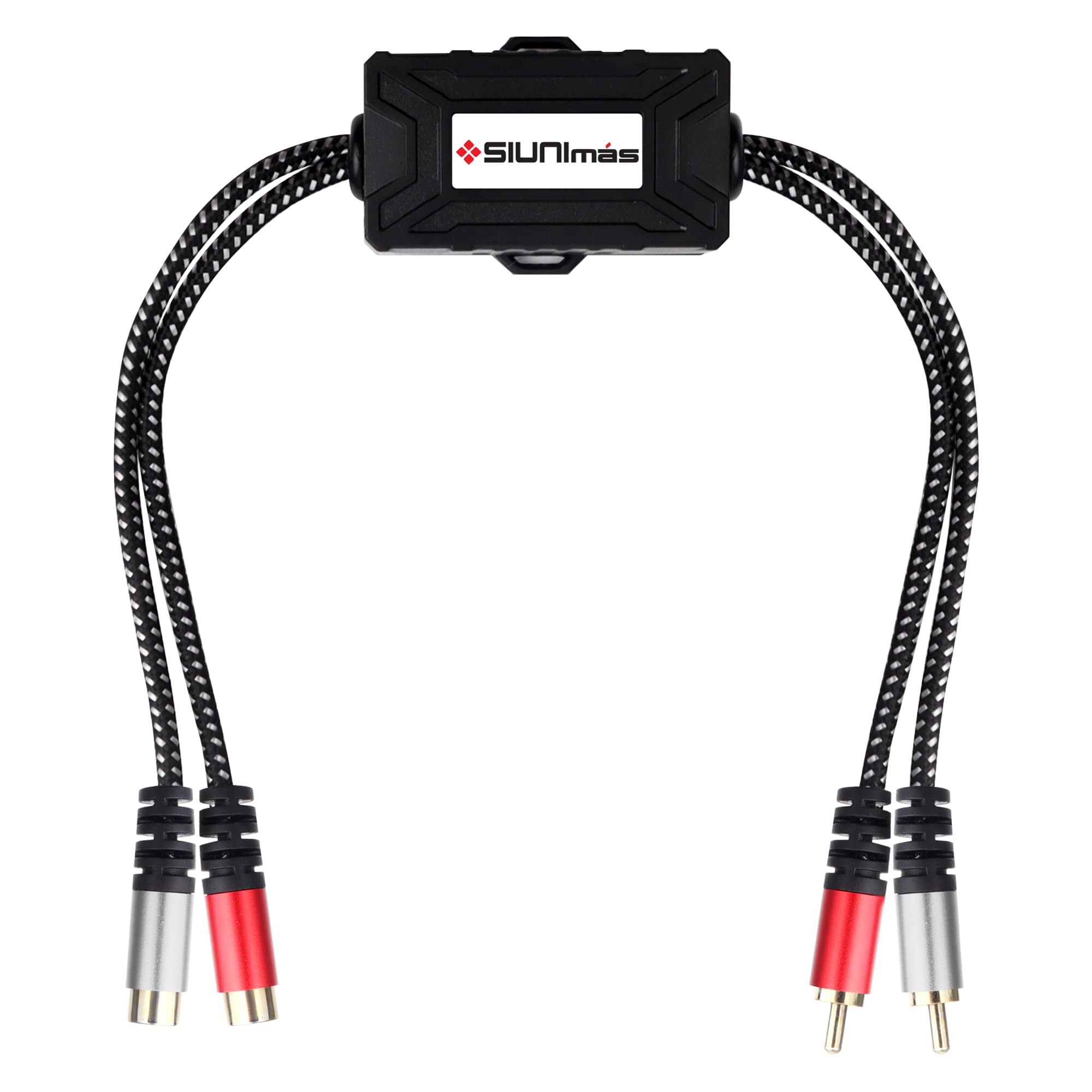
A two-channel RCA isolator with braided cords that tames TV-to-speaker and DJ controller screech.
The SIUNIMAS Pro is a two-channel RCA ground loop isolator wrapped in a durable ABS fireproof shell, with built-in nylon braided female-to-male cables that measure a handy 7.1 inches end to end. That hotswap design means you just plug it between your audio source and your receiver—no tools, no power, no complicated wiring. It’s built for home stereo, amplifiers, equalizers, and even DJ controllers, which makes it a flexible fix for the most common consumer hum scenarios.
Shoppers say it eliminated 95% of a screeching sound from a Pioneer FLX4 DJ controller caused by a laptop charger ground loop. It also halved the nagging hum between a TV and a powered 2.1 Sony speaker system that nothing else could touch. At just 2.24 ounces, it dangles inline without stressing cables, and the flat shape slips behind a media console easily.
The build quality is what owners praise most, with functionality and noise cancellation getting more mixed-but-hopeful feedback—some say it worked better than expected, others report it made things worse. The practical read: it’s a solid, well-made budget-priced isolator that solves classic RCA hum, but if your noise comes from a faulty component rather than a ground loop, no filter will fully save you.
home stereo: home theater and DJ setups where a TV, console, or controller hums over RCA connections.
pro racks: you’re working in a fully professional balanced-XLR studio, where this consumer RCA tool isn’t the right fit.
7. WisWinDa RCA Noise Filter Hum Eliminator (No Affect Bass)

An RCA filter that cancels subwoofer hum while swearing—and delivering—on keeping your bass intact.
The WisWinDa is marketed squarely at the “no affect bass” crowd, and its reviews back that up: subwoofer buyers report it stops the hum with no effect on sub performance. It uses a quality isolation transformer inside an ABS fireproof shell, with a plug-and-play RCA design that needs no tools. It’s built for both car and home stereo systems, working with amplifiers, speakers, mixers, or any RCA-equipped source.
The most striking praise comes from an owner with dual subwoofers—a Class AB and a Class D (two different amplifier topologies)—who said this filter fixed the ground loop and PC noise instantly, with attenuation (signal loss) so negligible it was easily offset by a gain tweak. One buyer credits it with “rescuing” an audio system worth thousands, eliminating an alternator-sound interference with an amp. The single-channel design handles one signal path cleanly, so it’s a precise tool for a specific hum.
Build quality and value for money are the two aspects owners praise most, with sound quality close behind. The honest caution: noise control gets the most mentions but is mixed, so a few buyers found it disabled their subwoofer entirely or needed to watch for swapped channels on the wiring. It’s a great fit for home audio and subwoofer duty, but car amp installs are where opinions split.
bass-heavy tunes: subwoofers and hi-fi home systems where you refuse to lose bass depth in exchange for silence.
full-range audio: car amplifier installs, where the mixed owner reports suggest it’s better suited to home audio than automotive power.
8. PYLE-PRO Compact Mini Hum Eliminator Box (PHE300)

A two-channel TRS workhorse that wipes GPU and USB hum from PC-to-studio-monitor runs.
The PYLE-PRO PHE300 is a two-channel passive ground loop isolator with 1/4-inch TRS inputs and outputs, designed to eliminate the 60Hz AC hum that ground loops create by acting like a loop antenna. It automatically converts unbalanced signals to balanced without signal loss, which is exactly why it’s a favorite for cleaning up computer-to-monitor audio chains. Because it’s passive, it needs no power supply—just drop it inline and the hum is gone.
Its defining win, per owners, is eliminating all GPU/USB-induced ground loop hum from a PC to studio monitors, something they’d tried many other fixes to solve without success. It also completely killed a loud hum between a computer and BOSE speakers, working as advertised. The compact footprint—just 2.36 x 4.09 x 1.38 inches—makes it nearly half the size of a typical DI box, and its 2-channel design handles a stereo pair in one unit.
Functionality is what owners praise most, by a wide margin, but the unit’s main weakness is its “hit or miss but excellent when it’s a hit” character—some units arrive with loose jacks, and the jacks may not fit large cables side-by-side. Placement in the signal path is critical, and complex systems may need multiple units. When it works, it’s a complete fix; the consistency is the only real question.
pedalboards: desktop studio users chasing GPU, USB, or EFI electrical noise bleeding into their monitors over 1/4-inch TRS cables.
passive setups: your pedals or hardware use tightly packed jacks—the dual TRS inputs sit close together and may not fit bulky cables side by side.
9. DS18 NF1 Car Audio Noise Filter RCA Ground Loop Isolator
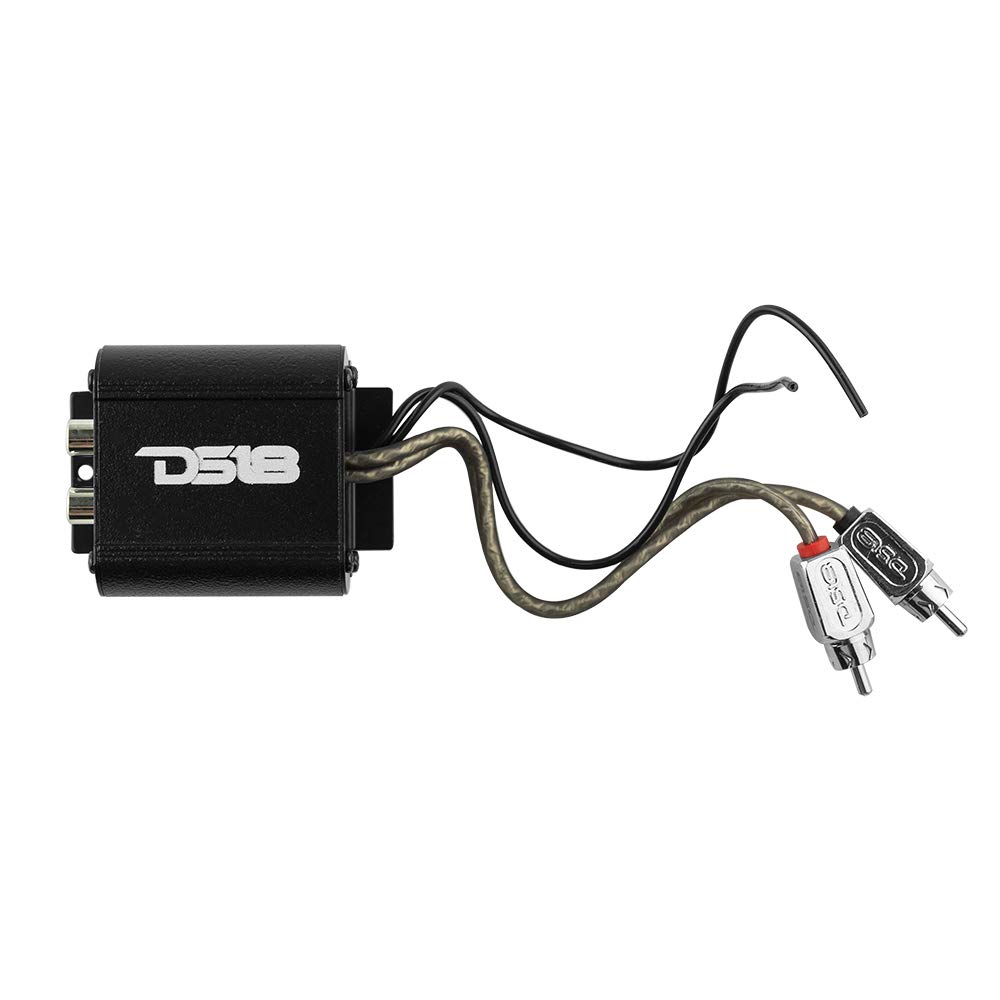
A compact RCA inline filter for car systems that knocks down alternator whine without touching your bass.
The DS18 NF1 is a car-audio-focused inline RCA filter that targets alternator whine, static, buzzing, and hissing caused by ground loops and RCA interference. It’s a plug-and-play unit with female RCA input and male RCA output, so you drop it between your head unit and amplifier with no power wiring required. Its advanced audio transformer technology isolates and filters noise while preserving signal integrity across a full 20Hz–20kHz range.
Owners mention it cut ground wire whine by 75-80%, enough to make systems listenable again, especially when installed near the equalizer rather than the amp. It works with amplifiers, subwoofers, head units, and other RCA-based devices, making it a universal budget pick for aftermarket car audio. The full-range response means it won’t rob your subwoofer of deep bass while it silences the whine, which is the core promise here.
The honest split in owner feedback: it genuinely works for many, but a professional sound engineer called it out for diminishing sound resolution and removing some desired audio, recommending fixing the install instead. This is a budget-tier, get-you-by fix—excellent for quieting a nagging whine, but not a transparent studio-grade tool. For the price, it’s a reasonable first step before you reroute your ground wires.
vehicle installs: a cheap first-line fix to confirm a car audio ground loop before you invest time in rewiring or rerouting grounds.
home systems: you’re chasing clean signal on pro studio monitors, where its slight resolution loss is more noticeable than in a moving car.
Understanding the Specs
Ground Lift Switch
A ground lift switch is a small toggle that physically disconnects the ground connection between your gear’s input and output, which breaks the circuit loop that causes hum. When your instrument or mixer picks up a low rumble, flipping this switch often kills it instantly—it’s the most direct fix for ground loop problems. It’s a feature you’ll find on instrument DI boxes like the Donner, not on consumer RCA filters.
Balanced vs Unbalanced Signal
A balanced signal uses three wires—positive, negative, and ground—to carry audio, which cancels out electrical noise picked up along the cable. An unbalanced signal uses just two wires and is more prone to hum, which is why long runs to mixers prefer balanced XLR or TRS. Filters like the PYLE-PRO automatically convert unbalanced to balanced, which is how they silence hum without losing signal strength.
FAQ
Will a ground loop isolator fix alternator whine in my car audio?
How do I know if I need a mono or stereo ground loop filter?
Can I use an RCA ground loop isolator with XLR studio gear?
Do audio noise filters need power to work?
Will a noise filter reduce my bass or degrade sound quality?
Where should I place the ground loop isolator in my signal chain?
Why does hum come back or not go away even with a filter?
How many ground loop isolators do I need for a full stereo system?
Can I use a 3.5mm ground loop isolator with a subwoofer or DJ controller?
Why does a ground loop isolator sometimes make noise worse?
Final Thoughts: The Verdict
For the majority of shoppers, the audio noise filter winner is the Donner Special-Ⅰ DI-Box because its ground lift switch and passive transformer give musicians a road-ready, plug-and-play hum fix while staying affordable. If you want something to scatter around the house for phones, laptops, and consoles, grab the BESIGN 5-Pack. And for subwoofer and hi-fi purists who refuse to lose bass, the Blue Jeans Cable Isolator is the one to reach for.
How We Picked
We do not accept paid placement. Every pick is matched to a real buyer and a real use-case; we do not hands-on test units.
Sources & Methodology
Specifications: manufacturer listings and product documentation. Review insights: verified customer reviews, as of August 2026. Pricing: not shown on this page (it changes often); check the current price via the retailer link.
As an Amazon Associate, Gadgets Feed earns from qualifying purchases. This does not affect which products we feature.