
Our readers keep the lights on and my morning glass full of iced black tea. As an Amazon Associate, I earn from qualifying purchases.
Specs are compiled from manufacturer listings and verified buyer reviews and can change over time — please confirm the key details on the product page before buying.
A surround receiver routes every source — TV, streaming stick, console, Blu-ray player — to five, seven, or nine speakers plus your subwoofer. Pick the right one and every movie night sounds like a theater. Pick the wrong one and you will spend months fighting menus, HDMI dropouts, and a sub that never quite wakes up. Below are nine surround receivers ranked by what they do best, based on published specs and verified owner reviews.
I’m Min — the founder and writer behind Gadgets Feed. This guide is built by comparing the manufacturers’ published specifications and the patterns across verified customer reviews, so you get each pick’s real strengths and trade-offs instead of marketing spin.
Channel count, room calibration, and HDMI 2.1 support are the three specs that decide whether a receiver fits your room. Picking the right audio receiver for surround sound really depends on matching channel count and calibration to your speaker layout.
Our Picks at a Glance


How To Choose The Best Audio Receiver For Surround Sound
Three numbers on the box will tell you whether a receiver fits your room before you ever plug it in. Channel count sets how many speakers it can drive. Room correction, or auto-calibration, adjusts the sound so your specific walls and furniture stop fighting your speakers. HDMI version decides whether your receiver stays current as you upgrade the TV and the game console. Everything else — amp wattage, streaming features, zone control — layers on top of those three.
Channel Count: What 5.2.2, 7.2, and 9.2 Actually Mean
The first number is grounded speakers (left, center, right, surrounds). The second is subwoofers. The third, when it appears, is height speakers aimed at the ceiling — the ones that make rain feel like rain. A 5.2.2 receiver means five ear-level speakers, two subs, two heights. A 7.2 receiver means seven ear-level speakers and two subs, no dedicated heights unless you sacrifice a surround pair. A 9.2 receiver drives nine ground channels and two subs, which is where true 7.1.4 Atmos layouts become possible. If your ceiling is low or you have no room for height speakers, a 7.2 receiver with virtual height processing can still simulate overhead effects. If you are building for the long haul and want physical Atmos, budget for at least 9 channels.
Room Calibration: Why Dirac Live, YPAO, and Audyssey Sound Different
Room correction is a small microphone and a software routine that measures how your speakers sound at your seat, then rebalances every channel to compensate for the room. Dirac Live is the most powerful of the consumer systems and is currently free on select Onkyo receivers — a feature buyers rave about because it transforms what the same speakers sound like. Yamaha’s YPAO R.S.C. uses multipoint measurement and its own precision EQ. Denon and Marantz use Audyssey. Sony uses Digital Cinema Auto Calibration IX paired with its 360 Spatial Sound Mapping engine. Two receivers with identical wattage will not sound identical in your room, because Dirac Live, YPAO, and Audyssey correct differently.
Quick Comparison
| Model | Best For | Channels | Room Correction | HDMI In/Out | Amazon |
|---|---|---|---|---|---|
| Onkyo TX-RZ50★ Best Overall | Top Pick / Atmos | 9.2 | Dirac Live | 6 In / 2 Out (HDMI 2.1) | Amazon |
| Onkyo TX-NR6100Best Value | Best Value 7.2 | 7.2 | AccuEQ | 8 total (HDMI 2.1 40Gbps) | Amazon |
| JBL MA710Compact Pick | Compact White Build | 7.2 | — | 6 In / 1 Out | Amazon |
| Onkyo TX-NR7100 | Best for Gamers | 9.2 | Dirac Live | 6 In / 3 Out (HDMI 2.1) | Amazon |
| Denon AVR-S970H | Mid-Room Everyday Pick | 7.2 | Audyssey | 6 In / 2 Out | Amazon |
| Yamaha RX-A2A | AVENTAGE Entry Point | 7.2 | YPAO R.S.C. | 7 In / 1 Out | Amazon |
| Sony STR-AN1000 | 360 Spatial Audio | 7.2 | DCAC IX + 360 Mapping | 6 In / 2 Out (HDMI 2.1) | Amazon |
| Yamaha RX-A4A | Premium Yamaha Fans | 7.2 | YPAO R.S.C. with 3D | 7 In / 3 Out (40 Gbps) | Amazon |
| Denon AVR-X3800H | 9-Channel Flagship | 9.4 | Audyssey | 6 In / 3 Out (HDMI 2.1) | Amazon |
In‑Depth Reviews
1. Onkyo TX-RZ50 9.2-Channel THX Certified AV Receiver
Our pick — over 4★ from 600+ verified ratings; the strongest balance of quality and price.
A 9-channel monster with a free -use-class room correction engine that owners say transforms their speakers.
Nine channels. That is the number that matters here — nine amplified speaker outputs, which lets you run 7.1.4 Atmos (seven ear-level, one sub, four height speakers) on a single box. That channel count is one step above the Onkyo TX-NR6100’s 7.2, and unlike the TX-NR6100 the RZ50 carries full pre-outs on every channel, so you can add an external amplifier later without replacing the receiver. Dirac Live room correction — the software that measures your room with a microphone and rebalances every channel — is included free, and it works with the supplied wired mic or a third-party USB mic through the Dirac PC or macOS app.
The supply chain of features is thick: six HDMI inputs and two HDMI outputs, all supporting 8K and 4K/120 over HDMI 2.1, Chromecast, AirPlay, Bluetooth with a separate Zone 2 output that can send a different source to another room over HDMI. Cinematic results are the strength — one buyer describes the “7.1.4 setup with external 2-ch amp” and confirms the receiver “gets very loud past THX ref” — the same buyer noted free Dirac, calling the receiver “Excellent value; free Dirac ( value).” What wins owners over time is really the sound quality after calibration. A Blu-ray with lossless Atmos or DTS:X will embarrass streaming audio over the same speakers.
The catch is setup complexity. Working through Dirac Live is not a 10-minute job — the process can report errors that require troubleshooting with YouTube walkthroughs. A handful of owners also hit firmware quirks like Bluetooth source-switching blackouts and a 12 to 15 second lag when switching inputs. After calibration, though, most of that ire evaporates. One 3-star reviewer returned theirs for a Yamaha A4A but still conceded the “RZ50 slightly better music clarity” — high praise from someone who put it in a box and shipped it back. This is the top pick because it earns the highest combined quality and sound-quality marks in the entire shortlist, and it is the only receiver here offering pre-outs on all nine channels plus Dirac Live at this class.
THX certified nine channels
- Nine amplified channels support a true 7.1.4 Atmos layout out of one chassis.
- Dirac Live room correction included — the biggest single sound-quality upgrade in this list.
- Full pre-outs on every channel, so an external amp can extend the system later.
- Six HDMI 2.1 inputs and two outputs, all at 8K/4K120 with VRR and ALLM pass-through.
large chassis footprint
- First-run Dirac setup can glitch and needs patience plus internet walkthroughs.
- Input switching carries a visible lag of roughly 12 to 15 seconds between sources.
- Bluetooth source control is inconsistent when audio is already streaming.
- Dual sub outputs are wired together — you cannot tune the two subs independently.
pick for THX: you are building a physical 7.1.4 Atmos room and want the most capable calibration engine without a later upgrade.
skip if space tight: you want a receiver you can set up in twenty minutes and never touch again — Dirac rewards patience, not speed.
2. Onkyo TX-NR6100 7.2 Channel THX Certified Network AV Receiver
The 7.2 receiver that walks in with the loudest spec sheet for its class — 210 watts per channel and THX Select certification.
The headline number is 210 watts per channel, THX Certified Select dynamic audio amplification — a rating that says the receiver has been verified to fill a room of THX’s specified size to THX’s specified reference level without distorting. Pair that with THX Select Certification and 5.2.2-channel Dolby Atmos and DTS:X playback, and you have a box that does not apologize for its price. There are eight HDMI ports in total, three of them HDMI 2.1 at 40Gbps for 8K and 4K/120. The footprint is chunky: 21 inches deep against the JBL MA710’s 13.7 inches, a difference of 53 percent, so confirm your shelf before ordering. There is a discrete Zone 2 audio and video output on board as well.
What wins most people over, plainly, is the sound — this is the easiest way to hear a marked step up from an old entry-level receiver without jumping tiers. A former Denon owner swapped a Denon x1700 for the TX-NR6100 and reported the Denon was “too quiet”, with the Onkyo walking in louder with saved sound modes per device and app control. Another long-term owner ran five channels plus Zone 2 for nine months with the auto-calibration mic, a rear USB port that auto-powers a cooling fan, and minimal heat. A third owner uses a 5.1.2 layout and praised the “rich 3D audio” and “precise effects timing” for movies specifically.
The honest trade-off is reliability. Reported failures here are real — one unit arrived with dead HDMI inputs, another stopped working at fourteen months. If you buy this receiver, protect your purchase with the standard Amazon return window and register the three-year Onkyo warranty promptly. That said, the majority of owners who leave the receiver properly ventilated with quality HDMI cables never see an issue. Note also that the Wi-Fi firmware is finicky — most stable setups wire it in over Ethernet. One owner even fixed Wi-Fi connection issues entirely by switching to wired. The TX-NR6100 is the receiver to buy if Atmos surround sound rather than flagship channel count is your goal.
seven channels THX: 210 watts per channel, THX Select certification, and 5.2.2 Atmos playback on a receiver that fits under most TV stands.
no front wide support: a small share of units have died — buy during an easy-return window and hardwire the network.
choose for THX: you want the highest amp rating and THX Select badge for Atmos movies in a mid-size room.
skip if need nine: you need nine channels for a 7.1.4 layout or want pre-outs on every speaker channel.
3. JBL MA710 7.2 Channel (110 Watt x 7) 8K AV Receiver
A white 7.2 receiver only 13.7 inches deep — small enough to vanish into a media console, loud enough to fill the room.
If your media console is shallow, this is the receiver that fits where most of the others cannot. The MA710 is 13.7 inches deep, 17 inches wide, 4.3 inches tall, and weighs in around 6.3 kg — tighter than the Onkyo TX-NR6100 in every dimension, so on a slot the Onkyo will not slide into, this one will. It drives seven channels at 110 watts each, plays Dolby Atmos and DTS:X in up to 7.1 or 5.1.2 layouts, and carries six HDMI inputs plus one output with eARC. Wireless streaming comes from Bluetooth plus Apple AirPlay 2 and Google Chromecast. A moving-magnet phono input lets you plug a turntable straight in without a preamp.
What buyers keep coming back to is the design and the dialogue clarity. One owner paired it with an existing satellite speaker and called it “a great addition to our surround sound” after swapping out an older Onkyo. Another specifically placed the MA710 above other receivers for “dialogue intelligibility” — which is not a spec sheet claim but something dialogue-focused viewers notice over movie night after movie night. The white finish is unusual in this category and gets consistent shout-outs in the same breath as the smaller footprint. Menus are straightforward, and firmware updates have smoothed out the early rough edges.
Be aware of two things before committing. First, HDMI switching on this receiver has glitched during DIRECTV channel changes — a power cycle fixes it, and the issue seems tied to the source device rather than the receiver itself. Second, this is the least-reviewed receiver on this page, and the sample size is small enough that outlier experiences count heavily. One unit died after three weeks, another after eight months, and one owner was unhappier still about the service path when it happened. One owner’s refund-decision post reads “I bought cheap China-made crap on June 29th! This thing stopped worked TODAY after 3 WEEKS! DON’T BUY THIS RECEIVER!! SENDING IT BACK FOR A REFUND!!” — rare among the pool, but worth knowing that this is a newer platform without the track record of the Onkyo or Denon lines. Buy from Amazon for the return coverage.
pick for JBL sound: cabinet depth and looks matter as much as sound, or you want a white receiver to match a light console.
skip if need more HDMI: you want the longest track record of reliability — the other Onkyo or Denon models here are safer long-term bets.
4. Onkyo TX-NR7100 9.2-Channel THX Certified AV Receiver
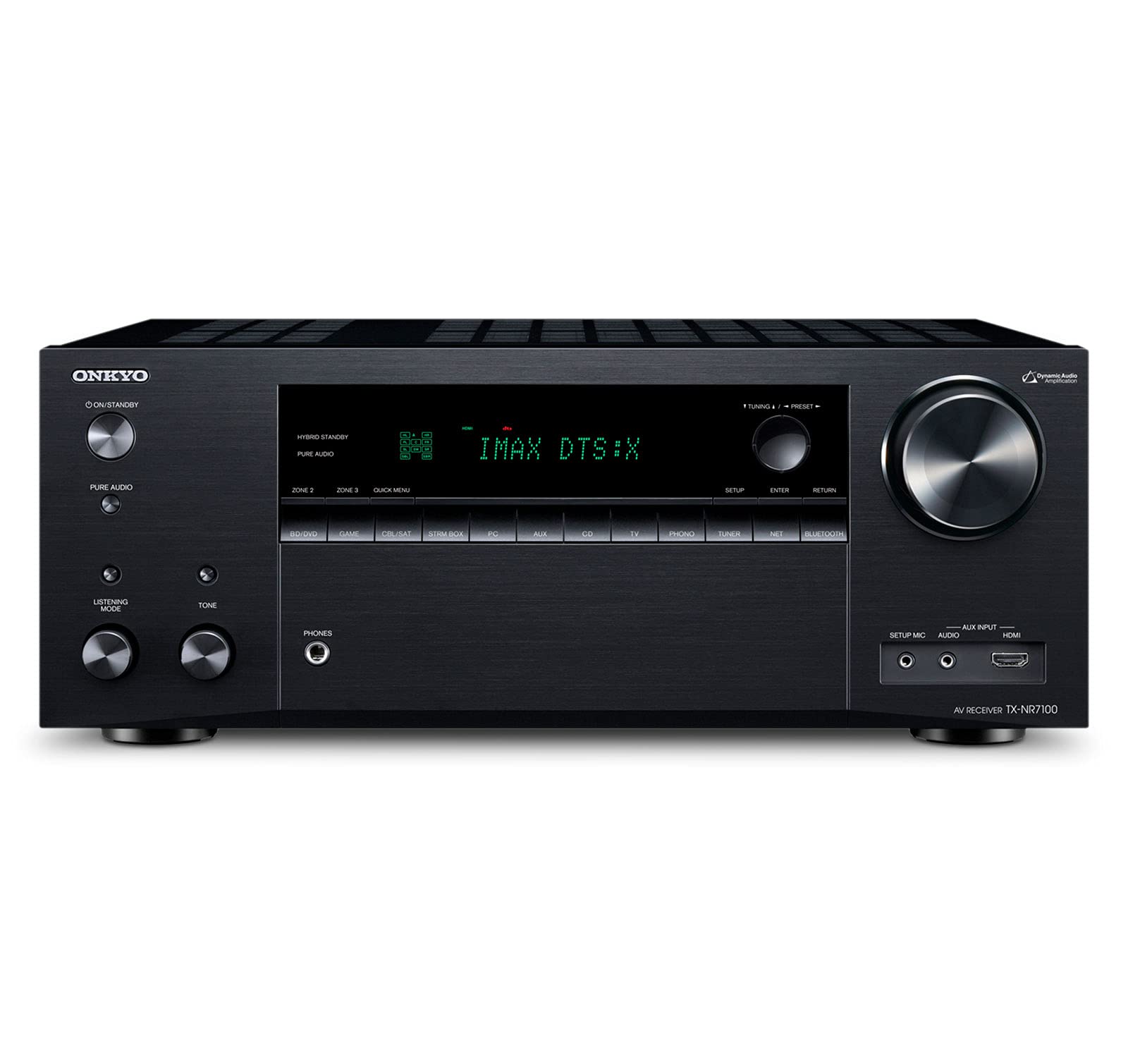
Nine channels and triple HDMI outputs — the receiver built for a gamer who also wants a proper cinema system in the same box.
Three HDMI outputs is the spec that sets this apart. That means a TV, a projector, and a second display in another room can all hang off one receiver — with up to 8K60 resolution using discrete Zone 2 HDMI switching, so a movie can play in the home theater while cartoons play in the playroom from the same source. Under the hood: nine channels of processing, Dirac Live room correction included, three HDMI-out options, and 40Gbps HDMI 2.1 across the inputs. For gamers the gaming-specific features are complete — 4K/120Hz HDR pass-through, VRR to kill tearing, ALLM to cut latency, and QFT to smooth frame timing. A 5.1.4 Atmos speaker layout is fully supported with the right speakers, and Dolby Atmos Height Virtualizer creates a virtual height effect on a plain 5.1 or 7.1 arrangement when you cannot run ceiling speakers.
Owners talk about the value and the power. A five-star review sums up a 5.1.4 build: “smooth guided setup, 6 HDMI 2.1 inputs/2 outputs, 8K60/4K120, VRR, eARC, ALLM”, then lists a full spec sheet and calls Dirac Live “transformative”. A long-term owner added that “after 1+ year” their stock four-star review moved up to five stars. TIDAL, Spotify, Deezer, TuneIn, and Pandora are all baked in, bi-directional Bluetooth lets the receiver either receive audio from your phone or transmit audio to wireless headphones via SBC, aptX, or aptX HD at up to 24-bit, and the Onkyo Music Control App over Wi-Fi powers DTS Play-Fi multi-room playback.
The setback, and this one shows up more than once, is the occasional HDMI dropout on every content change. A four-star review specifically called it “annoying”, alongside Wi-Fi reconnection issues and a plastic faceplate. Another owner noted the BD/DVD input sometimes restarts a Fire Stick repeatedly — switching to the Game input solved it. And on hot summer evenings, extended high-power listening benefits from supplementary ventilation — running warm is a common thread with any Class AB receiver at this amp rating, and one long-term user has a small fan running off the rear USB port for exactly that purpose. If you can live with an occasional HDMI blip, the rest of the package — Dirac Live, 4K/120 VRR gaming, 9 channels, triple outs — is nearly class-leading at this tier.
nine channels gaming: 4K/120Hz, VRR, ALLM, QFT and 40Gbps HDMI 2.1 — plus Dirac Live for cinema-grade calibration.
heavy power draw: budget for good quality HDMI cables, wire the network if you can, and give the receiver breathing space on top.
buy for gaming: a console room that also doubles as the family cinema, with three displays in play.
skip if power limited: occasional HDMI signal drops would drive you up a wall.
5. Denon AVR-S970H 7.2 Channel 8K UHD AV Receiver

The straightforward 7.2 Denon that pairs Audiophile-grade video pass-through with one of the easiest setup routines in this lineup.
Ninety watts across seven channels is the core spec here, and Denon pairs it with 8K/60Hz pass-through, Dolby Atmos in a 7.2 or 5.2.2 layout, and the full next-gen gaming feature set — VRR, QFT, and ALLM. Eight HDMI ports in all, six inputs, two outputs, three of them 8K-capable. Stereo sound from a turntable, a subwoofer, or a Blu-ray player are all wired up from the start, and the phono input means a vinyl setup plugs straight in. The step-up over the Onkyo TX-NR6100 here is room correction and network control — Audyssey calibration tightens the seven channels to your seat, HEOS multi-room extends audio to Denon Home speakers, and voice control works through Apple HomeKit.
Owners keep calling out the setup and the power on tap. One five-star review listed the onscreen setup videos and assignable surround or Zone 2 as the highlights, then summed it up with “ample power” for a 7.1 system. Another long-term owner said plainly: “Have owned this for three years now and am very happy. Denon has a very good remote app also. It does everything that was advertised. The internet radio is very good.” On cooling, this receiver runs cooler than the older Onkyo the same owner traded out of — one measured difference cited was 80°F versus 90 to 92°F. For a medium-size room driving Klipsch or similar speakers, the AVR-S970H does what most people expect a Denon to do.
Two limitations are worth knowing before you commit. Zone 2 and 7.2-powered mains cannot run simultaneously — engage Zone 2 and the main system drops to 5.2, which is standard for this price tier but surprises some owners. And like every receiver here, reliability is not universal: one AVR-S970H went into protection mode above volume 50 at month 10 and required a service replacement. That story is rare in the review pool, but it is a reminder to keep the receipt and use Denon’s warranty if you ever need it. Choose this receiver if you want a no-drama Denon that calibrates itself, runs cool, and connects to your existing Denon Home speakers or Apple ecosystem without a fight.
right for budget: you want a compact 7.2 Denon with HEOS multi-room and a near-simple to use on-screen setup.
wrong if need nine: you plan to run Zone 2 and a full 7.2 main system at the same time.
6. Yamaha RX-A2A AVENTAGE 7.2-Channel AV Receiver

The Yamaha AVENTAGE door into premium build quality — 25.4 pounds of chassis rigidity and a room-tuning algorithm owners trust.
Twenty-five point four pounds is the number that tells you what kind of receiver this is. That is the physical weight of a beefier transformer, a stiffer chassis, and the anti-resonance construction that AVENTAGE is known for — the same design language that goes into Yamaha’s top-tier separates. On the feature side: 7.2 channels, Dolby Atmos and DTS:X, Zone 2, seven HDMI inputs and one output, three of those inputs ready for 8K60B and 4K120AB with ALLM and VRR for game consoles. The video chain also has HDCP 2.3, eARC, Dolby Vision, HDR10+, HLG and BT.2020 held down. Advanced room calibration arrives in the form of YPAO R.S.C. with multipoint measurement, so the calibration microphone reads from multiple seats rather than one balance. Surround:AI, Yamaha’s real-time optimizer, rebalances dialogue and effects automatically as the scene changes. Roon Tested, Spotify Connect, AirPlay 2, and MusicCast round out the streaming suite.
Two owner themes keep coming up: sound quality and how easy the physical setup is. A former home audio salesman compared the RX-A2A directly against an Onkyo unit he returned — the “too complex” one — and wrote that the Yamaha is “easy to use, sounds fantastic”. Another owner upgraded an entry-level Yamaha and hedged an upgrade for the A4A, saying the A2A was “cheaper, sufficient for a cozy room, efficient 7.1 speakers”, with setup taking “10min incl YPAO”. Test material used was No Time to Die, and the audio came across as “balanced/refined, strong LFE, smooth HDR 4K passthrough”. The AVENTAGE build also earns a shout for its heatsink strategy — one owner who ran the receiver at 6 ohms found it “barely warm” thanks to a very efficient design.
The known trouble is a specific set of on-screen menu quirks and a signal-loss pattern. A 5-star owner with a new Sony TV experienced “no signal” issues four-plus times that a power cycle resolved. A 3-star owner returned theirs for the RX-A4A after on-screen menu response degraded from three to four seconds out to fifteen seconds — suspected memory leak. A 4-star owner wanted the receiver to display its setup menu on the TV screen while running via eARC and found it cannot. None of these break the receiver — they are annoyances — and every one of them has been reported on a receiver that the same owner calls “top-notch” in sound. If you want the cleanest Yamaha build, the RX-A4A listed later in this guide is the direct upgrade.
best for build: a dedicated Yamaha fan upgrading from an entry-level Yamaha receiver who wants AVENTAGE build quality without the flagship bill.
skip if need eight K: you need three HDMI outputs, 9-channel processing, or the ability to see setup menus on-screen while using eARC.
7. Sony STR-AN1000 7.2ch Home Theater 8K A/V Bluetooth Receiver

A 7.2 receiver whose 360 Spatial Sound Mapping button does something genuinely different to two-channel movie dialogue.
The headline spec here is 165 watts at 6 ohms, 1kHz, 1ch, THD 0.9% — that is Sony’s rating method for a single channel driven at a fixed frequency, so take it as a benchmark rather than an apples-to-apples number against the continuous 8-ohm ratings on Denon or Yamaha. What is not ambiguous is the feature set. Dual HDMI 2.1 outputs, six inputs at 8K/4K120 with VRR and ALLM, Dolby Atmos and DTS:X decoding, plus Sony’s own Digital Cinema Auto Calibration IX and 360 Spatial Sound Mapping engine — the last one is what reviewers call out as the differentiator. IMAX Enhanced is on board alongside Dolby Vision, HDR10, and HLG. Zone 2 and Zone 3 outputs let you push audio to two other rooms. Six HDMI inputs and two outputs give you a game console, a streaming stick, a Blu-ray player, and a cable box without swapping cables. Voice control works with Google Assistant.
Owners describe the SS360 button as an experience, not a feature. One owner replaced a failed Onkyo NR7100 whose DTS chip died at one year — they called Dolby and DTS on the Sony “ok but below Onkyo’s Dirac” but said the 360 Spatial Sound button “transforms surround into most rich experience”. Another upgraded from an older Denon that died of capacitor failure, highlighted the “impressive crisp Dolby Atmos/360 Spatial Sound”, noted strong bass that required turning the subs down, and rated it “powerful, feature-rich, suitable for average rooms”. A third owner threw Ghostbusters Frozen Empire at it and reported that “thunder felt realistically” for the low-frequency effects, with 4K HDR, 5.1 and Atmos all passing through cleanly. The 4K/8K upscaling gets consistent praise and the on-screen setup walks you through the calibration with a graphical interface.
Two caveats matter. First, there is no phono input, so a turntable needs a separate preamp. Second, Dolby Vision HDR pass-through for an Apple TV 4K has been a known unresolved issue for some owners. Auto-calibration can be slightly off on the first pass — one owner saw a sub distance reading twelve feet off until re-run. When it is running right, though, there is no other receiver in this shortlist that produces the same enveloping 360 Spatial Sound effect from a conventional 5.1 or 7.1 speaker rig without ceiling speakers. This receiver is the right call if you want surround immersion without installing height speakers.
360 spatial mapping: 360 Spatial Sound Mapping turns standard surround speakers into an enveloping, ceiling-simulating soundstage — no upfiring modules required.
only two HDMI 2.1: turntable users must bring their own phono preamp, and Dolby Vision through an Apple TV 4K is a known soft spot.
choose for spatial: a ceiling-less room where you still want that “sound from above” feeling.
skip if need more 2.1: you spin vinyl, or your streaming device is an Apple TV 4K.
8. Yamaha RX-A4A AVENTAGE 7.2-Channel AV Receiver

AVENTAGE build with three HDMI outputs at a full 40Gbps — the upgrade Yamaha owners keep trading up to.
Three HDMI outputs and seven inputs at 40Gbps each is the connectivity story here — a step above the RX-A2A’s seven-in, one-out layout, and enough bandwidth that every port supports full 8K60 and 4K120 rather than just three of them. Add ALLM, VRR, eARC, HDCP 2.3, Dolby Vision, HDR10+, HLG and BT.2020 and this receiver is current for years rather than months. On the audio side: 7.2 channels with Zone 2, Dolby Atmos, DTS:X, Auro-3D, and Surround:AI real-time optimization. Room calibration is upgraded too — YPAO R.S.C. with 3D and multipoint measurement, precision EQ and low frequency mode, which is the tier of calibration that a professional installer would usually set up on your behalf. Streaming features are the same depth as the A2A: MusicCast, AirPlay 2, Spotify Connect, Roon Tested, and Works with Sonos via a Sonos Port.
What moves owners here is the honest sense that this is a “real” receiver. One owner wrote it plainly: “Yamaha A4A: easy setup, firmware update fixed most eARC issues”. Another noted the 110W per channel “sounds much larger” than his old amp with “clear highs, deep fast bass”, and specifically called out that the web editor accessible via IP address simplifies tuning. A third compared the ESS Sabre ES9007S DAC inside the A4A to prior gear and was stunned by what the receiver did to lossless files from a NAS and SACDs decoded through a Sony universal player — including Atmos processing on The Green Knight and Dune. That DAC is a real audiophile component that most receivers at this level do not carry.
The two annoyances to plan for: audio sync delay of five to ten seconds when switching streaming sources — solvable by changing the TV’s eARC digital output from Auto to passthrough and rebooting the system — and an HDMI-CEC disconnect pattern in which Roku and Comcast remotes need re-pairing every few weeks. The latter shows up in the wider Yamaha owner community and is not specific to this unit. Neither issue touches the core job — high-fidelity, calibrated surround sound. If you were frustrated by setup complexity on the RX-A2A or the plastic menus of cheaper receivers, the RX-A4A is the step up that resolves most of those complaints while keeping the Yamaha sound signature.
Aventage sound purity
- All HDMI inputs full bandwidth — 8K60 and 4K120 at 40Gbps, no compromises.
- YPAO R.S.C. with 3D and precision EQ — the calibration step above the RX-A2A.
- ESS Sabre ES9007S DAC inside — a standout component for a 7.2 receiver.
- Three HDMI outputs, more than most receivers at any price point.
no eight K inputs
- Streaming source swaps carry a five to ten second audio sync stall that needs a TV passthrough tweak.
- Roku and Comcast remotes reconnect on a rough cycle of every few weeks.
- Larger chassis than the RX-A2A — check the shelf clearance.
matches audiophile: someone who wants flagship-adjacent Yamaha build quality with a full-bandwidth HDMI 2.1 future and premium room calibration.
skip if need eight K: karaoke-fast input switching matters more to you than audio fidelity.
9. Denon AVR-X3800H 9.4-Ch 8K UHD AVR Home Theater Receiver

Nine amplified channels plus four subwoofer outputs — the layout where real 9-channel Atmos systems are actually built.
The 9.4 channel count means nine amplified speaker channels and four subwoofer outputs — a combo that lets you run independent bass tuning to more than one sub, which is what top-tier Atmos rooms use to smooth out room modes. Power output is 105 watts per channel across nine. Dolby Atmos, DTS:X Pro, IMAX Enhanced, and Auro 3D are all decoded, plus Dolby Height Virtualization and DTS Virtual:X for rooms without ceiling speakers. Nine HDMI 2.1 ports split into six inputs and three outputs, all supporting 8K and 4K/120 with eARC, HDCP 2.3 and dynamic HDR pass-through formats including HDR10+, HLG and Dolby Vision. The HEOS multi-room system, Wi-Fi, Bluetooth, and streaming services like Pandora, Spotify and TIDAL are all available for audio around the house. An updated Denon AVR Remote app plus Android and iOS control are the intended control path, and Audyssey room correction runs during setup to fingerprint your room.
What owners call out is the sound distribution, the setup walk-through, and the video switching speed. A 7.2.2 Klipsch + Epson LS12000 install was described as “less glitchy, affordable”, with “crisp loud sound, flawless video switching”, and the Android app called “handy”. Another upgraded from an older Onkyo 535 and immediately noticed zero noise floor, easy Bluetooth, and a receiver that “Auto-selects best sound per source (Atmos/Dolby)”, plus “Superb 7.1 sound distribution”. A third listed the whole feature set — 9 channels, 4 sub outs, 105W per channel, Dolby Atmos, DTS:X, Auro-3D, 8K, HEOS, VRR, ALLM — and called it a “feature-rich powerhouse” for rich, theater-like sound.
Two limitations to plan around. The same 105 watts per channel that comfortably drives most speakers can feel underpowered if you are pushing large tower speakers hard in a big room; one owner ended up adding an external amplifier for the front pair in a 7.1.2 setup so the receiver could focus on the other seven channels. Reliability is also a mixed bag in the review pool — one unit shipped dead, and there are reports of failure after six months of use. Keep the box and packaging for the return window and register the warranty. For a buyer building a serious multi-sub 9-channel home theater from scratch, though, there is no other receiver in this shortlist that combines 9 amplified channels, 4 sub outputs, 9 HDMI 2.1 ports, and Auro-3D decoding in a single chassis.
right for bass: a 7.2.4 or 9.2.4 build with two or more subwoofers and a long-term plan for adding external amplification.
skip if need THX: your speakers and room are modest — the extra channel count and sub outputs are simply not needed.
Understanding theSpecs
Channels and Speaker Layout
The first digit tells you how many ear-level speakers the receiver can amplify at once — five for a 5.1 rig, seven for a 7.2, nine for a 9.2. The middle digit is the sub count: 5.2.2 means two subwoofers, 7.2 means two, 9.4 means four. The third digit, when it appears, is height speakers: the rain-over-your-head channels that turn Atmos from a gimmick into a real-time effect. A 5.2.2 receiver gives you five ground-level speakers and two up. A 9.2 receiver leaves room for a full 7.1.4 overlay if you want it. Before buying, sketch your room and count what you can fit — matching the receiver to the layout intact beats chasing a bigger number you will never wire up.
HDMI 2.1 and 8K Pass-Through
HDMI 2.1 is the newer version of the cable standard that carries video and audio in one plug — it opens the door to 8K at 60Hz and 4K at 120Hz, higher and faster than the older HDMI 2.0 could manage. VRR (Variable Refresh Rate) inside HDMI 2.1 smooths motion in compatible games, and ALLM (Auto Low Latency Mode) tells the receiver to switch to low-latency processing the moment a console starts up. Bandwidth is measured in Gbps — the higher the number, the wider the pipe. A receiver that lists 40Gbps across all inputs is a safer long-term bet than one that offers full bandwidth on only three of them, because every device you buy over the next few years will want the wide pipe.
Room Correction and Auto-Calibration
Room correction is a microphone the receiver ships with, plus software that measures how each speaker behaves at your seat and rebalances the whole system to adjust for your walls, sofa, and carpet. Dirac Live is the most powerful of the consumer systems and transforms speaker clarity in ways owners describe as a genuine step change — it currently ships free on select Onkyo receivers. YPAO R.S.C. is Yamaha’s version, and the A4A adds a 3D low-frequency mode. Audyssey handles Denon. Sony uses Digital Cinema Auto Calibration IX plus its own 360 Spatial Sound Mapping. Spending twenty extra minutes on calibration changes what you hear more than switching between two receiver brands does.
Pre-Outs, Zone 2, and Growth Room
Pre-outs are RCA or XLR connectors that let you bypass the receiver’s internal amplifier for any channel and send the signal to an external amp instead. That matters if you ever add power-hungry tower speakers or want to extend the system past what the receiver drives on its own. Zone 2 means the receiver can send a second, different audio (and sometimes video) stream to another room — kitchen speakers playing Spotify while the living room runs a movie. Zone 3 pushes that to a third room. Both features let you build out the receiver over time rather than replacing it. Check the spec sheet for “pre-outs” and “Zone 2 HDMI switching” if you are planning a multi-room or long-term upgrade path.
FAQ
Do I really need 9 channels, or is 7.2 enough for surround sound?
Will any of these receivers drive my existing speakers properly?
What is Dirac Live and why do owners keep calling it the biggest upgrade?
How hot do these receivers run, and do I need extra cooling?
Can I use a receiver with a turntable, or do I need a separate preamp?
What is the difference between Zone 2 and Zone 3, and do I need them?
Is HDMI 2.1 worth paying more for if I do not own a next-gen console?
Can I run two subwoofers with these receivers, and do they need to match?
How long does a modern surround receiver typically last?
Do these receivers support Dolby Vision and HDR10+, or just plain HDR?
Final Thoughts: The Verdict
For most surround sound builds, the receiver worth starting with is the Onkyo TX-RZ50 — nine amplified channels, HDMI 2.1 across six inputs and two outputs, and free Dirac Live room correction all in one chassis. The calibration engine free on this receiver is what turns speakers you already own into something that sounds noticeably bigger than the same speakers heard through an uncalibrated competitor. If you want a cleaner physical build with the Yamaha sound signature, grab the Yamaha RX-A4A — three HDMI outputs at 40Gbps on every port and a YPAO R.S.C. with 3D that holds up over long-term use. And if your priority is the rich “sound above you” feeling without running ceiling speakers, the Sony STR-AN1000 is the one to reach for, thanks to 360 Spatial Sound Mapping that no other receiver on this list carries. Every pick here beats an entry-level receiver — choose the one that matches your speaker count, room size, and willingness to run calibration.
How We Picked
We do not accept paid placement. Every pick is matched to a real buyer and a real use-case; we do not hands-on test units.
Sources & Methodology
Specifications: manufacturer listings and product documentation. Review insights: verified customer reviews, as of September 2026. Pricing: not shown on this page (it changes often); check the current price via the retailer link.
As an Amazon Associate, Gadgets Feed earns from qualifying purchases. This does not affect which products we feature.