
Our readers keep the lights on and my morning glass full of iced black tea. As an Amazon Associate, I earn from qualifying purchases.
Specs are compiled from manufacturer listings and verified buyer reviews and can change over time — please confirm the key details on the product page before buying.
Your TV’s built-in speakers are the weakest link in your entire home theater — they flatten explosions, mumble dialogue, and lose every bit of spatial detail the director mixed in. A dedicated audio receiver fixes that by decoding the surround formats your TV can’t handle and sending clean, powerful sound to your separate speakers. This guide cuts through the jargon to help you pick the right receiver for your TV, your room, and your speakers.
I’m Min — the founder and writer behind Gadgets Feed. This guide is built by comparing the manufacturers’ published specifications and the patterns across verified customer reviews, so you get each pick’s real strengths and trade-offs instead of marketing spin.
audio receiver for tv buyers face a wall of specs like eARC, Dolby Atmos, and per-channel wattage — this guide breaks down exactly which features matter for your setup.
Our Picks at a Glance


How To Choose The Best Audio Receiver For TV
Before you compare models, map out your physical setup and your sources. The right receiver depends on how many speakers you plan to run, which devices plug into it, and whether you’ll stream or stick to discs and cable.
Count your channels first
A 5.1 receiver powers five speakers and one subwoofer — perfect for most living rooms. A 7.2 receiver adds two more surround or height channels and a second sub, which opens up layouts like 5.2.2 that include ceiling speakers for Dolby Atmos. Buy the channel count that matches the speakers you can actually place in the room.
Check your TV’s audio return channel
If you watch most content through smart TV apps, you need a receiver with eARC (Enhanced Audio Return Channel) on its HDMI output. That one cable sends high-bitrate audio from your TV back down to the receiver, so apps like Netflix can deliver Dolby Atmos without any extra optical cable.
Match wattage to your speakers and room
Per-channel wattage tells you how much clean power the receiver can send each speaker. More watts gives you headroom for dynamic movie peaks, and it matters most with less-efficient speakers or larger rooms. For typical bookshelf and tower speakers in a medium room, a receiver rated around 80W to 100W per channel is usually plenty.
Quick Comparison
| Model | Best For | Channels | Power / Channel | Video Passthrough | Amazon |
|---|---|---|---|---|---|
| Denon AVR-X1700H★ Best Overall | Best Overall | 7.2 | 80W | 8K / 4K120 | Amazon |
| JBL MA310Best Value | Best Value | 5.2 | 60W | 4K | Amazon |
| Onkyo TX-NR5100Gaming Pick | Gaming | 7.2 | — | 8K / 4K120 | Amazon |
| JBL MA510 | 8K Simplicity | 5.2 | 75W | 8K | Amazon |
| Yamaha RX-V6A | Music + Movies | 7.2 | — | 8K / 4K120 | Amazon |
| Onkyo TX-NR6100 | THX Certified | 7.2 | 100W | 8K | Amazon |
| Denon AVR-S970H | Power + Features | 7.2 | 90W | 8K | Amazon |
| Sony STR-AN1000 | Room Calibration | 7.2 | 165W @ 6 ohms | 8K / 4K120 | Amazon |
| Yamaha RX-A4A | Premium Build | 7.2 | — | 8K / 4K120 | Amazon |
In‑Depth Reviews
1. Denon AVR-X1700H
Our pick — over 4★ from 650+ verified ratings; the strongest balance of quality and price.
The 7.2-channel all-rounder that makes a mid-size movie room feel like a commercial theater — 80W per channel.
The strongest case for this receiver is how it handles modern movie formats. You get Dolby Atmos, DTS:X, and even Dolby Atmos Height Virtualization, which fakes height effects when you don’t have ceiling speakers — so you feel sound coming from above without drilling into your ceiling. It also carries 3 dedicated 8K inputs and 1 output with 8K/60Hz and 4K/120Hz pass-through, plus 8K upscaling on all 6 HDMI inputs, future-proofing your video chain for years.
Setup is where owners say this Denon shines — the on-screen Quick Setup Guide walks you through connecting your TV, setting EQ, and optimizing surround sound, with color-coded back-panel connections that make organizing simple. The crowd favorite at well over 600 ratings, the thing everyone raves about is the build quality and the sound, with a 7.1.2 setup in a medium room described as giving a theater-like experience. Buyers report it plainly: “Replaced 12-yr-old Sony; pricey but worth it.”
Where it gets more complicated is connectivity. Owners mention some Bluetooth hiccups and note the auto-calibration mic can be finicky — several say they got better results manually adjusting their speakers. Still, at 80W per channel across 7.2 channels, plus phono input for a turntable and 2 pre-outs for subwoofers, it’s the most complete mid-range package here.
Why owners upgrade to this
- The 7.2 channel count leaves room to grow from 5.1 to a full Atmos layout later
- 3 dedicated 8K HDMI inputs handle the newest TVs and consoles
- HEOS multi-room streaming lets you play music in another zone while a movie runs in the living room
- Built-in phono input means your turntable plugs straight in
Where it gets real
- Bluetooth connectivity gets mixed owner reports — wired Ethernet is the more reliable path
- Auto-calibration is hit-or-miss; many owners end up adjusting speakers manually
- Owners note the setup takes time even though the guide is clear
Reach for this if: you want a 7.2-channel receiver that does Atmos now and leaves room to add two height speakers later without upgrading.
Look elsewhere if: you only need a simple 5.1 setup for a small room — a lower-channel model saves you money and complexity.
2. JBL MA310
The budget 5.2-channel receiver that reminds you a good-looking amp doesn’t have to be a boring black box.
If you want surround sound without paying for channels you’ll never use, this 5.2-channel JBL delivers 60W across 5 channels with native 5-channel decoding of Dolby and DTS formats. It has 4 HDMI inputs and 1 output with ARC, so a soundbar-free setup connecting your cable box, console, and streaming stick is straightforward. Bluetooth v5.1 with Low Energy handles wireless music streaming from your phone.
What wins owners over is the appearance — it’s genuinely not a boring black box, and the sound through a set of tower speakers and a sub is described as amazing for the money. The crowd favorite detail here: setup happens on your TV screen rather than the receiver display, which owners say is the key to getting it right.
The honest catch is the sound signature. Some owners find it really bad while others call it amazing — it’s genuinely mixed, so this is very much a “matches your speakers and ears” proposition. At 5.2 channels, you also give up the two extra channels a 7.2 Denon offers, so it’s best suited to a compact 5.1 room.
Fit first: the 5.2 channel count and 60W per channel suit a small-to-medium living room with five speakers, not a dedicated Atmos theater. Appearance and value are the two things owners praise most here — think of it as the smart-money pick for a first surround setup.
Pick this up if: you want four HDMI inputs, native Dolby/DTS decoding, and Bluetooth streaming at an entry-level outlay for a 5.1 room.
Step up if: you’re building toward a 7-channel Atmos layout — the Denon X1700H gives you that headroom and cleaner Bluetooth.
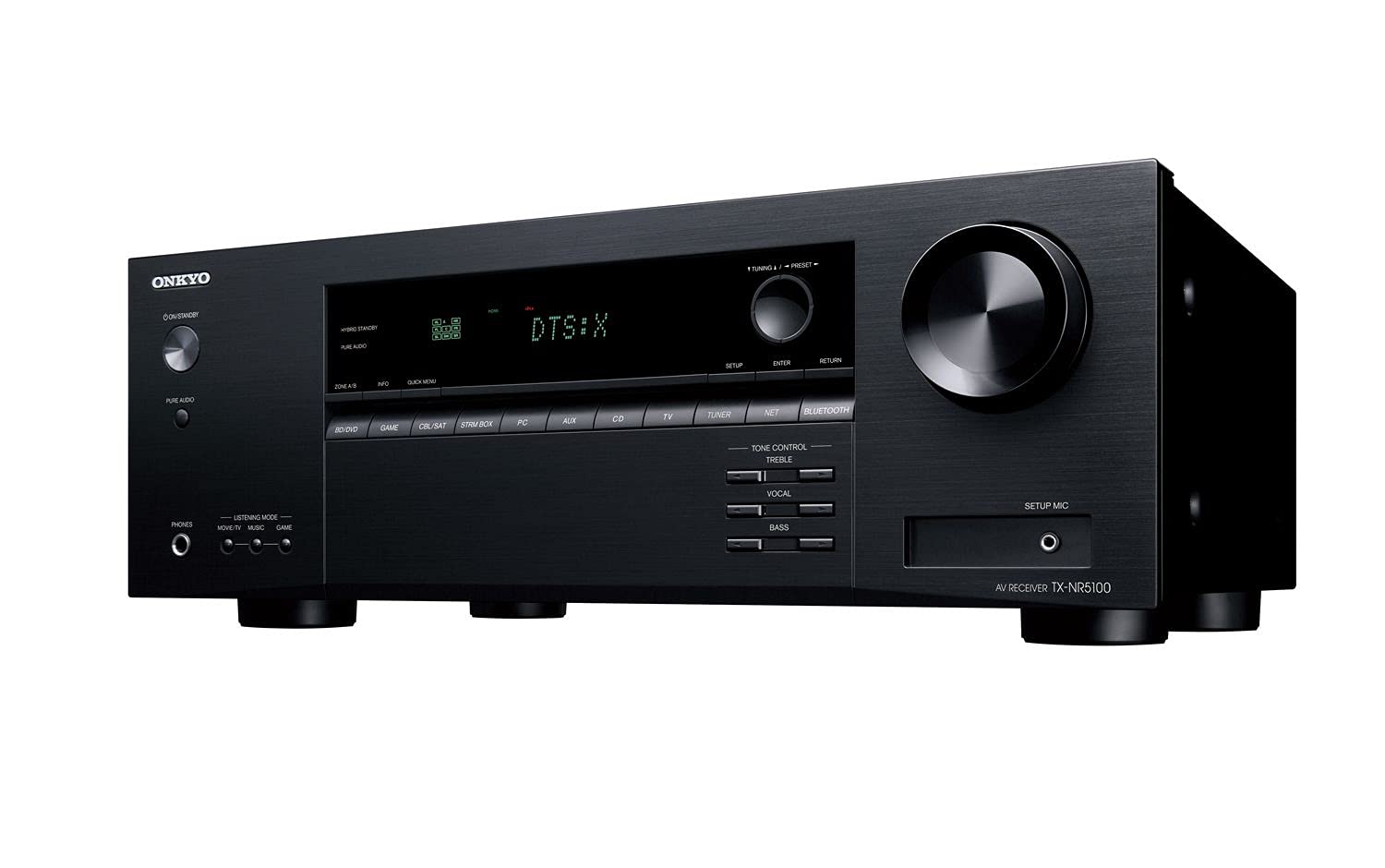
3. Onkyo TX-NR5100
A 7.2-channel receiver built around HDMI 2.1 gaming features — 4K/120Hz pass-through, VRR, ALLM, and QFT.
Gamers get a smoother, lag-free experience with this Onkyo. It passes through 4K/120Hz HDR (high dynamic range) for ultra-fast motion, and supports VRR (Variable Refresh Rate) to stop stutter and frame-tearing, ALLM (Auto Low Latency Mode) to cut input delay, and QFT (Quick Frame Transport) for faster data transfer. The eARC (Enhanced Audio Return Channel) hookup lets your TV send high-bitrate audio like Dolby Atmos, DTS: X, and Dolby TrueHD to the receiver with one cable.
Customers note it’s easy to set up with good quality sound — “Great receiver with good quality sound and easy install.” The larger display, simpler remote, and built-in stereo menu get specific praise. Setup wins people over here more than anything else.
But there are real caveats. The reliability and sound quality both get mixed owner feedback, with Bluetooth connectivity being a recurring weak spot — some report no connection to Bluetooth devices at all. One owner also flagged that the unit is advertised as a 7.2 but is actually a true 7.1 receiver. The power output also draws negative mentions, so pair it with efficient speakers. It’s also compact for a 7.2, measuring 12.9″D x 17.13″W x 6.3″H.
Made for consoles: pick this over the Denon X1700H if HDMI 2.1 gaming features matter more to you than the Denon’s extra streaming muscle — but know the Denon holds a cleaner reliability record in owner reports.
Choose this if: you’re a PlayStation 5 or Xbox Series X owner who wants VRR and 4K/120Hz pass-through without stepping up to the premium tier.
Think twice if: you rely heavily on Bluetooth headphones or wireless streaming — that’s where reviewers point out the most frustration.
4. JBL MA510

The 5.2-channel receiver that brings 8K video and a class-D amp to a minimalist front panel.
This is the JBL for someone who wants a genuinely simple, good-looking box that still handles the latest video. It’s a 5.2-channel receiver pushing 75W per channel with 8K video support, 4 HDMI inputs and 1 output with eARC, and native 5-channel Dolby and DTS decoding. The class-D amp and minimalist front panel are the details buyers specifically call out as what drove their decision.
Beyond HDMI, it streams wirelessly via Bluetooth, Apple AirPlay 2, and Google Chromecast network streaming — a broader wireless set than the MA310. Setup gets the most praise here, and owners say it sounds good once it’s dialed in. The one setup quirk repeated in owner reports: the receiver goes unresponsive when it connects to Wi-Fi and runs a firmware update, but it’s been flawless since that initial update.
The trade-offs: at 5.2 channels, you’re capped at a 5-speaker layout with no room for height channels, and sound quality feedback is more modest than the praise setup receives. It’s a mid-range pick that prioritizes clean video and tidy design over maximum channel count.
Owners say it best: “8K HDMI passthrough, on screen easy set up, class D amp, and a minimalist front panel are all distinctions that drove my decision.” That’s the whole pitch in one line.
Grab this if: you want 8K readiness and a clean, minimal amp without paying for a 7-channel receiver you won’t use.
Consider the Denon instead if: you’re set on a 7.2 Atmos layout — the X1700H gives you two more channels and a more proven calibration system.
5. Yamaha RX-V6A

The 7-channel multi-room hub that pairs 8K HDMI 2.1 with MusicCast streaming to every room.
If your goal is equal parts movies and music, this Yamaha is the most balanced pick. It’s a 7.2-channel receiver with 7 HDMI inputs and 1 output supporting 8K60 and 4K120 with HDCP 2.3 and eARC, plus Dolby Atmos, Dolby Atmos Height Virtualization, and DTS: X. The richness is in the streaming: Wi-Fi, Bluetooth, AirPlay 2, Spotify Connect, and MusicCast multi-room put a huge music library at your fingertips with voice control via Alexa, Google Assistant, or Siri.
The 4K video upscaling gets called out as excellent, and owners say it powers even 4-ohm speakers well. The deep feature set — Pandora, Spotify, Napster, SiriusXM, TIDAL, Deezer, Qobuz, and Amazon Music HD — is what wins owners over alongside the sound quality. At 4.5 kg, it’s one of the lighter full-featured receivers here, which helps with shelf placement.
Honest downsides: there’s no physical manual (online only), setup is genuinely complicated, and it won’t auto-power-on via TV eARC like Denon and Onkyo units do — you’ll manually power it on to switch sound away from TV speakers. Reliability gets mixed owner feedback too.
The streaming powerhouse
- MusicCast sends audio to other Yamaha speakers around the house
- 7 HDMI inputs cover a full rack of sources
- Voice control through Alexa, Google Assistant, or Siri via AirPlay 2
- Dual subwoofer outputs for deeper bass
The learning curve
- No printed manual — everything is online
- Setup is involved; one owner called it “an exercise in irritation” despite great sound
- Doesn’t wake from TV eARC automatically
Choose this if: music streaming across rooms matters as much as movie sound — the MusicCast ecosystem is the whole point.
Pick the Denon X1700H if: you want the easiest TV-first setup and don’t need multi-room music.
6. Onkyo TX-NR6100
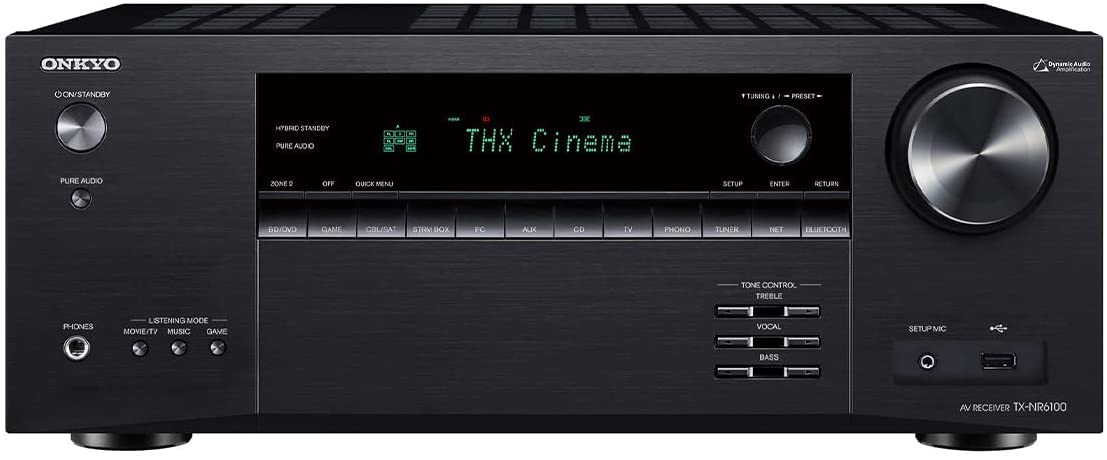
The THX Select-certified 7.2 receiver that hits 100W per channel and 8K HDMI 2.1 at 40Gbps.
The headline spec here is the THX Select Certification — a rating that means the receiver meets strict performance standards for a medium-sized home theater room. Under the hood, you get 210W per channel Dynamic Audio Amplification, 5.2.2-channel Dolby Atmos and DTS: X playback, and 8K with HDMI 2.1 at 40Gbps across 3 inputs. For a dedicated home theater, this is the most certification-heavy pick on the list.
Shoppers say it’s louder than the Denon X1700H when driving a Klipsch 5.1 setup, and the AccuEQ room calibration is called accurate. It also includes a discrete Zone 2 audio and video output, 8 HDMI ports, per-device sound modes, and a genuinely useful app. Owners repeatedly describe it as excellent value with fast input switching and 100W per channel of clean power.
The catch: sound quality feedback is mixed — some call it superb while others report it drops randomly, and Bluetooth connectivity works for some but fails to join wireless networks for others. A small number of buyers report reliability concerns, so it’s worth buying from a retailer with a solid return policy.
Built for immersion: owners say it handles Dolby Atmos and DTS: X with precise, rich height effects and great timing on action scenes — the best pure movie experience in this lineup.
Reach for it if: you want THX certification and 100W per channel to drive a full 5.2.2 Atmos theater without jumping to the top price tier.
Weigh the risk if: wireless reliability is a dealbreaker for you — Bluetooth and Wi-Fi get distinctly mixed owner reviews here.
7. Denon AVR-S970H

A 90W-per-channel 7.2 Denon built for gaming and vintage turntables, with 8 HDMI ports.
This Denon steps up the power and connectivity over the X1700H. It delivers 90W across 7 channels with 8K/60Hz pass-through, plus next-gen gaming support including VRR, QFT, and ALLM for reduced frame tearing and lag. The 8 HDMI ports (6 in / 2 out) include 3 dedicated 8K inputs, and there’s a phono input for a turntable plus USB and analog/digital inputs. It’s built to fill a medium room with a 7.2 or 5.2.2 setup.
Owners praise the performance and the user interface — the onscreen menus are easy to understand, and the setup is straightforward with a user-friendly remote. It runs cooler than some rivals, which one owner confirmed after upgrading from an older receiver. The eARC connection with a TV remote gets a simple thumbs-up: “The arc connection makes it easy to control with just the tv remote!”
The honest trade-off is wrangling the zone system: you get 7.2 or a powered Zone 2, but not both — running Zone 2 caps you at 5.2 max. And while 90W per channel is solid, a few owners find it underpowered relative to the advertised rating for very large rooms. Reliability draws some mixed feedback too, so check the warranty.
The complete Denon package
- 90W per channel across 7 channels fills a medium room with authority
- 8 HDMI ports (6 in / 2 out) handle every source plus a second display
- Phono input brings a vintage turntable into a modern system
- HEOS multi-room streaming works with Denon Home speakers
The fine print
- Zone 2 and 7.2 can’t run at the same time — it’s one or the other
- A few owners find the wattage underwhelming for very large rooms
- No tape deck connections for legacy recording gear
Pick this if: you want more power than the X1700H plus 8 HDMI ports and a phono stage — the most future-proof Denon here for a growing setup.
skip it if: you’ll never use a second zone — the X1700H gives you nearly everything at a friendlier price.
8. Sony STR-AN1000

The 7.2 Sony that uses 360 Spatial Sound Mapping to create phantom speakers out of thin air.
If you want a premium receiver with the smartest room calibration on the market, this Sony is it. The STR-AN1000 is a 7.2-channel receiver rated at 165W (6 ohms, 1 kHz, 1ch THD 0.9%) with 8K and 4K/120 HDMI connectivity via HDMI 2.1 (6-in / 2-out). It decodes Dolby Atmos and DTS: X, and its Digital Cinema Auto Calibration IX with 360 Spatial Sound Mapping is the standout feature — it maps your room and creates phantom speakers, so the surround image feels fuller than your actual speaker count.
Owners praise sound quality most here — crisp precision with incredible picture and sound performance. One owner called it “a high end audio experience you can’t go wrong with.” It also plays nicely with Sonos systems, streams via Bluetooth, Wi-Fi, Chromecast built-in, Spotify Connect, and Apple AirPlay, and includes Zone 2 and Zone 3 for multi-zone distribution. At 240W power consumption, it’s energy-conscious for the output it provides.
The setup experience is genuinely split — some find it easy, others struggle with the user interface. There’s no phono input, and the calibration mic can misread subwoofer distance. Owners also note the lack of Dolby Vision passthrough for Apple TV 4K as a known quirk. Still, for a receiver that makes a 7.1 channel sound amazing with high-mounted speakers, this is a premium step up.
Owners call it a winner: “The 7.1 channel sound is amazing with my Polk high speakers.” If you want a receiver that sounds bigger than its channel count, this is the one.
Choose this if: you want top-tier room calibration and 360 Spatial Sound Mapping to improve a modest speaker setup.
Look elsewhere if: you need a phono input or flawless Apple TV 4K Dolby Vision passthrough — those are real gaps here.
9. Yamaha RX-A4A AVENTAGE

The AVENTAGE flagship where premium build meets Surround:AI’s real-time sound optimization — 7.2 channels with a phono input.
This is Yamaha’s top-tier AVENTAGE line, and the difference is in the details. It’s a 7.2-channel receiver with Zone 2, Dolby Atmos and DTS: X, and Auro-3D support. The HDMI section is exemplary: 7-in / 3-out with HDCP 2.3 and eARC, with all HDMI inputs supporting 8K60 and 4K120 at 40Gbps, plus ALLM and VRR for gaming. what separates it is Surround:AI technology, which automatically tune sound and effects in real time — owners say it makes the room “seem so much bigger.”
The build quality is the story here. At 18.6 kg, this is a heavy, sturdy unit, and it includes a phono input for turntables, pre-outs for external amplifiers, and a digital FM tuner — rare for modern receivers. Room calibration (YPAO R.S.C. with 3D, multipoint measurement, precision EQ, and low frequency mode) gets praise for accurate sound. Owners describe it as outstanding for both movies and music, with the multi-channel sound fields emulating different rooms.
The known friction points: the setup is “brutal” per one owner — it requires a USB flash drive for firmware updates and has many screens to configure. The front panel display is also hard to read, drawing consistent mixed feedback. It weighs a lot and takes 17.38″D x 17.13″W x 7.5″H of shelf space, so measure your cabinet before buying.
The AVENTAGE advantage
- Surround:AI auto-tunes sound for each scene in real time
- 7-in / 3-out HDMI with 8K60 and 4K120 on every input
- Phono input plus pre-outs for external power amps
- Auro-3D support beyond the usual Atmos / DTS: X
What owners warn about
- Setup is genuinely tedious — firmware updates need a USB drive
- The front panel display is hard to read in low light
- At 18.6 kg and over 17 inches deep, it needs serious shelf space
Reach for this if: you want the best build and most automated sound tuning in this list, and you’re happy to spend an afternoon on setup.
Choose the Sony if: you’d rather have easier calibration and the phantom-speaker 360 Spatial Sound Mapping instead.
Understanding the Specs
Channel Count (5.1 vs 7.2)
The first number is how many speakers the receiver powers, and the second is the subwoofer count. A 7.2 receiver runs seven speakers and two subs, which lets you add height channels for Dolby Atmos. Buy the count that matches the speakers you can physically place in your room — unused channels are wasted money.
HDMI eARC and 2.1
eARC (Enhanced Audio Return Channel) sends high-bitrate audio from your TV back to the receiver over a single HDMI cable — essential if you watch through smart TV apps. HDMI 2.1 enables 8K60 and 4K120 pass-through plus gaming features like VRR and ALLM. Check that your TV and cables support the same standard or you’ll silently lose features.
FAQ
Do I need a receiver if I only watch TV apps?
What is the difference between 5.1 and 7.2 channels?
Will an 8K receiver work with my older 4K TV?
How many watts per channel do I really need?
Does every receiver support Dolby Atmos?
What is the difference between ARC and eARC?
Will a receiver work with my TV remote?
Can I connect a turntable to these receivers?
Final Thoughts: The Verdict
For most buyers, the audio receiver for tv winner is the Denon AVR-X1700H because it balances 7.2 channels, Dolby Atmos Height Virtualization, and 8K inputs with the most positive owner feedback in the list. If you’re a gamer who wants VRR and 4K/120Hz pass-through, grab the Onkyo TX-NR5100. And for a premium room-calibration experience that makes modest speakers sound huge, the Sony STR-AN1000 is the one to reach for.
How We Picked
We do not accept paid placement. Every pick is matched to a real buyer and a real use-case; we do not hands-on test units.
Sources & Methodology
Specifications: manufacturer listings and product documentation. Review insights: verified customer reviews, as of August 2026. Pricing: not shown on this page (it changes often); check the current price via the retailer link.
As an Amazon Associate, Gadgets Feed earns from qualifying purchases. This does not affect which products we feature.