
Choosing a receiver that sits between entry-level features and premium separates is a decision that defines your entire home audio system. The wrong pick leaves you hunting for missing inputs or wrestling with a complicated interface years before you planned to upgrade.
I’m Min — the co-founder and writer behind Gadgets Feed. I’ve spent dozens of hours analyzing the technical specifications, user feedback, and real-world performance data on the current crop of mid-range and premium home theater and stereo receivers available today.
Whether you need immersive surround sound for a dedicated theater room or high-resolution stereo for critical music listening, this guide breaks down the top contenders to help you find the very best audio receiver under 1000 for your specific needs and space.
How To Choose The Best Audio Receiver Under 1000
A receiver in this price range must deliver a compelling balance of power, connectivity, and room correction. Prioritizing features before you start shopping will save you from a costly return process.
Channel Count and Immersive Audio Support
7.2-channel receivers are the standard for a serious 5.1.2 Dolby Atmos setup, allowing two height channels for overhead effects. Some units offer 9 channels for 7.1.2, but at this tier, the extra amplifier channels often require using more speakers than most rooms can handle without significant acoustic treatment.
HDMI 2.1 and Gaming Features
For anyone connecting a PlayStation 5, Xbox Series X, or a PC with a high-end graphics card, HDMI 2.1 ports with 4K/120Hz and 8K/60Hz pass-through are essential. Look for Variable Refresh Rate (VRR) and Auto Low Latency Mode (ALLM) on the spec sheet to guarantee smooth, tear-free gameplay.
Room Correction and Calibration
Room correction software like Dirac Live, Audyssey MultEQ, and Yamaha YPAO R.S.C. analyzes your speaker placement and room acoustics to flatten frequency response. Dirac Live is increasingly considered the gold standard for its precision, but the included microphone and software version (full-band vs. limited) vary between models.
Streaming and Multi-Room Capabilities
Built-in Wi-Fi, Bluetooth with aptX HD, AirPlay 2, and Chromecast are standard on modern receivers. A unit that integrates with the MusicCast, HEOS, or DTS Play-Fi ecosystem allows synchronized playback across multiple rooms using wireless speakers.
Quick Comparison
On smaller screens, swipe sideways to see the full table.
| Model | Category | Best For | Key Spec | Amazon |
|---|---|---|---|---|
| Onkyo TX-NR7100 | Premium AVR | Room Correction Perfection | Dirac Live / 9.2ch 100W | Amazon |
| Denon AVR-S970H | Premium AVR | Balanced All-Rounder | HEOS / 90W x 7 | Amazon |
| Yamaha RX-A2A | Premium AVR | Build Quality & Stability | Surround:AI / 7.2ch | Amazon |
| Sony STR-AN1000 | Premium AVR | Sony Ecosystem & 360 Audio | 360 Spatial Sound / 7.2ch | Amazon |
| Denon AVR-S770H | Mid-Range AVR | Reliable Entry to Dolby Atmos | HEOS / 75W x 7 | Amazon |
| Yamaha RX-V6A | Mid-Range AVR | Feature-Rich Versatility | MusicCast / 7.2ch | Amazon |
| Onkyo TX-NR6100 | Mid-Range AVR | THX & Gaming Performance | THX Select / 7.2ch | Amazon |
| Cambridge Audio AXR100 | Premium Stereo | Pure Stereo Music | 100W / Sub Out / Phono | Amazon |
| JBL MA710 | Mid-Range AVR | Slim Design & Latest Codecs | 7.2ch / 8K / Phono | Amazon |
| Yamaha R-N600A | Mid-Range Stereo | Network Stereo Hub | ESS Sabre DAC / 80W | Amazon |
| Pioneer VSX-935 | Budget-Friendly AVR | Entry-Level Surround | HDMI 2.1 / 7.2ch | Amazon |
In‑Depth Reviews
1. Onkyo TX-NR7100 9.2-Channel AV Receiver
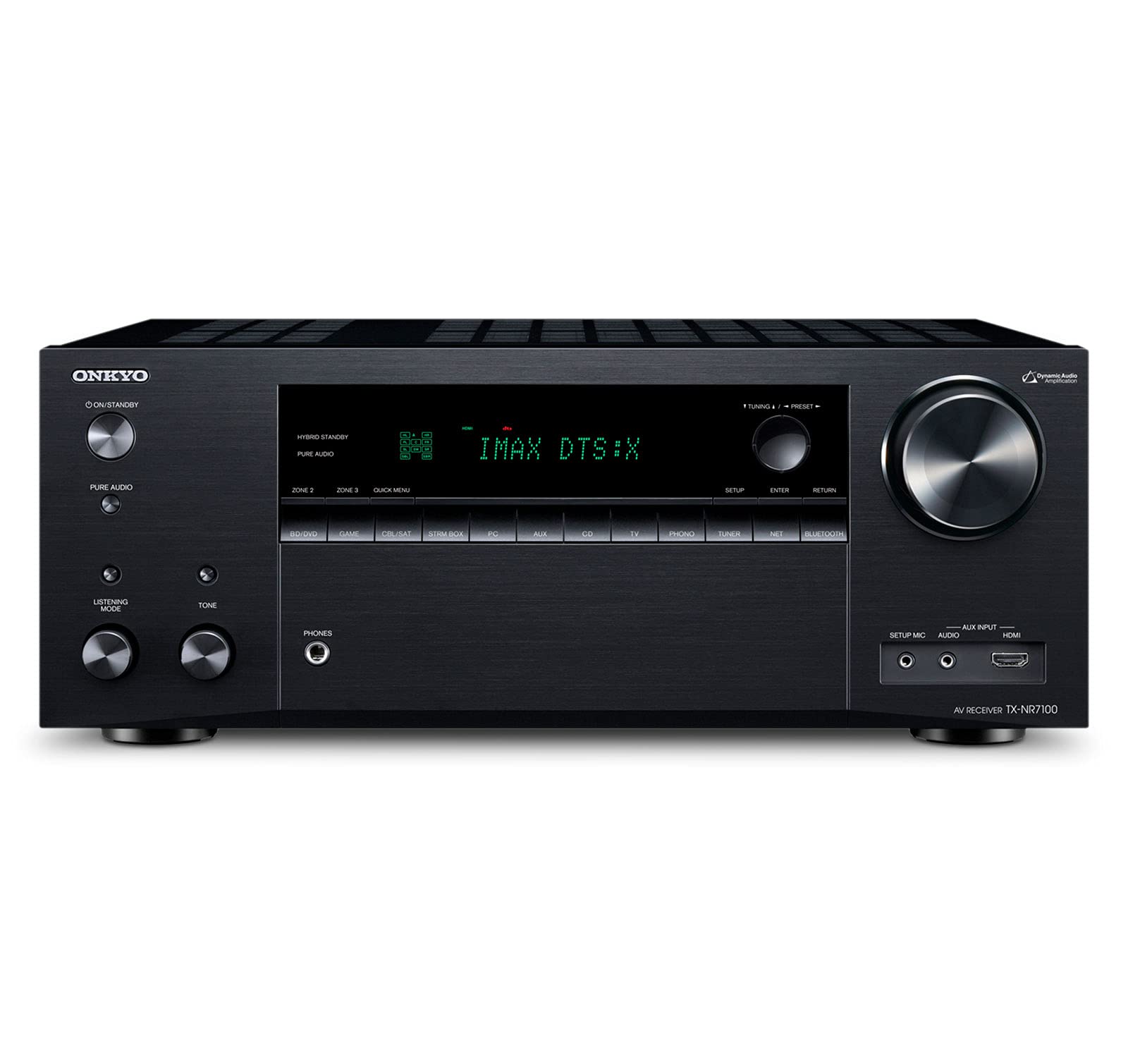
The Onkyo TX-NR7100 delivers a rare combination at this level: nine channels of amplification, full-bandwidth Dirac Live room correction out of the box, and THX Select certification. The 100-watt-per-channel rating provides ample headroom for dynamic movie soundtracks, and the inclusion of three HDMI 2.1 inputs with 8K/60Hz and 4K/120Hz pass-through ensures compatibility with the latest gaming consoles.
Dirac Live is the defining feature here. Unlike basic EQ curves, it measures your room’s acoustic response at multiple listening positions and applies correction across the full frequency spectrum. The result is noticeably tighter bass and better imaging, especially in rooms with challenging reflections. The receiver also supports Dolby Atmos, DTS:X, and includes Dolby Atmos Height Virtualization for configurations without ceiling speakers.
Connectivity is comprehensive with bi-directional Bluetooth aptX HD, DTS Play-Fi for multi-room audio, and “Works with Sonos” certification. The unit runs warm during extended use, and some users report that the remote lacks a backlight, but for those prioritizing sound calibration quality, this is the strongest contender in the group.
Why it’s great
- Full-bandwidth Dirac Live room correction included
- 9.2 channels for 5.1.4 or 7.1.2 configurations
- Supports HDMI 2.1 with VRR, ALLM, and QFT
Good to know
- Remote control is not backlit
- Some users report HDMI handshake issues
2. Denon AVR-S970H 8K Ultra HD 7.2 Channel Receiver

The Denon AVR-S970H sits at the top of the S-Series line, offering 90 watts per channel across seven channels with support for 8K/60Hz and 4K/120Hz pass-through. Its HEOS multi-room platform is one of the most polished in the industry, allowing seamless grouping with Denon Home speakers. The receiver also includes a phono input for turntable connectivity and supports Dolby Atmos, DTS:X, and Dolby Height Virtualization.
Setup is straightforward thanks to the on-screen assistant and the Audyssey MultEQ room correction system, which uses an included microphone to measure speaker distances and levels. While not as advanced as Dirac Live, Audyssey does a solid job taming minor room issues. The receiver runs cooler than some competitors, which matters if you place it in a confined media cabinet.
One trade-off is that using powered Zone 2 reduces the main room to 5.2 channels. The remote control is functional but not backlit, and the setup menu can feel dense for beginners. For a balanced mix of modern features, reliable build quality, and solid audio performance, the S970H is a compelling pick.
Why it’s great
- Smooth HEOS multi-room streaming platform
- Full HDMI 2.1 support with 4K/120Hz
- Phono input for vinyl playback
Good to know
- Powered Zone 2 reduces main channels to 5.2
- No included printed manual
3. Yamaha RX-A2A AVENTAGE 7.2-Channel AV Receiver

Yamaha’s Aventage line emphasizes build quality and mechanical stability, and the RX-A2A reflects that with a rigid chassis, a fifth foot for vibration damping, and a hefty 25.35-pound weight. It delivers 7.2 channels of amplification with Surround:AI technology, which analyzes audio content in real time and adjusts EQ and dynamics to emphasize dialogue or effects as the scene demands.
The receiver includes three HDMI 2.1 inputs supporting 8K/60Hz and 4K/120Hz, along with ALLM and VRR for gaming. YPAO R.S.C. with multipoint measurement provides a reliable room calibration that focuses on early reflections. The MusicCast ecosystem works seamlessly with other Yamaha wireless speakers, and the unit is Roon Tested for high-end music servers.
Some users report occasional HDMI handshake issues that require a power cycle, and the unit lacks analog video inputs. The three-year warranty is longer than most competitors, a confidence signal for a long-term purchase. For anyone who values build integrity and wants a receiver that feels more substantial than typical mass-market offerings, the A2A delivers.
Why it’s great
- Exceptional build quality with anti-vibration chassis
- Surround:AI real-time sound optimization
- Three-year warranty included
Good to know
- No analog video inputs for legacy devices
- Occasional HDMI handshake issues reported
4. Sony STR-AN1000 7.2 CH Surround Sound Receiver

The Sony STR-AN1000 leverages Sony’s long-standing cinema expertise with 360 Spatial Sound Mapping, which creates multiple phantom speakers from a physical 7.2-channel layout. Digital Cinema Auto Calibration IX (D.C.A.C. IX) measures the room and corrects for speaker placement and size, delivering a coherent soundstage that is particularly effective with Dolby Atmos soundtracks.
HDMI connectivity includes six inputs and two outputs, all supporting 8K and 4K/120Hz pass-through. The “Works with Sonos” certification allows integration into an existing Sonos system, and the receiver supports Chromecast, AirPlay 2, and Spotify Connect. The front display is quite small and difficult to read from a sofa, but the smartphone app provides full control.
Notably, the STR-AN1000 lacks a phono input for turntables, which may be a dealbreaker for vinyl enthusiasts. Some users have noted that Dolby Vision passthrough to an Apple TV 4K can require specific cable configurations. For those building a system around Sony speakers or already invested in the Sony ecosystem, the sound quality and spatial audio processing are genuinely impressive.
Why it’s great
- 360 Spatial Sound Mapping creates immersive phantom channels
- Excellent D.C.A.C. IX room calibration
- Supports Chromecast, AirPlay 2, and Sonos integration
Good to know
- No phono input for turntables
- Small front display is hard to read from distance
5. Denon AVR-S770H 7.2 Ch Home Theater Receiver

The Denon AVR-S770H is the entry-level 8K receiver in Denon’s line, offering 75 watts per channel across seven channels. It supports HDMI 2.1 features including 4K/120Hz, VRR, ALLM, and QFT, making it a solid foundation for a gaming-focused home theater. The HEOS multi-room platform and built-in Wi-Fi allow easy streaming from services like TIDAL and Spotify.
Audyssey MultEQ room correction is included, but it uses the basic version without the advanced EQ curve adjustments found on higher-tier Denon models. The guided setup assistant makes initial configuration simple even for first-time receiver buyers. Dolby Atmos and DTS:X are supported, and Dolby Height Virtualization offers pseudo-overhead effects without height speakers.
Some users report firmware-related glitches, including occasional random volume drops and slow boot times. The remote control is not backlit and has a learning curve. For the price, it offers the core features most users need without the complexity of higher-end models, making it a safe bet for someone transitioning from a soundbar.
Why it’s great
- Guided setup assistant simplifies first-time configuration
- Full HDMI 2.1 support for modern gaming
- HEOS multi-room streaming included
Good to know
- Some firmware glitches reported
- Remote is not backlit and takes practice to learn
6. Yamaha RX-V6A 7.2-Channel AV Receiver

The Yamaha RX-V6A is a well-rounded 7.2-channel receiver that brings HDMI 2.1 with 8K/60Hz and 4K/120Hz support to a mid-range price point. It includes seven HDMI inputs (one output) with HDCP 2.3, eARC, and support for HDR10+, Dolby Vision, and Hybrid Log-Gamma. The MusicCast platform enables multi-room audio with other Yamaha wireless speakers.
YPAO R.S.C. room correction with multipoint measurement helps refine the sound for different seating positions. The receiver supports Dolby Atmos, DTS:X, and Yamaha’s own Dolby Atmos Height Virtualization, which does a reasonable job creating a sense of height in rooms without in-ceiling speakers. Voice control via Alexa and Google Assistant is built in.
Some users note that the menu system feels basic compared to the competition, and the eARC implementation can be finicky with certain TV brands, sometimes requiring a manual power-on sequence. The receiver is sturdy and reliable for its class, but the user interface is a weak point.
Why it’s great
- Full HDMI 2.1 with 8K/60Hz pass-through
- MusicCast multi-room ecosystem
- YPAO R.S.C. room correction with multipoint
Good to know
- Menu interface is basic and dated
- eARC can have compatibility issues with some TVs
7. Onkyo TX-NR6100 7.2 Channel THX Certified Receiver
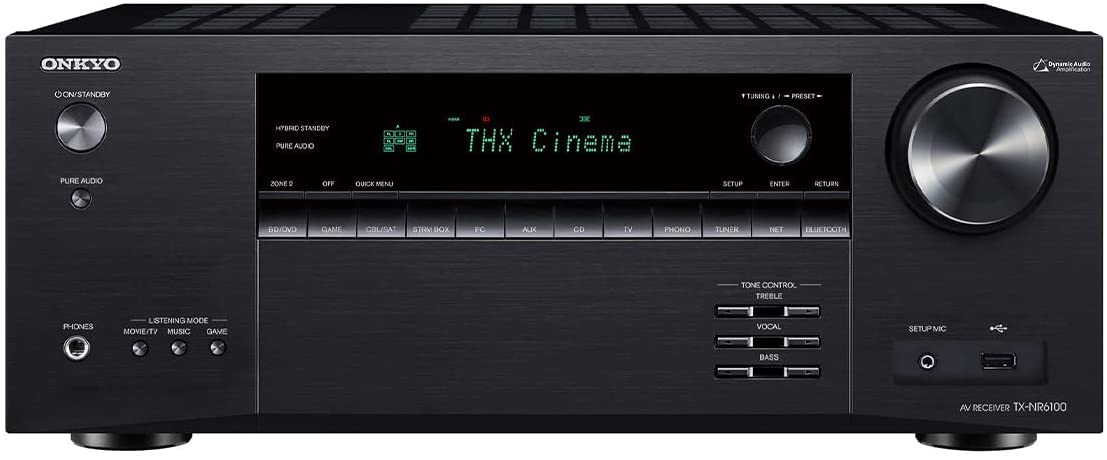
The Onkyo TX-NR6100 carries THX Select certification, meaning it meets strict standards for reference-level audio performance in medium-sized rooms. With three HDMI 2.1 inputs operating at 40Gbps and support for 4K/120Hz, VRR, and ALLM, it is explicitly designed for next-generation gaming. The 7.2-channel layout supports 5.2.2 Dolby Atmos configurations.
Dynamic Audio Amplification delivers 210 watts per channel (6 ohms, 1 kHz, THD 10%), providing substantial instantaneous current for dynamic peaks. The unit runs relatively cool thanks to a robust heatsink design. It also offers discrete Zone 2 audio and video output, allowing a different source to play in another room.
Long-term reliability is a concern, with some reports of HDMI 2.1 board failures after two years. The remote is not backlit, and inputs 4 through 6 lack the full HDMI 2.1 bandwidth, limiting which ports you can use for high-end gaming. For a dedicated gaming theater setup where THX certification provides peace of mind, this unit delivers on performance.
Why it’s great
- THX Select certification for reference-level sound
- Three HDMI 2.1 inputs with full 40Gbps bandwidth
- Discrete Zone 2 audio and video
Good to know
- Some reports of HDMI board failure after extended use
- Not all HDMI ports support full HDMI 2.1 bandwidth
8. Cambridge Audio AXR100 FM/AM Stereo Receiver

The Cambridge Audio AXR100 is a traditional stereo receiver optimized for two-channel music playback, delivering 100 watts per channel into 8 ohms. It includes a built-in phono stage for moving magnet cartridges, a high-quality DAC for digital sources, and a dedicated subwoofer output. There is no fan inside, so the unit operates silently, a critical factor for critical listening rooms.
Sound quality is described as warm and controlled, with a wide soundstage that handles complex orchestral passages without congestion. The Bluetooth implementation using the aptX codec supports high-quality wireless streaming, though some users find the range limited. The front panel features a classic brushed metal design with large knobs for volume, bass, and treble.
There is no HDMI connectivity, so this receiver is strictly for stereo sources like a turntable, CD player, television via optical, or media streamer. The remote control has poor IR range and unreadable buttons in low light. For someone building a dedicated music system who wants excellent amplification without surround sound complexity, the AXR100 is a standout.
Why it’s great
- Silent fanless operation perfect for critical listening
- Warm, controlled sound with wide soundstage
- Phono input and subwoofer output included
Good to know
- No HDMI inputs for video sources
- Remote control has poor IR range and unreadable buttons
9. JBL MA710 7.2 Channel 8K AV Receiver

The JBL MA710 is a 7.2-channel receiver that is significantly slimmer than its competitors at just 4.3 inches tall, making it a better fit for shallow AV racks or media consoles. It supports Dolby Atmos and DTS:X in a 5.1.2 configuration, includes a moving magnet phono input for turntables, and offers wireless streaming via AirPlay 2 and Google Chromecast.
With 110 watts per channel, the MA710 has ample power for most bookshelf and floorstanding speakers. The HDMI 2.1 inputs handle 8K video, and eARC simplifies connection to a TV. The setup menu is displayed on the TV screen, which helps streamline initial configuration, though the firmware update process can be unresponsive.
Some users report that the remote control is not backlit, making it difficult to use in a dark home theater. There is also a noted issue with downmixing DTS-HD Master Audio to 2.1 stereo, which limits its use for Blu-ray audio in stereo-only setups. For a compact receiver that packs modern codecs and connectivity into a smaller footprint, the MA710 is a solid choice.
Why it’s great
- Slim chassis fits shallow media cabinets
- Phono input for vinyl playback
- AirPlay 2 and Google Chromecast built-in
Good to know
- Cannot downmix DTS-HD Master Audio to 2.1
- Remote is not backlit
10. Yamaha R-N600A Network Receiver

The Yamaha R-N600A is a network stereo receiver that combines a high-quality ESS SABRE ES9010K2M Ultra DAC with streaming capabilities and a phono input. It supports high-resolution audio up to 384 kHz and native DSD 11.2 MHz playback, making it an excellent choice for audiophiles building a digital music server system. The 80 watts per channel are clean and effortless.
MusicCast wireless multi-room integration is included, allowing the receiver to stream from NAS devices, internet radio, and services like TIDAL and Qobuz. The front-panel USB port supports direct connection of flash drives for high-resolution playback. The unit does not include HDMI inputs, so it is intended solely for stereo music systems.
Some users find the phono stage lacks gain, and it only supports moving magnet cartridges. There is no room correction software included, so careful speaker placement is more important. The build quality is excellent, with a brushed metal front panel and solid controls that feel designed to last. For a music-first system that needs to serve as a central hub, this is an outstanding choice.
Why it’s great
- ESS SABRE DAC for high-resolution audio
- MusicCast streaming with NAS and internet radio support
- Native DSD 11.2 MHz playback
Good to know
- Phono stage is low gain and only accepts MM cartridges
- No HDMI or room correction features
11. Pioneer VSX-935 7.2 Channel Network Receiver
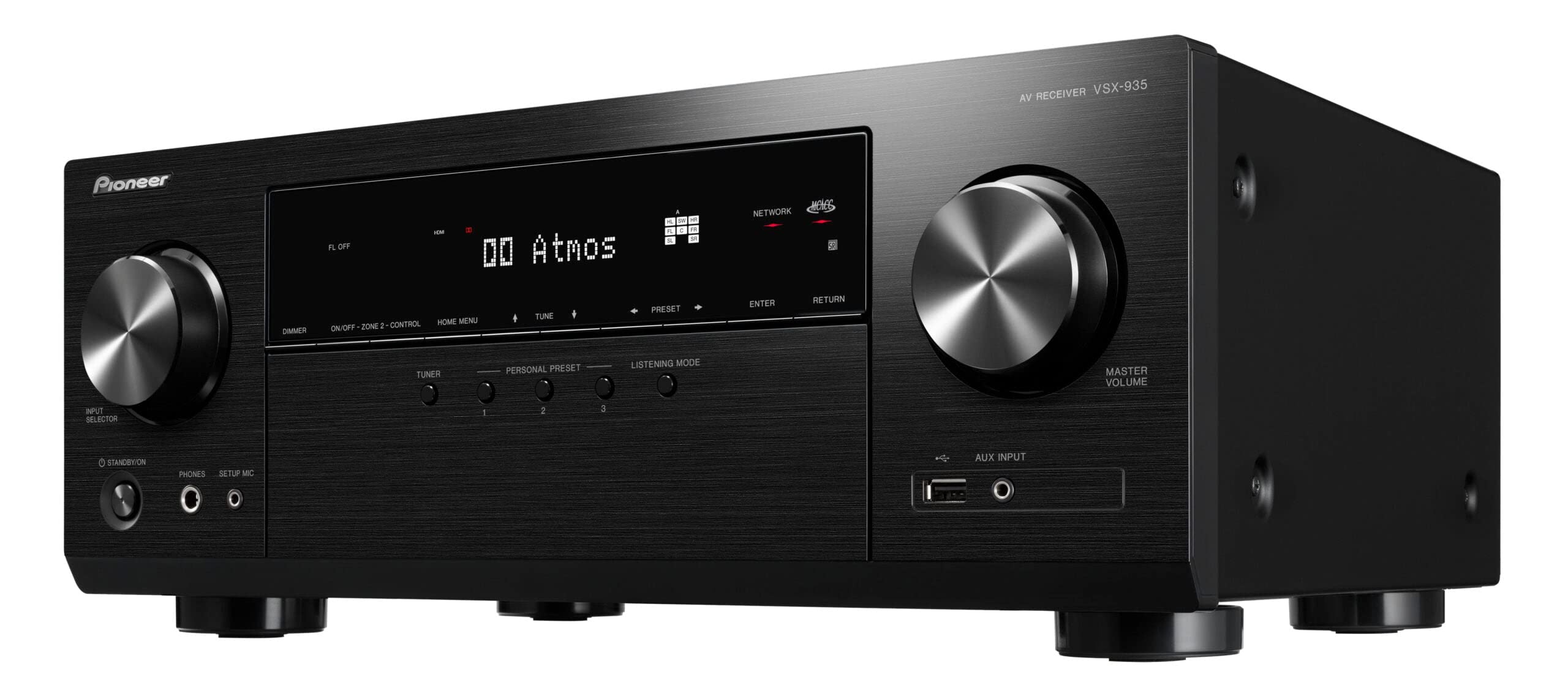
The Pioneer VSX-935 is a 7.2-channel receiver that brings Dolby Atmos, DTS:X, and HDMI 2.1 with 8K/60Hz pass-through to a budget-friendly price point. It includes Dolby Atmos Height Virtualization, which simulates overhead effects without physical height speakers. The unit is compact and surprisingly light for its capability set.
Sound quality is crisp and clear, with good volume range for both movies and music. The remote is RF-based, meaning it works through walls and cabinet doors, a unique convenience at this price. Dual-zone output allows a second set of speakers in another room. The auto setup calibration is basic, and many users report better results from manual configuration.
The Bluetooth implementation is limited to two-way communication that some users find unreliable and buried in complex menus. A small number of units have arrived DOA, though replacements have been handled quickly. For someone who wants modern surround sound and HDMI 2.1 gaming features on a strict budget, the VSX-935 delivers the essential features without a premium price.
Why it’s great
- RF remote works through walls and cabinets
- HDMI 2.1 with 8K/60Hz support
- Dolby Atmos Height Virtualization included
Good to know
- Auto setup calibration is poor
- Bluetooth interface is buried in menus and unreliable
FAQ
Do I need 7.1 or 5.1.2 channels for Dolby Atmos?
What is the real difference between Dirac Live and Audyssey room correction?
Will a 75W receiver be powerful enough for my speakers?
Can I use a stereo receiver for watching movies?
Final Thoughts: The Verdict
For most users, the best audio receiver under 1000 winner is the Onkyo TX-NR7100 because it delivers full-bandwidth Dirac Live room correction, nine channels of amplification, and robust HDMI 2.1 support at a price that leaves room for quality speakers. If you want a balanced all-rounder with a polished streaming platform, grab the Denon AVR-S970H. And for pure stereo music listening with a silent fanless design, nothing beats the Cambridge Audio AXR100.