
Our readers keep the lights on and my morning glass full of iced black tea. As an Amazon Associate, I earn from qualifying purchases.
Specs are compiled from manufacturer listings and verified buyer reviews and can change over time — please confirm the key details on the product page before buying.
An audio receiver is the brain of your home theater — it routes every signal from your TV, game console, and streaming box to your speakers. The trouble is, a bad one can leave dialogue buried under background noise or drop your HDMI signal at the worst moment. This guide cuts through the spec sheets to find the receivers that deliver clean surround sound while staying affordable.
I’m Min — the founder and writer behind Gadgets Feed. This guide is built by comparing the manufacturers’ published specifications and the patterns across verified customer reviews, so you get each pick’s real strengths and trade-offs instead of marketing spin.
Whether you are setting up your first 5.1 system or upgrading an aging unit, finding the right audio receiver under 500 depends on matching features like HDMI 2.1 bandwidth, channel count, and wattage to your actual living room setup, not a spec-sheet fantasy.
Quick Picks
- Denon AVR-S570BT (2022 Model) 5.2 Channel AV Receiver (Renewed) — Best Overall
- Denon AVR-X1700H 7.2ch 8K Home Theater Receiver (Renewed) — Atmos Value
- YAMAHA RX-V4A 5.2-Channel AV Receiver with MusicCast — Gamer’s Choice
- YAMAHA RX-V385 5.1-Channel 4K Ultra HD AV Receiver with Bluetooth — Reliable Entry
- Sony STRDH590 5.2 Channel Surround Sound Home Theater Receiver — Compact All-Rounder
- Pyle 5.2 Channel Hi-Fi Home Theater Receiver – 1000W MAX Wireless BT — Budget Starter
How To Choose The Best Audio Receiver Under 500
Focus on these three areas first.
Channel Count: 5.1 vs 5.2 vs 7.2
The first number tells you how many speakers the receiver can power, and the second tells you how many subwoofer outputs it has. A 5.1 setup (five speakers plus one subwoofer) is the standard starting point for most living rooms. A 5.2 receiver adds a second subwoofer output, which helps even out bass across a wide room. A 7.2 receiver adds two rear or height speakers for Dolby Atmos — only worth it if you have the space and the speaker budget to fill those extra channels.
HDMI Version and Bandwidth
You want an HDMI port that can pass the highest quality signal your display accepts without compressing it. HDMI 2.1 is the current standard, handling up to 8K@60Hz or 4K@120Hz — critical for a gaming console like the Xbox Series X. If you only watch movies on a 4K@60Hz TV, HDMI 2.0 with HDCP 2.2 is sufficient. Also look for eARC (enhanced Audio Return Channel), which lets your TV send lossless audio like Dolby Atmos back to the receiver over a single HDMI cable.
Room Calibration and Streaming Features
Automatic room calibration (like YPAO from Yamaha or Audyssey from Denon) uses a microphone to measure your room’s acoustics and adjust speaker levels, delays, and frequencies automatically — a must if your seating is off-center or you have odd room shapes. For streaming, built-in Bluetooth is standard, but Wi-Fi with AirPlay 2 or MusicCast lets you stream lossless music and group receivers in different rooms without extra hardware.
Quick Comparison
On smaller screens, swipe sideways to see the full table.
| Model | Best For | Channels | HDMI Version | Weight | Amazon |
|---|---|---|---|---|---|
| Denon AVR-X1700H (Renewed) | 7.2 Atmos on a budget | 7.2 | HDMI 2.1 (3x8K in) | 19 lb | $549.12$699.99Amazon |
| Denon AVR-S570BT (Renewed) | Best overall pick | 5.2 | HDMI 2.1 (4x8K in) | 20.2 lb | $398.80$449.00Amazon |
| YAMAHA RX-V4A | Gaming + multi-room | 5.2 | HDMI 2.1 (4 in/1 out) | 20 lb | $419.95$549.95Amazon |
| YAMAHA RX-V385 | Rock-solid entry level | 5.1 | HDMI 2.0 (4 in/1 out) | — | $399.95Amazon |
| Sony STRDH590 | Compact size, big features | 5.2 | HDMI 2.0 (4 in/1 out) | — | $498.00Amazon |
| Pyle 5.2 Channel | Budget-friendly starter | 5.2 | 4K pass-through | 11.08 lb | $190.49$208.99Amazon |
In‑Depth Reviews
1. Denon AVR-S570BT (2022 Model) 5.2 Channel AV Receiver (Renewed)

This receiver packs genuine 8K-ready HDMI 2.1 ports into a budget-friendly package.
This Denon gives you four 8K HDMI inputs and one HDMI output with eARC — meaning your Xbox or PS5 can pass 4K@120Hz straight through without a hiccup, and your TV sends Dolby Atmos back over the same cable. You get a 5.2-channel layout (five speakers plus two subwoofer outputs), which lets you smooth out bass in larger spaces. Buyers report the 70W per channel fills a 26×16 ft room with crisp, clear, low-distortion sound — concrete proof it can handle a decent-sized living room without breaking a sweat.
The catch is the size. At 20.2 pounds and with dimensions of 20.5 x 17.1 x 9 inches, this Denon is 82% heavier than the Pyle receiver and takes up significantly more shelf space — measure your cabinet before ordering. A few users noted the setup is a little complicated, but the on-screen assistant and color-coded speaker terminals take most of the guesswork out of it.
Unlike the Sony STRDH590, this Denon has 8K HDMI 2.1 inputs rather than HDMI 2.0, so you are not looking at an upgrade the moment you buy a new console. If you want a true future-proofed 5.2 receiver without jumping to the premium tier, this is the pick.
Where it shines
- Four 8K HDMI inputs with eARC for lossless audio return
- 70W per channel — verified by owners to fill a 26×16 ft room
- Includes Alexa voice control and Bluetooth streaming
Where it cuts corners
- Heavy and large — 20.2 lb, 20.5 inches deep
- Refurbished unit; warranty coverage depends on seller
- A few users found the initial setup confusing
Your best move if: You want a receiver that handles today’s 8K sources and tomorrow’s upgrades, without paying double for features you may not use yet.
Think twice if: Your media cabinet is shallow — the 20.5-inch depth will stick out of standard AV shelves.
2. Denon AVR-X1700H 7.2ch 8K Home Theater Receiver (Renewed)

This receiver delivers true 3D audio — Dolby Atmos, DTS:X, and seven channels — at a price typically reserved for 5-channel models.
While most receivers in this bracket limit you to 5 channels, this Denon gives you a 7.2 layout so you can run a traditional 5.1 setup plus two height speakers for overhead effects, or a 5.1.2 Atmos configuration. It also supports Dolby Atmos Height Virtualization, which simulates height sounds through regular speakers — handy if you cannot mount ceiling speakers. The three dedicated 8K HDMI inputs handle 8K/60Hz and 4K/120Hz pass-through, matching the capability of the AVR-S570BT but with more speaker flexibility.
Buyers consistently praise the sound quality, with one long-time owner calling it the cleanest sound they have had after owning three Pioneer and Sony receivers over 15 years. The Audyssey room calibration (an automatic speaker-tuning system that measures your room and adjusts the sound) drew compliments for being simple and effective. Note that some users reported random picture cutouts when not using certified 48Gbps HDMI cables — so budget for quality cables.
At 19 pounds, it is slightly lighter than the AVR-S570BT, but still a substantial unit. It also includes Wi-Fi, AirPlay 2, and HEOS multi-room streaming, letting you group it with other Denon speakers around the house — something the otherwise similar Sony STRDH590 completely lacks.
Dialogue and depth: The combination of Audyssey calibration and Dolby Atmos Height Virtualization gives you theater-like immersion even without ceiling speakers.
Worth noting: This is a renewed unit — check the seller’s warranty period. Also, you need a certified 48Gbps HDMI cable for stable 4K/8K signal pass-through.
Reach for this if: You want Dolby Atmos without the premium price tag and have the speaker count to use the extra two channels.
Look elsewhere if: You only need a basic 5.1 for a small room — the 7.2 channels are overkill and you can save with a 5-channel model.
3. YAMAHA RX-V4A 5.2-Channel AV Receiver with MusicCast

This Yamaha brings 8K/60B and 4K/120AB HDMI 2.1 to your game console, plus whole-home MusicCast streaming.
This is a 5.2-channel receiver built around the HDMI 2.1 spec that serious gamers need — it works with Xbox Series X for 4K@120Hz and 5.1 audio, as verified by owners. It also includes Wi-Fi (2.4 GHz and 5 GHz bands), AirPlay 2, and MusicCast, Yamaha’s multi-room system that lets you stream Spotify, TIDAL, Amazon Music HD, and other services to any MusicCast speaker in your home. The YPAO automatic room calibration (a system that uses the included microphone to tune your speakers to the room) was praised by buyers for perfecting timing and even detecting reversed speaker wires.
The trade-off comes in the daily experience. Several reviewers found the setup process inscrutable — the on-screen menus have an odd delay, and the remote has tiny buttons that are hard to use in the dark. The MusicCast app on your phone largely redeems this, offering a clean interface that works like a Sonos system. One buyer who returned the unit cited HDMI switching issues, specifically that it failed to pass 4K video to a 1080p monitor, so compatibility with mixed-resolution setups is not guaranteed.
Compared to the Sony STRDH590, the RX-V4A adds Wi-Fi streaming and a second subwoofer output, but costs a bit more. If multi-room streaming matters more to you than saving a few dollars, this Yamaha is the better daily driver.
The advantages
- HDMI 2.1 with 8K/60B and 4K/120AB — confirmed working with Xbox Series X
- MusicCast multi-room ecosystem for whole-home audio
- YPAO calibration with included microphone optimizes sound for your room
The drawbacks
- Finicky on-screen setup menus with noticeable input lag
- Tiny remote buttons that are hard to press in dim light
- Some units have HDMI handshake issues with mixed-resolution sources
Best for: Gamers who need full HDMI 2.1 bandwidth for 4K@120Hz and want to stream music to speakers in other rooms.
skip it if: You want a receiver you can set up quickly without touching a phone app — the initial setup is frustrating.
4. YAMAHA RX-V385 5.1-Channel 4K Ultra HD AV Receiver with Bluetooth

This entry-level workhorse offers YPAO calibration, 4K HDR pass-through, and sound quality that exceeds its price.
This Yamaha is a 5.1-channel receiver — five speakers plus one subwoofer — with four HDMI 2.0 inputs that support 4K HDR10, Dolby Vision, and hybrid log-gamma. It does not have HDMI 2.1 or eARC, so it is not the pick for a next-gen console at 120Hz, but for movie watching and casual gaming at 4K@60Hz, it is more than capable. Buyers consistently highlight the sound quality as excellent, with one user noting it delivers crisp dialogue and warm sound in direct mode, and another saying it was used daily for two years without a single issue.
YPAO auto-calibration (Yamaha’s system that uses the included microphone to set speaker levels and delays) makes setup simpler than most receivers in this class. The binding posts accept banana plugs on all channels, which is rare at this price point and makes connecting thick speaker cables much easier. The main limitation is the lack of eARC — you need to plug your sources directly into the receiver rather than relying on your TV to pass audio back. It also has only 4 HDMI inputs, which may feel tight if you have multiple streaming devices, a game console, and a Blu-ray player.
Compared to the Sony STRDH590, this Yamaha is widely regarded by owners as having superior sound — one reviewer directly called it “far superior to price comparable Sony receiver” — and it includes banana-plug-compatible terminals that the Sony does not. If you want a straightforward, reliable receiver that sounds great and does not force you through a complex setup, this is a strong choice.
the balance: YPAO calibration and banana-plug binding posts make this the easiest entry-level receiver to set up and get sounding right.
The single limit: No HDMI 2.1 and no eARC — skip this if you need 4K@120Hz gaming or want to route everything through your TV first.
Who it fits: The buyer who wants proven Yamaha reliability and great sound, does not game at 120Hz, and does not want to fiddle with complicated menus.
Who should pass: Anyone planning to buy an Xbox Series X or PS5 for 4K@120Hz gaming — you need HDMI 2.1 from a model like the Denon AVR-S570BT.
5. Sony STRDH590 5.2 Channel Surround Sound Home Theater Receiver
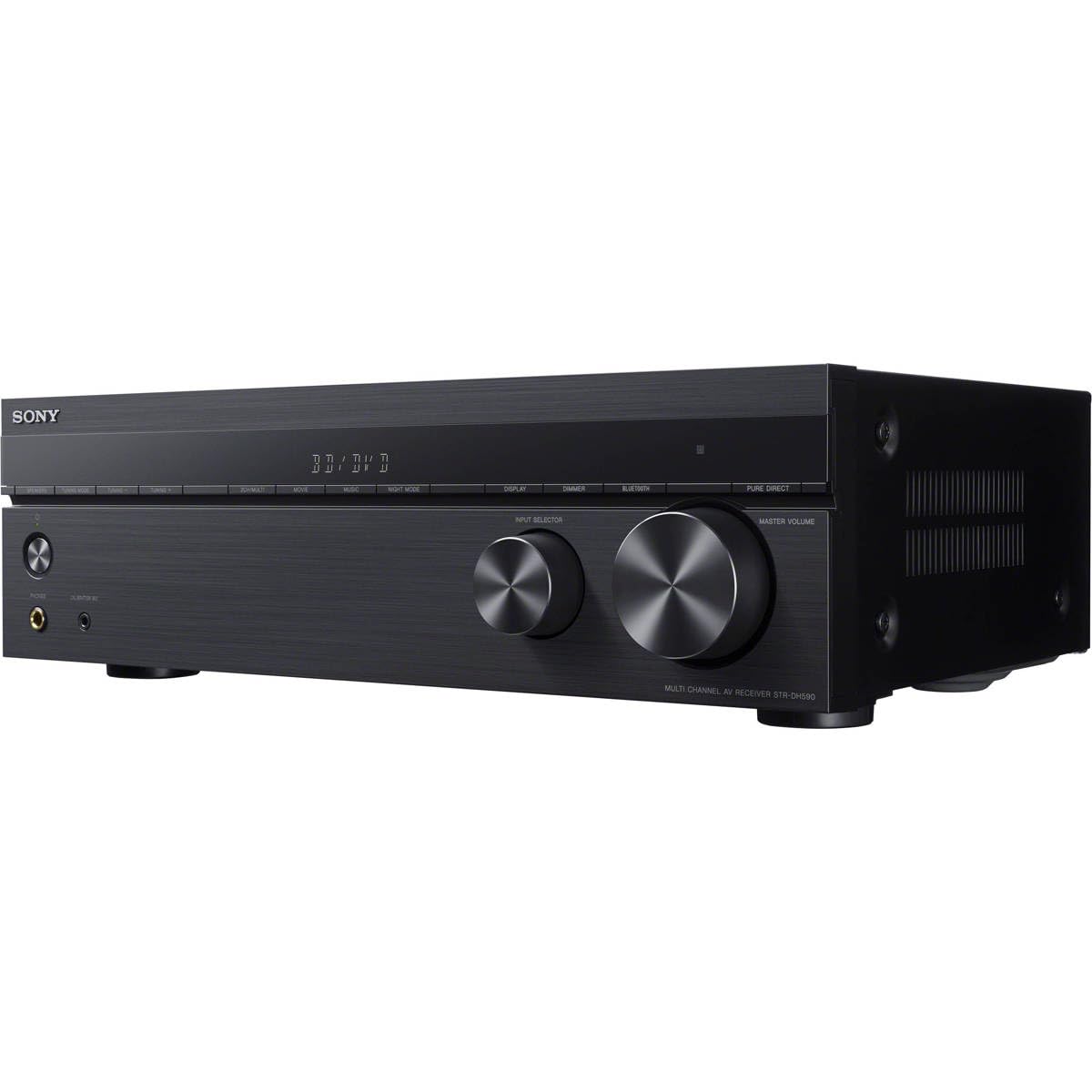
This slim-profile Sony packs 5.2 channels, Bluetooth, and eARC into a chassis just 5.25 inches tall.
Where the Denon AVR-S570BT measures 9 inches in height and 20.5 inches deep, this Sony comes in at just 5.25 x 17 x 11.75 inches — a 74% smaller depth, making it one of the few receivers that actually fits inside a standard media console without the back overhang. It is a 5.2-channel receiver (five speakers, two subwoofers) with four HDMI 2.0 inputs and eARC, so your TV can send lossless Dolby Atmos back to it over a single cable. Owners mention the FM tuner picks up stations 45 miles away and the remote has excellent range and simplicity.
The limitations come from its age and price positioning. It uses screw-type connectors for the main speakers and pin connectors for the center and rear, which make speaker wire connections fiddlier than the binding posts on Yamaha models. It has no phono input for a turntable, no AM tuner, and no Wi-Fi streaming — you must use Bluetooth from your phone. A few users noted that the input jacks are tightly spaced, so thick HDMI cables can be hard to plug in.
Sony’s S Force PRO virtual surround mode is a nice extra: it simulates surround sound from just two speakers, useful if you are not ready to buy a full speaker set yet. But for the same price range, the YAMAHA RX-V385 offers better sound according to buyers and easier speaker connections.
Size win
- Ultra-compact — only 11.75 inches deep and 5.25 inches tall
- eARC support for single-cable lossless audio from your TV
- Included mic makes speaker calibration straightforward
Size trade-offs
- No binding posts — main speakers use screw terminals, center/rear use pin connectors
- No phono input for a record player; no AM tuner
- Second subwoofer output but no Wi-Fi streaming — Bluetooth only
Reach for this if: Your media cabinet has limited depth (under 12 inches) and you need eARC for a clean one-cable connection to your TV.
Look elsewhere if: You want easy speaker connections (binding posts) or plan to stream lossless music over Wi-Fi — the Yamaha RX-V385 or Denon AVR-S570BT are better for those.
6. Pyle 5.2 Channel Hi-Fi Home Theater Receiver – 1000W MAX Wireless BT

The ultra-light budget entry that powers old speakers for less than half the price of major-brand receivers.
At 11.08 pounds, the Pyle is the lightest receiver in this list by a wide margin — 82% lighter than the Denon AVR-S570BT — so it is easy to move around or mount on a wall if you have a tight setup. It supports 5.2-channel surround sound with 4K Ultra HD video pass-through and built-in Bluetooth for wireless streaming from your phone. Multiple buyers mention it works great with older Panasonic or mismatched speakers as an affordable way to get them back in action, with one owner saying it “has my house vibrating.”
The catch is a critical HDMI limitation that makes true surround sound from a PC or game console unreliable. One buyer reports that the HDMI input from a PC is only recognized as 2-channel by Windows, and forcing a 5.1 override still outputs only two speakers — meaning this receiver cannot replace a failed Yamaha or Denon for PC surround use. The Bluetooth streaming works well for music, but the 1000W MAX rating is peak wattage; real continuous power will be much lower.
If your goal is simply to add Bluetooth streaming to an old pair of passive speakers in a garage or workshop, the Pyle is a bargain. But if you want a reliable 5.1 home theater with proper HDMI surround sound for movies or gaming, save up for one of the Yamaha or Denon options above — the Pyle will frustrate you in exactly the use case you bought it for.
What it does well: Bluetooth music streaming to passive speakers, 4K video pass-through for a single source, and a price that fits a workshop or garage budget.
What it does not do: Reliably decode 5.1 surround sound over HDMI — buyers confirm it cannot pull discrete audio channels from a PC, which defeats the purpose of a home theater receiver for many.
Who this fits: Someone who needs to add Bluetooth to a few old passive speakers for casual music listening and does not care about surround sound over HDMI.
Who this does not fit: Anyone building a 5.1 home theater or connecting a PC for surround gaming — the HDMI audio handling is a known issue per buyer reports.
Understanding the Specs
Channel Count (5.1 vs 5.2 vs 7.2)
The channel layout tells you how many speakers plus subwoofers the receiver can power. A 5.1 system (five speakers and one subwoofer) is the standard starting point for a living room. A 5.2 adds a second subwoofer output — useful for smoothing out bass in wider rooms. A 7.2 adds two extra channels for rear or height speakers, which unlocks Dolby Atmos (a 3D audio format that makes sounds feel like they are coming from above). You only need 7.2 if you have the space and budget for Atmos speakers.
HDMI 2.1 vs HDMI 2.0 and eARC
HDMI 2.1 is the current high-bandwidth standard, capable of passing 8K at 60Hz or 4K at 120Hz — critical for a smooth gaming experience on Xbox Series X or PS5. HDMI 2.0 maxes out at 4K at 60Hz, which is fine for movie streaming but will bottleneck a next-gen console. eARC (enhanced Audio Return Channel) lets your TV send lossless audio formats like Dolby Atmos back to the receiver over a single HDMI cable, so you do not need a separate optical audio cable from your TV to the receiver.
FAQ
Can I use a 5.1 receiver with only two speakers?
Will a receiver under work with my 4K TV and Xbox Series X?
What is the difference between a 5.1 and a 5.2 receiver?
Does a receiver need Wi-Fi if I only use Bluetooth?
What is YPAO and do I need it?
Will an audio receiver under power large floor-standing speakers?
Can I connect a turntable to these receivers?
How long do AV receivers typically last?
Final Thoughts: The Verdict
For most people, the best audio receiver under 500 is the Denon AVR-S570BT (Renewed) because it packs genuine 8K HDMI 2.1 ports, reliable 70W per channel, and eARC support into a budget that does not require sacrificing future-proofing. If you want Dolby Atmos and seven channels for a true 3D audio setup, the Denon AVR-X1700H (Renewed) gives you features usually found on receivers costing hundreds more. And for the gamer who needs proven HDMI 2.1 compatibility with an Xbox Series X plus multi-room music streaming, the YAMAHA RX-V4A is the most versatile pick on the list.
How We Picked
We do not accept paid placement, and we did not hands-on test every unit. Instead, we match each pick to a real buyer and use-case by comparing the manufacturers’ published specifications against the patterns in verified customer reviews — so you get each pick’s real strengths and trade-offs instead of marketing copy.
Sources & Methodology
Specifications: manufacturer listings and product documentation. Review insights: verified customer reviews, as of July 2026. Pricing: not shown on this page (it changes often); check the current price via the retailer link.
As an Amazon Associate, Gadgets Feed earns from qualifying purchases. This does not affect which products we feature.
Product prices and availability are accurate as of the date/time indicated and are subject to change. Any price and availability information displayed on Amazon at the time of purchase will apply to the purchase of this product. As an Amazon Associate I earn from qualifying purchases.
CERTAIN CONTENT THAT APPEARS ON THIS SITE COMES FROM AMAZON. THIS CONTENT IS PROVIDED "AS IS" AND IS SUBJECT TO CHANGE OR REMOVAL AT ANY TIME.
Amazon and the Amazon logo are trademarks of Amazon.com, Inc. or its affiliates.